REVIEW 2 major objections 4 minor 2 cited by
QCD-Gravity double copy in Regge asymptotics: from $2\rightarrow n$ amplitudes to radiation in shockwave collisions
T0 review · 2 major / 4 minor · reviewed 2026-08-06 · deepseek-v4-flash
Pith's one-line read The gravitational Lipatov vertex is exactly the QCD Lipatov vertex squared minus a QED bremsstrahlung term, and its soft limit is Weinberg's soft graviton theorem.
desk verdict Solid, careful lecture notes that re-derive known results well, with a real but self-flagged gap in the gravitational double-log ladder that should be stated more prominently. read the letter →
The pith
A machine-rendered reading of the paper's core claim, the machinery that carries it, and where it could break.
The reading
What carries the argument
The carrying object is the gravitational Lipatov vertex $C^{\mu\nu}(k_1,k_2)=\frac12 C^{\mu}(k_1,k_2)C^{\nu}(k_1,k_2)-\frac12 N^{\mu}(k_1,k_2)N^{\nu}(k_1,k_2)$, where $C^\mu$ is the QCD Lipatov vertex for emitting a gluon in multi-Regge kinematics and $N^\mu=\sqrt{k_1^2k_2^2}\,(p_1^\mu/(p_1\cdot\ell)-p_2^\mu/(p_2\cdot\ell))$ contains the QED bremsstrahlung factor. This vertex is the one-graviton emission building block of the effective ladder; together with the reggeized propagator it packages the many Feynman diagrams of Einstein gravity into a single bilinear object, and in the soft limit it becomes the Weinberg emission current.
What would settle it
Compute the complete tree-level $2\to 3$ graviton amplitude in multi-Regge kinematics while keeping all contact diagrams, and check whether the coefficient of $1/(k_1^2k_2^2)$ is exactly $\frac12(C^\mu C^\nu - N^\mu N^\nu)$; any extra leading-power tensor structure, or any discrepancy in the $k\to 0$ limit against the Weinberg current, would refute the double-copy identity.
Extended reading notes
Core claim
The central claim is that, in the Regge limit where $\sqrt{s}\gg |\ell_\perp|$ and logarithms of $s$ are resummed, the $2\to 2+n$ amplitude in Einstein gravity has exactly the same ladder form as in QCD: external vertices, $n$ copies of the gravitational Lipatov vertex, and reggeized graviton propagators dressed by $(\hat s_i/k^2)^{\alpha(k_i^2)}$. The new element is the precise bilinear identity for the gravitational vertex, Eq. (3.38), which uses the QCD Lipatov vertex and a QED bremsstrahlung vector. The paper further claims that the soft-graviton limit of this vertex reproduces Weinberg's soft theorem, so the Regge framework is a smooth extension of soft-graviton physics to hard emission, and that the same correspondence holds for shockwave backgrounds, propagators, and multi-particle radiation.
Load-bearing premise
The load-bearing premise is that the one-loop Regge trajectory exponentiates to all orders, dressing every t-channel gluon or graviton propagator by $(\hat s_i/k^2)^{\alpha(k_i^2)}$; the paper itself notes this was conjectured for gluons and assumed for gravitons, and that reggeization breaks down beyond next-to-leading-logarithmic accuracy.
Editorial extensions
If this is right
- The $2\to 2+n$ gravitational amplitude at leading logarithmic order is fully determined once the QCD Lipatov vertex and the QED bremsstrahlung factor are substituted into the bilinear identity.
- Weinberg's soft graviton theorem appears as the $k\to 0$ limit of the gravitational Lipatov vertex, so soft and hard gravitational emission are described by one continuous vertex.
- The gravitational BFKL equation at $q=0$ has an analytic eigenvalue solution structurally similar to QCD, but with a UV cutoff dependence that must be completed by double-log resummation.
- Gluon and graviton radiation in shockwave collisions obey parallel Wilson-line and rung structures, allowing the same dilute-dense and dense-dense power counting to be used in both theories.
- The exponentiation mechanism behind the QCD pomeron also produces the trans-Planckian eikonal and its inelastic corrections, tying saturation physics to black-hole formation dynamics.
Reading between the lines
- A testable extension the paper leaves implicit is to match the subleading soft-graviton theorem against the sub-eikonal terms in the classical Yang-Mills+Wong radiation field, which the paper shows must be retained before the double-copy replacement; a match would extend the vertex identity beyond leading power.
- The shockwave dictionary suggests that gravitational memory and supertranslation physics could be formulated in the same Regge/light-cone coordinates as color memory, giving gravitational wave observables a role in probing the semi-classical double copy.
- One could test the reggeization assumption dynamically by constructing a rapidity renormalization-group equation for gravitational Wilson-line correlators analogous to the BK equation; a non-exponentiating remainder at higher orders would show where the Lipatov ladder construction loses control.
Editorial analysis
A structured set of objections, weighed in public.
Referee Report
Summary. These lectures re-derive the QCD and gravitational 2→2+n amplitudes in multi-Regge kinematics using dispersive methods: the multi-particle phase space, the Lipatov vertex reconstructed from pole residues, the BFKL equation and its eigenvalue solution, and the gravitational analog with reggeized propagators. The paper's central claim is that the gravitational Lipatov vertex is the double copy C^{μν}(k1,k2) = (1/2) C^{μ}(k1,k2) C^{ν}(k1,k2) - (1/2) N^{μ}(k1,k2) N^{ν}(k1,k2) of Eq. (3.38), that the QCD ladder structure and BFKL equation carry over to gravity, that Weinberg's soft graviton theorem is recovered as the soft limit of the Lipatov framework, and that the Color Glass Condensate shockwave picture has a gravitational counterpart with a classical Wong-equation double copy. The manuscript also discusses saturation, color memory, trans-Planckian scattering, and the relation to the ACV eikonal program.
Significance. The paper has substantial pedagogical and reference value: it gives parameter-free re-derivations of the QCD Lipatov vertex from pole residues, the n-particle phase space in MRK, the BFKL eigenvalue (2.116), the gravitational BFKL eigenvalue (3.74), and the matching of the Lipatov vertex to Weinberg's soft graviton current in Sec. 3.5. It also provides an explicit classical double-copy construction from the Wong equations in Sec. 3.6 and a transparent map between CGC Wilson lines and color memory in Sec. 4.1.1. The manuscript is honest about its axioms: gluon reggeization is flagged as conjectural in Sec. 2.3, the breakdown of reggeization beyond NLLx is stated in Sec. 2.6, and the extension of CGC power counting to gravitational shockwaves is presented as an assumption. If the graviton double-log issue identified below is addressed, the paper would be a reliable modern synthesis of the Lipatov–ACV and CGC approaches.
major comments (2)
- [Secs. 3.2–3.4, Eqs. (3.48), (3.56), (3.78)–(3.81)] The central gravitational claim is internally incomplete. The 2→2+n amplitude in Eq. (3.48) and the gravitational BFKL equation in Eq. (3.56) are built from the one-loop trajectory α(k²) of Eq. (3.46), which is UV divergent as shown in Eq. (3.60). With the natural cutoff Λ_UV² ∼ s, the single virtual insertion σ(k_i²) in Eq. (3.44) contains a leading double logarithm log²(s/k²). The paper itself shows in Eqs. (3.76)–(3.81) that the complete elastic amplitude requires resummation of these double logs through the Riccati equation, producing Regge poles (s/t)^{±√(−3κ²t/8π²)} and the amplitude (3.81), which is not of the simple (s_i/k²)^{α(k²)} form used in Eq. (3.47). Since s-channel unitarity at Eqs. (3.49)–(3.50) requires the imaginary part of the complete elastic amplitude to be reproduced by the sum over the inelastic channels of Eq. (3.48), either the elastic amplitude (3.81) or the inelastic amplitudes (3.48) must carry double-log corrections. The manuscript derives neither for the inelastic channel; the statement immediately before Sec. 3.1 that double logs 'play a similarly crucial role' in constructing the 2→2+n amplitude is therefore not matched by the derivation. This is load-bearing for the claim that the QCD ladder and BFKL structure transfer to gravity.
- [Sec. 3.3, after Eq. (3.60)] The text correctly notes that replacing Λ_UV by √s inside the BFKL eigenvalue is inconsistent because the Mellin transform over s precedes the transverse-momentum integration. However, Eq. (3.56) and its eigenvalue solution (3.74) are obtained from the Mellin-transformed equation in Eqs. (3.51)–(3.53), so they already use the fixed-cutoff trajectory. A consistent leading-logarithmic derivation would either reorder the Mellin transform and the transverse integration, or explicitly restrict the domain of Eqs. (3.56)/(3.74) to fixed Λ_UV and treat the √s case as an open problem. As written, the paper moves from the correct warning to using the cutoff-dependent eigenvalue for the cross-section without supplying the promised reanalysis.
minor comments (4)
- [Eq. (2.27)] There is a typo: 'We we combine' should read 'When we combine'.
- [Sec. 3.5, displayed equation above Eq. (3.82)] The index structure in the term N^{μ}(q1,q2) N^{μ}(q1,q2) is incorrect; one index should be ν to match C^{μν}(q1,q2).
- [Eqs. (2.114) and (3.71)] The angular integrals are described as 'somewhat involved' but not shown; since the eigenvalues (2.116) and (3.74) are central results, a short appendix or a few intermediate steps for these integrals would improve verifiability.
- [Sec. 3 intro] The sentence that double logs 'play a similarly crucial role' in the 2→2+n amplitude should contain a forward reference to the equations where this role is realized; currently the reader is not directed to the relevant construction.
Circularity Check
No significant circularity: the BFKL and gravitational-Lipatov derivations are parameter-free re-derivations, and the self-citations that occur are not load-bearing.
full rationale
The paper's core derivation chain is self-contained. In QCD, the 2→2 discontinuity is computed from Cutkosky rules and the MRK phase space (Eqs. 2.2, 2.45-2.46), the Lipatov vertex is obtained both by summing the explicit gg→ggg graphs (Eqs. 2.32-2.33) and by pole reconstruction (Eqs. 2.59-2.60), and the BFKL equation (Eq. 2.99) follows from the Mellin transform of the reggeized ladder (Eqs. 2.88-2.97). None of these steps fit a parameter to the final result; the input is the set of Feynman diagrams and the MRK ordering. The gravity section similarly derives the Born amplitude (Eqs. 3.18, 3.28), reconstructs the 2→3 amplitude from t-channel poles, and obtains the gravitational Lipatov vertex C^μν = (1/2)C^μC^ν - (1/2)N^μN^ν (Eq. 3.38) by imposing unitarity to remove overlapping poles. The one-loop graviton trajectory (Eq. 3.46), the 2→n amplitude (Eq. 3.48), and the gravitational BFKL equation (Eq. 3.56) are built from these objects without any fitted input. The Weinberg-regime calculation of Sec. 3.5 is a genuine limit check: it shows the soft limit of the independently constructed Lipatov vertex matches the high-energy limit of Weinberg's current (Eqs. 3.89 and 3.103). The main self-citations occur in Sec. 3.6, where the classical double copy is attributed to the authors' prior work [113], and in Sec. 4.1.1 for the color-memory map [184,185]. These are not load-bearing for the central BFKL claims: the gravitational Lipatov vertex that the classical double copy reproduces was already derived in Sec. 3.1 from unitarity, and the color-memory discussion is an interpretive correspondence rather than an input to the BFKL or CGC derivations. The paper also explicitly flags the places where its derivation rests on assumptions rather than circularity: gluon reggeization is stated as a conjecture from [7] (Sec. 2.3), graviton reggeization is obtained by exponentiating the one-loop insertion (Sec. 3.2), and the UV/double-log limitations of the gravitational BFKL equation are acknowledged (Eqs. 3.60, 3.76-3.81, and the discussion after Eq. 3.56). Those are completeness or validity caveats, not instances of an output being equal to its input by construction. I therefore find no circular step requiring a quote-and-reduction entry.
Assumptions & free parameters
assumptions (5)
- domain assumption Multi-Regge kinematics dominance and strong rapidity ordering in the ladder
- domain assumption Gluon reggeization: exponentiation of the one-loop Regge trajectory
- domain assumption Graviton reggeization in the trans-Planckian Regge limit
- domain assumption Validity of color-kinematic double copy for the Lipatov vertex
- ad hoc to paper Classical-statistical CGC power counting applies to gravitational shockwaves
Cite this review
Pith. "Pith review of QCD-Gravity double copy in Regge asymptotics: from $2\rightarrow n$ amplitudes to radiation in shockwave collisions." pith.science (2026). https://pith.science/paper/XPEDANAL
@misc{pith2026250721252,
  author       = {Pith},
  title        = {Pith review of: QCD-Gravity double copy in Regge asymptotics: from $2\rightarrow n$ amplitudes to radiation in shockwave collisions},
  year         = {2026},
  howpublished = {\url{https://pith.science/paper/XPEDANAL}},
  note         = {Machine review of arXiv:2507.21252}
}
read the original abstract
These lectures discuss multi-particle production in QCD and in gravity at ultrarelativistic energies, their double copy relations, and strong parallels in emergent shockwave dynamics. Dispersive techniques are applied to derive the BFKL equation for multi-gluon production in Regge asymptotics. Identical methods apply in gravity and are captured by a gravitational Lipatov equation. The building blocks in both cases are Lipatov vertices and reggeized propagators satisfying double copy relations; in gravity, Weinberg's soft theorem is recovered as a limit of the Lipatov framework. BFKL evolution in QCD generates wee parton states of maximal occupancy characterized by an emergent semi-hard saturation scale. Renormalization group equations in the Color Glass Condensate (CGC) EFT describe wee parton correlations and their rapidity evolution. A shockwave picture of deeply inelastic scattering and hadron-hadron collisions follows, with multi-particle production described by Cutkosky's rules in strong time-dependent fields. Gluon radiation in the CGC EFT has a double copy in gravitational shockwave collisions, with a similar correspondence applicable between gluon and graviton shockwave propagators. Possible extensions of this semi-classical double copy are outlined for computing multi-particle production in gravitational shockwave collisions, self-force and tidal contributions, and classical and quantum noise in the focusing of geodesics.
Figures

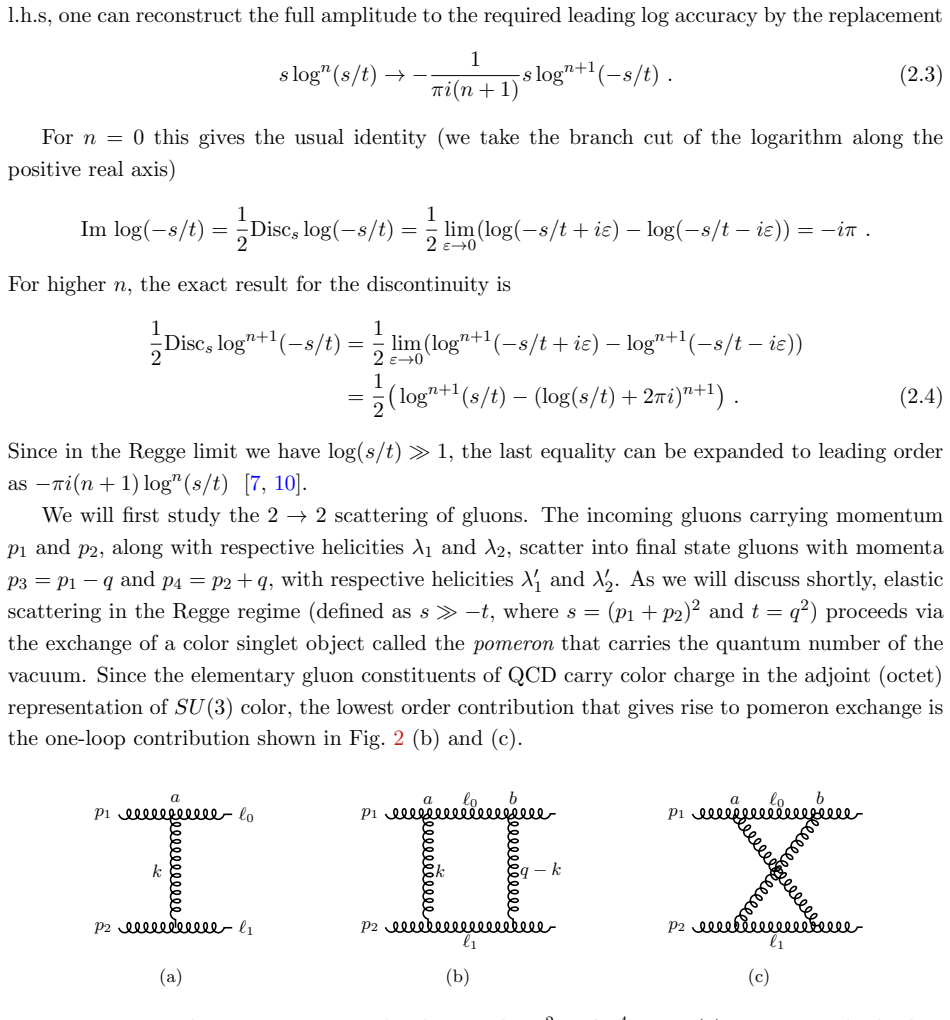

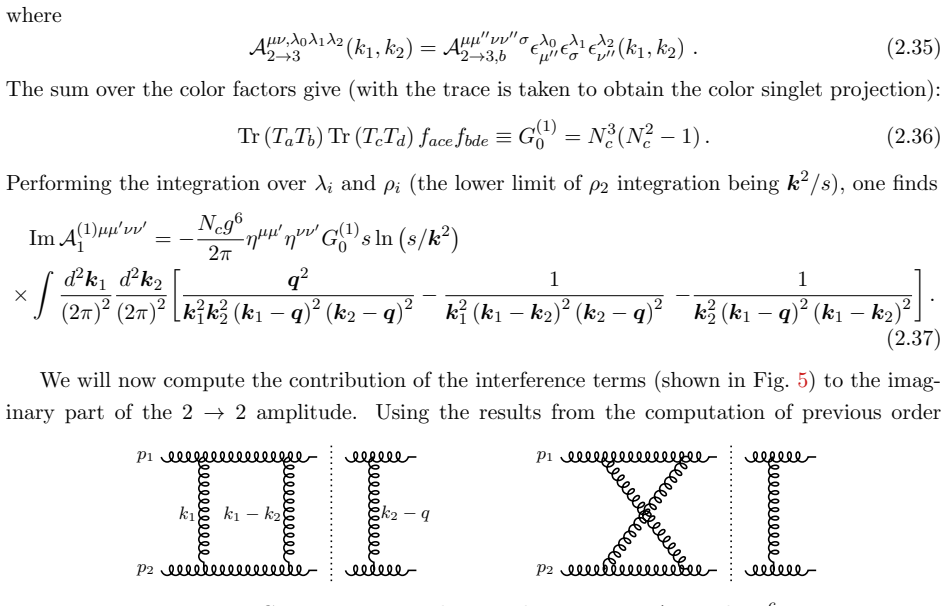
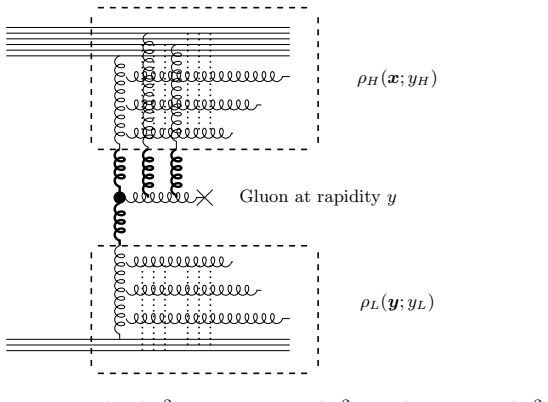
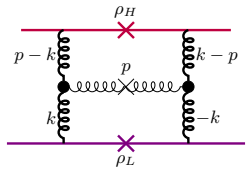
Figures from the paper (37 more)









Forward citations
Cited by 2 Pith papers
-
Squeezed-state radiation in shockwave scattering: QCD-Gravity double copy
The n-particle gluon radiation spectrum in shockwave scattering is a generalized Susskind-Glogower squeezed coherent state, and multi-graviton radiation follows similarly via double copy, with feasible large squeezing...
-
Analytic structure of the high-energy gravitational amplitude: multi-H diagrams and classical 5PM logarithms
Computes the leading double logarithm at 5PM in the high-energy gravitational amplitude via multi-H diagrams and dispersion relations, extracting the single-log imaginary part of the eikonal phase.
Reference graph
Works this paper leans on
-
[1]
Kawai, D
H. Kawai, D. C. Lewellen and S. H. H. Tye, A Relation Between Tree Amplitudes of Closed and Open Strings , Nucl. Phys. B 269 (1986) 1
1986
-
[2]
J. M. Maldacena, The Large N limit of superconformal field theories and supergravity , Adv. Theor. Math. Phys. 2 (1998) 231 [ hep-th/9711200]. 137
arXiv 1998
-
[3]
J. Polchinski and M. J. Strassler, Deep inelastic scattering and gauge / string duality , JHEP 05 (2003) 012 [ hep-th/0209211]
arXiv 2003
-
[4]
J. Polchinski and M. J. Strassler, Hard scattering and gauge / string duality , Phys. Rev. Lett. 88 (2002) 031601 [ hep-th/0109174]
arXiv 2002
-
[5]
R. C. Brower, J. Polchinski, M. J. Strassler and C.-I. Tan, The Pomeron and gauge/string duality, JHEP 12 (2007) 005 [ hep-th/0603115]
arXiv 2007
-
[6]
Buoninfante et al., Visions in Quantum Gravity , 2412.08696
L. Buoninfante et al., Visions in Quantum Gravity , 2412.08696
-
[7]
E. A. Kuraev, L. N. Lipatov and V. S. Fadin, Multi - Reggeon Processes in the Yang-Mills Theory, Sov. Phys. JETP 44 (1976) 443
1976
-
[8]
I. I. Balitsky and L. N. Lipatov, The Pomeranchuk Singularity in Quantum Chromodynamics, Sov. J. Nucl. Phys. 28 (1978) 822
1978
Show all 300 references
-
[9]
Del Duca, An introduction to the perturbative QCD pomeron and to jet physics at large rapidities, hep-ph/9503226
V. Del Duca, An introduction to the perturbative QCD pomeron and to jet physics at large rapidities, hep-ph/9503226
-
[10]
J. R. Forshaw and D. A. Ross, Quantum Chromodynamics and the Pomeron , vol. 9. Oxford University Press, 1998, 10.1017/9781009290111
1998 doi
-
[11]
B. L. Ioffe, V. S. Fadin and L. N. Lipatov, Quantum chromodynamics: Perturbative and nonperturbative aspects. Cambridge Univ. Press, 2010, 10.1017/CBO9780511711817
2010 doi
-
[12]
Y. V. Kovchegov and E. Levin, Quantum Chromodynamics at High Energy , vol. 33. Oxford University Press, 2013, 10.1017/9781009291446
2013 doi
-
[13]
Del Duca and L
V. Del Duca and L. J. Dixon, The SAGEX review on scattering amplitudes Chapter 15: The multi-Regge limit, J. Phys. A 55 (2022) 443016 [ 2203.13026]
2022 arXiv
-
[14]
Mizera, Physics of the analytic S-matrix , Phys
S. Mizera, Physics of the analytic S-matrix , Phys. Rept. 1047 (2024) 1 [ 2306.05395]
2024 arXiv
-
[15]
L. N. Lipatov, Reggeization of the Vector Meson and the Vacuum Singularity in Nonabelian Gauge Theories, Sov. J. Nucl. Phys. 23 (1976) 338
1976
-
[16]
L. N. Lipatov, Graviton Reggeization, Phys. Lett. B 116 (1982) 411
1982
-
[17]
L. N. Lipatov, Multi - Regge Processes in Gravitation , Sov. Phys. JETP 55 (1982) 582
1982
-
[18]
S. J. Parke and T. R. Taylor, An Amplitude for n Gluon Scattering, Phys. Rev. Lett. 56 (1986) 2459. 138
1986
-
[19]
Del Duca, Parke-Taylor amplitudes in the multi - Regge kinematics , Phys
V. Del Duca, Parke-Taylor amplitudes in the multi - Regge kinematics , Phys. Rev. D 48 (1993) 5133 [ hep-ph/9304259]
1993 arXiv
-
[20]
Del Duca, Equivalence of the Parke-Taylor and the Fadin-Kuraev-Lipatov amplitudes in the high-energy limit , Phys
V. Del Duca, Equivalence of the Parke-Taylor and the Fadin-Kuraev-Lipatov amplitudes in the high-energy limit , Phys. Rev. D 52 (1995) 1527 [ hep-ph/9503340]
1995 arXiv
-
[21]
F. A. Berends and W. T. Giele, Recursive Calculations for Processes with n Gluons , Nucl. Phys. B 306 (1988) 759
1988
-
[22]
Britto, F
R. Britto, F. Cachazo and B. Feng, New recursion relations for tree amplitudes of gluons , Nucl. Phys. B 715 (2005) 499 [ hep-th/0412308]
2005 arXiv
-
[23]
Britto, F
R. Britto, F. Cachazo, B. Feng and E. Witten, Direct proof of tree-level recursion relation in Yang-Mills theory, Phys. Rev. Lett. 94 (2005) 181602 [ hep-th/0501052]
2005 arXiv
-
[24]
L. V. Gribov, E. M. Levin and M. G. Ryskin, Semihard Processes in QCD , Phys. Rept. 100 (1983) 1
1983
- [25]
-
[26]
L. J. Dixon, Calculating scattering amplitudes efficiently , in Theoretical Advanced Study Institute in Elementary Particle Physics (TASI 95): QCD and Beyond , pp. 539–584, 1, 1996, hep-ph/9601359
1996 arXiv
-
[27]
L. J. Dixon, A brief introduction to modern amplitude methods , in Theoretical Advanced Study Institute in Elementary Particle Physics: Particle Physics: The Higgs Boson and Beyond, pp. 31–67, 2014, 1310.5353, DOI
2014 arXiv
-
[28]
Bartels, High-Energy Behavior in a Nonabelian Gauge Theory (II): First Corrections to Tn→m Beyond the Leading ln s Approximation, Nucl
J. Bartels, High-Energy Behavior in a Nonabelian Gauge Theory (II): First Corrections to Tn→m Beyond the Leading ln s Approximation, Nucl. Phys. B 175 (1980) 365
1980
-
[29]
Kwiecinski and M
J. Kwiecinski and M. Praszalowicz, Three Gluon Integral Equation and Odd c Singlet Regge Singularities in QCD , Phys. Lett. B 94 (1980) 413
1980
-
[30]
L. N. Lipatov, Asymptotic behavior of multicolor QCD at high energies in connection with exactly solvable spin models , JETP Lett. 59 (1994) 596 [ hep-th/9311037]
1994 arXiv
-
[31]
L. D. Faddeev and G. P. Korchemsky, High-energy QCD as a completely integrable model , Phys. Lett. B 342 (1995) 311 [ hep-th/9404173]
1995 arXiv
-
[32]
A. V. Belitsky, V. M. Braun, A. S. Gorsky and G. P. Korchemsky, Integrability in QCD and beyond, Int. J. Mod. Phys. A 19 (2004) 4715 [ hep-th/0407232]. 139
2004 arXiv
-
[33]
E. C. Aschenauer, S. Fazio, J. H. Lee, H. Mantysaari, B. S. Page, B. Schenke et al., The electron–ion collider: assessing the energy dependence of key measurements , Rept. Prog. Phys. 82 (2019) 024301 [ 1708.01527]
2019 arXiv
-
[34]
Morreale and F
A. Morreale and F. Salazar, Mining for Gluon Saturation at Colliders , Universe 7 (2021) 312 [2108.08254]
2021 arXiv
-
[35]
J. D. Bjorken, J. B. Kogut and D. E. Soper, Quantum Electrodynamics at Infinite Momentum: Scattering from an External Field , Phys. Rev. D 3 (1971) 1382
1971
-
[36]
L. D. McLerran and R. Venugopalan, Fock space distributions, structure functions, higher twists and small x , Phys. Rev. D 59 (1999) 094002 [ hep-ph/9809427]
1999 arXiv
-
[37]
Venugopalan, Classical methods in DIS and nuclear scattering at small x , Acta Phys
R. Venugopalan, Classical methods in DIS and nuclear scattering at small x , Acta Phys. Polon. B 30 (1999) 3731 [ hep-ph/9911371]
1999 arXiv
-
[38]
Kharzeev, Y
D. Kharzeev, Y. V. Kovchegov and K. Tuchin, Cronin effect and high p(T) suppression in pA collisions , Phys. Rev. D 68 (2003) 094013 [ hep-ph/0307037]
2003 arXiv
-
[39]
E. A. Kuraev, L. N. Lipatov and V. S. Fadin, The Pomeranchuk Singularity in Nonabelian Gauge Theories, Sov. Phys. JETP 45 (1977) 199
1977
-
[40]
V. S. Fadin and L. N. Lipatov, BFKL pomeron in the next-to-leading approximation , Phys. Lett. B 429 (1998) 127 [ hep-ph/9802290]
1998 arXiv
-
[41]
Ciafaloni and G
M. Ciafaloni and G. Camici, Energy scale(s) and next-to-leading BFKL equation , Phys. Lett. B 430 (1998) 349 [ hep-ph/9803389]
1998 arXiv
-
[42]
Ciafaloni, M
M. Ciafaloni, M. Taiuti and A. H. Mueller, Diffusion corrections to the hard pomeron , Nucl. Phys. B 616 (2001) 349 [ hep-ph/0107009]
2001 arXiv
-
[43]
Ciafaloni, D
M. Ciafaloni, D. Colferai and G. P. Salam, Renormalization group improved small x equation, Phys. Rev. D 60 (1999) 114036 [ hep-ph/9905566]
1999 arXiv
-
[44]
Ciafaloni, D
M. Ciafaloni, D. Colferai, G. P. Salam and A. M. Stasto, Renormalization group improved small x Green ’s function, Phys. Rev. D 68 (2003) 114003 [ hep-ph/0307188]
2003 arXiv
-
[45]
Gelis, E
F. Gelis, E. Iancu, J. Jalilian-Marian and R. Venugopalan, The Color Glass Condensate , Ann. Rev. Nucl. Part. Sci. 60 (2010) 463 [ 1002.0333]
2010 arXiv
-
[46]
Ciafaloni, D
M. Ciafaloni, D. Colferai, G. P. Salam and A. M. Stasto, Tunneling transition to the pomeron regime, Phys. Lett. B 541 (2002) 314 [ hep-ph/0204287]. 140
2002 arXiv
-
[47]
A. H. Mueller and D. N. Triantafyllopoulos, The Energy dependence of the saturation momentum, Nucl. Phys. B 640 (2002) 331 [ hep-ph/0205167]
2002 arXiv
-
[48]
A. H. Mueller and J.-w. Qiu, Gluon Recombination and Shadowing at Small Values of x , Nucl. Phys. B 268 (1986) 427
1986
-
[49]
Balitsky, Operator expansion for high-energy scattering , Nucl
I. Balitsky, Operator expansion for high-energy scattering , Nucl. Phys. B 463 (1996) 99 [hep-ph/9509348]
1996 arXiv
-
[50]
Y. V. Kovchegov, Small x F(2) structure function of a nucleus including multiple pomeron exchanges, Phys. Rev. D 60 (1999) 034008 [ hep-ph/9901281]
1999 arXiv
-
[51]
Y. V. Kovchegov, Unitarization of the BFKL pomeron on a nucleus , Phys. Rev. D 61 (2000) 074018 [ hep-ph/9905214]
2000 arXiv
-
[52]
Kutak and J
K. Kutak and J. Kwiecinski, Screening effects in the ultrahigh-energy neutrino interactions , Eur. Phys. J. C 29 (2003) 521 [ hep-ph/0303209]
2003 arXiv
-
[53]
Bartels, L
J. Bartels, L. N. Lipatov and G. P. Vacca, Interactions of reggeized gluons in the Mobius representation, Nucl. Phys. B 706 (2005) 391 [ hep-ph/0404110]
2005 arXiv
-
[54]
Bartels and K
J. Bartels and K. Kutak, A Momentum Space Analysis of the Triple Pomeron Vertex in pQCD, Eur. Phys. J. C 53 (2008) 533 [ 0710.3060]
2008 arXiv
-
[55]
Marquet and G
C. Marquet and G. Soyez, The Balitsky-Kovchegov equation in full momentum space , Nucl. Phys. A 760 (2005) 208 [ hep-ph/0504080]
2005 arXiv
-
[56]
A. H. Mueller, Limitations on using the operator product expansion at small values of x , Phys. Lett. B 396 (1997) 251 [ hep-ph/9612251]
1997 arXiv
-
[57]
A. H. Mueller, Small x Behavior and Parton Saturation: A QCD Model , Nucl. Phys. B 335 (1990) 115
1990
-
[58]
L. D. McLerran and R. Venugopalan, Gluon distribution functions for very large nuclei at small transverse momentum , Phys. Rev. D 49 (1994) 3352 [ hep-ph/9311205]
1994 arXiv
-
[59]
L. D. McLerran and R. Venugopalan, Computing quark and gluon distribution functions for very large nuclei , Phys. Rev. D49 (1994) 2233 [ hep-ph/9309289]
1994 arXiv
-
[60]
D. N. Triantafyllopoulos, Pomeron loops in high energy QCD , Acta Phys. Polon. B 36 (2005) 3593 [ hep-ph/0511226]. 141
2005 arXiv
-
[61]
Dumitru, E
A. Dumitru, E. Iancu, L. Portugal, G. Soyez and D. N. Triantafyllopoulos, Pomeron loop and running coupling effects in high energy QCD evolution , JHEP 08 (2007) 062 [0706.2540]
2007 arXiv
-
[62]
K. S. Thorne, Nonspherical gravitational collapse: A short review ,
-
[63]
Pretorius and D
F. Pretorius and D. Khurana, Black hole mergers and unstable circular orbits , Class. Quant. Grav. 24 (2007) S83 [ gr-qc/0702084]
2007 arXiv
-
[64]
Amati, M
D. Amati, M. Ciafaloni and G. Veneziano, Classical and Quantum Gravity Effects from Planckian Energy Superstring Collisions , Int. J. Mod. Phys. A 3 (1988) 1615
1988
-
[65]
I. J. Muzinich and M. Soldate, High-Energy Unitarity of Gravitation and Strings , Phys. Rev. D 37 (1988) 359
1988
-
[66]
D. N. Kabat and M. Ortiz, Eikonal quantum gravity and Planckian scattering , Nucl. Phys. B 388 (1992) 570 [ hep-th/9203082]
1992 arXiv
-
[67]
Amati, M
D. Amati, M. Ciafaloni and G. Veneziano, Superstring Collisions at Planckian Energies , Phys. Lett. B 197 (1987) 81
1987
-
[68]
Amati, M
D. Amati, M. Ciafaloni and G. Veneziano, Higher Order Gravitational Deflection and Soft Bremsstrahlung in Planckian Energy Superstring Collisions , Nucl. Phys. B 347 (1990) 550
1990
-
[69]
Amati, M
D. Amati, M. Ciafaloni and G. Veneziano, Planckian scattering beyond the semiclassical approximation, Phys. Lett. B 289 (1992) 87
1992
-
[70]
Amati, M
D. Amati, M. Ciafaloni and G. Veneziano, Effective action and all order gravitational eikonal at Planckian energies , Nucl. Phys. B 403 (1993) 707
1993
-
[71]
Amati, M
D. Amati, M. Ciafaloni and G. Veneziano, Towards an S-matrix description of gravitational collapse, JHEP 02 (2008) 049 [ 0712.1209]
2008 arXiv
-
[72]
N. E. J. Bjerrum-Bohr, J. F. Donoghue, B. R. Holstein, L. Plante and P. Vanhove, Light-like Scattering in Quantum Gravity , JHEP 11 (2016) 117 [ 1609.07477]
2016 arXiv
-
[73]
N. E. J. Bjerrum-Bohr, B. R. Holstein, J. F. Donoghue, L. Plant´ e and P. Vanhove, Illuminating Light Bending , PoS CORFU2016 (2017) 077 [ 1704.01624]
2017 arXiv
-
[74]
Ciafaloni and D
M. Ciafaloni and D. Colferai, Rescattering corrections and self-consistent metric in Planckian scattering, JHEP 10 (2014) 085 [ 1406.6540]. 142
2014 arXiv
-
[75]
Di Vecchia, S
P. Di Vecchia, S. G. Naculich, R. Russo, G. Veneziano and C. D. White, A tale of two exponentiations in N = 8 supergravity at subleading level , JHEP 03 (2020) 173 [1911.11716]
2020 arXiv
-
[76]
Koemans Collado, P
A. Koemans Collado, P. Di Vecchia and R. Russo, Revisiting the second post-Minkowskian eikonal and the dynamics of binary black holes , Phys. Rev. D 100 (2019) 066028 [1904.02667]
2019 arXiv
-
[77]
Di Vecchia, C
P. Di Vecchia, C. Heissenberg, R. Russo and G. Veneziano, Universality of ultra-relativistic gravitational scattering, Phys. Lett. B 811 (2020) 135924 [ 2008.12743]
2020 arXiv
-
[78]
Z. Bern, H. Ita, J. Parra-Martinez and M. S. Ruf, Universality in the classical limit of massless gravitational scattering , Phys. Rev. Lett. 125 (2020) 031601 [ 2002.02459]
2020 arXiv
-
[79]
Abreu, F
S. Abreu, F. Febres Cordero, H. Ita, M. Jaquier, B. Page, M. S. Ruf et al., Two-Loop Four-Graviton Scattering Amplitudes, Phys. Rev. Lett. 124 (2020) 211601 [ 2002.12374]
2020 arXiv
-
[80]
L. N. Lipatov, High-energy scattering in QCD and in quantum gravity and two-dimensional field theories, Nucl. Phys. B 365 (1991) 614
1991
-
[81]
B. R. Holstein and J. F. Donoghue, Classical physics and quantum loops , Phys. Rev. Lett. 93 (2004) 201602 [ hep-th/0405239]
2004 arXiv
-
[82]
Bartels, L
J. Bartels, L. N. Lipatov and A. Sabio Vera, Double-logarithms in Einstein-Hilbert gravity and supergravity, JHEP 07 (2014) 056 [ 1208.3423]
2014 arXiv
-
[83]
S. B. Giddings, The gravitational S-matrix: Erice lectures , Subnucl. Ser. 48 (2013) 93 [1105.2036]
2013 arXiv
-
[84]
Melville, S
S. Melville, S. G. Naculich, H. J. Schnitzer and C. D. White, Wilson line approach to gravity in the high energy limit , Phys. Rev. D 89 (2014) 025009 [ 1306.6019]
2014 arXiv
-
[85]
M. T. Grisaru, P. van Nieuwenhuizen and C. C. Wu, Reggeization and the Question of Higher Loop Renormalizability of Gravitation , Phys. Rev. D 12 (1975) 1563
1975
-
[86]
Weinberg, Infrared photons and gravitons , Phys
S. Weinberg, Infrared photons and gravitons , Phys. Rev. 140 (1965) B516
1965
-
[87]
S. K. Wong, Field and particle equations for the classical Yang-Mills field and particles with isotopic spin , Nuovo Cim. A 65 (1970) 689
1970
-
[88]
’t Hooft, On the Quantum Structure of a Black Hole , Nucl
G. ’t Hooft, On the Quantum Structure of a Black Hole , Nucl. Phys. B 256 (1985) 727
1985
-
[89]
’t Hooft, Graviton Dominance in Ultrahigh-Energy Scattering , Phys
G. ’t Hooft, Graviton Dominance in Ultrahigh-Energy Scattering , Phys. Lett. B 198 (1987) 61. 143
1987
-
[90]
Addazi, M
A. Addazi, M. Bianchi and G. Veneziano, Glimpses of black hole formation/evaporation in highly inelastic, ultra-planckian string collisions , JHEP 02 (2017) 111 [ 1611.03643]
2017 arXiv
-
[91]
Dvali, C
G. Dvali, C. Gomez, R. S. Isermann, D. L¨ ust and S. Stieberger, Black hole formation and classicalization in ultra-Planckian 2 →N scattering, Nucl. Phys. B 893 (2015) 187 [1409.7405]
2015 arXiv
-
[92]
B. S. DeWitt, Quantum Theory of Gravity. 1. The Canonical Theory , Phys. Rev. 160 (1967) 1113
1967
-
[93]
B. S. DeWitt, Quantum Theory of Gravity. 2. The Manifestly Covariant Theory , Phys. Rev. 162 (1967) 1195
1967
-
[94]
B. S. DeWitt, Quantum Theory of Gravity. 3. Applications of the Covariant Theory , Phys. Rev. 162 (1967) 1239
1967
-
[95]
Sannan, Gravity as the Limit of the Type II Superstring Theory , Phys
S. Sannan, Gravity as the Limit of the Type II Superstring Theory , Phys. Rev. D 34 (1986) 1749
1986
-
[96]
Sabio Vera, E
A. Sabio Vera, E. Serna Campillo and M. A. Vazquez-Mozo, Graviton emission in Einstein-Hilbert gravity, JHEP 03 (2012) 005 [ 1112.4494]
2012 arXiv
-
[97]
I. Z. Rothstein and M. Saavedra, A Systematic Lagrangian Formulation for Quantum and Classical Gravity at High Energies , 2412.04428
-
[98]
J. F. Donoghue, M. M. Ivanov and A. Shkerin, EPFL Lectures on General Relativity as a Quantum Field Theory , 1702.00319
-
[99]
Steinmann, ¨Uber den Zusammenhang zwischen den Wightmanfunktionen und der retardierten Kommutatoren, Helv
O. Steinmann, ¨Uber den Zusammenhang zwischen den Wightmanfunktionen und der retardierten Kommutatoren, Helv. Phys. Acta. 33 (1960) 257
1960
-
[100]
Steinmann, Wightman-Funktionen und retardierten Kommutatoren
O. Steinmann, Wightman-Funktionen und retardierten Kommutatoren. II , Helv. Phys. Acta. 33 (1960) 347
1960
-
[101]
Sabio Vera, E
A. Sabio Vera, E. Serna Campillo and M. A. Vazquez-Mozo, Color-Kinematics Duality and the Regge Limit of Inelastic Amplitudes , JHEP 04 (2013) 086 [ 1212.5103]
2013 arXiv
-
[102]
Johansson, A
H. Johansson, A. Sabio Vera, E. Serna Campillo and M. A. V´ azquez-Mozo, Color-Kinematics Duality in Multi-Regge Kinematics and Dimensional Reduction , JHEP 10 (2013) 215 [ 1307.3106]
2013 arXiv
-
[103]
Bartels, L
J. Bartels, L. N. Lipatov and A. Sabio Vera, BFKL Pomeron, Reggeized gluons and Bern-Dixon-Smirnov amplitudes , Phys. Rev. D 80 (2009) 045002 [ 0802.2065]. 144
2009 arXiv
-
[104]
Barcaro and V
D. Barcaro and V. Del Duca, The Central Emission Vertex of two gravitons , 2506.11822
-
[105]
I. Z. Rothstein and I. W. Stewart, An Effective Field Theory for Forward Scattering and Factorization Violation, JHEP 08 (2016) 025 [ 1601.04695]
2016 arXiv
-
[106]
Kirschner and L
R. Kirschner and L. n. Lipatov, Double Logarithmic Asymptotics and Regge Singularities of Quark Amplitudes with Flavor Exchange , Nucl. Phys. B 213 (1983) 122
1983
-
[107]
Caucal, F
P. Caucal, F. Salazar, B. Schenke and R. Venugopalan, Back-to-back inclusive dijets in DIS at small x: Sudakov suppression and gluon saturation at NLO , JHEP 11 (2022) 169 [2208.13872]
2022 arXiv
-
[108]
G. P. Salam, A Resummation of large subleading corrections at small x , JHEP 07 (1998) 019 [hep-ph/9806482]
1998 arXiv
-
[109]
Ciafaloni and D
M. Ciafaloni and D. Colferai, The BFKL equation at next-to-leading level and beyond , Phys. Lett. B 452 (1999) 372 [ hep-ph/9812366]
1999 arXiv
-
[110]
Kirschner and L
R. Kirschner and L. N. Lipatov, Double Logarithmic Asymptotics of Quark Scattering Amplitudes With Flavor Exchange , Phys. Rev. D 26 (1982) 1202
1982
-
[111]
Ciafaloni, D
M. Ciafaloni, D. Colferai and G. Veneziano, Emerging Hawking-Like Radiation from Gravitational Bremsstrahlung Beyond the Planck Scale , Phys. Rev. Lett. 115 (2015) 171301 [1505.06619]
2015 arXiv
-
[112]
Ciafaloni, D
M. Ciafaloni, D. Colferai, F. Coradeschi and G. Veneziano, Unified limiting form of graviton radiation at extreme energies , Phys. Rev. D 93 (2016) 044052 [ 1512.00281]
2016 arXiv
-
[113]
Raj and R
H. Raj and R. Venugopalan, Gravitational wave double copy of radiation from gluon shockwave collisions, Phys. Lett. B 853 (2024) 138669 [ 2312.03507]
2024 arXiv
-
[114]
W. D. Goldberger and A. K. Ridgway, Radiation and the classical double copy for color charges, Phys. Rev. D 95 (2017) 125010 [ 1611.03493]
2017 arXiv
-
[115]
Shen, Gravitational Radiation from Color-Kinematics Duality , JHEP 11 (2018) 162 [1806.07388]
C.-H. Shen, Gravitational Radiation from Color-Kinematics Duality , JHEP 11 (2018) 162 [1806.07388]
2018 arXiv
-
[116]
Akhoury, R
R. Akhoury, R. Saotome and G. Sterman, High Energy Scattering in Perturbative Quantum Gravity at Next to Leading Power , Phys. Rev. D 103 (2021) 064036 [ 1308.5204]
2021 arXiv
-
[117]
Athira and A
P. Athira and A. Manu, Classical double copy from Color Kinematics duality: A proof in the soft limit , Phys. Rev. D 101 (2020) 046014 [ 1907.10021]. 145
2020 arXiv
-
[118]
Z. Bern, J. J. M. Carrasco and H. Johansson, New Relations for Gauge-Theory Amplitudes , Phys. Rev. D 78 (2008) 085011 [ 0805.3993]
2008 arXiv
-
[119]
Z. Bern, J. J. M. Carrasco and H. Johansson, Perturbative Quantum Gravity as a Double Copy of Gauge Theory , Phys. Rev. Lett. 105 (2010) 061602 [ 1004.0476]
2010 arXiv
-
[120]
J. J. M. Carrasco and H. Johansson, Generic multiloop methods and application to N=4 super-Yang-Mills, J. Phys. A 44 (2011) 454004 [ 1103.3298]
2011 arXiv
-
[121]
Sondergaard, Perturbative Gravity and Gauge Theory Relations: A Review , Adv
T. Sondergaard, Perturbative Gravity and Gauge Theory Relations: A Review , Adv. High Energy Phys. 2012 (2012) 726030 [ 1106.0033]
2012 arXiv
-
[122]
Z. Bern, J. J. Carrasco, M. Chiodaroli, H. Johansson and R. Roiban, The Duality Between Color and Kinematics and its Applications , 1909.01358
1909 arXiv
-
[123]
Adamo, J
T. Adamo, J. J. M. Carrasco, M. Carrillo-Gonz´ alez, M. Chiodaroli, H. Elvang, H. Johansson et al., Snowmass White Paper: the Double Copy and its Applications , in Snowmass 2021 , 4, 2022, 2204.06547
2021 arXiv
-
[124]
D. J. Gross and P. F. Mende, The High-Energy Behavior of String Scattering Amplitudes , Phys. Lett. B 197 (1987) 129
1987
-
[125]
D. J. Gross and P. F. Mende, String Theory Beyond the Planck Scale , Nucl. Phys. B 303 (1988) 407
1988
-
[126]
D. A. Kosower, B. Maybee and D. O’Connell, Amplitudes, Observables, and Classical Scattering, JHEP 02 (2019) 137 [ 1811.10950]
2019 arXiv
-
[127]
de la Cruz, B
L. de la Cruz, B. Maybee, D. O’Connell and A. Ross, Classical Yang-Mills observables from amplitudes, JHEP 12 (2020) 076 [ 2009.03842]
2020 arXiv
-
[128]
N. E. J. Bjerrum-Bohr, P. H. Damgaard, G. Festuccia, L. Plant´ e and P. Vanhove, General Relativity from Scattering Amplitudes , Phys. Rev. Lett. 121 (2018) 171601 [ 1806.04920]
2018 arXiv
-
[129]
N. E. J. Bjerrum-Bohr, P. H. Damgaard, L. Plant´ e and P. Vanhove,Classical gravity from loop amplitudes, Phys. Rev. D 104 (2021) 026009 [ 2104.04510]
2021 arXiv
-
[130]
N. E. J. Bjerrum-Bohr, P. H. Damgaard, L. Plant´ e and P. Vanhove,The amplitude for classical gravitational scattering at third Post-Minkowskian order , JHEP 08 (2021) 172 [2105.05218]
2021 arXiv
-
[131]
Di Vecchia, C
P. Di Vecchia, C. Heissenberg, R. Russo and G. Veneziano, The gravitational eikonal: from particle, string and brane collisions to black-hole encounters , 2306.16488. 146
-
[132]
P. H. Damgaard, E. R. Hansen, L. Plant´ e and P. Vanhove,Classical observables from the exponential representation of the gravitational S-matrix , JHEP 09 (2023) 183 [ 2307.04746]
2023 arXiv
-
[133]
Damour, High-energy gravitational scattering and the general relativistic two-body problem, Phys
T. Damour, High-energy gravitational scattering and the general relativistic two-body problem, Phys. Rev. D 97 (2018) 044038 [ 1710.10599]
2018 arXiv
-
[134]
Damour, Classical and quantum scattering in post-Minkowskian gravity , Phys
T. Damour, Classical and quantum scattering in post-Minkowskian gravity , Phys. Rev. D 102 (2020) 024060 [ 1912.02139]
2020 arXiv
-
[135]
S. B. Giddings, Quantum-first gravity, Found. Phys. 49 (2019) 177 [ 1803.04973]
2019 arXiv
-
[136]
S. B. Giddings, M. Schmidt-Sommerfeld and J. R. Andersen, High energy scattering in gravity and supergravity, Phys. Rev. D 82 (2010) 104022 [ 1005.5408]
2010 arXiv
-
[137]
Dvali, G
G. Dvali, G. F. Giudice, C. Gomez and A. Kehagias, UV-Completion by Classicalization , JHEP 08 (2011) 108 [ 1010.1415]
2011 arXiv
-
[138]
Dvali and C
G. Dvali and C. Gomez, Black Hole’s Quantum N-Portrait , Fortsch. Phys. 61 (2013) 742 [1112.3359]
2013 arXiv
-
[139]
G. F. Sterman and S. Weinberg, Jets from Quantum Chromodynamics , Phys. Rev. Lett. 39 (1977) 1436
1977
-
[140]
I. A. Korchemskaya and G. P. Korchemsky, High-energy scattering in QCD and cross singularities of Wilson loops , Nucl. Phys. B 437 (1995) 127 [ hep-ph/9409446]
1995 arXiv
-
[141]
P. P. Kulish and L. D. Faddeev, Asymptotic conditions and infrared divergences in quantum electrodynamics, Theor. Math. Phys. 4 (1970) 745
1970
-
[142]
X. Feal, A. Tarasov and R. Venugopalan, QED as a many-body theory of worldlines: General formalism and infrared structure , Phys. Rev. D 106 (2022) 056009 [ 2206.04188]
2022 arXiv
-
[143]
X. Feal, A. Tarasov and R. Venugopalan, QED as a many-body theory of worldlines. II. All-order S-matrix formalism , Phys. Rev. D 107 (2023) 096021 [ 2211.15712]
2023 arXiv
-
[144]
Kapec, M
D. Kapec, M. Perry, A.-M. Raclariu and A. Strominger, Infrared Divergences in QED, Revisited, Phys. Rev. D 96 (2017) 085002 [ 1705.04311]
2017 arXiv
-
[145]
Choi and R
S. Choi and R. Akhoury, BMS Supertranslation Symmetry Implies Faddeev-Kulish Amplitudes, JHEP 02 (2018) 171 [ 1712.04551]
2018 arXiv
-
[146]
Bondi, M
H. Bondi, M. G. J. van der Burg and A. W. K. Metzner, Gravitational waves in general relativity. 7. Waves from axisymmetric isolated systems , Proc. Roy. Soc. Lond. A 269 (1962) 21. 147
1962
-
[147]
R. K. Sachs, Gravitational waves in general relativity. 8. Waves in asymptotically flat space-times, Proc. Roy. Soc. Lond. A 270 (1962) 103
1962
-
[148]
Ashtekar, M
A. Ashtekar, M. Campiglia and A. Laddha, Null infinity, the BMS group and infrared issues, Gen. Rel. Grav. 50 (2018) 140 [ 1808.07093]
2018 arXiv
-
[149]
Cachazo and A
F. Cachazo and A. Strominger, Evidence for a New Soft Graviton Theorem , 1404.4091
-
[150]
Strominger, Lectures on the Infrared Structure of Gravity and Gauge Theory
A. Strominger, Lectures on the Infrared Structure of Gravity and Gauge Theory . 3, 2017, [1703.05448]
2017 arXiv
-
[151]
Catani, M
S. Catani, M. Ciafaloni and G. Marchesini, Noncancelling infrared divergences in QCD coherent states, Nucl. Phys. B 264 (1986) 588
1986
-
[152]
L. J. Dixon, L. Magnea and G. F. Sterman, Universal structure of subleading infrared poles in gauge theory amplitudes , JHEP 08 (2008) 022 [ 0805.3515]
2008 arXiv
-
[153]
Lappi and L
T. Lappi and L. McLerran, Some features of the glasma , Nucl. Phys. A 772 (2006) 200 [hep-ph/0602189]
2006 arXiv
-
[154]
Gelis and R
F. Gelis and R. Venugopalan, Three lectures on multi-particle production in the glasma , Acta Phys. Polon. B 37 (2006) 3253 [ hep-ph/0611157]
2006 arXiv
-
[155]
Dumitru, F
A. Dumitru, F. Gelis, L. McLerran and R. Venugopalan, Glasma flux tubes and the near side ridge phenomenon at RHIC , Nucl. Phys. A 810 (2008) 91 [ 0804.3858]
2008 arXiv
-
[156]
Itzykson and J
C. Itzykson and J. B. Zuber, Quantum Field Theory , International Series In Pure and Applied Physics. McGraw-Hill, New York, 1980
1980
-
[157]
Weinberg, The Quantum theory of fields
S. Weinberg, The Quantum theory of fields. Vol. 1: Foundations . Cambridge University Press, 6, 2005, 10.1017/CBO9781139644167
2005 doi
-
[158]
M. E. Peskin and D. V. Schroeder, An Introduction to quantum field theory . Addison-Wesley, Reading, USA, 1995, 10.1201/9780429503559
1995 doi
-
[159]
V. A. Abramovsky, V. N. Gribov and O. V. Kancheli, Character of Inclusive Spectra and Fluctuations Produced in Inelastic Processes by Multi - Pomeron Exchange , Yad. Fiz. 18 (1973) 595
1973
-
[160]
Elkhidir, D
A. Elkhidir, D. O’Connell and R. Roiban, Supertranslations from Scattering Amplitudes, 2408.15961
-
[161]
Cristofoli, A
A. Cristofoli, A. Elkhidir, A. Ilderton and D. O’Connell, Large gauge effects and the structure of amplitudes , JHEP 06 (2023) 204 [ 2211.16438]. 148
2023 arXiv
-
[162]
Neill and I
D. Neill and I. Z. Rothstein, Classical Space-Times from the S Matrix , Nucl. Phys. B 877 (2013) 177 [ 1304.7263]
2013 arXiv
-
[163]
Z. Bern, L. J. Dixon, D. C. Dunbar and D. A. Kosower, Fusing gauge theory tree amplitudes into loop amplitudes , Nucl. Phys. B 435 (1995) 59 [ hep-ph/9409265]
1995 arXiv
-
[164]
Z. Bern, L. J. Dixon, D. C. Dunbar and D. A. Kosower, One loop n point gauge theory amplitudes, unitarity and collinear limits , Nucl. Phys. B 425 (1994) 217 [ hep-ph/9403226]
1994 arXiv
-
[165]
Dvali and R
G. Dvali and R. Venugopalan, Classicalization and unitarization of wee partons in QCD and gravity: The CGC-black hole correspondence , Phys. Rev. D 105 (2022) 056026 [2106.11989]
2022 arXiv
-
[166]
H. L. Verlinde and E. P. Verlinde, QCD at high-energies and two-dimensional field theory , hep-th/9302104
-
[167]
E. P. Verlinde and H. L. Verlinde, High-energy scattering in quantum gravity , Class. Quant. Grav. 10 (1993) S175
1993
-
[168]
Weinberg, Dynamics at infinite momentum , Phys
S. Weinberg, Dynamics at infinite momentum , Phys. Rev. 150 (1966) 1313
1966
-
[169]
Susskind, Model of selfinduced strong interactions , Phys
L. Susskind, Model of selfinduced strong interactions , Phys. Rev. 165 (1968) 1535
1968
-
[170]
Bardakci and M
K. Bardakci and M. B. Halpern, Theories at infinite momentum , Phys. Rev. 176 (1968) 1686
1968
-
[171]
Majumdar, On the Carrollian nature of the light front , Int
S. Majumdar, On the Carrollian nature of the light front , Int. J. Mod. Phys. A 39 (2024) 2447012 [2406.10353]
2024 arXiv
-
[172]
Jeon and R
S. Jeon and R. Venugopalan, Random walks of partons in SU(N(c)) and classical representations of color charges in QCD at small x , Phys. Rev. D 70 (2004) 105012 [hep-ph/0406169]
2004 arXiv
-
[173]
Iancu and R
E. Iancu and R. Venugopalan, The Color glass condensate and high-energy scattering in QCD, pp. 249–3363. World Scientific, 3, 2003. hep-ph/0303204. 10.1142/97898127955330005
2003 arXiv
-
[174]
Jalilian-Marian, S
J. Jalilian-Marian, S. Jeon and R. Venugopalan, Wong’s equations and the small x effective action in QCD , Phys. Rev. D 63 (2001) 036004 [ hep-ph/0003070]
2001 arXiv
-
[175]
Jalilian-Marian, A
J. Jalilian-Marian, A. Kovner, L. D. McLerran and H. Weigert, The Intrinsic glue distribution at very small x , Phys. Rev. D 55 (1997) 5414 [ hep-ph/9606337]. 149
1997 arXiv
-
[176]
Gelis, T
F. Gelis, T. Lappi and R. Venugopalan, High energy factorization in nucleus-nucleus collisions, Phys. Rev. D 78 (2008) 054019 [ 0804.2630]
2008 arXiv
-
[177]
B. L. Ioffe, Space-time picture of photon and neutrino scattering and electroproduction cross-section asymptotics, Phys. Lett. B 30 (1969) 123
1969
-
[178]
Jeon and R
S. Jeon and R. Venugopalan, A Classical Odderon in QCD at high energies , Phys. Rev. D 71 (2005) 125003 [ hep-ph/0503219]
2005 arXiv
-
[179]
Y. B. Zel’dovich and A. G. Polnarev, Radiation of gravitational waves by a cluster of superdense stars, Sov. Astron. 18 (1974) 17
1974
-
[180]
V. B. Braginsky and K. S. Thorne, Gravitational-wave bursts with memory and experimental prospects, Nature 327 (1987) 123
1987
-
[181]
Christodoulou, Nonlinear nature of gravitation and gravitational wave experiments , Phys
D. Christodoulou, Nonlinear nature of gravitation and gravitational wave experiments , Phys. Rev. Lett. 67 (1991) 1486
1991
-
[182]
Strominger and A
A. Strominger and A. Zhiboedov, Gravitational Memory, BMS Supertranslations and Soft Theorems, JHEP 01 (2016) 086 [ 1411.5745]
2016 arXiv
-
[183]
Pate, A.-M
M. Pate, A.-M. Raclariu and A. Strominger, Color Memory: A Yang-Mills Analog of Gravitational Wave Memory , Phys. Rev. Lett. 119 (2017) 261602 [ 1707.08016]
2017 arXiv
-
[184]
A. Ball, M. Pate, A.-M. Raclariu, A. Strominger and R. Venugopalan, Measuring color memory in a color glass condensate at electron–ion colliders , Annals Phys. 407 (2019) 15 [1805.12224]
2019 arXiv
-
[185]
T. He, P. Mitra and A. Strominger, 2D Kac-Moody Symmetry of 4D Yang-Mills Theory , JHEP 10 (2016) 137 [ 1503.02663]
2016 arXiv
-
[186]
Ayala, J
A. Ayala, J. Jalilian-Marian, L. D. McLerran and R. Venugopalan, The Gluon propagator in nonAbelian Weizsacker-Williams fields , Phys. Rev. D 52 (1995) 2935 [ hep-ph/9501324]
1995 arXiv
-
[187]
L. D. McLerran and R. Venugopalan, Green ’s functions in the color field of a large nucleus , Phys. Rev. D 50 (1994) 2225 [ hep-ph/9402335]
1994 arXiv
-
[188]
Raj and R
H. Raj and R. Venugopalan, QCD-gravity double-copy in the Regge regime: Shock wave propagators, Phys. Rev. D 110 (2024) 056010 [ 2406.10483]
2024 arXiv
-
[189]
J. P. Blaizot, F. Gelis and R. Venugopalan, High-energy pA collisions in the color glass condensate approach. 1. Gluon production and the Cronin effect , Nucl. Phys. A 743 (2004) 13 [hep-ph/0402256]. 150
2004 arXiv
-
[190]
Hebecker and H
A. Hebecker and H. Weigert, Small x parton distributions of large hadronic targets , Phys. Lett. B 432 (1998) 215 [ hep-ph/9804217]
1998 arXiv
- [191]
-
[192]
I. I. Balitsky and A. V. Belitsky, Nonlinear evolution in high density QCD , Nucl. Phys. B 629 (2002) 290 [ hep-ph/0110158]
2002 arXiv
-
[193]
Roy and R
K. Roy and R. Venugopalan, Inclusive prompt photon production in electron-nucleus scattering at small x , JHEP 05 (2018) 013 [ 1802.09550]
2018 arXiv
-
[194]
Roy and R
K. Roy and R. Venugopalan, NLO impact factor for inclusive photon +dijet production in e + A DIS at small x, Phys. Rev. D 101 (2020) 034028 [ 1911.04530]
2020 arXiv
-
[195]
J. P. Blaizot, F. Gelis and R. Venugopalan, High-energy pA collisions in the color glass condensate approach. 2. Quark production , Nucl. Phys. A 743 (2004) 57 [ hep-ph/0402257]
2004 arXiv
-
[196]
L. N. Lipatov, Gauge invariant effective action for high-energy processes in QCD , Nucl. Phys. B 452 (1995) 369 [ hep-ph/9502308]
1995 arXiv
-
[197]
L. N. Lipatov, Small x physics in perturbative QCD , Phys. Rept. 286 (1997) 131 [hep-ph/9610276]
1997 arXiv
-
[198]
E. N. Antonov, L. N. Lipatov, E. A. Kuraev and I. O. Cherednikov, Feynman rules for effective Regge action, Nucl. Phys. B 721 (2005) 111 [ hep-ph/0411185]
2005 arXiv
-
[199]
Caron-Huot, When does the gluon reggeize? , JHEP 05 (2015) 093 [ 1309.6521]
S. Caron-Huot, When does the gluon reggeize? , JHEP 05 (2015) 093 [ 1309.6521]
2015 arXiv
-
[200]
Hentschinski, Color glass condensate formalism, Balitsky-JIMWLK evolution, and Lipatov’s high energy effective action , Phys
M. Hentschinski, Color glass condensate formalism, Balitsky-JIMWLK evolution, and Lipatov’s high energy effective action , Phys. Rev. D 97 (2018) 114027 [ 1802.06755]
2018 arXiv
-
[201]
Bondarenko, L
S. Bondarenko, L. Lipatov and A. Prygarin, Effective action for reggeized gluons, classical gluon field of relativistic color charge and color glass condensate approach , Eur. Phys. J. C 77 (2017) 527 [ 1706.00278]
2017 arXiv
-
[202]
Bondarenko and S
S. Bondarenko and S. Pozdnyakov, On correlators of Reggeon fields and operators of Wilson lines in high energy QCD , Int. J. Mod. Phys. A 33 (2018) 1850204 [ 1806.02563]
2018 arXiv
-
[203]
Jalilian-Marian, A
J. Jalilian-Marian, A. Kovner, A. Leonidov and H. Weigert, The BFKL equation from the Wilson renormalization group , Nucl. Phys. B 504 (1997) 415 [ hep-ph/9701284]
1997 arXiv
-
[204]
Jalilian-Marian, A
J. Jalilian-Marian, A. Kovner and H. Weigert, The Wilson renormalization group for low x physics: Gluon evolution at finite parton density , Phys. Rev. D 59 (1998) 014015 [hep-ph/9709432]. 151
1998 arXiv
-
[205]
Jalilian-Marian, A
J. Jalilian-Marian, A. Kovner, A. Leonidov and H. Weigert, Unitarization of gluon distribution in the doubly logarithmic regime at high density , Phys. Rev. D 59 (1999) 034007 [hep-ph/9807462]
1999 arXiv
-
[206]
Iancu, A
E. Iancu, A. Leonidov and L. D. McLerran, Nonlinear gluon evolution in the color glass condensate. 1., Nucl. Phys. A 692 (2001) 583 [ hep-ph/0011241]
2001 arXiv
-
[207]
Iancu, A
E. Iancu, A. Leonidov and L. D. McLerran, The Renormalization group equation for the color glass condensate , Phys. Lett. B 510 (2001) 133 [ hep-ph/0102009]
2001 arXiv
-
[208]
Ferreiro, E
E. Ferreiro, E. Iancu, A. Leonidov and L. McLerran, Nonlinear gluon evolution in the color glass condensate. 2. , Nucl. Phys. A 703 (2002) 489 [ hep-ph/0109115]
2002 arXiv
-
[209]
Caucal, F
P. Caucal, F. Salazar and R. Venugopalan, Dijet impact factor in DIS at next-to-leading order in the Color Glass Condensate , JHEP 11 (2021) 222 [ 2108.06347]
2021 arXiv
-
[210]
Jalilian-Marian and Y
J. Jalilian-Marian and Y. V. Kovchegov, Inclusive two-gluon and valence quark-gluon production in DIS and pA , Phys. Rev. D 70 (2004) 114017 [ hep-ph/0405266]
2004 arXiv
-
[211]
Ayala, J
A. Ayala, J. Jalilian-Marian, L. D. McLerran and R. Venugopalan, Quantum corrections to the Weizsacker-Williams gluon distribution function at small x , Phys. Rev. D 53 (1996) 458 [hep-ph/9508302]
1996 arXiv
-
[212]
Weigert, Unitarity at small Bjorken x , Nucl
H. Weigert, Unitarity at small Bjorken x , Nucl. Phys. A 703 (2002) 823 [ hep-ph/0004044]
2002 arXiv
-
[213]
A. H. Mueller, A Simple derivation of the JIMWLK equation , Phys. Lett. B 523 (2001) 243 [hep-ph/0110169]
2001 arXiv
-
[214]
Kovner and U
A. Kovner and U. A. Wiedemann, Eikonal evolution and gluon radiation , Phys. Rev. D 64 (2001) 114002 [ hep-ph/0106240]
2001 arXiv
-
[215]
Angelopoulou, A
A.-K. Angelopoulou, A. D. Le and S. Munier, Scattering from an external field in quantum chromodynamics at high energies: From foundations to interdisciplinary connections , SciPost Phys. Lect. Notes 92 (2025) 1 [ 2311.14796]
2025 arXiv
-
[216]
A. M. Stasto, K. J. Golec-Biernat and J. Kwiecinski, Geometric scaling for the total gamma* p cross-section in the low x region , Phys. Rev. Lett. 86 (2001) 596 [ hep-ph/0007192]
2001 arXiv
-
[217]
Munier and R
S. Munier and R. B. Peschanski, Geometric scaling as traveling waves , Phys. Rev. Lett. 91 (2003) 232001 [ hep-ph/0309177]
2003 arXiv
-
[218]
Munier and R
S. Munier and R. B. Peschanski, Traveling wave fronts and the transition to saturation , Phys. Rev. D 69 (2004) 034008 [ hep-ph/0310357]. 152
2004 arXiv
-
[219]
Beuf, Universal behavior of the gluon saturation scale at high energy including full NLL BFKL effects, 1008.0498
G. Beuf, Universal behavior of the gluon saturation scale at high energy including full NLL BFKL effects, 1008.0498
-
[220]
Caucal, E
P. Caucal, E. Ferrand and F. Salazar, Semi-inclusive single-jet production in DIS at next-to-leading order in the Color Glass Condensate , JHEP 05 (2024) 110 [ 2401.01934]
2024 arXiv
-
[221]
Balitsky and G
I. Balitsky and G. A. Chirilli, Next-to-leading order evolution of color dipoles , Phys. Rev. D 77 (2008) 014019 [ 0710.4330]
2008 arXiv
-
[222]
Balitsky and G
I. Balitsky and G. A. Chirilli, Rapidity evolution of Wilson lines at the next-to-leading order, Phys. Rev. D 88 (2013) 111501 [ 1309.7644]
2013 arXiv
-
[223]
Kovner, M
A. Kovner, M. Lublinsky and Y. Mulian, Jalilian-Marian, Iancu, McLerran, Weigert, Leonidov, Kovner evolution at next to leading order , Phys. Rev. D 89 (2014) 061704 [1310.0378]
2014 arXiv
-
[224]
Lublinsky and Y
M. Lublinsky and Y. Mulian, High Energy QCD at NLO: from light-cone wave function to JIMWLK evolution , JHEP 05 (2017) 097 [ 1610.03453]
2017 arXiv
-
[225]
Caron-Huot and M
S. Caron-Huot and M. Herranen, High-energy evolution to three loops , JHEP 02 (2018) 058 [1604.07417]
2018 arXiv
-
[226]
Duclou´ e, E
B. Duclou´ e, E. Iancu, A. H. Mueller, G. Soyez and D. N. Triantafyllopoulos, Non-linear evolution in QCD at high-energy beyond leading order , JHEP 04 (2019) 081 [ 1902.06637]
2019 arXiv
-
[227]
G. Beuf, H. H¨ anninen, T. Lappi and H. M¨ antysaari,Color Glass Condensate at next-to-leading order meets HERA data , Phys. Rev. D 102 (2020) 074028 [ 2007.01645]
2020 arXiv
-
[228]
Jeon, Color Glass Condensate in Schwinger-Keldysh QCD , Annals Phys
S. Jeon, Color Glass Condensate in Schwinger-Keldysh QCD , Annals Phys. 340 (2014) 119 [1308.0263]
2014 arXiv
-
[229]
V. S. Fadin, Particularities of the NNLLA BFKL , AIP Conf. Proc. 1819 (2017) 060003 [1612.04481]
2017 arXiv
-
[230]
Caron-Huot, E
S. Caron-Huot, E. Gardi and L. Vernazza, Two-parton scattering in the high-energy limit , JHEP 06 (2017) 016 [ 1701.05241]
2017 arXiv
-
[231]
Falcioni, E
G. Falcioni, E. Gardi, N. Maher, C. Milloy and L. Vernazza, Disentangling the Regge Cut and Regge Pole in Perturbative QCD , Phys. Rev. Lett. 128 (2022) 132001 [ 2112.11098]
2022 arXiv
-
[232]
V. S. Fadin, Peculiarities of Regge Cuts in QCD , Phys. Part. Nucl. Lett. 22 (2025) 117 [2409.01698]. 153
2025 arXiv
-
[233]
Del Duca and E
V. Del Duca and E. W. N. Glover, The High-energy limit of QCD at two loops , JHEP 10 (2001) 035 [ hep-ph/0109028]
2001 arXiv
-
[234]
Berges, Introduction to nonequilibrium quantum field theory , AIP Conf
J. Berges, Introduction to nonequilibrium quantum field theory , AIP Conf. Proc. 739 (2004) 3 [hep-ph/0409233]
2004 arXiv
-
[235]
Gelis, T
F. Gelis, T. Lappi and R. Venugopalan, High energy factorization in nucleus-nucleus collisions. II. Multigluon correlations , Phys. Rev. D 78 (2008) 054020 [ 0807.1306]
2008 arXiv
-
[236]
Kovner, L
A. Kovner, L. D. McLerran and H. Weigert, Gluon production from nonAbelian Weizsacker-Williams fields in nucleus-nucleus collisions , Phys. Rev. D 52 (1995) 6231 [hep-ph/9502289]
1995 arXiv
-
[237]
Kovner, L
A. Kovner, L. D. McLerran and H. Weigert, Gluon production at high transverse momentum in the McLerran-Venugopalan model of nuclear structure functions , Phys. Rev. D 52 (1995) 3809 [hep-ph/9505320]
1995 arXiv
-
[238]
Krasnitz and R
A. Krasnitz and R. Venugopalan, Nonperturbative computation of gluon minijet production in nuclear collisions at very high-energies , Nucl. Phys. B 557 (1999) 237 [hep-ph/9809433]
1999 arXiv
-
[239]
Krasnitz and R
A. Krasnitz and R. Venugopalan, The Initial gluon multiplicity in heavy ion collisions , Phys. Rev. Lett. 86 (2001) 1717 [ hep-ph/0007108]
2001 arXiv
-
[240]
Berges, M
J. Berges, M. P. Heller, A. Mazeliauskas and R. Venugopalan, QCD thermalization: Ab initio approaches and interdisciplinary connections , Rev. Mod. Phys. 93 (2021) 035003 [2005.12299]
2021 arXiv
-
[241]
Y. V. Kovchegov and D. H. Rischke, Classical gluon radiation in ultrarelativistic nucleus-nucleus collisions , Phys. Rev. C 56 (1997) 1084 [ hep-ph/9704201]
1997 arXiv
-
[242]
Gyulassy and L
M. Gyulassy and L. D. McLerran, Yang-Mills radiation in ultrarelativistic nuclear collisions , Phys. Rev. C 56 (1997) 2219 [ nucl-th/9704034]
1997 arXiv
-
[243]
Dumitru and L
A. Dumitru and L. D. McLerran, How protons shatter colored glass , Nucl. Phys. A 700 (2002) 492 [ hep-ph/0105268]
2002 arXiv
-
[244]
Gelis and Y
F. Gelis and Y. Mehtar-Tani, Gluon propagation inside a high-energy nucleus , Phys. Rev. D 73 (2006) 034019 [ hep-ph/0512079]
2006 arXiv
-
[245]
Gelis and R
F. Gelis and R. Venugopalan, Particle production in field theories coupled to strong external sources, Nucl. Phys. A 776 (2006) 135 [ hep-ph/0601209]. 154
2006 arXiv
-
[246]
Moult and H
I. Moult and H. X. Zhu, Energy Correlators: A Journey From Theory to Experiment , 2506.09119
-
[247]
Chang, H
C.-H. Chang, H. Chen, D. Simmons-Duffin and H. X. Zhu, Seeing through the confinement screen: DGLAP/BFKL mixing and light-ray matching in QCD , 2506.06431
-
[248]
Budhraja, H
A. Budhraja, H. Chen and W. J. Waalewijn, ν-point energy correletors with FastEEC: Small-x physics from LHC jets , Phys. Lett. B 861 (2025) 139239 [ 2409.12235]
2025 arXiv
-
[249]
Gelis, T
F. Gelis, T. Lappi and L. McLerran, Glittering Glasmas , Nucl. Phys. A 828 (2009) 149 [0905.3234]
2009 arXiv
-
[250]
E. A. De Wolf, I. M. Dremin and W. Kittel, Scaling laws for density correlations and fluctuations in multiparticle dynamics , Phys. Rept. 270 (1996) 1 [ hep-ph/9508325]
1996 arXiv
-
[251]
I. M. Dremin and J. W. Gary, Hadron multiplicities, Phys. Rept. 349 (2001) 301 [hep-ph/0004215]
2001 arXiv
-
[252]
Lappi, S
T. Lappi, S. Srednyak and R. Venugopalan, Non-perturbative computation of double inclusive gluon production in the Glasma , JHEP 01 (2010) 066 [ 0911.2068]
2010 arXiv
-
[253]
Tribedy and R
P. Tribedy and R. Venugopalan, QCD saturation at the LHC: Comparisons of models to p + p and A + A data and predictions for p + Pb collisions , Phys. Lett. B 710 (2012) 125 [1112.2445]
2012 arXiv
-
[254]
Schenke, P
B. Schenke, P. Tribedy and R. Venugopalan, Multiplicity distributions in p+p, p+A and A+A collisions from Yang-Mills dynamics , Phys. Rev. C 89 (2014) 024901 [ 1311.3636]
2014 arXiv
-
[255]
Berges, K
J. Berges, K. Boguslavski, S. Schlichting and R. Venugopalan, Turbulent thermalization process in heavy-ion collisions at ultrarelativistic energies , Phys. Rev. D 89 (2014) 074011 [1303.5650]
2014 arXiv
-
[256]
Berges, K
J. Berges, K. Boguslavski, S. Schlichting and R. Venugopalan, Universal attractor in a highly occupied non-Abelian plasma, Phys. Rev. D 89 (2014) 114007 [ 1311.3005]
2014 arXiv
-
[257]
Berges, B
J. Berges, B. Schenke, S. Schlichting and R. Venugopalan, Turbulent thermalization process in high-energy heavy-ion collisions , Nucl. Phys. A 931 (2014) 348 [ 1409.1638]
2014 arXiv
-
[258]
R. P. Feynman, Quantum theory of gravitation , Acta Phys. Polon. 24 (1963) 697
1963
-
[259]
Caron-Huot, Loops and trees, JHEP 05 (2011) 080 [ 1007.3224]
S. Caron-Huot, Loops and trees, JHEP 05 (2011) 080 [ 1007.3224]
2011 arXiv
-
[260]
P. C. Aichelburg and R. U. Sexl, On the Gravitational field of a massless particle , Gen. Rel. Grav. 2 (1971) 303. 155
1971
-
[261]
V. S. Rychkov, Black hole production in particle collisions and higher curvature gravity , Phys. Rev. D 70 (2004) 044003 [ hep-ph/0401116]
2004 arXiv
-
[262]
V. S. Rychkov, Tests of classical gravity description for microscopic black hole production , hep-ph/0405104
-
[263]
S. B. Giddings and V. S. Rychkov, Black holes from colliding wavepackets , Phys. Rev. D 70 (2004) 104026 [ hep-th/0409131]
2004 arXiv
-
[264]
Dray and G
T. Dray and G. ’t Hooft, The Gravitational Shock Wave of a Massless Particle , Nucl. Phys. B 253 (1985) 173
1985
-
[265]
’t Hooft, The Scattering matrix approach for the quantum black hole: An Overview , Int
G. ’t Hooft, The Scattering matrix approach for the quantum black hole: An Overview , Int. J. Mod. Phys. A 11 (1996) 4623 [ gr-qc/9607022]
1996 arXiv
-
[266]
P. D. D’Eath and P. N. Payne, Gravitational radiation in high speed black hole collisions. 1. Perturbation treatment of the axisymmetric speed of light collision , Phys. Rev. D 46 (1992) 658
1992
-
[267]
P. D. D’Eath and P. N. Payne, Gravitational radiation in high speed black hole collisions. 2. Reduction to two independent variables and calculation of the second order news function , Phys. Rev. D 46 (1992) 675
1992
-
[268]
P. D. D’Eath and P. N. Payne, Gravitational radiation in high speed black hole collisions. 3. Results and conclusions , Phys. Rev. D 46 (1992) 694
1992
-
[269]
Sperhake, V
U. Sperhake, V. Cardoso, F. Pretorius, E. Berti and J. A. Gonzalez, The High-energy collision of two black holes , Phys. Rev. Lett. 101 (2008) 161101 [ 0806.1738]
2008 arXiv
-
[270]
Penrose, presented at the Cambridge University Seminar, Cambridge, England, 1974 (unpublished),
1974
-
[271]
D. M. Eardley and S. B. Giddings, Classical black hole production in high-energy collisions , Phys. Rev. D 66 (2002) 044011 [ gr-qc/0201034]
2002 arXiv
-
[272]
J. R. Klauder, ed., Contribution of K.S. Thorne in Magic without Magic - John Archibald Wheeler. A collection of essays in honor of his 60th Birthday . Freeman, San Francisco, 1972
1972
-
[273]
M. W. Choptuik and F. Pretorius, Ultra Relativistic Particle Collisions , Phys. Rev. Lett. 104 (2010) 111101 [ 0908.1780]
2010 arXiv
-
[274]
Rezzolla and K
L. Rezzolla and K. Takami, Black-hole production from ultrarelativistic collisions , Class. Quant. Grav. 30 (2013) 012001 [ 1209.6138]. 156
2013 arXiv
-
[275]
W. E. East and F. Pretorius, Ultrarelativistic black hole formation , Phys. Rev. Lett. 110 (2013) 101101 [ 1210.0443]
2013 arXiv
-
[276]
D. N. Page, Can two ultrarelativistic objects lose almost all their energy to gravitational radiation?, Phys. Rev. D 107 (2023) 064057 [ 2212.03890]
2023 arXiv
-
[277]
Raj and R
H. Raj and R. Venugopalan, Universal features of 2 →N scattering in QCD and gravity from shockwave collisions, Phys. Rev. D 109 (2024) 044064 [ 2311.03463]
2024 arXiv
-
[278]
Taliotis, Heavy Ion Collisions with Transverse Dynamics from Evolving AdS Geometries , JHEP 09 (2010) 102 [ 1004.3500]
A. Taliotis, Heavy Ion Collisions with Transverse Dynamics from Evolving AdS Geometries , JHEP 09 (2010) 102 [ 1004.3500]
2010 arXiv
-
[279]
Constantinou and A
Y. Constantinou and A. Taliotis, Bremsstrahlung and black hole production from collisions of ultra-boosted particles at non-zero impact parameter , JHEP 11 (2013) 175 [ 1308.2544]
2013 arXiv
-
[280]
W. D. Goldberger and A. K. Ridgway, Radiation and the classical double copy for color charges, Physical Review D 95 (2017)
2017
-
[281]
L. P. de Gioia and A.-M. Raclariu, Eikonal approximation in celestial CFT , JHEP 03 (2023) 030 [ 2206.10547]
2023 arXiv
-
[282]
G. W. Gibbons, Quantized Fields Propagating in Plane Wave Space-Times , Commun. Math. Phys. 45 (1975) 191
1975
-
[283]
Adamo, A
T. Adamo, A. Cristofoli, A. Ilderton and S. Klisch, All Order Gravitational Waveforms from Scattering Amplitudes, Phys. Rev. Lett. 131 (2023) 011601 [ 2210.04696]
2023 arXiv
-
[284]
Adamo, R
T. Adamo, R. Gonzo and A. Ilderton, Gravitational bound waveforms from amplitudes , JHEP 05 (2024) 034 [ 2402.00124]
2024 arXiv
-
[285]
J. B. Hartle and S. W. Hawking, Path Integral Derivation of Black Hole Radiance , Phys. Rev. D 13 (1976) 2188
1976
-
[286]
Ademollo, A
M. Ademollo, A. Bellini and M. Ciafaloni, Superstring Regge Amplitudes and Emission Vertices, Phys. Lett. B 223 (1989) 318
1989
-
[287]
Ademollo, A
M. Ademollo, A. Bellini and M. Ciafaloni, Superstring Regge Amplitudes and Graviton Radiation at Planckian Energies , Nucl. Phys. B 338 (1990) 114
1990
-
[288]
Ciafaloni and D
M. Ciafaloni and D. Colferai, Quantum Tunneling and Unitarity Features of an S-matrix for Gravitational Collapse , JHEP 12 (2009) 062 [ 0909.4523]
2009 arXiv
-
[289]
Ciafaloni, D
M. Ciafaloni, D. Colferai and G. Veneziano, Infrared features of gravitational scattering and radiation in the eikonal approach , Phys. Rev. D 99 (2019) 066008 [ 1812.08137]. 157
2019 arXiv
-
[290]
Strominger, Black Hole Information Revisited
A. Strominger, Black Hole Information Revisited . 2020. 1706.07143. 10.1142/97898112039610010
2020 arXiv
-
[291]
Carney, L
D. Carney, L. Chaurette, D. Neuenfeld and G. W. Semenoff, Dressed infrared quantum information, Phys. Rev. D 97 (2018) 025007 [ 1710.02531]
2018 arXiv
-
[292]
B. L. Hu, Stochastic gravity, Int. J. Theor. Phys. 38 (1999) 2987 [ gr-qc/9902064]
1999 arXiv
-
[293]
B.-L. B. Hu and E. Verdaguer, Semiclassical and Stochastic Gravity: Quantum Field Effects on Curved Spacetime, Cambridge Monographs on Mathematical Physics. Cambridge University Press, Cambridge, 1, 2020, 10.1017/9780511667497
2020 doi
-
[294]
Chawla and M
S. Chawla and M. Parikh, Quantum gravity corrections to the fall of an apple , Phys. Rev. D 107 (2023) 066024 [ 2112.14730]
2023 arXiv
-
[295]
Gelis and R
F. Gelis and R. Venugopalan, Particle production and AGK relations in the color glass condensate picture, Nucl. Phys. A 782 (2007) 297 [ hep-ph/0608117]
2007 arXiv
-
[296]
W. D. Goldberger and I. Z. Rothstein, An Effective field theory of gravity for extended objects, Phys. Rev. D 73 (2006) 104029 [ hep-th/0409156]
2006 arXiv
-
[297]
Barack and A
L. Barack and A. Pound, Self-force and radiation reaction in general relativity , Rept. Prog. Phys. 82 (2019) 016904 [ 1805.10385]
2019 arXiv
-
[298]
Barack et al., Comparison of post-Minkowskian and self-force expansions: Scattering in a scalar charge toy model , Phys
L. Barack et al., Comparison of post-Minkowskian and self-force expansions: Scattering in a scalar charge toy model , Phys. Rev. D 108 (2023) 024025 [ 2304.09200]
2023 arXiv
-
[299]
C. R. Galley, B. L. Hu and S.-Y. Lin, Electromagnetic and gravitational self-force on a relativistic particle from quantum fields in curved space , Phys. Rev. D 74 (2006) 024017 [gr-qc/0603099]
2006 arXiv
-
[300]
C. R. Galley and B. L. Hu, Self-force on extreme mass ratio inspirals via curved spacetime effective field theory , Phys. Rev. D 79 (2009) 064002 [ 0801.0900]
2009 arXiv
Reviewed August 6, 2026 · model on record in the stance chip above.
Discussion (0). Sign in to comment.