Artificial Broadcasts as Galactic Populations: III. Constraints on Radio Broadcasts from the Cosmic Population of Inhabited Galaxies
Pith reviewed 2026-05-19 02:04 UTC · model grok-4.3
The pith
Artificial radio broadcasts from inhabited galaxies are rarer than one per million large galaxies.
A machine-rendered reading of the paper's core claim, the machinery that carries it, and where it could break.
Core claim
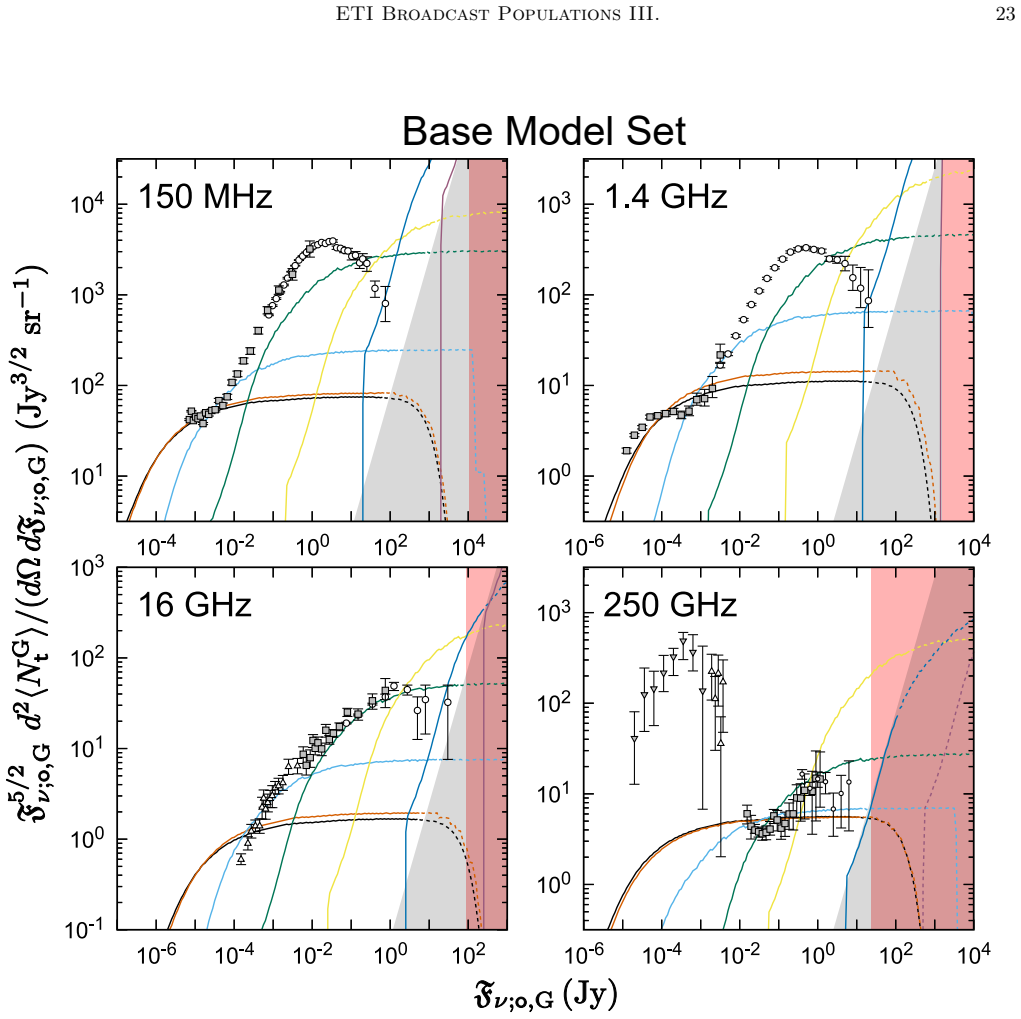
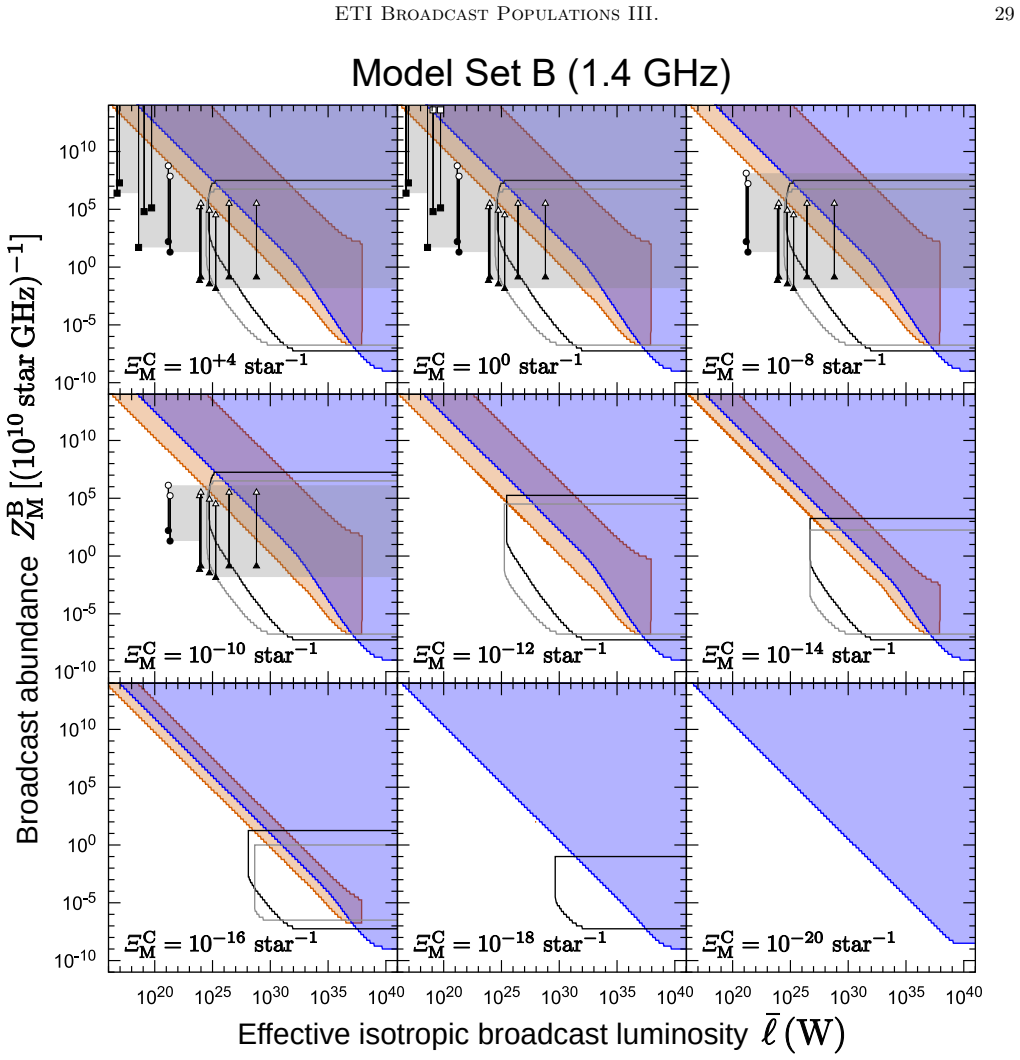
Using the formalism in Paper I and II, measured radio source counts set limits on radio broadcasts across the radio spectrum, including the first Search for Extraterrestrial Intelligence (SETI) constraints at ~250 GHz. Commensal limits from background galaxies in the fields of large SETI surveys provide stronger bounds in limited ranges. The abundance of Kardashev Type III radio broadcast populations is less than one in 10^{17} stars, about one in a million large galaxies. Limits weaken when broadcasts clump into discrete rare hosts and are also examined for a power-law distribution in broadcast luminosity.
What carries the argument
The population formalism treating artificial broadcasts as adding to galactic integrated radio luminosity, compared directly against observed radio source counts and SETI survey background fields.
If this is right
- First SETI constraints at ~250 GHz are obtained from source counts.
- Commensal field limits are more powerful but apply only over limited luminosity ranges and dedicated frequencies.
- Limits become weaker if broadcasts are concentrated in extremely rare host galaxies.
- The same population bounds apply to a power-law distribution of broadcast luminosities.
Where Pith is reading between the lines
- Future higher-sensitivity radio surveys could either detect the predicted population or push the abundance limit lower.
- The results imply that any widespread galactic civilizations must avoid producing radio emission bright enough to stand out in integrated counts.
- This approach connects standard radio astronomy source statistics directly to limits on the prevalence of advanced technological societies.
Load-bearing premise
Artificial broadcasts add to a galaxy's integrated radio luminosity in a manner that can be directly compared against observed radio source counts and SETI survey fields.
What would settle it
An observed excess in radio source counts at a well-characterized frequency that matches the predicted number density of artificial radio galaxies from the model.
Figures






read the original abstract
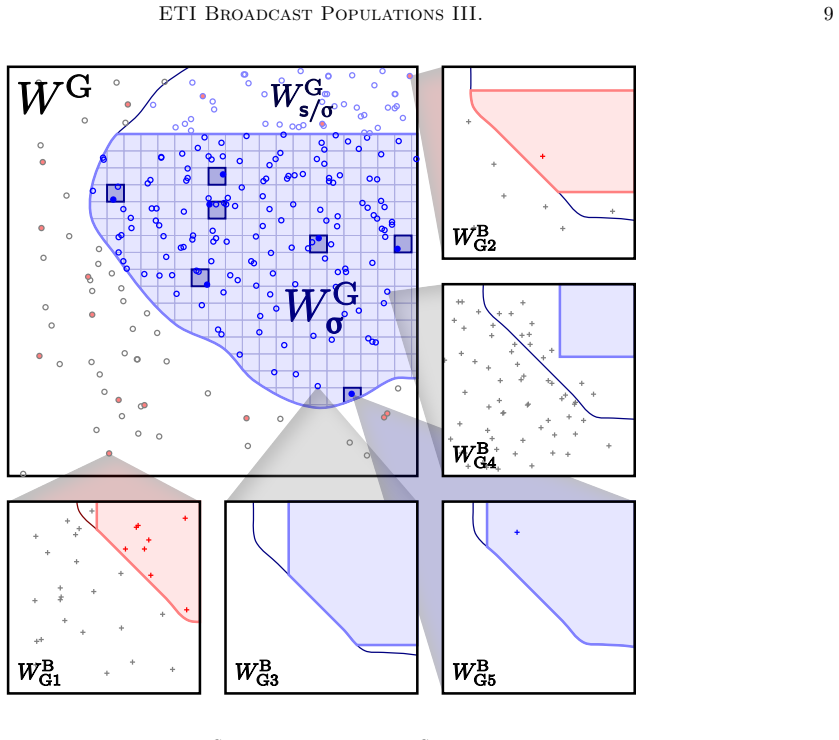
Any population of artificial radio broadcasts in a galaxy contributes to its integrated radio luminosity. If this radio emission is bright enough, inhabited galaxies themselves form a cosmic population of artificial radio galaxies. We can detect these broadcasts individually or set constraints from their collective emission. Using the formalism in Paper I and II, I set bounds on the artificial radio galaxy population using both of these methodologies. Measured radio source counts set limits on radio broadcasts across the radio spectrum, including the first Search for Extraterrestrial Intelligence (SETI) constraints at ~250 GHz. I compare these with commensal limits from background galaxies in the fields of large SETI surveys. The field limits are more powerful, but generally only over a limited luminosity range and for frequencies with dedicated SETI surveys. The limits are weaker when broadcasts clump into discrete hosts that are themselves extremely rare. I find that the abundance of Kardashev Type III radio broadcast populations is less than one in $10^{17}$ stars, about one in a million large galaxies. I also examine limits for a power-law distribution in broadcast luminosity.
Editorial analysis
A structured set of objections, weighed in public.
Referee Report
Summary. The manuscript extends the formalism from Papers I and II to constrain the cosmic population of artificial radio broadcasts by modeling their contribution to integrated galaxy radio luminosity. It derives upper limits using measured radio source counts across frequencies (including the first SETI constraints at ~250 GHz) and commensal limits from background galaxies in SETI survey fields, concluding that Kardashev Type III broadcast populations occur at a rate of less than one per 10^{17} stars (approximately one per million large galaxies). Limits are noted to weaken for clumped or rare hosts, and a power-law luminosity distribution is also examined.
Significance. If the central modeling assumptions hold, the work provides quantitative, data-driven upper bounds on the prevalence of advanced civilizations producing detectable radio emission, repurposing standard radio source count measurements and existing SETI observations for a novel population-level analysis. Credit is due for the first reported SETI-style limits at ~250 GHz and for explicitly comparing collective emission constraints against individual survey fields.
major comments (2)
- [Abstract and derivation of abundance limit] Abstract and the section deriving the 10^{17} abundance limit: the headline constraint is obtained by requiring that artificial broadcasts add to galaxy integrated radio luminosity without exceeding observed source counts. This step assumes steady broadband emission that shifts the luminosity function without introducing resolvable point sources, frequency-dependent effects, or confusion with star-formation emission; if broadcasts are narrowband, intermittent, or spectrally distinct, the derived number density can loosen by orders of magnitude, and the manuscript does not quantify this sensitivity.
- [Comparison of methodologies] Section comparing source-count limits to SETI field limits: the claim that field limits are more powerful but limited in luminosity range and frequency relies on the population formalism of Papers I and II. A brief self-contained recap of how survey selection functions, completeness corrections, and the ~250 GHz coverage are propagated would allow independent verification and reduce dependence on the prior series.
minor comments (2)
- [Power-law distribution subsection] Clarify notation for the broadcast luminosity function parameters when discussing the power-law distribution case to avoid ambiguity with the fixed-luminosity results.
- [Introduction and references] Ensure references to Papers I and II are consistently formatted and clearly separated from external radio catalog citations.
Simulated Author's Rebuttal
We thank the referee for their careful reading and constructive comments on our manuscript. We address each major point below and have incorporated revisions to improve clarity and robustness.
read point-by-point responses
-
Referee: Abstract and the section deriving the 10^{17} abundance limit: the headline constraint is obtained by requiring that artificial broadcasts add to galaxy integrated radio luminosity without exceeding observed source counts. This step assumes steady broadband emission that shifts the luminosity function without introducing resolvable point sources, frequency-dependent effects, or confusion with star-formation emission; if broadcasts are narrowband, intermittent, or spectrally distinct, the derived number density can loosen by orders of magnitude, and the manuscript does not quantify this sensitivity.
Authors: We agree that the headline limit is derived under the baseline assumption of steady, broadband emission that contributes to the integrated luminosity without producing individually resolvable sources. In the revised manuscript we have added a dedicated paragraph in the discussion section that quantifies the sensitivity to alternative emission models. For narrowband or intermittent broadcasts the effective duty cycle and bandwidth dilution factors are now explicitly estimated, showing that the number-density upper limit can weaken by up to two orders of magnitude in the most extreme cases while remaining informative. We also note that the source-count methodology still bounds the time-averaged power even for spectrally distinct signals, and we have updated the abstract to flag this modeling choice. revision: yes
-
Referee: Section comparing source-count limits to SETI field limits: the claim that field limits are more powerful but limited in luminosity range and frequency relies on the population formalism of Papers I and II. A brief self-contained recap of how survey selection functions, completeness corrections, and the ~250 GHz coverage are propagated would allow independent verification and reduce dependence on the prior series.
Authors: We accept that a self-contained summary would improve accessibility. The revised manuscript now includes a short subsection (approximately one paragraph) that recapitulates the essential elements of the population formalism: the mapping from individual broadcast luminosity to galaxy-integrated flux, the application of survey completeness corrections, and the specific propagation of the 250 GHz source-count data. This recap is written to be readable without requiring immediate reference to Papers I and II, while still directing interested readers to those works for full derivations. revision: yes
Circularity Check
Central abundance limits depend on self-cited population formalism from Papers I and II
specific steps
-
self citation load bearing
[Abstract]
"Using the formalism in Paper I and II, I set bounds on the artificial radio galaxy population using both of these methodologies. Measured radio source counts set limits on radio broadcasts across the radio spectrum, including the first Search for Extraterrestrial Intelligence (SETI) constraints at ~250 GHz."
The headline result is obtained by applying the population formalism and assumptions (artificial broadcasts adding to integrated radio luminosity, direct comparability to source counts) developed in the same author's prior papers. The specific 10^17 figure therefore reduces to those self-cited modeling choices rather than emerging from first-principles derivation or external verification within this manuscript.
full rationale
The derivation of the <1 per 10^17 stars limit proceeds by folding an assumed artificial radio luminosity contribution into the cosmic galaxy population and comparing against observed source counts/SETI fields. This step is load-bearing and rests on the population formalism introduced in the author's prior Papers I and II rather than being re-derived or independently validated here. External radio catalogs supply independent data, but the translation from those catalogs to broadcast number densities inherits the prior modeling choices for integrated luminosity addition, survey selection, and clumping effects. This produces partial circularity (score 6) without reducing the entire result to a pure self-definition or fitted-input renaming.
Axiom & Free-Parameter Ledger
free parameters (1)
- broadcast luminosity function parameters
axioms (1)
- domain assumption Artificial radio broadcasts within a galaxy contribute additively to its integrated radio luminosity without dominant absorption or scattering effects.
Lean theorems connected to this paper
-
IndisputableMonolith/Foundation/RealityFromDistinction.leanreality_from_one_distinction unclear?
unclearRelation between the paper passage and the cited Recognition theorem.
Using the formalism in Paper I and II, I set bounds on the artificial radio galaxy population using both of these methodologies. Measured radio source counts set limits...
What do these tags mean?
- matches
- The paper's claim is directly supported by a theorem in the formal canon.
- supports
- The theorem supports part of the paper's argument, but the paper may add assumptions or extra steps.
- extends
- The paper goes beyond the formal theorem; the theorem is a base layer rather than the whole result.
- uses
- The paper appears to rely on the theorem as machinery.
- contradicts
- The paper's claim conflicts with a theorem or certificate in the canon.
- unclear
- Pith found a possible connection, but the passage is too broad, indirect, or ambiguous to say the theorem truly supports the claim.
Reference graph
Works this paper leans on
-
[1]
Adelson, R. M. 1966, Journal of the Operational Research Society, 17, 73, doi: 10.1057/jors.1966.8 AMI Consortium, Davies, M. L., Franzen, T. M. O., et al. 2011, MNRAS, 415, 2708, doi: 10.1111/j.1365-2966.2011.18925.x
-
[2]
2007, in Stochastic Geometry, ed
Baddeley, A. 2007, in Stochastic Geometry, ed. W. Weil (Berlin: Springer), 1–75, doi: 10.1007/978-3-540-38175-4 1
-
[3]
Bauer, F. E., Alexander, D. M., Brandt, W. N., et al. 2004, AJ, 128, 2048, doi: 10.1086/424859
-
[4]
Behroozi, P., & Peeples, M. S. 2015, MNRAS, 454, 1811, doi: 10.1093/mnras/stv1817
-
[5]
Brzycki, B., Siemion, A. P. V., de Pater, I., et al. 2023, ApJ, 952, 46, doi: 10.3847/1538-4357/acdee0
-
[6]
Carlstrom, J. E., Ade, P. A. R., Aird, K. A., et al. 2011, PASP, 123, 568, doi: 10.1086/659879
-
[7]
Carter, B. 1983, Philosophical Transactions of the Royal Society of London Series A, 310, 347, doi: 10.1098/rsta.1983.0096
-
[8]
2003, ApJL, 586, L133, doi: 10.1086/374879
Chabrier, G. 2003, ApJL, 586, L133, doi: 10.1086/374879
-
[9]
Chiu, S. N., Stoyan, D., Kendall, W. S., & Mecke, J. 2013, Stochastic Geometry and its Applications: Third Edition (New York: Wiley), doi: 10.1002/9781118658222
-
[10]
2024, AJ, 167, 10, doi: 10.3847/1538-3881/acf576 ´Cirkovi´ c, M
Choza, C., Bautista, D., Croft, S., et al. 2024, AJ, 167, 10, doi: 10.3847/1538-3881/acf576 ´Cirkovi´ c, M. M., & Vukoti´ c, B. 2008, Origins of Life and Evolution of the Biosphere, 38, 535, doi: 10.1007/s11084-008-9149-y
-
[11]
1959, Nature, 184, 844, doi: 10.1038/184844a0
Cocconi, G., & Morrison, P. 1959, Nature, 184, 844, doi: 10.1038/184844a0
-
[12]
Condon, J. J. 1984, ApJ, 287, 461, doi: 10.1086/162705
-
[13]
Condon, J. J. 1992, ARA&A, 30, 575, doi: 10.1146/annurev.aa.30.090192.003043
-
[14]
Condon, J. J., Cotton, W. D., & Broderick, J. J. 2002, AJ, 124, 675, doi: 10.1086/341650
-
[15]
Condon, J. J., Cotton, W. D., Greisen, E. W., et al. 1998, AJ, 115, 1693, doi: 10.1086/300337
-
[16]
Condon, J. J., Cotton, W. D., Fomalont, E. B., et al. 2012, ApJ, 758, 23, doi: 10.1088/0004-637X/758/1/23
-
[17]
Cordes, J. M., Lazio, J. W., & Sagan, C. 1997, ApJ, 487, 782, doi: 10.1086/304620
-
[18]
Daley, D. J., & Vere-Jones, D. 2003, An Introduction to the Theory of Point Processes. Volume I: Elementary Theory and Methods (New York: Springer), doi: 10.1007/b97277
-
[19]
Daley, D. J., & Vere-Jones, D. 2008, An Introduction to the Theory of Point Processes. Volume II: General Theory and Structure (New York: Springer), doi: 10.1007/978-0-387-49835-5
-
[21]
Monthly Notices of the Royal Astronomical Society , author =
Driver, S. P., Bellstedt, S., Robotham, A. S. G., et al. 2022, MNRAS, 513, 439, doi: 10.1093/mnras/stac472
-
[22]
E., Siemion, A., Foster, G., et al
Enriquez, J. E., Siemion, A., Foster, G., et al. 2017, ApJ, 849, 104, doi: 10.3847/1538-4357/aa8d1b
-
[23]
Everett, W. B., Zhang, L., Crawford, T. M., et al. 2020, ApJ, 900, 55, doi: 10.3847/1538-4357/ab9df7
-
[24]
2018, A&A, 620, A152, doi: 10.1051/0004-6361/201832928
Franco, M., Elbaz, D., B´ ethermin, M., et al. 2018, A&A, 620, A152, doi: 10.1051/0004-6361/201832928
-
[25]
Franzen, T. M. O., Vernstrom, T., Jackson, C. A., et al. 2019, PASA, 36, e004, doi: 10.1017/pasa.2018.52
-
[26]
Freitas, R. A., J., & Valdes, F. 1985, Acta Astronautica, 12, 1027, doi: 10.1016/0094-5765(85)90031-1
-
[27]
2016, ApJS, 222, 1, doi: 10.3847/0067-0049/222/1/1
Fujimoto, S., Ouchi, M., Ono, Y., et al. 2016, ApJS, 222, 1, doi: 10.3847/0067-0049/222/1/1
-
[28]
Gajjar, V., Perez, K. I., Siemion, A. P. V., et al. 2021, AJ, 162, 33, doi: 10.3847/1538-3881/abfd36
-
[29]
Garrett, M. A., & Siemion, A. P. V. 2023, MNRAS, 519, 4581, doi: 10.1093/mnras/stac2607
-
[30]
Gowanlock, M. G. 2016, ApJ, 832, 38, doi: 10.3847/0004-637X/832/1/38
-
[31]
Gray, R. H., & Mooley, K. 2017, AJ, 153, 110, doi: 10.3847/1538-3881/153/3/110
-
[32]
Greve, T. R., Ivison, R. J., Bertoldi, F., et al. 2004, MNRAS, 354, 779, doi: 10.1111/j.1365-2966.2004.08235.x
-
[33]
Haenggi, M. 2013, Stochastic Geometry for Wireless Networks (Cambridge: Cambridge University Press), doi: 10.1017/cbo9781139043816
-
[34]
2021, ApJ, 922, 182, doi: 10.3847/1538-4357/ac2369 ETI Broadcast Populations III
Hanson, R., Martin, D., McCarter, C., & Paulson, J. 2021, ApJ, 922, 182, doi: 10.3847/1538-4357/ac2369 ETI Broadcast Populations III. 39
-
[35]
Harp, G. R., Richards, J., Tarter, J. C., et al. 2016, AJ, 152, 181, doi: 10.3847/0004-6256/152/6/181
-
[36]
Hogg, D. W. 1999, arXiv e-prints, astro. https://arxiv.org/abs/astro-ph/9905116
work page internal anchor Pith review Pith/arXiv arXiv 1999
-
[37]
1993, ApJ, 415, 218, doi: 10.1086/173157
Horowitz, P., & Sagan, C. 1993, ApJ, 415, 218, doi: 10.1086/173157
-
[38]
Isaacson, H., Siemion, A. P. V., Marcy, G. W., et al. 2017, PASP, 129, 054501, doi: 10.1088/1538-3873/aa5800
-
[39]
Jones, M. E. 1991, in Astronomical Society of the Pacific Conference Series, Vol. 19, IAU Colloq. 131: Radio Interferometry. Theory, Techniques, and Applications, ed. T. J. Cornwell & R. A. Perley, 395–399
work page 1991
-
[40]
Kardashev, N. S. 1964, Soviet Ast., 8, 217
work page 1964
-
[41]
Kingman, J. F. C. 1993, Poisson Processes (Oxford: Clarendon Press), doi: 10.1093/oso/9780198536932.001.0001
-
[42]
2024, arXiv e-prints, arXiv:2407.07097, doi: 10.48550/arXiv.2407.07097
Kipping, D., & Lewis, G. 2024, arXiv e-prints, arXiv:2407.07097, doi: 10.48550/arXiv.2407.07097
-
[43]
Kuiper, T. B. H., & Morris, M. 1977, Science, 196, 616, doi: 10.1126/science.196.4290.616
-
[44]
Lacki, B. C. 2021, International Journal of Astrobiology, 20, 359, doi: 10.1017/S1473550421000252
-
[45]
Lacki, B. C. 2024a, ApJ, 966, 182, doi: 10.3847/1538-4357/ad11f2
-
[46]
Lacki, B. C. 2024b, ApJ, 966, 183, doi: 10.3847/1538-4357/ad11f1
-
[47]
Last, G., & Penrose, M. 2017, Lectures on the Poisson Process (Cambridge: Cambridge University Press), doi: 10.1017/9781316104477
-
[48]
Lehmer, B. D., Xue, Y. Q., Brandt, W. N., et al. 2012, ApJ, 752, 46, doi: 10.1088/0004-637X/752/1/46
-
[49]
W., Gonzalez Abad, G., & Loeb, A
Lin, H. W., Gonzalez Abad, G., & Loeb, A. 2014, ApJL, 792, L7, doi: 10.1088/2041-8205/792/1/L7
-
[50]
Lindner, R. R., Baker, A. J., Omont, A., et al. 2011, ApJ, 737, 83, doi: 10.1088/0004-637X/737/2/83
-
[51]
Lineweaver, C. H., Fenner, Y., & Gibson, B. K. 2004, Science, 303, 59, doi: 10.1126/science.1092322
-
[52]
2021, AJ, 161, 55, doi: 10.3847/1538-3881/abcc77
Margot, J.-L., Pinchuk, P., Geil, R., et al. 2021, AJ, 161, 55, doi: 10.3847/1538-3881/abcc77
-
[53]
2016, MNRAS, 460, 3829, doi: 10.1093/mnras/stw1222
Maselli, A., Massaro, F., Cusumano, G., et al. 2016, MNRAS, 460, 3829, doi: 10.1093/mnras/stw1222
-
[54]
Massardi, M., Ekers, R. D., Murphy, T., et al. 2011, MNRAS, 412, 318, doi: 10.1111/j.1365-2966.2010.17917.x
-
[55]
Matthews, A. M., Condon, J. J., Cotton, W. D., & Mauch, T. 2021, ApJ, 909, 193, doi: 10.3847/1538-4357/abdd37
-
[56]
Observational constraints on the progenitors of Type II-P supernovae
Murphy, T., Sadler, E. M., Ekers, R. D., et al. 2010, MNRAS, 402, 2403, doi: 10.1111/j.1365-2966.2009.15961.x
-
[57]
Perley, R. A., & Butler, B. J. 2017, ApJS, 230, 7, doi: 10.3847/1538-4365/aa6df9 Planck Collaboration, Ade, P. A. R., Aghanim, N., et al. 2011a, A&A, 536, A1, doi: 10.1051/0004-6361/201116464 Planck Collaboration, Ade, P. A. R., Aghanim, N., et al. 2011b, A&A, 536, A7, doi: 10.1051/0004-6361/201116474 Planck Collaboration, Ade, P. A. R., Aghanim, N., et a...
-
[58]
Price, D. C., Enriquez, J. E., Brzycki, B., et al. 2020, AJ, 159, 86, doi: 10.3847/1538-3881/ab65f1
-
[59]
Sadler, E. M., Jackson, C. A., Cannon, R. D., et al. 2002, MNRAS, 329, 227, doi: 10.1046/j.1365-8711.2002.04998.x
-
[60]
1996, AJ, 112, 164, doi: 10.1086/117996
Shostak, S., Ekers, R., & Vaile, R. 1996, AJ, 112, 164, doi: 10.1086/117996
-
[61]
Tarter, J. 1985, in IAU Symposium, Vol. 112, The Search for Extraterrestrial Life: Recent Developments, ed. M. D. Papagiannis (Dordrecht: D. Reidel Publishing Co.), 271–290, doi: 10.1007/978-94-009-5462-5 37
-
[62]
2001, ARA&A, 39, 511, doi: 10.1146/annurev.astro.39.1.511
Tarter, J. 2001, ARA&A, 39, 511, doi: 10.1146/annurev.astro.39.1.511
-
[63]
Tauber, J. A., Mandolesi, N., Puget, J. L., et al. 2010, A&A, 520, A1, doi: 10.1051/0004-6361/200912983
-
[64]
Thorne, J. E., Robotham, A. S. G., Davies, L. J. M., et al. 2021, MNRAS, 505, 540, doi: 10.1093/mnras/stab1294
-
[65]
Tremblay, C. D., Price, D. C., & Tingay, S. J. 2022, PASA, 39, e008, doi: 10.1017/pasa.2022.5
-
[66]
Tremblay, C. D., & Tingay, S. J. 2020, PASA, 37, e035, doi: 10.1017/pasa.2020.27
-
[67]
Tremblay, C. D., & Tingay, S. J. 2024, ApJ, 972, 76, doi: 10.3847/1538-4357/ad6b11
-
[68]
2023, MNRAS, 522, 4649, doi: 10.1093/mnras/stad993
Uno, Y., Hashimoto, T., Goto, T., et al. 2023, MNRAS, 522, 4649, doi: 10.1093/mnras/stad993
-
[69]
Vernstrom, T., Scott, D., Wall, J. V., et al. 2014, MNRAS, 440, 2791, doi: 10.1093/mnras/stu470
-
[70]
Vieira, J. D., Crawford, T. M., Switzer, E. R., et al. 2010, ApJ, 719, 763, doi: 10.1088/0004-637X/719/1/763
-
[71]
Waldram, E. M., Pooley, G. G., Davies, M. L., Grainge, K. J. B., & Scott, P. F. 2010, MNRAS, 404, 1005, doi: 10.1111/j.1365-2966.2010.16333.x
-
[72]
Wesson, P. S. 1990, QJRAS, 31, 161
work page 1990
-
[73]
Whittam, I. H., Riley, J. M., Green, D. A., et al. 2016, MNRAS, 457, 1496, doi: 10.1093/mnras/stv2960
-
[74]
Williams, W. L., van Weeren, R. J., R¨ ottgering, H. J. A., et al. 2016, MNRAS, 460, 2385, doi: 10.1093/mnras/stw1056 40 Lacki
-
[75]
Wlodarczyk-Sroka, B. S., Garrett, M. A., & Siemion, A. P. V. 2020, MNRAS, 498, 5720, doi: 10.1093/mnras/staa2672
-
[76]
P., Drew, J., Siemion, A., et al
Worden, S. P., Drew, J., Siemion, A., et al. 2017, Acta Astronautica, 139, 98, doi: 10.1016/j.actaastro.2017.06.008
-
[77]
Wright, J. T. 2020, Serbian Astronomical Journal, 200, 1, doi: 10.2298/SAJ2000001W
-
[78]
Wright, J. T., Kanodia, S., & Lubar, E. 2018, AJ, 156, 260, doi: 10.3847/1538-3881/aae099
-
[79]
Yun, M. S., Reddy, N. A., & Condon, J. J. 2001, ApJ, 554, 803, doi: 10.1086/323145
-
[80]
2016, ApJ, 833, 214, doi: 10.3847/1538-4357/833/2/214
Zackrisson, E., Calissendorff, P., Gonz´ alez, J., et al. 2016, ApJ, 833, 214, doi: 10.3847/1538-4357/833/2/214
discussion (0)
Sign in with ORCID, Apple, or X to comment. Anyone can read and Pith papers without signing in.