Prospects of searches for invisible B-meson decays at FCC-ee
Pith reviewed 2026-05-19 00:14 UTC · model grok-4.3
The pith
FCC-ee could exclude branching fractions for invisible B-meson decays down to 7.6×10^{-9} at 90% confidence.
A machine-rendered reading of the paper's core claim, the machinery that carries it, and where it could break.
Core claim
The central claim is that at the FCC-ee with 6×10^{12} Z bosons, invisible B-meson decays with branching fractions above 7.6×10^{-9} can be excluded at 90% confidence level and above 9.7×10^{-9} at 95% confidence level, with discovery possible above 3.0×10^{-8}, based on simulations of signal and background events selected by rectangular cuts and a multiclass boosted decision tree classifier in a multipurpose detector.
What carries the argument
Multiclass boosted decision tree classifier used alongside rectangular cuts to separate invisible B-meson decay signals from Z boson decay backgrounds.
Load-bearing premise
The detector performance in the simulation accurately represents reality and backgrounds can be modeled without unexpected contributions from Z decays.
What would settle it
If real data shows that the classifier cannot reject backgrounds as effectively as in the simulation, the projected exclusion and discovery reaches would not be achieved.
Figures


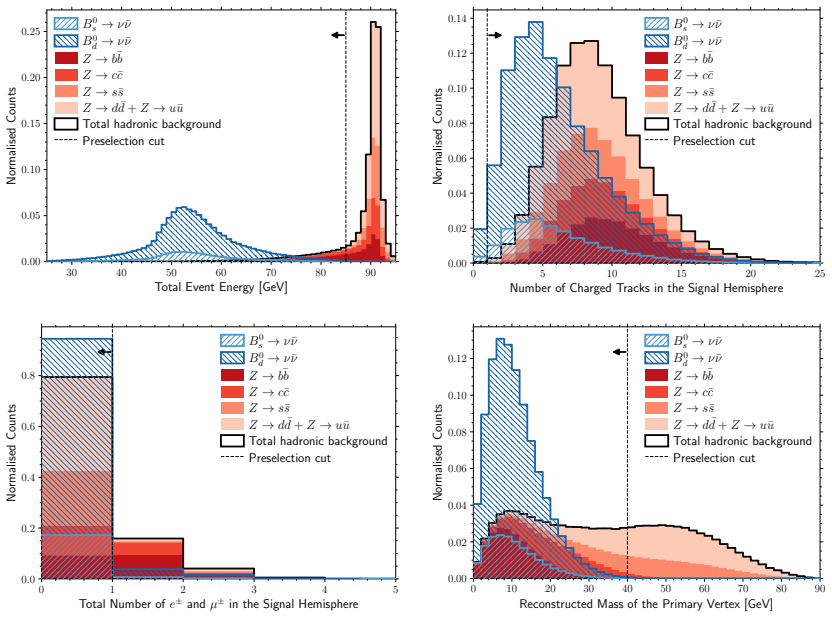


read the original abstract
We investigate the physics reach and potential for the study of $B$-meson decays to invisible final states at the Future Circular Collider running electron-positron collisions at the $Z$ pole (FCC-ee). Signal and background candidates are simulated for a proposed multipurpose detector, including inclusive contributions from $Z$ decays to leptons or quarks. Signal candidates are selected by a mixture of rectangular cuts and a multiclass boosted decision tree classifier. We determine that branching fractions above $7.6\times10^{-9}$ ($9.7\times10^{-9}$) would be excluded at 90% (95%) confidence level, and branching fractions above $3.0\times10^{-8}$ would be within discovery reach at FCC-ee if $6\times 10^{12}$ $Z$ bosons are produced.
Editorial analysis
A structured set of objections, weighed in public.
Referee Report
Summary. The manuscript presents a Monte Carlo-based sensitivity study for searches of invisible B-meson decays (e.g., B → invisible) at the FCC-ee Z-pole run. Signal and inclusive backgrounds from Z → leptons/quarks are simulated for a proposed multipurpose detector; candidates are selected with rectangular cuts followed by a multiclass boosted decision tree. With an assumed yield of 6×10^{12} Z bosons, the projected limits are a 90% CL exclusion for branching fractions above 7.6×10^{-9} (95% CL: 9.7×10^{-9}) and discovery reach above 3.0×10^{-8}.
Significance. If the simulated detector performance and background modeling hold, the projected sensitivity would improve existing limits on invisible B decays by more than an order of magnitude, providing a competitive probe of dark-sector or other new-physics scenarios. The study employs standard forward simulation techniques with a multiclass BDT for background rejection; the arithmetic converting post-selection yields into branching-fraction limits is internally consistent and free of circularity.
major comments (1)
- The central limits rest on the assumed background rejection power of the multiclass BDT and the modeling of Z → qq/ℓℓ backgrounds. The manuscript should include a dedicated subsection (or appendix) quantifying the impact of systematic uncertainties on the background shape and normalization, together with any cross-checks against known Z-pole data or control samples; without this, the quoted numerical reach cannot be fully assessed for robustness.
minor comments (2)
- Figure captions and the text describing the BDT input variables should explicitly list the full set of features used (e.g., missing energy, vertex displacement, lepton vetoes) so that the classifier performance can be reproduced or compared with other analyses.
- The abstract and conclusion should state the assumed integrated luminosity or Z yield more prominently, and clarify whether the 6×10^{12} figure already incorporates the FCC-ee design luminosity and running time.
Simulated Author's Rebuttal
We thank the referee for the careful reading of the manuscript and the constructive suggestion regarding systematic uncertainties. We address the comment below and have revised the manuscript to incorporate additional discussion as requested.
read point-by-point responses
-
Referee: The central limits rest on the assumed background rejection power of the multiclass BDT and the modeling of Z → qq/ℓℓ backgrounds. The manuscript should include a dedicated subsection (or appendix) quantifying the impact of systematic uncertainties on the background shape and normalization, together with any cross-checks against known Z-pole data or control samples; without this, the quoted numerical reach cannot be fully assessed for robustness.
Authors: We agree that quantifying the impact of systematic uncertainties strengthens the assessment of the projected sensitivity. In the revised manuscript we have added a new subsection (Section 4.3) that discusses the main sources of uncertainty on background normalization and shape. We assign a conservative 5% relative uncertainty on the post-selection background yield, motivated by typical control-sample precisions achieved at LEP Z-pole runs, and propagate this uncertainty into the limit calculation using a profile-likelihood approach. The resulting degradation of the 90% CL exclusion limit is shown to be modest (from 7.6×10^{-9} to 8.2×10^{-9}). We also outline how future data-driven cross-checks with well-measured Z→qq and Z→ℓℓ control samples will be performed once real FCC-ee data become available. Because the present study is a Monte-Carlo-based sensitivity projection rather than an analysis of existing data, we cannot yet perform those cross-checks; the added subsection therefore focuses on the assumptions and their quantitative effect on the quoted reach. revision: yes
Circularity Check
No significant circularity; standard simulation-based projection
full rationale
The paper derives projected branching-fraction sensitivities (7.6e-9 at 90% CL, 3.0e-8 for discovery) from forward Monte Carlo simulation of signal efficiency and background rejection for 6e12 Z bosons, using rectangular cuts plus a multiclass BDT on a proposed detector. No step reduces by construction to a fitted parameter, self-definition, or load-bearing self-citation; the arithmetic converting post-selection yields into limits follows directly from the simulated event counts and assumed luminosity without internal redefinition or smuggling of ansatze. The central claim remains externally falsifiable via future data and does not rely on prior author work for uniqueness or normalization.
Axiom & Free-Parameter Ledger
free parameters (1)
- Z boson yield =
6×10^{12}
axioms (1)
- domain assumption Standard Monte Carlo tools accurately model signal and background processes for the proposed detector
Lean theorems connected to this paper
-
IndisputableMonolith/Cost/FunctionalEquation.leanwashburn_uniqueness_aczel unclear?
unclearRelation between the paper passage and the cited Recognition theorem.
Signal candidates are selected by a mixture of rectangular cuts and a multiclass boosted decision tree classifier... FoM = S / sqrt(S + B)
-
IndisputableMonolith/Foundation/RealityFromDistinction.leanreality_from_one_distinction unclear?
unclearRelation between the paper passage and the cited Recognition theorem.
We determine that branching fractions above 7.2e-9 would be excluded at 90% CL with 6e12 Z bosons
What do these tags mean?
- matches
- The paper's claim is directly supported by a theorem in the formal canon.
- supports
- The theorem supports part of the paper's argument, but the paper may add assumptions or extra steps.
- extends
- The paper goes beyond the formal theorem; the theorem is a base layer rather than the whole result.
- uses
- The paper appears to rely on the theorem as machinery.
- contradicts
- The paper's claim conflicts with a theorem or certificate in the canon.
- unclear
- Pith found a possible connection, but the passage is too broad, indirect, or ambiguous to say the theorem truly supports the claim.
Reference graph
Works this paper leans on
-
[1]
C. Bird, P. Jackson, R. V. Kowalewski, and M. Pospelov, Search for dark matter in b →s transitions with missing energy , Phys. Rev. Lett. 93 (2004) 201803, arXiv:hep-ph/0401195
work page internal anchor Pith review Pith/arXiv arXiv 2004
-
[2]
Rare meson decays into very light neutralinos
B. O’Leary,Rare meson decays into very light neutralinos , AIP Conf. Proc. 1200 (2010) 502, arXiv:0909.3994
work page internal anchor Pith review Pith/arXiv arXiv 2010
-
[3]
G. Alonso- ´Alvarez and M. Escudero Abenza, The first limit on invisible decays of Bs mesons comes from LEP, Eur. Phys. J. C 84 (2024) 553, arXiv:2310.13043
-
[4]
Invisible widths of heavy mesons
B. Bhattacharya, C. M. Grant, and A. A. Petrov, Invisible widths of heavy mesons , Phys. Rev. D 99 (2019) 093010, arXiv:1809.04606
work page internal anchor Pith review Pith/arXiv arXiv 2019
-
[5]
C. D. Lu and D. X. Zhang, Bs(Bd) →γν¯ν, Phys. Lett. B 381 (1996) 348, arXiv:hep-ph/9604378
work page internal anchor Pith review Pith/arXiv arXiv 1996
-
[6]
B. Bortolato and J. F. Kamenik, Light Majorana neutrinos in (demi)invisible meson decays , Eur. Phys. J. C 81 (2021) 388, arXiv:2007.08863
-
[7]
Searching for light Dark Matter in heavy meson decays
A. Badin and A. A. Petrov, Searching for light Dark Matter in heavy meson decays , Phys. Rev. D 82 (2010) 034005, arXiv:1005.1277. 19
work page internal anchor Pith review Pith/arXiv arXiv 2010
-
[8]
BaBar, J. P. Lees et al., Improved limits on B0 decays to invisible final states and to ν¯νγ, Phys. Rev. D 86 (2012) 051105, arXiv:1206.2543
work page internal anchor Pith review Pith/arXiv arXiv 2012
-
[9]
Belle II, W. Altmannshofer et al. , The Belle II Physics Book , PTEP 2019 (2019) 123C01, arXiv:1808.10567, [Erratum: PTEP 2020, 029201 (2020)]
-
[10]
Amhis et al., Prospects forB+ c →τ+ντat FCC-ee, JHEP 12 (2021) 133, arXiv:2105.13330
Y. Amhis et al., Prospects forB+ c →τ+ντat FCC-ee, JHEP 12 (2021) 133, arXiv:2105.13330
- [11]
-
[12]
Zuo et al., Prospects for B+ c and B+→τ+ντat FCC-ee, Eur
X. Zuo et al., Prospects for B+ c and B+→τ+ντat FCC-ee, Eur. Phys. J. C 84 (2024) 87, arXiv:2305.02998
-
[13]
FCC, A. Abada et al., FCC Physics Opportunities: Future Circular Collider Conceptual Design Report Volume 1, Eur. Phys. J. C 79 (2019) 474
work page 2019
-
[14]
Future Circular Collider Feasibility Study Report: Volume 1, Physics, Experiments, Detectors
FCC, M. Benedikt et al., Future Circular Collider Feasibility Study Report: Volume 1, Physics, Experiments, Detectors, arXiv:2505.00272arXiv:2505.00272
work page internal anchor Pith review Pith/arXiv arXiv
-
[15]
FCC, M. Benedikt et al., Future Circular Collider Feasibility Study Report: Volume 2, Acceler- ators, Technical Infrastructure and Safety, arXiv:2505.00274arXiv:2505.00274
-
[16]
FCC, M. Benedikt et al., Future Circular Collider Feasibility Study Report: Volume 3, Civil Engineering, Implementation and Sustainability , arXiv:2505.00273arXiv:2505.00273
-
[17]
FCC, A. Abada et al. , FCC-ee: The Lepton Collider: Future Circular Collider Conceptual Design Report Volume 2, Eur. Phys. J. ST 228 (2019) 261
work page 2019
-
[18]
Particle Data Group, R. L. Workman et al., Review of Particle Physics , PTEP 2022 (2022) 083C01
work page 2022
-
[19]
The International Linear Collider: A Global Project
P. Bambade et al., The International Linear Collider: A Global Project , arXiv:1903.01629
work page internal anchor Pith review Pith/arXiv arXiv 1903
-
[20]
S. Monteil and G. Wilkinson, Heavy-quark opportunities and challenges at FCC-ee , Eur. Phys. J. Plus 136 (2021) 837, arXiv:2106.01259
-
[21]
T. Sj¨ ostrandet al., An Introduction to PYTHIA 8.2 , Comput. Phys. Commun. 191 (2015) 159, arXiv:1410.3012
work page internal anchor Pith review Pith/arXiv arXiv 2015
-
[22]
D. J. Lange, The EvtGen particle decay simulation package , Nucl. Instrum. Meth. A 462 (2001) 152
work page 2001
-
[23]
PHOTOS Interface in C++; Technical and Physics Documentation
N. Davidson, T. Przedzinski, and Z. Was, PHOTOS interface in C++: Technical and Physics Documentation, Comput. Phys. Commun. 199 (2016) 86, arXiv:1011.0937
work page internal anchor Pith review Pith/arXiv arXiv 2016
-
[24]
IDEA Study Group, M. Abbrescia et al. , The IDEA detector concept for FCC-ee , arXiv:2502.21223
-
[25]
DELPHES 3, A modular framework for fast simulation of a generic collider experiment
DELPHES 3, J. de Favereau et al., DELPHES 3, A modular framework for fast simulation of a generic collider experiment , JHEP 02 (2014) 057, arXiv:1307.6346
work page internal anchor Pith review Pith/arXiv arXiv 2014
-
[26]
Marchiori et al., HEP-FCC/FCC-config: v0.2.0, 2025
G. Marchiori et al., HEP-FCC/FCC-config: v0.2.0, 2025. doi: 10.5281/zenodo.15544272. 20
-
[27]
Volkl et al., key4hep/edm4hep: v00-03-02 , 2021
V. Volkl et al., key4hep/edm4hep: v00-03-02 , 2021. doi: 10.5281/zenodo.4785063
-
[28]
Particle Data Group, S. Navas et al. , Review of particle physics , Phys. Rev. D 110 (2024) 030001
work page 2024
-
[29]
L. R¨ ohriget al. , Measuring Ab FB and Rb with exclusive b-hadron decays at the FCC-ee , arXiv:2502.17281
-
[30]
J. Abdallah et al., A study of the b-quark fragmentation function with the DELPHI detector at LEP I and an averaged distribution obtained at the Z-Pole , The European Physical Journal C 71 (2011)
work page 2011
-
[31]
T. Chen and C. Guestrin, XGBoost: A scalable tree boosting system , in Proceedings of the 22nd ACM SIGKDD International Conference on Knowledge Discovery and Data Mining , KDD ’16, (New York, NY, USA), 785–794, ACM, 2016
work page 2016
-
[32]
HFLAV collaboration, Y. Amhis et al., Averages of b-hadron, c-hadron, and τ-lepton properties as of 2018 , The European Physical Journal C 81 (2021)
work page 2018
-
[33]
E. B. Wilson, Probable inference, the law of succession, and statistical inference , Journal of the American Statistical Association 22 (1927) 209
work page 1927
-
[34]
S. S. Wilks, The Large-Sample Distribution of the Likelihood Ratio for Testing Composite Hypotheses, The Annals of Mathematical Statistics 9 (1938) 60
work page 1938
-
[35]
F. Blekman et al., Tagging more quark jet flavours at FCC-ee at 91 GeV with a transformer-based neural network, Eur. Phys. J. C 85 (2025) 165, arXiv:2406.08590. 21
discussion (0)
Sign in with ORCID, Apple, or X to comment. Anyone can read and Pith papers without signing in.