Constrained free energy minimization for the design of thermal states and stabilizer thermodynamic systems
Pith reviewed 2026-05-18 23:08 UTC · model grok-4.3
The pith
Hybrid quantum-classical algorithms encode quantum information into stabilizer codes at a fixed temperature
A machine-rendered reading of the paper's core claim, the machinery that carries it, and where it could break.
Core claim
The algorithms, when applied to stabilizer thermodynamic systems constructed from codes such as the one-to-three-qubit repetition code, the five-qubit perfect code, and the two-to-four-qubit error-detecting code, converge to states that encode quantum information at a prescribed temperature and provide an effective warm-start for single-to-multiple qubit mappings.
What carries the argument
Stabilizer thermodynamic system, with Hamiltonian built from stabilizer operators and charges from logical operators
Load-bearing premise
The first- and second-order classical and hybrid quantum-classical algorithms converge to global optima
What would settle it
A direct computation showing that the algorithm output for the repetition code at a chosen temperature does not match the expected minimum free energy state under the logical charge constraints would disprove the encoding claim
Figures




read the original abstract
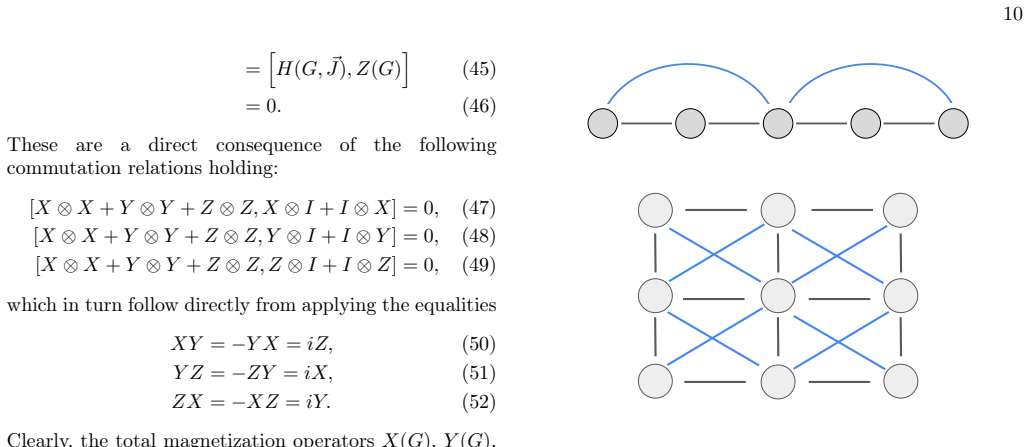
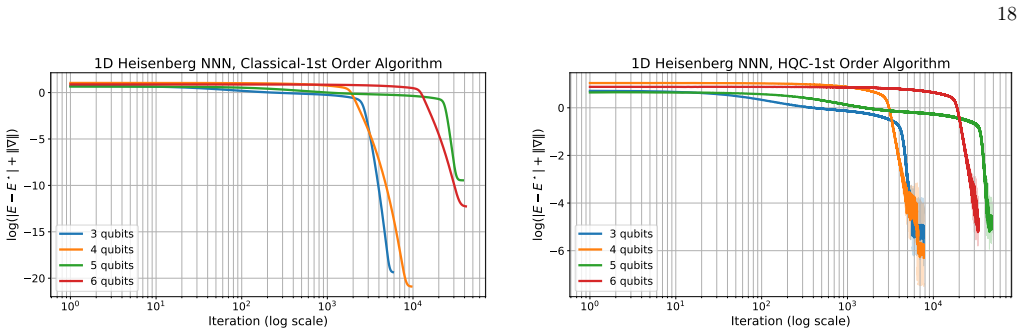
A quantum thermodynamic system is described by a Hamiltonian and a list of conserved, non-commuting charges, and a fundamental goal is to determine the minimum energy of the system subject to constraints on the charges. Recently, [Liu et al., arXiv:2505.04514] proposed first- and second-order classical and hybrid quantum-classical algorithms for solving a dual chemical potential maximization problem, and they proved that these algorithms converge to global optima by means of gradient-ascent approaches. In this paper, we benchmark these algorithms on several problems of interest in thermodynamics, including one- and two-dimensional quantum Heisenberg models with nearest- and next-nearest neighbor interactions and with the charges set to the total x, y, and z magnetizations. We also offer an alternative compelling interpretation of these algorithms as methods for designing ground and thermal states of controllable Hamiltonians, with potential applications in molecular and material design. Furthermore, we introduce stabilizer thermodynamic systems as thermodynamic systems based on stabilizer codes, with the Hamiltonian constructed from a given code's stabilizer operators and the charges constructed from the code's logical operators. We benchmark the aforementioned algorithms on several examples of stabilizer thermodynamic systems, including those constructed from the one-to-three-qubit repetition code, the perfect one-to-five-qubit code, and the two-to-four-qubit error-detecting code. Finally, we observe that the aforementioned hybrid quantum-classical algorithms, when applied to stabilizer thermodynamic systems, can serve as alternative methods for encoding quantum information into stabilizer codes at a fixed temperature, and we provide an effective method for warm-starting these encoding algorithms whenever a single qubit is encoded into multiple physical qubits.
Editorial analysis
A structured set of objections, weighed in public.
Referee Report
Summary. The manuscript benchmarks first- and second-order classical and hybrid quantum-classical algorithms (from Liu et al., arXiv:2505.04514) for constrained free-energy minimization on one- and two-dimensional Heisenberg models with magnetization charges. It introduces 'stabilizer thermodynamic systems' whose Hamiltonians are built from stabilizer generators and whose charges are built from logical operators, benchmarks the algorithms on repetition, perfect five-qubit, and two-to-four-qubit codes, and claims that the same optimization procedures constitute alternative methods for encoding quantum information into stabilizer codes at fixed temperature, together with a warm-starting technique when one logical qubit is encoded into multiple physical qubits.
Significance. If the encoding interpretation is substantiated, the work would establish a concrete link between constrained thermodynamic optimization and stabilizer-code encoding at finite temperature, potentially useful for warm-starting logical-state preparation. The benchmarks on standard Heisenberg models and small stabilizer codes supply practical performance data for the prior algorithms. The construction of stabilizer thermodynamic systems is a clear conceptual contribution that stands independently of the convergence proofs in the cited prior work.
major comments (2)
- [Abstract and stabilizer thermodynamic systems section] Abstract and the section defining stabilizer thermodynamic systems: the central claim that the hybrid algorithms 'can serve as alternative methods for encoding quantum information into stabilizer codes at a fixed temperature' is not supported by any post-optimization diagnostics. No stabilizer expectation values, code-space fidelity, or logical-operator error rates are reported to verify that the optimized thermal states concentrate support inside the code space rather than leaking into orthogonal subspaces. Because logical operators commute with stabilizers, the charge constraints alone do not guarantee this concentration; explicit verification is therefore load-bearing for the novel interpretation.
- [Benchmark sections] Benchmark sections on Heisenberg models and stabilizer codes: the manuscript states that benchmarks were performed but supplies no quantitative results, convergence plots, error bars, or comparison against known thermal-state properties. Without these data it is impossible to assess whether the algorithms reach the claimed global optima on the new instances or whether the stabilizer-system construction yields physically meaningful thermal states.
minor comments (2)
- The notation distinguishing the Hamiltonian constructed from stabilizers versus the charges constructed from logical operators should be introduced with explicit equations at first use to avoid ambiguity when the same symbols appear in both the Heisenberg and stabilizer sections.
- A brief comparison table summarizing runtimes or iteration counts across the classical, hybrid, and warm-start variants would improve readability of the benchmark results.
Simulated Author's Rebuttal
We thank the referee for their detailed and constructive report. We address each major comment below and have revised the manuscript to incorporate additional diagnostics and quantitative results where the concerns are valid.
read point-by-point responses
-
Referee: [Abstract and stabilizer thermodynamic systems section] Abstract and the section defining stabilizer thermodynamic systems: the central claim that the hybrid algorithms 'can serve as alternative methods for encoding quantum information into stabilizer codes at a fixed temperature' is not supported by any post-optimization diagnostics. No stabilizer expectation values, code-space fidelity, or logical-operator error rates are reported to verify that the optimized thermal states concentrate support inside the code space rather than leaking into orthogonal subspaces. Because logical operators commute with stabilizers, the charge constraints alone do not guarantee this concentration; explicit verification is therefore load-bearing for the novel interpretation.
Authors: We agree that explicit post-optimization verification is required to substantiate the encoding interpretation, as the commuting property of logical operators with stabilizers does not by itself guarantee concentration within the code space. In the revised manuscript we have added a dedicated subsection reporting the stabilizer expectation values, code-space fidelity, and logical-operator error rates for the optimized thermal states on the repetition code, five-qubit code, and two-to-four-qubit code. These diagnostics confirm that the states remain predominantly inside the code space (fidelities > 0.92 across the tested instances) and support the claim that the procedure provides an alternative route to fixed-temperature encoding. revision: yes
-
Referee: [Benchmark sections] Benchmark sections on Heisenberg models and stabilizer codes: the manuscript states that benchmarks were performed but supplies no quantitative results, convergence plots, error bars, or comparison against known thermal-state properties. Without these data it is impossible to assess whether the algorithms reach the claimed global optima on the new instances or whether the stabilizer-system construction yields physically meaningful thermal states.
Authors: We acknowledge that the original presentation of the benchmark results was insufficiently quantitative. The revised manuscript now includes explicit convergence plots with error bars (from 20 independent runs), tables of final free-energy values, and direct comparisons to exact thermal-state properties obtained by diagonalization for all systems small enough to permit it. For the larger Heisenberg instances we report the best achieved free energies together with the corresponding charge deviations, allowing assessment of proximity to the global optima. revision: yes
Circularity Check
Minor self-citation for convergence proof; new constructions and observations remain independent
specific steps
-
self citation load bearing
[Abstract]
"Recently, [Liu et al., arXiv:2505.04514] proposed first- and second-order classical and hybrid quantum-classical algorithms for solving a dual chemical potential maximization problem, and they proved that these algorithms converge to global optima by means of gradient-ascent approaches."
The global convergence guarantee that underpins all subsequent benchmarks and the encoding interpretation is taken from a prior paper whose author list overlaps with the present work; while the new stabilizer-system construction and encoding observation are independent, the reliability of the algorithmic results rests on this self-citation.
full rationale
The paper relies on Liu et al. (arXiv:2505.04514) only for the definition and convergence properties of the first- and second-order algorithms. All load-bearing novel elements—the construction of stabilizer thermodynamic systems (Hamiltonian from stabilizer generators, charges from logical operators), the benchmarks on repetition and perfect codes, the observation that the algorithms can encode information at fixed temperature, and the warm-starting technique—are self-contained additions that do not reduce to the cited inputs by definition, fitting, or renaming. The self-citation is therefore minor and non-load-bearing for the central claims.
Axiom & Free-Parameter Ledger
axioms (1)
- domain assumption The first- and second-order algorithms converge to global optima of the dual chemical-potential maximization problem
invented entities (1)
-
stabilizer thermodynamic systems
no independent evidence
Lean theorems connected to this paper
-
IndisputableMonolith/Cost/FunctionalEquation.leanwashburn_uniqueness_aczel echoes?
echoesECHOES: this paper passage has the same mathematical shape or conceptual pattern as the Recognition theorem, but is not a direct formal dependency.
parameterized thermal states ... are optimal for solving constrained free-energy minimization problems
What do these tags mean?
- matches
- The paper's claim is directly supported by a theorem in the formal canon.
- supports
- The theorem supports part of the paper's argument, but the paper may add assumptions or extra steps.
- extends
- The paper goes beyond the formal theorem; the theorem is a base layer rather than the whole result.
- uses
- The paper appears to rely on the theorem as machinery.
- contradicts
- The paper's claim conflicts with a theorem or certificate in the canon.
- unclear
- Pith found a possible connection, but the passage is too broad, indirect, or ambiguous to say the theorem truly supports the claim.
Reference graph
Works this paper leans on
-
[1]
P. W. Shor, Algorithms for quantum computation: Discrete logarithms and factoring, inProceedings of the 35th Annual Symposium on Foundations of Computer Science(IEEE Computer Society Press, Los Alamitos, California, 1994) pp. 124–134
work page 1994
-
[2]
L. K. Grover, A fast quantum mechanical algorithm for databasesearch,inProceedings of the 28th Annual ACM Symposium on the Theory of Computing (STOC)(1996) pp. 212–219, arXiv:quant-ph/9605043
work page internal anchor Pith review Pith/arXiv arXiv 1996
-
[3]
A. Abbas, A. Ambainis, B. Augustino, A. Bärtschi, H. Buhrman, C. Coffrin, G. Cortiana, V. Dunjko, D. J. Egger, B. G. Elmegreen, N. Franco, F. Fratini, B. Fuller, J. Gacon, C. Gonciulea, S. Gribling, S. Gupta, S. Hadfield, R. Heese, G. Kircher, T. Kleinert, T. Koch, G.Korpas, S.Lenk, J.Marecek, V.Markov, G.Mazzola, S. Mensa, N. Mohseni, G. Nannicini, C. O’...
work page 2024
-
[4]
F. G. S. L. Brandao and K. M. Svore, Quantum speed- ups for solving semidefinite programs, in2017 IEEE 58th Annual Symposium on Foundations of Computer Science (FOCS)(2017) pp. 415–426
work page 2017
-
[5]
J. van Apeldoorn and A. Gilyén, Improvements in Quantum SDP-Solving with Applications, in46th International Colloquium on Automata, Languages, and Programming (ICALP 2019), Leibniz International Proceedings in Informatics (LIPIcs), Vol. 132, edited by C. Baier, I. Chatzigiannakis, P. Flocchini, and S. Leonardi (Schloss Dagstuhl–Leibniz-Zentrum fuer Inform...
work page 2019
-
[6]
F. G. S. L. Brandão, A. Kalev, T. Li, C. Y.-Y. Lin, K. M. Svore, and X. Wu, Quantum SDP Solvers: Large Speed-Ups, Optimality, and Applications to Quantum Learning, in46th International Colloquium on Automata, Languages, and Programming (ICALP 2019), Leibniz International Proceedings in Informatics (LIPIcs), Vol. 132, edited by C. Baier, I. Chatzigiannakis...
work page 2019
-
[7]
J. van Apeldoorn, A. Gilyén, S. Gribling, and R. de Wolf, Quantum SDP-Solvers: Better upper and lower bounds, Quantum4, 230 (2020)
work page 2020
-
[8]
I. Kerenidis and A. Prakash, A quantum interior point method for LPs and SDPs, ACM Transactions on Quantum Computing1, 5 (2020)
work page 2020
- [9]
-
[10]
B. Augustino, G. Nannicini, T. Terlaky, and L. F. Zuluaga, Quantum interior point methods for semidefinite optimization, Quantum7, 1110 (2023)
work page 2023
- [11]
-
[12]
T.L.Patti, J.Kossaifi, A.Anandkumar,andS.F.Yelin, Quantum Goemans-Williamson algorithm with the Hadamard test and approximate amplitude constraints, Quantum7, 1057 (2023)
work page 2023
- [13]
-
[14]
H. Westerheim, J. Chen, Z. Holmes, I. Luo, T. Nuradha, D. Patel, S. Rethinasamy, K. Wang, and M. M. Wilde, Dual-VQE: A quantum algorithm to lower bound the ground-state energy (2023), arXiv:2312.03083 [quant- ph]
- [15]
- [16]
- [17]
-
[18]
E. H. Lieb,The Stability of Matter: From Atoms to Stars(Springer, Springer Berlin, Heidelberg, 2005)
work page 2005
-
[19]
M. O. Steinhauser and S. Hiermaier, A review of computational methods in materials science: Examples from shock-wave and polymer physics, International Journal of Molecular Sciences10, 5135 (2009)
work page 2009
-
[20]
M. A. Continentino,Key Methods and Concepts in Condensed Matter Physics, 2053-2563 (IOP Publishing, 2021)
work page 2053
-
[21]
P. Deglmann, A. Schäfer, and C. Lennartz, Application of quantum calculations in the chemical industry—an overview, International Journal of Quantum Chemistry 115, 107 (2015)
work page 2015
-
[22]
N. Yunger Halpern, P. Faist, J. Oppenheim, and A. Winter, Microcanonical and resource-theoretic derivations of the thermal state of a quantum system with noncommuting charges, Nature Communications 7, 12051 (2016)
work page 2016
-
[23]
N. Yunger Halpern, M. E. Beverland, and A. Kalev, Noncommuting conserved charges in quantum many- body thermalization, Physical Review E101, 042117 (2020)
work page 2020
- [24]
-
[25]
M. H. Amin, E. Andriyash, J. Rolfe, B. Kulchytskyy, and R. Melko, Quantum Boltzmann machine, Physical Review X8, 021050 (2018)
work page 2018
-
[26]
M. Benedetti, J. Realpe-Gómez, R. Biswas, and A. Perdomo-Ortiz, Quantum-assisted learning of hardware-embedded probabilistic graphical models, Physical Review X7, 041052 (2017)
work page 2017
-
[27]
M.KieferováandN.Wiebe,Tomographyandgenerative training with quantum Boltzmann machines, Physical Review A96, 062327 (2017)
work page 2017
-
[28]
S. Bubeck, Convex optimization: Algorithms and complexity, Foundations and Trends in Machine Learning8, 231 (2015)
work page 2015
- [29]
- [30]
-
[31]
J. Rajakumar and J. D. Watson, Gibbs sampling gives quantum advantage at constant temperatures with O(1)-local Hamiltonians (2024), arXiv:2408.01516 [quant-ph]
-
[32]
T. Bergamaschi, C.-F. Chen, and Y. Liu, Quantum computational advantage with constant-temperature Gibbs sampling (2024), arXiv:2404.14639 [quant-ph]
-
[33]
H. Chen, B. Li, J. Lu, and L. Ying, A randomized method for simulating Lindblad equations and thermal state preparation (2024)
work page 2024
-
[34]
Efficient thermalization and universal quantum computing with quantum Gibbs samplers
C. Rouzé, D. S. Franca, and Álvaro M. Alhambra, Efficient thermalization and universal quantum computing with quantum Gibbs samplers (2024), arXiv:2403.12691 [quant-ph]
work page internal anchor Pith review Pith/arXiv arXiv 2024
- [35]
- [36]
-
[37]
Quantum Heisenberg models and their probabilistic representations
C. Goldschmidt, D. Ueltschi, and P. Windridge, Entropy and the quantum II, Contemporary Mathematics (2011) Chap. Quantum Heisenberg models and their probabilistic representations, pp. 177–224, arXiv:1104.0983 [math-ph]
work page internal anchor Pith review Pith/arXiv arXiv 2011
-
[38]
D. C. Mattis,The Theory of Magnetism Made Simple (World Scientific, 2006)
work page 2006
-
[39]
An Introduction to Quantum Error Correction and Fault-Tolerant Quantum Computation
D. Gottesman, An introduction to quantum error correction and fault-tolerant quantum computation (2009), arXiv:0904.2557 [quant-ph]
work page internal anchor Pith review Pith/arXiv arXiv 2009
-
[40]
S. J. Devitt, W. J. Munro, and K. Nemoto, Quantum error correction for beginners, Reports on Progress in Physics76, 076001 (2013)
work page 2013
-
[41]
D. A. Lidar and T. A. Brun, eds.,Quantum Error Correction(Cambridge University Press, 2013)
work page 2013
-
[42]
Roffe, Quantum error correction: an introductory guide, Contemporary Physics60, 226–245 (2019)
J. Roffe, Quantum error correction: an introductory guide, Contemporary Physics60, 226–245 (2019)
work page 2019
- [43]
-
[44]
D. Gottesman, Class of quantum error-correcting codes saturating the quantum Hamming bound, Physical Review A54, 1862 (1996)
work page 1996
-
[45]
A. R. Calderbank, E. M. Rains, P. W. Shor, and N. J. A. Sloane, Quantum error correction and orthogonal geometry, Physical Review Letters78, 405 (1997)
work page 1997
- [46]
-
[47]
D. M. Bacon,Decoherence, control, and symmetry in quantum computers, Ph.D. thesis, University of California, Berkeley (2001), arXiv:quant-ph/0305025 [quant-ph]
work page internal anchor Pith review Pith/arXiv arXiv 2001
- [48]
-
[49]
S. P. Jordan, E. Farhi, and P. W. Shor, Error-correcting codes for adiabatic quantum computation, Physical ReviewA74, 052322 (2006)
work page 2006
-
[50]
Bacon, Stability of quantum concatenated-code Hamiltonians, Physical Review A78, 042324 (2008)
D. Bacon, Stability of quantum concatenated-code Hamiltonians, Physical Review A78, 042324 (2008)
work page 2008
-
[51]
B. Yoshida, Classification of quantum phases and topology of logical operators in an exactly solved model of quantum codes, Annals of Physics326, 15 (2011)
work page 2011
-
[52]
K. C. Young, M. Sarovar, J. Aytac, C. M. Herdman, and K. B. Whaley, Finite temperature quantum simulation of stabilizer Hamiltonians, Journal of Physics B: Atomic, Molecular and Optical Physics45, 154012 (2012)
work page 2012
-
[53]
How fast do stabilizer Hamiltonians thermalize?
K. Temme and M. J. Kastoryano, How fast do stabilizer Hamiltonians thermalize? (2015), arXiv:1505.07811 [quant-ph]
work page internal anchor Pith review Pith/arXiv arXiv 2015
-
[54]
K. Temme, Thermalization time bounds for Pauli stabilizer Hamiltonians, Communications in Mathematical Physics350, 603 (2017)
work page 2017
-
[55]
Z. Weinstein, G. Ortiz, and Z. Nussinov, Universality classes of stabilizer code Hamiltonians, Physical Review Letters123, 230503 (2019)
work page 2019
-
[56]
Stabilizer Codes and Quantum Error Correction
D. Gottesman,Stabilizer Codes and Quantum Error Correction, Ph.D. thesis, California Institute of Technology(1997),arXiv:quant-ph/9705052[quant-ph]
work page internal anchor Pith review Pith/arXiv arXiv 1997
-
[57]
M. M. Wilde,Quantum Coding with Entanglement, Ph.D. thesis, University of Southern California (2008), arXiv:0806.4214 [quant-ph]
work page internal anchor Pith review Pith/arXiv arXiv 2008
-
[58]
Peres, Reversible logic and quantum computers, Physical Review A32, 3266 (1985)
A. Peres, Reversible logic and quantum computers, Physical Review A32, 3266 (1985)
work page 1985
-
[59]
R. Laflamme, C. Miquel, J. P. Paz, and W. H. Zurek, Perfect quantum error correcting code, Physical Review Letters77, 198 (1996)
work page 1996
-
[60]
C. H. Bennett, D. P. DiVincenzo, J. A. Smolin, and W. K. Wootters, Mixed-state entanglement and quantum error correction, Physical Review A54, 3824 (1996)
work page 1996
-
[61]
L. Vaidman, L. Goldenberg, and S. Wiesner, Error prevention scheme with four particles, Physical Review A54, R1745 (1996)
work page 1996
- [62]
-
[63]
S. Boyd and L. Vandenberghe,Convex Optimization (Cambridge University Press, 2004)
work page 2004
-
[64]
F. Alizadeh, J.-P. A. Haeberly, and M. L. Overton, Primal-dual interior-point methods for semidefinite programming: Convergence rates, stability and numerical results, SIAM Journal on Optimization8, 746 (1998)
work page 1998
-
[65]
M. J. Todd, K. C. Toh, and R. H. Tütüncü, On the Nesterov–Todd direction in semidefinite programming, 23 SIAM Journal on Optimization8, 769 (1998)
work page 1998
- [66]
-
[67]
A. M. Alhambra and J. I. Cirac, Locally accurate tensor networks for thermal states and time evolution, PRX Quantum2, 040331 (2021)
work page 2021
-
[68]
S. Lu, G. Giudice, and J. I. Cirac, Variational neural and tensor network approximations of thermal states, Physical Review B111, 075102 (2025)
work page 2025
-
[69]
D. Cocchiarella and M. C. Banuls, Low-temperature Gibbs states with tensor networks (2025), arXiv:2501.08300 [quant-ph]
-
[70]
Z. Cai, R. Babbush, S. C. Benjamin, S. Endo, W. J. Huggins, Y. Li, J. R. McClean, and T. E. O’Brien, Quantum error mitigation, Reviews of Modern Physics 95, 045005 (2023)
work page 2023
-
[71]
A. Javadi-Abhari, M. Treinish, K. Krsulich, C. J. Wood, J. Lishman, J. Gacon, S. Martiel, P. D. Nation, L. S. Bishop, A. W. Cross, B. R. Johnson, and J. M. Gambetta, Quantum computing with Qiskit (2024), arXiv:2405.08810 [quant-ph]
work page internal anchor Pith review Pith/arXiv arXiv 2024
-
[72]
Y. Guryanova, S. Popescu, A. J. Short, R. Silva, and P. Skrzypczyk, Thermodynamics of quantum systems with multiple conserved quantities, Nature Communications7, 12049 (2016)
work page 2016
-
[73]
M. Lostaglio, D. Jennings, and T. Rudolph, Thermodynamic resource theories, non-commutativity and maximum entropy principles, New Journal of Physics19, 043008 (2017)
work page 2017
- [74]
- [75]
-
[76]
Let us note that the dimension of the system we are considering here isd n, instead ofdas considered previously in [16]
-
[77]
G. Garrigos and R. M. Gower, Handbook of convergence theorems for (stochastic) gradient methods (2024), arXiv:2301.11235 [math.OC]
-
[78]
C. R. Harris, K. J. Millman, S. J. van der Walt, R. Gommers, P. Virtanen, D. Cournapeau, E. Wieser, J. Taylor, S. Berg, N. J. Smith, R. Kern, M. Picus, S. Hoyer, M. H. van Kerkwijk, M. Brett, A. Haldane, J. F. del Río, M. Wiebe, P. Peterson, P. Gérard- Marchant, K. Sheppard, T. Reddy, W. Weckesser, H. Abbasi, C. Gohlke, and T. E. Oliphant, Array programmi...
work page 2020
-
[79]
B. T. Polyak, Some methods of speeding up the convergence of iteration methods, USSR Computational Mathematics and Mathematical Physics4, 1 (1964)
work page 1964
-
[80]
D.P.KingmaandJ.Ba,Adam: Amethodforstochastic optimization (2017), arXiv:1412.6980 [cs.LG]
work page internal anchor Pith review Pith/arXiv arXiv 2017
discussion (0)
Sign in with ORCID, Apple, or X to comment. Anyone can read and Pith papers without signing in.