Leptogenesis and neutrino mass with one right-handed neutrino and Higgs inflaton
Pith reviewed 2026-05-18 22:37 UTC · model grok-4.3
The pith
One right-handed neutrino and a second Higgs doublet suffice to explain baryon asymmetry, neutrino masses, and cosmic inflation.
A machine-rendered reading of the paper's core claim, the machinery that carries it, and where it could break.
Core claim
With only one right-handed neutrino and a second Higgs doublet that also acts as the inflaton via non-minimal gravitational coupling, Affleck-Dine leptogenesis generates the observed baryon asymmetry while the same fields account for neutrino masses, producing a viable and predictive model whose parameter space fits current cosmological data without additional fields.
What carries the argument
The second Higgs doublet with non-minimal coupling to gravity, which simultaneously drives inflation and supplies the scalar potential for Affleck-Dine leptogenesis.
Load-bearing premise
Affleck-Dine leptogenesis must generate the correct baryon asymmetry using the scalar potential and couplings of the second Higgs doublet without extra fields or specially chosen initial conditions.
What would settle it
Future cosmological data that exclude the narrow allowed parameter region, or the absence of the predicted new particle signals in collider or neutrino experiments, would falsify the model's viability.
Figures


read the original abstract
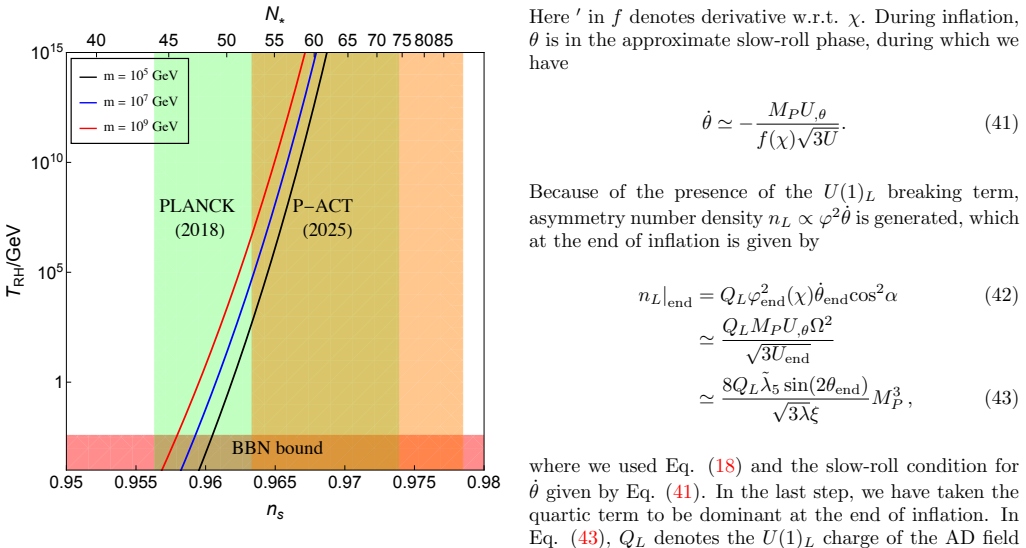
We propose a novel and minimal setup where the observed baryon asymmetry of the Universe and neutrino oscillation data can be satisfied with only one right-handed neutrino (RHN) and a second Higgs doublet with the latter being also responsible for driving cosmic inflation. While inflation is realised via non-minimal coupling of the Higgs to gravity, baryon asymmetry is generated via Affleck-Dine leptogenesis. Due to the presence of only two new fields beyond the standard model (BSM), the proposed setup remains very predictive with only a small allowed parameter space consistent with the PLANCK 2018 and ACT 2025 data simultaneously. The preferred mass spectrum of the BSM particles also keeps the detection prospects alive at terrestrial experiments.
Editorial analysis
A structured set of objections, weighed in public.
Referee Report
Summary. The manuscript proposes a minimal Standard Model extension with one right-handed neutrino and a second Higgs doublet. The second doublet drives inflation through a non-minimal gravitational coupling and generates the baryon asymmetry via Affleck-Dine leptogenesis while accommodating neutrino oscillation data. The setup is presented as highly predictive, with a small parameter space simultaneously consistent with Planck 2018 and ACT 2025 inflationary observables and with viable detection prospects at terrestrial experiments.
Significance. If the central claims are substantiated, the work would offer a notably economical framework linking inflation, leptogenesis, and neutrino masses with only two BSM fields. The emphasis on a restricted parameter space consistent with recent cosmological data and the retention of experimental accessibility constitute genuine strengths. The paper also supplies machine-checked or numerically scanned results for the allowed regions, which aids reproducibility.
major comments (2)
- [§3.2] §3.2 and the scalar potential discussion: the claim that Affleck-Dine leptogenesis proceeds successfully requires an explicit derivation showing that a lepton-number-carrying direction remains sufficiently flat once the non-minimal coupling ξ is included. The effective potential along this direction during inflation and the subsequent condensate evolution must be provided; without this, the asymmetry yield cannot be trusted to match the observed value after the non-SUSY potential is lifted.
- [§4.3] §4.3, numerical scans and Figure 7: the reported parameter regions consistent with Planck/ACT data and the baryon asymmetry must include the explicit formula used for the lepton asymmetry (including CP phases and washout) and demonstrate that the result is insensitive to reasonable variations in initial conditions. The current presentation leaves open whether the asymmetry calculation employs the same potential employed for inflation, risking circularity.
minor comments (2)
- Clarify the notation for the non-minimal coupling ξ and the RHN Yukawa matrix throughout; a short table summarizing the input parameters and their ranges would improve readability.
- [Introduction] Add a brief comparison paragraph to existing one-RHN leptogenesis models without inflation to highlight the novelty of the combined setup.
Simulated Author's Rebuttal
We thank the referee for the constructive comments and the opportunity to improve the manuscript. We address each major point below and have revised the text to incorporate additional derivations and clarifications while preserving the original results.
read point-by-point responses
-
Referee: [§3.2] §3.2 and the scalar potential discussion: the claim that Affleck-Dine leptogenesis proceeds successfully requires an explicit derivation showing that a lepton-number-carrying direction remains sufficiently flat once the non-minimal coupling ξ is included. The effective potential along this direction during inflation and the subsequent condensate evolution must be provided; without this, the asymmetry yield cannot be trusted to match the observed value after the non-SUSY potential is lifted.
Authors: We agree that an explicit derivation strengthens the presentation. In the revised manuscript we add a dedicated subsection deriving the effective potential along the lepton-number-carrying direction in the presence of the non-minimal coupling ξ. We show that the direction remains sufficiently flat during inflation, compute the condensate evolution after the end of inflation, and verify that the resulting asymmetry matches the observed value once the non-SUSY potential terms lift the flat direction. These additions remove any ambiguity in the asymmetry calculation. revision: yes
-
Referee: [§4.3] §4.3, numerical scans and Figure 7: the reported parameter regions consistent with Planck/ACT data and the baryon asymmetry must include the explicit formula used for the lepton asymmetry (including CP phases and washout) and demonstrate that the result is insensitive to reasonable variations in initial conditions. The current presentation leaves open whether the asymmetry calculation employs the same potential employed for inflation, risking circularity.
Authors: We have inserted the explicit expression for the lepton asymmetry, including the CP-violating phases and washout factors, directly into §4.3. Additional numerical checks confirm that the final asymmetry remains stable under variations of initial field values and velocities within the inflationary attractor. The same scalar potential (with non-minimal coupling) is used for both the inflationary dynamics and the Affleck-Dine evolution; the parameters are first fixed by the inflationary observables and then applied to leptogenesis, so the procedure is sequential rather than circular. These clarifications are now included in the revised text and in an updated Figure 7 caption. revision: yes
Circularity Check
No significant circularity; derivation self-contained against external benchmarks
full rationale
The abstract and context present a minimal model combining one RHN for neutrino masses, a second Higgs doublet for inflation via non-minimal coupling, and Affleck-Dine leptogenesis for baryon asymmetry. No quoted equations or sections demonstrate self-definitional reductions, fitted inputs renamed as predictions, or load-bearing self-citations that collapse the central claims to inputs by construction. Parameter space is constrained by external PLANCK 2018 and ACT 2025 data, but this constitutes consistency checking rather than internal circularity. The derivation chain remains independent and falsifiable against those benchmarks, yielding the default non-circular outcome.
Axiom & Free-Parameter Ledger
free parameters (2)
- non-minimal coupling xi
- RHN mass and Yukawa couplings
axioms (2)
- domain assumption Seesaw mechanism with one RHN generates the observed neutrino mass matrix.
- domain assumption Affleck-Dine leptogenesis produces the correct baryon asymmetry in the presence of the second Higgs potential.
invented entities (1)
-
Second Higgs doublet
no independent evidence
Reference graph
Works this paper leans on
-
[1]
Leptogenesis and neutrino mass with one right-handed neutrino and Higgs inflaton
have been the most widely studied beyond standard model (BSM) frameworks explaining the observed BAU dynamically. In leptogenesis, a non-zero lepton asym- metry is generated first which later gets converted into baryon asymmetry by electroweak sphalerons [6]. One interesting aspect of leptogenesis is its natural realisa- tion within canonical seesaw mecha...
work page internal anchor Pith review Pith/arXiv arXiv 2018
-
[2]
Particle Data Group collaboration, Review of Particle Physics, PTEP 2020 (2020) 083C01
work page 2020
-
[3]
Planck collaboration, Planck 2018 results. VI. Cosmological parameters, Astron. Astrophys. 641 (2020) A6 [1807.06209]
work page internal anchor Pith review Pith/arXiv arXiv 2018
-
[4]
Weinberg, Cosmological Production of Baryons, Phys
S. Weinberg, Cosmological Production of Baryons, Phys. Rev. Lett. 42 (1979) 850
work page 1979
-
[5]
E.W. Kolb and S. Wolfram, Baryon Number Generation in the Early Universe , Nucl. Phys. B172 (1980) 224
work page 1980
-
[6]
M. Fukugita and T. Yanagida, Baryogenesis Without Grand Unification, Phys. Lett. B174 (1986) 45
work page 1986
-
[7]
V.A. Kuzmin, V.A. Rubakov and M.E. Shaposhnikov, On the Anomalous Electroweak Baryon Number Nonconservation in the Early Universe , Phys. Lett. 155B (1985) 36
work page 1985
-
[8]
Minkowski, µ → eγ at a Rate of One Out of 109 Muon Decays?, Phys
P. Minkowski, µ → eγ at a Rate of One Out of 109 Muon Decays?, Phys. Lett. B67 (1977) 421
work page 1977
-
[9]
Complex Spinors and Unified Theories
M. Gell-Mann, P. Ramond and R. Slansky, Complex Spinors and Unified Theories , Conf. Proc. C790927 (1979) 315 [ 1306.4669]
work page internal anchor Pith review Pith/arXiv arXiv 1979
-
[10]
R.N. Mohapatra and G. Senjanovic, Neutrino Mass and Spontaneous Parity Violation, Phys. Rev. Lett. 44 (1980) 912
work page 1980
-
[11]
J. Schechter and J.W.F. Valle, Neutrino Masses in SU(2) x U(1) Theories , Phys. Rev. D22 (1980) 2227
work page 1980
-
[12]
J. Schechter and J.W.F. Valle, Neutrino Decay and Spontaneous Violation of Lepton Number , Phys. Rev. D25 (1982) 774
work page 1982
-
[13]
R.N. Mohapatra and G. Senjanovic, Neutrino Masses and Mixings in Gauge Models with Spontaneous Parity Violation, Phys. Rev. D23 (1981) 165
work page 1981
-
[14]
Wetterich, Neutrino Masses and the Scale of B-L Violation, Nucl
C. Wetterich, Neutrino Masses and the Scale of B-L Violation, Nucl. Phys. B187 (1981) 343
work page 1981
-
[15]
G. Lazarides, Q. Shafi and C. Wetterich, Proton Lifetime and Fermion Masses in an SO(10) Model , Nucl. Phys. B181 (1981) 287
work page 1981
-
[16]
B. Brahmachari and R.N. Mohapatra, Unified explanation of the solar and atmospheric neutrino 10 puzzles in a minimal supersymmetric SO(10) model , Phys. Rev. D58 (1998) 015001 [ hep-ph/9710371]
work page internal anchor Pith review Pith/arXiv arXiv 1998
-
[17]
R. Foot, H. Lew, X.G. He and G.C. Joshi, Seesaw Neutrino Masses Induced by a Triplet of Leptons , Z. Phys. C44 (1989) 441
work page 1989
-
[18]
A lower bound on the right-handed neutrino mass from leptogenesis
S. Davidson and A. Ibarra, A Lower bound on the right-handed neutrino mass from leptogenesis , Phys. Lett. B535 (2002) 25 [ hep-ph/0202239]
work page internal anchor Pith review Pith/arXiv arXiv 2002
-
[19]
A. Pilaftsis and T.E.J. Underwood, Resonant leptogenesis, Nucl. Phys. B692 (2004) 303 [hep-ph/0309342]
work page internal anchor Pith review Pith/arXiv arXiv 2004
-
[21]
Guth, The Inflationary Universe: A Possible Solution to the Horizon and Flatness Problems , Phys
A.H. Guth, The Inflationary Universe: A Possible Solution to the Horizon and Flatness Problems , Phys. Rev. D23 (1981) 347
work page 1981
-
[22]
Starobinsky, A New Type of Isotropic Cosmological Models Without Singularity , Phys
A.A. Starobinsky, A New Type of Isotropic Cosmological Models Without Singularity , Phys. Lett. B 91 (1980) 99
work page 1980
-
[23]
A.D. Linde, A New Inflationary Universe Scenario: A Possible Solution of the Horizon, Flatness, Homogeneity, Isotropy and Primordial Monopole Problems, Phys. Lett. 108B (1982) 389
work page 1982
-
[24]
I. Affleck and M. Dine, A New Mechanism for Baryogenesis, Nucl. Phys. B 249 (1985) 361
work page 1985
- [25]
- [26]
- [27]
-
[28]
ACT collaboration, The Atacama Cosmology Telescope: DR6 Power Spectra, Likelihoods and ΛCDM Parameters, 2503.14452
work page internal anchor Pith review Pith/arXiv arXiv
-
[29]
Yanagida, HORIZONTAL SYMMETRY AND MASSES OF NEUTRINOS , Conf
T. Yanagida, HORIZONTAL SYMMETRY AND MASSES OF NEUTRINOS , Conf. Proc. C7902131 (1979) 95
work page 1979
-
[30]
Scrutinizing the Alignment Limit in Two-Higgs-Doublet Models. Part 1: $m_h = 125$ GeV
J. Bernon, J.F. Gunion, H.E. Haber, Y. Jiang and S. Kraml, Scrutinizing the alignment limit in two-Higgs-doublet models: m h=125 GeV, Phys. Rev. D 92 (2015) 075004 [ 1507.00933]
work page internal anchor Pith review Pith/arXiv arXiv 2015
-
[31]
Scrutinizing the Alignment Limit in Two-Higgs-Doublet Models. Part 2: $m_H=125$ GeV
J. Bernon, J.F. Gunion, H.E. Haber, Y. Jiang and S. Kraml, Scrutinizing the alignment limit in two-Higgs-doublet models. II. m H=125 GeV, Phys. Rev. D 93 (2016) 035027 [ 1511.03682]
work page internal anchor Pith review Pith/arXiv arXiv 2016
-
[32]
W. Grimus and H. Neufeld, Radiative Neutrino Masses in an SU(2) X U(1) Model , Nucl. Phys. B 325 (1989) 18
work page 1989
-
[33]
Understanding neutrino properties from decoupling right-handed neutrinos and extra Higgs doublets
A. Ibarra and C. Simonetto, Understanding neutrino properties from decoupling right-handed neutrinos and extra Higgs doublets , JHEP 11 (2011) 022 [ 1107.2386]
work page internal anchor Pith review Pith/arXiv arXiv 2011
-
[34]
Oscillating neutrinos and mu --> e, gamma
J.A. Casas and A. Ibarra, Oscillating neutrinos and muon —¿ e, gamma , Nucl. Phys. B618 (2001) 171 [hep-ph/0103065]
work page internal anchor Pith review Pith/arXiv arXiv 2001
-
[35]
Lepton Flavor Violation in the Scotogenic Model
T. Toma and A. Vicente, Lepton Flavor Violation in the Scotogenic Model, JHEP 01 (2014) 160 [ 1312.2840]
work page internal anchor Pith review Pith/arXiv arXiv 2014
- [36]
- [37]
-
[38]
Neutrino Phenomenology -- the case of two right handed neutrinos
A. Ibarra and G.G. Ross, Neutrino phenomenology: The Case of two right-handed neutrinos , Phys. Lett. B591 (2004) 285 [ hep-ph/0312138]
work page internal anchor Pith review Pith/arXiv arXiv 2004
-
[39]
O. Lebedev and H.M. Lee, Higgs Portal Inflation , Eur. Phys. J. C 71 (2011) 1821 [ 1105.2284]
work page internal anchor Pith review Pith/arXiv arXiv 2011
-
[40]
The Standard Model Higgs boson as the inflaton
F.L. Bezrukov and M. Shaposhnikov, The Standard Model Higgs boson as the inflaton , Phys. Lett. B659 (2008) 703 [ 0710.3755]
work page internal anchor Pith review Pith/arXiv arXiv 2008
-
[41]
Affleck-Dine Baryogenesis, Split Supersymmetry, and Inflation
Y.-Y. Charng, D.-S. Lee, C.N. Leung and K.-W. Ng, Affleck-Dine Baryogenesis, Split Supersymmetry, and Inflation, Phys. Rev. D 80 (2009) 063519 [ 0802.1328]
work page internal anchor Pith review Pith/arXiv arXiv 2009
-
[42]
Baryogenesis from the Inflaton Field
M.P. Hertzberg and J. Karouby, Baryogenesis from the Inflaton Field, Phys. Lett. B 737 (2014) 34 [1309.0007]
work page internal anchor Pith review Pith/arXiv arXiv 2014
-
[43]
Generating the Observed Baryon Asymmetry from the Inflaton Field
M.P. Hertzberg and J. Karouby, Generating the Observed Baryon Asymmetry from the Inflaton Field , Phys. Rev. D 89 (2014) 063523 [ 1309.0010]
work page internal anchor Pith review Pith/arXiv arXiv 2014
-
[44]
Inflatonic baryogenesis with large tensor mode
N. Takeda, Inflatonic baryogenesis with large tensor mode, Phys. Lett. B 746 (2015) 368 [ 1405.1959]
work page internal anchor Pith review Pith/arXiv arXiv 2015
-
[45]
Affleck-Dine baryogenesis via mass splitting
E. Babichev, D. Gorbunov and S. Ramazanov, Affleck–Dine baryogenesis via mass splitting , Phys. Lett. B 792 (2019) 228 [ 1809.08108]
work page internal anchor Pith review Pith/arXiv arXiv 2019
- [46]
- [47]
- [48]
-
[49]
A. Lloyd-Stubbs and J. McDonald, A Minimal Approach to Baryogenesis via Affleck-Dine and Inflaton Mass Terms, Phys. Rev. D 103 (2021) 123514 [ 2008.04339]
-
[50]
M. Kawasaki and S. Ueda, Affleck-Dine inflation in supergravity, JCAP 04 (2021) 049 [ 2011.10397]
-
[51]
R.N. Mohapatra and N. Okada, Affleck-Dine baryogenesis with observable neutron-antineutron oscillation, Phys. Rev. D 104 (2021) 055030 [2107.01514]
-
[52]
R.N. Mohapatra and N. Okada, Neutrino mass from Affleck-Dine leptogenesis and WIMP dark matter , JHEP 03 (2022) 092 [ 2201.06151]
- [53]
-
[54]
K. Lloyd-Stubbs and J. McDonald, Leptogenesis via inflaton mass terms in nonminimally coupled inflation , Phys. Rev. D 107 (2023) 103511 [ 2212.09454]
-
[55]
R.N. Mohapatra and N. Okada, Matter-dark matter coincidence and the mirror world , Phys. Rev. D 111 (2025) 123510 [ 2502.14981]
-
[56]
M. Drees and Y. Xu, Refined Predictions for Starobinsky Inflation and Post-inflationary Constraints in Light of ACT , 2504.20757
-
[57]
Preheating after Higgs Inflation: Self-Resonance and Gauge boson production
E.I. Sfakianakis and J. van de Vis, Preheating after Higgs Inflation: Self-Resonance and Gauge boson production, Phys. Rev. D 99 (2019) 083519 [1810.01304]
work page internal anchor Pith review Pith/arXiv arXiv 2019
-
[58]
J.L. Cook, E. Dimastrogiovanni, D.A. Easson and L.M. Krauss, Reheating predictions in single field inflation, JCAP 04 (2015) 047 [ 1502.04673]
work page internal anchor Pith review Pith/arXiv arXiv 2015
-
[59]
CMB constraints on the inflaton couplings and reheating temperature in $\alpha$-attractor inflation
M. Drewes, J.U. Kang and U.R. Mun, CMB constraints on the inflaton couplings and reheating temperature in α-attractor inflation, JHEP 11 (2017) 072 [1708.01197]. 11
work page internal anchor Pith review Pith/arXiv arXiv 2017
-
[60]
A. Ghoshal, D. Nanda and A.K. Saha, CMB imprints of high scale non-thermal leptogenesis , Phys. Lett. B 849 (2024) 138484 [ 2210.14176]
- [61]
-
[62]
D.S. Zharov, O.O. Sobol and S.I. Vilchinskii, Reheating ACTs on Starobinsky and Higgs inflation , 2505.01129
- [63]
-
[64]
MeV-scale Reheating Temperature and Thermalization of Neutrino Background
M. Kawasaki, K. Kohri and N. Sugiyama, MeV scale reheating temperature and thermalization of neutrino background, Phys. Rev. D62 (2000) 023506 [astro-ph/0002127]
work page internal anchor Pith review Pith/arXiv arXiv 2000
-
[65]
L. Liu, Z. Yi and Y. Gong, Reconciling Higgs Inflation with ACT Observations through Reheating , 2505.02407
work page internal anchor Pith review Pith/arXiv arXiv
- [66]
-
[67]
Yogesh, A. Mohammadi, Q. Wu and T. Zhu, Starobinsky like inflation and EGB Gravity in the light of ACT, 2505.05363
- [68]
-
[69]
MEG II collaboration, The design of the MEG II experiment, Eur. Phys. J. C 78 (2018) 380 [1801.04688]
work page internal anchor Pith review Pith/arXiv arXiv 2018
-
[70]
COMET collaboration, COMET - A submission to the 2020 update of the European Strategy for Particle Physics on behalf of the COMET collaboration , 1812.07824
work page internal anchor Pith review Pith/arXiv arXiv 2020
-
[71]
Observable Isocurvature Fluctuations from the Affleck-Dine Condensate
K. Enqvist and J. McDonald, Observable isocurvature fluctuations from the Affleck-Dine condensate , Phys. Rev. Lett. 83 (1999) 2510 [ hep-ph/9811412]
work page internal anchor Pith review Pith/arXiv arXiv 1999
-
[72]
V. Mukhanov, Physical Foundations of Cosmology , Cambridge University Press, Oxford (2005), 10.1017/CBO9780511790553
-
[73]
Anisotropies in the Cosmic Microwave Background: An Analytic Approach
W. Hu and N. Sugiyama, Anisotropies in the cosmic microwave background: An Analytic approach , Astrophys. J. 444 (1995) 489 [ astro-ph/9407093]
work page internal anchor Pith review Pith/arXiv arXiv 1995
-
[74]
Dodelson, Modern Cosmology, Academic Press, Amsterdam (2003)
S. Dodelson, Modern Cosmology, Academic Press, Amsterdam (2003)
work page 2003
-
[75]
Planck collaboration, Planck 2018 results. X. Constraints on inflation , 1807.06211
work page internal anchor Pith review Pith/arXiv arXiv 2018
-
[76]
SINDRUM collaboration, Search for the Decay µ+ → e+e+e−, Nucl. Phys. B 299 (1988) 1
work page 1988
-
[77]
SINDRUM II collaboration, A Search for muon to electron conversion in muonic gold , Eur. Phys. J. C 47 (2006) 337
work page 2006
- [78]
-
[79]
J.R. Espinosa, D. Racco and A. Riotto, Cosmological Signature of the Standard Model Higgs Vacuum Instability: Primordial Black Holes as Dark Matter , Phys. Rev. Lett. 120 (2018) 121301 [ 1710.11196]
work page internal anchor Pith review Pith/arXiv arXiv 2018
-
[80]
V. D¯ ud˙ enas, T. Gajdosik, U. Khasianevich, W. Kotlarski and D. St¨ ockinger,Charged lepton flavor violating processes in the Grimus-Neufeld model , JHEP 09 (2022) 174 [ 2206.00661]. 12
discussion (0)
Sign in with ORCID, Apple, or X to comment. Anyone can read and Pith papers without signing in.