Foundational Design Principles and Patterns for Building Robust and Adaptive GenAI-Native Systems
Pith reviewed 2026-05-18 22:07 UTC · model grok-4.3
The pith
GenAI systems achieve robustness by merging their capabilities with classic software engineering principles.
A machine-rendered reading of the paper's core claim, the machinery that carries it, and where it could break.
Core claim
Future GenAI-native systems should integrate GenAI's cognitive capabilities with traditional software engineering principles to create robust, adaptive, and efficient systems. Foundational design principles are organized around five key pillars—reliability, excellence, evolvability, self-reliance, and assurance—while architectural patterns such as GenAI-native cells, organic substrates, and programmable routers provide the structure for resilient, self-evolving behavior. The paper also outlines the main ingredients of a GenAI-native software stack and examines impacts across technical, user, economic, and legal dimensions.
What carries the argument
Five pillars (reliability, excellence, evolvability, self-reliance, assurance) together with the architectural patterns of GenAI-native cells, organic substrates, and programmable routers that together embed AI capabilities inside disciplined, modular engineering structures.
If this is right
- Systems maintain reliable output even when underlying AI models behave inconsistently.
- Self-reliance mechanisms reduce the need for constant human oversight and retraining.
- Evolvability allows the system to incorporate new capabilities without full redesign.
- Assurance layers make safety and compliance easier to demonstrate and audit.
- Overall efficiency improves because internal routing and substrates minimize wasted computation.
Where Pith is reading between the lines
- The cell-and-substrate model might map directly onto existing microservice or agent frameworks, turning each AI component into a living unit that grows or contracts.
- Developers could create measurable benchmarks for each pillar to track whether reliability or evolvability actually increases after adoption.
- The same patterns could be tried first in narrow domains such as automated testing or customer-support agents to gather early evidence before wider rollout.
- Legal and regulatory discussions would need concrete metrics for what counts as sufficient assurance in a self-evolving system.
Load-bearing premise
That the five pillars and the patterns of GenAI-native cells, organic substrates, and programmable routers will actually reduce the unpredictability and inefficiency of generative AI when put into practice.
What would settle it
A working prototype built according to the pillars and patterns that shows no measurable improvement in error consistency, adaptation speed, or resource use compared with a conventional GenAI system would disprove the central claim.
Figures


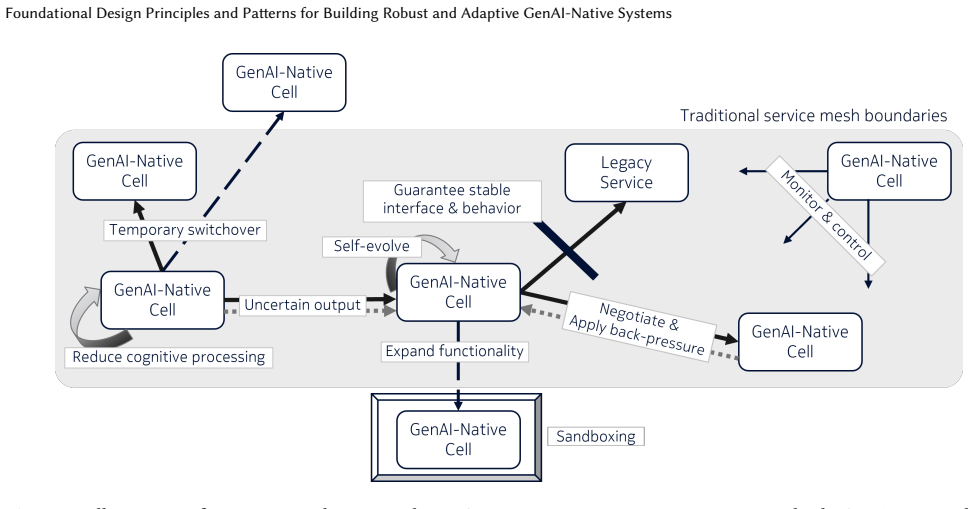


read the original abstract
Generative AI (GenAI) has emerged as a transformative technology, demonstrating remarkable capabilities across diverse application domains. However, GenAI faces several major challenges in developing reliable and efficient GenAI-empowered systems due to its unpredictability and inefficiency. This paper advocates for a paradigm shift: future GenAI-native systems should integrate GenAI's cognitive capabilities with traditional software engineering principles to create robust, adaptive, and efficient systems. We introduce foundational GenAI-native design principles centered around five key pillars -- reliability, excellence, evolvability, self-reliance, and assurance -- and propose architectural patterns such as GenAI-native cells, organic substrates, and programmable routers to guide the creation of resilient and self-evolving systems. Additionally, we outline the key ingredients of a GenAI-native software stack and discuss the impact of these systems from technical, user adoption, economic, and legal perspectives, underscoring the need for further validation and experimentation. Our work aims to inspire future research and encourage relevant communities to implement and refine this conceptual framework.
Editorial analysis
A structured set of objections, weighed in public.
Referee Report
Summary. The paper advocates for integrating GenAI cognitive capabilities with traditional software engineering principles to address unpredictability and inefficiency in GenAI-empowered systems. It proposes five design pillars (reliability, excellence, evolvability, self-reliance, assurance) and three architectural patterns (GenAI-native cells, organic substrates, programmable routers), outlines a GenAI-native software stack, and discusses technical, adoption, economic, and legal impacts while calling for further validation.
Significance. If the framework proves effective upon validation, it could offer a useful high-level structure for designing robust GenAI-native systems and help bridge AI capabilities with established software engineering practices, potentially guiding future research in the area.
major comments (2)
- [Foundational Design Principles] The central advocacy for the five pillars rests on their ability to mitigate unpredictability, yet the pillars section defines them internally without reference to established SE metrics, benchmarks, or prior literature on AI reliability (e.g., no citations to work on verifiable AI or adaptive systems).
- [Architectural Patterns] The architectural patterns section introduces GenAI-native cells, organic substrates, and programmable routers as solutions but provides no concrete sketches, pseudocode, or illustrative scenarios showing how they would reduce inefficiency or enable self-evolution in practice.
minor comments (2)
- [Abstract and Discussion] The abstract states the need for validation but the discussion of impacts could more explicitly tie back to how the pillars and patterns would be evaluated.
- [Throughout] Notation for the proposed patterns is introduced without a summary table or diagram, which would aid clarity for readers unfamiliar with the terminology.
Simulated Author's Rebuttal
We thank the referee for the detailed and constructive review. The comments highlight opportunities to strengthen connections to prior literature and to illustrate the proposed patterns more concretely. We address each major comment below and indicate the revisions we will make.
read point-by-point responses
-
Referee: [Foundational Design Principles] The central advocacy for the five pillars rests on their ability to mitigate unpredictability, yet the pillars section defines them internally without reference to established SE metrics, benchmarks, or prior literature on AI reliability (e.g., no citations to work on verifiable AI or adaptive systems).
Authors: We agree that explicit links to established software engineering metrics and prior work on verifiable AI and adaptive systems would improve the grounding of the five pillars. Although the pillars were synthesized from the specific challenges of unpredictability and inefficiency in GenAI-empowered systems, we will revise the relevant section to incorporate citations to relevant literature on AI reliability, verifiable AI, and adaptive systems, along with references to standard SE quality metrics where applicable. revision: yes
-
Referee: [Architectural Patterns] The architectural patterns section introduces GenAI-native cells, organic substrates, and programmable routers as solutions but provides no concrete sketches, pseudocode, or illustrative scenarios showing how they would reduce inefficiency or enable self-evolution in practice.
Authors: The patterns are presented at a conceptual level to establish foundational ideas rather than as fully specified implementations. We acknowledge that the absence of illustrative scenarios limits the ability to demonstrate practical impact. In the revision we will add concise, high-level scenarios for each pattern that illustrate potential mechanisms for reducing inefficiency and supporting self-evolution, while clarifying that detailed pseudocode or empirical validation lies beyond the scope of this conceptual framework and is left for future work. revision: partial
Circularity Check
No significant circularity in conceptual framework proposal
full rationale
The paper is explicitly a conceptual position paper that introduces five design pillars (reliability, excellence, evolvability, self-reliance, assurance) and three architectural patterns (GenAI-native cells, organic substrates, programmable routers) as a proposed high-level framework. It contains no equations, derivations, empirical predictions, fitted parameters, or self-citations that reduce any central claim to its own inputs by construction. The text states the need for further validation and experimentation rather than asserting that the proposals have been shown to work, keeping the normative suggestions self-contained as original design ideas without circular reductions.
Axiom & Free-Parameter Ledger
axioms (1)
- domain assumption GenAI systems face major challenges due to unpredictability and inefficiency that integration with SE principles can resolve.
invented entities (3)
-
GenAI-native cells
no independent evidence
-
organic substrates
no independent evidence
-
programmable routers
no independent evidence
Lean theorems connected to this paper
-
IndisputableMonolith/Foundation/AbsoluteFloorClosure.leanreality_from_one_distinction unclear?
unclearRelation between the paper passage and the cited Recognition theorem.
We introduce foundational GenAI-native design principles centered around five key pillars—reliability, excellence, evolvability, self-reliance, and assurance—and propose architectural patterns such as GenAI-native cells, organic substrates, and programmable routers
-
IndisputableMonolith/Foundation/AlexanderDuality.leanalexander_duality_circle_linking unclear?
unclearRelation between the paper passage and the cited Recognition theorem.
GenAI-native cell... evolution of a microservice... static core, multiple dynamic processes, and adaptive interaction
What do these tags mean?
- matches
- The paper's claim is directly supported by a theorem in the formal canon.
- supports
- The theorem supports part of the paper's argument, but the paper may add assumptions or extra steps.
- extends
- The paper goes beyond the formal theorem; the theorem is a base layer rather than the whole result.
- uses
- The paper appears to rely on the theorem as machinery.
- contradicts
- The paper's claim conflicts with a theorem or certificate in the canon.
- unclear
- Pith found a possible connection, but the passage is too broad, indirect, or ambiguous to say the theorem truly supports the claim.
Reference graph
Works this paper leans on
-
[1]
A2A Protocol. 2025. A2A Protocol – Agent-to-Agent Communication Standard.https://a2aprotocol.ai/Accessed: 2025-06
work page 2025
-
[2]
Amazon Web Services. 2025. Amazon Bedrock Agents.https://aws. amazon.com/bedrock/agents/Accessed: 2025-06
work page 2025
-
[3]
Anthropic. 2024. Anthropic introduces the Model Context Protocol. https://www.anthropic.com/news/model-context-protocolAccessed: 2025-04
work page 2024
-
[4]
Anthropic. 2025. Claude Code: Your code’s new collaborator.https: //www.anthropic.com/claude-codeAccessed: 2025-06
work page 2025
-
[5]
Marcus Arvan. 2024. ‘Interpretability’and ‘alignment’are fool’s er- rands: a proof that controlling misaligned large language models is the best anyone can hope for.AI & SOCIETY(2024), 1–16
work page 2024
-
[6]
Bowen Cao, Deng Cai, Zhisong Zhang, Yuexian Zou, and Wai Lam
-
[7]
arXiv preprint arXiv:2406.10248(2024)
On the worst prompt performance of large language models. arXiv preprint arXiv:2406.10248(2024)
-
[8]
Yunmo Chen, Tongfei Chen, Harsh Jhamtani, Patrick Xia, Richard Shin, Jason Eisner, and Benjamin Van Durme. 2024. Learning to retrieve iteratively for in-context learning. InProceedings of the 2024 Conference on Empirical Methods in Natural Language Processing. 7156–7168
work page 2024
- [9]
-
[10]
Continue.dev. 2025. Continue.dev: The Open-Source AI Code Assis- tant.https://www.continue.dev/Accessed: 2025-06
work page 2025
-
[11]
Cursor. 2025. Cursor: The AI Code Editor.https://www.cursor.sh Accessed: 2025-06
work page 2025
-
[12]
Emilia David. 2025. ‘Sandbox first’: Andrew Ng’s blueprint for acceler- ating enterprise AI innovation.https://venturebeat.com/ai/sandbox- first-andrew-ngs-blueprint-for-accelerating-enterprise-ai- innovation/Accessed: 2025-06
work page 2025
-
[13]
European Parliament and Council. 2024. Regulation (EU) 2024/1689 – Artificial Intelligence Act. Official Journal of the European Union, OJ L 1689, 12 July 2024
work page 2024
-
[14]
Martin Fowler. 2024. Patterns of Generative AI.https://martinfowler. com/articles/gen-ai-patterns/Accessed: 2025-06
work page 2024
-
[15]
Luyu Gao, Aman Madaan, Shuyan Zhou, Uri Alon, Pengfei Liu, Yiming Yang, Jamie Callan, and Graham Neubig. 2023. PAL: Program-aided language models. InInternational Conference on Machine Learning. PMLR, 10764–10799
work page 2023
-
[16]
Yunfan Gao, Yun Xiong, Xinyu Gao, Kangxiang Jia, Jinliu Pan, Yuxi Bi, Yi Dai, Jiawei Sun, Haofen Wang, and Haofen Wang. 2023. Retrieval- augmented generation for large language models: A survey.arXiv preprint arXiv:2312.109972 (2023)
work page internal anchor Pith review Pith/arXiv arXiv 2023
-
[17]
GitHub. 2021. GitHub Copilot: Your AI Pair Programmer. https://github.blog/2021-06-29-introducing-github-copilot-ai- pair-programmer/Accessed: 2025-06
work page 2021
-
[18]
Google Cloud. [n. d.]. Vertex AI Agent Builder / Agent Engine
-
[19]
Daya Guo, Dejian Yang, Haowei Zhang, Junxiao Song, Ruoyu Zhang, Runxin Xu, Qihao Zhu, Shirong Ma, Peiyi Wang, Xiao Bi, et al. 2025. Deepseek-r1: Incentivizing reasoning capability in llms via reinforce- ment learning.arXiv preprint arXiv:2501.12948(2025)
work page internal anchor Pith review Pith/arXiv arXiv 2025
-
[20]
Taicheng Guo, Xiuying Chen, Yaqi Wang, Ruidi Chang, Shichao Pei, Nitesh V Chawla, Olaf Wiest, and Xiangliang Zhang. 2024. Large lan- guage model based multi-agents: A survey of progress and challenges. arXiv preprint arXiv:2402.01680(2024)
work page internal anchor Pith review Pith/arXiv arXiv 2024
-
[21]
Shanshan Han, Qifan Zhang, Yuhang Yao, Weizhao Jin, Zhaozhuo Xu, and Chaoyang He. 2024. LLM multi-agent systems: Challenges and open problems.arXiv preprint arXiv:2402.03578(2024)
work page internal anchor Pith review Pith/arXiv arXiv 2024
-
[22]
Sirui Hong, Xiawu Zheng, Jonathan Chen, Yuheng Cheng, Jinlin Wang, Ceyao Zhang, Zili Wang, Steven Ka Shing Yau, Zijuan Lin, Liyang Zhou, et al. 2023. Metagpt: Meta programming for multi-agent col- laborative framework.arXiv preprint arXiv:2308.003523, 4 (2023), 6
work page internal anchor Pith review Pith/arXiv arXiv 2023
-
[23]
Xinyi Hou, Yanjie Zhao, Yue Liu, Zhou Yang, Kailong Wang, Li Li, Xiapu Luo, David Lo, John Grundy, and Haoyu Wang. 2024. Large language models for software engineering: A systematic literature review.ACM Transactions on Software Engineering and Methodology 33, 8 (2024), 1–79
work page 2024
- [24]
-
[25]
Lei Huang, Weijiang Yu, Weitao Ma, Weihong Zhong, Zhangyin Feng, Haotian Wang, Qianglong Chen, Weihua Peng, Xiaocheng Feng, Bing Qin, et al. 2025. A survey on hallucination in large language models: Principles, taxonomy, challenges, and open questions.ACM Transac- tions on Information Systems43, 2 (2025), 1–55
work page 2025
-
[26]
James Huckle and Sean Williams. 2025. Easy Problems that LLMs Get Wrong. InFuture of Information and Communication Conference. Springer, 313–332
work page 2025
-
[27]
1986.Kaizen: The Key to Japan’s Competitive Success
Masaaki Imai. 1986.Kaizen: The Key to Japan’s Competitive Success. McGraw-Hill, New York
work page 1986
- [28]
-
[29]
Daniel Kahneman. 2011.Thinking, fast and slow. macmillan
work page 2011
-
[30]
Vivek Ladsariya. 2025. The Future Is Agent-to-Agent: A Call for Founders.https://www.psl.com/feed-posts/the-future-is-agent-to- agent-a-call-for-foundersPublished March 31, 2025; accessed 2025- 07-09
work page 2025
-
[31]
Patrick Lewis, Ethan Perez, Aleksandra Piktus, Fabio Petroni, Vladimir Karpukhin, Naman Goyal, Heinrich Küttler, Mike Lewis, Wen-tau Yih, Tim Rocktäschel, et al . 2020. Retrieval-augmented generation for knowledge-intensive nlp tasks.Advances in neural information processing systems33 (2020), 9459–9474
work page 2020
-
[32]
Lexology. 2025. Agentic AI and EU Legal Considerations. https://www.lexology.com/library/detail.aspx?g=0695e657-7d5a- 49e5-9e44-9da10418dc7aAccessed: 2025-06
work page 2025
-
[33]
Tian Liang, Zhiwei He, Wenxiang Jiao, Xing Wang, Yan Wang, Rui Wang, Yujiu Yang, Shuming Shi, and Zhaopeng Tu. 2023. Encouraging divergent thinking in large language models through multi-agent debate.arXiv preprint arXiv:2305.19118(2023)
work page internal anchor Pith review Pith/arXiv arXiv 2023
-
[34]
Geoffrey Litt. 2023. LLMs and End-User Programming.https://www. geoffreylitt.com/2023/03/25/llm-end-user-programmingAccessed: 2025-04
work page 2023
- [35]
- [36]
-
[37]
Grégoire Mialon, Clémentine Fourrier, Thomas Wolf, Yann LeCun, and Thomas Scialom. 2023. Gaia: a benchmark for general ai assistants. Foundational Design Principles and Patterns for Building Robust and Adaptive GenAI-Native Systems InThe Twelfth International Conference on Learning Representations
work page 2023
-
[38]
Microsoft Azure. 2025. Azure AI Foundry Agent Service.https: //learn.microsoft.com/azure/ai-foundry/agents/overviewAccessed: 2025-06
work page 2025
-
[39]
Reiichiro Nakano, Jacob Hilton, Suchir Balaji, Jeff Wu, Long Ouyang, Christina Kim, Christopher Hesse, Shantanu Jain, Vineet Kosaraju, William Saunders, et al . 2021. Webgpt: Browser-assisted question- answering with human feedback.arXiv preprint arXiv:2112.09332 (2021)
work page internal anchor Pith review Pith/arXiv arXiv 2021
-
[40]
John F. Nash. 1951. Non-cooperative games.Annals of Mathematics 54, 2 (1951), 286–295
work page 1951
-
[41]
Sergii Netesanyi. 2024. Top 10 Cloud-Native Best Practices for Ap- plication Development.https://www.n-ix.com/cloud-native-best- practices/Accessed: 2025-04
work page 2024
-
[42]
Casey Newton. 2025. The AI browser wars are about to begin.https:// www.platformer.news/ai-web-browsers-openai-perplexity-opera/Ac- cessed: 2025-06
work page 2025
- [43]
-
[44]
OpenAI. 2024. Learning to Reason with LLMs.https://openai.com/ index/learning-to-reason-with-llms/Accessed: 2025-04
work page 2024
-
[45]
OpenAI. 2025. Introducing Codex: AI Software Engineering Agent. https://openai.com/codex/Accessed: 2025-06
work page 2025
-
[46]
OpenAI. 2025. Introducing Operator.https://openai.com/index/ introducing-operator/Accessed: 2025-04
work page 2025
-
[47]
OWASP Foundation. 2025. OWASP Generative AI Security Project. https://genai.owasp.org/Accessed: 2025-04
work page 2025
-
[48]
Thomas Pyzdek and Paul A. Keller. 2023.The Six Sigma Handbook: A Complete Guide for Green Belts, Black Belts, and Managers at All Levels (6 ed.). McGraw-Hill Education, New York
work page 2023
- [49]
-
[50]
Pranab Sahoo, Ayush Kumar Singh, Sriparna Saha, Vinija Jain, Samrat Mondal, and Aman Chadha. 2024. A systematic survey of prompt engineering in large language models: Techniques and applications. arXiv preprint arXiv:2402.07927(2024)
work page internal anchor Pith review Pith/arXiv arXiv 2024
-
[51]
Ranjan Sapkota, Konstantinos I. Roumeliotis, and Manoj Karkee
-
[52]
Vibe Coding vs. Agentic Coding: Fundamentals and Prac- tical Implications of Agentic AI. arXiv:2505.19443 [cs.SE]https: //arxiv.org/abs/2505.19443
-
[53]
Timo Schick, Jane Dwivedi-Yu, Roberto Dessì, Roberta Raileanu, Maria Lomeli, Eric Hambro, Luke Zettlemoyer, Nicola Cancedda, and Thomas Scialom. 2023. Toolformer: Language models can teach themselves to use tools.Advances in Neural Information Processing Systems36 (2023), 68539–68551
work page 2023
-
[54]
Amazon Web Services. 2025. What is Cloud Native?https://aws. amazon.com/what-is/cloud-native/Accessed: 2025-04
work page 2025
-
[55]
Noah Shinn, Federico Cassano, Ashwin Gopinath, Karthik Narasimhan, and Shunyu Yao. 2023. Reflexion: Language agents with verbal reinforcement learning.Advances in Neural Information Processing Systems36 (2023), 8634–8652
work page 2023
-
[56]
StackBlitz. 2025. Bolt.new: AI-Powered Web App Builder.https: //bolt.new/Accessed: 2025-06
work page 2025
-
[57]
Maira Ladeira Tanke, Mark Roy, Navneet Sabbineni, and Mon- ica Sunkara. 2024. Best practices for building robust gener- ative AI applications with Amazon Bedrock Agents – Part 1. https://aws.amazon.com/blogs/machine-learning/best-practices- for-building-robust-generative-ai-applications-with-amazon- bedrock-agents-part-1/Accessed: 2025-06
work page 2024
-
[58]
Maira Ladeira Tanke, Mark Roy, Navneet Sabbineni, and Mon- ica Sunkara. 2024. Best practices for building robust gener- ative AI applications with Amazon Bedrock Agents – Part 2. https://aws.amazon.com/blogs/machine-learning/best-practices- for-building-robust-generative-ai-applications-with-amazon- bedrock-agents-part-2/Accessed: 2025-06
work page 2024
- [59]
- [60]
-
[61]
Xingyao Wang, Yangyi Chen, Lifan Yuan, Yizhe Zhang, Yunzhu Li, Hao Peng, and Heng Ji. 2024. Executable Code Actions Elicit Better LLM Agents. InForty-first International Conference on Machine Learning. https://openreview.net/forum?id=jJ9BoXAfFa
work page 2024
-
[62]
Jason Wei, Xuezhi Wang, Dale Schuurmans, Maarten Bosma, Fei Xia, Ed Chi, Quoc V Le, Denny Zhou, et al. 2022. Chain-of-thought prompt- ing elicits reasoning in large language models.Advances in neural information processing systems35 (2022), 24824–24837
work page 2022
-
[63]
Scott Wu and Cognition Labs. 2024. Introducing Devin, the First AI Software Engineer.https://cognition.ai/blog/introducing-devin
work page 2024
- [64]
- [65]
- [66]
-
[67]
Yue Zhang, Yafu Li, Leyang Cui, Deng Cai, Lemao Liu, Tingchen Fu, Xinting Huang, Enbo Zhao, Yu Zhang, Yulong Chen, et al. 2023. Siren’s song in the AI ocean: a survey on hallucination in large language models.arXiv preprint arXiv:2309.01219(2023)
work page internal anchor Pith review Pith/arXiv arXiv 2023
- [68]
-
[69]
Haiyan Zhao, Hanjie Chen, Fan Yang, Ninghao Liu, Huiqi Deng, Hengyi Cai, Shuaiqiang Wang, Dawei Yin, and Mengnan Du. 2024. Explainability for large language models: A survey.ACM Transactions on Intelligent Systems and Technology15, 2 (2024), 1–38
work page 2024
-
[70]
Yueheng Zhu, Chao Liu, Xuan He, Xiaoxue Ren, Zhongxin Liu, Ruwei Pan, and Hongyu Zhang. 2025. AdaCoder: An Adaptive Planning and Multi-Agent Framework for Function-Level Code Generation.arXiv preprint arXiv:2504.04220(2025). Frederik Vandeputte A GenAI-native Design Pillars Overview Figure 5 illustrates the five design pillars and their main direct interd...
discussion (0)
Sign in with ORCID, Apple, or X to comment. Anyone can read and Pith papers without signing in.