Computation and Language · arXiv:2508.15754 v2 · submitted 21 Aug 2025
When Tools Hurt LLM Reasoning: State-Dependent Belief Revision under External Evidence
The paper says
“Tool use is often assumed to monotonically improve reasoning, where external evidence is expected to help when relevant and be ignored when irrelevant. We show that this assumption fails in a state-dependent way.”
more of the abstract
Across benchmarks with Python and Wikipedia tools, external evidence reliably helps when initial beliefs are weak, but can flip already-correct answers when those beliefs are strong. We frame this as a misallocation of revision authority, arguing that deferring to external evidence is suboptimal when internal support for the correct answer surpasses the tool's expected output quality. This predicts that harm should concentrate on high-confidence no-tool cases. We test this prediction with threshold localization, wrong-trace audits, and a same-clue intervention showing that revision framing changes the damage caused by misleading evidence. These findings suggest that mixed no-tool/tool-assisted inference should arbitrate authority rather than privilege tool evidence by default. As a minimal demonstration, we introduce CASE, a label-free controller that selects between no-tool and tool-assisted trajectories using answer-state certainty and improves over existing confidence-based arbitration baselines.The code for our experiments is available at https://github.com/epsilondylan/State-Dependent-Belief-Revision.
from the abstract
Pith says
Machine review · deepseek-v4-flash · 5 Aug 2026 · of version 1 of the paper; version 2 is newer · what was read was not recorded · not checked by a person
It can be wrong. Challenge this review or reply to it.
Holds up, with conditions. ReasonZoo's benchmark and case studies have real value, but the paper's 'consistently outperform' claim is contradicted by its own Table 1 and the PAC metric as defined is trivially gameable. This line is wrong
4 major objections · 4 minor
How often objections from reviews like this one are right: not yet measured
Not checked: figures, code, what the references say.
The paper says, at Abstract; §5.1; Table 1
The review did not quote this passage.
Pith says: Objection 1 of 4 · major
The abstract and §5.1 claim TIR-enabled models 'consistently outperform' non-TIR counterparts. Table 1 contradicts this. DeepSeek-R1-0528 with PoT falls from 41.9 to 36.6 average accuracy (-5.3), with negative deltas in 6 of 9 categories (GSM -10.0, BL -24.6, DL -17.2, OR -7.0, Phy -32.0, FL -16.5).
more of objection 1
Negative per-category deltas appear for every Qwen3 model and for both PoT and MT-TIR (e.g., Qwen3-8B PoT BL -14.0; Qwen3-32B PoT BL -17.3 and Phy -16.0; Qwen3-235B-A22B PoT Phy -17.0). Across the 90 paired (model, method, category) cells, 22 are negative. The phrase 'consistently outperform' is therefore not supported by the paper's own data. A claim restricted to 'TIR often improves average accuracy, with substantial per-domain exceptions' would be defensible.
The paper says, at §4.3, Eq. (2)-(3)
The review did not quote this passage.
Pith says: Objection 2 of 4 · major
The PAC definition is internally inconsistent. The prose says PAC measures the cost required to achieve a performance threshold and selects the most efficiently solved subset, i.e., low average cost. But Eq. (2) defines PACτ = min_{s∈Sτ} (1 - (1/(|s|·Cmax)) Σ_{i∈s} C_i).
more of objection 2
Since the leading '1 -' reverses order, the min is attained by the subset with the highest average cost, not the lowest. Either the min should be a max over s (to maximize 1 - avg cost), or the '1 -' should be removed and the min retained. In addition, 'performance at least τ' is ambiguous: is τ measured as accuracy on the subset s or as the subset's contribution to whole-data accuracy? The reported PAC values are consistent only with an oracle interpretation whereby the model may cherry-pick the cheapest samples that reach τ. Eq. (3) further maximizes over τ, compounding the ambiguity. Because PAC/m-PAC are the basis of
The paper says, at §5.2, Table 2; Appendix B, Table 6
The review did not quote this passage.
Pith says: Objection 3 of 4 · major
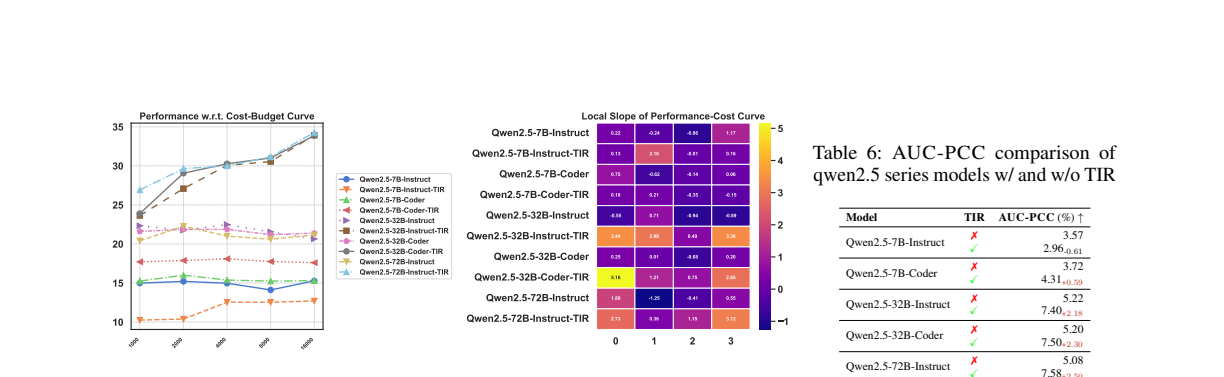
The abstract's claim that 'TIR enhances reasoning efficiency, as evidenced by improved PAC and AUC-PCC' is also not universal in the reported data. DeepSeek-R1-0528 PoT lowers m-PAC (All Tokens) from 36.5 to 28.2 (-8.3) and lowers PAC by 0.1; Qwen2.5-7B-Instruct TIR lowers AUC-PCC from 3.57 to 2.96 (Table 6).
more of objection 3
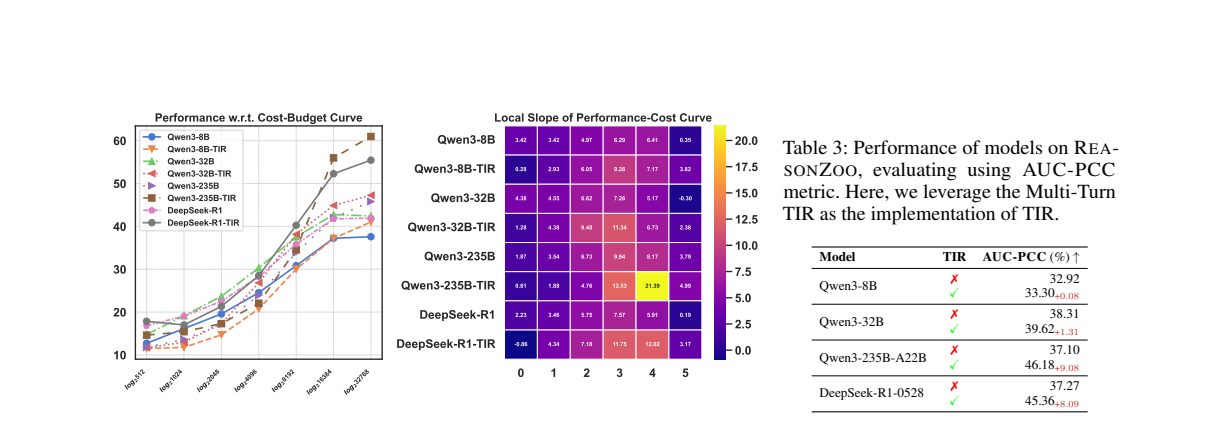
Even in favorable cases, Qwen3-8B AUC-PCC improves by only 0.08 (Table 3). These exceptions are acknowledged only indirectly (e.g., 'PoT yields variable efficiency gains' in §5.2) but are omitted from the abstract and conclusion. The conclusion should be restated as a conditional or partial benefit, or the analysis should identify conditions under which TIR hurts efficiency.
The paper says, at §4.3, Eq. (5)-(6); Table 3
The review did not quote this passage.
Pith says: Objection 4 of 4 · major
The AUC-PCC construction is not reproducible as described. The text says 'we use the similar method proposed in Muennighoff et al. (2025) to obtain performance under specific cost budget,' but no concrete procedure is given: how are budget points chosen, how is truncation/forcing implemented for multi-turn TIR, and how are tool-call tokens counted in the budget?
more of objection 4
Eq. (5) normalizes by Cmax, but Table 2 sets Cmax=32,768 while Figure 2 shows budgets up to 32,768; the relationship is unclear. Since the paper proposes AUC-PCC as a new metric, the estimation protocol must be specified so readers can reproduce the curves and slopes in Figures 2 and 4.
4 minor objections
The paper says, at §5.4, Table 4
Pith says: minor objection 1 of 4
The text says outcome efficiency for Qwen3-32B improves 'from 147% to 27.1%'. This should be '14.7% to 27.1%'.
The paper says, at Table 2
Pith says: minor objection 2 of 4
The '# Tokens' entries for the Qwen3-32B baseline and Qwen3-235B-A22B baseline are both 9,160. This looks like a typo and should be checked, as token counts feed the efficiency metrics.
show 2 more
The paper says, at Appendix A vs Table 1
Pith says: minor objection 3 of 4
The category is called 'Communication Code' in Table 1 and 'Cipher and Coding Theory' in Appendix A, and 'Cipher and Code' in Table 5. Use one consistent name.
The paper says, at §5.4, Figure 3
Pith says: minor objection 4 of 4
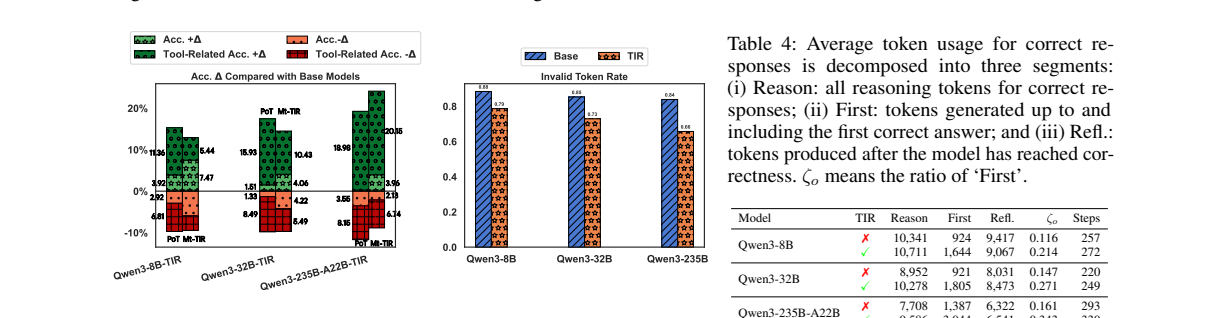
The attribution analysis relies on Qwen2.5-32B-Instruct as an auxiliary judge to label whether prediction changes are tool-related. No validation of this judging step is reported; a small manual check or agreement measure would strengthen the claim.
What would settle it
Perform an arithmetic check on Table 1: for each (model, category, method) cell, compute delta = accuracy(TIR) - accuracy(non-TIR baseline). Then report (i) the number and percentage of positive deltas across all 90 cells, (ii) the average delta for each TIR method per model, and (iii) the average delta separately for Math and Non-Math category groups. If DeepSeek-R1-PoT has a negative average (-5.3) or if the percentage of negative cells is nonzero, the abstract's 'consistently outperform' is false as written. This check requires no new experiments.
from the skeptic's reading
How the review went
4 readings by deepseek-v4-flash · 5 Aug 2026
- Reader holds up, with conditions
- Skeptic partly agrees
- Editor wrote the verdict above
- Referee major revision: 4 major objections, 4 minor
Not run on this paper: the simulated authors' defence.
Pith did not check this review's objections against the paper.
The review in full
The review in brief, machine-written
Quick take: the benchmark is worth using; the central claims are not. ReasonZoo covers nine reasoning categories beyond math, the construction looks sensible, and the qualitative cases (Viterbi decoding, grade-school math, the physics failure) are the most honest part of the paper. The related work is solid.
Now the problems. The abstract and Section 5.1 say TIR-enabled models 'consistently outperform' non-TIR counterparts. That is false against their own Table 1. DeepSeek-R1-0528 with PoT drops from 41.9 to 36.6 average accuracy, with negative deltas in six of nine categories. Across the 90 model-method-category pairs, roughly 22 are negative, and every family has losses on physics, Boolean logic, or other non-math categories. The averages do show TIR often helps—MT-TIR on Qwen3-235B and DeepSeek-R1 are clear gains—but 'consistent' is not the right word. This is an internal inconsistency, not a disagreement with the literature.
The efficiency metrics have a more serious issue. Equation (2) defines PACτ as the minimum average cost over any subset of samples whose accuracy is at least τ. A subset of one correct sample satisfies that for any τ≤1, so PACτ is just the normalized cost of the cheapest correct sample, and PAC in Eq. (3) is that same constant. That does not match the reported numbers in Table 2, where PAC and m-PAC differ substantially (84.9 vs 25.4 for Qwen3-8B baseline). Either the formula is missing a constraint or the table was computed with a different procedure. As written, PAC is trivial to game and says nothing about reaching a performance threshold. The efficiency claims rest on this metric, so this needs to be fixed before anyone can trust the m-PAC and AUC-PCC results.
Credit: the benchmark itself is a real contribution if the data and code are released—there is no release link in the text, which should be added. The attribution analysis is explicitly unvalidated, so treat it as qualitative. The case studies are valuable and honestly show TIR can hurt.
This paper is for people working on TIR evaluation and efficiency metrics. It deserves peer review, not desk rejection, but the referee will need to require a corrected accuracy claim and a working PAC definition. I wouldn't cite it as-is.
The strongest objection
The abstract's central claim is that 'TIR-enabled models consistently outperform their non-TIR counterparts in both mathematical and non-mathematical tasks.' This is not what Table 1 shows. For DeepSeek-R1-0528, PoT reduces average accuracy from 41.9 to 36.6 (-5.3), with negative deltas in 6 of 9 categories (GSM -10.0, BL -24.6, DL -17.2, OR -7.0, Phy -32.0, FL -16.5). Category-level negatives appear for every model family and both prompting-based TIR methods: Qwen3-8B MT-TIR loses on BL (-7.3), DL (-0.7), Phy (-4.0), and FL (-3.5); Qwen3-32B PoT loses on NC (-0.5), BL (-17.3), and Phy (-16.0); Qwen3-235B-A22B PoT loses on Phy (-17.0). Across the 90 paired (model, category, method) cells in Table 1, roughly 22 are negative. Thus 'consistently outperform' is false under both per-category and per-method-average readings; it is an internal inconsistency in the paper's own data, not a disagreement with external consensus. Section 5.1 supports the headline only by citing favorable examples and omitting these counterexamples. A revised claim restricted to 'TIR often improves average accuracy, with substantial exceptions' could be defensible, but the domain-general, consistent-benefit conclusion needs correction.
The reader's weakest assumption is the PAC metric. That concern is real: Eq. 2 minimizes over arbitrary subsets, so a single cheap correct sample can define PAC_tau and make the efficiency metric cherry-picked. However, the most load-bearing problem for the paper's central claim is even more basic: the accuracy headline fails against the paper's own Table 1. DeepSeek-R1-PoT has a negative overall delta, and negative category-level deltas occur in every model family, so 'consistently outperform' is internally contradicted. This does not require resolving the PAC ambiguity. I therefore partially agree with the reader: the PAC concern is a serious efficiency-metric flaw, but the accuracy claim is the more fundamental checkpoint. The benchmark and broad evaluation are still valuable, and the flaws are reparable by rewording the claim, reporting paired significance/error bars, fixing the PAC definition, and releasing data/code. Hence the CONDITIONAL verdict stands; no adjustment is needed.
The referee's report
ReasonZoo is a useful contribution to tool-use evaluation: it broadens the evaluation of TIR beyond mathematics, includes multiple TIR implementations, and provides qualitative case studies that illustrate both benefits and failure modes. If the accuracy and efficiency claims were sustained, the paper would support a domain-general view of TIR as a reasoning enhancement. However, the manuscript's own tables contain many exceptions to the 'consistent' claims, and the PAC definition as written is mathematically inconsistent with its prose. The benchmark and the comparative data remain valuable, but the headline conclusions need substantial recalibration and the proposed efficiency metric needs correction before the results can be interpreted.
Pith's reading of the paper (a machine's summary, not the authors')
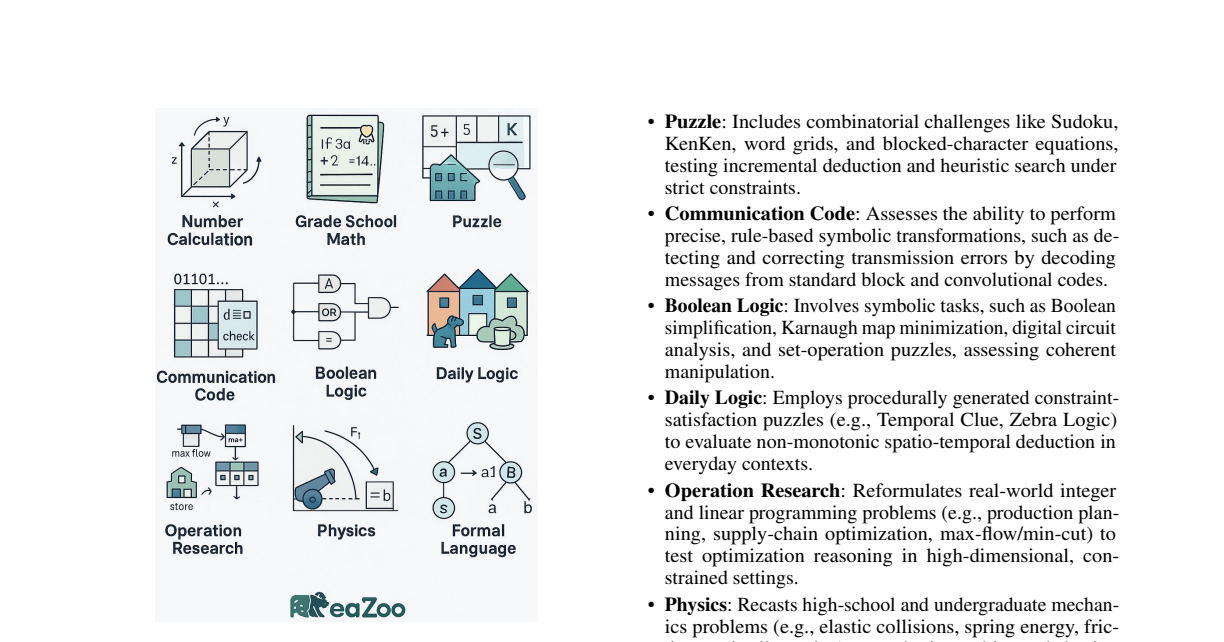
This paper sets out to show that letting a large language model call an external tool, typically a Python interpreter, during reasoning is a general improvement rather than a math-only trick. It introduces ReasonZoo, a nine-category benchmark spanning number calculation, grade-school math, puzzles, communication codes, boolean logic, daily logic, operations research, physics, and formal language, with every task designed to be solvable either by pure verbal reasoning or with tool help. To judge efficiency, the authors propose Performance-Aware Cost (PAC) and Area Under the Performance-Cost Curve (AUC-PCC), which score how much accuracy a model buys per token. Across base reasoning models and tool-specialized agents, tool-enabled versions consistently outperform their non-tool counterparts in accuracy and in these efficiency metrics. The paper attributes the gains to tool feedback correcting errors and to shorter, more goal-directed reasoning paths rather than more verbose thinking.
What carries the argument. The load-bearing instruments are ReasonZoo plus the PAC/m-PAC and AUC-PCC metrics. PAC (Eq. 2) is the minimum average normalized token cost over any subset of test samples that reaches a target accuracy τ; m-PAC averages this over a series of thresholds. AUC-PCC (Eq. 6) is the trapezoidal area under the normalized accuracy-versus-token-budget curve. Together they convert "overthinking" from a qualitative complaint into a number: high PAC and AUC-PCC mean a model reaches correct answers early and with few tokens. The TIR loop is formalized as s_i ∼ πθ(·|q, c_{i−1}), c_i ← c_{i−1} ⊕ s_i ⊕ R(s_i), where reasoning steps containing executable code are interleaved with tool execution results R(s_i
Core claim. The central claim is that Tool-Integrated Reasoning (TIR) generalizes: models that can interleave natural-language planning with executable code and read back tool results outperform their non-TIR counterparts on both mathematical and non-mathematical tasks. The paper further claims TIR improves reasoning efficiency, not just accuracy: m-PAC and AUC-PCC increase, the fraction of tokens spent before the first correct answer roughly doubles (for example, from 11.6% to 21.4% for one 8B model), and the accuracy-versus-token-budget curve flattens earlier, evidence of reduced overthinking. On the authors' terms, tool integration is not merely a way to supply missing arithmetic; it changes how the
The premise it rests on. The load-bearing assumption is that the PAC metric measures the token cost of reaching a target performance, but the formula is ambiguous about whether that accuracy is scored on the easy subset the model picks or on the whole test set, and the reported numbers only work under the subset reading.
If the paper is right (Pith's inferences, not the authors')
TIR should be expected to help on non-mathematical tasks—logic puzzles, constraint satisfaction, formal grammar, scheduling—where the same multi-step computation can be externalized, not just on arithmetic.
Accuracy-only evaluation understates the value of tool use; cost-aware metrics can reveal efficiency gains even when average accuracy differences are small.
Larger models and models trained with tool-centric reinforcement learning convert tool access into larger accuracy and efficiency gains than small base models.
Tool use has a fixed overhead: below roughly 8K tokens of budget, TIR can hurt slightly, so tools pay off mainly when the model is allowed enough compute to run and verify code.
TIR does not eliminate errors: attribution analysis shows some previously correct answers are lost to tool misuse, so robust tool integration still needs work.
My inference: if the PAC definition is read as an oracle that lets the model pick its cheapest successful subset, the efficiency advantage may partly reflect subset selection rather than smoother reasoning; a whole-dataset reading of Eq. (2) could erase or reverse the reported m-PAC gains. This ambiguity is in the paper's formula, but the oracle-style interpretation is my editorial reading.
My inference: the paper's own case studies show tool use can mislead on abstract physics and formal-language problems, so the domain-general claim likely needs a qualifier: tool integration is broadly useful, but future systems may need a router that decides when to refrain from calling tools.
My inference: because the crossover in the cost-budget curves is consistent across models, AUC-PCC could be used operationally—set per-query token budgets dynamically and enable tools only when the predicted task complexity justifies the initial overhead.
My inference: a clean extension would hold output length fixed across tool and no-tool conditions to separate "tools give an external scratchpad" from "tools teach better planning"; ReasonZoo's paired design makes this feasible by re-using the same questions.
Check this review
Pith stored no record of this review's passes and took no fingerprint of it. Reviews made by code from 13 Nov 2026 on carry both.
How often reviews like this one are right
Reviews like this one: written by deepseek-v4-flash, where what was read was not recorded.
How often objections from reviews like this one are right: not yet measured
Reviews by people
This review was written by a machine. No person has reviewed this paper on Pith yet. A scientist listed on Pith can review it for a fee, and their review is published here whatever it concludes.
The paper
Abstract
Tool use is often assumed to monotonically improve reasoning, where external evidence is expected to help when relevant and be ignored when irrelevant. We show that this assumption fails in a state-dependent way. Across benchmarks with Python and Wikipedia tools, external evidence reliably helps when initial beliefs are weak, but can flip already-correct answers when those beliefs are strong. We frame this as a misallocation of revision authority, arguing that deferring to external evidence is suboptimal when internal support for the correct answer surpasses the tool's expected output quality. This predicts that harm should concentrate on high-confidence no-tool cases. We test this prediction with threshold localization, wrong-trace audits, and a same-clue intervention showing that revision framing changes the damage caused by misleading evidence. These findings suggest that mixed no-tool/tool-assisted inference should arbitrate authority rather than privilege tool evidence by default. As a minimal demonstration, we introduce CASE, a label-free controller that selects between no-tool and tool-assisted trajectories using answer-state certainty and improves over existing confidence-based arbitration baselines.The code for our experiments is available at https://github.com/epsilondylan/State-Dependent-Belief-Revision.
The paper's own sentences, arranged, kept beside the review and separate from it. Each label is drawn from a closed vocabulary; the number beside it is the probability the classifier gave that label. No sentence in this record was written by a model.
abstract compiled · 2026-09-23
The authors' main claim, as the classifier picked it out 0.71
“These findings suggest that mixed no-tool/tool-assisted inference should arbitrate authority rather than privilege tool evidence by default.”
How the main claim is stated: hedged possibility 1.00
What the abstract itself states, as probabilities: claims first 0.05 · states limitation 0.30 · human participants 0.04 · controlled comparison 0.86 · randomized assignment 0.02 · states quantitative result 0.06 · compares with prior results 0.85 · mentions code or data availability 0.98
The abstract, sentence by sentence
This table labels the abstract only (arXiv listing abstract v2). The number is the probability the classifier gave the label.
| Sentence | Role | The authors' own work | States the main conclusion | Strength |
|---|---|---|---|---|
| Tool use is often assumed to monotonically improve reasoning, where external evidence is expected to help when relevant and be ignored when irrelevant. | background 1.00 | 0.04 | 0.03 | asserted 0.87 |
| We show that this assumption fails in a state-dependent way. | contribution 0.54 | 0.83 | 0.29 | asserted 1.00 |
| Across benchmarks with Python and Wikipedia tools, external evidence reliably helps when initial beliefs are weak, but can flip already-correct answers when those beliefs are strong. | result 1.00 | 0.94 | 0.60 | asserted 1.00 |
| We frame this as a misallocation of revision authority, arguing that deferring to external evidence is suboptimal when internal support for the correct answer surpasses the tool's expected output quality. | interpretation 0.99 | 0.46 | 0.39 | asserted 0.97 |
| This predicts that harm should concentrate on high-confidence no-tool cases. | interpretation 0.85 | 0.41 | 0.10 | asserted 0.54 |
| We test this prediction with threshold localization, wrong-trace audits, and a same-clue intervention showing that revision framing changes the damage caused by misleading evidence. | method 0.82 | 0.96 | 0.06 | asserted 1.00 |
| These findings suggest that mixed no-tool/tool-assisted inference should arbitrate authority rather than privilege tool evidence by default. | interpretation 0.98 | 0.41 | 0.66 | hedged possibility 1.00 |
| As a minimal demonstration, we introduce CASE, a label-free controller that selects between no-tool and tool-assisted trajectories using answer-state certainty and improves over existing confidence-based arbitration baselines.The code for our experiments is available at https://github.com/epsilondylan/State-Dependent-Belief-Revision. | contribution 0.90 | 0.95 | 0.13 | asserted 1.00 |
What kind of paper the classifier reports this is: empirical study 0.91 · evidence from observation or experiment 0.97
What was examined, and what was not
Sources read
- arXiv listing abstract v2
Not examined
- full text
- figures and tables
- references and citing sentences
- relations to other papers
Levels run
- P abstract
Not run
- S sections
- T body sentences
- C citations
- R cross-paper relations
How the labels were made
Compiled by classifier-1.13.0 via TypeSafe API, question bank abstract-p1-20260923, 2026-09-23: 1 request, 6,241 input tokens.
Every quoted sentence on this record is the authors'. Every label is from Pith's closed vocabulary, with the probability shown beside it. This record as JSON
Figures (4)
Figures are the authors', reproduced from the paper.
Cited by 1 Pith paper
Reviewed papers on Pith that cite this one. The full citation record
How the literature uses it
3 arXiv papers cite this in 3 sentences
Papers citing it · 1 sentence without a confident label
Cites it as background 2 papers
-
Tool-Integrated Reasoning (TIR) has therefore emerged as a promising paradigm that augments LLM reasoning with external retrieval, computation, code execution, and environment interaction [ref] .
TIDE-Bench: Task-Aware and Diagnostic Evaluation of Tool-Integrated Reasoning · Introduction · 0.98
-
More recent analyses such as TIR [ref] study when tool-integrated reasoning helps in practice and when the added orchestration primarily increases latency or compute, and cost-aware evaluations make this trade-off even more explicit [ref] .
ReaComp: Compiling LLM Reasoning into Symbolic Solvers for Efficient Program Synthesis · Related Work · 0.93
Challenges and discussion
Disagree with the review, or know something it missed? Leave a comment, or challenge this review formally: a challenge becomes a permanent entry in this paper's record, and its decision is published here.
Come back by email
A short list of the week's newly reviewed papers. Nothing is sent until you confirm from your inbox, and every email has a link that stops it. No account.
No comments yet.
Sign in to comment