Computer Vision and Pattern Recognition · arXiv:2611.25840 v1 · submitted 19 Nov 2026 · 45 references
Harnessing Medical Visual-Language Models with Agentic Evidence Management
The paper says
“Medical vision-language agents increasingly rely on segmentation tools, and recent work has focused on acquiring the right mask, often treating a good mask as the end point of tool use. But do these agents use the resulting evidence effectively?”
more of the abstract
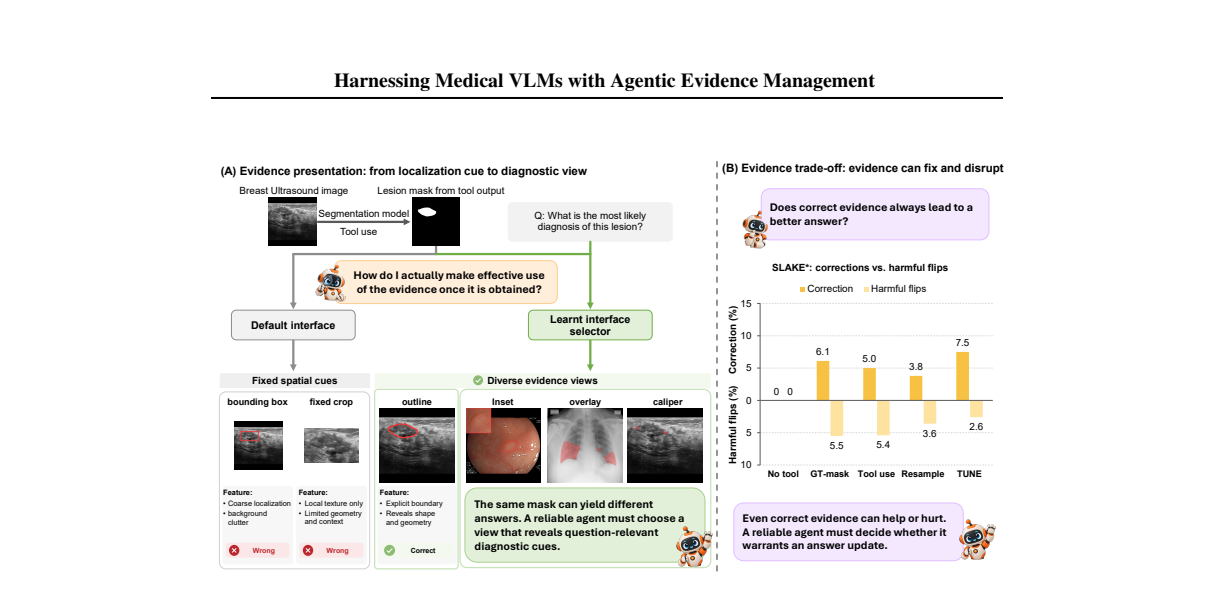
To answer this question, we need a benchmark that separates evidence use from segmentation quality, spans multiple medical image types, and allows the same mask to be presented in different ways. Existing medical VQA datasets do not jointly provide these properties. We therefore construct Mask-Evidence MedVQA, a 2.5K-example benchmark spanning four image types, where each question is paired with an answer-relevant ground-truth mask and multiple possible renderings. Our study reveals two limitations of direct tool use. First, evidence presentation matters. Different renderings of the same fixed mask can substantially change model behavior. Second, masks introduce an evidence trade-off. Highlighting a relevant region can expose diagnostic evidence the model previously missed, but the added visual cue can also induce incorrect associations. As a result, even a ground-truth mask can correct some answers while turning initially correct ones into incorrect ones. Together, these findings show that acquiring the right mask is not enough. An agent must also decide how to present the evidence and whether it should change the answer. We therefore introduce TUNE (Tool Use is Not Enough), an evidence-management harness that explicitly manages what evidence to acquire, how to present it, and whether to accept the resulting answer update. Across three public medical VQA benchmarks, evidence management improves the fine-tuned Qwen3.5-9B backbone's mean accuracy by 4.0 percentage points. Full TUNE improves over direct tool use by 9.1 points on average across seven benchmarks and achieves competitive results against existing medical VLMs and agents.
from the abstract
Pith says
Machine review · deepseek-v4-flash · 20 Nov 2026 · read the full text (104,488 characters) · not checked by a person
It can be wrong. Challenge this review or reply to it.
Holds up.
5 minor · 2 open questions
How often objections from reviews like this one are right: not yet measured
The paper, first character to last
The reviewer was given the whole text, 104,488 characters. Not checked: figures, code, what the 45 references say.
5 minor objections
The paper says, at Abstract and Section 3
Pith says: minor objection 1 of 5
The benchmark size is given as both 2.5K (abstract) and 2,494 (main text). Please harmonise the two numbers.
The paper says, at Section 4.3
Pith says: minor objection 2 of 5
The prompt for the Answer Critic (Appendix A.7) says that the two candidates are randomly ordered, which mitigates positional bias. It would be helpful to state in the main text that random ordering is used during both training and inference, as currently it is only mentioned in the prompt appendix.
show 3 more
The paper says, at Table 8 (component ablation)
Pith says: minor objection 3 of 5
The table shows that the one-shot Critic lowers accuracy relative to not having a Critic at all. This is interesting but is not discussed in the text. A brief explanation would help the reader understand why training is necessary and what the one-shot prompt fails to capture.
The paper says, at Appendix A.1
Pith says: minor objection 4 of 5
Table 13 reports human review of 200 examples with Fleiss' κ=0.71. It would be useful to also report the average pairwise agreement percentage for transparency.
The paper says, at Section 5.2, Figure 3
Pith says: minor objection 5 of 5
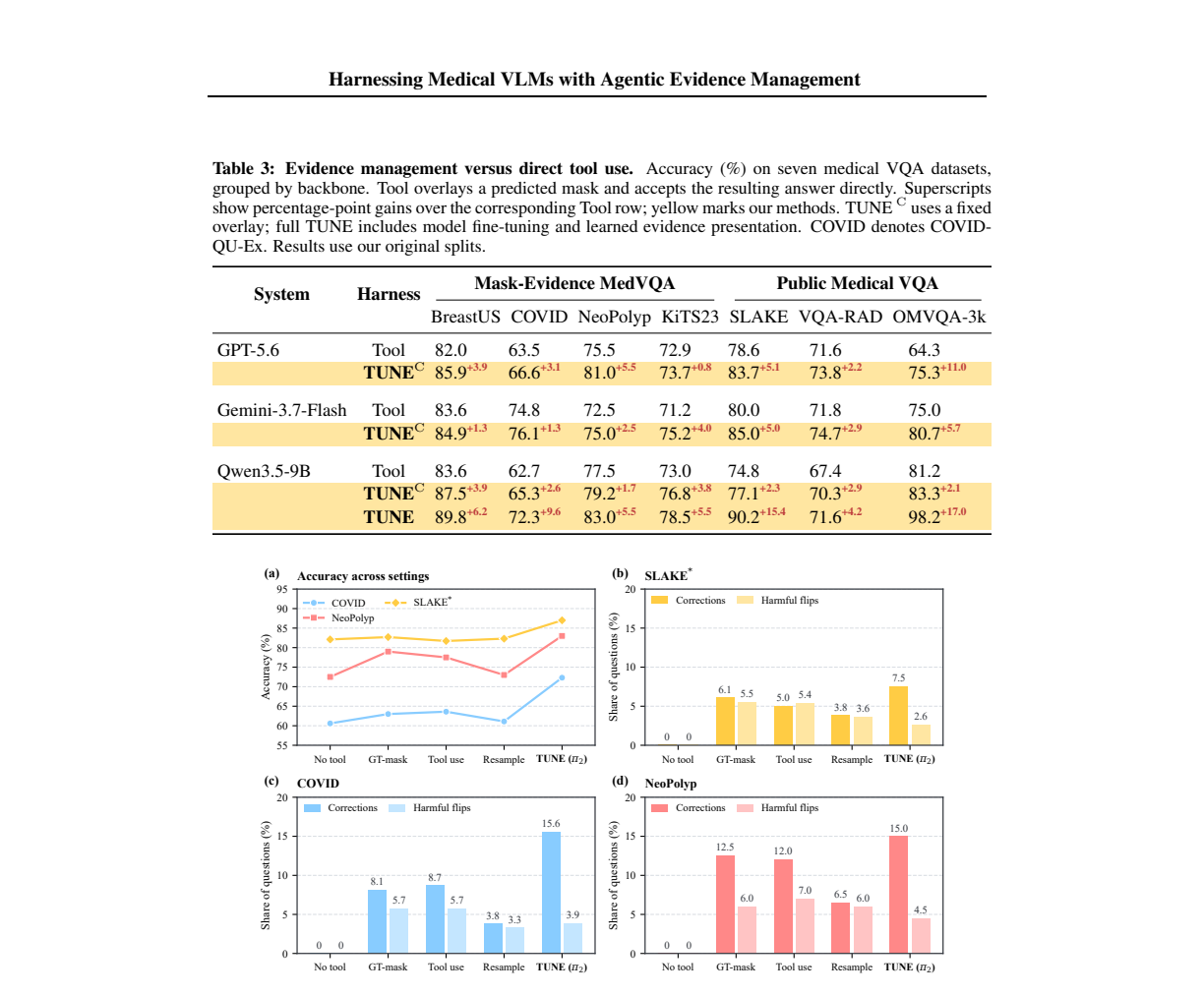
The caption says "Resample" selects between two answers the SFT model generates without tools. This is not defined in the main text and appears only in the figure caption. Please define it in Section 5.2 or the experimental setup.
Open questions (2)
Pith raised these and could not confirm them against the text of the paper it read. They are questions for the authors, not findings.
- Table 5 (Section 5.1, Table 5) Which data split (CARE's released splits or the authors' original splits) is used for the standalone VLM rows and for the TUNE^C rows in Table 5?
- Section 5.1, Table 6 and Figure 3 Could a biased Critic cause a systematic shift in the types of questions that get non-decisive disagreements, and why does this not affect the headline improvement?
What would settle it
Compute the answer critic's accuracy separately on non-decisive pairs (where both candidate answers are correct or both wrong) for each dataset. If accuracy on non-decisive pairs is below 50% (chance), then the critic's choices on those pairs add noise, and the headline accuracy gain from TUNE may be inflated relative to a critic that abstained on non-decisive disagreements.
from Pith's summary of the paper
How the review went
4 passes by deepseek-v4-flash · 20 Nov 2026
- Reader holds up
- Skeptic concern not confirmed: listed as an open question
- Referee 5 minor
- Check against the paper kept 0 of 3 objections
Not run on this paper: the editor, the simulated authors' defence.
Pith's passes raised 3 objections. A check against the paper's text kept 0 and left 3 as questions.
The review in full
The stress test's concern
Not confirmed. Pith could not check this concern against the text of the paper it was given; it is listed as an open question, not a finding.
The referee's report
Not published. Pith's referee wrote this assessment before its objections were checked against the paper, and 2 of its 2 major objections did not survive that check.
Pith's reading of the paper (a machine's summary, not the authors')
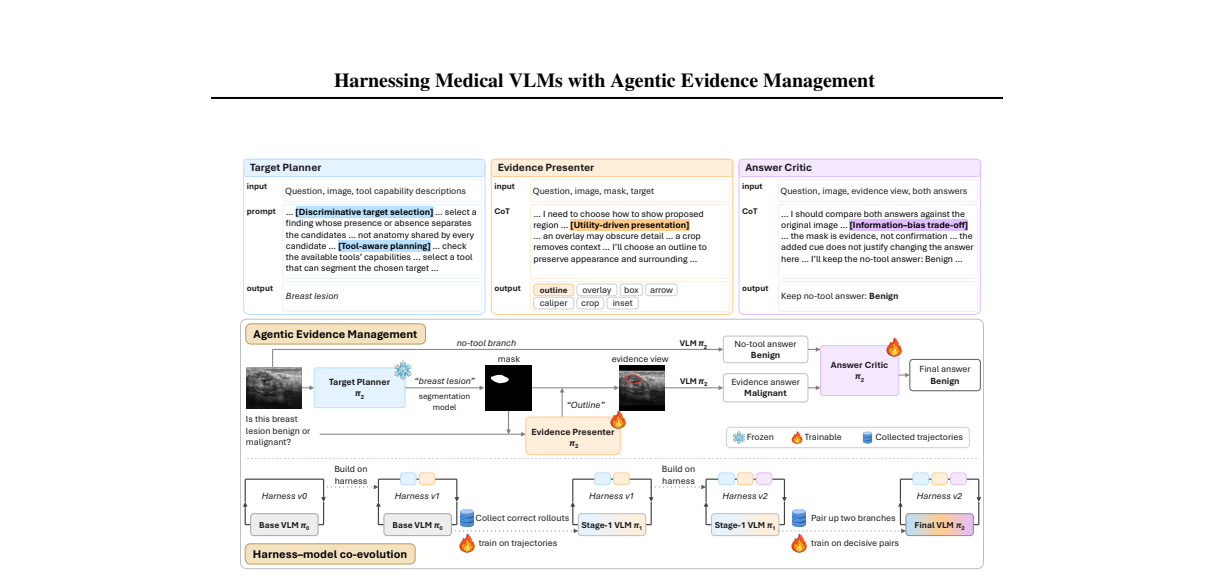
Current medical vision-language agents focus on acquiring the correct segmentation mask, often treating a good mask as the end point of tool use. The paper argues that even with a ground-truth mask, different visual renderings of the same mask can change the model's answer, and the mask can correct some answers while flipping others wrong. Thus, tool acquisition alone is insufficient; an agent must also manage how evidence is presented and whether the evidence warrants an answer update. The authors construct Mask-Evidence MedVQA, a benchmark isolating these factors, and propose TUNE (Tool Use is Not Enough), a harness that plans what evidence to acquire, selects how to render it, and compares original vs. evidence-conditioned answers to decide on the final answer. TUNE improves over direct tool use by 9.1 percentage points on average across seven benchmarks, and achieves competitive results against existing medical VLMs and agents.
What carries the argument. The TUNE harness consists of three stages managed by a shared VLM with role-specific prompts: (1) the Target Planner, which proposes a discriminative semantic target for segmentation that can distinguish among candidate answers; (2) the Evidence Presenter, which selects one of 12 deterministic rendering interfaces (overlay, outline, caliper, crop, inset, etc.) based on the question, image, and mask geometry, learned from rollout trajectories; and (3) the Answer Critic, which compares the no-tool answer and the evidence-conditioned answer, trained on decisive pairs where exactly one candidate is correct, and selects the final answer. The harness and VLM co-evolve: a first harness generates successful presentation trajectories for fine-tuning, then a second harness collects decisive answer pairs for critic training, using the updated model.
Core claim. The paper establishes that even perfect segmentation masks are not sufficient for reliable medical VLM tool use because (1) different renderings of the same fixed mask substantially change model behavior, and (2) a ground-truth mask can both correct initially wrong answers and turn initially correct ones wrong, revealing an information–bias trade-off. Therefore, an agent must decide not only what evidence to acquire but also how to present it and whether to accept the resulting answer update. The proposed TUNE harness operationalizes this by combining a target planner, an evidence presenter that learns to select from 12 interface styles based on answer utility, and an answer critic that compares no-tool and evidence-conditioned predictions and selects the correct one, trained on decisive answer pairs. TUNE achieves a 9.1 percentage point average accuracy gain over direct tool use across seven datasets and a 4.0 point gain on three public medical VQA benchmarks.
The premise it rests on. The paper assumes that the 12-element interface library spans the useful ways to present a mask, and the answer critic is trained only on decisive pairs (where exactly one answer is correct) but applied to all pairs where answers differ, including non-decisive pairs (both correct or both wrong), which constitute 86.7% of disagreements; the critic's accuracy on non-decisive pairs is not reported, and poor performance there could reduce or eliminate the overall gain from evidence management.
If the paper is right (Pith's inferences, not the authors')
If TUNE's approach is correct, medical VLM agent design must include explicit evidence management stages beyond mask acquisition, and evaluation benchmarks should incorporate multiple renderings per mask to separate evidence use from segmentation quality.
The information–bias trade-off implies that even perfect evidence can reduce accuracy, so response-review mechanisms that compare tool-conditioned and tool-free answers should become standard in agent pipelines.
The co-evolution recipe (harness-generated trajectories improving the model, which then informs a better harness) could be applied to other tool-use domains where supervision for intermediate decisions is scarce.
The Answer Critic's reliance on decisive pairs for training, while ignoring the 86.7% of non-decisive disagreements, suggests that the reported gains may be partly due to effective handling of decisive pairs; the impact on non-decisive cases deserves careful evaluation to confirm overall robustness.
Many existing medical VLM agents that rely on overlay renderings may be systematically underestimating the evidence utility: the paper shows that interface choice can shift accuracy by over 10 percentage points, so a default overlay could be suboptimal for many questions.
The fact that different image types (e.g., COVID chest X-ray vs. colonoscopy) prefer different interfaces suggests that presentation selection should be learned per modality or per question type rather than set globally, which the TUNE Presenter does.
If the Critic performs poorly on non-decisive pairs (where both answers are correct or both wrong), the 68% tool-selection rate on those pairs could introduce noise that erodes overall gains; a future study could measure Critic accuracy on non-decisive pairs explicitly or restrict Critic invocation to decisive disagreements only.
Check this review
What was read
The passes were given all 104,488 characters of the paper's LaTeX source.
Fingerprint of that text (SHA-256): a164184fce183e64093ac1dd817aa14c5164f5cbd03d3fe14680086331830a66
Pith does not keep that text. Rebuilt from the paper's source or PDF by the same code, it has this fingerprint if it is the same text. From a copy of Pith's code:
PYTHONPATH=. python scripts/review_input_check.py 2611.25840
The passes, in the order they ran
- Reader deepseek-v4-flash · medium effort · $0.0023 · instructions of the Reader, fingerprint f9ead7300382…
- Skeptic deepseek-v4-flash · medium effort · $0.0022 · instructions of the Skeptic, fingerprint 8f88c0f61488…
- Referee deepseek-v4-flash · medium effort · $0.0021 · instructions of the Referee, fingerprint a852d99aea0d…
- Check against the paper deepseek-v4-flash · medium effort · $0.0032 · instructions of the Check against the paper, fingerprint 6c7a6883d551…
- Circularity check deepseek-v4-flash · medium effort · $0.0017 · instructions of the Circularity check, fingerprint e9946e39d67b…
- Summary for the page deepseek-v4-flash · medium effort · temperature 0.2 · $0.0021 · instructions of the Summary for the page, fingerprint e4f56bf568e7…
The passes cost $0.014 in model calls together.
Version stamped on this review: pith-pipeline@v1.4.1-daily-deepseek-or-medium+deepseek/deepseek-v4-flash+p.ce10e2b95288
Each link opens a pass's instructions as plain text, the exact bytes its fingerprint was taken over. Every stored set of instructions.
curl -s https://pith.science/methodology/prompts/f9ead730038216984cfb56d7cb34332bdf691828296a1de4245f3d6667d4bf56 | sha256sum
prints the fingerprint of the reader's instructions. The same works for every pass.
The receipt
The review's fingerprint was taken on 20 Nov 2026. The review you are reading still matches it.
Fingerprint of the review (SHA-256): 54b0b69697326ed1718567d2212945674d1bda96579115f6381444c94a25d2ca
curl -s 'https://pith.science/api/v1/verdicts/2611.25840?form=canonical' | sha256sum
prints the fingerprint of the review as it stands now. The rule, in four steps.
A matching fingerprint shows the review has not changed since that date. It does not show that the review is right.
How often reviews like this one are right
Reviews like this one: written by deepseek-v4-flash, from the paper's LaTeX source.
How often objections from reviews like this one are right: not yet measured
Reviews by people
This review was written by a machine. No person has reviewed this paper on Pith yet. A scientist listed on Pith can review it for a fee, and their review is published here whatever it concludes.
The paper
Abstract
Medical vision-language agents increasingly rely on segmentation tools, and recent work has focused on acquiring the right mask, often treating a good mask as the end point of tool use. But do these agents use the resulting evidence effectively? To answer this question, we need a benchmark that separates evidence use from segmentation quality, spans multiple medical image types, and allows the same mask to be presented in different ways. Existing medical VQA datasets do not jointly provide these properties. We therefore construct Mask-Evidence MedVQA, a 2.5K-example benchmark spanning four image types, where each question is paired with an answer-relevant ground-truth mask and multiple possible renderings. Our study reveals two limitations of direct tool use. First, evidence presentation matters. Different renderings of the same fixed mask can substantially change model behavior. Second, masks introduce an evidence trade-off. Highlighting a relevant region can expose diagnostic evidence the model previously missed, but the added visual cue can also induce incorrect associations. As a result, even a ground-truth mask can correct some answers while turning initially correct ones into incorrect ones. Together, these findings show that acquiring the right mask is not enough. An agent must also decide how to present the evidence and whether it should change the answer. We therefore introduce TUNE (Tool Use is Not Enough), an evidence-management harness that explicitly manages what evidence to acquire, how to present it, and whether to accept the resulting answer update. Across three public medical VQA benchmarks, evidence management improves the fine-tuned Qwen3.5-9B backbone's mean accuracy by 4.0 percentage points. Full TUNE improves over direct tool use by 9.1 points on average across seven benchmarks and achieves competitive results against existing medical VLMs and agents.
The paper's own sentences, arranged, kept beside the review and separate from it. Each label is drawn from a closed vocabulary; the number beside it is the probability the classifier gave that label. No sentence in this record was written by a model.
abstract compiled · 2026-11-20
The authors' main claim, as the classifier picked it out 0.82
“Together, these findings show that acquiring the right mask is not enough.”
How the main claim is stated: asserted 1.00
What the abstract itself states, as probabilities: claims first 0.14 · states limitation 0.29 · human participants 0.11 · controlled comparison 0.93 · randomized assignment 0.02 · states quantitative result 0.99 · compares with prior results 0.97 · mentions code or data availability 0.06
The abstract, sentence by sentence
This table labels the abstract only (arXiv listing abstract v1). The number is the probability the classifier gave the label.
| Sentence | Role | The authors' own work | States the main conclusion | Strength |
|---|---|---|---|---|
| Medical vision-language agents increasingly rely on segmentation tools, and recent work has focused on acquiring the right mask, often treating a good mask as the end point of tool use. | background 1.00 | 0.04 | 0.02 | asserted 0.99 |
| But do these agents use the resulting evidence effectively? | gap 0.89 | 0.04 | 0.02 | unclear 0.94 |
| To answer this question, we need a benchmark that separates evidence use from segmentation quality, spans multiple medical image types, and allows the same mask to be presented in different ways. | gap 0.88 | 0.09 | 0.03 | asserted 0.84 |
| Existing medical VQA datasets do not jointly provide these properties. | gap 0.99 | 0.11 | 0.02 | asserted 1.00 |
| We therefore construct Mask-Evidence MedVQA, a 2.5K-example benchmark spanning four image types, where each question is paired with an answer-relevant ground-truth mask and multiple possible renderings. | contribution 0.62 | 0.95 | 0.04 | asserted 1.00 |
| Our study reveals two limitations of direct tool use. | result 0.87 | 0.87 | 0.07 | asserted 1.00 |
| First, evidence presentation matters. | result 0.92 | 0.72 | 0.06 | asserted 1.00 |
| Different renderings of the same fixed mask can substantially change model behavior. | result 1.00 | 0.90 | 0.07 | asserted 0.99 |
| Second, masks introduce an evidence trade-off. | result 0.89 | 0.73 | 0.07 | asserted 0.99 |
| Highlighting a relevant region can expose diagnostic evidence the model previously missed, but the added visual cue can also induce incorrect associations. | result 0.89 | 0.86 | 0.08 | asserted 0.62 |
| As a result, even a ground-truth mask can correct some answers while turning initially correct ones into incorrect ones. | result 0.90 | 0.89 | 0.10 | asserted 0.99 |
| Together, these findings show that acquiring the right mask is not enough. | interpretation 0.99 | 0.74 | 0.43 | asserted 1.00 |
| An agent must also decide how to present the evidence and whether it should change the answer. | interpretation 0.99 | 0.55 | 0.50 | asserted 1.00 |
| We therefore introduce TUNE (Tool Use is Not Enough), an evidence-management harness that explicitly manages what evidence to acquire, how to present it, and whether to accept the resulting answer update. | contribution 0.87 | 0.94 | 0.28 | asserted 0.99 |
| Across three public medical VQA benchmarks, evidence management improves the fine-tuned Qwen3.5-9B backbone's mean accuracy by 4.0 percentage points. | result 1.00 | 0.96 | 0.12 | asserted 1.00 |
| Full TUNE improves over direct tool use by 9.1 points on average across seven benchmarks and achieves competitive results against existing medical VLMs and agents. | result 1.00 | 0.96 | 0.26 | asserted 1.00 |
What kind of paper the classifier reports this is: method or tool 0.52 · evidence from observation or experiment 1.00
What was examined, and what was not
Sources read
- arXiv listing abstract v1
Not examined
- full text
- figures and tables
- references and citing sentences
- relations to other papers
Levels run
- P abstract
Not run
- S sections
- T body sentences
- C citations
- R cross-paper relations
How the labels were made
Compiled by classifier-1.13.0 via TypeSafe API, question bank abstract-p1-20260923, 2026-11-20: 1 request, 11,241 input tokens.
Every quoted sentence on this record is the authors'. Every label is from Pith's closed vocabulary, with the probability shown beside it. This record as JSON
Figures (3)
Figures are the authors', reproduced from the paper.
References (45)
- [1] Walid Al-Dhabyani, Mohammed Gomaa, Hussien Khaled, and Aly Fahmy. Dataset of breast ultrasound images. Data in Brief, 28: 0 104863, February 2020. ISSN 2352-3409 on Pith
- [2] Anthropic . Introducing Claude Opus 5 , 2026. URL https://www.anthropic.com/news/claude-opus-5 on Pith
- [3] Junying Chen, Chi Gui, Ruyi Ouyang, Anningzhe Gao, Shunian Chen, Guiming Hardy Chen, Xidong Wang, Ruifei Zhang, Zhenyang Cai, Ke Ji, Guangjun Yu, Xiang Wan, and Benyou Wang. Huatuogpt-vision, towards injecting medical visual knowledge into multimodal llms at scale. CoRR, abs/2... on PithPith's reviewarXiv
- [4] Stefan Denner, Markus Bujotzek, Dimitrios Bounias, David Zimmerer, Raphael Stock, and Klaus Maier-Hein. Visual prompt engineering for vision language models in radiology. arXiv preprint arXiv:2408.15802, 2024 on PithPith's reviewarXiv
- [5] Yuexi Du, Jinglu Wang, Shujie Liu, Nicha C. Dvornek, and Yan Lu. CARE : Towards clinical accountability in multi-modal medical reasoning with an evidence-grounded agentic framework. arXiv preprint arXiv:2603.01607, 2026 on PitharXiv
- [6] Adibvafa Fallahpour, Jun Ma, Alif Munim, Hongwei Lyu, and Bo Wang. Medrax: Medical reasoning agent for chest x-ray. arXiv preprint arXiv:2502.02673, 2025 on PithPith's reviewarXiv
- [7] Google DeepMind . Gemini 3.7 Flash model card, 2026 a . URL https://deepmind.google/models/model-cards/gemini-3-7-flash/ on Pith
- [8] Google DeepMind . Gemma 4 model card, 2026 b . URL https://ai.google.dev/gemma/docs/core/model_card_4 on Pith
- [9] Guangfu Guo, Xiaoqian Lu, and Yue Feng. Med-vragent: a framework for medical visual reasoning-enhanced agents. In Proceedings of the 2025 Conference on Empirical Methods in Natural Language Processing, pages 18613--18627, 2025 on Pith
- [10] Xuehai He, Yichen Zhang, Luntian Mou, Eric Xing, and Pengtao Xie. Pathvqa: 30000+ questions for medical visual question answering. arXiv preprint arXiv:2003.10286, 2020 on PithPith's reviewarXiv
- [11] Yutao Hu, Tianbin Li, Quanfeng Lu, Wenqi Shao, Junjun He, Yu Qiao, and Ping Luo. Omnimedvqa: A new large-scale comprehensive evaluation benchmark for medical LVLM . In IEEE/CVF Conference on Computer Vision and Pattern Recognition, CVPR 2024, Seattle, WA, USA, June 16-22, 2024... on Pith
- [12] Yukun Huang, Sanxing Chen, Hongyi Cai, and Bhuwan Dhingra. To trust or not to trust? enhancing large language models' situated faithfulness to external contexts, 2025. arXiv:2410.14675 on PithPith's reviewarXiv
- [13] Sarah Jabbour, David Fouhey, Ella Kazerooni, Michael W Sjoding, and Jenna Wiens. Deep learning applied to chest x-rays: exploiting and preventing shortcuts. In Machine Learning for Healthcare Conference, pages 750--782. PMLR, 2020 on Pith
- [14] Helena Jambor, Alberto Antonietti, Bradly Alicea, Tracy L Audisio, Susann Auer, Vivek Bhardwaj, Steven J Burgess, Iuliia Ferling, Ma gorzata Anna Gazda, Luke H Hoeppner, et al. Creating clear and informative image-based figures for scientific publications. PLoS biology, 19 0 (... on Pith
- [15] Yankai Jiang, Yujie Zhang, Peng Zhang, Wenjie Li, Yichen Li, Jintai Chen, Xiaoming Shi, and Shihui Zhen. Ophiuchus: Incentivizing tool-augmented ``think with images'' for joint medical segmentation, understanding and reasoning. arXiv preprint arXiv:2512.14157, 2025 a . Version... on PithPith's reviewarXiv
- [16] Yuhua Jiang, Yuwen Xiong, Yufeng Yuan, Chao Xin, Wenyuan Xu, Yu Yue, Qianchuan Zhao, and Lin Yan. Pag: Multi-turn reinforced llm self-correction with policy as generative verifier, 2025 b . arXiv:2506.10406 on PithPith's reviewarXiv
- [17] Phan Ngoc Lan, Nguyen Sy An, Dao Viet Hang, Dao Van Long, Tran Quang Trung, Nguyen Thi Thuy, and Dinh Viet Sang. Neounet : Towards accurate colon polyp segmentation and neoplasm detection. In George Bebis, Vassilis Athitsos, Tong Yan, Manfred Lau, Frederick W. B. Li, Conglei S... on Pith
- [18] LASA Team , Weiwen Xu, Hou Pong Chan, Long Li, Mahani Aljunied, Ruifeng Yuan, Jianyu Wang, Chenghao Xiao, Guizhen Chen, Chaoqun Liu, Zhaodonghui Li, Yu Sun, Junao Shen, Chaojun Wang, Jie Tan, Deli Zhao, Tingyang Xu, Hao Zhang, and Yu Rong. Lingshu: A generalist foundation mode... on PithPith's reviewarXiv
- [19] Jason J. Lau, Soumya Gayen, Asma Ben Abacha, and Dina Demner-Fushman. A dataset of clinically generated visual questions and answers about radiology images. Scientific Data, 5 0 (1), November 2018. ISSN 2052-4463 on Pith
- [20] Jungyeon Lee, Yejin Yoon, and Taeuk Kim. Same semantics, different outcome: On the modality robustness of multimodal llms under knowledge conflict, 2026. arXiv:2609.00550 on PithPith's reviewarXiv
show 25 more
- [21] Binxu Li, Tiankai Yan, Yuanting Pan, Jie Luo, Ruiyang Ji, Jiayuan Ding, Zhe Xu, Shilong Liu, Haoyu Dong, Zihao Lin, and Yixin Wang. Mmedagent: Learning to use medical tools with multi-modal agent. arXiv preprint arXiv:2407.02483, 2024 on PithPith's reviewarXiv
- [22] Chunyuan Li, Cliff Wong, Sheng Zhang, Naoto Usuyama, Haotian Liu, Jianwei Yang, Tristan Naumann, Hoifung Poon, and Jianfeng Gao. Llava-med: Training a large language-and-vision assistant for biomedicine in one day. In Alice Oh, Tristan Naumann, Amir Globerson, Kate Saenko, Mor... on Pith
- [23] Bo Liu, Li-Ming Zhan, Li Xu, Lin Ma, Yan Yang, and Xiao-Ming Wu. Slake: A semantically-labeled knowledge-enhanced dataset for medical visual question answering. arXiv preprint arXiv:2102.09542, 2021 on PithPith's reviewarXiv
- [24] Jun Ma, Yuting He, Feifei Li, Lin Han, Chenyu You, and Bo Wang. Segment anything in medical images. Nature Communications, 15 0 (1), January 2024. ISSN 2041-1723 on Pith
- [25] Meta . Llama 3.2-Vision model card, 2024. URL https://github.com/meta-llama/llama-models/blob/main/models/llama3_2/MODEL_CARD_VISION.md on Pith
- [26] Andriy Myronenko, Dong Yang, Yufan He, and Daguang Xu. Automated 3d segmentation of kidneys and tumors in miccai kits 2023 challenge. In International Challenge on Kidney and Kidney Tumor Segmentation, pages 1--7. Springer, 2023 on Pith
- [27] Dung Nguyen, Minh Khoi Ho, Huy Ta, Thanh Tam Nguyen, Qi Chen, Kumar Rav, Quy Duong Dang, Satwik Ramchandre, Son Lam Phung, Zhibin Liao, Minh-Son To, Johan Verjans, Phi Le Nguyen, and Vu Minh Hieu Phan. Localizing before answering: A benchmark for grounded medical visual questi... on Pith
- [28] OpenAI . GPT-5.6 : Frontier intelligence that scales with your ambition, 2026. URL https://openai.com/index/gpt-5-6/ on Pith
- [29] Jiazhen Pan, Che Liu, Junde Wu, Fenglin Liu, Jiayuan Zhu, Hongwei Bran Li, Chen Chen, Cheng Ouyang, and Daniel Rueckert. Medvlm-r1: Incentivizing medical reasoning capability of vision-language models (vlms) via reinforcement learning. In James C. Gee, Daniel C. Alexander, Jae... on Pith
- [30] Qwen Team . Qwen3.5-9B model card, 2026. URL https://huggingface.co/Qwen/Qwen3.5-9B on Pith
- [31] Andrew Sellergren, Sahar Kazemzadeh, Tiam Jaroensri, Atilla Kiraly, Madeleine Traverse, Timo Kohlberger, Shawn Xu, Fayaz Jamil, Cían Hughes, Charles Lau, Justin Chen, Fereshteh Mahvar, Liron Yatziv, Tiffany Chen, Bram Sterling, Stefanie Anna Baby, Susanna Maria Baby, Jeremy La... on PithPith's reviewarXiv
- [32] Aleksandar Shtedritski, Christian Rupprecht, and Andrea Vedaldi. What does clip know about a red circle? visual prompt engineering for vlms. arXiv preprint arXiv:2304.06712, 2023 on PithPith's reviewarXiv
- [33] Anas M. Tahir, Muhammad E.H. Chowdhury, Amith Khandakar, Tawsifur Rahman, Yazan Qiblawey, Uzair Khurshid, Serkan Kiranyaz, Nabil Ibtehaz, M. Sohel Rahman, Somaya Al-Maadeed, Sakib Mahmud, Maymouna Ezeddin, Khaled Hameed, and Tahir Hamid. Covid-19 infection localization and sev... on Pith
- [34] Yufei Tao and Ameeta Agrawal. No-worse context-aware decoding: Preventing neutral regression in context-conditioned generation. In Findings of the Association for Computational Linguistics: ACL 2026, pages 9736--9751, 2026 on Pith
- [35] Sergio Tascon-Morales, Pablo M \'a rquez-Neila, and Raphael Sznitman. Targeted visual prompting for medical visual question answering. In Applications of Medical Artificial Intelligence, volume 15384 of Lecture Notes in Computer Science, pages 64--73. Springer, 2025 on Pith
- [36] Shengzhi Wang, Jun Yang, Kai Wu, Xiaozhong Ji, Yiwen Ye, Ziyang Chen, Mingliang Xiong, Wen Fang, Mingqing Liu, Mengyuan Xu, Miaoxuan Shan, Caiyan Liu, Bin He, and Qingwen Liu. MIRA : Medical image reflection for agentic diagnosis, 2026. arXiv:2608.10827 on PithPith's reviewarXiv
- [37] Julia K Winkler, Christine Fink, Ferdinand Toberer, Alexander Enk, Teresa Deinlein, Rainer Hofmann-Wellenhof, Luc Thomas, Aimilios Lallas, Andreas Blum, Wilhelm Stolz, et al. Association between surgical skin markings in dermoscopic images and diagnostic performance of a deep ... on Pith
- [38] Jinge Wu, Yunsoo Kim, and Honghan Wu. Hallucination benchmark in medical visual question answering. arXiv preprint arXiv:2401.05827, 2024 on PithPith's reviewarXiv
- [39] Ting Yu, Zixuan Tong, Jun Yu, and Ke Zhang. Fine-grained adaptive visual prompt for generative medical visual question answering. In Proceedings of the AAAI Conference on Artificial Intelligence, volume 39, pages 9662--9670, 2025 on Pith
- [40] Xiaoman Zhang, Chaoyi Wu, Ziheng Zhao, Weixiong Lin, Ya Zhang, Yanfeng Wang, and Weidi Xie. PMC-VQA: visual instruction tuning for medical visual question answering. CoRR, abs/2305.10415, 2023 on PithPith's reviewarXiv
- [41] Theodore Zhao, Yu Gu, Jianwei Yang, Naoto Usuyama, Ho Hin Lee, Sid Kiblawi, Tristan Naumann, Jianfeng Gao, Angela Crabtree, Jacob Abel, Christine Moung-Wen, Brian Piening, Carlo Bifulco, Mu Wei, Hoifung Poon, and Sheng Wang. A foundation model for joint segmentation, detection... on Pith
- [42] Yufeng Zhao, Junnan Liu, Hongwei Liu, Dongsheng Zhu, Yuan Shen, Songyang Zhang, and Kai Chen. When tools hurt llm reasoning: State-dependent belief revision under external evidence, 2026. arXiv:2508.15754 on PithPith's reviewarXiv
- [43] Ziwei Zheng, Michael Yang, Jack Hong, Chenxiao Zhao, Guohai Xu, Le Yang, Chao Shen, and Xing Yu. Deepeyes: Incentivizing "thinking with images" via reinforcement learning. arXiv preprint arXiv:2505.14362, 2025 on PithPith's reviewarXiv
- [44] Jinguo Zhu, Weiyun Wang, Zhe Chen, Zhaoyang Liu, Shenglong Ye, Lixin Gu, Hao Tian, Yuchen Duan, Weijie Su, Jie Shao, Zhangwei Gao, Erfei Cui, Xuehui Wang, Yue Cao, Yangzhou Liu, Xingguang Wei, Hongjie Zhang, Haomin Wang, Weiye Xu, Hao Li, Jiahao Wang, Nianchen Deng, Songze Li,... on PithPith's reviewarXiv
- [45] Kangyu Zhu, Ziyuan Qin, Huahui Yi, Zekun Jiang, Qicheng Lao, Shaoting Zhang, and Kang Li. Guiding medical vision-language models with diverse visual prompts: Framework design and comprehensive exploration of prompt variations. In Proceedings of the 2025 Conference of the Natio... on Pith
Challenges and discussion
Disagree with the review, or know something it missed? Leave a comment, or challenge this review formally: a challenge becomes a permanent entry in this paper's record, and its decision is published here.
Come back by email
A short list of the week's newly reviewed papers. Nothing is sent until you confirm from your inbox, and every email has a link that stops it. No account.
No comments yet.
Sign in to comment