Computation and Language · arXiv:2609.00550 v1 · submitted 1 Sep 2026 · 55 references
Same Semantics, Different Outcome: On the Modality Robustness of Multimodal LLMs under Knowledge Conflict
The paper says
“Multimodal large language models (MLLMs) are increasingly provided with contextual evidence in heterogeneous forms: as a text passage, as a rendered image of the same passage, or as both together.”
more of the abstract
However, it remains unclear how consistently these surface forms are processed, especially when the evidence conflicts with the model's parametric knowledge. We study modality robustness under knowledge conflict across 13 MLLMs and two datasets, and find them far from robust. (1) Contrary to common belief, models favor a context that contradicts parametric knowledge more readily in image form than in text form; (2) when a contradicting text and image are presented together, the preferred modality is essentially arbitrary, varying with input order, model, and dataset. We further demonstrate that this instability has practical consequences: it degrades performance in multimodal RAG and can be exploited by adversarial attacks. To alleviate this brittleness, we examine several simple techniques—prompting, steering, supervised fine-tuning (SFT), and direct preference optimization; the majority prove ineffective, whereas SFT achieves moderate success. We therefore call for greater awareness of this inconsistency and argue that it is fundamental, demanding attention at multiple training stages.
from the abstract
Pith says
Machine review · deepseek-v4-flash · 9 Sep 2026 · what was read was not recorded · not checked by a person
It can be wrong. Challenge this review or reply to it.
Holds up, with conditions. A solid empirical correction to the oversold 'text bias' narrative — the instability claim holds up, though the paper's quantitative rigor is thinner than it should be. This line is wrong
3 major objections · 6 minor
How often objections from reviews like this one are right: not yet measured
Not checked: figures, code, what the 55 references say.
The paper says, at Section 3.1, Section 7.2, Appendix A.1
The review did not quote this passage.
Pith says: Objection 1 of 3 · major
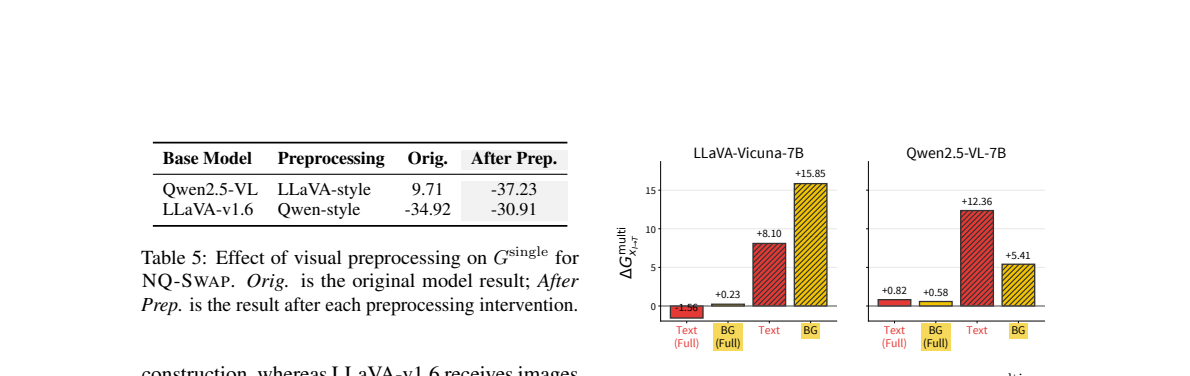
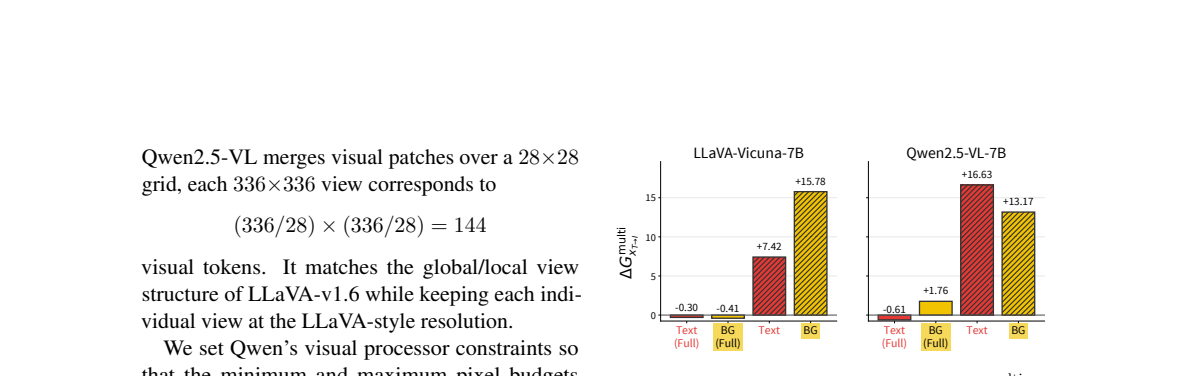
The single-evidence result that MLLMs prefer image-rendered evidence over text is not fully identified as a modality effect, because the default renderer may impose uncontrolled answer salience. The paper verifies OCR readability and shows that global color/background perturbations are nearly inert, but Section 7.2 and Figure 5 show that highlighting the answer-bearing span changes Gmulti by 5.41 to 16.63 points.
more of objection 1
The default renderer in Appendix A.1 uses adaptive width, center alignment, and pixel-based word wrapping, so the vertical position and line breaks of the answer token vary across instances; the text condition carries no equivalent visual prominence. Since the absolute single-evidence differences in Table 9 are mostly in the 3 to 32 percentage-point range, a substantial part of Gsingle could reflect rendering salience rather than modality. The conclusion in Section 8 ('Modality preference is thus better understood as an artifact of the evaluation setup') is consistent with this concern, but then the single-evidence reversal should be stated as presentation-dependent rather than image-specific. A concrete fix is to rerun the single-evidence comparison with at least one alternative renderer (e.g., line breaks matched to the text passage, or the answer forced to a fixed relative position), and to report Gsingle under both templates.
The paper says, at Section 3.2, Table 8, Section 5.2
The review did not quote this passage.
Pith says: Objection 2 of 3 · major
The quantitative layer of the paper is under-specified. EFR is computed from exactly three generations per prompt, but no temperature, sampling seed, or decoding configuration is reported, and it is not stated whether the three generations are at temperature zero.
more of objection 2
All headline quantities, including the 8/13 and 6/13 aggregate sign flips, the per-instance flip ratios in Table 8, and the average +6.99 percentage-point ASR increase in Section 5.2, are point estimates without confidence intervals or significance tests. Several flip ratios are small in magnitude, and the ASR increases vary across cells, so sampling noise is a plausible alternative explanation for some claims. Please report the decoding settings, justify the choice of three samples, and provide bootstrap confidence intervals or significance tests for the aggregate sign-flip and ASR claims.
The paper says, at Section 6, Appendix C, Tables 3 and 4
The review did not quote this passage.
Pith says: Objection 3 of 3 · major
The fine-tuning and DPO comparisons do not use matched baselines. The main experiments use vLLM while the mitigation experiments use Hugging Face Transformers, and Appendix C explicitly concedes that backend differences may produce different values, yet Tables 3 and 4 compare intervention results against 'Original' values that mix Table 1 numbers with newly computed subsets.
more of objection 3
For example, Table 3 takes the original multi T→I value as 73.82, matching Table 1, while Table 4 reports a DPO-equivalent original of 68.47 and a steering-equivalent original of 77.77; the single-evidence originals in Table 3 (2.54 and 3.45) do not match the 4.09 value in Table 1. The claimed SFT improvement from 73.82 to 52.04 could therefore be partly an artifact of inference backend or evaluation subset. Please re-measure every 'Original' row with the same backend, evaluation subset, and decoding settings as the intervention rows, and report the raw EFR values for each baseline.
6 minor objections
The paper says, at Table 3
Pith says: minor objection 1 of 6
The header structure is confusing: the labels 'False' and 'True' appear to span blocks of columns, but it is not immediately clear which columns correspond to misleading versus reliable evidence and which correspond to single-evidence versus multi-evidence settings.
The paper says, at Section 5.1, Figure 3
Pith says: minor objection 2 of 6
Gemini 2.5 Pro appears in the RAG experiment, but the model list in Section 3.2 includes only Claude, GPT, Qwen, MiniCPM, OmniVinci, InternVL, and LLaVA; please specify which Gemini version and API snapshot was used and why it appears only in this case study.
show 4 more
The paper says, at Section 5.1
Pith says: minor objection 3 of 6
The RAG experiment samples 170 MS MARCO v2.1 instances but does not describe the sampling procedure, and Figure 3 shows no error bars or per-instance distributions; please add this information.
The paper says, at Section 3.2, Equation (1)
Pith says: minor objection 4 of 6
The EFR definition requires all three responses to equal the external answer exactly, while the footnote says normalized span matching is used; please clarify whether the three generations are matched before or after normalization and how alias handling interacts with the unanimity requirement.
The paper says, at Appendix C
Pith says: minor objection 5 of 6
There are several typos and formatting inconsistencies, including 'he resulting model' in C.2, 'redResults.' in C.3, and the inconsistent 'LLaV A' spacing throughout; these should be corrected.
The paper says, at Section 3.2, Equation (3)
Pith says: minor objection 6 of 6
The normalized gap G divides by EFR_I + EFR_T; when both rates are close to zero, small absolute differences can produce large normalized values. Since Table 9 shows that some cells have absolute EFR differences below 1 to 2 percentage points, please add a note about this amplification and consider reporting raw EFR values alongside G in the main text.
What would settle it
Take a random subset of 200 instances from NQ-SWAP single-evidence where the model shows positive Gsingle. For each, create three rendered variants of eI: (1) default rendering as in the paper, (2) answer-bearing sentence shifted to the top of the image by inserting blank lines after the passage, (3) answer-bearing sentence shifted to the bottom by prepending blank lines. Compute Gsingle for variant (1) vs text, and compare with Gsingle for variants (2) and (3). If Gsingle varies systematically by more than 5 percentage points across answer positions, the observed image preference is partially an artifact of default layout, not modality.
from the skeptic's reading
How the review went
4 readings by deepseek-v4-flash · 9 Sep 2026
- Reader holds up, with conditions
- Skeptic partly agrees
- Editor wrote the verdict above
- Referee major revision: 3 major objections, 6 minor
Not run on this paper: the simulated authors' defence.
Pith did not check this review's objections against the paper.
The review in full
The review in brief, machine-written
The paper does something genuinely useful: it shows, systematically, that the widely reported 'text bias' in MLLMs does not hold under knowledge conflict. Instead, modality preference flips with input order, model family, and dataset. That finding itself is worth publishing. The controlled setup — rendering the same passage as text and as an image, verifying parametric knowledge per model — is a real methodological step over earlier work, which mostly assumed parametric knowledge was fixed or used natural images with uncontrolled confounds. The downstream experiments (RAG, safety attacks) make the instability concrete, and the mitigation sweep (prompting, SFT, DPO, steering) is honest about how hard the problem is.
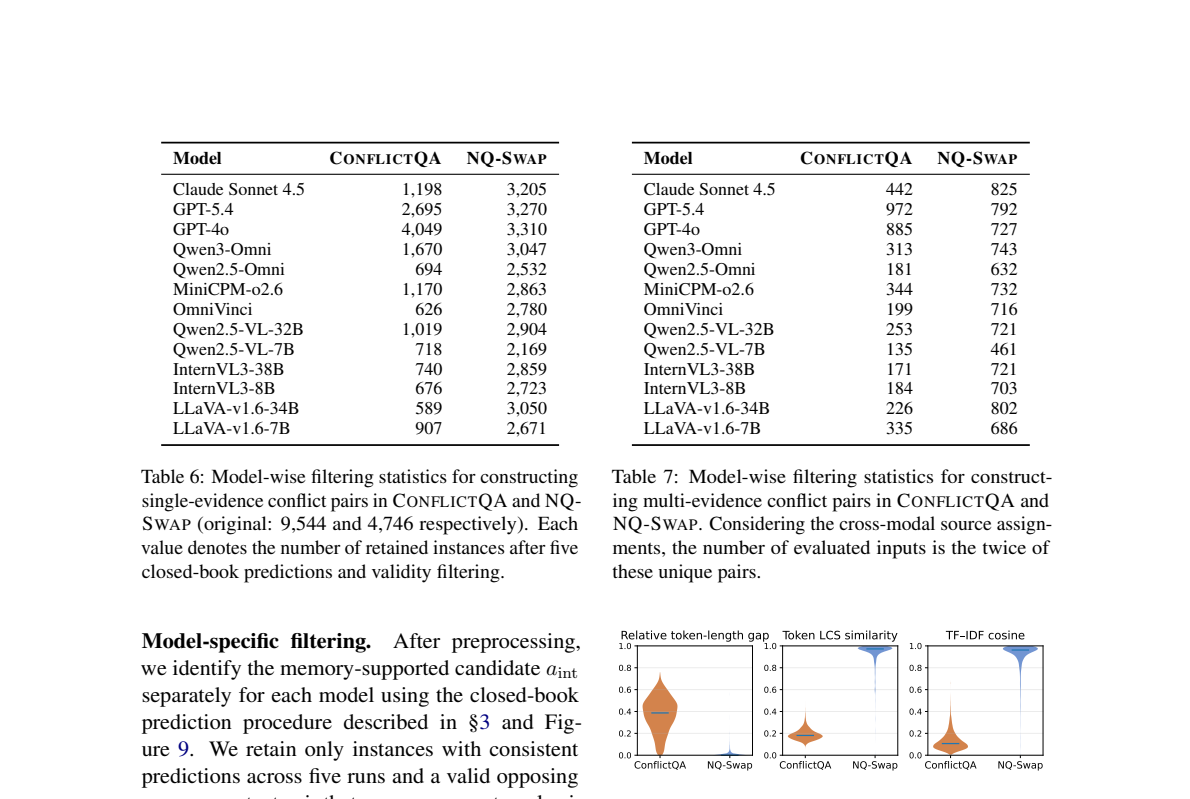
The soft spots are real but not fatal. The single-evidence image preference is the headline claim, but it rests on only three generations per prompt with no confidence intervals, and the model-wise filtering makes the comparison across models apples-to-oranges (instance counts vary by an order of magnitude). The abstract says 'models favor a context that contradicts parametric knowledge more readily in image form', but several models (LLaVA) show the opposite — the paper's own data weaken the directional claim. The rendering template concern from the stress test is partially addressed by the perturbation checks (global color/background shifts <2 points), but the answer-span highlighting shift (5–16 points) shows that visual salience matters, and the default rendering is not proven inert. I don't think this undermines the multi-evidence instability results, which are more varied, but the single-evidence finding is less certain than the paper suggests. No code or data released, and three proprietary models can't be rerun.
This paper deserves a serious referee. The core empirical contribution stands; the quantitative weaknesses can be addressed with confidence intervals, matched-instance analysis, and a softened abstract. I'd bring it to a reading group and would cite it for the instability finding alone.
Recommendation: send to peer review, but expect requests for uncertainty quantification, matched comparisons, and released artifacts before acceptance.
The strongest objection
The central assumption that rendering is semantically lossless is only partially tested. The paper verifies readability (ROUGE-L >= 98.37) and tests global color/background changes (<2 point shift) and answer-span highlighting (5-16 point shift). However, the default rendering template — adaptive width, left-aligned black text on white — imposes specific line breaks, vertical spacing, and answer position within the rendered image. These could systematically make the answer more or less salient compared to the text condition, where the answer is embedded in a passage. The perturbation tests change appearance uniformly across the whole image, leaving the relative vertical position and word-wrapping of the answer unchanged. The paper's own Figure 5 shows that highlighting the answer span (changing its visual salience) shifts Gmulti by 5-16 points. This demonstrates that visual formatting choices that go beyond global appearance can alter modality preference. Consequently, the single-evidence finding that models prefer image over text might partially reflect the salience of the answer in the default rendering rather than modality itself. The multi-evidence flip ratios are less affected because both modalities are present, but the asymmetry in G values between datasets (e.g., NQ-SWAP vs CONFLICTQA) could be influenced by how the answer entities appear in the rendered passage.
The reader identified the rendering assumption as weakest, focusing on semantic losslessness and checking readability and global perturbations. My concern goes deeper: even if text is readable and global appearance is irrelevant, the default rendering's answer position, line breaks, and spacing could introduce systematic visual salience biases that the paper's perturbation tests do not capture because those tests leave the answer's relative visual position unchanged. This is load-bearing because the single-evidence image preference finding (a headline result) would be weakened if it is partially due to layout rather than modality. However, I set verdict_should_be to UNCHANGED because the multi-evidence findings (order sensitivity, flip ratios) do not rely on the single-evidence rendering assumption as heavily: in multi-evidence, both modalities are present and the comparison is about which evidence the model follows when they conflict, which is less susceptible to layout artifacts since both conditions share the same visual presentation. The paper's core claim of instability across order, model, and dataset is still well-supported. I partially agree with the reader because we both identify the rendering as critical, but I argue the checks are insufficient in a more specific way.
The referee's report
If the central instability claim survives scrutiny, this is an important correction to the prevailing text-bias narrative for MLLMs, with direct implications for RAG design and safety evaluation. The study has genuine methodological strengths: it filters instances according to each model's parametric knowledge, uses two complementary knowledge-conflict benchmarks, reports model-wise filtering statistics, verifies OCR readability of rendered evidence, and includes perturbation and preprocessing analyses that go beyond what is typical in this literature. The paper is also commendably transparent about the failure of most mitigation strategies, which is valuable negative evidence. The main barriers are not circularity or lack of novelty; they are the rendering-confounding question and the under-specified quantitative layer, both of which are addressable experimentally.
Pith's reading of the paper (a machine's summary, not the authors')
This paper asks whether multimodal large language models resolve knowledge conflicts consistently when the same external evidence arrives as plain text or as a rendered image of that text. Across 13 models and two datasets, it finds they do not: in the single-evidence setting, models follow evidence that contradicts their own memory more readily as an image than as text — the opposite of the text bias widely reported in prior work — and when a contradicting text and image are presented together, the preferred modality flips with input order, model family, and dataset construction. The authors conclude that modality preference under knowledge conflict is an artifact of the evaluation setup rather than a fixed property of the model. A sympathetic reader should care because the finding lands directly on deployed pipelines: changing only the surface form of a retrieved passage changes question-answering results in multimodal RAG, and moving a harmful instruction into an image raises refusal-failure rates by about 7 percentage points on average.
What carries the argument. The load-bearing construction is the text-as-image rendering template: the evidence passage is drawn as black DejaVuSans text on a white background at 24 points, with pixel-width line wrapping and an adaptive canvas, so the image condition is a rendered image of the text condition. The argument is carried by two metrics. The external-source following rate (EFR) credits a model only when three repeated responses all match the evidence-supported answer, and the normalized image-over-text gap $G$ rescales the image-minus-text EFR difference by their sum, so positive values mean image preference and negative values text preference, bounded in $[-100,100]$. Two ordered multi-evidence prompts, $x_{I\to T}$ and $x_{T\to I}$, embed the same two conflicting pieces of evidence in opposite orders, turning input order into the manipulated variable. Per-model closed-book filtering with unanimous agreement across five answer samples aligns the factual context with each model's own parametric answer, ensuring the measured conflict is genuinely between memory and external evidence rather than between two levels of a single surface form.
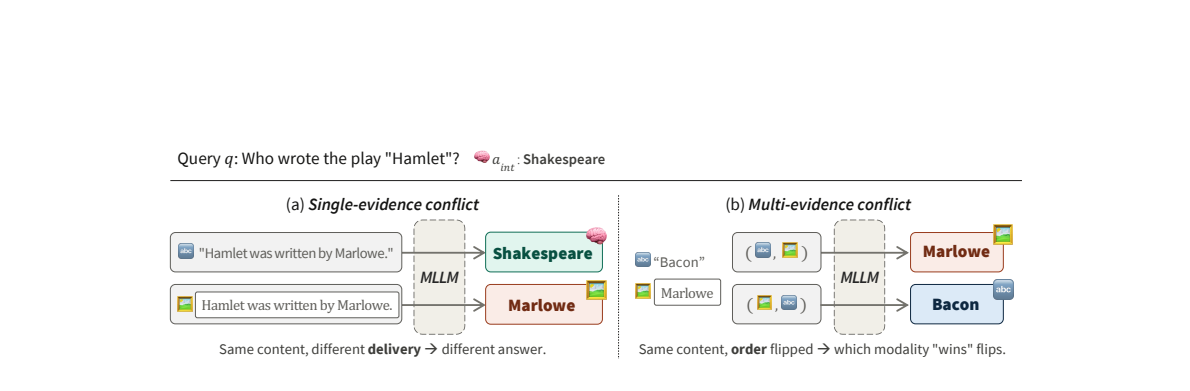
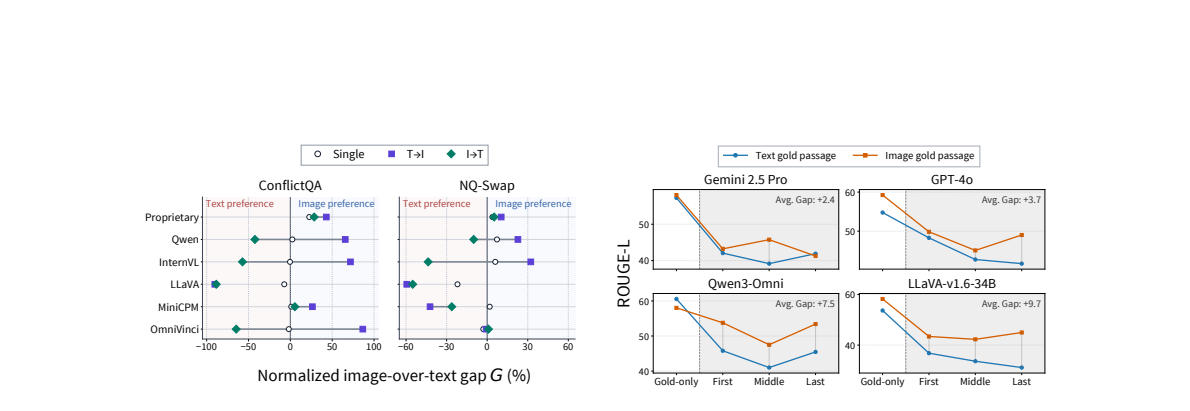
Core claim. The central claim is that multimodal LLMs are not modality-robust under knowledge conflict: the same evidence, delivered as text or as a rendered image of that text, is not processed as the same input. In the single-evidence conflict, where rendering is the only delivery change, the paper reports a weak but pervasive image preference — models follow counter-knowledge evidence more readily in image form, with the strongest proprietary model reaching +42.86% on the image-over-text gap on CONFLICTQA — directly contradicting the previously reported textual bias. In the multi-evidence conflict, where a text and an image support competing answers against parametric memory, the preferred modality is essentially arbitrary: reversing input order flips the sign of the aggregate image-over-text gap in 8 of 13 models on CONFLICTQA and 6 of 13 on NQ-SWAP, with per-instance flip ratios up to 66.8%. The paper's own summary is that no fixed text or image preference survives once evidence composition and ordering are allowed to vary, and that modality preference is better understood as an artifact of the evaluation setup than as a property of the model.
The premise it rests on. The comparison rests on treating a rendered image of a text passage as semantically identical to the passage itself, so that any difference in which answer the model follows is attributed to modality rather than to how the text looks; the paper verifies the images are fully readable (ROUGE-L 98.37 and above), but its own highlighting experiments show that visual form is not inert, shifting the gap by 5 to 16 points when the answer-bearing span is emphasized.
If the paper is right (Pith's inferences, not the authors')
In the single-evidence setting, the widely reported text bias reverses for most models: rendering the same counter-knowledge evidence as an image makes models follow it more readily, with the strongest proprietary model reaching +42.86% on CONFLICTQA.
In the multi-evidence setting, no stable modality preference exists: reversing the order of a text and an image flips the sign of the aggregated gap in 8/13 models on CONFLICTQA and 6/13 on NQ-SWAP, with per-instance flip ratios up to 66.8%.
In multimodal RAG, changing only the gold passage's format from text to rendered image changes answer quality, and image rendering actually mitigates the lost-in-the-middle effect, with gains up to +6.59 ROUGE-L when the gold passage sits in the middle position.
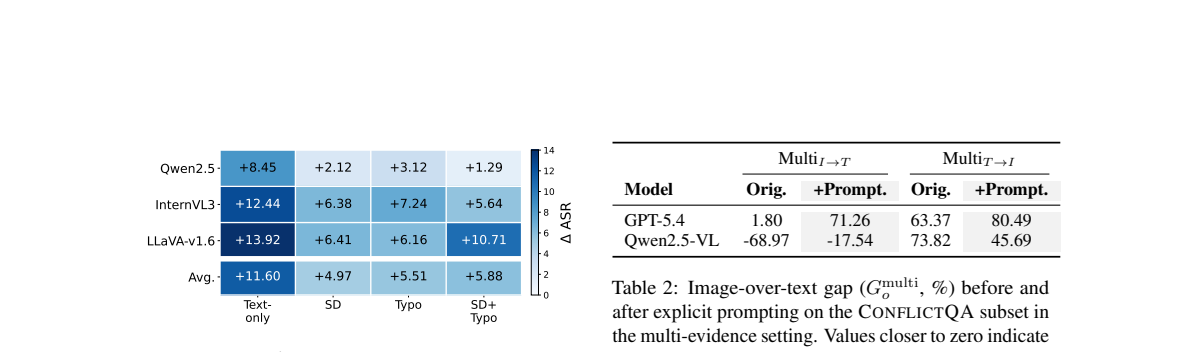
In safety settings, transferring the full harmful instruction into an image raises attack success by 6.99 percentage points on average across 156 settings (positive in 80.8% of comparisons), an exploitable vulnerability beyond embedding only key phrases visually.
Among the mitigation attempts, prompting, DPO, and representation steering fail to balance modality reliance — often trading image preference for text preference — while conflict-aware SFT on Qwen2.5-VL-7B moves every reported gap closer to zero and reduces following of misleading images while preserving following of reliable ones.
If modality preference is a property of the evaluation setup rather than the model, then benchmark comparisons that fix one rendering template and one input order are measuring a convention; model families should be re-tested across renderings and orderings before any modality-bias claim is attributed to the model itself.
The salience results suggest modality instability may be partly a controllable dial: since highlighting the answer-bearing span shifts the gap by roughly 5 to 16 points while global color and background changes shift it by under 2 points, salience-controlled rendering could be engineered deliberately — to protect RAG answers or to harden models against image-rendered instructions.
Because image-rendered instructions raise attack success by about 7 points on average, safety evaluations that test text and image prompts under separate protocols likely underestimate real-world refusal failures, since document-based workflows deliver the same instruction in both forms interchangeably.
The preprocessing crossover — Qwen2.5-VL receiving LLaVA-style view construction moved its single-evidence gap from +9.71 to -37.23, near LLaVA's native value — points to the vision tokenizer's resolution and view selection as a high-leverage training target for making modality reliance more stable.
Check this review
Pith stored no record of this review's passes and took no fingerprint of it. Reviews made by code from 13 Nov 2026 on carry both.
How often reviews like this one are right
Reviews like this one: written by deepseek-v4-flash, where what was read was not recorded.
How often objections from reviews like this one are right: not yet measured
Reviews by people
This review was written by a machine. No person has reviewed this paper on Pith yet. A scientist listed on Pith can review it for a fee, and their review is published here whatever it concludes.
The paper
Abstract
Multimodal large language models (MLLMs) are increasingly provided with contextual evidence in heterogeneous forms: as a text passage, as a rendered image of the same passage, or as both together. However, it remains unclear how consistently these surface forms are processed, especially when the evidence conflicts with the model's parametric knowledge. We study modality robustness under knowledge conflict across 13 MLLMs and two datasets, and find them far from robust. (1) Contrary to common belief, models favor a context that contradicts parametric knowledge more readily in image form than in text form; (2) when a contradicting text and image are presented together, the preferred modality is essentially arbitrary, varying with input order, model, and dataset. We further demonstrate that this instability has practical consequences: it degrades performance in multimodal RAG and can be exploited by adversarial attacks. To alleviate this brittleness, we examine several simple techniques—prompting, steering, supervised fine-tuning (SFT), and direct preference optimization; the majority prove ineffective, whereas SFT achieves moderate success. We therefore call for greater awareness of this inconsistency and argue that it is fundamental, demanding attention at multiple training stages.
The paper's own sentences, arranged, kept beside the review and separate from it. Each label is drawn from a closed vocabulary; the number beside it is the probability the classifier gave that label. No sentence in this record was written by a model.
abstract compiled · 2026-09-23
The authors' main claim, as the classifier picked it out 0.73
“We study modality robustness under knowledge conflict across 13 MLLMs and two datasets, and find them far from robust.”
How the main claim is stated: asserted 1.00
What the abstract itself states, as probabilities: claims first 0.05 · states limitation 0.57 · human participants 0.05 · controlled comparison 0.38 · randomized assignment 0.02 · states quantitative result 0.68 · compares with prior results 0.44 · mentions code or data availability 0.03
The abstract, sentence by sentence
This table labels the abstract only (arXiv listing abstract v1). The number is the probability the classifier gave the label.
| Sentence | Role | The authors' own work | States the main conclusion | Strength |
|---|---|---|---|---|
| Multimodal large language models (MLLMs) are increasingly provided with contextual evidence in heterogeneous forms: as a text passage, as a rendered image of the same passage, or as both together. | background 1.00 | 0.05 | 0.02 | asserted 0.99 |
| However, it remains unclear how consistently these surface forms are processed, especially when the evidence conflicts with the model's parametric knowledge. | gap 1.00 | 0.05 | 0.04 | asserted 0.64 |
| We study modality robustness under knowledge conflict across 13 MLLMs and two datasets, and find them far from robust. | result 0.55 | 0.97 | 0.56 | asserted 1.00 |
| (1) Contrary to common belief, models favor a context that contradicts parametric knowledge more readily in image form than in text form; (2) when a contradicting text and image are presented together, the preferred modality is essentially arbitrary, varying with input order, model, and dataset. | result 1.00 | 0.95 | 0.74 | asserted 1.00 |
| We further demonstrate that this instability has practical consequences: it degrades performance in multimodal RAG and can be exploited by adversarial attacks. | interpretation 0.51 | 0.94 | 0.12 | asserted 1.00 |
| To alleviate this brittleness, we examine several simple techniques---prompting, steering, supervised fine-tuning (SFT), and direct preference optimization; the majority prove ineffective, whereas SFT achieves moderate success. | result 0.54 | 0.95 | 0.10 | asserted 1.00 |
| We therefore call for greater awareness of this inconsistency and argue that it is fundamental, demanding attention at multiple training stages. | future work 0.77 | 0.22 | 0.39 | asserted 1.00 |
What kind of paper the classifier reports this is: empirical study 1.00 · evidence from observation or experiment 1.00
What was examined, and what was not
Sources read
- arXiv listing abstract v1
Not examined
- full text
- figures and tables
- references and citing sentences
- relations to other papers
Levels run
- P abstract
Not run
- S sections
- T body sentences
- C citations
- R cross-paper relations
How the labels were made
Compiled by classifier-1.13.0 via TypeSafe API, question bank abstract-p1-20260923, 2026-09-23: 1 request, 5,740 input tokens.
Every quoted sentence on this record is the authors'. Every label is from Pith's closed vocabulary, with the probability shown beside it. This record as JSON
Figures (14)


Showing 10 of the paper's 14 figures. Figures are the authors', reproduced from the paper.
References (55)
- [1] Anthropic. 2025. Claude 4.5 Sonnet https://www.anthropic.com/news/claude-sonnet-4-5 on Pith
- [4] Ailin Deng, Tri Cao, Zhirui Chen, and Bryan Hooi. 2025. https://api.semanticscholar.org/CorpusID:276775193 Words or vision: Do vision-language models have blind faith in text? 2025 IEEE/CVF Conference on Computer Vision and Pattern Recognition (CVPR), pages 3867--3876 on Pith
- [5] Manuel Faysse, Hugues Sibille, Tony Wu, Bilel Omrani, Gautier Viaud, C \'e line Hudelot, and Pierre Colombo. 2025. https://openreview.net/forum?id=ogjBpZ8uSi C ol P ali: Efficient document retrieval with vision language models . In The Thirteenth International Conference on Le... on Pith
- [9] Yifan Jia, Yuntao Du, Kailin Jiang, Yuyang Liang, Qihan Ren, Yi Xin, Rui Yang, Fenze Feng, MingCai Chen, Hengyang Lu, and 1 others. 2026. Benchmarking multimodal knowledge conflict for large multimodal models. In Proceedings of the AAAI Conference on Artificial Intelligence, v... on Pith
- [10] Zhuoran Jin, Pengfei Cao, Hongbang Yuan, Yubo Chen, Jiexin Xu, Huaijun Li, Xiaojian Jiang, Kang Liu, and Jun Zhao. 2024. https://doi.org/10.18653/v1/2024.findings-acl.70 Cutting off the head ends the conflict: A mechanism for interpreting and mitigating knowledge conflicts in ... on Pithdoi:10.18653/v1/2024.findings-acl.70
- [11] Anant Khandelwal, Manish Gupta, and Puneet Agrawal. 2025. https://doi.org/10.18653/v1/2025.emnlp-main.348 C o C o A : Confidence- and context-aware adaptive decoding for resolving knowledge conflicts in large language models . In Proceedings of the 2025 Conference on Empirical... on Pithdoi:10.18653/v1/2025.emnlp-main.348
- [12] Tom Kwiatkowski, Jennimaria Palomaki, Olivia Redfield, Michael Collins, Ankur Parikh, Chris Alberti, Danielle Epstein, Illia Polosukhin, Jacob Devlin, Kenton Lee, Kristina Toutanova, Llion Jones, Matthew Kelcey, Ming-Wei Chang, Andrew M. Dai, Jakob Uszkoreit, Quoc Le, and Slav... on Pithdoi:10.1162/tacl_a_00276
- [13] Kang-il Lee, Minbeom Kim, Seunghyun Yoon, Minsung Kim, Dongryeol Lee, Hyukhun Koh, and Kyomin Jung. 2025. https://doi.org/10.18653/v1/2025.findings-naacl.231 VL ind-bench: Measuring language priors in large vision-language models . In Findings of the Association for Computatio... on Pithdoi:10.18653/v1/2025.findings-naacl.231
- [14] Haotian Liu, Chunyuan Li, Qingyang Wu, and Yong Jae Lee. 2023. Visual instruction tuning. Advances in neural information processing systems, 36:34892--34916 on Pith
- [15] Nelson F. Liu, Kevin Lin, John Hewitt, Ashwin Paranjape, Michele Bevilacqua, Fabio Petroni, and Percy Liang. 2024 a . https://doi.org/10.1162/tacl_a_00638 Lost in the middle: How language models use long contexts . Transactions of the Association for Computational Linguistics,... on Pithdoi:10.1162/tacl_a_00638
- [16] Xiaoyuan Liu, Wenxuan Wang, Youliang Yuan, Jen-tse Huang, Qiuzhi Liu, Pinjia He, and Zhaopeng Tu. 2025. https://doi.org/10.18653/v1/2025.acl-long.872 Insight over sight: Exploring the vision-knowledge conflicts in multimodal LLM s . In Proceedings of the 63rd Annual Meeting of... on Pithdoi:10.18653/v1/2025.acl-long.872
- [17] Xin Liu, Yichen Zhu, Jindong Gu, Yunshi Lan, Chao Yang, and Yu Qiao. 2024 b . Mm-safetybench: A benchmark for safety evaluation of multimodal large language models. In European Conference on Computer Vision, pages 386--403. Springer on Pith
- [18] Shayne Longpre, Kartik Perisetla, Anthony Chen, Nikhil Ramesh, Chris DuBois, and Sameer Singh. 2021. https://doi.org/10.18653/v1/2021.emnlp-main.565 Entity-based knowledge conflicts in question answering . In Proceedings of the 2021 Conference on Empirical Methods in Natural L... on Pithdoi:10.18653/v1/2021.emnlp-main.565
- [19] Alex Mallen, Akari Asai, Victor Zhong, Rajarshi Das, Daniel Khashabi, and Hannaneh Hajishirzi. 2023. https://doi.org/10.18653/v1/2023.acl-long.546 When not to trust language models: Investigating effectiveness of parametric and non-parametric memories . In Proceedings of the 6... on Pithdoi:10.18653/v1/2023.acl-long.546
- [21] OpenAI. 2026. GPT-5.4 https://openai.com/index/introducing-gpt-5-4/ on Pith
- [22] OpenBMB . 2025. MiniCPM-o Series . https://github.com/OpenBMB/MiniCPM-o on Pith
- [23] Francesco Ortu, Zhijing Jin, Diego Doimo, and Alberto Cazzaniga. 2025. https://openreview.net/forum?id=GhSp6uvUuR When seeing overrides knowing: Disentangling knowledge conflicts in vision-language models . In Mechanistic Interpretability Workshop at NeurIPS 2025 on Pith
- [24] Rafael Rafailov, Archit Sharma, Eric Mitchell, Christopher D Manning, Stefano Ermon, and Chelsea Finn. 2023. Direct preference optimization: Your language model is secretly a reward model. Advances in neural information processing systems, 36:53728--53741 on Pith
- [25] Mong Yuan Sim, Wei Emma Zhang, Xiang Dai, and Biaoyan Fang. 2025. https://doi.org/10.18653/v1/2025.findings-acl.1256 Can VLM s actually see and read? a survey on modality collapse in vision-language models . In Findings of the Association for Computational Linguistics: ACL 202... on Pithdoi:10.18653/v1/2025.findings-acl.1256
- [26] Xuezhi Wang, Jason Wei, Dale Schuurmans, Quoc V Le, Ed H. Chi, Sharan Narang, Aakanksha Chowdhery, and Denny Zhou. 2023. https://openreview.net/forum?id=1PL1NIMMrw Self-consistency improves chain of thought reasoning in language models . In The Eleventh International Conferenc... on Pith
show 35 more
- [27] Yike Wang, Shangbin Feng, Heng Wang, Weijia Shi, Vidhisha Balachandran, Tianxing He, and Yulia Tsvetkov. 2024. https://openreview.net/forum?id=ptvV5HGTNN Resolving knowledge conflicts in large language models . In First Conference on Language Modeling on Pith
- [28] Jian Xie, Kai Zhang, Jiangjie Chen, Renze Lou, and Yu Su. 2024. https://openreview.net/forum?id=auKAUJZMO6 Adaptive chameleon or stubborn sloth: Revealing the behavior of large language models in knowledge conflicts . In The Twelfth International Conference on Learning Representations on Pith
- [31] Rongwu Xu, Zehan Qi, Zhijiang Guo, Cunxiang Wang, Hongru Wang, Yue Zhang, and Wei Xu. 2024. https://doi.org/10.18653/v1/2024.emnlp-main.486 Knowledge conflicts for LLM s: A survey . In Proceedings of the 2024 Conference on Empirical Methods in Natural Language Processing, page... on Pithdoi:10.18653/v1/2024.emnlp-main.486
- [34] Shi Yu, Chaoyue Tang, Bokai Xu, Junbo Cui, Junhao Ran, Yukun Yan, Zhenghao Liu, Shuo Wang, Xu Han, Zhiyuan Liu, and Maosong Sun. 2025. https://openreview.net/forum?id=zG459X3Xge V is RAG : Vision-based retrieval-augmented generation on multi-modality documents . In The Thirtee... on Pith
- [37] Zongmeng Zhang, Wengang Zhou, Jie Zhao, and Houqiang Li. 2025 c . https://openreview.net/forum?id=SP43jVv7fJ Robust multimodal large language models against modality conflict . In Forty-second International Conference on Machine Learning on Pith
- [39] Adaptive Chameleon or Stubborn Sloth: Revealing the Behavior of Large Language Models in Knowledge Conflicts , author=. The Twelfth International Conference on Learning Representations , year= on Pith
- [40] MMM-Fact: A Multimodal, Multi-Domain Fact-Checking Dataset with Multi-Level Retrieval Difficulty , author=. arXiv preprint arXiv:2510.25120 , year= on PitharXiv
- [41] Robust Multimodal Large Language Models Against Modality Conflict , author=. Forty-second International Conference on Machine Learning , year= on Pith
- [42] Challenges in Understanding Modality Conflict in Vision-Language Models , author=. arXiv preprint arXiv:2509.02805 , year= on PithPith's reviewarXiv
- [43] When modalities conflict: How unimodal reasoning uncertainty governs preference dynamics in mllms , author=. arXiv preprint arXiv:2511.02243 , year= on PitharXiv
- [44] How Do Vision-Language Models Process Conflicting Information Across Modalities? , author=. arXiv preprint arXiv:2507.01790 , year= on PithPith's reviewarXiv
- [45] Benchmarking multimodal knowledge conflict for large multimodal models , author=. Proceedings of the AAAI Conference on Artificial Intelligence , volume= on Pith
- [46] Gpt-4o system card , author=. arXiv preprint arXiv:2410.21276 , year= on PithPith's reviewarXiv
- [47] Gemini 2.5: Pushing the frontier with advanced reasoning, multimodality, long context, and next generation agentic capabilities , author=. arXiv preprint arXiv:2507.06261 , year= on PithPith's reviewarXiv
- [48] MS MARCO: A human generated machine reading comprehension dataset , author=. arXiv preprint arXiv:1611.09268 , year= on PithPith's reviewarXiv
- [49] Mm-safetybench: A benchmark for safety evaluation of multimodal large language models , author=. European Conference on Computer Vision , pages=. 2024 , organization= on Pith
- [50] OpenRLHF: An Easy-to-use, Scalable and High-performance RLHF Framework , author=. arXiv preprint arXiv:2405.11143 , year= on PithPith's reviewarXiv
- [51] Qwen3-omni technical report , author=. arXiv preprint arXiv:2509.17765 , year= on PithPith's reviewarXiv
- [52] Qwen2. 5-Omni Technical Report , author=. arXiv preprint arXiv:2503.20215 , year= on PithPith's reviewarXiv
- [53] OmniVinci: Enhancing Architecture and Data for Omni-Modal Understanding LLM , author=. arXiv preprint arXiv:2510.15870 , year= on PitharXiv
- [54] Qwen2.5-VL Technical Report , author=. arXiv preprint arXiv:2502.13923 , year= on PithPith's reviewarXiv
- [55] Internvl3: Exploring advanced training and test-time recipes for open-source multimodal models , author=. arXiv preprint arXiv:2504.10479 , year= on PithPith's reviewarXiv
- [56] Visual instruction tuning , author=. Advances in neural information processing systems , volume= on Pith
- [57] Yu, Shi and Tang, Chaoyue and Xu, Bokai and Cui, Junbo and Ran, Junhao and Yan, Yukun and Liu, Zhenghao and Wang, Shuo and Han, Xu and Liu, Zhiyuan and Sun, Maosong , booktitle =. 2025 , url = on Pith
- [58] Faysse, Manuel and Sibille, Hugues and Wu, Tony and Omrani, Bilel and Viaud, Gautier and Hudelot, C. The Thirteenth International Conference on Learning Representations , year = on Pith
- [59] Vision-language instruction tuning: A review and analysis , author=. arXiv preprint arXiv:2311.08172 , year= on PithPith's reviewarXiv
- [60] Resolving Knowledge Conflicts in Large Language Models , author=. First Conference on Language Modeling , year= on Pith
- [61] When seeing Overrides Knowing: Disentangling Knowledge Conflicts in Vision-Language Models , author=. Mechanistic Interpretability Workshop at NeurIPS 2025 , year= on Pith
- [62] Words or Vision: Do Vision-Language Models Have Blind Faith in Text? , author=. 2025 IEEE/CVF Conference on Computer Vision and Pattern Recognition (CVPR) , year= on Pith
- [63] Evaluating and steering modality preferences in multimodal large language model , author=. arXiv preprint arXiv:2505.20977 , year= on PitharXiv
- [64] CLASH: A Benchmark for Cross-Modal Contradiction Detection , author=. arXiv preprint arXiv:2511.19199 , year= on PitharXiv
- [65] Angela van Sprang and Laurens Samson and Ana Lucic and Erman Acar and Sennay Ghebreab and Yuki M. Asano , title=. CoRR , volume=. 2025 , month= on Pith
- [66] Reading, Not Thinking: Understanding and Bridging the Modality Gap When Text Becomes Pixels in Multimodal LLMs , author=. arXiv preprint arXiv:2603.09095 , year= on PithPith's reviewarXiv
- [67] Self-Consistency Improves Chain of Thought Reasoning in Language Models , author=. The Eleventh International Conference on Learning Representations , year= on Pith
- [68] Direct preference optimization: Your language model is secretly a reward model , author=. Advances in neural information processing systems , volume= on Pith
Cited by 2 Pith papers
Reviewed papers on Pith that cite this one. The full citation record
Challenges and discussion
Disagree with the review, or know something it missed? Leave a comment, or challenge this review formally: a challenge becomes a permanent entry in this paper's record, and its decision is published here.
Come back by email
A short list of the week's newly reviewed papers. Nothing is sent until you confirm from your inbox, and every email has a link that stops it. No account.
No comments yet.
Sign in to comment