REVIEW 3 major objections 4 minor 3 cited by
Neural models can replace the physics core of a robot simulator and stay accurate over thousands of steps.
Reviewed by Pith at T0; open to challenge. T0 means a machine referee read the full paper against a public rubric. the ladder, T0–T4 →
Neural dynamics models trained on random simulator data act as a general robot physics backend, supporting policy learning and real-world fine-tuning with stable long-horizon prediction.
T0 review reviewed 2026-08-05 challenge →
load-bearing objection A strong, well-engineered neural simulator paper; the torque-trajectory gap is real but testable, and the empirical package justifies serious review. the 3 major comments →
Neural Robot Dynamics
The pith
A machine-rendered reading of the paper's core claim, the machinery that carries it, and where it could break.
The reading
Core claim
The paper claims that a learned model can act as an interchangeable backend solver inside a classical articulated-rigid-body simulator. NeRD consumes the robot's state, contact events at pre-specified points, joint torques, and the base-frame gravity vector over a ten-step history, and outputs the relative state change to the next macro-step. Because the inputs are the same intermediate quantities used by classical dynamics and contact solvers, the model does not need to memorize a specific scene or controller. Because the representation is robot-centric, it is invariant under translation and rotation about the gravity axis, which the authors argue is what lets a model trained on random traj
What carries the argument
The central mechanism is the hybrid prediction framework: collision detection and the low-level controller remain in the analytical simulator, while NeRD replaces the solver that integrates dynamics under contact. Its state representation is robot-centric, expressing all inputs and the predicted state difference in the moving base frame and treating gravity as an external vector in that frame, which enforces spatial invariance and shrinks the state space. A causal Transformer over the ten-step history maps these quantities to the next state difference; the relative prediction target keeps outputs small, and the history provides smoothed velocity information that stabilizes training and rollo
Load-bearing premise
A fixed set of contact points plus the torque at the start of a macro-step fully determines what happens to the robot over that step, so every interaction with the environment must be visible through those measurements.
What would settle it
Take a NeRD model trained with a fixed set of contact points on a robot link, then place an obstacle that touches that link at a different, unprescribed point; if the neural rollout diverges from the analytical simulator within a few hundred steps, the contact representation does not capture all relevant interaction.
If this is right
- One pretrained NeRD model can support policy learning for tasks whose state distributions were never seen in its random training data, and the learned policies achieve rewards essentially matching those of a ground-truth analytical simulator.
- Because NeRD predicts the macro-step state difference directly, it can bypass finer substepping at test time, giving a speed advantage while remaining stable over long horizons.
- The same trained model works with different low-level controllers, such as joint-torque and joint-position control, without retraining.
- A NeRD model pretrained on simulation can be fine-tuned from a small real-world dataset in minutes, outperforming the analytical simulator on that data and matching specialized single-body models.
- Fine-tuning makes a continual digital-twin workflow plausible: each robot's simulator can be updated as the robot wears or the environment changes.
Where Pith is reading between the lines
- The robot-centric invariance idea suggests that other symmetry structures of robot dynamics, such as reflection or repetitive joint topology, could be encoded the same way to further reduce data requirements.
- The fixed-contact-point assumption implies the model's generalization is bounded by the chosen contact layout; adding learned or adaptive contact-point selection could extend NeRD to arbitrary impact locations.
- Direct macro-step prediction may also serve as a differentiable world model for policy optimization through gradient-based backpropagation, beyond the reinforcement-learning use shown in the paper.
- The fact that sequence modeling, rather than the stateless physics solver, improves accuracy hints that learned simulators may benefit from explicitly modeling unobserved substep behavior rather than only fitting state transitions.
Editorial analysis
A structured set of objections, weighed in public.
Referee Report
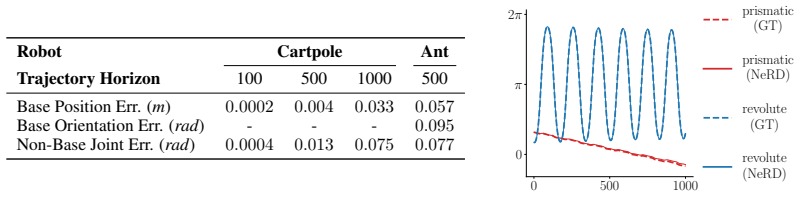
Summary. NeRD is a learned robot-specific dynamics model that replaces the low-level forward-dynamics and contact solvers of an analytical simulator while retaining the simulator's collision detection and low-level controller modules. Its input is a robot-centric, body-frame state representation built from robot state, contact events, joint torques, and gravity over a history window of h=10; a causal Transformer predicts the state difference over one macro-step. The model is pretrained on random trajectories generated by Warp and then evaluated on long-horizon prediction (Cartpole, Ant), contact generalization (Double Pendulum), RL policy learning for four robots, zero-shot sim-to-real Franka reach, and fine-tuning on real cube-tossing data. The paper reports low errors, close reward parity between NeRD and the analytical simulator in most tasks, and real-world transfer, with ablations supporting the main design choices.
Significance. If the central claims hold, NeRD is a significant step toward generalizable neural simulators for articulated rigid-body robots: it is tested on six systems, uses a modular hybrid framework, shows long-horizon stability, and demonstrates that policies trained exclusively inside the learned simulator can transfer to an analytical simulator and to a real Franka. The paper also provides concrete quantitative evidence: 2048-trajectory evaluations, ablations, and real-world fine-tuning with comparison to specialized baselines. The main caveats are the underspecified interaction between macro-step prediction and PD controllers, and one task with a large reward discrepancy. These do not invalidate the overall approach but do require targeted revision before the generalization claims are fully supported.
major comments (3)
- [§3.2, Fig. 2, Appendix A, Appendix C.1.3] The model input contains the joint torque τ_t only at the macro-step boundary, but the model may span multiple analytical substeps (Appendix A) and the Franka/ANYmal policies are executed through joint-position PD controllers (Appendix C.1.3). If the PD controller is evaluated at the physics substep rate, the torque trajectory inside the macro-step is not determined by the model's input: the same input vector corresponds to many possible next states. Training data were generated with random torque sequences (§4), not with PD feedback, so the history of boundary torques does not encode the intra-step torque law. This is a load-bearing gap for the claimed generalization to customized low-level controllers. Please report the control update rate in all position-controlled experiments; if it is faster than the macro-step, either include the torque trajectory/target positions and gains in the
- [§5.3, Table 1] The text states that NeRD-trained policies achieve 'remarkably similar rewards' when deployed in the NeRD and ground-truth simulators. However, the Ant Spin Tracking row reports a +17.21% reward difference (GT 2624.7 ± 641.0 vs. NeRD 3076.5 ± 433.5), the largest discrepancy of the seven tasks and in the optimistic direction. This is relevant to the central claim of zero-shot deployment in the analytical simulator. The paper should either explain this outlier or qualify the claim; as written, the 'remarkably similar' statement is overstated for this task.
- [§5.1, §5.3] The abstract claims NeRD is 'stable and accurate over a thousand simulation steps.' In §5.1 the 1000-step evidence is Cartpole only, which is contact-free; the contact-rich Ant evaluation is 500 steps. The ANYmal tasks run 1000 episodes but report reward, not per-step state error. Please provide a per-step state-error evaluation for at least one contact-rich system at 1000 steps, or soften the claim to reflect the systems actually evaluated at that horizon.
minor comments (4)
- [§5.2, Table 3] The Double Pendulum contact-generalization results are reported without comparison to an analytical baseline or an ablation that lacks contact information. Since the claim is about the necessity of contact encoding, adding such a baseline would strengthen the quantitative support.
- [Appendix C.6] The computation-speed comparison (Warp 28K FPS vs. NeRD 46K FPS for Ant) is presented with appropriate caveats. It would be useful to report the same comparison for the position-controlled Franka/ANYmal systems, since PD evaluation rate interacts with the macro-step issue raised above.
- [§4] The training-data section states that random trajectories are generated 'within the robot's motor torque limits,' but no details are given on how torque sequences are temporally correlated (e.g., white noise vs. smooth random walks) or whether they are held constant over substeps. This matters for understanding what the model can infer from τ_t in the history window.
- [Appendix C.1.3] The phrase 'converted from the target joint positions via the joint-position PD controller' is important but underspecified. Please state the PD gains, the control frequency, and whether the controller is evaluated at the macro-step rate or the physics-substep rate.
Circularity Check
No significant circularity: NeRD is trained on and evaluated against an external analytical simulator and real-world data.
full rationale
The central derivation is not circular. NeRD is a learned surrogate for the low-level dynamics and contact solver of an analytical simulator. Training data are generated by the Warp/Featherstone simulator (§4: "We generate the training datasets for NeRD in a task-agnostic manner using Warp with the Featherstone solver"), and the learned model is then tested on held-out trajectories of that same analytical simulator, on RL tasks never seen during training, and on real-world cube-tossing data (§5). This is a standard supervised-learning evaluation against an external benchmark, not a self-referential prediction: the target state differences are produced by an independent numerical solver, not by the model's own inputs or by a fitted parameter renamed as a prediction. The self-citations to Warp [24] and NeuralSim [42] are not load-bearing: Warp is an open-source analytical simulator whose outputs are generated independently of the trained model, and NeuralSim is discussed only as related work. The robot-centric state representation and relative-state prediction are architectural choices that improve learning, not circular definitions of the target. The only substantive caveat is the macro-step determinism assumption in Appendix A ("Multi-Substep Prediction"): if a PD controller updates inside the macro-step, the model input may not uniquely determine the next state. That is a correctness/generalization limitation, not circularity, because the model is not fitted to a quantity that is also an input. Hence the paper's central claims have independent empirical content.
Axiom & Free-Parameter Ledger
free parameters (4)
- history window size h =
10
- contact distance threshold xi =
max(4 * contact thickness, 0.1)
- Warp contact and inertia parameters for cube-tossing pretraining =
manually tuned
- Transformer hyperparameters (embedding 192/384, 6 layers, 12 heads, learning rate schedule) =
see Table 2
axioms (5)
- domain assumption The next macro-step state is a function of the current state, contact info, joint torques, gravity, and the previous h steps; no additional environment or controller state is needed.
- domain assumption A fixed set of pre-specified contact points p_i^0 on the robot, with the closest non-robot point, normal, and distance, completely characterizes contact interaction with any environment.
- domain assumption Rigid-body dynamics with a uniform gravity field are invariant under translation and rotation about the gravity axis, and this symmetry is losslessly encoded by expressing inputs and outputs in the robot base frame plus the gravity vector.
- domain assumption Random task-agnostic trajectories provide sufficient coverage of the state-action distribution for downstream tasks.
- domain assumption The torque command at the start of a macro-step determines the torques applied over the entire step (or the model can recover this from history); the learned model need not model substeps.
Cite this review
Pith. "Pith review of Neural Robot Dynamics." pith.science (2026). https://pith.science/paper/YJR77OQL
@misc{pith2026250815755,
  author       = {Pith},
  title        = {Pith review of: Neural Robot Dynamics},
  year         = {2026},
  howpublished = {\url{https://pith.science/paper/YJR77OQL}},
  note         = {Machine review of arXiv:2508.15755}
}
read the original abstract
Accurate and efficient simulation of modern robots remains challenging due to their high degrees of freedom and intricate mechanisms. Neural simulators have emerged as a promising alternative to traditional analytical simulators, capable of efficiently predicting complex dynamics and adapting to real-world data; however, existing neural simulators typically require application-specific training and fail to generalize to novel tasks and/or environments, primarily due to inadequate representations of the global state. In this work, we address the problem of learning generalizable neural simulators for robots that are structured as articulated rigid bodies. We propose NeRD (Neural Robot Dynamics), learned robot-specific dynamics models for predicting future states for articulated rigid bodies under contact constraints. NeRD uniquely replaces the low-level dynamics and contact solvers in an analytical simulator and employs a robot-centric and spatially-invariant simulation state representation. We integrate the learned NeRD models as an interchangeable backend solver within a state-of-the-art robotics simulator. We conduct extensive experiments to show that the NeRD simulators are stable and accurate over a thousand simulation steps; generalize across tasks and environment configurations; enable policy learning exclusively in a neural engine; and, unlike most classical simulators, can be fine-tuned from real-world data to bridge the gap between simulation and reality.
Figures




Forward citations
Cited by 3 Pith papers
-
Simulation Distillation: Pretraining World Models in Simulation for Rapid Real-World Adaptation
SimDist pretrains world models in simulation and adapts them to real-world robots by updating only the latent dynamics model, enabling rapid improvement on contact-rich tasks where prior methods fail.
-
Pretraining in Actor-Critic Reinforcement Learning for Locomotion
Pretraining an inverse dynamics model on task-agnostic exploration data and using its weights to initialize PPO actor and critic improves sample efficiency by ~37% and final performance by ~7% across nine simulated lo...
-
CableRobotGraphSim: A Graph Neural Network for Modeling Partially Observable Cable-Driven Robot Dynamics
A fully learnable GNN predicts cable-driven tensegrity dynamics from partial observations and serves as the transition model for closed-loop MPPI navigation, beating differentiable physics baselines.
Reference graph
Works this paper leans on
-
[1]
O. M. Andrychowicz, B. Baker, M. Chociej, R. Jozefowicz, B. McGrew, J. Pachocki, A. Petron, M. Plappert, G. Powell, A. Ray, et al. Learning dexterous in-hand manipulation. The International Journal of Robotics Research , 2020
work page 2020
-
[2]
T. Chen, M. Tippur, S. Wu, V . Kumar, E. Adelson, and P. Agrawal. Visual dexterity: In-hand reorientation of novel and complex object shapes. Science Robotics, 2023
work page 2023
-
[3]
T. Haarnoja, B. Moran, G. Lever, S. H. Huang, D. Tirumala, J. Humplik, M. Wulfmeier, S. Tun- yasuvunakool, N. Y . Siegel, R. Hafner, M. Bloesch, K. Hartikainen, A. Byravan, L. Hasen- clever, Y . Tassa, F. Sadeghi, N. Batchelor, F. Casarini, S. Saliceti, C. Game, N. Sreendra, K. Patel, M. Gwira, A. Huber, N. Hurley, F. Nori, R. Hadsell, and N. Heess. Learn...
work page 2024
-
[4]
A. Handa, A. Allshire, V . Makoviychuk, A. Petrenko, R. Singh, J. Liu, D. Makoviichuk, K. Van Wyk, A. Zhurkevich, B. Sundaralingam, et al. Dextreme: Transfer of agile in-hand manipulation from simulation to reality. In 2023 IEEE International Conference on Robotics and Automation (ICRA), 2023
work page 2023
- [5]
-
[6]
J. Lee, J. Hwangbo, L. Wellhausen, V . Koltun, and M. Hutter. Learning quadrupedal locomo- tion over challenging terrain. Science robotics, 2020
work page 2020
-
[7]
B. Tang, I. Akinola, J. Xu, B. Wen, A. Handa, K. Van Wyk, D. Fox, G. S. Sukhatme, F. Ramos, and Y . Narang. Automate: Specialist and generalist assembly policies over diverse geometries. In Robotics: Science and Systems , 2024. 9
work page 2024
-
[8]
N. Funk, C. Schaff, R. Madan, T. Yoneda, J. U. De Jesus, J. Watson, E. K. Gordon, F. Widmaier, S. Bauer, S. S. Srinivasa, et al. Benchmarking structured policies and policy optimization for real-world dexterous object manipulation. IEEE Robotics and Automation Letters , 2021
work page 2021
-
[9]
J. Gu, F. Xiang, X. Li, Z. Ling, X. Liu, T. Mu, Y . Tang, S. Tao, X. Wei, Y . Yao, X. Yuan, P. Xie, Z. Huang, R. Chen, and H. Su. Maniskill2: A unified benchmark for generalizable manipulation skills. In The Eleventh International Conference on Learning Representations , 2023
work page 2023
-
[10]
X. Li, K. Hsu, J. Gu, K. Pertsch, O. Mees, H. R. Walke, C. Fu, I. Lunawat, I. Sieh, S. Kir- mani, S. Levine, J. Wu, C. Finn, H. Su, Q. Vuong, and T. Xiao. Evaluating real-world robot manipulation policies in simulation. arXiv preprint arXiv:2405.05941, 2024
Pith/arXiv arXiv 2024
-
[11]
Z. Liu, W. Liu, Y . Qin, F. Xiang, M. Gou, S. Xin, M. A. Roa, B. Calli, H. Su, Y . Sun, et al. Ocrtoc: A cloud-based competition and benchmark for robotic grasping and manipulation. IEEE Robotics and Automation Letters , 2021
work page 2021
-
[12]
T. Du, A. Schulz, B. Zhu, B. Bickel, and W. Matusik. Computational multicopter design.ACM Trans. Graph., 2016
work page 2016
-
[13]
M. Li, R. Antonova, D. Sadigh, and J. Bohg. Learning tool morphology for contact-rich manipulation tasks with differentiable simulation. In 2023 IEEE International Conference on Robotics and Automation (ICRA) , 2023
work page 2023
-
[14]
J. Xu, T. Chen, L. Zlokapa, M. Foshey, W. Matusik, S. Sueda, and P. Agrawal. An End-to- End Differentiable Framework for Contact-Aware Robot Design. In Proceedings of Robotics: Science and Systems, 2021
work page 2021
-
[15]
S. Pfrommer, M. Halm, and M. Posa. Contactnets: Learning discontinuous contact dynam- ics with smooth, implicit representations. In Proceedings of the 2020 Conference on Robot Learning, 2021
work page 2020
-
[16]
B. Hoffman, J. Cheng, C. Li, and S. Coros. Learning more with less: Sample efficient dynamics learning and model-based rl for loco-manipulation. arXiv preprint arXiv:2501.10499, 2025
-
[17]
A. Ajay, J. Wu, N. Fazeli, M. Bauza, L. P. Kaelbling, J. B. Tenenbaum, and A. Rodriguez. Augmenting physical simulators with stochastic neural networks: Case study of planar pushing and bouncing. In 2018 IEEE/RSJ International Conference on Intelligent Robots and Systems (IROS), 2018
work page 2018
-
[18]
A. Zeng, S. Song, J. Lee, A. Rodriguez, and T. Funkhouser. Tossingbot: Learning to throw arbitrary objects with residual physics. IEEE Transactions on Robotics, 2020
work page 2020
- [19]
-
[20]
C. Li, A. Krause, and M. Hutter. Robotic world model: A neural network simulator for robust policy optimization in robotics, 2025
work page 2025
-
[21]
M. Andriluka, B. Tabanpour, C. D. Freeman, and C. Sminchisescu. Learned neural physics simulation for articulated 3d human pose reconstruction. In Computer Vision – ECCV 2024: 18th European Conference, Proceedings, Part LXXXIV, 2024
work page 2024
-
[22]
L. Fussell, K. Bergamin, and D. Holden. Supertrack: motion tracking for physically simulated characters using supervised learning. ACM Trans. Graph., 40(6), 2021
work page 2021
- [23]
-
[24]
M. Macklin. Warp: A high-performance python framework for gpu simulation and graphics. https://github.com/nvidia/warp, 2022
work page 2022
-
[25]
H. Bertiche, M. Madadi, and S. Escalera. Neural cloth simulation. ACM Trans. Graph., 2022
work page 2022
-
[26]
Y . Jin, D. Omens, Z. Geng, J. Teran, A. Kumar, K. Tashiro, and R. Fedkiw. A neural-network- based approach for loose-fitting clothing. arXiv preprint arXiv:2404.16896, 2024
work page internal anchor Pith review Pith/arXiv arXiv 2024
- [27]
-
[28]
L. Ladick `y, S. Jeong, B. Solenthaler, M. Pollefeys, and M. Gross. Data-driven fluid simulations using regression forests. ACM Transactions on Graphics (TOG), 2015
work page 2015
-
[29]
A. Sanchez-Gonzalez, J. Godwin, T. Pfaff, R. Ying, J. Leskovec, and P. W. Battaglia. Learning to simulate complex physics with graph networks. In International Conference on Machine Learning, 2020
work page 2020
-
[30]
J. Li, Y . Gao, J. Dai, S. Li, A. Hao, and H. Qin. Mpmnet: A data-driven mpm framework for dynamic fluid-solid interaction. IEEE Transactions on Visualization and Computer Graphics , 2024
work page 2024
- [31]
- [32]
-
[33]
K. R. Allen, T. L. Guevara, Y . Rubanova, K. Stachenfeld, A. Sanchez-Gonzalez, P. Battaglia, and T. Pfaff. Graph network simulators can learn discontinuous, rigid contact dynamics. In Proceedings of The 6th Conference on Robot Learning , 2023
work page 2023
-
[34]
K. R. Allen, Y . Rubanova, T. Lopez-Guevara, W. F. Whitney, A. Sanchez-Gonzalez, P. Battaglia, and T. Pfaff. Learning rigid dynamics with face interaction graph networks. In The Eleventh International Conference on Learning Representations , 2023
work page 2023
- [35]
-
[36]
D. Hafner, J. Pasukonis, J. Ba, and T. Lillicrap. Mastering diverse domains through world models. arXiv preprint arXiv:2301.04104, 2023
Pith/arXiv arXiv 2023
-
[37]
Hansen, H
N. Hansen, H. Su, and X. Wang. Td-mpc2: Scalable, robust world models for continuous control, 2024
2024
-
[38]
T. M. Moerland, J. Broekens, A. Plaat, C. M. Jonker, et al. Model-based reinforcement learn- ing: A survey. F oundations and Trends® in Machine Learning, 2023
work page 2023
-
[39]
A. Sanchez-Gonzalez, N. Heess, J. T. Springenberg, J. Merel, M. Riedmiller, R. Hadsell, and P. Battaglia. Graph networks as learnable physics engines for inference and control. In Inter- national conference on machine learning , 2018
work page 2018
- [40]
- [41]
- [42]
-
[43]
M. Kim, J. Yoon, D. Son, and D. Lee. Data-driven contact clustering for robot simulation. In 2019 International Conference on Robotics and Automation (ICRA) , 2019
work page 2019
-
[44]
D. Son and B. Kim. Local object crop collision network for efficient simulation of non-convex objects in gpu-based simulators. arXiv preprint arXiv:2304.09439, 2023
Pith/arXiv arXiv 2023
- [45]
- [46]
-
[47]
A. Radford, J. Wu, R. Child, D. Luan, D. Amodei, I. Sutskever, et al. Language models are unsupervised multitask learners. OpenAI blog, 2019
work page 2019
-
[48]
I. Sutskever, O. Vinyals, and Q. V . Le. Sequence to sequence learning with neural networks. In Proceedings of the 28th International Conference on Neural Information Processing Systems - V olume 2, 2014
work page 2014
-
[49]
T. Shinbrot, C. Grebogi, J. Wisdom, and J. A. Yorke. Chaos in a double pendulum. American Journal of Physics, 1992
work page 1992
-
[50]
M. Hutter, C. Gehring, D. Jud, A. Lauber, C. D. Bellicoso, V . Tsounis, J. Hwangbo, K. Bodie, P. Fankhauser, M. Bloesch, R. Diethelm, S. Bachmann, A. Melzer, and M. Hoepflinger. Any- mal - a highly mobile and dynamic quadrupedal robot. In 2016 IEEE/RSJ International Con- ference on Intelligent Robots and Systems (IROS) , 2016
work page 2016
-
[51]
J. Schulman, F. Wolski, P. Dhariwal, A. Radford, and O. Klimov. Proximal policy optimization algorithms. arXiv preprint arXiv:1707.06347, 2017
Pith/arXiv arXiv 2017
-
[52]
V . Makoviychuk, L. Wawrzyniak, Y . Guo, M. Lu, K. Storey, M. Macklin, D. Hoeller, N. Rudin, A. Allshire, A. Handa, and G. State. Isaac gym: High performance gpu-based physics simula- tion for robot learning, 2021. 12 Neural Robot Dynamics: Appendix Appendix Contents A Additional NeRD Details 14 B Additional Training Details and Hyperparameters 15 C Addit...
work page 2021
This paper was first reviewed by deepseek-v4-flash on August 5, 2026.
discussion (0)
Sign in with ORCID, Apple, or X to comment. Anyone can read and Pith papers without signing in.