f-mode Oscillations for Hyperons and H-dibaryons in Neutron Stars
Pith reviewed 2026-05-21 22:03 UTC · model grok-4.3
The pith
Hyperons and H-dibaryons modify f-mode frequencies and universal relations in neutron stars when treated inside the quark meson coupling model.
A machine-rendered reading of the paper's core claim, the machinery that carries it, and where it could break.
Core claim
Within the quark meson coupling model, which accounts for the self-consistent change in valence-quark structure of baryons in strong Lorentz scalar fields, the inclusion of hyperons and H-dibaryons together with optional short-range repulsion alters the f-mode frequencies of neutron stars. Universal relations linking f-mode frequency, compactness, and tidal deformability remain approximately valid under the relativistic Cowling approximation and can be compared with earlier results for applications in gravitational-wave asteroseismology.
What carries the argument
The quark meson coupling model extended to hyperons and H-dibaryons, with self-consistent valence-quark modification in Lorentz scalar mean fields, used to generate the equation of state for f-mode calculations in the relativistic Cowling approximation.
If this is right
- Universal relations between f-mode frequency, stellar mass, and radius continue to hold to good accuracy even after hyperons and H-dibaryons are added.
- Additional short-range repulsion between hyperons or dibaryons produces measurable shifts in the f-mode spectrum.
- The same model framework yields equations of state that can be directly compared with existing literature results for gravitational-wave asteroseismology.
- Observations of f-modes could in principle distinguish equations of state that contain hyperons or H-dibaryons from those that do not.
Where Pith is reading between the lines
- If the universal relations survive the addition of these particles, they could serve as a cleaner probe of neutron-star structure in future detectors than models that ignore hyperons.
- A mismatch between observed f-modes and the model predictions would point either to missing physics in the quark meson coupling treatment or to the absence of hyperons and dibaryons at the relevant densities.
- The approach could be extended to other exotic particles such as delta resonances or strangelets to test how robust the universal relations remain.
Load-bearing premise
The quark meson coupling model continues to describe the interactions and structure of hyperons and H-dibaryons correctly at the densities found in neutron-star cores.
What would settle it
A gravitational-wave detection of an f-mode frequency from a known-mass neutron star that lies outside the range predicted when hyperons or H-dibaryons are included in the quark meson coupling model would falsify the central claim.
Figures


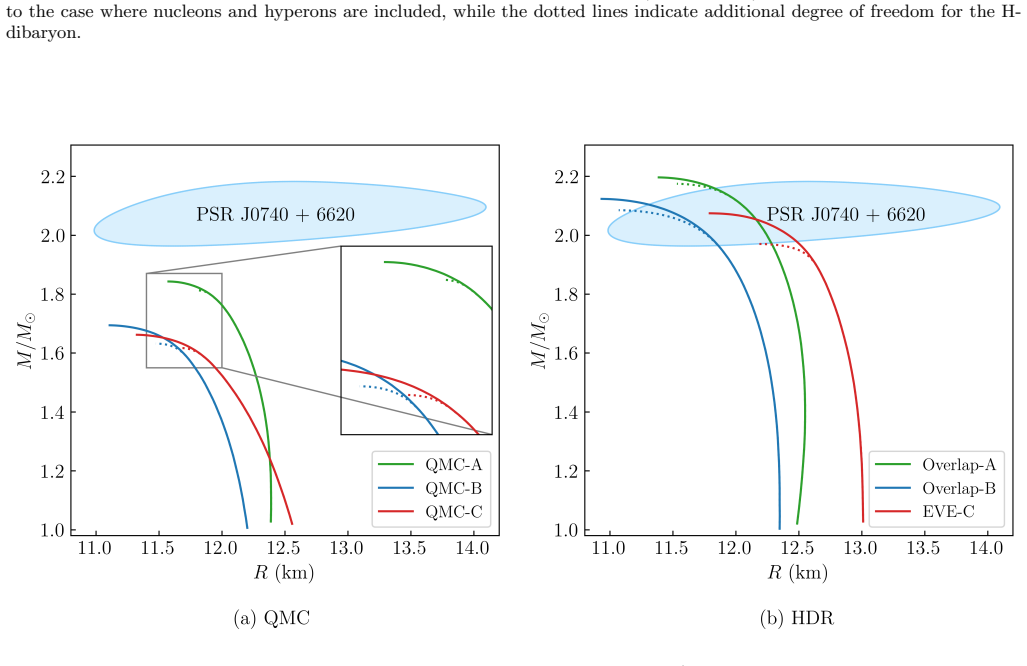


read the original abstract
The fundamental ($f$-mode) oscillations of neutron stars are studied within the quark meson coupling model, a relativistic Hartree-Fock theory of dense nuclear matter, which takes into account the self-consistent modification of the valence quark structure of the bound baryons in the associated strong Lorentz scalar mean fields. For the first time, hyperons and H-dibaryons are included, along with the effects of potential additional short-range repulsion within this scheme, and their influence on $f$-modes is investigated. Universal relations are studied within the relativistic Cowling approximation and compared against those in the existing literature for potential applications in gravitational wave asteroseismology.
Editorial analysis
A structured set of objections, weighed in public.
Referee Report
Summary. The manuscript studies the fundamental (f-mode) oscillations of neutron stars in the quark-meson coupling (QMC) model, a relativistic Hartree-Fock framework that incorporates self-consistent valence-quark structure modifications in strong Lorentz scalar fields. For the first time, hyperons and H-dibaryons are included together with optional additional short-range repulsion; their effects on f-mode frequencies are computed and universal relations are examined in the relativistic Cowling approximation for potential use in gravitational-wave asteroseismology.
Significance. If the underlying model extension is reliable, the work supplies the first systematic exploration of H-dibaryon effects on f-modes within a quark-level description of dense matter. The resulting universal relations, if robust, could furnish additional observables for constraining the dense-matter equation of state from future gravitational-wave data.
major comments (1)
- [Model and formalism] The central extrapolation—that the QMC model's self-consistent valence-quark modification in Lorentz scalar fields continues to apply to the six-quark H-dibaryon at the densities where it appears in the neutron-star core—is load-bearing for all reported f-mode frequencies and universal relations, yet receives no independent validation against lattice QCD or variational six-quark calculations.
minor comments (1)
- [Results] Clarify whether the short-range repulsion strength is treated as a free parameter or fixed by additional constraints; its value should be stated explicitly when results are presented.
Simulated Author's Rebuttal
We thank the referee for their detailed review and insightful comments on our manuscript arXiv:2508.15912. We address the major comment point by point below. We have revised the manuscript to incorporate additional discussion on model assumptions and limitations as appropriate.
read point-by-point responses
-
Referee: [Model and formalism] The central extrapolation—that the QMC model's self-consistent valence-quark modification in Lorentz scalar fields continues to apply to the six-quark H-dibaryon at the densities where it appears in the neutron-star core—is load-bearing for all reported f-mode frequencies and universal relations, yet receives no independent validation against lattice QCD or variational six-quark calculations.
Authors: We acknowledge that extending the QMC framework to the H-dibaryon constitutes an extrapolation of the self-consistent valence-quark modification in Lorentz scalar fields, as the model was originally developed and validated primarily for three-quark baryons. The H-dibaryon is treated within the same relativistic Hartree-Fock scheme as a six-quark composite, with its effective mass and interactions determined consistently from the underlying quark-level dynamics and the same scalar mean fields. While direct lattice QCD or variational six-quark calculations at the relevant high densities are not yet available to provide independent validation, the approach builds on prior QMC applications to hyperons and is consistent with the model's quark-meson coupling philosophy. We agree that this assumption is central and have added a dedicated paragraph in the revised manuscript (Section II and the discussion of results) explicitly stating the extrapolation, its motivation from the model's success with baryons, and the current lack of high-density multi-quark benchmarks, along with references to existing low-density variational studies of the H-dibaryon. revision: partial
Axiom & Free-Parameter Ledger
free parameters (1)
- short-range repulsion strength
axioms (1)
- domain assumption The quark meson coupling model remains valid when hyperons and H-dibaryons are present at neutron-star densities.
Lean theorems connected to this paper
-
IndisputableMonolith/Cost/FunctionalEquation.leanwashburn_uniqueness_aczel unclear?
unclearRelation between the paper passage and the cited Recognition theorem.
The in-medium effective mass of the baryon with flavour f is given by M*_f = Nu Ωu + Nd Ωd + Ns Ωs - z0/RB + BV + ΔEM. ... M*_f = Mf - wσ^f gσ σ + (d/2) ~wσ^f (gσ σ)^2
-
IndisputableMonolith/Foundation/DimensionForcing.leanalexander_duality_circle_linking unclear?
unclearRelation between the paper passage and the cited Recognition theorem.
Universal relations ... νf (kHz) = a + b √(M̄/R̄³) ... ωM (kHz km) = a (M/R) + b
What do these tags mean?
- matches
- The paper's claim is directly supported by a theorem in the formal canon.
- supports
- The theorem supports part of the paper's argument, but the paper may add assumptions or extra steps.
- extends
- The paper goes beyond the formal theorem; the theorem is a base layer rather than the whole result.
- uses
- The paper appears to rely on the theorem as machinery.
- contradicts
- The paper's claim conflicts with a theorem or certificate in the canon.
- unclear
- Pith found a possible connection, but the passage is too broad, indirect, or ambiguous to say the theorem truly supports the claim.
Reference graph
Works this paper leans on
-
[1]
when comparing νf at their maximum masses. There are many differences between the QMC model and the models used in other studies. We provide a brief dis- cussion in the appendix but just like the H, hyperonic signatures in νf are also likely model-dependent. This could also give us clues to the types of interactions one might expect between baryons at hig...
work page 2021
-
[2]
The f-modes for nucleonic EoS are larger at maxi- mum mass which is in conflict to previous studies [33, 51]. In Pradhan et al. , the Cowling approximation νf of hy- peronic EoS were higher than nucleonic EoS at each of their respective maximum masses. In contrast we do not find the same results here. We have checked that this is not idiosyncratic to the ...
-
[3]
J. M. Lattimer, Annual Review of Nuclear and Particle Science 71, 433 (2021)
work page 2021
-
[4]
Li et al., Dense Matter in Neutron Stars with eXTP (2025), arXiv:2506.08104 [astro-ph.HE]
A. Li et al., Dense Matter in Neutron Stars with eXTP (2025), arXiv:2506.08104 [astro-ph.HE]
- [5]
-
[6]
D. L. Whittenbury, H. H. Matevosyan, and A. W. Thomas, Phys. Rev. C 93, 035807 (2016), arXiv:1511.08561 [nucl-th]
work page internal anchor Pith review Pith/arXiv arXiv 2016
-
[7]
A new quark-hadron hybrid equation of state for astrophysics - I. High-mass twin compact stars
S. Benic, D. Blaschke, D. E. Alvarez-Castillo, T. Fis- cher, and S. Typel, Astron. Astrophys. 577, A40 (2015), arXiv:1411.2856 [astro-ph.HE]
work page internal anchor Pith review Pith/arXiv arXiv 2015
-
[8]
Hadron-Quark Crossover and Massive Hybrid Stars with Strangeness
K. Masuda, T. Hatsuda, and T. Takatsuka, Astrophys. J. 764, 12 (2013), arXiv:1205.3621 [nucl-th]
work page internal anchor Pith review Pith/arXiv arXiv 2013
- [9]
-
[10]
B. K. Agrawal and S. K. Dhiman, Phys. Rev. D 79, 103006 (2009), arXiv:0904.2946 [astro-ph.HE]
work page internal anchor Pith review Pith/arXiv arXiv 2009
-
[11]
Cold uniform matter and neutron stars in the quark-mesons-coupling model
J. Rikovska-Stone, P. A. M. Guichon, H. H. Matevosyan, and A. W. Thomas, Nucl. Phys. A 792, 341 (2007), arXiv:nucl-th/0611030
work page internal anchor Pith review Pith/arXiv arXiv 2007
-
[12]
F. Weber, A. Ho, R. P. Negreiros, and P. Rosenfield, Int. J. Mod. Phys. D 16, 231 (2007), arXiv:astro-ph/0604422
work page internal anchor Pith review Pith/arXiv arXiv 2007
-
[13]
Hybrid stars that masquerade as neutron stars
M. Alford, M. Braby, M. W. Paris, and S. Reddy, Astro- phys. J. 629, 969 (2005), arXiv:nucl-th/0411016
work page internal anchor Pith review Pith/arXiv arXiv 2005
-
[14]
Maximum mass, moment of inertia and compactness of relativistic stars
C. Breu and L. Rezzolla, Mon. Not. Roy. Astron. Soc. 459, 646 (2016), arXiv:1601.06083 [gr-qc]
work page internal anchor Pith review Pith/arXiv arXiv 2016
-
[15]
B. P. Abbott et al. (LIGO Scientific, Virgo), Phys. Rev. Lett. 121, 161101 (2018), arXiv:1805.11581 [gr-qc]
work page internal anchor Pith review Pith/arXiv arXiv 2018
-
[16]
B. P. Abbott et al. (LIGO Scientific, Virgo), Phys. Rev. Lett. 119, 161101 (2017), arXiv:1710.05832 [gr-qc]
work page internal anchor Pith review Pith/arXiv arXiv 2017
-
[17]
N. K. Glendenning, Compact Stars: Nuclear Physics, Particle Physics and General Relativity , Astronomy and Astrophysics Library (Springer New York, 1997)
work page 1997
-
[18]
Hybrid stars in the light of GW170817
R. Nandi and P. Char, Astrophys. J. 857, 12 (2018), arXiv:1712.08094 [astro-ph.HE]
work page internal anchor Pith review Pith/arXiv arXiv 2018
- [19]
-
[20]
I. F. Ranea-Sandoval, O. M. Guilera, M. Mariani, and M. G. Orsaria, JCAP 12, 031, arXiv:1807.02166 [astro- ph.HE]
work page internal anchor Pith review Pith/arXiv arXiv
- [21]
-
[22]
Implications from GW170817 and I-Love-Q relations for relativistic hybrid stars
V. Paschalidis, K. Yagi, D. Alvarez-Castillo, D. B. Blaschke, and A. Sedrakian, Phys. Rev. D 97, 084038 (2018), arXiv:1712.00451 [astro-ph.HE]
work page internal anchor Pith review Pith/arXiv arXiv 2018
-
[23]
R. L. Jaffe, Phys. Rev. Lett. 38, 195 (1977), [Erratum: Phys.Rev.Lett. 38, 617 (1977)]
work page 1977
-
[24]
P. J. Mulders and A. W. Thomas, J. Phys. G 9, 1159 (1983)
work page 1983
- [25]
- [26]
-
[27]
A Massive Pulsar in a Compact Relativistic Binary
J. Antoniadis et al. , Science 340, 6131 (2013), arXiv:1304.6875 [astro-ph.HE]
work page internal anchor Pith review Pith/arXiv arXiv 2013
-
[28]
D. J. Nice, E. M. Splaver, I. H. Stairs, O. Loehmer, A. Jessner, M. Kramer, and J. M. Cordes, Astrophys. J. 634, 1242 (2005), arXiv:astro-ph/0508050
work page internal anchor Pith review Pith/arXiv arXiv 2005
-
[29]
M. C. Miller et al., Astrophys. J. Lett. 918, L28 (2021), arXiv:2105.06979 [astro-ph.HE]
work page internal anchor Pith review Pith/arXiv arXiv 2021
- [30]
-
[31]
E. Fonseca et al. , Astrophys. J. Lett. 915, L12 (2021), arXiv:2104.00880 [astro-ph.HE]
-
[32]
The Radius of the High Mass Pul- sar PSR J0740+6620 With 3.6 Years of NICER Data,
T. Salmi et al. , Astrophys. J. 974, 294 (2024), arXiv:2406.14466 [astro-ph.HE]
-
[33]
C. G. Bassa et al., Astrophys. J. Lett. 846, L20 (2017), arXiv:1709.01453 [astro-ph.HE]
work page internal anchor Pith review Pith/arXiv arXiv 2017
- [34]
-
[35]
B. K. Pradhan and D. Chatterjee, Physical Review C 103, 10.1103/physrevc.103.035810 (2021)
- [36]
-
[37]
K. D. Kokkotas and B. G. Schmidt, Living Reviews in Relativity 2, 2 (1999)
work page 1999
-
[38]
Andersson, Universe 7, 10.3390/universe7040097 (2021)
N. Andersson, Universe 7, 10.3390/universe7040097 (2021)
- [40]
-
[41]
O. H. Wilson and W. C. G. Ho, Phys. Rev. D109, 083006 (2024)
work page 2024
-
[42]
W. C. G. Ho, D. I. Jones, N. Andersson, and C. M. Es- pinoza, Phys. Rev. D 101, 103009 (2020)
work page 2020
-
[43]
G. Montefusco, M. Antonelli, and F. Gulminelli, Astron. Astrophys. 694, A150 (2025), arXiv:2410.08008 [nucl-th]
-
[44]
O. P. Jyothilakshmi, P. E. S. Krishnan, V. Sreekanth, H. Chandrakar, and T. K. Jha, Symmetry 17, 10.3390/sym17020230 (2025)
- [45]
- [46]
-
[47]
T. G. Cowling, Monthly Notices of the Royal Astronomical Society 101, 367 (1941), https://academic.oup.com/mnras/article- pdf/101/8/367/8071901/mnras101-0367.pdf
work page 1941
-
[48]
K. S. Thorne and A. Campolattaro, Astro Phys. Journal 149, 591 (1967)
work page 1967
- [49]
-
[50]
Towards gravitational-wave asteroseismology
N. Andersson and K. D. Kokkotas, Mon. Not. Roy. As- tron. Soc. 299, 1059 (1998), arXiv:gr-qc/9711088
work page internal anchor Pith review Pith/arXiv arXiv 1998
- [51]
-
[52]
D. D. Doneva, E. Gaertig, K. D. Kokkotas, and C. Kr¨ uger, Phys. Rev. D88, 044052 (2013)
work page 2013
-
[53]
I. A. Rather, K. D. Marquez, P. Thakur, and O. Louren¸ co, Phys. Rev. D112, 023013 (2025)
work page 2025
- [54]
-
[55]
P. A. M. Guichon, Phys. Lett. B 200, 235 (1988)
work page 1988
- [56]
-
[57]
P. A. M. Guichon and A. W. Thomas, Phys. Rev. Lett. 93, 132502 (2004), arXiv:nucl-th/0402064
work page internal anchor Pith review Pith/arXiv arXiv 2004
- [58]
-
[59]
K. L. Martinez, A. W. Thomas, J. R. Stone, and P. A. M. Guichon, Phys. Rev. C 100, 024333 (2019)
work page 2019
-
[60]
J. R. Stone, P. A. M. Guichon, and A. W. Thomas, Frontiers in Astronomy and Space Sciences9, 10.3389/fs- pas.2022.903007 (2022)
work page doi:10.3389/fs- 2022
-
[61]
P. A. M. Guichon, J. R. Stone, and A. W. Thomas, Prog. Part. Nucl. Phys. 100, 262 (2018), arXiv:1802.08368 [nucl-th]
work page internal anchor Pith review Pith/arXiv arXiv 2018
-
[62]
T. A. DeGrand, R. L. Jaffe, K. Johnson, and J. E. Kiskis, Phys. Rev. D 12, 2060 (1975)
work page 2060
-
[63]
P. A. M. Guichon, A. W. Thomas, and K. Tsushima, Nucl. Phys. A 814, 66 (2008), arXiv:0712.1925 [nucl-th]
work page internal anchor Pith review Pith/arXiv arXiv 2008
-
[64]
K. Tsushima, K. Saito, J. Haidenbauer, and A. Thomas, Nuclear Physics A 630, 691 (1998)
work page 1998
-
[65]
Hyperonic stars and the symmetry energy
C. Providˆ encia, M. Fortin, H. Pais, and A. Rabhi, Hyperonic stars and the symmetry energy (2018), arXiv:1811.00786 [astro-ph.HE]
work page internal anchor Pith review Pith/arXiv arXiv 2018
-
[66]
J. R. Stone, N. J. Stone, and S. A. Moszkowski, Phys. Rev. C 89, 044316 (2014), arXiv:1404.0744 [nucl-th]
work page internal anchor Pith review Pith/arXiv arXiv 2014
- [67]
-
[68]
Effects of Fock term, tensor coupling and baryon structure variation on a neutron star
T. Miyatsu, T. Katayama, and K. Saito, Phys. Lett. B 709, 242 (2012), arXiv:1110.3868 [nucl-th]
work page internal anchor Pith review Pith/arXiv arXiv 2012
-
[69]
Fock terms in the quark-meson coupling model
G. Krein, A. W. Thomas, and K. Tsushima, Nucl. Phys. A 650, 313 (1999), arXiv:nucl-th/9810023
work page internal anchor Pith review Pith/arXiv arXiv 1999
- [70]
- [71]
-
[72]
Novel Six-Quark Hidden-Color Dibaryon States in QCD
M. Bashkanov, S. J. Brodsky, and H. Clement, Phys. Lett. B 727, 438 (2013), arXiv:1308.6404 [hep-ph]
work page internal anchor Pith review Pith/arXiv arXiv 2013
-
[73]
Puzzles in Hadronic Physics and Novel Quantum Chromodynamics Phenomenology
S. Brodsky, G. de Teramond, and M. Karliner, Ann. Rev. Nucl. Part. Sci. 62, 2082 (2011), arXiv:1302.5684 [hep- ph]. 16
work page internal anchor Pith review Pith/arXiv arXiv 2082
- [74]
- [75]
-
[76]
P. K. Panda, M. E. Bracco, M. Chiapparini, E. Conte, and G. Krein, Phys. Rev. C 65, 065206 (2002), arXiv:nucl-th/0205051
work page internal anchor Pith review Pith/arXiv arXiv 2002
-
[77]
R. M. Aguirre and A. L. De Paoli, Phys. Rev. C 68, 055804 (2003), arXiv:nucl-th/0211038
work page internal anchor Pith review Pith/arXiv arXiv 2003
-
[78]
D. H. Rischke, M. I. Gorenstein, H. Stoecker, and W. Greiner, Z. Phys. C 51, 485 (1991)
work page 1991
- [79]
- [80]
-
[81]
C. B. Dover, Nuovo Cim. A 102, 521 (1989)
work page 1989
discussion (0)
Sign in with ORCID, Apple, or X to comment. Anyone can read and Pith papers without signing in.