REVIEW 6 major objections 5 minor 90 references
Per-sample distortion between input and output manifolds ranks which texts a transformer will fail to keep stable, and prioritizing those samples makes attacks more successful and fine-tuning more robust.
Reviewed by Pith at T0; open to challenge. T0 means a machine referee read the full paper against a public rubric. the ladder, T0–T4 →
SALMAN ranks each text sample's fragility via the distortion between input and output embedding distances and uses the ranking to improve attack success rates and fine-tuning robustness.
T0 review reviewed 2026-08-05 challenge →
load-bearing objection SALMAN's per-sample DMD ranking is a plausible idea, but the headline attack result rests on 5 samples and the theory has gaps; the fine-tuning experiments are the strongest part. the 6 major comments →
SALMAN: Stability Analysis of Language Models Through the Maps Between Graph-based Manifolds
The pith
A machine-rendered reading of the paper's core claim, the machinery that carries it, and where it could break.
The reading
Core claim
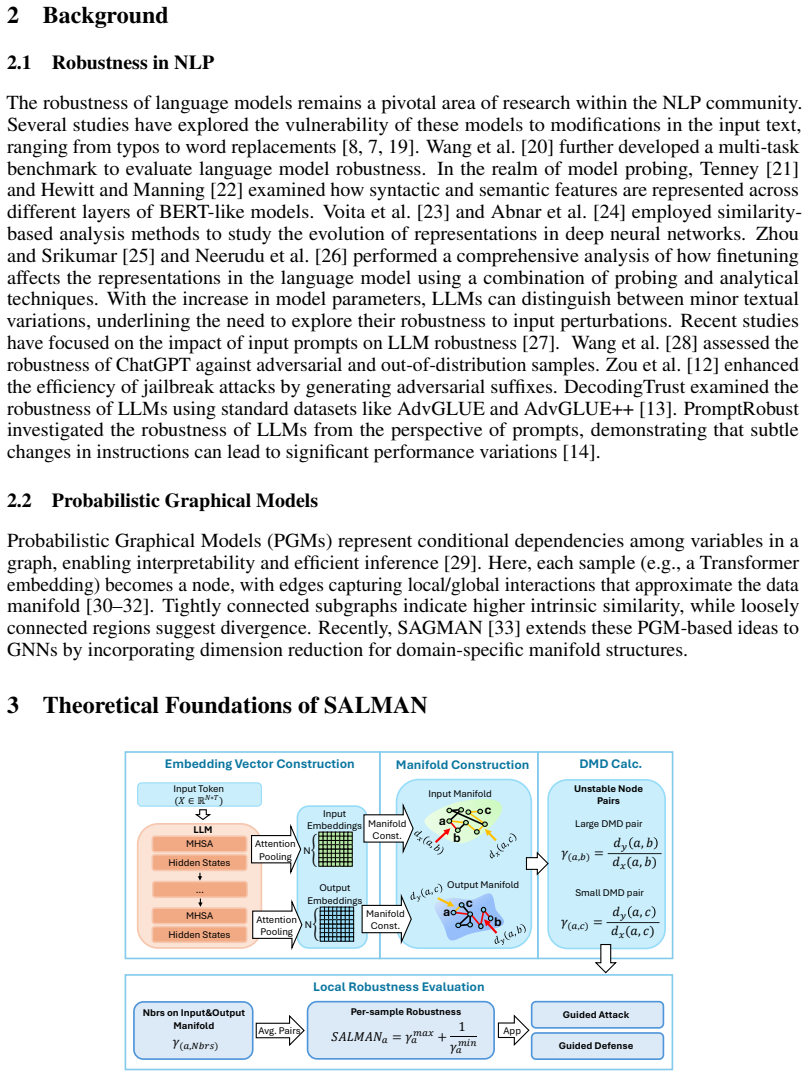
The central claim is that the model's input-output mapping can be treated as a map between two graph-based manifolds, and that per-sample distortion of that map predicts local robustness. For a pair of samples p,q, the DMD is gamma(p,q)=dY(p,q)/dX(p,q), the ratio of effective-resistance distances in the output manifold to those in the input manifold; large gamma means the model expands small input differences, small gamma means it collapses distant inputs. The paper argues both extremes matter, proves gamma_min is bounded below by 1/lambda_max(LX^+ LY), and derives the per-sample SALMAN score as the average of gamma^3 + gamma^-3 over neighbors, with a spectral approximation via weighted eige
What carries the argument
Distance Mapping Distortion (DMD): the ratio of output-manifold to input-manifold effective-resistance distance between sample pairs, gamma(p,q)=dY/dX. The paper replaces geodesic distance with effective resistance so that Laplacian pseudoinverses yield tractable formulas, builds input and output manifolds from k-NN graphs sparsified in near-linear time by a low-resistance-diameter decomposition, and converts per-pair distortion into a per-sample SALMAN score. Theorems 3.4 and 3.5 connect the extremes of gamma to eigenvalues of the matrix pencils LX^+ LY and LY^+ LX, so the score can be computed from a few dominant spectral embeddings rather than all node pairs.
Load-bearing premise
Everything rests on the assumption that pruning the graph down to a sparse approximation, for speed, does not change the distance comparisons that rank samples; if the pruning distorts those distances, the ranking is noise.
What would settle it
Compute DMD on the full k-NN graph without sparsification for a modest dataset, then compare the top 1% ranked by full-graph DMD with the top 1% ranked by the sparsified version under the same attack; if the overlap is no better than chance or the attack-success gap disappears, the ranking is an artifact of sparsification. Alternatively, run the guided attack with more than the 520 samples used here and across multiple random seeds to see whether the 60% top-1% attack success rate over random selection is reproducible.
If this is right
- Robustness evaluation of a model on a dataset becomes a one-time geometric computation that can be reused for many downstream decisions.
- Adversarial testing can be made cheaper: attacking the most distorted 1% of samples should reveal vulnerabilities faster than random sampling, with higher success rate per query.
- Fine-tuning can be reweighted by DMD to improve model-level robustness scores without sacrificing task accuracy, while keeping fine-tuned representations closer to the pretrained checkpoint.
- The ranking transfers across model sizes, so a small proxy model can flag fragile samples for a much larger target model.
- The same score captures both expansion failures and collapse failures, giving a two-sided view of local instability rather than only worst-case expansion.
Where Pith is reading between the lines
- Because DMD only needs input and output embeddings, the same recipe should apply to vision or multimodal transformers provided their representations form stable manifolds; a direct test on image-scale embeddings would be a natural extension the paper does not attempt.
- The proxy-transfer results suggest DMD may be detecting dataset-level fragile regions rather than model-specific weights; if true, the ranking could be precomputed once per dataset and reused across architectures, though the paper only tests this on a few LLM pairs.
- An implicit consequence is that DMD could serve as a data-cleaning or curriculum signal independent of attacks: intrinsically distorted samples are likely where label noise or annotation ambiguity concentrates, a hypothesis the paper does not test.
- The collapse term (gamma_min)^-1 may also predict over-confidence or hallucination, since it flags inputs the model maps too close together; the paper does not connect DMD to generation quality, but the geometry suggests that connection.
Editorial analysis
A structured set of objections, weighed in public.
Referee Report
Summary. The paper proposes SALMAN, a per-sample robustness scoring framework for transformer-based language models. It constructs k-NN graphs over pooled hidden-state embeddings from the first and last layers, sparsifies them via a claimed near-linear spectral-sparsification routine, and defines a Distance Mapping Distortion (DMD) score per sample. The authors claim that high-DMD samples are more susceptible to perturbations, that attacking the top 1% of such samples yields higher and more efficient jailbreak attack success, and that up-weighting them during fine-tuning improves robustness while preserving accuracy. Experiments are reported on BERT/RoBERTa/DistilBERT/ALBERT/GPT-2/LLaMA across GLUE-style tasks and AdvBench.
Significance. If the central claims held, SALMAN would be a practically useful, model-agnostic tool: it would provide a per-sample vulnerability ranking computable in near-linear time, without adversarial perturbation search, and would directly inform attack prioritization and robust fine-tuning. The paper has several commendable features: it addresses a real gap (sample-level robustness for both small and large LMs), proposes a concrete geometric score, includes multiple model/task evaluations, ablates the k-NN parameter, reports runtime, and tests proxy-model transferability. However, the theoretical support for the manifold construction is incomplete and the headline attack experiment is statistically underpowered; as presented, the evidence does not establish the paper's strongest practical claims.
major comments (6)
- [Section 4.2, Figure 2, Table 5] The headline attack-efficiency claim is statistically unsupported. AdvBench has 520 prompts, so the top-1% subset is about 5 samples; an ASR of 60% is 3/5 successes and the 95% CI is roughly 17-100%, so the values 40%, 48%, 56%, 60% in Table 5 differ by single samples. The random 1% baseline ASR is never stated, so the claim that attacking non-robust samples is 'more efficient and more effective' cannot be evaluated. Please report attack results on larger subsets (e.g., top 10%), exact counts, bootstrap/CI intervals, and the random-baseline ASR.
- [Section 3.3, Appendix A.5, Eq. (16)] The SALMAN score rests on Theorem 3.5, but its proof assumes each edge vector e_pq is 'dominantly aligned' with a single generalized eigenvector. This is asserted, not proved, and no bound is given for residual terms. Without that assumption, the claimed proportionality ||V_r^T e_pq||^2 + ||W_r^T e_pq||^2 ∝ γ^3 + γ^{-3} does not follow. Since Eq. (4) is the definition of the per-sample score, this gap is load-bearing; either prove the approximation with explicit error bounds or present the score as an empirically motivated heuristic and validate it independently of the theorem.
- [Section 3.2, Appendix A.2] The pruning rule of Theorem 3.1 is derived from an unjustified identification. For Θ = L + σ^{-2}I, ∂log det Θ/∂w_pq = e_pq^T (L+σ^{-2}I)^{-1} e_pq, not the effective resistance e_pq^T L^+ e_pq. The appendix writes '≈' without a bound or a limiting argument. Since the distance ratio ρ_pq and the whole spectral-sparsification step depend on this derivative, Theorem 3.1 is not proven as stated.
- [Section 3.2, Appendix A.3, Lemma A.1, Theorem A.2] The near-linear LRD sparsification is not established. Lemma A.1 asserts high-probability error bounds for Krylov-subspace resistance estimates but gives no proof or precise statement; Theorem A.2 is only a proof sketch. The validation in Appendix A.9 (Table 15) measures correlation/MSE on Cora/Citeseer/Polblogs, not the stated (1±ε) spectral guarantee, and at SPF=4 the relative resistance error reaches 1.43 for Polblogs. Since DMD is computed on the sparsified manifolds, this gap affects the central geometric proxy.
- [Section 4.1, Tables 1-2, Table 4] The claim that SALMAN 'reliably distinguishes' robust from non-robust samples is supported only by point estimates with no error bars or significance tests. Several gaps are small (e.g., RoBERTa MNLI 0.9993 vs 0.9926; GPT-2 MNLI 0.9993 vs 0.9904), and no random-selection baseline is reported for these cosine-similarity comparisons. The k-NN ablation in Table 11 likewise reports single runs. Please provide variances across seeds or bootstrap intervals and compare against random subsets of the same size.
- [Appendix A.4, Theorem 3.4 proof] The proof uses the identity (L_Y^+ L_X)^{-1} = L_X^+ L_Y without stating the conditions under which it holds; for arbitrary non-commuting Laplacian pseudoinverses this is not generally valid. The resulting bound γ_min ≥ 1/λ_max(L_X^+ L_Y) therefore needs a proof or a corrected statement. This matters because the 'collapse' component of the SALMAN score is motivated by this relation.
minor comments (5)
- [Section 3.1] The notation is confusing: {x1,...,xN} is used for token sequences, but xi is also used for individual token embeddings. Use distinct symbols for a sequence and its constituent tokens.
- [Section 3.3, Eq. (4)] The neighborhood N(p) is not clearly defined. The text mentions NX(p) but does not specify whether the average is taken over input-graph neighbors, output-graph neighbors, or their union/intersection.
- [Abstract/Section 3.3] The DMD measure is credited to Cheng et al. [40] in Section 3.3, yet the abstract and contribution list call it 'novel'. Please reconcile the novelty claim.
- [Figure 2] Panel (b) lacks axis labels and error bars; the caption should state what is plotted (number of attack attempts vs. subset, or similar) and clarify why no uncertainty is shown.
- [Appendix A.6] There is no statement about code release, random seeds for fine-tuning, or the hardware used for the runtime table. These details would substantially improve reproducibility.
Circularity Check
No significant circularity: DMD is an independently validated geometric score, not a fitted or self-referential predictor.
full rationale
The central measure, DMD, is defined as a geometric ratio of output-to-input distances (Eq. 2) and the per-sample SALMAN score as a local average of distortion terms (Eq. 4). These are quantities computed from the model's frozen embeddings; they are not fitted to the attack or perturbation outcomes. The paper's key empirical claims—that high-DMD samples show larger output shifts under external perturbations (spaCy, TextAttack) and that attacking the top DMD-ranked samples yields higher jailbreak ASR under GCG/AutoDAN—use data and procedures not involved in computing the DMD score, so the ranking is not forced by construction. The spectral sparsification and effective-resistance machinery rests on external mathematical results (Spielman-Srivastava, Koutis et al.) and is additionally validated on Cora/Citeseer/Polblogs in Appendix A.9, providing independent support. Self-citations to the authors' prior SPADE paper supply the DMD concept and a spectral upper bound, but the per-sample extension, the min-distortion theorem, and the empirical validations are derived or tested independently; no load-bearing argument reduces to a self-citation that is itself unverified. The small size of the AdvBench top-1% subset (~5 samples) is a legitimate statistical-power concern, but it is not a circularity: the attack success rate is an external outcome, not an input to the DMD computation.
Axiom & Free-Parameter Ledger
free parameters (5)
- k (number of nearest neighbors) =
10 to 70 depending on dataset (Table 10)
- SPF (spectral pruning factor) =
2 to 3 depending on dataset
- sigma^2 (prior variance in precision matrix) =
not specified
- weighting schedule parameters for guided fine-tuning =
top-25% weight 2.0, bottom-5% weight 0.0
- top-k% attack subset =
1% and 10%
axioms (5)
- domain assumption Effective resistance distances approximate geodesic distances on the data manifold.
- domain assumption The pooled MHSA hidden-state embeddings form a stable, deterministic manifold (cosine similarity 1.00 across seeds).
- ad hoc to paper Maximizing F(Theta) is equivalent to pruning edges with small distance ratio rho_pq.
- ad hoc to paper The LRD decomposition yields a (1 +/- epsilon) spectral approximation with near-linear cost.
- ad hoc to paper For each edge (p,q), the vector e_pq is dominantly aligned with one generalized eigenvector of (L_Y^+, L_X^+).
invented entities (1)
-
SALMAN score (per-sample DMD-based robustness index)
independent evidence
Cite this review
Pith. "Pith review of SALMAN: Stability Analysis of Language Models Through the Maps Between Graph-based Manifolds." pith.science (2026). https://pith.science/paper/G3JXTY6Z
@misc{pith2026250818306,
  author       = {Pith},
  title        = {Pith review of: SALMAN: Stability Analysis of Language Models Through the Maps Between Graph-based Manifolds},
  year         = {2026},
  howpublished = {\url{https://pith.science/paper/G3JXTY6Z}},
  note         = {Machine review of arXiv:2508.18306}
}
read the original abstract
Recent strides in pretrained transformer-based language models have propelled state-of-the-art performance in numerous NLP tasks. Yet, as these models grow in size and deployment, their robustness under input perturbations becomes an increasingly urgent question. Existing robustness methods often diverge between small-parameter and large-scale models (LLMs), and they typically rely on labor-intensive, sample-specific adversarial designs. In this paper, we propose a unified, local (sample-level) robustness framework (SALMAN) that evaluates model stability without modifying internal parameters or resorting to complex perturbation heuristics. Central to our approach is a novel Distance Mapping Distortion (DMD) measure, which ranks each sample's susceptibility by comparing input-to-output distance mappings in a near-linear complexity manner. By demonstrating significant gains in attack efficiency and robust training, we position our framework as a practical, model-agnostic tool for advancing the reliability of transformer-based NLP systems.
Figures


Reference graph
Works this paper leans on
-
[1]
Chi Sun, Xipeng Qiu, Yige Xu, and Xuanjing Huang. How to fine-tune bert for text classification? In Chinese computational linguistics: 18th China national conference, CCL 2019, Kunming, China, October 18–20, 2019, proceedings 18, pages 194–206. Springer, 2019
2019
-
[2]
Automatic text summariza- tion: A comprehensive survey
Wafaa S El-Kassas, Cherif R Salama, Ahmed A Rafea, and Hoda K Mohamed. Automatic text summariza- tion: A comprehensive survey. Expert systems with applications, 165:113679, 2021
2021
-
[3]
Josh Achiam, Steven Adler, Sandhini Agarwal, Lama Ahmad, Ilge Akkaya, Florencia Leoni Aleman, Diogo Almeida, Janko Altenschmidt, Sam Altman, Shyamal Anadkat, et al. Gpt-4 technical report. arXiv preprint arXiv:2303.08774, 2023
Pith/arXiv arXiv 2023
-
[4]
Chain-of-thought prompting elicits reasoning in large language models
Jason Wei, Xuezhi Wang, Dale Schuurmans, Maarten Bosma, Fei Xia, Ed Chi, Quoc V Le, Denny Zhou, et al. Chain-of-thought prompting elicits reasoning in large language models. Advances in neural information processing systems, 35:24824–24837, 2022
2022
-
[5]
Hotflip: White-box adversarial examples for text classification
Javid Ebrahimi, Anyi Rao, Daniel Lowd, and Dejing Dou. Hotflip: White-box adversarial examples for text classification. arXiv preprint arXiv:1712.06751, 2017
Pith/arXiv arXiv 2017
-
[6]
Adversarial examples for evaluating reading comprehension systems
Robin Jia and Percy Liang. Adversarial examples for evaluating reading comprehension systems. arXiv preprint arXiv:1707.07328, 2017
Pith/arXiv arXiv 2017
-
[7]
Is bert really robust? a strong baseline for natural language attack on text classification and entailment
Di Jin, Zhijing Jin, Joey Tianyi Zhou, and Peter Szolovits. Is bert really robust? a strong baseline for natural language attack on text classification and entailment. In Proceedings of the AAAI conference on artificial intelligence, volume 34, pages 8018–8025, 2020
2020
-
[8]
Bert-attack: Adversarial attack against bert using bert
Linyang Li, Ruotian Ma, Qipeng Guo, Xiangyang Xue, and Xipeng Qiu. Bert-attack: Adversarial attack against bert using bert. arXiv preprint arXiv:2004.09984, 2020
Pith/arXiv arXiv 2004
-
[9]
Freelb: Enhanced adversarial training for natural language understanding
Chen Zhu, Yu Cheng, Zhe Gan, Siqi Sun, Tom Goldstein, and Jingjing Liu. Freelb: Enhanced adversarial training for natural language understanding. In International Conference on Learning Representations
-
[10]
Searching for an effective defender: Benchmarking defense against adversarial word substitution
Zongyi Li, Jianhan Xu, Jiehang Zeng, Linyang Li, Xiaoqing Zheng, Qi Zhang, Kai-Wei Chang, and Cho-Jui Hsieh. Searching for an effective defender: Benchmarking defense against adversarial word substitution. In Proceedings of the 2021 Conference on Empirical Methods in Natural Language Processing, pages 3137–3147, 2021
2021
-
[11]
Perturbscore: Connecting discrete and continuous perturbations in nlp
Linyang Li, Ke Ren, Yunfan Shao, Pengyu Wang, and Xipeng Qiu. Perturbscore: Connecting discrete and continuous perturbations in nlp. In Findings of the Association for Computational Linguistics: EMNLP 2023, pages 6638–6648, 2023
2023
-
[12]
Universal and transferable adversarial attacks on aligned language models
Andy Zou, Zifan Wang, Nicholas Carlini, Milad Nasr, J Zico Kolter, and Matt Fredrikson. Universal and transferable adversarial attacks on aligned language models. arXiv preprint arXiv:2307.15043, 2023
Pith/arXiv arXiv 2023
-
[13]
Decodingtrust: A comprehensive assessment of trustworthiness in gpt models
Boxin Wang, Weixin Chen, Hengzhi Pei, Chulin Xie, Mintong Kang, Chenhui Zhang, Chejian Xu, Zidi Xiong, Ritik Dutta, Rylan Schaeffer, et al. Decodingtrust: A comprehensive assessment of trustworthiness in gpt models. In NeurIPS, 2023
2023
-
[14]
Promptrobust: Towards evaluating the robustness of large language models on adversarial prompts
Kaijie Zhu, Jindong Wang, Jiaheng Zhou, Zichen Wang, Hao Chen, Yidong Wang, Linyi Yang, Wei Ye, Yue Zhang, Neil Gong, et al. Promptrobust: Towards evaluating the robustness of large language models on adversarial prompts. In Proceedings of the 1st ACM Workshop on Large AI Systems and Models with Privacy and Safety Analysis, pages 57–68, 2023
2023
-
[15]
Textbugger: Generating adversarial text against real-world applications
Jinfeng Li, Shouling Ji, Tianyu Du, Bo Li, and Ting Wang. Textbugger: Generating adversarial text against real-world applications. arXiv preprint arXiv:1812.05271, 2018
Pith/arXiv arXiv 2018
-
[16]
Bae: Bert-based adversarial examples for text classification
Siddhant Garg and Goutham Ramakrishnan. Bae: Bert-based adversarial examples for text classification. arXiv preprint arXiv:2004.01970, 2020
Pith/arXiv arXiv 2004
-
[17]
Advprompter: Fast adaptive adversarial prompting for llms
Anselm Paulus, Arman Zharmagambetov, Chuan Guo, Brandon Amos, and Yuandong Tian. Advprompter: Fast adaptive adversarial prompting for llms. arXiv preprint arXiv:2404.16873, 2024
Pith/arXiv arXiv 2024
-
[18]
Theo- retically principled trade-off between robustness and accuracy
Hongyang Zhang, Yaodong Yu, Jiantao Jiao, Eric Xing, Laurent El Ghaoui, and Michael Jordan. Theo- retically principled trade-off between robustness and accuracy. In International conference on machine learning, pages 7472–7482. PMLR, 2019
2019
-
[19]
Adv- bert: Bert is not robust on misspellings! generating nature adversarial samples on bert
Lichao Sun, Kazuma Hashimoto, Wenpeng Yin, Akari Asai, Jia Li, Philip Yu, and Caiming Xiong. Adv- bert: Bert is not robust on misspellings! generating nature adversarial samples on bert. arXiv preprint arXiv:2003.04985, 2020. 11
Pith/arXiv arXiv 2003
-
[20]
Adversarial glue: A multi-task benchmark for robustness evaluation of language models
Boxin Wang, Chejian Xu, Shuohang Wang, Zhe Gan, Yu Cheng, Jianfeng Gao, Ahmed Hassan Awadallah, and Bo Li. Adversarial glue: A multi-task benchmark for robustness evaluation of language models. arXiv preprint arXiv:2111.02840, 2021
Pith/arXiv arXiv 2021
-
[21]
Bert rediscovers the classical nlp pipeline
I Tenney. Bert rediscovers the classical nlp pipeline. arXiv preprint arXiv:1905.05950, 2019
Pith/arXiv arXiv 1905
-
[22]
A structural probe for finding syntax in word representations
John Hewitt and Christopher D Manning. A structural probe for finding syntax in word representations. In Proceedings of the 2019 Conference of the North American Chapter of the Association for Computational Linguistics: Human Language Technologies, Volume 1 (Long and Short Papers), pages 4129–4138, 2019
2019
-
[23]
Elena V oita, Rico Sennrich, and Ivan Titov. The bottom-up evolution of representations in the transformer: A study with machine translation and language modeling objectives. InProceedings of the 2019 Conference on Empirical Methods in Natural Language Processing and the 9th International Joint Conference on Natural Language Processing (EMNLP-IJCNLP), pag...
work page 2019
-
[24]
Samira Abnar, Lisa Beinborn, Rochelle Choenni, and Willem Zuidema. Blackbox meets blackbox: Representational similarity and stability analysis of neural language models and brains. arXiv preprint arXiv:1906.01539, 2019
work page internal anchor Pith review Pith/arXiv arXiv 1906
-
[25]
A Closer Look at How Fine-tuning Changes BERT
Yichu Zhou and Vivek Srikumar. A closer look at how fine-tuning changes bert. arXiv preprint arXiv:2106.14282, 2021
work page internal anchor Pith review Pith/arXiv arXiv 2021
-
[26]
On Robustness of Finetuned Transformer-based NLP Models
Pavan Kalyan Reddy Neerudu, Subba Reddy Oota, Mounika Marreddy, Venkateswara Rao Kagita, and Manish Gupta. On robustness of finetuned transformer-based nlp models.arXiv preprint arXiv:2305.14453, 2023
work page internal anchor Pith review Pith/arXiv arXiv 2023
-
[27]
Survey of vulnerabilities in large language models revealed by adversarial attacks
Erfan Shayegani, Md Abdullah Al Mamun, Yu Fu, Pedram Zaree, Yue Dong, and Nael Abu-Ghazaleh. Survey of vulnerabilities in large language models revealed by adversarial attacks. arXiv preprint arXiv:2310.10844, 2023
Pith/arXiv arXiv 2023
-
[28]
On the robustness of chatgpt: An adversarial and out-of-distribution perspective
Jindong Wang, HU Xixu, Wenxin Hou, Hao Chen, Runkai Zheng, Yidong Wang, Linyi Yang, Wei Ye, Haojun Huang, Xiubo Geng, et al. On the robustness of chatgpt: An adversarial and out-of-distribution perspective. In ICLR 2023 Workshop on Trustworthy and Reliable Large-Scale Machine Learning Models
work page 2023
-
[29]
Probabilistic graphical models: Principles and techniques, 2009
Daphane Koller. Probabilistic graphical models: Principles and techniques, 2009
work page 2009
-
[30]
Pgm-explainer: Probabilistic graphical model explanations for graph neural networks
Minh Vu and My T Thai. Pgm-explainer: Probabilistic graphical model explanations for graph neural networks. Advances in neural information processing systems, 33:12225–12235, 2020
2020
-
[31]
Sgl: Spectral graph learning from measurements
Zhuo Feng. Sgl: Spectral graph learning from measurements. In 2021 58th ACM/IEEE Design Automation Conference (DAC), pages 727–732. IEEE, 2021
work page 2021
-
[32]
Manifold structure in graph embeddings
Patrick Rubin-Delanchy. Manifold structure in graph embeddings. Advances in neural information processing systems, 33:11687–11699, 2020
work page 2020
-
[33]
SAGMAN: Stability Analysis of Graph Neural Networks on the Manifolds
Wuxinlin Cheng, Chenhui Deng, Ali Aghdaei, Zhiru Zhang, and Zhuo Feng. Sagman: Stability analysis of graph neural networks on the manifolds. arXiv preprint arXiv:2402.08653, 2024
work page internal anchor Pith review Pith/arXiv arXiv 2024
-
[34]
The structure of the token space for large language models
Michael Robinson, Sourya Dey, and Shauna Sweet. The structure of the token space for large language models. arXiv preprint arXiv:2410.08993, 2024
Pith/arXiv arXiv 2024
-
[35]
Dynamic Stochastic Decoding Strategy for Open-Domain Dialogue Generation
Yiwei Li, Fei Mi, Yitong Li, Yasheng Wang, Bin Sun, Shaoxiong Feng, and Kan Li. Dynamic stochastic decoding strategy for open-domain dialogue generation. arXiv preprint arXiv:2406.07850, 2024
work page internal anchor Pith review Pith/arXiv arXiv 2024
-
[36]
Define: Deep factorized input word embeddings for neural sequence modeling
Sachin Mehta, Rik Koncel-Kedziorski, Mohammad Rastegari, and Hannaneh Hajishirzi. Define: Deep factorized input word embeddings for neural sequence modeling. CoRR, 2019
work page 2019
-
[37]
Learning graphs from data: A signal representation perspective
Xiaowen Dong, Dorina Thanou, Michael Rabbat, and Pascal Frossard. Learning graphs from data: A signal representation perspective. IEEE Signal Processing Magazine, 36(3):44–63, 2019
2019
-
[38]
Graph sparsification by effective resistances
Daniel A Spielman and Nikhil Srivastava. Graph sparsification by effective resistances. In Proceedings of the fortieth annual ACM symposium on Theory of computing, pages 563–568, 2008
work page 2008
-
[39]
Timothy Chu, Yu Gao, Richard Peng, Sushant Sachdeva, Saurabh Sawlani, and Junxing Wang. Graph sparsification, spectral sketches, and faster resistance computation via short cycle decompositions. SIAM Journal on Computing, (0):FOCS18–85, 2020
work page 2020
-
[40]
Spade: A spectral method for black-box adversarial robustness evaluation
Wuxinlin Cheng, Chenhui Deng, Zhiqiang Zhao, Yaohui Cai, Zhiru Zhang, and Zhuo Feng. Spade: A spectral method for black-box adversarial robustness evaluation. In International Conference on Machine Learning, pages 1814–1824. PMLR, 2021. 12
work page 2021
-
[41]
The electrical resistance of a graph captures its commute and cover times
Ashok K Chandra, Prabhakar Raghavan, Walter L Ruzzo, Roman Smolensky, and Prasoon Tiwari. The electrical resistance of a graph captures its commute and cover times. Computational Complexity, 6(4): 312–340, 1996
work page 1996
-
[42]
Approaching optimality for solving sdd linear systems
Ioannis Koutis, Gary L Miller, and Richard Peng. Approaching optimality for solving sdd linear systems. In Foundations of Computer Science (FOCS), 2010 51st Annual IEEE Symposium on , pages 235–244. IEEE, 2010
work page 2010
-
[43]
Approximate gaussian elimination for laplacians-fast, sparse, and simple
Rasmus Kyng and Sushant Sachdeva. Approximate gaussian elimination for laplacians-fast, sparse, and simple. In 2016 IEEE 57th Annual Symposium on Foundations of Computer Science (FOCS) , pages 573–582. IEEE, 2016
work page 2016
-
[44]
Efficient and robust approximate nearest neighbor search using hierarchical navigable small world graphs
Yu A Malkov and Dmitry A Yashunin. Efficient and robust approximate nearest neighbor search using hierarchical navigable small world graphs. IEEE transactions on pattern analysis and machine intelligence, 42(4):824–836, 2018
2018
-
[45]
Simple and scalable constrained clustering: a generalized spectral method
Mihai Cucuringu, Ioannis Koutis, Sanjay Chawla, Gary Miller, and Richard Peng. Simple and scalable constrained clustering: a generalized spectral method. In Artificial Intelligence and Statistics , pages 445–454. PMLR, 2016
work page 2016
-
[46]
Graph-based clustering via group sparsity and manifold regularization
Jianyu Miao, Tiejun Yang, Junwei Jin, and Lingfeng Niu. Graph-based clustering via group sparsity and manifold regularization. IEEE Access, 7:172123–172135, 2019
work page 2019
-
[47]
Levenshtein Training for Word-level Quality Estimation
Shuoyang Ding, Marcin Junczys-Dowmunt, Matt Post, and Philipp Koehn. Levenshtein training for word-level quality estimation. arXiv preprint arXiv:2109.05611, 2021
work page internal anchor Pith review Pith/arXiv arXiv 2021
-
[48]
Towards Variable-Length Textual Adversarial Attacks
Junliang Guo, Zhirui Zhang, Linlin Zhang, Linli Xu, Boxing Chen, Enhong Chen, and Weihua Luo. Towards variable-length textual adversarial attacks. arXiv preprint arXiv:2104.08139, 2021
work page internal anchor Pith review Pith/arXiv arXiv 2021
-
[49]
Fraud’s bargain attack: Generating adversarial text samples via word manipulation process
Mingze Ni, Zhensu Sun, and Wei Liu. Fraud’s bargain attack: Generating adversarial text samples via word manipulation process. IEEE Transactions on Knowledge and Data Engineering, 2024
work page 2024
-
[50]
Thai Le, Jooyoung Lee, Kevin Yen, Yifan Hu, and Dongwon Lee. Perturbations in the wild: Lever- aging human-written text perturbations for realistic adversarial attack and defense. arXiv preprint arXiv:2203.10346, 2022
work page internal anchor Pith review Pith/arXiv arXiv 2022
-
[51]
Don't Retrain, Just Rewrite: Countering Adversarial Perturbations by Rewriting Text
Ashim Gupta, Carter Wood Blum, Temma Choji, Yingjie Fei, Shalin Shah, Alakananda Vempala, and Vivek Srikumar. Don’t retrain, just rewrite: Countering adversarial perturbations by rewriting text. arXiv preprint arXiv:2305.16444, 2023
work page internal anchor Pith review Pith/arXiv arXiv 2023
-
[52]
Contrastive learning with text augmentation for text classification
Ouyang Jia, Huimin Huang, Jiaxin Ren, Luodi Xie, and Yinyin Xiao. Contrastive learning with text augmentation for text classification. Applied Intelligence, 53(16):19522–19531, 2023
work page 2023
-
[53]
spaCy: Industrial-strength Natural Language Processing in Python
Matthew Honnibal, Ines Montani, Sofie Van Landeghem, and Adriane Boyd. spaCy: Industrial-strength Natural Language Processing in Python. 2020. doi: 10.5281/zenodo.1212303
-
[54]
John X Morris, Eli Lifland, Jin Yong Yoo, Jake Grigsby, Di Jin, and Yanjun Qi. Textattack: A framework for adversarial attacks, data augmentation, and adversarial training in nlp.arXiv preprint arXiv:2005.05909, 2020
Pith/arXiv arXiv 2005
-
[55]
Bertscore: Evaluating text generation with bert
Tianyi Zhang, Varsha Kishore, Felix Wu, Kilian Q Weinberger, and Yoav Artzi. Bertscore: Evaluating text generation with bert. arXiv preprint arXiv:1904.09675, 2019
Pith/arXiv arXiv 1904
-
[56]
Reevaluating adversarial examples in natural language
John X Morris, Eli Lifland, Jack Lanchantin, Yangfeng Ji, and Yanjun Qi. Reevaluating adversarial examples in natural language. arXiv preprint arXiv:2004.14174, 2020
Pith/arXiv arXiv 2004
-
[57]
Jailbreak attacks and defenses against large language models: A survey
Sibo Yi, Yule Liu, Zhen Sun, Tianshuo Cong, Xinlei He, Jiaxing Song, Ke Xu, and Qi Li. Jailbreak attacks and defenses against large language models: A survey. arXiv preprint arXiv:2407.04295, 2024
Pith/arXiv arXiv 2024
-
[58]
Comprehensive assessment of jailbreak attacks against llms
Junjie Chu, Yugeng Liu, Ziqing Yang, Xinyue Shen, Michael Backes, and Yang Zhang. Comprehensive assessment of jailbreak attacks against llms. arXiv preprint arXiv:2402.05668, 2024
Pith/arXiv arXiv 2024
-
[59]
Autodan: Generating stealthy jailbreak prompts on aligned large language models
Xiaogeng Liu, Nan Xu, Muhao Chen, and Chaowei Xiao. Autodan: Generating stealthy jailbreak prompts on aligned large language models. arXiv preprint arXiv:2310.04451, 2023
Pith/arXiv arXiv 2023
-
[60]
Universal language model fine-tuning for text classification
Jeremy Howard and Sebastian Ruder. Universal language model fine-tuning for text classification. arXiv preprint arXiv:1801.06146, 2018. 13
Pith/arXiv arXiv 2018
-
[61]
Improving generalization of adversarial training via robust critical fine-tuning
Kaijie Zhu, Xixu Hu, Jindong Wang, Xing Xie, and Ge Yang. Improving generalization of adversarial training via robust critical fine-tuning. In Proceedings of the IEEE/CVF International Conference on Computer Vision, pages 4424–4434, 2023
work page 2023
-
[62]
ROSE: Robust Selective Fine-tuning for Pre-trained Language Models
Lan Jiang, Hao Zhou, Yankai Lin, Peng Li, Jie Zhou, and Rui Jiang. Rose: Robust selective fine-tuning for pre-trained language models. arXiv preprint arXiv:2210.09658, 2022
work page internal anchor Pith review Pith/arXiv arXiv 2022
-
[63]
Transformers: State-of-the-art natural language processing
Thomas Wolf. Transformers: State-of-the-art natural language processing. arXiv preprint arXiv:1910.03771, 2020
Pith/arXiv arXiv 1910
-
[64]
Sentence-bert: Sentence embeddings using siamese bert-networks
N Reimers. Sentence-bert: Sentence embeddings using siamese bert-networks. arXiv preprint arXiv:1908.10084, 2019
Pith/arXiv arXiv 1908
-
[65]
Graph Sparsification by Effective Resistances
Daniel Spielman and Nikhil Srivastava. Graph Sparsification by Effective Resistances. SIAM Journal on Computing, 40(6):1913–1926, 2011
work page 1913
-
[66]
Glue: A multi-task benchmark and analysis platform for natural language understanding
Alex Wang. Glue: A multi-task benchmark and analysis platform for natural language understanding. arXiv preprint arXiv:1804.07461, 2018
Pith/arXiv arXiv 2018
-
[67]
Bert: Pre-training of deep bidirectional transformers for language understanding
Jacob Devlin. Bert: Pre-training of deep bidirectional transformers for language understanding. arXiv preprint arXiv:1810.04805, 2018
Pith/arXiv arXiv 2018
-
[68]
Roberta: A robustly optimized bert pretraining approach
Yinhan Liu. Roberta: A robustly optimized bert pretraining approach. arXiv preprint arXiv:1907.11692, 364, 2019
Pith/arXiv arXiv 1907
-
[69]
Distilbert, a distilled version of bert: smaller, faster, cheaper and lighter
V Sanh. Distilbert, a distilled version of bert: smaller, faster, cheaper and lighter. arXiv preprint arXiv:1910.01108, 2019
Pith/arXiv arXiv 1910
-
[70]
Albert: A lite bert for self-supervised learning of language representations
Zhenzhong Lan. Albert: A lite bert for self-supervised learning of language representations. arXiv preprint arXiv:1909.11942, 2019
Pith/arXiv arXiv 1909
-
[71]
Language models are unsupervised multitask learners
Alec Radford, Jeffrey Wu, Rewon Child, David Luan, Dario Amodei, Ilya Sutskever, et al. Language models are unsupervised multitask learners. OpenAI blog, 1(8):9, 2019
2019
-
[72]
Llama: Open and efficient foundation language models
Hugo Touvron, Thibaut Lavril, Gautier Izacard, Xavier Martinet, Marie-Anne Lachaux, Timothée Lacroix, Baptiste Rozière, Naman Goyal, Eric Hambro, Faisal Azhar, et al. Llama: Open and efficient foundation language models. arXiv preprint arXiv:2302.13971, 2023
Pith/arXiv arXiv 2023
-
[73]
Spectral sparsification of graphs
Daniel A Spielman and Shang-Hua Teng. Spectral sparsification of graphs. SIAM Journal on Computing, 40(4):981–1025, 2011
work page 2011
-
[74]
The electrical resistance of a graph captures its commute and cover times
Ashok K Chandra, Prabhakar Raghavan, Walter L Ruzzo, and Roman Smolensky. The electrical resistance of a graph captures its commute and cover times. InProceedings of the twenty-first annual ACM symposium on Theory of computing, pages 574–586, 1989
work page 1989
-
[75]
Wendy Ellens, Floske M Spieksma, Piet Van Mieghem, Almerima Jamakovic, and Robert E Kooij. Effective graph resistance. Linear algebra and its applications, 435(10):2491–2506, 2011
work page 2011
-
[76]
Bojan Mohar. Graph laplacians. Topics in algebraic graph theory, 102:113–136, 2004
work page 2004
-
[77]
Resistance-distance matrix: A computational algorithm and its application
D Babi´c, Douglas J Klein, István Lukovits, Sonja Nikoli´c, and N Trinajsti´c. Resistance-distance matrix: A computational algorithm and its application. International Journal of Quantum Chemistry, 90(1):166–176, 2002. 14 A Technical Appendices and Supplementary Material A.1 Deterministic Hidden-State Embeddings Though modern transformers can produce stoc...
work page 2002
-
[78]
Decomposing the Objective. Writing L = P (p,q)∈E wp,q ep,q e⊤ p,q, we split F (Θ) into two terms: F (Θ) = F1(Θ) − 1 k F2(Θ), where F1(Θ) = logdet(Θ) , F 2(Θ) = Tr X ⊤Θ X . Since Θ = L + 1 σ2 I, each edge weight wp,q appears explicitly in L
-
[79]
Gradient with Respect to an Edge Weight. To optimize F (Θ) w.r.t. a single edge weight wp,q: • Term F1(Θ): Let λi be the i-th eigenvalue of L, and vi its eigenvector. Then ∂ ∂wp,q logdet(Θ) = ∂ ∂wp,q h logdet L + 1 σ2 I i . By standard matrix calculus, this derivative can be linked to the effective resistance distance deff (p, q): ∂F1 ∂wp,q ≈ deff (p, q),...
-
[80]
Rewriting Equation (6): deff (p, q) − 1 k 1 wp,q = 0 ⇐ ⇒deff (p, q) = 1 k 1 wp,q
Distance Ratio and Pruning Condition. Rewriting Equation (6): deff (p, q) − 1 k 1 wp,q = 0 ⇐ ⇒deff (p, q) = 1 k 1 wp,q . Define the distance ratio for edge (p, q): ρp,q = deff (p, q) ddat(p, q) = wp,q deff (p, q) . When deff (p, q) is relatively large compared to 1 wp,q , we have ρp,q large, indicating an important edge for logdet(Θ). Conversely, if ρp,q ...
This paper was first reviewed by deepseek-v4-flash on August 5, 2026.
discussion (0)
Sign in with ORCID, Apple, or X to comment. Anyone can read and Pith papers without signing in.