REVIEW 4 major objections 4 minor 1 cited by
DELIVER's central claim: a Voronoi-based relay scheme can turn natural-language pickup-and-delivery commands into multi-robot handoff chains that keep total mission cost roughly constant while reducing per-agent travel by up to 55%.
Reviewed by Pith at T0; open to challenge. T0 means a machine referee read the full paper against a public rubric. the ladder, T0–T4 →
DELIVER combines an LLM parser, Voronoi territory division, and relay handoffs so multiple robots can cooperatively deliver an item from a single spoken instruction.
T0 review reviewed 2026-08-05 challenge →
load-bearing objection Solid system integration paper whose headline 'consistent mission cost' claim is undercut by its own Fig. 3(a); the relay overhead is real and the evaluation is too thin to support the current phrasing. the 4 major comments →
DELIVER: A System for LLM-Guided Coordinated Multi-Robot Pickup and Delivery using Voronoi-Based Relay Planning
The pith
A machine-rendered reading of the paper's core claim, the machinery that carries it, and where it could break.
The reading
Core claim
On the paper's own terms, the discovery is that a relay handoff problem reduces to a geometric selection problem. Given robot positions, a Voronoi partition of the workspace assigns each robot a region; the A* path from pickup to delivery identifies the active relay chain as the robots whose regions intersect it; and for every consecutive pair the best handoff point is the point on their shared Voronoi edge that minimizes the larger of the two distances to the robots, found as the intersection of that edge with the perpendicular bisector of the two robot positions. The paper reports that this procedure keeps total mission path length within 19–29 units for teams of 1, 3, 5, and 10 agents, wh
What carries the argument
The central object is the Voronoi tessellation of the workspace computed from robot positions, together with the relay-point rule on its edges. The relay point z* for robots xi and xi+1 is chosen on their shared boundary edge to minimize the maximum of the two distances to the robots, which the paper solves by intersecting the edge with the perpendicular bisector of the two robot positions; if no intersection lies on the edge, the better endpoint is chosen. This rule is what converts a global path into a chain of local segments, and each robot's finite-state machine executes its segment, signals readiness at the handoff, and passes the item along.
Load-bearing premise
The planning layer assumes a convex, obstacle-free workspace, so the computed relay handoff point on a Voronoi boundary is assumed to be reachable; if that point lies in an obstacle or unreachable space, the relay fails, and the paper defers this case to future work.
What would settle it
In an environment shaped so that the Voronoi boundary between the pickup-side and delivery-side robots crosses an obstacle (e.g., a wall or pillar between them), compute the relay point with the paper's perpendicular-bisector rule without obstacle handling: the handoff point will sit inside the obstacle and the relay cannot complete. Alternatively, measure total mission path length for teams of 3, 5, and 10 in a strongly non-convex workspace; if total length grows with team size instead of staying flat, the consistent-mission-cost claim is refuted.
If this is right
- If DELIVER's claim holds, a pickup-and-delivery task can be distributed over a team without increasing total distance: total mission length stays roughly flat as team size grows (19–29 units across 1, 3, 5, and 10 agents).
- Per-agent travel drops substantially with team size (up to 55% versus a single agent), so each robot does less work for the same task.
- Active relay agents grow sublinearly (about 3.5 of 10 robots active on average), so adding robots does not drag idle agents into the task.
- Because handoffs happen on Voronoi boundaries with lightweight signaling (ROS messages or LED cues), coordination does not require centralized global replanning at execution time.
- The same LLM-plus-FSM pipeline transfers from discrete-grid simulation to continuous Gazebo with Nav2 obstacle avoidance and to physical TurtleBot3 hardware.
Where Pith is reading between the lines
- Editorial extension: the total-cost invariance is a geometric consequence in convex, obstacle-free workspaces: the polyline through Voronoi-boundary transfer points approximates the straight-line global path, so total distance is bounded by path length plus detours. A non-convex or obstacle-rich workspace would likely break this invariance unless transfer points are projected into free space.
- Editorial extension: the active-agent selection rule (path-region intersection) suggests a direct generalization to multi-item or streaming tasks: the same Voronoi partition can serve many overlapping relay chains, and per-item active sets can be computed independently.
- Editorial extension: a testable extension would be to compare DELIVER's total mission cost against the A* path length in the same workspace; if the ratio grows with obstacle density, the claim of consistent mission cost can be characterized quantitatively.
Editorial analysis
A structured set of objections, weighed in public.
Referee Report
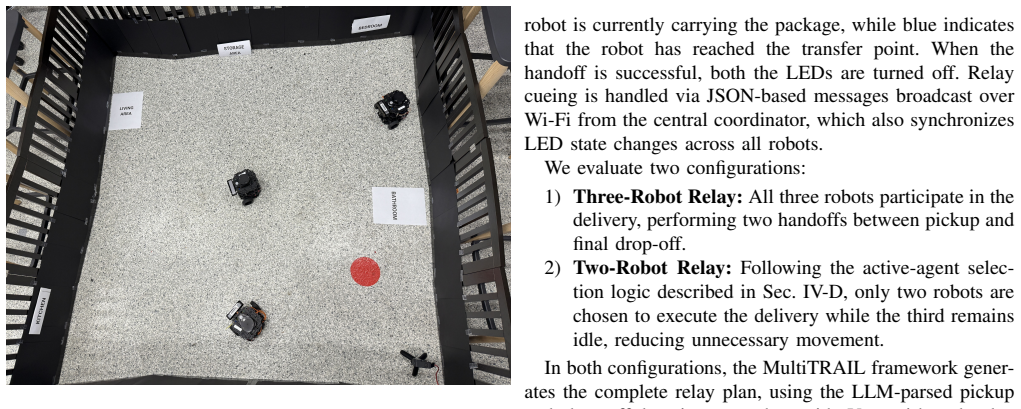
Summary. The paper presents DELIVER, a modular pipeline that maps a natural-language pickup-and-delivery command to a team of mobile robots. A LLaMA3-8B instance extracts pickup/drop-off locations; a Voronoi partition of the robot positions defines spatial regions; an A* path is intersected with these regions to select active agents; relay transfer points are computed on shared Voronoi boundaries by minimizing the maximum distance to the two neighboring agents (Sec. IV-E); and finite-state machines execute the segments with ROS/LED handoff signaling. Validation is reported in a 20x20 MultiTRAIL grid (100 trials per team size), in ROS2/Gazebo with 2 and 4 TurtleBots (10 trials each), and on three physical TurtleBots in a 1.7 m square arena. The headline claim is that DELIVER maintains consistent mission cost across team sizes while reducing per-agent workload by up to 55% relative to a single-agent system.
Significance. If the efficiency claim were supported, DELIVER would be a useful integrated demonstration of language-guided multi-robot relay. The system integration is real and commendable: the pipeline operates end-to-end, the relay-point computation in Sec. IV-E is mathematically sound, and the hardware trials show that the FSM/waypoint architecture transfers to physical robots. The paper is also transparent about the convex, obstacle-free idealization. However, the headline quantitative advantage is not established by the reported data. The per-agent workload reduction is partly structural because it follows from dividing a total path length among active agents, and Fig. 3(a) contradicts the 'consistent mission cost' claim. The contribution is best evaluated as a system integration study; the scalability/efficiency claims need reanalysis, more appropriate baselines, and qualified wording.
major comments (4)
- [§V-A, Fig. 3(a)] The reported total path lengths for team sizes 1, 3, 5, and 10 are 19, 28, 26, and 29. The n=3 total is 47% higher than the n=1 baseline (28 vs. 19), and n=10 is 53% higher. This directly contradicts the abstract and Sec. V-A statements that mission cost is 'consistent' or 'nearly constant' across team sizes. No error bars, confidence intervals, or significance tests are reported despite 100 trials per condition. The claim must be weakened to acknowledge a relay-induced total-path overhead of roughly 50%, or the authors must provide statistical evidence that the 19-to-28 jump is within noise.
- [§V-A, Fig. 3(b)] The per-active-agent path length is computed as total path length divided by the number of active relay agents (e.g., 19/1=19, 28/2=14, 26/2.4≈11, 29/3.5≈8.3). The 'up to 55% reduction' is therefore a mathematical consequence of partitioning a total path among more agents, not an independent measure of efficiency. Since the total path length grows with team size, the reduction does not indicate improved system efficiency; at most it demonstrates workload distribution. To make the efficiency claim meaningful, compare against a non-relay multi-robot baseline or report coordination overhead separately, and clarify that the per-agent metric is derived rather than measured independently.
- [§IV-B, §IV-E, Fig. 5] The Voronoi partition and transfer-point computation assume an obstacle-free convex workspace. As the authors acknowledge in Sec. IV-B and again in the conclusion, transfer points computed on Voronoi boundaries may fall inside obstacles or be unreachable. The Gazebo experiments avoid this hard case because the Voronoi partition is computed offline in a convex 2D workspace and the resulting waypoints are handed to Nav2 (Fig. 5 caption). Consequently, the paper's claim of collision-free relay coordination in 'real-world settings' is not actually demonstrated for non-convex or obstacle-rich environments. This limitation should be stated prominently in the abstract/introduction, and ideally at least one non-convex or obstacle-containing partition should be tested.
- [§V-A and §II-B] The only baseline is a single robot performing the entire task. There is no comparison with a non-relay multi-robot plan or with established MAPD/MAPF methods such as Token Passing or Rolling-Horizon Collision Resolution, which are cited in Sec. II-B. Thus the claimed novelty and scalability of the relay-coordination mechanism are not benchmarked against existing approaches. The sublinear active-agent counts in Fig. 3(c) are descriptive, but without a comparative baseline they do not establish that DELIVER's active-agent selection is efficient relative to alternative coordination strategies.
minor comments (4)
- [Figures 3–5] Figure 3 should include error bars, standard deviations, or a table with per-trial statistics; the current plot reports only point values with no dispersion despite 100 trials per condition. Figure 4 and Figure 5 captions are detailed but the figures are not referenced explicitly in the body text; please add cross-references.
- [§IV-A] The LLM classification accuracy (84.37%) is cited from prior work [5] and is not measured in the current experiments. In MultiTRAIL the task is 'sampled directly in simulation,' and in Gazebo the commands are text-based. Please clarify that the NLU component is not independently evaluated here, so the end-to-end language-to-relay claim is only partially supported by this paper's experiments.
- [Global] There are formatting typos in the camera-ready text, including 'V oronoi' and 'T otal' in headings/figures and 'Y et al.' in references. These should be corrected in revision.
- [§VI] The future-work paragraph mentions extending Voronoi allocation to non-convex environments and handling transfer points near obstacles. This is an important limitation of the current system and should be moved or summarized earlier, e.g., in Sec. IV-B, so that readers are not misled about the current scope.
Circularity Check
No significant circularity; the NLU self-citation is minor and non-load-bearing, and the per-agent workload metric is definitional but not a fitted prediction.
full rationale
The paper's derivation chain is largely self-contained. A natural-language command is parsed into pickup/drop-off coordinates, the workspace is partitioned into Voronoi regions, active agents are selected by path-region intersection, transfer points are computed on shared Voronoi boundaries, and execution is governed by FSMs. No parameter is fitted to a subset of data and then renamed as a prediction, and no uniqueness claim is imported from the authors' prior work to force the design. The only self-citation is in Sec. IV-A, where the LLM parser is said to be 'directly adopted from our prior work [5]' with an 84.37% classification accuracy. That citation is not load-bearing for the central relay/efficiency claims: the MultiTRAIL efficiency experiments sample pickup/delivery locations directly, and the hardware experiments use text-based commands, so the relay results do not rest on the prior NLU accuracy. The per-agent workload reduction is indeed arithmetically tied to the definition of the metric: mean path per active agent equals total path length divided by the number of active relay agents, as seen in Fig. 3. This makes the 'up to 55%' reduction a property of averaging rather than an independent empirical discovery, but the paper does not claim to derive this from a first-principles model or to predict it from fitted inputs—it reports the system's behavior. The larger empirical concern is the 'consistent mission cost' claim, since Fig. 3(a) shows total path length rising from 19 (n=1) to 28 (n=3), a 47% increase; that is a correctness/evidence mismatch, not a circularity. The authors also acknowledge the convex, obstacle-free approximation in Sec. IV-B and future-work limitations in Sec. VI, which further indicate the limits are disclosed rather than hidden by circular reasoning. Overall, no prediction or derivation reduces by construction to its own inputs.
Axiom & Free-Parameter Ledger
axioms (4)
- domain assumption Workspace is convex and obstacle-free for high-level Voronoi partitioning and relay point computation.
- domain assumption The LLM module's previously measured 84.37% classification accuracy transfers to the multi-robot setting and is not re-evaluated here.
- domain assumption Relay agents can transfer the physical item at a handoff point using only proximity and signaling cues.
- standard math The A* path over the environment is a faithful global plan for selecting active agents.
Cite this review
Pith. "Pith review of DELIVER: A System for LLM-Guided Coordinated Multi-Robot Pickup and Delivery using Voronoi-Based Relay Planning." pith.science (2026). https://pith.science/paper/2KFWB6OJ
@misc{pith2026250819114,
  author       = {Pith},
  title        = {Pith review of: DELIVER: A System for LLM-Guided Coordinated Multi-Robot Pickup and Delivery using Voronoi-Based Relay Planning},
  year         = {2026},
  howpublished = {\url{https://pith.science/paper/2KFWB6OJ}},
  note         = {Machine review of arXiv:2508.19114}
}
read the original abstract
We present DELIVER (Directed Execution of Language-instructed Item Via Engineered Relay), a fully integrated framework for cooperative multi-robot pickup and delivery driven by natural language commands. DELIVER unifies natural language understanding, spatial decomposition, relay planning, and motion execution to enable scalable, collision-free coordination in real-world settings. Given a spoken or written instruction, a lightweight instance of LLaMA3 interprets the command to extract pickup and delivery locations. The environment is partitioned using a Voronoi tessellation to define robot-specific operating regions. Robots then compute optimal relay points along shared boundaries and coordinate handoffs. A finite-state machine governs each robot's behavior, enabling robust execution. We implement DELIVER on the MultiTRAIL simulation platform and validate it in both ROS2-based Gazebo simulations and real-world hardware using TurtleBot3 robots. Empirical results show that DELIVER maintains consistent mission cost across varying team sizes while reducing per-agent workload by up to 55% compared to a single-agent system. Moreover, the number of active relay agents remains low even as team size increases, demonstrating the system's scalability and efficient agent utilization. These findings underscore DELIVER's modular and extensible architecture for language-guided multi-robot coordination, advancing the frontiers of cyber-physical system integration.
Figures



Forward citations
Cited by 1 Pith paper
-
Relay-Based Coordination for Energy-Efficient Multi-Robot Pickup and Delivery
VCST-RCP reduces multi-robot delivery fleet travel distance by 31% on average by routing packages through a Voronoi-constrained Steiner tree relay backbone rather than direct source-to-destination paths.
Reference graph
Works this paper leans on
-
[1]
Autonomous delivery robots: A literature review,
M. Hossain, “Autonomous delivery robots: A literature review,” IEEE Engineering Management Review , vol. 51, no. 4, pp. 77–89, 2023
work page 2023
-
[2]
Service robots in the healthcare sector,
J. Holland, L. Kingston, C. McCarthy, E. Armstrong, P. O’Dwyer, F. Merz, and M. McConnell, “Service robots in the healthcare sector,” Robotics, vol. 10, no. 1, p. 47, 2021
work page 2021
-
[3]
A survey of large language models,
W. X. Zhao, K. Zhou, J. Li, T. Tang, X. Wang, Y . Hou, Y . Min, B. Zhang, J. Zhang, Z. Dong et al. , “A survey of large language models,” arXiv preprint arXiv:2303.18223 , 2023
Pith/arXiv arXiv 2023
-
[4]
A survey on evaluation of large language models,
Y . Chang, X. Wang, J. Wang, Y . Wu, L. Yang, K. Zhu, H. Chen, X. Yi, C. Wang, Y . Wang et al. , “A survey on evaluation of large language models,” ACM Transactions on Intelligent Systems and Technology , vol. 15, no. 3, pp. 1–45, 2024
2024
-
[5]
A. K. Srivastava and P. Dames, “Speech-guided sequential planning for autonomous navigation using large language model meta ai 3 (llama3),” in International Conference on Social Robotics . Springer, 2024, pp. 158–168
work page 2024
-
[6]
Holistic evaluation of language models,
P. Liang, R. Bommasani, T. Lee, D. Tsipras, D. Soylu, M. Yasunaga, Y . Zhang, D. Narayanan, Y . Wu, A. Kumaret al., “Holistic evaluation of language models,” arXiv preprint arXiv:2211.09110 , 2022
Pith/arXiv arXiv 2022
-
[7]
Adversarial nli: A new benchmark for natural language understand- ing,
Y . Nie, A. Williams, E. Dinan, M. Bansal, J. Weston, and D. Kiela, “Adversarial nli: A new benchmark for natural language understand- ing,” arXiv preprint arXiv:1910.14599 , 2019
Pith/arXiv arXiv 1910
-
[8]
Towards expert- level medical question answering with large language models,
K. Singhal, T. Tu, J. Gottweis, R. Sayres, E. Wulczyn, L. Hou, K. Clark, S. Pfohl, H. Cole-Lewis, D. Neal et al. , “Towards expert- level medical question answering with large language models,” arXiv preprint arXiv:2305.09617, 2023
Pith/arXiv arXiv 2023
-
[9]
Large language models in machine translation,
T. Brants, A. Popat, P. Xu, F. J. Och, and J. Dean, “Large language models in machine translation,” in Proceedings of the 2007 Joint Conference on Empirical Methods in Natural Language Processing and Computational Natural Language Learning (EMNLP-CoNLL) , 2007, pp. 858–867
work page 2007
-
[10]
Large language models for text clas- sification: From zero-shot learning to fine-tuning,
Y . Chae and T. Davidson, “Large language models for text clas- sification: From zero-shot learning to fine-tuning,” Open Science Foundation, 2023
work page 2023
-
[11]
A comprehensive survey on pretrained foun- dation models: A history from BERT to ChatGPT,
C. Zhou, Q. Li, C. Li, J. Yu, Y . Liu, G. Wang, K. Zhang, C. Ji, Q. Yan, L. He et al. , “A comprehensive survey on pretrained foun- dation models: A history from BERT to ChatGPT,” arXiv preprint arXiv:2302.09419, 2023
Pith/arXiv arXiv 2023
-
[12]
Sayplan: Grounding large language models using 3d scene graphs for scalable task planning,
K. Rana, J. Haviland, S. Garg, J. Abou-Chakra, I. D. Reid, and N. Suenderhauf, “Sayplan: Grounding large language models using 3d scene graphs for scalable task planning,” CoRR, 2023
work page 2023
-
[13]
P. Shah, M. Fiser, A. Faust, J. C. Kew, and D. Hakkani-Tur, “Fol- lownet: Robot navigation by following natural language directions with deep reinforcement learning,” arXiv preprint arXiv:1805.06150 , 2018
Pith/arXiv arXiv 2018
-
[14]
Lm-nav: Robotic navigation with large pre-trained models of language, vision, and action,
D. Shah, B. Osi ´nski, S. Levine et al. , “Lm-nav: Robotic navigation with large pre-trained models of language, vision, and action,” in Conference on robot learning . PMLR, 2023, pp. 492–504
work page 2023
-
[15]
M. Chang, T. Gervet, M. Khanna, S. Yenamandra, D. Shah, S. Y . Min, K. Shah, C. Paxton, S. Gupta, D. Batra et al., “Goat: Go to any thing,” arXiv preprint arXiv:2311.06430 , 2023
Pith/arXiv arXiv 2023
-
[16]
Arena 3.0: Advancing social navigation in collaborative and highly dynamic environments,
L. K ¨astner, V . Shcherbyna, H. Zeng, T. A. Le, M. H.-K. Schreff, H. Osmaev, N. T. Tran, D. Diaz, J. Golebiowski, H. Soh et al., “Arena 3.0: Advancing social navigation in collaborative and highly dynamic environments,” arXiv preprint arXiv:2406.00837 , 2024
Pith/arXiv arXiv 2024
-
[17]
The multiple traveling salesman problem: an overview of formulations and solution procedures,
T. Bektas, “The multiple traveling salesman problem: an overview of formulations and solution procedures,” omega, vol. 34, no. 3, pp. 209–219, 2006
work page 2006
-
[18]
A method for solving traveling-salesman problems,
G. A. Croes, “A method for solving traveling-salesman problems,” Operations research, vol. 6, no. 6, pp. 791–812, 1958
work page 1958
-
[19]
Task and path planning for multi- agent pickup and delivery,
M. Liu, H. Ma, J. Li, and S. Koenig, “Task and path planning for multi- agent pickup and delivery,” in Proceedings of the International Joint Conference on Autonomous Agents and Multiagent Systems (AAMAS) , 2019
work page 2019
-
[20]
Lifelong multi-agent path finding for online pickup and delivery tasks,
H. Ma, J. Li, T. Kumar, and S. Koenig, “Lifelong multi-agent path finding for online pickup and delivery tasks,” arXiv preprint arXiv:1705.10868, 2017
Pith/arXiv arXiv 2017
-
[21]
Lifelong multi-agent path finding in large-scale warehouses,
J. Li, A. Tinka, S. Kiesel, J. W. Durham, T. S. Kumar, and S. Koenig, “Lifelong multi-agent path finding in large-scale warehouses,” in Proceedings of the AAAI Conference on Artificial Intelligence, vol. 35, no. 13, 2021, pp. 11 272–11 281
2021
-
[22]
A tsp-based online algorithm for multi-task multi-agent pickup and delivery,
F. Kudo and K. Cai, “A tsp-based online algorithm for multi-task multi-agent pickup and delivery,” IEEE Robotics and Automation Letters, vol. 8, no. 9, pp. 5910–5917, 2023
work page 2023
-
[23]
Multi-goal multi-agent pickup and delivery,
Q. Xu, J. Li, S. Koenig, and H. Ma, “Multi-goal multi-agent pickup and delivery,” in 2022 IEEE/RSJ International Conference on Intelli- gent Robots and Systems (IROS) . IEEE, 2022, pp. 9964–9971
work page 2022
-
[24]
Multirobot rendezvous planning for recharging in persistent tasks,
N. Mathew, S. L. Smith, and S. L. Waslander, “Multirobot rendezvous planning for recharging in persistent tasks,” IEEE Transactions on Robotics, vol. 31, no. 1, pp. 128–142, Feb 2015
work page 2015
-
[25]
Rendezvous planning for multiple auvs with mobile charging stations in dynamic currents,
B. Li, B. R. Page, J. Hoffman, B. Moridian, and N. Mahmoudian, “Rendezvous planning for multiple auvs with mobile charging stations in dynamic currents,” IEEE Robotics and Automation Letters , vol. 4, no. 2, pp. 1653–1660, April 2019
work page 2019
-
[26]
S. Kemna, J. G. Rogers, C. Nieto-Granda, S. Young, and G. S. Sukhatme, “Multi-robot coordination through dynamic voronoi par- titioning for informative adaptive sampling in communication- constrained environments,” in 2017 IEEE International Conference on Robotics and Automation (ICRA) . IEEE, 2017, pp. 2124–2130
work page 2017
-
[27]
A. K. Srivastava, G. P. Kontoudis, D. Sofge, and M. Otte, “Distributed multi-robot information gathering using path-based sensors in entropy- weighted voronoi regions,” in International Symposium on Distributed Autonomous Robotic Systems . Springer, 2022, pp. 286–299
work page 2022
-
[28]
Anchor-oriented localized voronoi partitioning for gps-denied multi-robot coverage,
A. Munir, E. Latif, and R. Parasuraman, “Anchor-oriented localized voronoi partitioning for gps-denied multi-robot coverage,” in 2024 IEEE/RSJ International Conference on Intelligent Robots and Systems (IROS). IEEE, 2024, pp. 3395–3402
work page 2024
-
[29]
J. Hu, H. Niu, J. Carrasco, B. Lennox, and F. Arvin, “V oronoi- based multi-robot autonomous exploration in unknown environments via deep reinforcement learning,” IEEE Transactions on Vehicular Technology, vol. 69, no. 12, pp. 14 413–14 423, 2020
work page 2020
-
[30]
V oronoi-based coverage control with connec- tivity maintenance for robotic sensor networks,
W. Luo and K. Sycara, “V oronoi-based coverage control with connec- tivity maintenance for robotic sensor networks,” in 2019 International Symposium on Multi-Robot and Multi-Agent Systems (MRS) . IEEE, 2019, pp. 148–154
work page 2019
-
[31]
A voronoi diagram-based workspace partition for weak cooperation of multi-robot system in orchard,
J. Kim and H. I. Son, “A voronoi diagram-based workspace partition for weak cooperation of multi-robot system in orchard,” IEEE Access, vol. 8, pp. 20 676–20 686, 2020
work page 2020
-
[32]
S.-K. Huang, W.-J. Wang, and C.-H. Sun, “A path planning strategy for multi-robot moving with path-priority order based on a generalized voronoi diagram,” Applied Sciences, vol. 11, no. 20, p. 9650, 2021
work page 2021
-
[33]
K. Lee and K. Lee, “Adaptive centroidal voronoi tessellation with agent dropout and reinsertion for multi-agent non-convex area cover- age,” IEEE Access, vol. 12, pp. 5503–5516, 2024
work page 2024
-
[34]
Gm-vpc: An algorithm for multi- robot coverage of known spaces using generalized voronoi partition,
V . G. Nair and K. Guruprasad, “Gm-vpc: An algorithm for multi- robot coverage of known spaces using generalized voronoi partition,” Robotica, vol. 38, no. 5, pp. 845–860, 2020
2020
-
[35]
Distributed voronoi partitioning for multi-robot systems with limited range sensors,
K. Guruprasad and P. Dasgupta, “Distributed voronoi partitioning for multi-robot systems with limited range sensors,” in 2012 IEEE/RSJ international conference on intelligent robots and systems . IEEE, 2012, pp. 3546–3552
work page 2012
-
[36]
Distributed multi-target search and tracking using the phd filter,
P. M. Dames, “Distributed multi-target search and tracking using the phd filter,” Autonomous robots, vol. 44, no. 3, pp. 673–689, 2020
work page 2020
-
[37]
The zermelo–voronoi diagram: A dynamic partition problem,
E. Bakolas and P. Tsiotras, “The zermelo–voronoi diagram: A dynamic partition problem,” Automatica, vol. 46, no. 12, pp. 2059–2067, 2010
work page 2059
This paper was first reviewed by deepseek-v4-flash on August 5, 2026.
discussion (0)
Sign in with ORCID, Apple, or X to comment. Anyone can read and Pith papers without signing in.