REVIEW 5 major objections 6 minor 29 references
QuadKAN: KAN-Enhanced Quadruped Motion Control via End-to-End Reinforcement Learning
T0 review · 5 major / 6 minor · reviewed 2026-08-05 · deepseek-v4-flash
Pith's one-line read Replacing the MLP encoders and fusion heads of a vision-guided quadruped policy with spline-parameterized KAN layers yields a policy that earns higher reward, collides less, and generalizes to unseen obstacles in simulation.
desk verdict Plausible and novel architecture, but the headline KAN advantage is not yet secure: the key MLP comparison may be confounded, and the collision reduction is under-powered. read the letter →
The pith
A machine-rendered reading of the paper's core claim, the machinery that carries it, and where it could break.
The reading
What carries the argument
The key machinery is the B-spline-parameterized KAN layer: each unit projects the input to a scalar with a learnable vector and bias, expands that scalar on a fixed bank of B-spline basis functions, and combines the basis coefficients with learnable weights before a smooth nonlinearity. Because the bases have local support, the resulting function is piecewise-smooth and locally controlled, matching the phase structure of gait; curvature and Jacobian/Lipschitz regularizers keep the policy smooth and low-jitter. The same spline construction serves as the proprioceptive encoder and as an attention-free fusion head that pools proprioceptive and vision tokens, keeping complexity linear in token c
What would settle it
On the Thin Obstacle terrain, run the MLP fusion head with a width sweep (for example hidden widths 64, 256, 1024, 2048) under the same PPO budget and record return and collisions; if any MLP width reaches or beats QuadKAN's 874.37 return with 15.23 collisions, the spline inductive bias is not the deciding factor.
Extended reading notes
Core claim
The paper's central claim is that the spline parameterization itself, not merely additional parameters or training effort, is what lifts performance. KAN layers implement learnable one-dimensional functions as B-spline basis expansions with local support; using them in the proprioceptive encoder and the cross-modal fusion head aligns the state-to-action mapping with the piecewise-smooth nature of gait—smooth within a contact phase, sharp at foot-strike and lift-off. Trained end-to-end with PPO and with multi-modal delay randomization to mimic real sensor asynchrony, QuadKAN beats unstructured MLP fusion on return and collision avoidance across all three simulated terrains. On the trained thi
Load-bearing premise
The load-bearing premise is that the MLP baselines get parameter counts and training budgets comparable to QuadKAN's; Section 5.1 promises this, but no parameter counts or runtimes are reported, so if the MLPs are smaller or under-trained the gap could be capacity rather than spline structure.
Editorial extensions
If this is right
- On the trained Thin Obstacle terrain, replacing MLP fusion heads with the KAN spline head increases episode return by about 10% (874.37 vs 794.30) and cuts obstacle collisions by about 76% (15.23 vs 63.27) at comparable distance.
- Zero-shot on the unseen static rugged-obstacle terrain, the spline policy keeps its advantage: higher return, about 44% fewer collisions, and nearly equal distance against the MLP fusion baseline.
- On the unseen dynamic-obstacle terrain, the gap widens: QuadKAN's return rises from 105.70 to 261.52 and distance from 12.60 m to 17.77 m relative to the MLP fusion baseline.
- Unimodal depth-only policies, whether MLP or KAN, nearly collapse in these environments, confirming that proprioception and vision carry complementary information.
- KAN policies converge faster and show lower cross-seed variance (coefficient of variation 0.094 vs 0.105 for the MLP fusion policy), which the paper reads as training stability under PPO.
Reading between the lines
- An implication the authors leave implicit: if the spline bias is responsible for the gains, the same KAN encoder/fusion recipe should transfer to other contact-rich or periodic gaits such as biped walking, hopping, or stair climbing; zero-shot transfer on those simulators would test this.
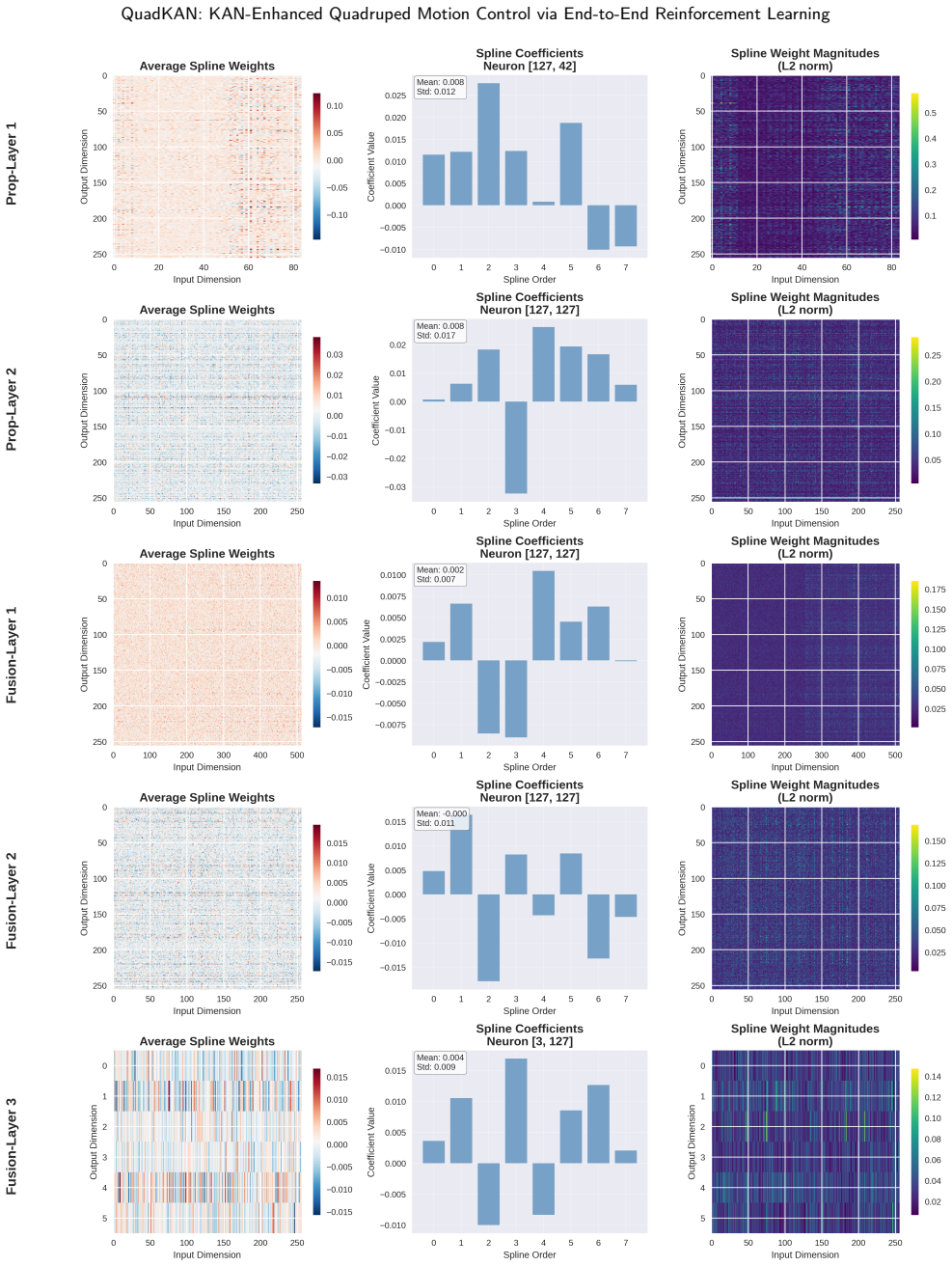
- A testable extension: vary the curvature and Jacobian regularizer weights to see whether the reported heavier-tailed, more localized spline weights predict lower action jitter and fewer collisions, as the interpretability analysis suggests.
- The attention-free design opens a scaling path the paper does not benchmark: more vision tokens or higher-resolution depth could be fused at linear cost, exactly where transformer-based fusion becomes costly.
Editorial analysis
A structured set of objections, weighed in public.
Referee Report
Summary. The paper proposes QuadKAN, a vision-guided quadruped locomotion policy in which the proprioceptive encoder and the cross-modal fusion head are parameterized by Kolmogorov–Arnold Networks (KANs) with B-spline bases, replacing standard MLPs. The method is trained end-to-end with PPO under Multi-Modal Delay Randomization (MMDR). The authors report evaluations in PyBullet on a trained Thin Obstacle terrain and two unseen terrains (static and dynamic obstacles with rugged ground), comparing QuadKAN against MLP and unimodal baselines on return, collision times, and distance traveled. The central claim is that spline-parameterized KAN policies outperform unstructured MLP policies, with headline numbers such as a 10.1% return gain and 75.9% collision reduction on the trained terrain (Table 4).
Significance. If the reported gains were established, the paper would provide evidence that a structured, spline-based function class improves sample efficiency, safety, and interpretability in vision-guided quadruped control, an area where MLP policies are standard. The idea of using KANs in a cross-modal locomotion policy is timely and the attention-free fusion design is interesting. However, the evidence is not yet convincing: the MLP baseline is not shown to be matched in capacity or runtime; several headline differences are statistically indistinguishable from noise; the ablation does not isolate the KAN encoder from the KAN fusion head; and claimed jitter/energy improvements are not directly measured. The paper also does not currently provide code or a complete set of hyperparameters, limiting reproducibility. With additional careful experiments and reporting, the manuscript could be a useful contribution.
major comments (5)
- [§5.1, §5.2, Table 4] RQ2 explicitly requires comparison 'at matched parameter count and runtime,' but no parameter counts, model sizes, or inference runtimes are reported for the MLP Proprio-Vision baseline or any other baseline. Figure 9 gives parameter counts for KAN variants (2.63M vs. 2.22M) but not for the MLP baseline. The observed 10.1% return and 75.9% collision differences could therefore be due to capacity, training dynamics, or runtime differences rather than the spline inductive bias. The central claim is not secure without reporting these statistics and, ideally, a matched-capacity MLP baseline.
- [§5.1, Baselines and Variants] The text states that all agents 'share the same proprioceptive and depth encoders with a matched token width,' but QuadKAN is described as having a 'KAN-based proprioceptive encoder.' If the MLP Proprio-Vision baseline uses the same KAN encoder, then Table 4 only tests the KAN fusion head against an MLP fusion head, providing no evidence for the claimed encoder-level benefit. If it uses an MLP encoder, then the encoders are not shared and the statement is false. This inconsistency must be resolved, and ablated variants (e.g., KAN encoder + MLP fusion and MLP encoder + KAN fusion) are needed to separate the two contributions.
- [§5.2, Tables 4 and 5] No statistical significance tests or confidence intervals are reported anywhere. For the flagship collision claim on Thin Obstacle, QuadKAN's 15.23±20.69 vs. MLP Proprio-Vision's 63.27±86.91 (n=10) gives Welch t≈1.7, p≈0.12, so the 75.9% collision reduction is not established. In the dynamic-obstacle generalization (Table 5), the return difference (261.52±371.47 vs. 105.70±475.62) has very large overlap and is not significant; the static-obstacle return difference (787.98±191.89 vs. 745.26±205.93) is also far from significant (t≈0.5). The paper's claim of 'consistently higher returns' and 'fewer collisions' across terrains is therefore overstated. Report per-metric paired bootstrap intervals or equivalent tests for every comparison.
- [§3.2, Eq. (9), §5.3] The spline curvature and Jacobian regularizers in Eq. (9) are explicitly designed to smooth the policy output, yet the paper claims 'reduced action jitter and energy' without reporting any jitter, torque, or energy metric. The return includes a small energy penalty (Eq. 26), but a −0.005·‖τ‖² term cannot substantiate a general energy claim. Add direct measurements of action smoothness (e.g., action-rate or jerk) and energy consumption for all compared methods, ideally with the regularizers ablated.
- [Table 1 and §4.2] Several hyperparameters that are load-bearing for the method are missing. The spline degree q and knot vector Ψ in Eq. (8) are not specified; the table only gives 'b=8' bases per unit. The regularization strengths λ_c, λ_L, and β_spline in Eq. (9)/(20) are not reported, despite being part of the proposed loss. The visual patch size P is also not given. Without these values, the experiments cannot be reproduced and the role of the regularizers in the reported gains cannot be assessed.
minor comments (6)
- [§5.3] Typo: 'Albation Studies' should be 'Ablation Studies.'
- [§5.5] The text contains malformed percentages '− − 8.4%' and '− − 8.7%' in the Dynamic Obstacle paragraph; these appear to be arithmetic errors or typos and should be corrected.
- [§5.1, Collision metric] The collision count is accumulated until 'three evaluation episodes complete or the robot falls,' and episodes with no obstacle interaction are excluded. This metric conflates fall timing with collision rate and may make collision counts non-comparable across methods with different fall rates. Clarify the evaluation protocol and consider reporting per-episode collision counts over a fixed number of episodes.
- [§4.1, Repository] The paper states both 'A repository is hosted at https://github.com/allen-quad-robot/quadkan' and 'to be made available upon acceptance.' This is contradictory; code access is important for reproducibility.
- [§2 and §5.2] The baselines are internal variants (MLP/Proprio/KAN), not actual published state-of-the-art locomotion policies. The abstract and introduction use 'state-of-the-art (SOTA) baselines,' which is misleading. Either compare against published vision-guided locomotion methods or rephrase.
- [§3.2, Eq. (8)] Define the B-spline basis functions B_m, the degree q, and the number of bases M precisely; the current notation ('b=8' in Table 1) is insufficient to reproduce the architecture.
Circularity Check
No significant circularity: QuadKAN's central claim is an empirical KAN-vs-MLP comparison, not a derived prediction; a minor same-author citation and an unverified matched-capacity assertion do not make the derivation circular.
full rationale
Walking the derivation chain: Section 3 defines the spline-KAN encoder and fusion head; Section 4 fixes PPO and MMDR; Section 5 compares against MLP baselines. No equation uses the target result as an input. The spline curvature/Jacobian penalties (Eq. 9a-9c, folded into Eq. 20) explicitly target smooth, low-jitter actuation, so any jitter reduction would be partly by construction; however, the paper reports no direct jitter metric and the central claims about return and collisions are not derived from these penalties. Reference [5] (Locomamba) is by the same authors but only supports a general statement about vision, and is not load-bearing; MMDR is adopted from prior work [6] rather than justified by self-citation. The more serious issue is that RQ2's 'matched parameter count and runtime' condition is asserted but parameter counts and runtimes for the MLP baseline are not reported (Section 5.1/Table 4), and the baseline description is ambiguous about whether it shares the KAN proprioceptive encoder. This is a missing-support/confound issue for the empirical comparison, not a circularity. Score 2 reflects only the minor same-author citation; the derivation itself is self-contained.
Assumptions & free parameters
free parameters (6)
- Reward weights (alive, energy) =
0.1, 0.005
- Spline regularization strengths (lambda_c, lambda_L, beta_spline) =
not reported
- CNN patch size P =
unspecified
- Visual delay sampling distribution =
unspecified
- Obstacle density curriculum schedule =
unspecified
- Spline degree and knot vector =
unspecified
assumptions (5)
- domain assumption PyBullet simulation with randomized dynamics approximates physical quadruped behavior
- domain assumption Gait is piecewise smooth and B-spline bases with local support capture this structure
- domain assumption Multi-Modal Delay Randomization from Imai et al. [6] is effective in this PPO setting
- standard math KAN implementation from Liu et al. [8] is mathematically correct and trainable with PPO
- standard math PPO with GAE, Tanh-Gaussian policy, and the given hyperparameters optimizes the MDP reliably
Cite this review
Pith. "Pith review of QuadKAN: KAN-Enhanced Quadruped Motion Control via End-to-End Reinforcement Learning." pith.science (2026). https://pith.science/paper/PKGG3W6W
@misc{pith2026250819153,
  author       = {Pith},
  title        = {Pith review of: QuadKAN: KAN-Enhanced Quadruped Motion Control via End-to-End Reinforcement Learning},
  year         = {2026},
  howpublished = {\url{https://pith.science/paper/PKGG3W6W}},
  note         = {Machine review of arXiv:2508.19153}
}
read the original abstract
We address vision-guided quadruped motion control with reinforcement learning (RL) and highlight the necessity of combining proprioception with vision for robust control. We propose QuadKAN, a spline-parameterized cross-modal policy instantiated with Kolmogorov-Arnold Networks (KANs). The framework incorporates a spline encoder for proprioception and a spline fusion head for proprioception-vision inputs. This structured function class aligns the state-to-action mapping with the piecewise-smooth nature of gait, improving sample efficiency, reducing action jitter and energy consumption, and providing interpretable posture-action sensitivities. We adopt Multi-Modal Delay Randomization (MMDR) and perform end-to-end training with Proximal Policy Optimization (PPO). Evaluations across diverse terrains, including both even and uneven surfaces and scenarios with static or dynamic obstacles, demonstrate that QuadKAN achieves consistently higher returns, greater distances, and fewer collisions than state-of-the-art (SOTA) baselines. These results show that spline-parameterized policies offer a simple, effective, and interpretable alternative for robust vision-guided locomotion. A repository will be made available upon acceptance.
Figures


Figures from the paper (4 more)


Reference graph
Works this paper leans on
-
[25]
R. Yang, M. Zhang, N. Hansen, H. Xu, X. Wang, Learning vision- guided quadrupedal locomotion end-to-end with cross-modal trans- formers, arXiv preprint arXiv:2107.03996 (2021)
arXiv 2021
-
[6]
C. S. Imai, M. Zhang, Y. Zhang, M. Kierebiński, R. Yang, Y. Qin, X. Wang, Vision-guided quadrupedal locomotion in the wild with multi-modal delay randomization, in: 2022 IEEE/RSJ international conferenceonintelligentrobotsandsystems(IROS),IEEE,2022,pp. 5556–5563
work page 2022
-
[1]
Y. Fan, Z. Pei, C. Wang, M. Li, Z. Tang, Q. Liu, A review of quadruped robots: Structure, control, and autonomous motion, Ad- vanced Intelligent Systems 6 (2024) 2300783
work page 2024
-
[2]
J. Carpentier, P.-B. Wieber, Recent progress in legged robots loco- motion control, Current Robotics Reports 2 (2021) 231–238
work page 2021
- [3]
-
[4]
Z. Li, F. Liu, W. Yang, S. Peng, J. Zhou, A survey of convolutional neural networks: analysis, applications, and prospects, IEEE transac- tionsonneuralnetworksandlearningsystems33(2021)6999–7019
work page 2021
- [5]
- [7]
Show all 29 references
-
[8]
Hou,M.Tegmark,Kan:Kolmogorov-arnoldnetworks,arXivpreprint arXiv:2404.19756 (2024)
Z.Liu,Y.Wang,S.Vaidya,F.Ruehle,J.Halverson,M.Soljačić,T.Y. Hou,M.Tegmark,Kan:Kolmogorov-arnoldnetworks,arXivpreprint arXiv:2404.19756 (2024)
2024 arXiv
-
[9]
Somvanshi, S
S. Somvanshi, S. A. Javed, M. M. Islam, D. Pandit, S. Das, A survey on kolmogorov-arnold network, ACM Computing Surveys (2024)
2024
-
[10]
H.Miura,I.Shimoyama, Dynamicwalkofabiped, TheInternational Journal of Robotics Research 3 (1984) 60–74
1984
-
[11]
Bledt, M
G. Bledt, M. J. Powell, B. Katz, J. Di Carlo, P. M. Wensing, S. Kim, Mit cheetah 3: Design and control of a robust, dynamic quadruped robot, in: 2018 IEEE/RSJ International Conference on Intelligent Robots and Systems (IROS), IEEE, 2018, pp. 2245–2252
2018
-
[12]
Grandia, F
R. Grandia, F. Farshidian, R. Ranftl, M. Hutter, Feedback mpc for torque-controlled legged robots, in: 2019 IEEE/RSJ International Conference on Intelligent Robots and Systems (IROS), IEEE, 2019, pp. 4730–4737
2019
-
[13]
Di Carlo, P
J. Di Carlo, P. M. Wensing, B. Katz, G. Bledt, S. Kim, Dynamic locomotion in the mit cheetah 3 through convex model-predictive control, in: 2018 IEEE/RSJ international conference on intelligent robots and systems (IROS), IEEE, 2018, pp. 1–9
2018
-
[14]
Y. Ding, A. Pandala, H.-W. Park, Real-time model predictive control for versatile dynamic motions in quadrupedal robots, in: 2019 InternationalConferenceonRoboticsandAutomation(ICRA),IEEE, 2019, pp. 8484–8490
2019
-
[15]
J.Carius,R.Ranftl,V.Koltun,M.Hutter, Trajectoryoptimizationfor leggedrobotswithslippingmotions, IEEERoboticsandAutomation Letters 4 (2019) 3013–3020
2019
-
[16]
J. Tan, T. Zhang, E. Coumans, A. Iscen, Y. Bai, D. Hafner, S. Bohez, V.Vanhoucke, Sim-to-real:Learningagilelocomotionforquadruped robots, arXiv preprint arXiv:1804.10332 (2018)
2018 arXiv
-
[17]
Hwangbo, J
J. Hwangbo, J. Lee, A. Dosovitskiy, D. Bellicoso, V. Tsounis, V. Koltun, M. Hutter, Learning agile and dynamic motor skills for legged robots, Science Robotics 4 (2019) eaau5872
2019
-
[18]
Kumar, Z
A. Kumar, Z. Fu, D. Pathak, J. Malik, Rma: Rapid motor adaptation for legged robots, arXiv preprint arXiv:2107.04034 (2021)
2021 arXiv
-
[19]
Z. Xie, X. Da, B. Babich, A. Garg, M. v. de Panne, Glide: Gen- eralizable quadrupedal locomotion in diverse environments with a centroidal model, in: International workshop on the algorithmic foundations of robotics, Springer, 2022, pp. 523–539
2022
-
[20]
D.Jain,A.Iscen,K.Caluwaerts, Hierarchicalreinforcementlearning for quadruped locomotion, in: 2019 IEEE/RSJ international confer- enceonintelligentrobotsandsystems(IROS),IEEE,2019,pp.7551– 7557
2019
-
[21]
W. Yu, D. Jain, A. Escontrela, A. Iscen, P. Xu, E. Coumans, S. Ha, J. Tan, T. Zhang, Visual-locomotion: Learning to walk on complex terrains with vision, in: 5th Annual Conference on Robot Learning, 2021
2021
-
[22]
H. Duan, B. Pandit, M. S. Gadde, B. Van Marum, J. Dao, C. Kim, A. Fern, Learning vision-based bipedal locomotion for challenging terrain, in: 2024 IEEE International Conference on Robotics and Automation (ICRA), IEEE, 2024, pp. 56–62
2024
-
[23]
Fahmi, V
S. Fahmi, V. Barasuol, D. Esteban, O. Villarreal, C. Semini, Vital: Vision-based terrain-aware locomotion for legged robots, IEEE Transactions on Robotics 39 (2022) 885–904
2022
-
[24]
X. Han, S. Chen, Z. Fu, Z. Feng, L. Fan, D. An, C. Wang, L. Guo, W. Meng, X. Zhang, et al., Multimodal fusion and vision-language models: A survey for robot vision, arXiv preprint arXiv:2504.02477 (2025)
2025
-
[26]
X. Wang, Y. Chen, W. Zhu, A survey on curriculum learning, IEEE transactions on pattern analysis and machine intelligence 44 (2021) 4555–4576
2021
-
[27]
J.Schulman,F.Wolski,P.Dhariwal,A.Radford,O.Klimov,Proximal policy optimization algorithms, arXiv preprint arXiv:1707.06347 (2017)
2017 arXiv
-
[28]
Coumans, Y
E. Coumans, Y. Bai, Pybullet quickstart guide, ed: PyBullet Quickstart Guide. https://docs. google. com/document/u/1/d (2021)
2021
-
[29]
T. Ji, Y. Hou, D. Zhang, A comprehensive survey on kolmogorov arnold networks (kan), arXiv preprint arXiv:2407.11075 (2024). Allen Wang and Gavin Tao:Preprint submitted to ElsevierPage 9 of 9 QuadKAN: KAN-Enhanced Quadruped Motion Control via End-to-End Reinforcement Learning ...
2024 arXiv
Reviewed August 5, 2026 · model on record in the stance chip above.
Discussion (0). Sign in to comment.