REVIEW 4 major objections 6 minor 40 references
URSA makes a real quadruped build its own diverse skill repertoire and use it to recover from leg damage.
Reviewed by Pith at T0; open to challenge. T0 means a machine referee read the full paper against a public rubric. the ladder, T0–T4 →
URSA extends quality-diversity actor-critic with learned skill spaces, safety constraints, and world-model training, enabling real-world unsupervised skill discovery on a quadruped.
T0 review reviewed 2026-08-05 challenge →
load-bearing objection Real-hardware unsupervised QD is a genuine step forward, but the abstract's damage-adaptation numbers outrun what the experiments actually support. the 4 major comments →
From Tabula Rasa to Emergent Abilities: Discovering Robot Skills via Real-World Unsupervised Quality-Diversity
The pith
A machine-rendered reading of the paper's core claim, the machinery that carries it, and where it could break.
The reading
Core claim
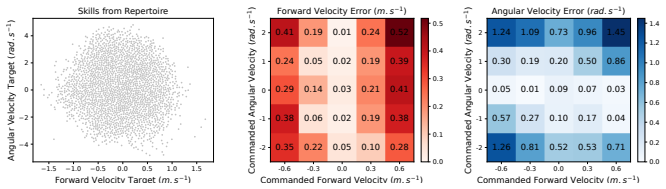
URSA's central claim: a robot can grow a skill repertoire on its own body, defining a skill as the expected feature vector of a policy's stationary distribution. Features are hand-chosen velocities or, unsupervised, a VAE latent encoding. New skills are sampled from a KDE over the repertoire and trained under two Lagrangian constraints: stay close to the target skill in successor-feature space, and keep the cost critic non-positive to remain upright. Greedy deletion maximizes a lower bound on KDE entropy, spreading skills uniformly. Demonstrated: diverse real quadruped gaits, and a Bayesian search selects a compensating skill in a few trials after leg damage.
What carries the argument
The load-bearing mechanism is the diversity-preserving repertoire R. Every safe state feature is added, then the skill with the smallest nearest-neighbor Mahalanobis distance is removed, a rule derived from a lower bound on the entropy of a KDE fitted to R; this converts raw observations into an evenly spread set of behaviors without a predefined descriptor. Around R, a skill-conditioned actor-critic trained by imagined rollouts in a world model enforces two constraints via Lagrangian critics: the successor-feature constraint (the policy really executes the skill) and the safety constraint (the robot stays upright and inside the safe state set).
Load-bearing premise
The repertoire's diversity guarantee rests on the approximation that replacing the closest-neighbor skill leaves the covariance of the skill set essentially unchanged; if that approximation fails, the entropy bound that drives uniform coverage of the reachable skill space no longer holds.
What would settle it
During a simulated training run, record the true entropy of the KDE fitted to the repertoire and the nearest-neighbor lower bound after every repertoire update; if the two diverge over time, or if the covariance shifts by more than a small amount after a single swap, the greedy replacement is not delivering the uniformity it claims. A cheaper check is to run the same deletion rule on a fixed random skill set, where the true entropy-maximizing deletion can be found by exhaustive search, and compare outcomes.
If this is right
- A robot can acquire a broad skill set on hardware with only about five hours of interaction, because most policy learning happens inside an imagined world model.
- Damage recovery becomes a search problem over an existing repertoire: selecting the best compensating skill takes a few trials rather than retraining the policy.
- Unsupervised discovery can be steered by the choice of feature space: with hand-chosen velocity features, the same mechanism yields controllable velocity-tracking skills.
- Skill diversity itself can help performance, since the repertoire-based learner also beats the single-skill learner in the undamaged setting.
Where Pith is reading between the lines
- The repertoire/search split suggests a natural interface for lifelong learning: a planner or user could query the latent space for a behavior that satisfies a desired outcome, which the paper only demonstrates through velocity targets and ITE.
- Because the skill space is learned by a VAE, the method is in principle morphology-agnostic, but the paper's own limitation notes that the choice of which state dimensions feed the encoder is decisive; ablating those inputs would make that dependency explicit.
- The entropy lower bound could be tightened by updating the covariance with each replacement, removing the paper's 'negligible change' assumption and likely changing which skills get deleted early in training.
- A direct test of the diversity mechanism would compare the greedy nearest-neighbor deletion against an exact entropy-maximizing deletion in simulation, isolating whether the uniformity gains come from the update rule or from the KDE sampling.
Editorial analysis
A structured set of objections, weighed in public.
Referee Report
Summary. The paper proposes URSA, an extension of QDAC for unsupervised quality-diversity skill discovery directly on real-world robots. URSA combines a learned VAE-based skill space, a KDE-based sampling distribution over a fixed-size repertoire, safety constraints, and a DayDreamer world-model backbone. The authors evaluate URSA on a Unitree A1 quadruped in simulation and in the real world, claiming diverse locomotion skill discovery and downstream damage adaptation. The abstract further claims that URSA outperforms all baselines in 5/9 simulated and 3/5 real-world damage scenarios.
Significance. If the claims are supported, this would be a meaningful step toward real-world unsupervised QD, with potential impact on robot damage adaptation and continuous skill learning. The paper includes a correct and reasonably transparent mathematical derivation in Appendix C, and the experimental setup is nontrivial: real-world learning on a quadruped without sim-to-real transfer, with safety constraints and an asynchronous world-model framework. The main weakness is that the headline quantitative claims are not consistently supported by the paper's own experimental text and figures, which limits the reliability of the central message.
major comments (4)
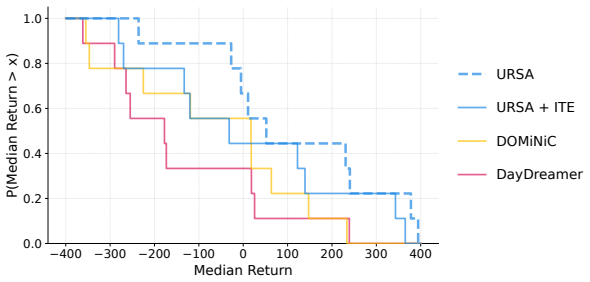
- [Abstract; Section 5.3; Appendix A; Figure 5] The abstract's claim of '5 out of 9 simulated and 3 out of 5 real-world damage scenarios' is not supported by the reported results. Section 5.3 states that URSA+ITE outperforms both DOMiNiC and DayDreamer only in upper-leg joint damage, and that DOMiNiC's near-optimality constraint is more beneficial for severe full-leg failures. Appendix A explicitly says 'URSA does not consistently outperform all baselines across individual damage scenarios.' In the real-world comparison, Figure 5 shows only URSA+ITE versus DayDreamer; DOMiNiC was not run, so 'outperforms all baselines in 3 out of 5 real-world scenarios' cannot be evaluated. Moreover, the text in Section 5.3 says URSA outperforms DayDreamer in all damage scenarios except back-right leg failures, which is 4 out of 5, not 3 out of 5. These discrepancies must be resolved and the abstract revised to match the evidence.
- [Section 5.3, Figure 5] The real-world results are based on two independent runs per condition, and the figure reports median and IQR across those two runs. With n=2, the per-scenario 'win' count is not statistically meaningful, and the paper should either provide individual run values, confidence intervals that account for small n, or weaken the per-scenario comparison to a qualitative trend. This is load-bearing for RQ2 because the damage-adaptation advantage is the main downstream-utility claim.
- [Section 5.3, Figure 4] The comparison underlying the '5 out of 9' claim is not clearly defined. Figure 4 shows two URSA variants: a hatched 'best return for URSA' bar and a URSA+ITE bar. The hatched bar appears to be an oracle upper bound over all skills in the repertoire rather than a deployable policy. If the 5/9 count is based on this oracle, it is not an apples-to-apples comparison with the baselines. The paper should report a precise win convention (which variant, which baseline, which scenarios) and provide per-scenario tables rather than only a CCDF.
- [Section 4.2, Eq. (1)] The repertoire update rule removes the skill with the smallest nearest-neighbor distance, justified by maximizing the entropy lower bound in Eq. (1). However, the paper states 'Assuming the impact of those updates on Σ is negligible' without providing evidence. Since Σ is recomputed from the repertoire and changes every time a skill is added or removed, this assumption is nontrivial. The paper should either justify why the covariance update is negligible or provide an ablation comparing the proposed update against random replacement or a direct entropy estimate. This is important because the diversity mechanism is central to the method's claimed advantage.
minor comments (6)
- [Figure 4 caption] The caption says 'The best return for URSA is shown in hatched bars' but the legend lists both 'URSA' and 'URSA + ITE'. It would be clearer to explicitly label the hatched bars as an upper bound or 'best over repertoire' and to state how this differs from the ITE variant.
- [Section 5.3] The text says 'URSA outperforms DayDreamer in all damage scenarios except for back-right leg failures', but the real-world panel in Figure 5 includes a 'No Damage' condition. Clarify whether the 5/9 and 3/5 counts include the no-damage condition, since the abstract says 'damage scenarios'.
- [Section 5.2, Figure 3] The claim of '4 times greater coverage compared to the baselines' is not supported by a precise definition of coverage. Please specify how the joint-angle space is discretized and how coverage is computed.
- [Appendix D.4, Table 1] The hyperparameter table would benefit from also listing the safety threshold and reward weights, which are currently given only in the text of D.1. This would make the setup easier to reproduce.
- [Section 4.2, Equation (1)] The notation 'k' for the constant term is defined only in the derivation of Appendix C. Consider defining it inline or referring explicitly to Eq. (C.1) to avoid confusion.
- [Figure 5, middle panel] The middle panel caption says 'evolution of attempted skills' but the x-axis is 'ITE iteration' and the y-axis is 'Total Return'. Clarify what is plotted, e.g., the skill selected by ITE and its evaluated return.
Circularity Check
No circularity: the derivation is self-contained; the overstated damage-adaptation claim is a robustness issue, not a circular reduction.
full rationale
The paper's derivation chain is not circular. The entropy lower bound (Eq. 1, Appendix C) is a standard log-sum-exp inequality, and the repertoire update is a greedy heuristic for maximizing that bound under an explicit 'impact of those updates on Sigma is negligible' assumption; whether that assumption holds is a correctness concern, not circularity. The central diversity claim is evaluated externally via joint-angle coverage (Fig. 3), a metric independent of the latent-space entropy objective, so the discovery claim is not self-referential. Damage-adaptation results are empirical comparisons against external baselines (DayDreamer, DOMiNiC); the abstract's '3 out of 5 real-world' claim is weakened because DOMiNiC was not run and n=2, but that is an overstatement/statistical robustness issue, not a reduction of the prediction to the training objective. The paper cites prior work by the same authors (QDAC, AURORA), but these are published, peer-reviewed components used as building blocks, not invoked as proof of URSA's own efficacy. No equation equals its input by construction, and no fitted parameter is renamed as a prediction. The stated limitation that the system 'is limited to exploring skills that have been previously encountered during training' further confirms that the repertoire update is a heuristic with acknowledged gaps, not a tautology. Score 0.
Axiom & Free-Parameter Ledger
free parameters (6)
- Nz (target distinct skills) =
512
- NR (repertoire size) =
4096
- VAE latent dimension =
2
- Safe-state threshold rupr =
0.7
- Reward weights (5, -0.5, -0.5) =
5, -0.5, -0.5
- ITE length scale =
0.1
axioms (6)
- domain assumption The DayDreamer world model (RSSM) provides accurate enough latent dynamics for real-world skill learning.
- domain assumption The reachable skill space is well-approximated by a Gaussian KDE with a fixed covariance.
- domain assumption The hand-defined safe state set captures all unsafe behaviors.
- ad hoc to paper The entropy lower-bound maximization via nearest-neighbor removal yields a uniform repertoire.
- domain assumption The VAE latent space is a meaningful behavior descriptor for diversity.
- domain assumption The reward function is an adequate proxy for downstream task utility.
Cite this review
Pith. "Pith review of From Tabula Rasa to Emergent Abilities: Discovering Robot Skills via Real-World Unsupervised Quality-Diversity." pith.science (2026). https://pith.science/paper/KIFCSASS
@misc{pith2026250819172,
  author       = {Pith},
  title        = {Pith review of: From Tabula Rasa to Emergent Abilities: Discovering Robot Skills via Real-World Unsupervised Quality-Diversity},
  year         = {2026},
  howpublished = {\url{https://pith.science/paper/KIFCSASS}},
  note         = {Machine review of arXiv:2508.19172}
}
read the original abstract
Autonomous skill discovery aims to enable robots to acquire diverse behaviors without explicit supervision. Learning such behaviors directly on physical hardware remains challenging due to safety and data efficiency constraints. Existing methods, including Quality-Diversity Actor-Critic (QDAC), require manually defined skill spaces and carefully tuned heuristics, limiting real-world applicability. We propose Unsupervised Real-world Skill Acquisition (URSA), an extension of QDAC that enables robots to autonomously discover and master diverse, high-performing skills directly in the real world. We demonstrate that URSA successfully discovers diverse locomotion skills on a Unitree A1 quadruped in both simulation and the real world. Our approach supports both heuristic-driven skill discovery and fully unsupervised settings. We also show that the learned skill repertoire can be reused for downstream tasks such as real-world damage adaptation, where URSA outperforms all baselines in 5 out of 9 simulated and 3 out of 5 real-world damage scenarios. Our results establish a new framework for real-world robot learning that enables continuous skill discovery with limited human intervention, representing a significant step toward more autonomous and adaptable robotic systems. Demonstration videos are available at https://adaptive-intelligent-robotics.github.io/URSA.
Figures



Reference graph
Works this paper leans on
-
[1]
J. Luo, Z. Hu, C. Xu, Y . L. Tan, J. Berg, A. Sharma, S. Schaal, C. Finn, A. Gupta, and S. Levine. Serl: A software suite for sample-efficient robotic reinforcement learning. 2024 IEEE International Conference on Robotics and Automation (ICRA) , pages 16961–16969, 2024. URL https://api.semanticscholar.org/CorpusID:267311834
work page 2024
-
[2]
I. Kostrikov, L. M. Smith, and S. Levine. Demonstrating A walk in the park: Learning to walk in 20 minutes with model-free reinforcement learning. In K. E. Bekris, K. Hauser, S. L. Herbert, and J. Yu, editors, Robotics: Science and Systems XIX, Daegu, Republic of Korea, July 10-14, 2023, 2023. doi:10.15607/RSS.2023.XIX.056. URL https://doi.org/10. 15607/R...
-
[3]
A. Cully, J. Clune, D. Tarapore, and J.-B. Mouret. Robots that can adapt like animals. Nature, 521(7553):503–507, May 2015. ISSN 1476-4687. doi:10.1038/nature14422. URL https: //doi.org/10.1038/nature14422
-
[4]
K. Chatzilygeroudis, V . Vassiliades, and J.-B. Mouret. Reset-free trial-and-error learning for robot damage recovery. Robotics and Autonomous Systems , 100:236–250, 2018
work page 2018
-
[5]
R. Kaushik, P. Desreumaux, and J.-B. Mouret. Adaptive prior selection for repertoire-based online adaptation in robotics. Frontiers in Robotics and AI, 6:151, 2020. 9
work page 2020
-
[6]
A. Sharma, M. Ahn, S. Levine, V . Kumar, K. Hausman, and S. Gu. Emergent Real-World Robotic Skills via Unsupervised Off-Policy Reinforcement Learning. In Robotics: Science and Systems XVI. Robotics: Science and Systems Foundation, July 2020. ISBN 978-0-9923747-6-1. doi:10.15607/RSS.2020.XVI.053. URL http://www.roboticsproceedings.org/ rss16/p053.pdf
-
[7]
S. C. Smith, B. Lim, H. Janmohamed, and A. Cully. Quality-diversity optimisation on a physical robot through dynamics-aware and reset-free learning. In Proceedings of the Companion Conference on Genetic and Evolutionary Computation , GECCO ’23 Companion, page 171–174, New York, NY , USA, 2023. Association for Computing Machinery. ISBN 9798400701207. doi: ...
-
[8]
J. K. Pugh, L. B. Soros, and K. O. Stanley. Quality diversity: A new frontier for evolutionary computation. Frontiers in Robotics and AI, 3:40, 2016
work page 2016
-
[9]
A. Cully and Y . Demiris. Quality and diversity optimization: A unifying modular framework. IEEE Transactions on Evolutionary Computation , 22(2):245–259, 2017
work page 2017
-
[10]
A. Cully. Autonomous skill discovery with quality-diversity and unsupervised descriptors. In Proceedings of the Genetic and Evolutionary Computation Conference , pages 81–89, 2019
work page 2019
-
[11]
L. Grillotti and A. Cully. Relevance-guided unsupervised discovery of abilities with quality- diversity algorithms. In Proceedings of the Genetic and Evolutionary Computation Conference , pages 77–85, 2022
work page 2022
-
[12]
L. Coiffard, P. Templier, and A. Cully. Overcoming Deceptiveness in Fitness Optimization with Unsupervised Quality-Diversity, page 122–130. Association for Computing Machinery, New York, NY , USA, 2025. ISBN 9798400714658. URLhttps://doi.org/10.1145/ 3712256.3726314
arXiv 2025
-
[13]
L. Grillotti, M. Faldor, B. Gonz´alez Le´on, and A. Cully. Quality-diversity actor-critic: Learning high-performing and diverse behaviors via value and successor features critics. In International Conference on Machine Learning. PMLR, 2024
work page 2024
-
[14]
P. Wu, A. Escontrela, D. Hafner, K. Goldberg, and P. Abbeel. DayDreamer: World Models for Physical Robot Learning, June 2022. URL http://arxiv.org/abs/2206.14176. arXiv:2206.14176 [cs]
Pith/arXiv arXiv 2022
-
[15]
R. S. Sutton and A. G. Barto. Reinforcement learning: an introduction . Adaptive computation and machine learning series. The MIT Press, Cambridge, Massachusetts, second edition edition,
-
[16]
A. Barreto, W. Dabney, R. Munos, J. J. Hunt, T. Schaul, H. van Hasselt, and D. Silver. Suc- cessor features for transfer in reinforcement learning. In Proceedings of the 31st International Conference on Neural Information Processing Systems , NIPS’17, pages 4058–4068, Red Hook, NY , USA, Dec. 2017. Curran Associates Inc. ISBN 978-1-5108-6096-4
work page 2017
-
[17]
E. Altman. Constrained Markov decision processes. Routledge, 1999
work page 1999
-
[18]
E. Parzen. On estimation of a probability density function and mode.The annals of mathematical statistics, 33(3):1065–1076, 1962
work page 1962
-
[19]
M. Rosenblatt. Remarks on Some Nonparametric Estimates of a Density Function. The Annals of Mathematical Statistics , 27(3):832 – 837, 1956. doi:10.1214/aoms/1177728190. URL https://doi.org/10.1214/aoms/1177728190
arXiv 1956
-
[20]
D. W. Scott. Multivariate Density Estimation: Theory, Practice and Visualization . John Wiley & Sons, Inc., New York, 1992. 10
work page 1992
-
[21]
D. P. Kingma and M. Welling. Auto-encoding variational bayes. In Y . Bengio and Y . LeCun, editors, 2nd International Conference on Learning Representations, ICLR 2014, Banff, AB, Canada, April 14-16, 2014, Conference Track Proceedings , 2014. URL http://arxiv. org/abs/1312.6114
Pith/arXiv arXiv 2014
- [22]
-
[23]
B. Eysenbach, A. Gupta, J. Ibarz, and S. Levine. Diversity is all you need: Learning skills without a reward function. In 7th International Conference on Learning Representations, ICLR 2019, New Orleans, LA, USA, May 6-9, 2019 . OpenReview.net, 2019. URL https: //openreview.net/forum?id=SJx63jRqFm
work page 2019
- [24]
-
[25]
S. Park, K. Lee, Y . Lee, and P. Abbeel. Controllability-aware unsupervised skill discovery. arXiv preprint arXiv:2302.05103, 2023
work page internal anchor Pith review Pith/arXiv arXiv 2023
-
[26]
S. Park, O. Rybkin, and S. Levine. Metra: Scalable unsupervised rl with metric-aware abstrac- tion. arXiv preprint arXiv:2310.08887, 2023
Pith/arXiv arXiv 2023
-
[27]
S. Kumar, A. Kumar, S. Levine, and C. Finn. One solution is not all you need: few-shot extrapolation via structured MaxEnt RL. In Proceedings of the 34th International Conference on Neural Information Processing Systems , NIPS’20, pages 8198–8210, Red Hook, NY , USA, Dec. 2020. Curran Associates Inc. ISBN 978-1-71382-954-6
work page 2020
-
[28]
Discovering Policies with DOMiNO: Diversity Optimization Maintaining Near Optimality
T. Zahavy, Y . Schroecker, F. Behbahani, K. Baumli, S. Flennerhag, S. Hou, and S. Singh. Discovering policies with domino: Diversity optimization maintaining near optimality. arXiv preprint arXiv:2205.13521, 2022
work page internal anchor Pith review Pith/arXiv arXiv 2022
- [29]
-
[30]
G. Paolo, M. Coninx, A. Laflaqui `ere, and S. Doncieux. Discovering and Exploiting Sparse Rewards in a Learned Behavior Space. Evolutionary Computation, 32(3):275–305, Sept. 2024. ISSN 1063-6560. doi:10.1162/evco a 00343. URL https://doi.org/10.1162/evco_ a_00343
doi:10.1162/evco 2024
-
[31]
URL https://ieeexplore.ieee.org/ document/9196819/
doi:10.1109/ICRA40945.2020.9196819. URL https://ieeexplore.ieee.org/ document/9196819/
arXiv 2020
-
[32]
A. Laversanne-Finot, A. P´er´e, and P.-Y . Oudeyer. Intrinsically motivated exploration of learned goal spaces. Frontiers in neurorobotics, 14:555271, 2021
work page 2021
-
[33]
B. Lim, A. Reichenbach, and A. Cully. Learning to walk autonomously via reset-free quality- diversity. In Proceedings of the Genetic and Evolutionary Computation Conference , GECCO ’22, pages 86–94, New York, NY , USA, July 2022. Association for Computing Machinery. ISBN 978-1-4503-9237-2. doi:10.1145/3512290.3528715. URL https://doi.org/10. 1145/3512290.3528715
arXiv 2022
-
[34]
D. Tarapore, J. Clune, A. Cully, and J.-B. Mouret. How do different encodings influence the performance of the map-elites algorithm? In Proceedings of the Genetic and Evolutionary Computation Conference 2016, pages 173–180, 2016. 11
work page 2016
-
[35]
Gait in Eight: Efficient On-Robot Learning for Omnidirectional Quadruped Locomotion
N. Bohlinger, J. Kinzel, D. Palenicek, L. Antczak, and J. Peters. Gait in eight: Efficient on-robot learning for omnidirectional quadruped locomotion. arXiv preprint arXiv:2503.08375, 2025
work page internal anchor Pith review Pith/arXiv arXiv 2025
-
[37]
S. Ha, P. Xu, Z. Tan, S. Levine, and J. Tan. Learning to walk in the real world with minimal human effort. In J. Kober, F. Ramos, and C. Tomlin, editors,Proceedings of the 2020 Conference on Robot Learning, volume 155 of Proceedings of Machine Learning Research, pages 1110–
work page 2020
-
[39]
Component Selection: Uniformly select an index i ∼ Uniform(1, . . . , NR) from the repertoire
-
[40]
Gaussian Sampling: Sample ztarget ∼ N(zi, Σ) using the selected repertoire skill zi as the mean. The covariance matrix Σ is the empirical covariance of all skills in the repertoire scaled by Scott’s rule bandwidth h = N − 1 D+4 R , such that the final covariance is Σ = h2Σempirical. This sampling procedure naturally concentrates samples around regions of ...
-
[1120]
URL https://proceedings.mlr.press/v155/ ha21c.html
PMLR, 16–18 Nov 2021. URL https://proceedings.mlr.press/v155/ ha21c.html. 12 −400 −300 −200 −100 0 100 200 300 400 Median Return 0.0 0.2 0.4 0.6 0.8 1.0P(Median Return > x) URSA URSA + ITE DOMiNiC DayDreamer Figure 7: Complementary cumulative distribution functions (CCDF) of the median performance across the simulated damage scenarios from Figure 4. HH1 1...
work page 2021
-
[2018]
ISBN 978-0-262-03924-6
This paper was first reviewed by deepseek-v4-flash on August 5, 2026.
discussion (0)
Sign in with ORCID, Apple, or X to comment. Anyone can read and Pith papers without signing in.