REVIEW 3 major objections 5 minor 3 cited by
Should LLMs be WEIRD? Exploring WEIRDness and Human Rights in Large Language Models
T0 review · 3 major / 5 minor · reviewed 2026-08-05 · deepseek-v4-flash
Pith's one-line read The paper argues that lowering an LLM's alignment with WEIRD (Western, Educated, Industrialized, Rich, Democratic) values increases the cultural variety of its answers but also raises the rate at which it produces responses judged to violat
desk verdict Useful WEIRD measurement, but the human-rights trade-off claim is built on an evaluation loop too noisy to carry it. read the letter →
The pith
A machine-rendered reading of the paper's core claim, the machinery that carries it, and where it could break.
The reading
What carries the argument
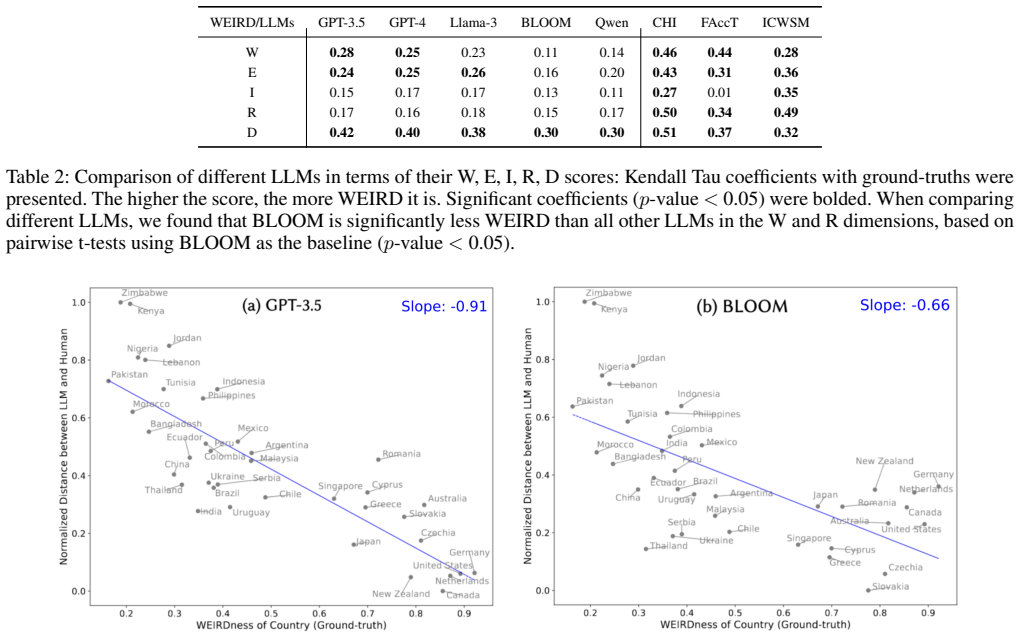
The central object is the WEIRD score, a country-level composite of five normalized variables (Western, Educated, Industrialized, Rich, Democratic) drawn from prior WEIRD-population measurement work, paired with a similarity score between each LLM's option distribution on World Values Survey questions and each country's human response distribution. The paper compares the ranking of countries by LLM similarity to the ranking by each WEIRD variable using Kendall rank correlation, and computes a human-rights violation score as the percentage of model responses that a majority of three LLM assessors judged to violate at least one article of a charter. The key mechanism is the negative slope in t
What would settle it
Have a panel of human-rights lawyers adjudicate all responses from BLOOM and GPT-4, or a sample large enough to resolve a 2 to 4 percentage point difference, against UDHR Articles 1-6 and 7-11 while blind to model identity; if BLOOM's violation rate is no higher than GPT-4's under human judgment, the paper's central trade-off is an artifact of the LLM assessors.
Extended reading notes
Core claim
The central claim is that WEIRDness and human-rights alignment are coupled in current LLMs: the more a model reflects the values of WEIRD populations, the fewer human-rights violations its responses are judged to contain, while models that reflect less-WEIRD populations show more violations, concentrated in dignity and equality and in justice and fairness. The paper grounds this in the responses of GPT-3.5, GPT-4, Llama-3, BLOOM, and Qwen to World Values Survey Wave 7 items, comparing model-country similarity to country-level WEIRD scores, and in majority-vote judgments by three LLM assessors against the Universal Declaration of Human Rights and regional charters from Asia, the Middle East,
Load-bearing premise
The load-bearing premise is that the three LLM assessors' majority votes are an unbiased measure of human-rights violations, so the 2 to 4 percentage point gap between models reflects what the models generate rather than the assessors' own cultural priors.
Editorial extensions
If this is right
- Reducing WEIRD bias in LLMs, for example by diversifying training data, can increase the frequency of outputs judged to violate human rights, so representation work must be paired with rights constraints.
- Evaluation of cultural bias should include human-rights charters, not just WEIRD-alignment scores, because the two metrics diverge across models.
- WEIRD-aligned values are not wholly a bias problem: they correlate with support for democratic governance, social trust, immigration openness, and rights protections.
- Approaches such as Constitutional AI that embed human-rights principles may only partly resolve the tension, because the conflict lies in the values themselves, not just in model training.
- LLM-based assessors can annotate human-rights violations with roughly 91% agreement against manual labels, but the residual errors concentrate in the same ambiguous gender and equality cases where the paper's main result lives.
Reading between the lines
- The 2 to 4 percentage point gap may be inflated by the evaluation loop: GPT-4 serves as both a response-generation model and one of the three assessors, so models sharing the assessors' cultural priors are more likely to be cleared. Human adjudication of all outputs, not just 150 samples, is needed before treating the trade-off as robust.
- The result may be an artifact of the World Values Survey question set, which asks directly about gender roles and family norms; a rights-relevant benchmark such as the paper's proposed WVS-HR could sharpen or soften the measured trade-off.
- The paper's own data show the relationship is not uniform across WEIRD dimensions: the Rich component does not distinguish models, and Democracy may be doing most of the work. If so, the 'WEIRD' composite framing obscures a more specific claim about democratic values and rights.
- If the trade-off holds, a practical corollary is to impose a human-rights floor rather than demand full cultural representativeness: allow cultural variation in LLM responses only above a baseline that forbids dehumanizing or discriminatory statements.
Editorial analysis
A structured set of objections, weighed in public.
Referee Report
Summary. The paper asks whether LLMs exhibit WEIRD (Western, Educated, Industrialized, Rich, Democratic) value alignment and whether such alignment trades off against human-rights compliance. Using World Values Survey Wave 7 questions, the authors elicit multiple-choice responses from GPT-3.5, GPT-4, Llama-3, BLOOM, and Qwen, compare model response distributions with country-level human responses, and compute Kendall correlations with country-level WEIRD variables. Human-rights violations are labeled by a majority vote of three LLM assessors (GPT-4, Qwen, BLOOM) against the UDHR and three regional charters, with a manual validation of 150 responses. The paper reports that GPT-3.5 and GPT-4 are the most WEIRD, BLOOM and Qwen the least, and that the less-WEIRD models show 2--4 percentage points more human-rights-violating outputs, especially on gender and equality. It interprets this as a representativeness-versus-rights trade-off and discusses Constitutional AI as a partial remedy.
Significance. If the empirical claim were established, the paper would make a useful contribution to the AI fairness and cultural-representation literature: it jointly measures two normative dimensions that are usually studied separately, uses a global survey instrument, compares against multiple human-rights charters, and provides concrete, interpretable examples. The methodology is transparent, the WVS-based setup is a natural extension of existing WEIRDness measures to LLMs, and the authors provide a public data/supplementary repository. The main value lies in the proposed benchmark and in the explicit attempt to surface a potential tension between representational diversity and rights-protective outputs. However, the headline trade-off is not yet supported with the current evidence, because the outcome variable is produced by an evaluation loop that includes the very models being ranked, and because the reported differences are smaller than the measurement error of the assessors.
major comments (3)
- [§3.2, Table 3] The central 2--4 percentage point HRV differences rest on labels produced by majority voting among GPT-4, Qwen, and BLOOM, two of which are also the response-generation models being compared. Manual validation covers only 150 of more than 30,000 judgments, reports 91% overall accuracy, and the misclassified cases largely overlap with cases where human annotators disagreed. Because a 9% label-error rate is larger than the headline gap, a small model-correlated bias in the assessors could create or erase the reported ordering. The Limitations section acknowledges this risk, but the paper does not quantify it. I would need a stratified validation per target model and per charter, an ablation that removes each assessor from the vote, or human verification of at least the violation-positive cases before accepting the trade-off claim.
- [Table 3] No confidence intervals, standard errors, or significance tests are reported for any HRV percentage. With plausible response counts in the hundreds, the difference between BLOOM's 15.6% and GPT-4's 11.9% is only a few standard errors and may not be statistically significant. The absence of uncertainty quantification is load-bearing because the paper's conclusion is an ordering claim across models. I request bootstrap confidence intervals and a formal pairwise comparison (e.g., a bootstrap or chi-square test) for both the overall HRV and the theme-level rows.
- [§4.3, abstract] The claimed 'representativeness-versus-rights trade-off' is not actually demonstrated by the five-model pattern. GPT-3.5 has the highest or among the highest WEIRD alignment in Table 2, yet its UDHR HRV is 13.9%, essentially tied with Qwen's 14.0% and higher than GPT-4's 11.9%. Thus the relationship is non-monotonic across the five models, and the abstract's generalization to 'as cultural representation in LLMs increases, so does the risk of reproducing discriminatory beliefs' goes beyond the data. Establishing such a trade-off requires a larger model sample and a statistical test of the association at the model level, not a pair-wise comparison of BLOOM/Qwen against GPT-4.
minor comments (5)
- [§3.3, Eq. (3)] The equation for HRV(m) appears corrupted: the text writes HRV(m) = nom/nom, which is identically 1. The intended expression should be number of violating responses divided by total responses.
- [§3.2] The validation paragraph alternates between 'the evaluation LLM' and 'the LLM assessors'. It should state explicitly whether the reported 91% accuracy applies to the majority-vote ensemble or to an individual assessor, and how the 150 validation samples were allocated across the three assessors.
- [Table 2] The caption states that significant coefficients are bolded, but no bolding is visible in the table and no p-values are reported. The pairwise t-test description ('using BLOOM as the baseline') is also too terse to verify; please report the test statistic, effect size, and multiple-comparison handling.
- [§3.2] The procedure for generating multiple completions per question is underspecified. The paper says sample sizes matched the number of WVS respondents per country, but does not report temperature, number of independent draws, or any seed/API settings. Reproducibility of P_m(o_i|q) requires this information.
- [Throughout] Minor typographical inconsistencies: 'QWen' appears in places for 'Qwen'; the prompt text reads 'If had to select one of the options'; 'Human Right Documents' should be 'Human Rights Documents'. These are easy to fix.
Circularity Check
Self-referential HRV assessment loop; WEIRDness metric itself is externally grounded.
-
self definitional
[Section 3.2 ("Human Rights Evaluation LLM"); Table 3]
"Specifically, we choose three LLMs as assessors given their state-of-the-art performance and cultural coverage: GPT-4, QWen and BLOOM. ... We then applied majority voting to determine whether a violation occurred: if more than one LLM assessor judged that a response violated a human rights article, we considered it a violation."
HRV(m) in §3.3 is the percentage of model m's responses that "violated at least one of the human rights articles", where "violated" is decided by majority vote among GPT-4, Qwen, and BLOOM. For three of the five ranked models—GPT-4, Qwen, BLOOM—the assessor set contains the very model whose violation rate is reported. Hence the ranking in Table 3 (GPT-4 11.9% vs BLOOM 15.6% vs Qwen 14.0%) is not an independent measurement: each of these models partially judges itself, so any systematic self-leniency, self-severity, or shared cultural prior among the assessors is present on both sides of the comparison. The manual validation of only 150 of more than 30,000 judgments (91% accuracy; errors concentrated where annotators disagreed) is too small to de-confound this loop. The headline 2–4 percent
full rationale
The paper's WEIRDness measurement is not circular: country WEIRD scores come from published external indices (Huntington, UNDP, UNIDO, World Bank, Freedom House), LLM–human similarity is computed directly from WVS responses, and no fitted parameter is renamed as a prediction. There is also no load-bearing self-citation chain; the authors' prior WEIRD-metric work is methodological rather than evidential for the headline claim. The circularity burden lies in the human-rights outcome measure. Section 3.2 uses GPT-4, Qwen, and BLOOM as the assessor ensemble, and Table 3 then ranks those same three models by violation rate; for each, one of the three majority votes is its own judgment. The 2–4 percentage-point differences are comparable to or smaller than the 9% assessor error measured on 150 cases, and the validation sample is not stratified by charter or by model. The central representativeness-versus-rights trade-off is therefore not independently established: the measured outcome is entangled with the cultural priors of the models being compared. This is a moderate, partial circularity rather than a fully forced one, because majority voting and the external human-rights charters provide some independent content, and because the WEIRDness side of the comparison is externally grounded.
Assumptions & free parameters
free parameters (3)
- WEIRD aggregate weights =
1/5 each dimension
- Question-selection quantile threshold =
top 20% (80-100% bin)
- Human rights majority-vote threshold =
2 of 3 assessors
assumptions (5)
- domain assumption WVS Wave 7 country response distributions are valid measures of mainstream national values.
- domain assumption A model's forced multiple-choice answer expresses its values rather than instruction-following.
- domain assumption LLM assessors with majority voting provide valid human-rights violation labels.
- domain assumption The WEIRD operationalization from Huntington, UNDP, UNIDO, World Bank and Freedom House is appropriate.
- domain assumption Kendall tau between country-level LLM-response similarity and WEIRD variables measures a model's WEIRDness.
Cite this review
Pith. "Pith review of Should LLMs be WEIRD? Exploring WEIRDness and Human Rights in Large Language Models." pith.science (2026). https://pith.science/paper/GMKYCPGO
@misc{pith2026250819269,
  author       = {Pith},
  title        = {Pith review of: Should LLMs be WEIRD? Exploring WEIRDness and Human Rights in Large Language Models},
  year         = {2026},
  howpublished = {\url{https://pith.science/paper/GMKYCPGO}},
  note         = {Machine review of arXiv:2508.19269}
}
read the original abstract
Large language models (LLMs) are often trained on data that reflect WEIRD values: Western, Educated, Industrialized, Rich, and Democratic. This raises concerns about cultural bias and fairness. Using responses to the World Values Survey, we evaluated five widely used LLMs: GPT-3.5, GPT-4, Llama-3, BLOOM, and Qwen. We measured how closely these responses aligned with the values of the WEIRD countries and whether they conflicted with human rights principles. To reflect global diversity, we compared the results with the Universal Declaration of Human Rights and three regional charters from Asia, the Middle East, and Africa. Models with lower alignment to WEIRD values, such as BLOOM and Qwen, produced more culturally varied responses but were 2% to 4% more likely to generate outputs that violated human rights, especially regarding gender and equality. For example, some models agreed with the statements ``a man who cannot father children is not a real man'' and ``a husband should always know where his wife is'', reflecting harmful gender norms. These findings suggest that as cultural representation in LLMs increases, so does the risk of reproducing discriminatory beliefs. Approaches such as Constitutional AI, which could embed human rights principles into model behavior, may only partly help resolve this tension.
Figures
Forward citations
Cited by 3 Pith papers
-
Scenario-based Probing and Steering Cultural Values in Large Language Models--Extended Version
Scenario-based dilemmas combined with activation steering probe and shift LLM values along Inglehart-Welzel axes, revealing persistent entanglement between dimensions that mirrors human survey data.
-
Occupational Prompting Reveals Cultural Bias in Large Language Models
Occupational prompting of open-weight LLMs elicits structured value patterns in Inglehart-Welzel cultural space, extending prior nationality-based cultural bias evaluations.
-
Prompt Programming for Cultural Bias and Alignment of Large Language Models
Automatically optimized prompts (DSPy) reduce survey-measured cultural distance for open-weight LLMs more often than manual cultural prompting, with MIPROv2 and a large proposer model giving the most consistent gains.
Reference graph
Works this paper leans on
-
[6]
arXiv preprint arXiv:2309.10771
Redefining qualitative analysis in the AI era: Utiliz- ing ChatGPT for efficient thematic analysis. arXiv preprint arXiv:2309.10771. Ziems, C.; Held, W.; Shaikh, O.; Chen, J.; Zhang, Z.; and Yang, D. 2024. Can large language models transform com- putational social science? Computational Linguistics, 50(1): 237–291
arXiv 2024
-
[2004]
Boston University International Law Journal , 24(2): 147. Arnett, J. J. 2008. The neglected 95%: Why American psy- chology needs to become less American.American Psychol- ogist, 63(7): 602–614. Assembly, U. N. G. 1949. Universal declaration of human rights, volume 3381. Department of State, United States of America. Atari, M.; Haidt, J.; Graham, J.; Kolev...
arXiv 2008
-
[2012]
Human Rights Law Review, 13(3): 557–579. Salda˜na, J. 2015. The Coding Manual for Qualitative Re- searchers. Sage. Schmitt, D. P.; Allik, J.; McCrae, R. R.; and Benet-Mart´ınez, V . 2007. The geographic distribution of Big Five person- ality traits: Patterns and profiles of human self-description across 56 nations. Journal of Cross-cultural Psychology , 3...
arXiv 2015
-
[2023]
Linxen, S.; Sturm, C.; Br ¨uhlmann, F.; Cassau, V .; Opwis, K.; and Reinecke, K
Bloom: A 176b-parameter open-access multilingual language model. Linxen, S.; Sturm, C.; Br ¨uhlmann, F.; Cassau, V .; Opwis, K.; and Reinecke, K. 2021. How WEIRD is CHI? In Pro- ceedings of the Conference on Human Factors in Computing Systems (CHI), CHI ’21. ACM. ISBN 9781450380966. Liu, R.; Jia, C.; Wei, J.; Xu, G.; and V osoughi, S. 2022. Quantifying an...
arXiv 2021
-
[2024]
In Proceedings of the AAAI/ACM Conference on AI, Ethics, and Society, volume 7, 584–596
ExploreGen: Large language models for envisioning the uses and risks of AI technologies. In Proceedings of the AAAI/ACM Conference on AI, Ethics, and Society, volume 7, 584–596. Hewitt, L.; Ashokkumar, A.; Ghezae1, I.; and Willer, R. 2024. Predicting Results of Social Sci- ence Experiments Using Large Language Models. https://docsend.com/view/ity6yf2danse...
arXiv 2024
-
[2025]
In Proceedings of the ACM on Web Conference 2025, 3204–3218
C3ai: Crafting and evaluating constitutions for consti- tutional ai. In Proceedings of the ACM on Web Conference 2025, 3204–3218. Laufer, B.; Jain, S.; Cooper, A. F.; Kleinberg, J.; and Heidari, H. 2022. Four Years of FAccT: A Reflexive, Mixed-Methods Analysis of Research Contributions, Shortcomings, and Fu- ture Prospects. In ACM Conference on Fairness, ...
work page 2025
Reviewed August 5, 2026 · model on record in the stance chip above.
Discussion (0). Sign in to comment.