REVIEW 4 major objections 5 minor 7 cited by
AWorld claims that distributing agent-environment rollouts makes GRPO training practical and lifts a Qwen3-32B agent to 32.23% pass@1 on GAIA, beating GPT-4o.
Reviewed by Pith at T0; open to challenge. T0 means a machine referee read the full paper against a public rubric. the ladder, T0–T4 →
AWorld, a distributed rollout framework, cuts agent experience-collection time 14.6x and trains a Qwen3-32B agent scoring 32.23% on GAIA, above GPT-4o and near DeepSeek-V3.
T0 review reviewed 2026-08-05 challenge →
load-bearing objection Real open-source rollout infrastructure, but the paper's causal story needs the missing SFT-only baseline before the RL claim lands. the 4 major comments →
AWorld: Orchestrating the Training Recipe for Agentic AI
The pith
A machine-rendered reading of the paper's core claim, the machinery that carries it, and where it could break.
The reading
Core claim
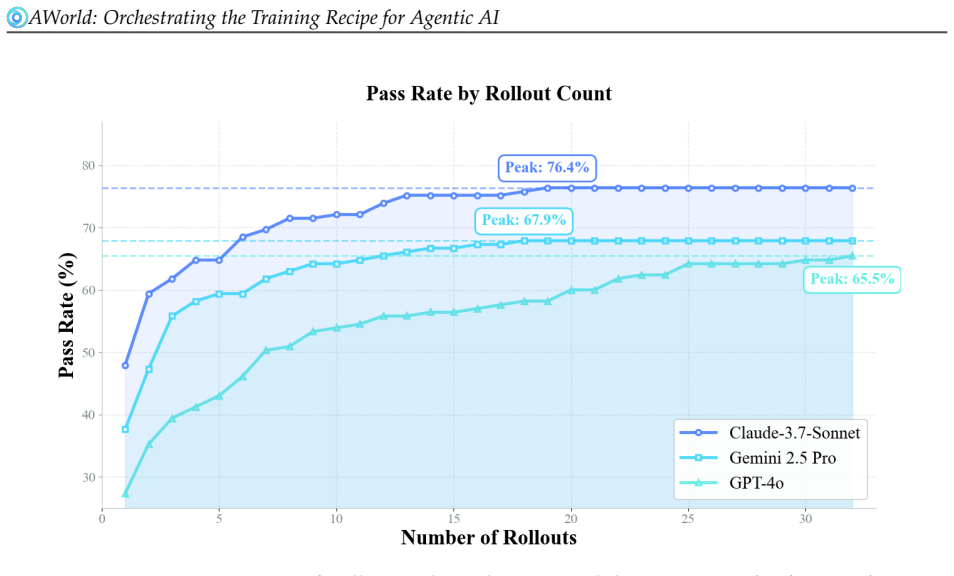
On its own terms, the paper makes two empirical discoveries. First, on the GAIA validation set, pass@k rises sharply with rollout count for every model tested: Claude 3.7 Sonnet climbs from 47.9% at pass@1 to 76.4% at pass@32, and GPT-4o more than doubles from 27.3% to 65.5%. This establishes that rollout volume, not just model intelligence, drives agent success. Second, AWorld's distributed executor shrinks a full rollout-plus-training cycle from 7839 seconds to 669 seconds, a 14.6x reduction in the rollout phase, making large-scale reinforcement learning feasible. Using this throughput, the paper trains Qwen3-32B-AWorld: SFT on 886 Claude 3.7 Sonnet successful trajectories, then GRPO with
What carries the argument
The load-bearing object is the AWORLD Executor, a distributed rollout engine that replaces the rollout module of an external RL training framework. It manages many sandboxed agent environments as concurrent pods across a cluster, keeps task state consistent through a centralized trace server, and unifies communication between agents, tools, and models through a Message object. This machinery converts a sequential, single-node rollout that takes 7695 seconds into a 525-second cluster-scale rollout, thereby making the exploration phase of GRPO no longer the wall-clock bottleneck.
Load-bearing premise
The headline rankings assume the 886 Claude-sampled training trajectories come from questions not in the GAIA test set and that the comparison models were run under equally capable scaffolds, so the claim of surpassing GPT-4o reflects model quality rather than test-set leakage or weaker baselines.
What would settle it
Re-run the pipeline with SFT only (no GRPO) on the same 886 trajectories and measure GAIA test pass@1: if it is already near 32.23%, the reinforcement-learning stage is not what produced the claimed gain. Also inspect the overlap between GAIA test questions and the SFT training data.
If this is right
- Agent training on long-horizon benchmarks becomes a throughput problem: once rollouts are distributed, the same GRPO recipe can be run on open-weight models without proprietary data pipelines.
- Open-weight 32B models can reach or exceed GPT-4o-level GAIA performance, lowering the cost bar for reproducing frontier agent results.
- The measured pass-rate-versus-rollout curves imply that evaluation protocols should report pass@k alongside pass@1, and that giving a fixed agent more attempts is a cheap source of gains.
- Improvement on xbench-DeepSearch without training on its samples suggests the learned policy transfers across tool-use benchmarks, not just GAIA.
- Level 3 GAIA questions, the hardest tier, show the largest relative gains, indicating the recipe targets the long-horizon reasoning that stumps baseline agents.
Where Pith is reading between the lines
- Because no SFT-only checkpoint is reported, the +10.6-point gain could be dominated by the 886 Claude-sampled trajectories; ablating RL versus SFT would settle the paper's strongest causal claim about reinforcement learning.
- The same distributed-rollout recipe should transfer to other sandboxed agent benchmarks such as web navigation or computer control, but that transfer is untested here.
- The pass-rate curves imply a deployment strategy the paper does not discuss: at inference time, run k rollouts and select the best answer to harvest gains without retraining.
- If rollout throughput is genuinely the binding constraint, the next bottleneck will be reward signal design and environment fidelity, where exact-match rules may be too coarse for more open-ended tasks.
Editorial analysis
A structured set of objections, weighed in public.
Referee Report
Summary. The paper presents AWorld, an open-source distributed execution framework for agent-environment interaction, and uses it to collect rollouts on GAIA and train a Qwen3-32B agent via SFT followed by GRPO. It reports a 14.6x speedup over single-node sequential rollout, and a final GAIA test pass@1 of 32.23%, surpassing the reported GPT-4o score (27.91%) and approaching DeepSeek-V3 (31.89%). The authors argue that rollout throughput is the primary bottleneck for agentic training and that AWorld's distributed architecture makes large-scale RL practical.
Significance. If the claims hold, the contribution is a useful open infrastructure and a concrete demonstration that an open-weight 32B model can reach competitive GAIA performance with a relatively simple recipe. The paper's strengths include releasing code and model weights, using a rule-based reward, and evaluating on a held-out benchmark. The centrality of the claims, however, depends on whether the reported gain is attributable to RL and whether the comparison scores are computed under comparable scaffolds; both points currently require additional evidence.
major comments (4)
- [§3.4, Table 3] The +10.6 pp gain from 21.59% to 32.23% is attributed to the RL process, but no SFT-only checkpoint is reported. Since the SFT stage uses 886 successful trajectories sampled by Claude 3.7 Sonnet, the entire gain could stem from imitation/distillation rather than from GRPO or from AWorld's distributed rollouts. Please evaluate and release an SFT-only model, and report its GAIA test score in Table 3. In addition, the source split of the 886 trajectories is not stated; if any of these trajectories were generated from GAIA test prompts, the test-set number would be invalid. Both points are necessary to support the paper's central causal narrative.
- [§3.4, Table 3] The comparison scores for GPT-4o, Claude 3.7 Sonnet, and DeepSeek-V3 are reported without specifying the agent scaffold, tool set, prompt template, or evaluation protocol. GAIA results are highly sensitive to these choices, so the claim that Qwen3-32B-AWorld 'surpasses GPT-4o' is not verifiable from the information given. Please provide the exact evaluation harness used for the reported baseline numbers, or run those models on the same AWorld-based harness.
- [§3.2, Figure 6] The monotone increase of pass@k with k is a mathematical property of the pass@k estimator, not an empirical discovery. Figure 6 can quantify the magnitude and the diminishing-returns shape, but the text's claim that 'This finding empirically confirms that a sufficient rollout count is essential' is circular. Please reframe this section as a calibration of known monotonicity, or report a per-attempt success measure (e.g., conditional success probability after previous failures) if the intended claim is that additional attempts improve the agent itself rather than the estimator.
- [§3.3, Table 2] The 14.6x speedup is reported without the number of tasks, number of worker pods, cluster size, node hardware, or the timeout/task distribution. This makes it difficult to determine whether the gain comes from parallelism across additional machines rather than from AWorld's design. Please include a workload description, the exact hardware used in both settings, and ideally a speedup-vs-workers curve. Also state whether the single-node baseline used the same tool stack, model inference engine, and termination conditions.
minor comments (5)
- [§3.4, Implementations] GRPO hyperparameters (learning rate, rollout batch size, mini-batch size, number of GRPO steps, KL coefficient) and SFT training details (epochs, learning rate, packing) are not reported. These are needed for reproducibility of the training recipe.
- [§3.4, Table 3] The xbench-DeepSearch benchmark is not described. State what it measures, how the scores in Table 3 were obtained, and whether the same evaluation protocol was used for the base and trained models.
- [§3.2, Figure 6] The caption uses 'rollouts per task' and 'pass@k' together; please clarify that k here is the number of sequential attempts per question, since the standard pass@k definition assumes a fixed set of k independent samples. This affects how readers interpret the monotonicity.
- [§3.4, Reward Calculator] The rule-based reward of exact string match with the ground truth may be overly strict for GAIA, where many answers accept paraphrases or equivalent units. Describe any normalization (e.g., number formatting, punctuation, unit conversion) applied before comparison.
- [References] The citation 'Google et al., 2023' is nonstandard; the reference list contains the Gemini report, so please ensure in-text citations match the reference list.
Circularity Check
Low circularity: one definitional overstatement in the rollout-count motivation; core speedup and benchmark claims are independent.
specific steps
-
self definitional
[Section 3.2, Figure 6]
"We plot the pass@k success rate for three leading models on the full 165-question GAIA validation set, varying the number of rollouts (k) from 1 to 32. ... increasing the number of rollouts directly and substantially improves the pass rate for all models."
pass@k is the probability that at least one of k attempts succeeds; for any fixed per-attempt success probability p, pass@k = 1 - (1-p)^k, which is non-decreasing in k by construction. The qualitative upward trend is therefore an identity of the metric, not an empirical discovery. The paper leans on this trend to conclude that 'a sufficient rollout count is essential ... for ensuring the agent has successful examples to learn from,' which is also tautologically true. The empirical content of Figure 6 is limited to the per-attempt success rates and the plateau location; the direction of the effect is definitional.
full rationale
The paper's central engineering and benchmark claims—the 14.6x distributed rollout speedup (Table 2) and the 32.23% GAIA test pass@1 for Qwen3-32B-AWorld (Table 3)—are self-contained empirical measurements. They do not reduce to their inputs: the speedup is a measured wall-clock comparison, and the GAIA score is an external benchmark result. The only definitional circularity I find is in the motivational experiment of Section 3.2: the reported monotonic increase of pass@k with k is guaranteed by the definition of pass@k as 'at least one success in k attempts,' so using it as an 'empirical confirmation' that rollout count is essential is tautological. This step is not load-bearing for the system's measured speedup or the final benchmark score, so the overall circularity is low. The missing SFT-only checkpoint is a substantive confound for the attribution of the full +10.6 pp gain to reinforcement learning, but that is a correctness/experimental-design issue, not circularity; likewise, undisclosed scaffold details for comparison models affect external validity but are not circular. Self-citation is not load-bearing in this paper.
Axiom & Free-Parameter Ledger
free parameters (3)
- rollouts per task =
32
- SFT dataset size =
886 trajectories
- GRPO training hyperparameters
axioms (5)
- domain assumption GAIA validation and test splits are representative of real-world agentic tasks and mutually exchangeable for training purposes.
- ad hoc to paper The monotone increase of pass@k with k means that more practice data improves agent capability.
- domain assumption A rule-based exact-match reward is a sufficient learning signal for GAIA tasks.
- domain assumption The 886 Claude-sampled SFT trajectories do not leak information from the GAIA test set.
- domain assumption The comparison models in Table 3 were evaluated under scaffolds comparable to AWorld.
Cite this review
Pith. "Pith review of AWorld: Orchestrating the Training Recipe for Agentic AI." pith.science (2026). https://pith.science/paper/3CUMARDU
@misc{pith2026250820404,
  author       = {Pith},
  title        = {Pith review of: AWorld: Orchestrating the Training Recipe for Agentic AI},
  year         = {2026},
  howpublished = {\url{https://pith.science/paper/3CUMARDU}},
  note         = {Machine review of arXiv:2508.20404}
}
read the original abstract
The learning from practice paradigm is crucial for developing capable Agentic AI systems, yet it is severely hampered by inefficient experience generation, a bottleneck especially pronounced in complex benchmarks like GAIA. To address this, we introduce AWorld, an open-source system engineered for large-scale agent-environment interaction. By distributing tasks across a cluster, AWorld accelerates experience collection by 14.6x compared to standard single-node, sequential execution. This critical speedup makes extensive reinforcement learning practical and scalable. Leveraging this capability, we trained a Qwen3-32B-based agent that achieves pass@1 accuracy of 32.23% on the GAIA test set, which surpasses GPT-4o (27.91%) and rivals DeepSeek-V3 (31.89%). Our open-source system and the resulting agent provide a practical blueprint for a complete agentic AI training pipeline, from efficient interaction to demonstrable model improvement.
Figures


Forward citations
Cited by 7 Pith papers
-
Autogenesis: A Self-Evolving Agent Protocol
Autogenesis Protocol defines structured resource management and closed-loop self-evolution for multi-agent LLM systems, with the resulting AGS showing gains over baselines on long-horizon benchmarks.
-
Open, Reliable, and Collective: A Community-Driven Framework for Tool-Using AI Agents
A community-maintained, schema-standardized toolbox with continuous intrinsic-tool evaluation yields 6–22% relative gains over a curated baseline across multiple LLM agent architectures.
-
The Landscape of Agentic Reinforcement Learning for LLMs: A Survey
Survey that defines agentic RL for LLMs via POMDPs, introduces a taxonomy of planning/tool-use/memory/reasoning capabilities and domains, and compiles open environments from over 500 papers.
-
Autogenesis: A Self-Evolving Agent Protocol
Autogenesis Protocol defines resource and evolution layers for LLM agents, enabling a system that shows performance gains on long-horizon planning benchmarks.
-
Autogenesis: A Self-Evolving Agent Protocol
AGP decouples agent resources from a closed-loop self-evolution interface; AGS using it reports consistent gains on long-horizon multi-resource agent benchmarks.
-
DIG to Heal: Scaling General-purpose Agent Collaboration via Explainable Dynamic Decision Paths
A dynamic interaction graph can expose and partially heal structural failures in emergent multi-agent LLM collaboration, with mixed empirical support.
-
OxyGent: Making Multi-Agent Systems Modular, Observable, and Evolvable via Oxy Abstraction
OxyGent supplies a modular framework for multi-agent systems via the Oxy abstraction for composition and monitoring and the OxyBank engine for continuous automated evolution.
Reference graph
Works this paper leans on
-
[1]
Josh Achiam, Steven Adler, Sandhini Agarwal, Lama Ahmad, Ilge Akkaya, Florencia Leoni Aleman, Diogo Almeida, Janko Altenschmidt, Sam Altman, Shyamal Anadkat, et al. Gpt-4 technical report. arXiv preprint arXiv:2303.08774,
-
[3]
Gheorghe Comanici, Eric Bieber, Mike Schaekermann, Ice Pasupat, Noveen Sachdeva, Inderjit Dhillon, Marcel Blistein, Ori Ram, Dan Zhang, Evan Rosen, et al. Gemini 2.5: Pushing the frontier with advanced reasoning, multimodality, long context, and next generation agentic capabilities. arXiv preprint arXiv:2507.06261,
-
[4]
Areal: A large-scale asynchronous reinforcement learning system for language reasoning
Wei Fu, Jiaxuan Gao, Xujie Shen, Chen Zhu, Zhiyu Mei, Chuyi He, Shusheng Xu, Guo Wei, Jun Mei, Jiashu Wang, et al. Areal: A large-scale asynchronous reinforcement learning system for language reasoning. arXiv preprint arXiv:2505.24298,
-
[5]
Google. Agent2agent protocol, 2025a. URL https://github.com/google-a2a/A2A. Google. Events - adk documentation, 2025b. URL https://google.github.io/adk-docs/events/. Gemini Team Google, Rohan Anil, Sebastian Borgeaud, Jean-Baptiste Alayrac, Jiahui Yu, Radu Soricut, Johan Schalkwyk, Andrew M Dai, Anja Hauth, Katie Millican, et al. Gemini: a family of highl...
-
[8]
Aixin Liu, Bei Feng, Bing Xue, Bingxuan Wang, Bochao Wu, Chengda Lu, Chenggang Zhao, Chengqi Deng, Chenyu Zhang, Chong Ruan, et al. Deepseek-v3 technical report. arXiv preprint arXiv:2412.19437,
-
[10]
Deepseekmath: Pushing the limits of mathematical reasoning in open language models
Zhihong Shao, Peiyi Wang, Qihao Zhu, Runxin Xu, Junxiao Song, Xiao Bi, Haowei Zhang, Mingchuan Zhang, YK Li, Yang Wu, et al. Deepseekmath: Pushing the limits of mathematical reasoning in open language models. arXiv preprint arXiv:2402.03300,
-
[11]
google/discover/blog/ai-solves-imo-problems-at-silver-medal-level/
URL https://deepmind. google/discover/blog/ai-solves-imo-problems-at-silver-medal-level/ . Blog post. 11 AWorld: Orchestrating the Training Recipe for Agentic AI Hugo Touvron, Thibaut Lavril, Gautier Izacard, Xavier Martinet, Marie-Anne Lachaux, Timoth´ee Lacroix, Baptiste Rozi`ere, Naman Goyal, Eric Hambro, Faisal Azhar, et al. Llama: Open and efficient ...
-
[12]
An Yang, Anfeng Li, Baosong Yang, Beichen Zhang, Binyuan Hui, Bo Zheng, Bowen Yu, Chang Gao, Chengen Huang, Chenxu Lv, et al. Qwen3 technical report. arXiv preprint arXiv:2505.09388,
-
[2020]
Ranjan Sapkota, Konstantinos I Roumeliotis, and Manoj Karkee. Ai agents vs. agentic ai: A conceptual taxonomy, applications and challenges. arXiv preprint arXiv:2505.10468,
-
[2023]
Openrlhf: An easy-to-use, scalable and high-performance rlhf framework
Jian Hu, Xibin Wu, Zilin Zhu, Weixun Wang, Dehao Zhang, Yu Cao, et al. Openrlhf: An easy-to-use, scalable and high-performance rlhf framework. arXiv preprint arXiv:2405.11143,
-
[2024]
Aaron Hurst, Adam Lerer, Adam P Goucher, Adam Perelman, Aditya Ramesh, Aidan Clark, AJ Ostrow, Akila Welihinda, Alan Hayes, Alec Radford, et al. Gpt-4o system card. arXiv preprint arXiv:2410.21276,
-
[2025]
anthropic.com/m/785e231869ea8b3b/original/claude-3-7-sonnet-system-card.pdf
URL https://assets. anthropic.com/m/785e231869ea8b3b/original/claude-3-7-sonnet-system-card.pdf . System Card. Kaiyuan Chen, Yixin Ren, Yang Liu, Xiaobo Hu, Haotong Tian, Tianbao Xie, Fangfu Liu, Haoye Zhang, Hongzhang Liu, Yuan Gong, et al. xbench: Tracking agents productivity scaling with profession-aligned real-world evaluations. arXiv preprint arXiv:2...
This paper was first reviewed by deepseek-v4-flash on August 5, 2026.
discussion (0)
Sign in with ORCID, Apple, or X to comment. Anyone can read and Pith papers without signing in.