REVIEW 3 major objections 6 minor 20 references
Mini Autonomous Car Driving based on 3D Convolutional Neural Networks
T0 review · 3 major / 6 minor · reviewed 2026-08-05 · deepseek-v4-flash
Pith's one-line read A behavior-cloning 3D CNN with residual blocks and batch normalization completes Mini Monaco in 35.10 s on average, beating both an LSTM-based RNN (36.24 s) and a GRU-based RNN (36.56 s).
desk verdict A useful ablation, but the headline 3D CNN advantage is compromised by selecting the best variant on the same Mini Monaco track used for the claim. read the letter →
The pith
A machine-rendered reading of the paper's core claim, the machinery that carries it, and where it could break.
The reading
What carries the argument
The load-bearing object is the modified 3D CNN: three-dimensional convolutions slide over both space and time, so a short stack of front-camera color-and-depth frames is mapped directly to steering and throttle commands without a recurrent state. Two modifications carry the argument. The residual identity y = F(x, {W_i}) + x lets gradients skip layers during training, and batch normalization standardizes intermediate activations, together making the deeper temporal stack trainable on datasets of about ten thousand images. The comparison mechanism is behavior cloning: recorded joystick commands paired with camera frames train the networks, and 30-lap average lap time is the deciding metric. T
What would settle it
Run the default RNN, modified RNN, and the selected 3D CNN on 30 fresh Mini Monaco laps that were never used when choosing the 3D CNN's layer count, then compare mean lap times with their standard deviations; if the 3D CNN mean is not lower than both RNN means, the reported superiority is an artifact of selection.
Extended reading notes
Core claim
The central claim is that a 3D CNN consuming short stacks of RGB-D frames can outperform RNN-based steering policies on a behavior-cloning task in a simulated miniature-car environment. The authors report that their modified 3D CNN, a standard 3D CNN augmented with residual blocks, LeakyReLU activations, and batch normalization, averaged 35.10 s per lap on Mini Monaco over 30 laps, beating the default LSTM-based RNN (36.24 s) and the GRU-based modified RNN (36.56 s). They further report an ablation in which the version with one fewer 3D convolutional layer is fastest on the same track (34.10 s), while the version with an extra layer overfits. On the simpler Generated Track, the GRU-based RNN
Load-bearing premise
The model labeled fastest was chosen because of its performance on the same Mini Monaco laps where it is then reported as the winner, so its lap-time advantage over the RNNs is not measured under independent model selection.
Editorial extensions
If this is right
- A 3D CNN with residual connections and batch normalization can serve as a complete behavior-cloning autopilot, with no recurrent layer needed to achieve the fastest lap times on a visually complex track.
- On such tracks, a smaller 3D CNN can beat a larger one: the one-layer-leaner variant was fastest and the one-layer-heavier variant overfit.
- The architecture ranking is environment-dependent: on the simpler track the GRU-based RNN was slightly faster, so the 3D CNN advantage does not generalize to low-complexity tracks.
- Lap-time variability stayed small across 30 laps for all models, so the observed speed differences are not large relative to run-to-run consistency.
Reading between the lines
- The authors leave implicit that the depth channel is never ablated, so whether the 3D CNN's edge comes from temporal structure or from depth information remains untested; an RGB-only version of the same model would isolate the source.
- Because the leaner model won, even smaller temporal windows or factorized spatiotemporal convolutions might preserve the lap-time benefit while reducing computation for embedded deployment.
- A practical decision rule suggested by the paper but not stated: use a recurrent policy on visually sparse tracks and a lean 3D CNN on visually cluttered ones.
- The same methodology transfers naturally to physical miniature cars, since the simulator is designed for that transfer and a fixed-size temporal window avoids maintaining recurrent state during deployment.
Editorial analysis
A structured set of objections, weighed in public.
Referee Report
Summary. The manuscript presents a behavior-cloning comparison between 3D CNN and RNN autopilot models in the DonkeyCar simulator, using two tracks (Mini Monaco and a simpler Generated Track). Standard and modified variants are trained; the modified 3D CNN adds residual blocks, LeakyReLU, and batch normalization, while the modified RNN replaces LSTM with GRU. Performance is measured as average lap time and standard deviation over 30 laps per model/track, with track deviations and response speed declared but not reported. The paper's headline claim is that the modified 3D CNN achieves the fastest average lap time on Mini Monaco (Table I: 35.10 s vs 36.24 s and 36.56 s for RNNs). An ablation study on Mini Monaco selects a 3D CNN variant with one fewer 3D convolutional layer as the final model.
Significance. If the result is robust, the paper would provide a useful, inexpensive comparison of spatiotemporal 3D convolutions versus recurrent temporal modeling for miniature autonomous-car control, with practical implications for embedded deployment. The study's strengths are its use of two visually distinct environments, 30 evaluation laps per model, explicit standard deviations, and an ablation of 3D CNN depth. However, the empirical support is currently compromised by model selection on the same track used for the headline comparison and by internal numerical contradictions. These issues are fixable with a clean held-out evaluation and consistent reporting; they do not invalidate the overall experimental design, but they must be resolved before the comparative claim can be accepted.
major comments (3)
- [§IV-C, Tables I and II] Inconsistent reporting of the winning model. Table I lists '3D CNN Modified' at 35.10 s on Mini Monaco; Table II lists '3D CNN Modified' at 35.56 s and the selected variant (one layer less) at 34.10 s. Section IV-A additionally states that the 3D CNN Modified 'underperformed on Mini Monaco.' The reader cannot tell which architecture produced the headline time, or which of 34.10/35.10/35.56 is the result of the final model. Please reconcile the tables and narrative and report the selected model's time unambiguously.
- [§IV-C, Table I] Model selection on the evaluation track biases the comparison. The ablation that chose 'one 3D convolutional layer less' was conducted on Mini Monaco, and Table I then reports the 3D CNN advantage on Mini Monaco. This is not independent evidence: selecting the best of three variants on the same track inflates the apparent improvement. On Generated Track the same model is not faster than RNN Modified (14.58 vs 14.45 s). Confirm the result by evaluating the preselected architecture on a held-out track or independent laps, or by reporting all variants with a selection-aware comparison.
- [§III-D, Table I] Two of the four declared metrics are absent. Track Deviations and Response Speed are defined but never reported; the abstract and conclusion appeal to 'driving consistency' without presenting those data. Moreover, lap-time differences of about 0.5–1.5 s with per-lap standard deviations of ~0.5 s over 30 laps are not shown to be statistically significant. Please provide the missing metric values and at least a paired test or per-lap distributions for the central comparison.
minor comments (6)
- [Abstract, §III-C] The paper says RGB-D information is used, but the camera description mentions RGB plus a depth channel; clarify whether depth is an input to the networks or only collected.
- [§III-C] The sentence 'It was synchronized with the control cycle A total...' is incomplete; please revise.
- [§III-A, Eq. (6)] The batch-normalization equation is garbled in the PDF; check the math notation.
- [Table II] '1 layers less' should be 'one layer less'; row labels for the selected variant should be consistent with Table I.
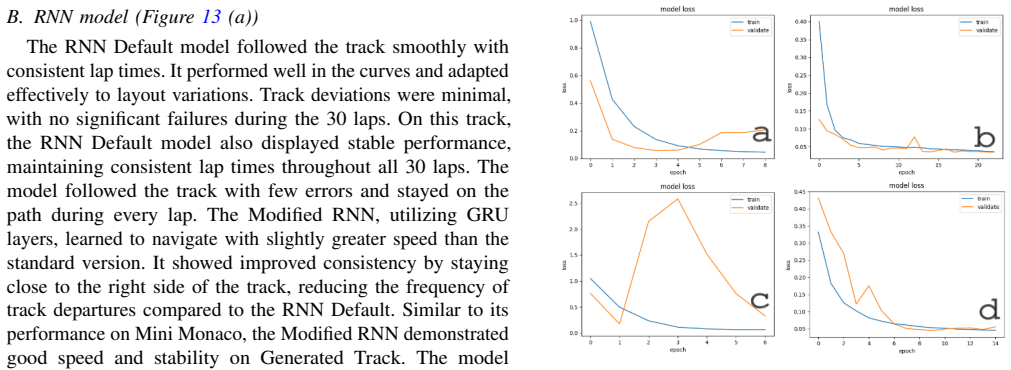
- [§IV-C] Figure references such as 'removing some layers 4, (12, c)' and '5, (12, d)' need correction.
- [General] The paper would benefit from reporting hyperparameters, random seeds, and code/data availability for reproducibility.
Circularity Check
Central 3D CNN advantage is reported on the same Mini Monaco track used to select the 3D CNN variant, so the comparison is partly a selection artifact.
-
fitted input called prediction
[Section IV-C (Ablation Study) + Table I / Table II]
"Based on the results, we selected 3D CNN Modified version with one 3D convolutional layer less which was able to outperform the other structures. ... Table I: Model Mini Monaco (sec) ... 3D CNN Modified 35.10 (±0.63)"
The same Mini Monaco lap-time metric used to select the final 3D CNN architecture in the ablation (Table II) is then used in Table I as the evidence that the 3D CNN is faster than RNNs. The architecture is therefore optimized for the evaluation condition; the reported advantage is not an unbiased out-of-sample comparison. RNN variants were not similarly selected, so the central claim is a selection artifact rather than an independent finding.
full rationale
The paper is an empirical benchmarking study; there is no mathematical derivation chain to be circular in the usual sense. The main load-bearing comparison (Section IV-B/Table I) reports that 3D CNN Modified is fastest on Mini Monaco. However, Section IV-C says the final 3D CNN variant was selected from an ablation study using exactly the Mini Monaco average lap time (Table II). Thus the headline result is not an out-of-sample prediction: the architecture was chosen because it performed well on this track and metric. The RNN comparators were not similarly selected, so the advantage is at least partly a selection artifact. The numerical inconsistencies (Table I 35.10 vs Table II 34.10/35.56; Section IV-A saying the 3D CNN Modified underperformed on Mini Monaco) further weaken confidence but are correctness issues rather than circularity. There is no load-bearing self-citation: the authors' prior MAC papers [3],[4] are background, and the claimed result is not justified by a citation. Overall, the central empirical claim is not independent of the selection procedure, but it is not a derivation that reduces to its inputs by construction. Score 4 reflects this partial circularity, not a fully forced result.
Assumptions & free parameters
free parameters (2)
- Number of 3D convolutional layers (ablation choice) =
one layer fewer than the modified 3D CNN baseline
- Training hyperparameters (learning rate, batch size, epochs, optimizer, temporal sequence length) =
not reported
assumptions (5)
- domain assumption DonkeyCar simulation is a valid proxy for real Mini Autonomous Car driving.
- domain assumption Behavior cloning from human joystick demonstrations learns adequate control.
- domain assumption The camera stream (RGB-D at 20 FPS, 160x120) provides sufficient input for control.
- domain assumption The 20% validation split is not used for model selection.
- standard math Standard definitions of LSTM, GRU, and 3D convolutions are correct.
Cite this review
Pith. "Pith review of Mini Autonomous Car Driving based on 3D Convolutional Neural Networks." pith.science (2026). https://pith.science/paper/T7QRGEC7
@misc{pith2026250821271,
  author       = {Pith},
  title        = {Pith review of: Mini Autonomous Car Driving based on 3D Convolutional Neural Networks},
  year         = {2026},
  howpublished = {\url{https://pith.science/paper/T7QRGEC7}},
  note         = {Machine review of arXiv:2508.21271}
}
read the original abstract
Autonomous driving applications have become increasingly relevant in the automotive industry due to their potential to enhance vehicle safety, efficiency, and user experience, thereby meeting the growing demand for sophisticated driving assistance features. However, the development of reliable and trustworthy autonomous systems poses challenges such as high complexity, prolonged training periods, and intrinsic levels of uncertainty. Mini Autonomous Cars (MACs) are used as a practical testbed, enabling validation of autonomous control methodologies on small-scale setups. This simplified and cost-effective environment facilitates rapid evaluation and comparison of machine learning models, which is particularly useful for algorithms requiring online training. To address these challenges, this work presents a methodology based on RGB-D information and three-dimensional convolutional neural networks (3D CNNs) for MAC autonomous driving in simulated environments. We evaluate the proposed approach against recurrent neural networks (RNNs), with architectures trained and tested on two simulated tracks with distinct environmental features. Performance was assessed using task completion success, lap-time metrics, and driving consistency. Results highlight how architectural modifications and track complexity influence the models' generalization capability and vehicle control performance. The proposed 3D CNN demonstrated promising results when compared with RNNs.
Figures


Figures from the paper (8 more)






Reference graph
Works this paper leans on
-
[1]
N. Prawira, N. Selviandro, and G. S. Wulandari, “A comparative study of state-of-the-art object detection algorithms for autonomous vehicles in donkeycar simulator,” in 2025 International Conference on Advancement in Data Science, E-learning and Information System (ICADEIS) . IEEE, 2025, pp. 1–6
work page 2025
-
[2]
Miniature autonomy as means to find new approaches in reliable autonomous driving ai method design,
T. Tiedemann, L. Schwalb, M. Kasten, R. Grotkasten, and S. Pareigis, “Miniature autonomy as means to find new approaches in reliable autonomous driving ai method design,” Frontiers in neurorobotics, vol. 16, p. 846355, 2022
work page 2022
-
[3]
Behavior cloning for mini autonomous car path following,
P. Moraes, C. Peters, H. Sodre, W. Moraes, S. Barcelona, J. Deniz, V . Castelli, B. Guterres, and R. Grando, “Behavior cloning for mini autonomous car path following,” in 2024 IEEE URUCON . IEEE, 2024, pp. 1–5
work page 2024
-
[4]
UruBots Autonomous Cars Team One Description Paper for FIRA 2024
P. Moraes, C. Peters, A. Da Rosa, V . Melgar, F. Nu ˜nez, M. Retamar, W. Moraes, V . Saravia, H. Sodre, S. Barcelona et al. , “Urubots autonomous cars team one description paper for fira 2024,” arXiv preprint arXiv:2406.08745, 2024
work page Pith review arXiv 2024
-
[5]
A. Elmquist, A. Young, I. Mahajan, K. Fahey, A. Dashora, S. Ashokkumar, S. Caldararu, V . Freire, X. Xu, R. Serban et al. , “A software toolkit and hardware platform for investigating and comparing robot autonomy algorithms in simulation and reality,” arXiv preprint arXiv:2206.06537 , 2022
work page Pith review arXiv 2022
-
[6]
T. Samak, C. Samak, S. Kandhasamy, V . Krovi, and M. Xie, “Autodrive: A comprehensive, flexible and integrated digital twin ecosystem for autonomous driving research & education,” Robotics, vol. 12, no. 3, p. 77, 2023
work page 2023
-
[7]
Autonomous r/c car behavioral cloning optimization,
J. Jung, “Autonomous r/c car behavioral cloning optimization,” https: //cs229.stanford.edu/proj2018/report/51.pdf, 2018
work page 2018
-
[8]
gym-donkeycar: A simulator for donkey car with openai gym interface,
T. Kramer, “gym-donkeycar: A simulator for donkey car with openai gym interface,” https://github.com/tawnkramer/gym-donkeycar, accessed: 2025-05-28
work page 2025
Show all 20 references
-
[9]
Behavioral cloning models reality check for autonomous driving,
M. Yildirim, B. Dagda, V . Asodia, and S. Fallah, “Behavioral cloning models reality check for autonomous driving,” arXiv preprint arXiv:2409.07218, 2024
2024 arXiv
-
[10]
Exploring the limitations of behavior cloning for autonomous driving,
F. Codevilla, E. Santana, A. M. L ´opez, and A. Gaidon, “Exploring the limitations of behavior cloning for autonomous driving,” arXiv preprint arXiv:1904.08980, 2019
1904 arXiv
-
[11]
Impact of model architecture against adversarial example’s effectivity,
V . Karnala and D. M. Campbell, “Impact of model architecture against adversarial example’s effectivity,” Journal of Student Research , vol. 10, no. 2, p. 1612, 2020
2020
-
[12]
Self-driving scale car trained by deep reinforcement learning,
Q. Zhang and T. Du, “Self-driving scale car trained by deep reinforcement learning,” arXiv preprint arXiv:1909.03467 , 2019
1909 arXiv
-
[13]
Sim-to-real transfer for miniature autonomous car racing,
Y .-J. R. Chu, T.-H. Wei, J.-B. Huang, Y .-H. Chen, I. Wu et al. , “Sim-to-real transfer for miniature autonomous car racing,” arXiv preprint arXiv:2011.05617 , 2020. [Online]. Available: https: //arxiv.org/abs/2011.05617
2011 arXiv
-
[14]
How hard is it to cross the room?–training (recurrent) neural networks to steer a uav,
K. Kelchtermans and T. Tuytelaars, “How hard is it to cross the room?–training (recurrent) neural networks to steer a uav,” arXiv preprint arXiv:1702.07600 , 2017. [Online]. Available: https: //arxiv.org/abs/1702.07600
2017 arXiv
-
[15]
Long short-term memory,
S. Hochreiter and J. Schmidhuber, “Long short-term memory,” Neural Computation, vol. 9, no. 8, pp. 1735–1780, 1997. [Online]. Available: https://www.bioinf.jku.at/publications/older/2604.pdf
1997
-
[16]
Learning phrase representations using rnn encoder-decoder for statistical machine translation,
K. Cho, B. van Merri ¨enboer, C. Gulcehre, D. Bahdanau, F. Bougares, H. Schwenk, and Y . Bengio, “Learning phrase representations using rnn encoder-decoder for statistical machine translation,” arXiv preprint arXiv:1406.1078, 2014. [Online]. Available: https://arxiv.org/abs/1406. 1078
2014 arXiv
-
[17]
Empirical evaluation of gated recurrent neural networks on sequence modeling,
J. Chung, C. Gulcehre, K. Cho, and Y . Bengio, “Empirical evaluation of gated recurrent neural networks on sequence modeling,” arXiv preprint arXiv:1412.3555 , 2014. [Online]. Available: https: //arxiv.org/abs/1412.3555
2014 arXiv
-
[18]
Deep residual learning for image recognition,
K. He, X. Zhang, S. Ren, and J. Sun, “Deep residual learning for image recognition,” in Proceedings of the IEEE Conference on Computer Vision and Pattern Recognition (CVPR) , 2016, pp. 770–778. [Online]. Available: https://arxiv.org/abs/1512.03385
2016 arXiv
-
[19]
Batch normalization: Accelerating deep network training by reducing internal covariate shift,
S. Ioffe and C. Szegedy, “Batch normalization: Accelerating deep network training by reducing internal covariate shift,” in International Conference on Machine Learning (ICML) , 2015, pp. 448–456. [Online]. Available: https://arxiv.org/abs/1502.03167
2015 arXiv
-
[20]
Donkeycar: An open source diy self-driving platform,
Autorope, “Donkeycar: An open source diy self-driving platform,” https: //github.com/autorope/donkeycar, accessed: 2025-05-28
2025
Reviewed August 5, 2026 · model on record in the stance chip above.
Discussion (0). Sign in to comment.