REVIEW 4 major objections 5 minor 74 references
A sentence transformer trained on attack technique descriptions can name the CVE vulnerabilities behind an attack, reaching F1 89.0 while uncovering 275 links missing from MITRE's repositories.
Reviewed by Pith at T0; open to challenge. T0 means a machine referee read the full paper against a public rubric. the ladder, T0–T4 →
T0 review · deepseek-v4-flash
2026-08-05 11:53 UTC pith:P2KVAWRL
load-bearing objection The F1=89 headline is attack-level triage, not per-vulnerability identification; with link-level metrics at ~58, the paper still deserves review but needs an honest reframing. the 4 major comments →
From Attack Descriptions to Vulnerabilities: A Sentence Transformer-Based Approach
The pith
A machine-rendered reading of the paper's core claim, the machinery that carries it, and where it could break.
Core claim
The paper's central discovery, on its own terms, is that attack and vulnerability descriptions lie close enough in sentence-embedding space for cosine-similarity ranking to work as a linking rule. Fourteen pre-trained sentence transformers are fine-tuned on an annotated dataset in which each attack carries the CVEs reachable through explicit MITRE links (Technique to CAPEC pattern to CWE to example CVE); every CVE description is then scored against each attack description. MMPNet, a dot-product-trained MPNet model, performs best on Technique descriptions: F1 89.0, precision 84.0, recall 94.7, AUC 0.82, plus 56 percent mapping accuracy and 61 percent detection accuracy against the ground trut
What carries the argument
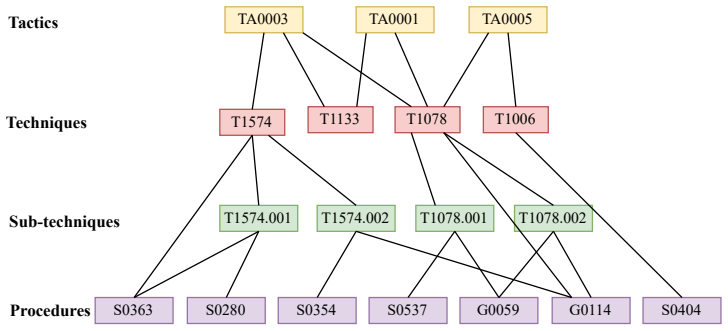
Two objects carry the argument. First, MMPNet (multi-qa-mpnet-base-dot-v1): a pre-trained MPNet sentence transformer, fine-tuned here with CosineSimilarityLoss, that embeds attack and CVE descriptions into 768-dimensional vectors; its dot-product training is credited with capturing context beyond mere angle, which is why it beats the other 13 models. Second, the ground-truth mapping M(a), built by chaining explicit links MITRE already publishes: an ATT&CK Technique is matched to the CAPEC attack patterns that mention it, each pattern to the CWEs that cite it, and each CWE to the CVE examples on its page. Predictions are made by ranking all CVE embeddings against an attack embedding with cosi
Load-bearing premise
The whole evaluation assumes that chaining MITRE's explicit links—technique to attack pattern to weakness to example CVE—produces the complete and correct set of real attack–vulnerability connections, even though MITRE's own pages describe their CVE lists as curated examples, not complete lists.
What would settle it
Take the Technique–CVE pairs MITRE added to its repositories after this paper's data snapshot (the paper reports at least one such case) and ask the fine-tuned MMPNet model at threshold rho=58 to rank them: if it does not retrieve most of these independently confirmed real links, the reported 94.7 recall is an artifact of evaluating against an incomplete oracle. A second check: have two independent analysts, blinded to the authors' decisions, re-review the 434 predicted-but-unlinked CVEs; the 275-link claim stands only if their agreement approaches the authors' 63 percent hit rate.
If this is right
- Technique descriptions can be turned into ranked CVE candidate lists automatically, so a defender who sees a technique can be handed a short patch list instead of a manual repository hunt.
- Adopting the 275 validated Technique–CVE links into MITRE and downstream databases raises documented attack–vulnerability coverage by roughly 12 percent.
- Because Technique text beats Tactic, Procedure, and Attack Pattern text across models, future attack-to-vulnerability automation should be built on technique-level descriptions.
- The measured incompleteness of MITRE's curated links is itself a result: repository enrichment can become a continuous, machine-assisted process rather than pure manual curation.
Where Pith is reading between the lines
- My extension: the same ranking pipeline should transfer to noisier, non-curated attack text such as incident reports and security-news articles; the paper lists this as future work, but the released code makes it immediately testable, and the transfer could be measured by how many of the model's top-ranked CVEs match NVD records for the affected product.
- My caveat: precision and recall are computed against an oracle built from MITRE's own example links, so the numbers measure agreement with a curated, text-similarity-biased list, not with an absolute ground truth; a differently sourced oracle would likely shift them.
- My extension: per-technique thresholds, which the paper flags as future work, are a cheap, high-value experiment given the released dataset, since a single global rho visibly trades precision for recall unequally across techniques.
- My caveat: the 275-link enrichment count rests on agreement between two authors; a blinded multi-analyst replication, or tracking which of the submitted links MITRE accepts, would turn the enrichment claim into an auditable number.
Editorial analysis
A structured set of objections, weighed in public.
Referee Report
Summary. The paper proposes an automated approach to link MITRE ATT&CK attack descriptions to CVE vulnerability reports using sentence transformers. The authors construct a ground-truth dataset by chaining explicit links from ATT&CK Techniques through CAPEC attack patterns and CWE entries to CVE IDs, then evaluate 14 sentence-transformer models on four attack-description types (Tactic, Technique, Procedure, Attack Pattern). The central reported result is that the multi-qa-mpnet-base-dot-v1 (MMPNet) model, applied to Technique descriptions, achieves an F1-score of 89.0, precision of 84.0, and recall of 94.7 in identifying CVEs from attack texts. The paper also reports link-level mapping/detection accuracies of 56% and 61%, and claims to discover 275 previously undocumented Technique–CVE links through manual review. The main contributions are the comparative model evaluation, the annotated dataset, and the proposed method for enriching incomplete MITRE mappings.
Significance. If the headline F1 result held as stated, the paper would provide useful evidence that an off-the-shelf sentence transformer can automate a substantial portion of attack-to-vulnerability linking and enrich incomplete MITRE repositories. The comparative evaluation across 14 models and four attack-text types is a useful reference point, and the release of the dataset and code supports reproducibility and follow-up work. However, the central quantitative claim is not supported by the evaluation as designed: the F1=89.0 is computed at the level of attack texts, not at the level of individual Technique–CVE links, while the paper's own link-level accuracies imply an F1 of roughly 58. The oracle used for ground truth is explicitly incomplete, and the threshold and best-model selection involve fitting on data from the same distribution as the test set. These issues are load-bearing for the paper's main claim that transformers 'identify CVE vulnerabilities with an F1-score of 89.0.' The contribution remains potentially valuable, but the empirical claims need reframing and reanalysis.
major comments (4)
- [Abstract; Section 4.1, Table 7; Section 3.1.6, Table 6] The reported F1=89.0 is an attack-level classification metric, not a vulnerability-identification metric. In Table 6, a True Positive is defined as an attack a for which L_rho(a) ∩ M(a) ≠ ∅, i.e., a technique is counted as fully correct if it recovers at least one linked CVE. Consequently, a technique that retrieves one true CVE while missing dozens of linked CVEs still contributes a full positive. The paper's own link-level results in Section 4.2 (Mapping Accuracy = 56%, Detection Accuracy = 61%) give a harmonic mean of about 58, far below 89.0. The abstract and conclusion claim that the model 'identifies CVE vulnerabilities with an F1-score of 89.0' is therefore misleading. Please report link-level precision, recall, and F1 as the primary evaluation of vulnerability identification, or explicitly and consistently label the attack-level score as a triage/retrieval-at-technique metric.
- [Section 3.3; Section 3.1.4; Section 3.2] The threshold ρ is selected via ROC analysis on a balanced 50-positive/50-negative sample drawn from the original dataset, and the same threshold is then used to produce the reported results. This is a form of threshold fitting on data that overlaps the evaluation set, and it can inflate the reported precision/recall. In addition, the best model is selected by taking the maximum F1 over 14 models evaluated on the same 10% test split (Section 3.1.4, Section 3.2). With only about 10 positive Techniques in the test set (Table 4: 100 linked Techniques, 10% split), the expected maximum of 14 noisy F1 estimates is substantial. Please select the threshold and the best model using a validation fold only, and report confidence intervals or bootstrap estimates for all headline metrics.
- [Section 3.1.1; Section 3.1.2; Section 3.5] The ground truth M(a) is built from explicit links in MITRE pages, but the paper itself quotes CWE pages as stating that their CVE lists are 'a curated list of examples ... not a complete list' (Section 3.1.1). Thus the oracle is known to be incomplete. This incompleteness directly affects the reported precision/recall: a correct but undocumented prediction is counted as a false positive, while an incomplete M(a) can also distort recall and link-level accuracies. The manual validation in Section 3.5 (two authors agreeing on a 'clear semantic match') is not a substitute for a well-defined annotation protocol, and no inter-rater reliability is reported. As a result, the status of the 275 'new links' as true positives versus false positives cannot be fully resolved by the current evaluation design. Please either (a) treat M(a) as a partial oracle and report precision/recall bounds under alt
- [Table 4; Section 4.3; Section 5 (External validity)] The evaluation sample is very small: Table 4 lists 100 linked Techniques out of 625 total Technique entries, and with an 80/10/10 split the reported attack-level F1 rests on roughly 10 positive Techniques. This is acknowledged in Section 5, but the abstract and RQ summaries do not convey the fragility of the headline number. Moreover, Section 4.3 and Table 8 refer to '201 Techniques' while Table 4 reports 625 Technique rows; the paper also alternates between 'Techniques' and 'Subtechniques' (Section 2.2 vs. Section 5). These inconsistencies make it difficult to determine the exact population and sample. Please clarify the unit of analysis and provide exact counts, plus uncertainty measures for the reported F1.
minor comments (5)
- [Figures 5–7] In the manuscript version provided, the text inside Figures 5, 6, and 7 appears as corrupted vector-path code (e.g., '/uni00000013/uni00000011/...'), making the ROC curve and box plots unreadable. Please ensure the figures are embedded with proper text rendering.
- [Section 2.2 vs. Section 5] The paper uses 'Technique' and 'Subtechnique' inconsistently. Section 2.2 says the framework contains 201 Techniques and 424 Subtechniques, while Table 4 reports 625 Techniques; Section 5 says the ground truth is a subset of 100 ATT&CK subtechniques. Please standardize the terminology and counts.
- [Section 7, Conclusion] The conclusion calls the approach 'the first approach to automatically link attacks to vulnerabilities,' but the related work and Table 9 include prior attack-to-vulnerability efforts, including the authors' own VULDAT. This overclaim should be softened.
- [Section 4.1, Discussion] The discussion states that MMPNet and MSMBERT use dot-product loss functions, which allows them to 'capture the differences in embeddings based on their context semantics.' However, the inference stage uses cosine similarity, not raw dot-product similarity. Please clarify the distinction between training loss and inference metric.
- [Abstract; Section 4.1 RQ1 Summary] The phrase 'identifies CVE vulnerabilities with an F1-score of 89.0' should be qualified to specify the unit of analysis (attack text rather than individual CVE links). This is not just a wording issue: it is the main source of the overstated central claim.
Circularity Check
RQ3's manual validation of 275 new links uses the same semantic-match criterion the model optimizes, making the 'new link' claim partly self-confirming; RQ1/RQ2 evaluation is held-out and not circular.
specific steps
-
self definitional
[Section 3.5 (Manual validation), with Section 3.1.4 and Section 3.1.5]
"Missing CVE IDs were considered 'to be linked' when both authors agreed that there was a clear semantic match between the Technique and the CVE descriptions after two iterations."
The model defines a predicted link as cosine similarity above a threshold between Technique and CVE embeddings (Section 3.1.5), and is fine-tuned with CosineSimilarityLoss (Section 3.1.4). The RQ3 validation of whether an undocumented prediction is a real link uses the same construct: 'clear semantic match' between the very same Technique and CVE descriptions. Thus the 275 'recommended' links are accepted precisely when a human reproduces the semantic similarity the model was trained to compute. Since the MITRE oracle is acknowledged incomplete ('not a complete list'), the false-positive set is ambiguous, and the manual semantic-match check is the only arbiter. The claim that the model 'enriches' MITRE therefore reduces, for the 275 count, to the model's own similarity judgment being re-la
full rationale
The core RQ1/RQ2 evaluation is a supervised sentence-transformer benchmark on a held-out 10% test split (Section 3.1.4), so its F1/Jaccard numbers are not circular in themselves. No self-citation is load-bearing; VULDAT is prior work but the current evaluation stands on the new 14-model comparison. The main circularity is confined to RQ3: the '275 new links' are validated by human agreement on semantic match, which is the same construct the model's cosine similarity implements and was fine-tuned to optimize, making the novelty count partly self-confirming. Separately (a validity concern, not circularity), the headline F1=89 is computed at attack level (any correct CVE makes the technique a true positive, Section 3.1.6 Table 6), while link-level Mapping/Detection Accuracy are 56%/61%; this overstates 'identifying CVE vulnerabilities' but does not by itself make the derivation circular. Overall: partial circularity in the claim of discovering new links, with independent content in the retrieval comparison.
Axiom & Free-Parameter Ledger
free parameters (3)
- Similarity threshold rho =
60 initially, ROC-optimal 58 on a balanced sample
- Fine-tuning hyperparameters =
4 epochs, 100 warmup steps
- Train/validation/test split ratios =
80/10/10
axioms (4)
- domain assumption Explicit links found on MITRE CWE/CVE/CAPEC/ATT&CK pages are a reliable ground truth for attack-vulnerability relations.
- domain assumption The chain Technique -> CAPEC pattern -> CWE -> CVE captures the true set of CVEs exploitable by a technique.
- domain assumption Cosine similarity between sentence embeddings is a valid measure of semantic attack-vulnerability relatedness after fine-tuning.
- domain assumption The 384-token truncation does not cut any relevant description.
Cite this review
Pith. "Pith review of From Attack Descriptions to Vulnerabilities: A Sentence Transformer-Based Approach." pith.science (2026). https://pith.science/paper/P2KVAWRL
@misc{pith2026250902077,
  author       = {Pith},
  title        = {Pith review of: From Attack Descriptions to Vulnerabilities: A Sentence Transformer-Based Approach},
  year         = {2026},
  howpublished = {\url{https://pith.science/paper/P2KVAWRL}},
  note         = {Machine review of arXiv:2509.02077}
}
read the original abstract
In the domain of security, vulnerabilities frequently remain undetected even after their exploitation. In this work, vulnerabilities refer to publicly disclosed flaws documented in Common Vulnerabilities and Exposures (CVE) reports. Establishing a connection between attacks and vulnerabilities is essential for enabling timely incident response, as it provides defenders with immediate, actionable insights. However, manually mapping attacks to CVEs is infeasible, thereby motivating the need for automation. This paper evaluates 14 state-of-the-art (SOTA) sentence transformers for automatically identifying vulnerabilities from textual descriptions of attacks. Our results demonstrate that the multi-qa-mpnet-base-dot-v1 (MMPNet) model achieves superior classification performance when using attack Technique descriptions, with an F1-score of 89.0, precision of 84.0, and recall of 94.7. Furthermore, it was observed that, on average, 56% of the vulnerabilities identified by the MMPNet model are also represented within the CVE repository in conjunction with an attack, while 61% of the vulnerabilities detected by the model correspond to those cataloged in the CVE repository. A manual inspection of the results revealed the existence of 275 predicted links that were not documented in the MITRE repositories. Consequently, the automation of linking attack techniques to vulnerabilities not only enhances the detection and response capabilities related to software security incidents but also diminishes the duration during which vulnerabilities remain exploitable, thereby contributing to the development of more secure systems.
Figures


Reference graph
Works this paper leans on
-
[1]
W. S. Admass, Y . Y . Munaye, A. A. Diro, Cyber security: State of the art, challenges and future directions, Cyber Security and Applications 2 (2024) 100031
work page 2024
-
[2]
M. M. Robert Muggah, Cybercrime to cost the world 10.5 trillion annually by 2025, accessed: January 28, 2024. https://www.weforum. org/agenda/2023/01/global-rules-crack-down-cybercrime/ (2023)
work page 2025
-
[3]
C. Point, 38% increase in 2022 global cyberattacks, https://blog.checkpoint.com/2023/01/05/ 38-increase-in-2022-global-cyberattacks/ (2024)
work page 2022
-
[4]
M. R. Rahman, R. M. Hezaveh, L. Williams, What are the attackers doing now? automating cyberthreat intelligence extraction from text on pace with the changing threat landscape: A survey, ACM Computing Surveys 55 (12) (2023) 1–36
work page 2023
-
[5]
MITRE, Attack, https://attack.mitre.org/ (2025). 20
work page 2025
-
[6]
MITRE, Capec, https://capec.mitre.org/ (2025)
work page 2025
-
[7]
MITRE, Cwe dataset, https://cwe.mitre.org/ (2025)
work page 2025
-
[8]
MITRE, Cve, https://www.cve.org (2024)
work page 2024
- [9]
-
[10]
T. Armerding, Cve definitions, https://www.csoonline.com/article/3204884/what-is-cve-its-definition-and-purpose. html
-
[11]
R. T. Othman, Vulnerability detection for software-intensive system, in: Proceedings of the 28th International Conference on Evaluation and Assessment in Software Engineering, 2024, pp. 510–515
work page 2024
-
[12]
F. ¨O. S¨onmez, Classifying common vulnerabilities and exposures database using text mining and graph theoretical analysis, Machine Intelli- gence and Big Data Analytics for Cybersecurity Applications (2021) 313–338
work page 2021
- [13]
- [14]
-
[15]
Othman, Att&ck2vul - automated vulnerability detection from cyberattack text, accessed: Feb 2, 2025
R. Othman, Att&ck2vul - automated vulnerability detection from cyberattack text, accessed: Feb 2, 2025. https://github.com/ref3t/ Attack2VUL/tree/main (2025)
work page 2025
-
[16]
N. Reimers, I. Gurevych, Sentence-bert: Sentence embeddings using siamese bert-networks, in: Proceedings of the 2019 Conference on Empirical Methods in Natural Language Processing and the 9th International Joint Conference on Natural Language Processing (EMNLP- IJCNLP), Association for Computational Linguistics, 2019
work page 2019
-
[17]
C. Ra ffel, N. Shazeer, A. Roberts, K. Lee, S. Narang, M. Matena, Y . Zhou, W. Li, P. J. Liu, Exploring the limits of transfer learning with a unified text-to-text transformer, Journal of machine learning research 21 (140) (2020) 1–67
work page 2020
-
[18]
Othman, Vuldat- vulnerability dataset, accessed: Feb 2, 2025
R. Othman, Vuldat- vulnerability dataset, accessed: Feb 2, 2025. figshare.Dataset.https://doi.org/10.6084/m9.figshare. 25828102.v1 (2025)
-
[19]
Y . Dong, Y . Tang, X. Cheng, Y . Yang, Dekedver: A deep learning-based multi-type software vulnerability classification framework using vulnerability description and source code, Information and Software Technology 163 (2023) 107290
work page 2023
- [20]
-
[21]
K. Dempsey, P. Eavy, G. Moore, Automation support for security control assessments, V ol. 1: Overview (2017) 8011–1
work page 2017
-
[22]
M. Esposito, D. Falessi, Validate: A deep dive into vulnerability prediction datasets, Information and Software Technology (2024) 107448
work page 2024
-
[23]
S. Alevizopoulou, P. Koloveas, C. Tryfonopoulos, P. Raftopoulou, Social media monitoring for iot cyber-threats, in: 2021 IEEE International Conference on Cyber Security and Resilience (CSR), IEEE, 2021, pp. 436–441
work page 2021
- [24]
- [25]
-
[26]
C. Theisen, N. Munaiah, M. Al-Zyoud, J. C. Carver, A. Meneely, L. Williams, Attack surface definitions: A systematic literature review, Information and Software Technology 104 (2018) 94–103
work page 2018
-
[27]
D. Iorga, D.-G. Corlatescu, O. Grigorescu, C. Sandescu, M. Dascalu, R. Rughinis, Yggdrasil—early detection of cybernetic vulnerabilities from twitter, in: 2021 23rd International Conference on Control Systems and Computer Science (CSCS), IEEE, 2021, pp. 463–468
work page 2021
-
[28]
A. L. Queiroz, S. Mckeever, B. Keegan, Eavesdropping hackers: Detecting software vulnerability communication on social media using text mining, in: The Fourth International Conference on Cyber-Technologies and Cyber-Systems, 2019, pp. 41–48
work page 2019
-
[29]
Baccar, Automated mapping of cve vulnerabilties to mitre att&ck framework, Ph.D
K. Baccar, Automated mapping of cve vulnerabilties to mitre att&ck framework, Ph.D. thesis, Tekup (2021)
work page 2021
-
[30]
N. Dion ´ısio, F. Alves, P. M. Ferreira, A. Bessani, Cyberthreat detection from twitter using deep neural networks, in: 2019 international joint conference on neural networks (IJCNN), IEEE, 2019, pp. 1–8
work page 2019
-
[31]
W. Tang, M. Tang, M. Ban, Z. Zhao, M. Feng, Csgvd: A deep learning approach combining sequence and graph embedding for source code vulnerability detection, Journal of Systems and Software 199 (2023) 111623
work page 2023
-
[32]
X. Sun, Z. Ye, L. Bo, X. Wu, Y . Wei, T. Zhang, B. Li, Automatic software vulnerability assessment by extracting vulnerability elements, Journal of Systems and Software 204 (2023) 111790
work page 2023
-
[33]
NVD, Cvss, https://nvd.nist.gov/vuln-metrics/cvss/v3-calculator
-
[34]
M. R. Rahman, S. K. Basak, R. Mahdavi-Hezaveh, L. A. Williams, Attackers reveal their arsenal: An investigation of adversarial techniques in cti reports, CoRR (2024)
work page 2024
-
[35]
S. B. Son, S. Park, H. Lee, Y . Kim, D. Kim, J. Kim, Introduction to mitre att&ck: Concepts and use cases, in: 2023 International Conference on Information Networking (ICOIN), IEEE, 2023, pp. 158–161
work page 2023
- [36]
-
[37]
MITRE, Mitre att&ck, https://attack.mitre.org/ (2024)
work page 2024
- [38]
-
[39]
Metasploit, https://www.metasploit.com/
-
[40]
Fin6 group, https://attack.mitre.org/groups/G0037/
-
[41]
Y . Wu, Q. Liu, X. Liao, S. Ji, P. Wang, X. Wang, C. Wu, Z. Li, Price tag: towards semi-automatically discovery tactics, techniques and procedures of e-commerce cyber threat intelligence, IEEE Transactions on Dependable and Secure Computing (2021)
work page 2021
-
[42]
U. Noor, Z. Anwar, T. Amjad, K.-K. R. Choo, A machine learning-based fintech cyber threat attribution framework using high-level indicators of compromise, Future Generation Computer Systems 96 (2019) 227–242
work page 2019
-
[43]
N. Muennigho ff, N. Tazi, L. Magne, N. Reimers, Mteb: Massive text embedding benchmark, arXiv preprint arXiv:2210.07316 (2022). 21
Pith/arXiv arXiv 2022
-
[44]
M. T. Colangelo, M. Meleti, S. Guizzardi, E. Calciolari, C. Galli, A comparative analysis of sentence transformer models for automated journal recommendation using pubmed metadata, Big Data and Cognitive Computing 9 (3) (2025) 67
work page 2025
-
[45]
H. Choi, J. Kim, S. Joe, Y . Gwon, Evaluation of bert and albert sentence embedding performance on downstream nlp tasks, in: 2020 25th International conference on pattern recognition (ICPR), IEEE, 2021, pp. 5482–5487
work page 2020
-
[46]
https://www.sbert.net/docs/pretrained_models.html (2024)
Sentence transformers, accessed: May 2, 2024. https://www.sbert.net/docs/pretrained_models.html (2024)
work page 2024
-
[47]
W. Wang, F. Wei, L. Dong, H. Bao, N. Yang, M. Zhou, Minilm: Deep self-attention distillation for task-agnostic compression of pre-trained transformers, Advances in Neural Information Processing Systems 33 (2020) 5776–5788
work page 2020
- [48]
-
[49]
O. Okonkwo, A. Dridi, E. Vakaj, Leveraging word embeddings and transformers to extract semantics from building regulations text, in: Proceedings of the 11th Linked Data in Architecture and Construction Workshop, 2023
work page 2023
- [50]
-
[51]
K. Hiniduma, S. Byna, J. L. Bez, Data readiness for ai: A 360-degree survey, ACM Comput. Surv. 57 (9) (Apr. 2025). doi:10.1145/3722214. URL https://doi.org/10.1145/3722214
doi:10.1145/3722214 2025
-
[52]
Semantic textual similarity, https://github.com/UKPLab/sentence-transformers/blob/master/examples/sentence_ transformer/training/sts/README.md
-
[53]
A. Lobo, P. Oliveira, P. Sampaio, P. Novais, Cost-sensitive learning and threshold-moving approach to improve industrial lots release process on imbalanced datasets, in: International Symposium on Distributed Computing and Artificial Intelligence, Springer, 2022, pp. 280–290
work page 2022
-
[54]
V . S. Sheng, C. X. Ling, Thresholding for making classifiers cost-sensitive, in: Aaai, V ol. 6, 2006, pp. 476–481
work page 2006
-
[55]
J. Ni, C. Qu, J. Lu, Z. Dai, G. H. ´Abrego, J. Ma, V . Y . Zhao, Y . Luan, K. B. Hall, M.-W. Chang, Y . Yang, Large dual encoders are generalizable retrievers (2021). arXiv:2112.07899. URL https://arxiv.org/abs/2112.07899
Pith/arXiv arXiv 2021
-
[56]
D. I. Sjøberg, G. R. Bergersen, Construct validity in software engineering, IEEE Transactions on Software Engineering 49 (3) (2022) 1374– 1396
work page 2022
-
[57]
W. R. Shadish, T. D. Cook, D. T. Campbell, Experimental and quasi-experimental designs for generalized causal inference / William R. Shedish, Thomas D. Cook, Donald T. Campbell, Wadsworth, Cengage Learning, Belmont, CA, 2002
work page 2002
- [58]
-
[59]
O ffsec, Exploit-db, https://www.exploit-db.com/
- [60]
-
[61]
Devlin, M.-W
J. Devlin, M.-W. Chang, K. Lee, K. Toutanova, Bert: Pre-training of deep bidirectional transformers for language understanding, in: Proceed- ings of the 2019 conference of the North American chapter of the association for computational linguistics: human language technologies, volume 1 (long and short papers), 2019, pp. 4171–4186
2019
-
[62]
J. Sun, Z. Xing, H. Guo, D. Ye, X. Li, X. Xu, L. Zhu, Generating informative cve description from exploitdb posts by extractive summariza- tion, CoRR (2021)
work page 2021
-
[63]
Y . Lakhdhar, S. Rekhis, Machine learning based approach for the automated mapping of discovered vulnerabilities to adversial tactics, in: 2021 IEEE Security and Privacy Workshops (SPW), IEEE, 2021, pp. 309–317
work page 2021
-
[64]
O. Grigorescu, A. Nica, M. Dascalu, R. Rughinis, Cve2att&ck: Bert-based mapping of cves to mitre att&ck techniques, Algorithms 15 (9) (2022) 314
work page 2022
- [65]
-
[66]
Y . Liu, M. Ott, N. Goyal, J. Du, M. Joshi, D. Chen, O. Levy, M. Lewis, L. Zettlemoyer, V . Stoyanov, Roberta: A robustly optimized bert pretraining approach, arXiv preprint arXiv:1907.11692 (2019)
Pith/arXiv arXiv 1907
-
[67]
E. Hemberg, A. Srinivasan, N. Rutar, U.-M. O’Reilly, Sourcing language models and text information for inferring cyber threat, vulnerability and mitigation relationships (2022)
work page 2022
-
[68]
K. Kanakogi, H. Washizaki, Y . Fukazawa, S. Ogata, T. Okubo, T. Kato, H. Kanuka, A. Hazeyama, N. Yoshioka, Tracing cve vulnerability information to capec attack patterns using natural language processing techniques, Information 12 (8) (2021) 298
work page 2021
- [69]
-
[70]
E. Hemberg, J. Kelly, M. Shlapentokh-Rothman, B. Reinstadler, K. Xu, N. Rutar, U.-M. O’Reilly, Linking threat tactics, techniques, and patterns with defensive weaknesses, vulnerabilities and affected platform configurations for cyber hunting (2021). arXiv:2010.00533
Pith/arXiv arXiv 2021
-
[71]
J. Ramos, et al., Using tf-idf to determine word relevance in document queries, in: Proceedings of the first instructional conference on machine learning, V ol. 242, Citeseer, 2003, pp. 29–48
work page 2003
-
[72]
J. H. Lau, T. Baldwin, An empirical evaluation of doc2vec with practical insights into document embedding generation, in: Proceedings of the 1st Workshop on Representation Learning for NLP, Association for Computational Linguistics, 2016
work page 2016
-
[73]
K. Kanakogi, H. Washizaki, Y . Fukazawa, S. Ogata, T. Okubo, T. Kato, H. Kanuka, A. Hazeyama, N. Yoshioka, Comparative evaluation of nlp-based approaches for linking capec attack patterns from cve vulnerability information, Applied Sciences 12 (7) (2022) 3400
work page 2022
-
[74]
SecurityWeek, News vulnerabilities, https://www.securityweek.com/category/vulnerabilities/. 22 Refat Othman is a PhD candidate in Advanced-Systems Engineering at the Free University of Bozen-Bolzano, specializing in cybersecurity. He works as a researcher at the Cybersecu- rity Laboratory (CSLab), where his research focuses on automating vulnerability det...
work page 2008
discussion (0)
Sign in with ORCID, Apple, or X to comment. Anyone can read and Pith papers without signing in.