REVIEW 4 major objections 5 minor 2 cited by
A decoding tweak makes LLM story branches up to 2.6x more diverse
Reviewed by Pith at T0; open to challenge. T0 means a machine referee read the full paper against a public rubric. the ladder, T0–T4 →
Avoidance Decoding penalizes token choices that resemble previously generated story branches, using a hybrid concept-level and narrative-level similarity penalty, and reports large diversity gains across several LLMs.
T0 review reviewed 2026-08-05 challenge →
load-bearing objection A sensible recombination of known penalties into a training-free diversity knob, but the headline numbers are confounded by an unequal baseline protocol; the human data suggests a real but modest effect. the 4 major comments →
Avoidance Decoding for Diverse Multi-Branch Story Generation
The pith
A machine-rendered reading of the paper's core claim, the machinery that carries it, and where it could break.
The reading
Core claim
The authors propose Avoidance Decoding, a contrastive decoding method that modifies token logits at each step by penalizing similarity to previously generated branches. The penalty, called the Similarity-based Contrastive Penalty, is a hybrid of two terms: the Concept-level Similarity Penalty, computed as the maximum cosine similarity between a candidate token's hidden state and the hidden states of all tokens in negative samples, and the Narrative-level Similarity Penalty, computed as the cosine similarity between the current sentence embedding (with the candidate token appended) and each negative sample using Sentence-BERT. The two terms are blended by a sigmoid weight that shifts from con
What carries the argument
The Similarity-based Contrastive Penalty (Eq. 9), a hybrid of Concept-level Similarity Penalty (max hidden-state cosine similarity to negative-sample tokens) and Narrative-level Similarity Penalty (sentence-embedding cosine similarity to negative samples), blended with a sigmoid weight that shifts emphasis from concept to narrative as generation proceeds; this penalty modifies top-k logits and greedy selection picks the argmax.
Load-bearing premise
The method only works as advertised if previously generated stories live outside the prompt, in external memory, so that identical tokens across branches produce identical hidden states and the similarity penalty measures what it claims to measure.
What would settle it
Run a controlled comparison where contrastive baselines also use a fixed prompt plus external memory of previous outputs (rather than injecting all prior stories into the instruction), and measure the diversity gap; if the gap disappears or shrinks sharply, the claimed advantage is a property of the protocol asymmetry, not of the penalty itself.
If this is right
- Diversity becomes controllable deterministically: the same prompt and negative-sample set always produce the same branch divergence, with no temperature or random seed involved.
- The method scales to many branches because the penalty is the max over all stored negative samples, and it naturally applies to any multi-output decoding setup where outputs should diverge.
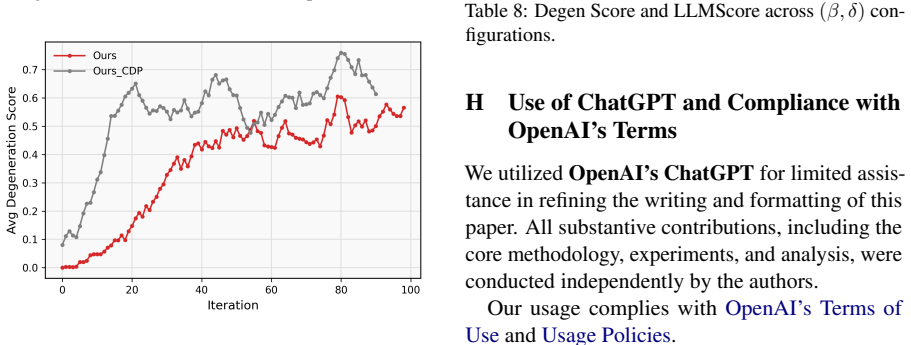
- Repetition metrics drop substantially while degeneration stays low, suggesting the method avoids the usual diversity-fluency trade-off.
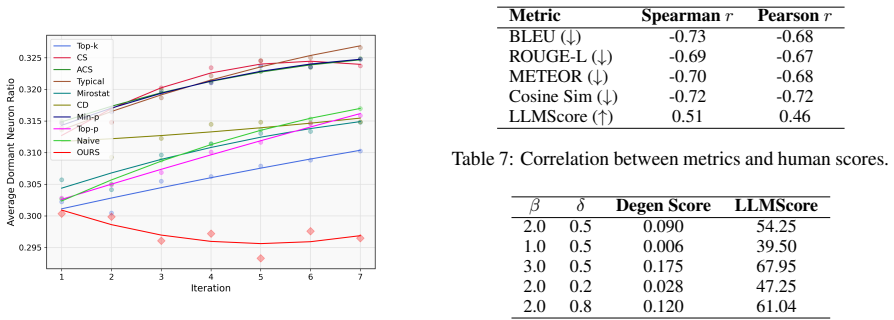
- Broader neuron activation across iterations is evidence that the model's latent creative capacity is engaged rather than suppressed.
- The approach is model-agnostic and training-free, so it can be dropped into existing generation pipelines for interactive or tree-structured story writing.
Where Pith is reading between the lines
- The comparison with contrastive baselines is protocol-asymmetric: baselines receive all prior stories inside the instruction prompt, while Avoidance Decoding keeps them in external memory; a matched protocol—giving baselines the same fixed-prompt external-memory condition—may shrink the reported diversity gap.
- The same penalty mechanism could be applied to other multi-output generation tasks such as multiple chain-of-thought reasoning paths, diverse code solutions, or varied summaries, where the same 'write something different' failure occurs.
- The method could be combined with stochastic sampling to add a controlled amount of randomness on top of the deterministic penalty, potentially improving diversity further without losing the degeneration guarantee.
- The fixed-prompt external-memory design suggests that a key load-bearing detail is not the penalty formula alone but how negative samples are supplied to the model; the insight generalizes to any contrastive decoding scheme.
Editorial analysis
A structured set of objections, weighed in public.
Referee Report
Summary. The paper proposes Avoidance Decoding, a training-free decoding strategy for multi-branch story generation. The method modifies token logits by subtracting a hybrid penalty: Concept-level Similarity Penalty (CSP), computed as the maximum cosine similarity between candidate token hidden states and hidden states of negative-sample tokens, and Narrative-level Similarity Penalty (NSP), computed as Sentence-BERT cosine similarity between the current output sentence and negative samples. The hybrid weight shifts from CSP to NSP as generation proceeds (Eqs. 6-9). Experiments on Mistral 7B, Llama 3B/8B, Qwen 7B and two story datasets report large gains in n-gram diversity metrics, Sent-Sim, LLMScore, and human-rated diversity over stochastic sampling, contrastive search, and DBS baselines. The paper also includes ablations (OursCSP, OursNSP), a degeneration analysis, a dormant-neuron analysis, and a human evaluation.
Significance. If the reported comparisons were protocol-matched, the contribution would be valuable: a deterministic, training-free method for controlling diversity with a plausible concept-to-narrative mechanism. The paper has strengths: the hybrid penalty is novel; the ablation shows both components are needed (OursCSP degenerates, OursNSP lacks diversity); results span multiple models and datasets; and human evaluation is included. However, the experimental protocol differs between Ours and every baseline, and one of the evaluation metrics (Sent-Sim) is the same quantity the method minimizes. These issues must be resolved before the headline claims can be accepted.
major comments (4)
- [Section 5.1 vs 5.2.2, Tables 1-4] Baselines receive every prior output inside the instruction prompt (Figure 9), while Ours uses a fixed instruction and external-memory negative samples (Algorithm 1). In §5.2.2 the authors attribute the low diversity of CS/ACS to this modified instruction, noting that accumulated prior stories produce different hidden states for identical tokens. If that is the explanation, the comparison is not controlled: the baselines are evaluated under a different input distribution, so the higher diversity of Ours may reflect the fixed-prompt/external-memory protocol rather than the penalty in Eq. (9). No protocol-matched control (e.g., CS/ACS with external memory, or Ours with in-context negatives) is reported. Please provide such a control to isolate the effect of the penalty.
- [Section 5.2.1 and Eq. (7)] The Sent-Sim metric uses Sentence-BERT cosine similarity, which is exactly the NSP penalty minimized by Ours. Thus the large Sent-Sim reductions (e.g., Table 1: 27.56 vs 48.51) are partly by construction. The paper should replace this metric with an independent semantic similarity measure (e.g., a different embedding model or a trained similarity judge) or explicitly state that Sent-Sim is an optimization target rather than an evaluation metric. This does not affect n-gram metrics, but the repetition claim is currently supported by a circular component.
- [Section 5.2.4 and Appendix D] T0 is tuned on Llama-3.1-8B and the Llama-8B results are then reported in Appendix D. This is a form of data snooping for that model. Please report a validation/test split or use a separate model for hyperparameter selection. The Mistral 7B headline results are less affected, but the Llama-8B rows should be labeled as tuned or re-evaluated.
- [Table 6 and Section F] The 'up to 2.6x' claim is based on LLMScore, but the human evaluation shows only a small advantage for Ours over the best sampling baseline (Diversity 3.48 vs 3.38, Table 6) and the reported LLMScore-human correlation is moderate (Spearman 0.51, Pearson 0.46, Table 7). No significance tests are reported for the human ratings. The authors should report confidence intervals or significance tests and discuss the discrepancy between the large LLMScore gap and the small human-rated gap. As written, the '2.6x' claim overstates the practical improvement.
minor comments (5)
- [Tables 1-2] 'OursN SP' should be 'OursNSP' (unwanted space).
- [Throughout] The metric name is inconsistent: 'LLM-Score' in Section 5.2.1 vs 'LLMScore' in tables and Appendix F. Please unify.
- [Eq. (8)] The sigmoid in γ = δ + (1−δ)·sigmoid(t − T0) has no slope/temperature parameter; the transition from CSP to NSP may be abrupt or slow depending on logit scale. Please clarify the schedule (e.g., whether a steepness parameter was considered).
- [Section 4.1, Eq. (2)] The approximation log(1−p) ≈ −α p is only valid for small p; near p=1 it is inaccurate. Since this is presented as motivation, it should be explicitly labeled a heuristic rather than a formal derivation.
- [Section 5.2.2] The rule for selecting the temperature setting ('greatest number of cases with average degeneration ≤ 0.1') may introduce selection bias. Please report results for all three temperatures or justify why this selection does not favor specific methods.
Circularity Check
Sent-Sim metric is the same SBERT cosine similarity the NSP penalty directly minimizes; the LLMScore and human-evaluation claims remain independent, and the baseline comparison is confounded by protocol asymmetry.
specific steps
-
self definitional
[Section 4.2.2 Eq. (7) and Section 5.2.1 'Sent-sim' metric; Section 4 negative-sample definition]
"In this work, we treat previously generated outputs for the same input as negative samples ... sNSP_j = cos(E(y1:t ⊕ w_j), E(x−)) ... Sent-sim: To quantify semantic similarity, we first convert generated outputs into embedding vectors using Sentence-BERT, then compute the pairwise cosine similarity between these vectors."
The NSP penalty (Eq. 7) is the Sentence-BERT cosine similarity between the current output plus candidate token and each negative sample, where negative samples are the previously generated stories. The Sent-sim evaluation metric is the same Sentence-BERT cosine similarity averaged over all pairs of generated stories. Since greedy decoding with the hybrid penalty explicitly minimizes the former, the reported Sent-sim improvement is a direct consequence of the decoding objective, not an independent test of diversity. This makes the 'sentence similarity' portion of the repetition-reduction claim circular; the LLMScore and human-evaluation results are separate and not reduced by this step.
full rationale
The paper's core derivation (Eqs. 1-4) is a probabilistic motivation for logit penalization; it is approximate rather than circular. No load-bearing self-citation is present: the authors' prior works are only cited for prompts and general related work, not to justify the central mechanism. The main potential circularity is that the NSP penalty uses exactly the same Sentence-BERT cosine similarity function that the Sent-sim metric measures, so the reported 30%+ reduction in sentence similarity is forced by the method's own objective. However, the headline 2.6x diversity claim rests on LLMScore (GPT-o4-mini evaluation) and is corroborated by human evaluation, which are not directly optimized by the penalty. Two further concerns weaken the evaluation but are not circularity: (1) T0, beta, and delta are selected using the same LLMScore/Degen metrics on which results are reported (Appendix J, Section 5.2.4), so some reported numbers reflect hyperparameter selection; (2) Section 5.2.2 itself states that CS/ACS low diversity may stem from the modified instruction that accumulates prior stories in the prompt, while Ours uses fixed instruction with external memory, making the baseline comparison asymmetric. These are experimental-design issues, not derivation circularity. Overall, partial circularity of one metric, with independent content in the central claim.
Axiom & Free-Parameter Ledger
free parameters (5)
- beta (penalty scale) =
2.0
- delta (minimum CSP weight) =
0.5
- T0 (inflection point) =
25
- per-method temperature =
one of {0.7, 1.0, 1.3} per method
- k and alpha_ACS (candidate count, adaptive weight) =
computed per step following Arias et al. 2024
axioms (7)
- domain assumption First-order approximation log(1-p) approximately -alpha*p (Eq. 2)
- domain assumption Conditional independence of negative samples: P_s(n_i | x1:t, not n1:i-1) approximately P_s(n_i | x1:t)
- ad hoc to paper Max (L-infinity) substitution for the sum (L1) of penalties (Eq. 4)
- ad hoc to paper Maximum cosine similarity between candidate-token hidden states and negative-sample token hidden states is a valid proxy for concept-level story similarity (Eq. 6)
- domain assumption Sentence-BERT cosine similarity is a valid proxy for narrative-level similarity (Eq. 7)
- domain assumption GPT-o4-mini LLM-judge scores track human diversity judgments
- domain assumption Identical tokens have identical hidden states across branches when the prompt is fixed and negative samples are out of context (Section 5.2.2)
Cite this review
Pith. "Pith review of Avoidance Decoding for Diverse Multi-Branch Story Generation." pith.science (2026). https://pith.science/paper/YH3GOGQE
@misc{pith2026250902170,
  author       = {Pith},
  title        = {Pith review of: Avoidance Decoding for Diverse Multi-Branch Story Generation},
  year         = {2026},
  howpublished = {\url{https://pith.science/paper/YH3GOGQE}},
  note         = {Machine review of arXiv:2509.02170}
}
read the original abstract
Large Language Models (LLMs) often generate repetitive and monotonous outputs, especially in tasks like story generation, due to limited creative diversity when given the same input prompt. To address this challenge, we propose a novel decoding strategy, Avoidance Decoding, that modifies token logits by penalizing similarity to previously generated outputs, thereby encouraging more diverse multi-branch stories. This penalty adaptively balances two similarity measures: (1) Concept-level Similarity Penalty, which is prioritized in early stages to diversify initial story concepts, and (2) Narrative-level Similarity Penalty, which is increasingly emphasized later to ensure natural yet diverse plot development. Notably, our method achieves up to 2.6 times higher output diversity and reduces repetition by an average of 30% compared to strong baselines, while effectively mitigating text degeneration. Furthermore, we reveal that our method activates a broader range of neurons, demonstrating that it leverages the model's intrinsic creativity.
Figures




Forward citations
Cited by 2 Pith papers
-
A Universal Avoidance Method for Diverse Multi-branch Generation
UAG is a universal avoidance generation method that increases multi-branch diversity in diffusion and transformer models by penalizing output similarity, delivering up to 1.9x higher diversity with 4.4x speed and 1/64...
-
Output-Space Search: Targeting LLM Generations in a Frozen Encoder-Defined Output Space
Retrieval-grounded reinforcement learning makes an autoregressive LLM hit requested coordinates in a frozen encoder-defined PCA space, giving an outer loop a low-dimensional target to sweep or optimize.
Reference graph
Works this paper leans on
-
[1]
Amal Alabdulkarim, Winston Li, Lara J Martin, and Mark O Riedl. 2021. Goal-directed story generation: Augmenting generative language models with reinforcement learning. arXiv preprint arXiv:2112.08593
work page internal anchor Pith review Pith/arXiv arXiv 2021
-
[2]
Esteban Garces Arias, Julian Rodemann, Meimingwei Li, Christian Heumann, and Matthias A enmacher. 2024. Adaptive contrastive search: Uncertainty-guided decoding for open-ended text generation. arXiv preprint arXiv:2407.18698
work page internal anchor Pith review Pith/arXiv arXiv 2024
-
[3]
Minwook Bae and Hyounghun Kim. 2024. Collective critics for creative story generation. arXiv preprint arXiv:2410.02428
Pith/arXiv arXiv 2024
-
[4]
Jinze Bai, Shuai Bai, Yunfei Chu, Zeyu Cui, Kai Dang, Xiaodong Deng, Yang Fan, Wenbin Ge, Yu Han, Fei Huang, Binyuan Hui, Luo Ji, Mei Li, Junyang Lin, Runji Lin, Dayiheng Liu, Gao Liu, Chengqiang Lu, Keming Lu, Jianxin Ma, Rui Men, Xingzhang Ren, Xuancheng Ren, Chuanqi Tan, Sinan Tan, Jianhong Tu, Peng Wang, Shijie Wang, Wei Wang, Shengguang Wu, Benfeng X...
Pith/arXiv arXiv 2023
-
[5]
Satanjeev Banerjee and Alon Lavie. 2005. Meteor: An automatic metric for mt evaluation with improved correlation with human judgments. In Proceedings of the acl workshop on intrinsic and extrinsic evaluation measures for machine translation and/or summarization, pages 65--72
2005
-
[6]
Sourya Basu, Govardana Sachitanandam Ramachandran, Nitish Shirish Keskar, and Lav R Varshney. 2020. Mirostat: A neural text decoding algorithm that directly controls perplexity. arXiv preprint arXiv:2007.14966
Pith/arXiv arXiv 2020
-
[7]
Yung-Sung Chuang, Yujia Xie, Hongyin Luo, Yoon Kim, James Glass, and Pengcheng He. 2023. Dola: Decoding by contrasting layers improves factuality in large language models. arXiv preprint arXiv:2309.03883
Pith/arXiv arXiv 2023
-
[8]
Angela Fan, Mike Lewis, and Yann Dauphin. 2018. Hierarchical neural story generation. arXiv preprint arXiv:1805.04833
Pith/arXiv arXiv 2018
-
[9]
Parsa Ghaffari and Chris Hokamp. 2025. Narrative studio: Visual narrative exploration using llms and monte carlo tree search. arXiv preprint arXiv:2504.02426
Pith/arXiv arXiv 2025
-
[10]
YiQiu Guo, Yuchen Yang, Zhe Chen, Pingjie Wang, Yusheng Liao, Ya Zhang, Yanfeng Wang, and Yu Wang. 2025. Dsvd: Dynamic self-verify decoding for faithful generation in large language models. arXiv preprint arXiv:2503.03149
work page internal anchor Pith review Pith/arXiv arXiv 2025
-
[11]
Chris Hokamp and Qun Liu. 2017. Lexically constrained decoding for sequence generation using grid beam search. arXiv preprint arXiv:1704.07138
Pith/arXiv arXiv 2017
-
[12]
Ari Holtzman, Jan Buys, Li Du, Maxwell Forbes, and Yejin Choi. 2019. The curious case of neural text degeneration. arXiv preprint arXiv:1904.09751
Pith/arXiv arXiv 2019
-
[13]
Runsheng Huang, Lara J Martin, Chris Callison-Burch, et al. 2024. What-if: Exploring branching narratives by meta-prompting large language models. arXiv preprint arXiv:2412.10582
arXiv 2024
-
[14]
Corinna Jaschek, Tom Beckmann, Jaime A Garcia, and William L Raffe. 2019. Mysterious murder-mcts-driven murder mystery generation. In 2019 IEEE Conference on Games (CoG), pages 1--8. IEEE
work page 2019
-
[15]
Albert Q. Jiang, Alexandre Sablayrolles, Arthur Mensch, Chris Bamford, Devendra Singh Chaplot, Diego de las Casas, Florian Bressand, Gianna Lengyel, Guillaume Lample, Lucile Saulnier, Lélio Renard Lavaud, Marie-Anne Lachaux, Pierre Stock, Teven Le Scao, Thibaut Lavril, Thomas Wang, Timothée Lacroix, and William El Sayed. 2023. http://arxiv.org/abs/2310.06...
Pith/arXiv arXiv 2023
-
[16]
Minbeom Kim, Kang-il Lee, Seongho Joo, Hwaran Lee, Thibaut Thonet, and Kyomin Jung. 2025. Drift: Decoding-time personalized alignments with implicit user preferences. arXiv preprint arXiv:2502.14289
Pith/arXiv arXiv 2025
-
[17]
Robert Kirk, Ishita Mediratta, Christoforos Nalmpantis, Jelena Luketina, Eric Hambro, Edward Grefenstette, and Roberta Raileanu. 2023. Understanding the effects of rlhf on llm generalisation and diversity. arXiv preprint arXiv:2310.06452
Pith/arXiv arXiv 2023
-
[18]
Arash Lagzian, Srinivas Anumasa, and Dianbo Liu. 2025. Multi-novelty: Improve the diversity and novelty of contents generated by large language models via inference-time multi-views brainstorming. arXiv preprint arXiv:2502.12700
work page internal anchor Pith review Pith/arXiv arXiv 2025
-
[19]
Xiang Lisa Li, Ari Holtzman, Daniel Fried, Percy Liang, Jason Eisner, Tatsunori Hashimoto, Luke Zettlemoyer, and Mike Lewis. 2022. Contrastive decoding: Open-ended text generation as optimization. arXiv preprint arXiv:2210.15097
Pith/arXiv arXiv 2022
-
[20]
Chin-Yew Lin. 2004. Rouge: A package for automatic evaluation of summaries. In Text summarization branches out, pages 74--81
2004
-
[21]
Tobias Materzok. 2025. Cos (m+ o) s: Curiosity and rl-enhanced mcts for exploring story space via language models. arXiv preprint arXiv:2501.17104
Pith/arXiv arXiv 2025
-
[22]
Clara Meister, Tiago Pimentel, Gian Wiher, and Ryan Cotterell. 2023. Locally typical sampling. Transactions of the Association for Computational Linguistics, 11:102--121
work page 2023
-
[23]
Minh Nguyen, Andrew Baker, Clement Neo, Allen Roush, Andreas Kirsch, and Ravid Shwartz-Ziv. 2024. Turning up the heat: Min-p sampling for creative and coherent llm outputs. arXiv preprint arXiv:2407.01082
arXiv 2024
-
[24]
Kolby Nottingham, Ruo-Ping Dong, Ben Kasper, and Wesley N Kerr. 2024. Improving branching language via self-reflection
work page 2024
-
[25]
OpenAI . 2024. Gpt-4o system card. https://arxiv.org/abs/2410.21276
Pith/arXiv arXiv 2024
-
[26]
OpenAI. 2025. https://openai.com/index/introducing-o3-and-o4-mini/ gpt-o4-mini [large language model] . Accessed: 2025-05-17
work page 2025
-
[27]
Kishore Papineni, Salim Roukos, Todd Ward, and Wei-Jing Zhu. 2002. Bleu: a method for automatic evaluation of machine translation. In Proceedings of the 40th annual meeting of the Association for Computational Linguistics, pages 311--318
2002
-
[28]
Kyeongman Park, Minbeom Kim, and Kyomin Jung. 2024 a . A character-centric creative story generation via imagination. arXiv preprint arXiv:2409.16667
Pith/arXiv arXiv 2024
-
[29]
Kyeongman Park, Nakyeong Yang, and Kyomin Jung. 2024 b . Longstory: Coherent, complete and length controlled long story generation. In Pacific-Asia Conference on Knowledge Discovery and Data Mining, pages 184--196. Springer
work page 2024
-
[30]
Zeeshan Patel, Karim El-Refai, Jonathan Pei, and Tianle Li. 2024. Swag: Storytelling with action guidance. arXiv preprint arXiv:2402.03483
work page internal anchor Pith review Pith/arXiv arXiv 2024
-
[31]
Nils Reimers and Iryna Gurevych. 2019. Sentence-bert: Sentence embeddings using siamese bert-networks. arXiv preprint arXiv:1908.10084
Pith/arXiv arXiv 2019
-
[32]
Ghada Sokar, Rishabh Agarwal, Pablo Samuel Castro, and Utku Evci. 2023. The dormant neuron phenomenon in deep reinforcement learning. In International Conference on Machine Learning, pages 32145--32168. PMLR
work page 2023
-
[33]
Yixuan Su, Tian Lan, Yan Wang, Dani Yogatama, Lingpeng Kong, and Nigel Collier. 2022. A contrastive framework for neural text generation. Advances in Neural Information Processing Systems, 35:21548--21561
work page 2022
-
[34]
Haoran Sun, Yekun Chai, Shuohuan Wang, Yu Sun, Hua Wu, and Haifeng Wang. 2025. Curiosity-driven reinforcement learning from human feedback. arXiv preprint arXiv:2501.11463
Pith/arXiv arXiv 2025
-
[35]
Hugo Touvron, Thibaut Lavril, Gautier Izacard, Xavier Martinet, et al. 2024. Llama 3: Open foundation and instruction models. https://ai.meta.com/blog/meta-llama-3/
work page 2024
-
[36]
Ashwin K Vijayakumar, Michael Cogswell, Ramprasath R Selvaraju, Qing Sun, Stefan Lee, David Crandall, and Dhruv Batra. 2016. Diverse beam search: Decoding diverse solutions from neural sequence models. arXiv preprint arXiv:1610.02424
Pith/arXiv arXiv 2016
-
[37]
Danqing Wang, Jianxin Ma, Fei Fang, and Lei Li. 2024. Typedthinker: Diversify large language model reasoning with typed thinking
work page 2024
-
[38]
Xuezhi Wang, Jason Wei, Dale Schuurmans, Quoc Le, Ed Chi, Sharan Narang, Aakanksha Chowdhery, and Denny Zhou. 2022. Self-consistency improves chain of thought reasoning in language models. arXiv preprint arXiv:2203.11171
Pith/arXiv arXiv 2022
-
[39]
Sean Welleck, Ilia Kulikov, Stephen Roller, Emily Dinan, Kyunghyun Cho, and Jason Weston. 2019. Neural text generation with unlikelihood training. arXiv preprint arXiv:1908.04319
Pith/arXiv arXiv 2019
-
[40]
Zhihua Wen, Zhiliang Tian, Wei Wu, Yuxin Yang, Yanqi Shi, Zhen Huang, and Dongsheng Li. 2023. Grove: a retrieval-augmented complex story generation framework with a forest of evidence. arXiv preprint arXiv:2310.05388
Pith/arXiv arXiv 2023
-
[41]
Emily Wenger and Yoed Kenett. 2025. We're different, we're the same: Creative homogeneity across llms. arXiv preprint arXiv:2501.19361
Pith/arXiv arXiv 2025
-
[43]
Zongqian Wu, Tianyu Li, Baoduo Xu, Jiaying Yang, Mengmeng Zhan, Xiaofeng Zhu, and Lei Feng. 2025 b . Is depth all you need? an exploration of iterative reasoning in llms. arXiv preprint arXiv:2502.10858
work page internal anchor Pith review Pith/arXiv arXiv 2025
-
[44]
Yiming Zhang, Harshita Diddee, Susan Holm, Hanchen Liu, Xinyue Liu, Vinay Samuel, Barry Wang, and Daphne Ippolito. 2025. http://arxiv.org/abs/2504.05228 Noveltybench: Evaluating language models for humanlike diversity
Pith/arXiv arXiv 2025
-
[45]
Wenhong Zhu, Hongkun Hao, and Rui Wang. 2023. Penalty decoding: Well suppress the self-reinforcement effect in open-ended text generation. arXiv preprint arXiv:2310.14971
Pith/arXiv arXiv 2023
-
[46]
URL: " 'urlintro :=
ENTRY address author booktitle chapter edition editor howpublished institution journal key month note number organization pages publisher school series title type volume year eprint doi pubmed url lastchecked label extra.label sort.label short.list INTEGERS output.state before.all mid.sentence after.sentence after.block STRINGS urlintro eprinturl eprintpr...
-
[47]
write newline
" write newline "" before.all 'output.state := FUNCTION n.dashify 't := "" t empty not t #1 #1 substring "-" = t #1 #2 substring "--" = not "--" * t #2 global.max substring 't := t #1 #1 substring "-" = "-" * t #2 global.max substring 't := while if t #1 #1 substring * t #2 global.max substring 't := if while FUNCTION word.in bbl.in capitalize " " * FUNCT...
This paper was first reviewed by deepseek-v4-flash on August 5, 2026.
discussion (0)
Sign in with ORCID, Apple, or X to comment. Anyone can read and Pith papers without signing in.