REVIEW 5 major objections 5 minor 14 references
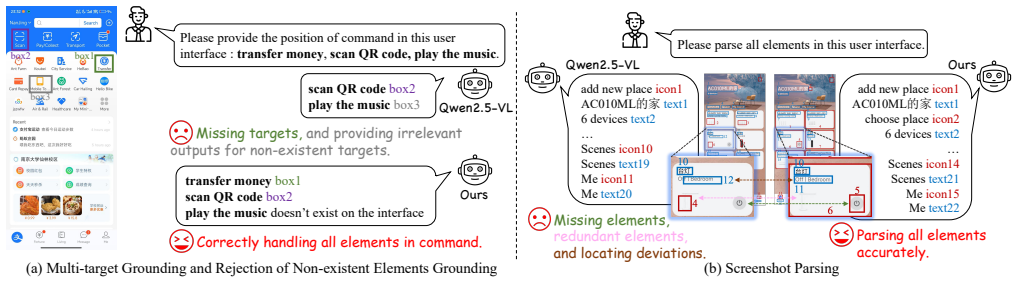
SparkUI-Parser replaces discrete coordinate tokens with continuous regression, reaching state-of-the-art GUI grounding and full-interface parsing at roughly 5x the inference speed.
Reviewed by Pith at T0; open to challenge. T0 means a machine referee read the full paper against a public rubric. the ladder, T0–T4 →
T0 review · deepseek-v4-flash
2026-08-05 05:48 UTC pith:X7CQ6R4U
load-bearing objection SparkUI-Parser is a genuinely new architecture for GUI perception with solid external grounding results, but its parsing claim rests on a self-built benchmark that may share an annotation pipeline with its training data—recommend peer review with major revision on the parsing evaluation. the 5 major comments →
SparkUI-Parser: Enhancing GUI Perception with Robust Grounding and Parsing
The pith
A machine-rendered reading of the paper's core claim, the machinery that carries it, and where it could break.
Core claim
The paper claims that a pre-trained MLLM, fine-tuned with LoRA, can be turned into a precise GUI perceiver by decoupling semantics from geometry. Text tokens continue to describe element semantics through normal autoregressive generation, while special [VG] tokens are routed to a transformer-based coordinate decoder that combines the token's hidden state with vision-adapter features and regresses a bounding box as a continuous four-dimensional output. Because a single special token replaces the several discrete coordinate tokens that text generation would require, inference becomes faster and ground-truth alignment is handled by an element matcher that uses a modified Hungarian algorithm wit
What carries the argument
The central mechanism is the route-then-predict design: a token router classifies MLLM output tokens into text, [VG] (visual grounding), and [REJ] (reject) tokens; the [VG] token's last-layer hidden state is fused with vision-adapter features and fed to a lightweight transformer-based coordinate decoder that regresses continuous bounding-box coordinates directly, rather than by sampling coordinate tokens from the vocabulary. This continuous regression is what carries the accuracy and speed gains, with the element matcher (modified Hungarian matching) keeping predicted elements aligned to ground truth during training.
Load-bearing premise
If the hidden state of the [VG] token does not actually carry spatial information about the referenced element, the coordinate decoder cannot recover its location, and the whole grounding advantage collapses.
What would settle it
Train the same model on the same data under two output heads: the proposed continuous coordinate decoder and a discrete-token coordinate head; if the discrete head matches or exceeds the decoder's grounding accuracy, the central claim that continuous modeling is the source of the gains is falsified. A cheaper probe: shuffle the [VG] hidden-state vectors while keeping vision features fixed; if predicted boxes remain accurate, the hidden state is not doing the spatial work the paper attributes to it.
If this is right
- GUI agents built with SparkUI-Parser can query multiple elements at once and receive boxes for each, with a single [VG] token per box instead of a long coordinate string, cutting grounding latency to roughly a fifth.
- Because [REJ] tokens let the model decline requests for elements that are not on the screen, downstream agents can avoid acting on hallucinated locations.
- The ScreenParse benchmark, with element recall, precision, and semantic similarity, gives the community a way to measure full-interface parsing rather than only predefined single-target grounding.
- On the same class of MLLM backbones, replacing discrete coordinate tokens with continuous regression appears to yield about 3 percentage points of average grounding improvement, suggesting the bottleneck is the output representation, not the model size.
- Fine-grained parsing output—semantics plus coordinates for every element—can supply richer structural state to planners that previously relied on separate OCR and icon-detection tools.
Where Pith is reading between the lines
- A natural stress test would push the coordinate decoder to novel screen densities, e.g. very small icons or nested UI containers; if the [VG] hidden state does not encode scale-invariant location, the continuous-regression gain may shrink.
- The rejection mechanism could be transferred to other MLLM grounding tasks (documents, diagrams, robotics) as a generic way to suppress hallucinated referring expressions.
- Since the vision adapter is trained alongside the frozen MLLM, the method invites a study of whether the adapter is learning to compensate for the MLLM's weak GUI spatial priors; ablating it drops precision dramatically (Table 4).
- ScreenParse's annotation pipeline—expert detectors plus human check—could be extended to video frames or dynamic interfaces, where parsing must handle temporal consistency.
Editorial analysis
A structured set of objections, weighed in public.
Referee Report
Summary. SparkUI-Parser is an end-to-end GUI perception model built on InternVL2.5-8B. It augments the MLLM with a token router that separates text outputs from learned [VG]/[REJ] tokens; [VG] tokens are combined with vision-adapter features and regressed by a transformer coordinate decoder to continuous bounding boxes, while [REJ] tokens are discarded. A Hungarian-based element matcher aligns predictions for multi-element outputs during training. The paper introduces ScreenParse, a GUI parsing benchmark with element recall, precision, and semantic similarity metrics, and reports SOTA grounding on ScreenSpot, ScreenSpot-v2, CAGUI-Grounding, and parsing on ScreenParse, with 5x/4x speedups over strong baselines.
Significance. If the results hold, the paper makes a useful step: it shows that replacing discrete coordinate token generation with a lightweight continuous regression head on MLLM hidden states can improve both latency and accuracy, and it is among the first end-to-end MLLM-based systems to output full-interface element lists. The grounding results are validated on independent external benchmarks (ScreenSpot, ScreenSpot-v2, CAGUI-Grounding) with consistent improvements over strong baselines, and the ablations broadly support the contributions of the coordinate decoder, vision adapter, element matcher, and parsing data. The open-sourced resources and efficiency measurements are additional strengths. However, the parsing pillar is evaluated only on the authors' new benchmark, which is constructed with the same style of automated annotation used to create training data; this, together with an undefined semantic-similarity metric and absent error bars, means the broad claim about 'fine-grained parsing of the entire interface' is not yet fully supported.
major comments (5)
- [Sec. 4.1 and Sec. 5.1] The parsing claim is evaluated only on ScreenParse, and the construction of ScreenParse (Sec. 4.1) uses Grounding DINO + PaddleOCR + an MLLM + human checks over ScreenSpot screenshots plus 'user interfaces from common Chinese applications'. The parsing training data (Sec. 5.1) is 'self-annotated Chinese datasets' on 'self-collected user interfaces' with no stated disjointness in screens, apps, or annotation software. If the Chinese ScreenParse images overlap with the self-collected UI set, or if the same low-level annotators/pipeline produce both, the parsing recall/precision/semantic similarity numbers in Table 3 would reflect in-distribution fit rather than a general parsing ability. The paper should provide a formal disjointness analysis (e.g., image hashing, app-level split, annotation-pipeline independence) and, ideally, an external parsing benchmark or human evaluation. This is loa
- [Sec. 4.3 and Eq. (4)] Semantic similarity is never defined. No embedding model, aggregation formula, or exact-match variant is given, so a reader cannot reproduce any SemanticSim entry in Table 3 or compare across baselines. The matching threshold mu=0.55 is stated as an experimental choice without sensitivity analysis, yet it determines which predicted elements enter recall/precision and which pairs are scored for semantics. Provide the metric definition (e.g., sentence-embedding cosine with a named model) and a sensitivity table over mu (e.g., 0.45, 0.5, 0.55, 0.6, 0.65) for the full model and at least one baseline.
- [Sec. 3.1, Eq. (3)] The coordinate decoder takes f_token[VG] and f_vision, but the token router's operation is described only as 'based on the logits of output tokens' with no classification mechanism, loss, or training details. The paper also does not examine whether the [VG] hidden state actually contains the spatial information assumed by Eq. (3); the only evidence is the large drop when the vision adapter is removed (Table 4). Since the entire continuous-coordinate advantage rests on this premise, please specify the router (e.g., linear probe on logits, threshold, whether trained with cross-entropy) and add a diagnostic or analysis of the [VG] representation (e.g., probing with the decoder, visualizing attention, or ablating f_token[VG] while keeping f_vision).
- [Tables 1-4] No error bars or repeated runs are reported. Several headline differences are small (e.g., Table 1: 88.0 vs. 84.4 on ScreenSpot; Table 2: 81.6 vs. 77.8 on CAGUI-Grounding; Table 4: SemanticSim 0.932 vs. 0.930 without the coordinate decoder). Without variance estimates, the 'consistently outperforms' claim is not statistically grounded. Report at least three seeds or confidence intervals, especially for the ablation and ScreenParse results.
- [Sec. 1 and Sec. 3.2] The rejection of non-existent elements is listed as a core contribution and enabled by the [REJ] token, but the experiments contain no targeted measurement. The reported grounding benchmarks mostly involve present targets, and ScreenParse precision is only an indirect measure. Please add an evaluation protocol where instructions refer to absent elements (or a subset of absent targets), reporting false-positive rates and the effect of removing the rejection mechanism.
minor comments (5)
- [Throughout] Typographical errors: 'natual' (Sec. 2.1), 'adpater' (Sec. 3.1/Fig. 2), 'furthur' (Sec. 6), 'lora-rank' and 'lora-alpha' should be math-formatted.
- [Eq. (4)-(5)] The matched index sigma is defined via argmin but used in Eq. (5) without specifying that it denotes the argmin index; clarify the notation and the case where no match exists.
- [Table 1] The Claude Computer Use row shows only an average value of 83.0 with dashes in all per-column entries; explain how this average is obtained and under what evaluation protocol.
- [Sec. 5.2 and Table 3] Inference time reporting should state hardware, batch size, input resolution, and whether times are end-to-end or per element, so that comparisons across methods are meaningful.
- [Sec. 5.1] The paper says 'See Supplementary for more datasets details,' but the supplement is not included in the submission; for the review process, ensure the supplementary material is available or move key dataset construction details into the main text.
Circularity Check
No significant circularity: grounding is externally benchmarked; parsing claim is self-built but not shown to be equivalent to training inputs.
full rationale
I walked the derivation chain. The core architecture (Eqs. 1–3) is an explicit design: token router, vision adapter, and coordinate decoder are trained with the stated losses (Eqs. 4–6). No fitted parameter is renamed as a prediction. Grounding is validated on external benchmarks (ScreenSpot, ScreenSpot-v2, CAGUI-Grounding) whose annotations are not produced by this paper; those results are independent evidence. Parsing is evaluated on the authors' new ScreenParse benchmark, which is self-built, but the paper describes construction via independent expert models (Grounding DINO, PaddleOCR, MLLM) plus manual checking, and it does not state that ScreenParse images appear in the training set. The semantic-similarity metric is under-specified and the matching threshold mu=0.55 is a training hyperparameter, but these are reproducibility concerns, not circular reductions. There is no load-bearing self-citation or imported uniqueness theorem. Hence no significant circularity is demonstrated.
Axiom & Free-Parameter Ledger
free parameters (4)
- element matcher matching threshold mu =
0.55
- loss weights lambda_CE, lambda_1, lambda_IoU =
2.0, 4.0, 1.0
- LoRA rank and alpha =
r=16, alpha=32
- learning rate and warmup ratio =
3e-5, 0.03
axioms (5)
- standard math Hungarian matching and IoU loss provide a valid training signal for element alignment.
- domain assumption The [VG] token hidden state of the MLLM carries sufficient spatial information for the coordinate decoder to regress bounding boxes.
- domain assumption The MLLM can learn to emit [VG] and [REJ] tokens and the token router can reliably classify them from logits.
- domain assumption ScreenParse's ground truth (from Grounding DINO + PaddleOCR + MLLM semantic supplementation + human check) is complete and accurate enough to serve as a benchmark.
- domain assumption Pre-trained MLLMs' vision encoder features, after LoRA tuning, are sufficient for GUI-specific localization after an MLP adapter.
invented entities (2)
-
[VG] token
no independent evidence
-
[REJ] token
no independent evidence
Cite this review
Pith. "Pith review of SparkUI-Parser: Enhancing GUI Perception with Robust Grounding and Parsing." pith.science (2026). https://pith.science/paper/X7CQ6R4U
@misc{pith2026250904908,
  author       = {Pith},
  title        = {Pith review of: SparkUI-Parser: Enhancing GUI Perception with Robust Grounding and Parsing},
  year         = {2026},
  howpublished = {\url{https://pith.science/paper/X7CQ6R4U}},
  note         = {Machine review of arXiv:2509.04908}
}
read the original abstract
The existing Multimodal Large Language Models (MLLMs) for GUI perception have made great progress. However, the following challenges still exist in prior methods: 1) They model discrete coordinates based on text autoregressive mechanism, which results in lower grounding accuracy and slower inference speed. 2) They can only locate predefined sets of elements and are not capable of parsing the entire interface, which hampers the broad application and support for downstream tasks. To address the above issues, we propose SparkUI-Parser, a novel end-to-end framework where higher localization precision and fine-grained parsing capability of the entire interface are simultaneously achieved. Specifically, instead of using probability-based discrete modeling, we perform continuous modeling of coordinates based on a pre-trained Multimodal Large Language Model (MLLM) with an additional token router and coordinate decoder. This effectively mitigates the limitations inherent in the discrete output characteristics and the token-by-token generation process of MLLMs, consequently boosting both the accuracy and the inference speed. To further enhance robustness, a rejection mechanism based on a modified Hungarian matching algorithm is introduced, which empowers the model to identify and reject non-existent elements, thereby reducing false positives. Moreover, we present ScreenParse, a rigorously constructed benchmark to systematically assess structural perception capabilities of GUI models across diverse scenarios. Extensive experiments demonstrate that our approach consistently outperforms SOTA methods on ScreenSpot, ScreenSpot-v2, CAGUI-Grounding and ScreenParse benchmarks. The resources are available at https://github.com/antgroup/SparkUI-Parser.
Figures


Reference graph
Works this paper leans on
-
[5]
Hong, W.; Wang, W.; Lv, Q.; Xu, J.; Yu, W.; Ji, J.; Wang, Y .; Wang, Z.; Dong, Y .; Ding, M.; et al
Navigating the digital world as humans do: Universal visual grounding for gui agents.arXiv preprint arXiv:2410.05243. Hong, W.; Wang, W.; Lv, Q.; Xu, J.; Yu, W.; Ji, J.; Wang, Y .; Wang, Z.; Dong, Y .; Ding, M.; et al
-
[6]
Li, Z.; You, K.; Zhang, H.; Feng, D.; Agrawal, H.; Li, X.; Moorthy, M
Gpt-4o system card.arXiv preprint arXiv:2410.21276. Li, Z.; You, K.; Zhang, H.; Feng, D.; Agrawal, H.; Li, X.; Moorthy, M. P. S.; Nichols, J.; Yang, Y .; and Gan, Z
-
[7]
Liu, H.; Li, C.; Wu, Q.; and Lee, Y
Ferret-ui 2: Mastering universal user interface understanding across platforms.arXiv preprint arXiv:2410.18967. Liu, H.; Li, C.; Wu, Q.; and Lee, Y . J
-
[8]
arXiv preprint arXiv:2501.12326
UI-TARS: Pioneering Automated GUI Interaction with Native Agents. arXiv preprint arXiv:2501.12326. Rezatofighi, H.; Tsoi, N.; Gwak, J.; Sadeghian, A.; Reid, I.; and Savarese, S
-
[9]
Wan, J.; Song, S.; Yu, W.; Liu, Y .; Cheng, W.; Huang, F.; Bai, X.; Yao, C.; and Yang, Z
Gemini: a family of highly capable multimodal models.arXiv preprint arXiv:2312.11805. Wan, J.; Song, S.; Yu, W.; Liu, Y .; Cheng, W.; Huang, F.; Bai, X.; Yao, C.; and Yang, Z
-
[10]
Xu, Y .; Wang, Z.; Wang, J.; Lu, D.; Xie, T.; Saha, A.; Sa- hoo, D.; Yu, T.; and Xiong, C
Os-atlas: A foundation action model for generalist gui agents.arXiv preprint arXiv:2410.23218. Xu, Y .; Wang, Z.; Wang, J.; Lu, D.; Xie, T.; Saha, A.; Sa- hoo, D.; Yu, T.; and Xiong, C
-
[11]
Yang, Y .; Wang, Y .; Li, D.; Luo, Z.; Chen, B.; Huang, C.; and Li, J
Aguvis: Unified pure vision agents for autonomous gui interaction.arXiv preprint arXiv:2412.04454. Yang, Y .; Wang, Y .; Li, D.; Luo, Z.; Chen, B.; Huang, C.; and Li, J
-
[12]
arXiv preprint arXiv:2412.16256
Aria-UI: Visual Grounding for GUI Instructions. arXiv preprint arXiv:2412.16256. Yang, Z.; Li, L.; Lin, K.; Wang, J.; Lin, C.-C.; Liu, Z.; and Wang, L
-
[13]
The dawn of lmms: Preliminary explorations with gpt-4v (ision).arXiv preprint arXiv:2309.17421, 9(1):
-
[14]
AgentCPM-GUI: Building Mobile-Use Agents with Reinforcement Fine- Tuning.arXiv preprint arXiv:2506.01391
-
[2020]
InEuropean conference on computer vi- sion, 213–229
End-to-end object detection with transformers. InEuropean conference on computer vi- sion, 213–229. Springer. Chen, Z.; Wang, W.; Cao, Y .; Liu, Y .; Gao, Z.; Cui, E.; Zhu, J.; Ye, S.; Tian, H.; Liu, Z.; et al. 2024a. Expanding Per- formance Boundaries of Open-Source Multimodal Models with Model, Data, and Test-Time Scaling.arXiv preprint arXiv:2412.05271...
-
[2023]
Qwen-VL: A Versatile Vision- Language Model for Understanding, Localization, Text Reading, and Beyond.arXiv preprint arXiv:2308.12966. Bai, S.; Chen, K.; Liu, X.; Wang, J.; Ge, W.; Song, S.; Dang, K.; Wang, P.; Wang, S.; Tang, J.; et al
-
[2024]
Seeclick: Harnessing gui grounding for ad- vanced visual gui agents.arXiv preprint arXiv:2401.10935. GoogleDeepmind
-
[2025]
5-vl technical report.arXiv preprint arXiv:2502.13923
Qwen2. 5-vl technical report.arXiv preprint arXiv:2502.13923. Carion, N.; Massa, F.; Synnaeve, G.; Usunier, N.; Kirillov, A.; and Zagoruyko, S
discussion (0)
Sign in with ORCID, Apple, or X to comment. Anyone can read and Pith papers without signing in.