REVIEW 3 major objections 5 minor 31 references
Pointing-Guided Target Estimation via Transformer-Based Attention
T0 review · 3 major / 5 minor · reviewed 2026-08-05 · deepseek-v4-flash
Pith's one-line read A transformer with inter-modality attention can map monocular RGB pointing gestures to the intended tabletop object with 90% accuracy, matching a geometric baseline without extra hardware.
desk verdict A competent tabletop pointing paper whose empirical claim is plausible, but whose 'no geometric rules' framing is undercut by its own hand-coded angle feature and whose data split needs clarification before the 90% number is taken at face value. read the letter →
The pith
A machine-rendered reading of the paper's core claim, the machinery that carries it, and where it could break.
The reading
What carries the argument
The load-bearing mechanism is the inter-modality attention block: hand-pose tokens act as queries against object-location keys and values, so each hand landmark aggregates object context, forming a pose-object memory. A separate relationship token per hand-object pair—the cosine angle between the index-finger vector and the centroid vector, plus a non-relation token of -1 for non-pointing hands—is fed to the decoder, which self-attends and then cross-attends to the encoder memory; a feedforward network with sigmoid assigns each object a score, and the highest score is the prediction. The non-object token (-1,-1) gives the same architecture an explicit 'not pointing' output.
What would settle it
Re-run the eight-fold experiment with strict participant-disjoint splits, and additionally separate the augmented samples by their source video; if top-1 accuracy on never-seen participants drops well below 90%, the result was driven by scene/participant correlations rather than a general pointing-to-object mapping. A second check: collect trials where two objects lie on the same pointing ray and measure accuracy on those alone, since the paper's own patch matrix reports the model often selecting the farther object.
Extended reading notes
Core claim
The paper's central claim is that a pointing gesture can be treated as a relation between hand and object tokens and scored by inter-modality attention: the encoder lets hand pose features attend to object locations, the decoder lets relationship tokens—the angle between the index finger and each object centroid—attend to that fused memory, and a sigmoid output ranks the objects. With all three modalities the architecture reaches 90% accuracy and 96% top-2 accuracy, slightly above the 89% of the 2D geometric baseline. This is presented as evidence that the intended object can be predicted accurately using monocular RGB data, and that the hand-coded angular relationship is what lifts the mode
Load-bearing premise
The reported accuracy assumes the held-out test scenes—and the participants and augmented copies associated with them—are truly unseen in training; if that separation leaks, 90 percent overstates how well the model reads new pointing gestures.
Editorial extensions
If this is right
- A robot can rank the likely pointing targets in a single forward pass, so a downstream planner can ask for confirmation or grasp the most likely one.
- Monocular RGB is sufficient in the controlled tabletop regime, removing the need for depth sensors, IMUs, or multi-camera calibration.
- The two-modality result (71%) shows that pose and location alone learn coarse relations (top-2 92%); the angular relationship is what refines the final choice, which means explicit relational geometry still matters inside a learned pipeline.
- The patch confusion matrix offers a way to inspect where spatial errors concentrate—such as objects aligned along the pointing ray—rather than aggregating over arbitrary object indices.
- The architecture is modular: gaze or other cues could be added as additional tokens without changing the scoring head.
Reading between the lines
- The 19-point jump when adding the angle suggests the attention mechanism itself may be learning proximity and alignment, while the crisp selection is effectively delegated to the hand-coded cosine angle; a test that removes only the angle and replaces it with a learned direction embedding would separate those contributions.
- From the patch confusion matrix patterns, the model often picks an object farther along the pointing ray behind the true target; a targeted evaluation on collinear-object configurations would show whether this is a systematic bias.
- The same scorer could be trained for gaze direction, head pose, or other deictic cues by changing only the query tokens, and the non-object token gives a natural 'no referent' output for those modalities.
- A strict participant-disjoint and scene-disjoint evaluation would be the natural next check that the accuracy is a statement about reading novel pointing gestures rather than about recognizing familiar layouts.
Editorial analysis
A structured set of objections, weighed in public.
Referee Report
Summary. The paper proposes MM-ITF, a transformer-based encoder-decoder with inter-modality attention for pointing target estimation in a tabletop HRI scenario. Hand keypoints from MediaPipe and object centroids from OWLv2 are embedded, together with a third input: the angle between the index-finger vector and each object centroid. A non-object token represents resting hands, and the model assigns a score to each candidate object, selecting the highest. The method is evaluated on 30 videos from 18 participants (572 source samples, augmented to 2,342,912), using an eight-fold protocol with 21 training, 3 validation, and 6 held-out test scenes. Reported results: 90% accuracy and 96% top-2 accuracy for the three-modality model, 71% accuracy for the two-modality ablation, and 89% accuracy for the geometric baseline. The paper also introduces a patch confusion matrix for spatial error analysis and claims that the method works from monocular RGB without predefined geometric rules.
Significance. If the evaluation is valid, the paper makes a moderate but useful contribution: it shows that a transformer with inter-modality attention can fuse 2D hand landmarks and object centroids for pointing-target selection, avoiding 3D reconstruction and wearable sensors. The patch confusion matrix is a clear interpretability tool, the code is released, and the two-modality versus three-modality ablation gives insight into the role of the relationship input. However, the central claim that the method works without geometric rules is weakened by the explicit hand-coded angle feature, and the augmentation/split ordering must be clarified before the 90% accuracy figure can be interpreted as a true generalization estimate. Overall, the contribution is appropriate for an applied HRI venue, but the evaluation protocol and wording of the main claim require revision.
major comments (3)
- [§3.1, §4.2] The placement of data augmentation relative to the train/validation/test split is not stated. Section 3.1 describes augmentation of the 572 samples to 2,342,912 samples, and Section 4.2 describes the 21/3/6 split, but the text does not say whether augmentation is applied before or after the split. If augmentation is applied before the split, augmented copies of the six held-out test scenes appear in the training folds; since the transformations preserve the pointing direction, the model could memorize test-scene variants and the reported 90% accuracy would not measure generalization to unseen scenes. In addition, the split is at the scene level, not the participant level, and the dataset contains 18 participants with 30 videos; identity leakage could also inflate accuracy. The authors should explicitly state the augmentation/split ordering and provide a participant-disjoint split or repo
- [§3.2, Eq. (3), §5] The abstract and conclusion claim that the method predicts pointing targets 'without relying on predefined geometric rules.' This is not supported as written: the relationship feature θ_i in Eq. (3) is a hand-coded angular alignment between the index-finger vector and each object centroid. The ablation in Table 1 shows that adding this feature raises accuracy from 71% to 90%, so the geometric prior is the main driver of the result. The method avoids geometric post-processing such as line-intersection, but it still relies on a predefined geometric relationship as an input. The authors should reframe the claim as 'without geometric post-processing' or show that the model can learn the angular relationship from pose and object coordinates alone.
- [§4.2, Table 1] The evaluation protocol is arithmetically consistent if read as a fixed six-scene test set with rotating three-scene validation subsets, but the text calls it 'eight-fold cross-validation,' which is non-standard. More importantly, the reported metrics are averaged over eight models, yet all eight models appear to share the same six test scenes, and neither the number of test samples per scene nor per-fold breakdown is given. With only six test scenes, scene-level correlations can dominate the reported 0.90 accuracy and the ±0.017 standard deviation. The authors should provide per-fold and per-scene results, the number of test frames, and a clear statement of how the six test scenes were selected.
minor comments (5)
- [§4.2] The split description should be rewritten for clarity. The phrase 'eight-fold cross-validation' alongside 'trained on 21 scenes and validated on a unique subset of three' and 'six scenes held out as a test set' can be read as inconsistent unless one infers that the six test scenes are fixed. Please state explicitly that the six test scenes are fixed and that the 24 remaining scenes rotate through validation across the eight folds.
- [§3.1] The augmentation description says 'eight random shifts along both the x- and y-axes.' This is ambiguous: it could mean eight shifts total, or 8×8 = 64 shifts. The stated final count of 2,342,912 from 572 source samples implies 2 × 8 × 8 × 8 × 4 = 4096-fold augmentation, but the multiplier should be spelled out.
- [Table 1] The three-modality model and the baseline differ by only one point (0.90 vs. 0.89), and the reported standard deviations overlap. The paper does not report any significance test or confidence intervals. Since the conclusion emphasizes achieving performance comparable to the baseline, a statistical comparison would strengthen the claim.
- [§4.3, Figure 4] The patch coordinates in the confusion matrix (e.g., '(1,12)', '(3,12)') are used in the text but the figure does not define the origin or ordering of the patch grid. Please add axis labels and a description of how patch indices relate to image coordinates.
- [Title] The title contains a formatting artifact: 'T arget' should be 'Target'.
Circularity Check
No significant circularity: the central accuracy claim is an empirical evaluation on held-out scenes, and the self-citations are not load-bearing.
full rationale
The central claim (Abstract: 'Our results demonstrate that the method can accurately predict the intended object using monocular RGB data') is supported by an eight-fold cross-validation in Section 4.2 with scenes held out for testing. The only hand-coded geometric input is the relationship angle θ_i in Eq. (3), but this is an input feature to a learned transformer; the target object is not defined as argmin θ_i, and the model is trained and evaluated on independent labels. The reported 90% accuracy is therefore not forced by construction. The paper's self-citations ([1], [2], [14]) are used for baseline comparison, prior setup, and robot platform description; none carries the derivation of the main result. The potential concern that augmentation in Section 3.1 may have been applied before the train/test split is a data-validity risk, not a circularity, and is not evidenced by the paper's text. No load-bearing step reduces to its own input or to a self-citation chain.
Assumptions & free parameters
free parameters (3)
- Transformer hyperparameters (d_T, layers, heads, optimizer, epochs, batch size)
- Augmentation schedule
- Relationship feature definition
assumptions (5)
- domain assumption MediaPipe Hands provides 21 sufficiently accurate 2D landmarks per hand in the fisheye image.
- domain assumption OWLv2 detects the ten YCB objects and their bounding-box centroids reliably enough.
- ad hoc to paper The angle between the index finger vector and each object centroid is the decisive relationship for pointing.
- domain assumption Joint augmentation preserves the pointing target label.
- domain assumption Train, validation, and test scenes are independent and participant identity does not leak across folds.
Cite this review
Pith. "Pith review of Pointing-Guided Target Estimation via Transformer-Based Attention." pith.science (2026). https://pith.science/paper/XBQQK7XJ
@misc{pith2026250905031,
  author       = {Pith},
  title        = {Pith review of: Pointing-Guided Target Estimation via Transformer-Based Attention},
  year         = {2026},
  howpublished = {\url{https://pith.science/paper/XBQQK7XJ}},
  note         = {Machine review of arXiv:2509.05031}
}
read the original abstract
Deictic gestures, like pointing, are a fundamental form of non-verbal communication, enabling humans to direct attention to specific objects or locations. This capability is essential in Human-Robot Interaction (HRI), where robots should be able to predict human intent and anticipate appropriate responses. In this work, we propose the Multi-Modality Inter-TransFormer (MM-ITF), a modular architecture to predict objects in a controlled tabletop scenario with the NICOL robot, where humans indicate targets through natural pointing gestures. Leveraging inter-modality attention, MM-ITF maps 2D pointing gestures to object locations, assigns a likelihood score to each, and identifies the most likely target. Our results demonstrate that the method can accurately predict the intended object using monocular RGB data, thus enabling intuitive and accessible human-robot collaboration. To evaluate the performance, we introduce a patch confusion matrix, providing insights into the model's predictions across candidate object locations. Code available at: https://github.com/lucamuellercode/MMITF.
Figures
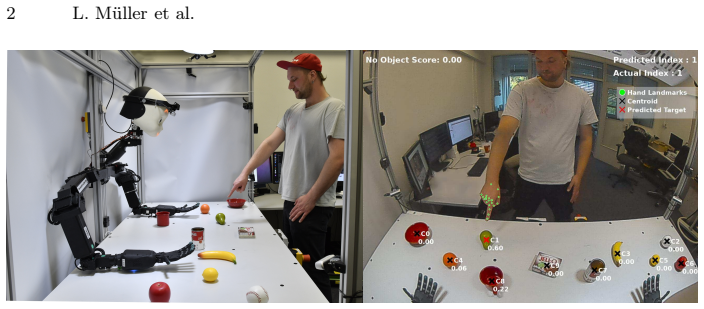


Figures from the paper (1 more)

Reference graph
Works this paper leans on
-
[1]
Ali, H., Allgeuer, P., Wermter, S.: Comparing Apples to Or anges: LLM-powered Multimodal Intention Prediction in an Object Categorizati on Task. ICSR (2024)
work page 2024
- [2]
-
[3]
Image Vision Computing 130(C) (2023)
Antoun, M., Asmar, D.: Human Object Interaction Detectio n: Design and Survey. Image Vision Computing 130(C) (2023)
work page 2023
-
[4]
Confere nce on Computer and Robot Vision (CR V) pp
Azari, B., Lim, A., Vaughan, R.T.: Commodifying Pointing in HRI: Simple and Fast Pointing Gesture Detection from RGB-D Images. Confere nce on Computer and Robot Vision (CR V) pp. 174–180 (2019)
work page 2019
-
[5]
Bamani, E., Nissinman, E., Koenigsberg, L., Meir, I., Mat alon, Y., Sintov, A.: Recognition and Estimation of Human Finger Pointing with an RGB Camera for Robot Directive. arXiv 2307.02949 (2023)
arXiv 2023
-
[6]
In: International Conference on Advanced Robotics ICAR
Calli, B., Singh, A., Walsman, A., Srinivasa, S., Abbeel, P., Dollar, A.M.: The YCB object and Model set: Towards common benchmarks for manipul ation research. In: International Conference on Advanced Robotics ICAR. pp. 51 0–517 (2015)
work page 2015
-
[7]
IEEE Tra nsactions on Pat- tern Analysis & Machine Int
Cao, Z., Hidalgo, G., Simon, T., Wei, S.E., Sheikh, Y.: Ope nPose: Realtime Multi- Person 2D Pose Estimation Using Part Affinity Fields. IEEE Tra nsactions on Pat- tern Analysis & Machine Int. 43(01), 172–186 (2021)
work page 2021
-
[8]
Carion, N., Massa, F., Synnaeve, G., Usunier, N., Kirillo v, A., Zagoruyko, S.: End- to-End Object Detection with Transformers. In: Vedaldi, A. , Bischof, H., Brox, T., Frahm, J.M. (eds.) ECCV. pp. 213–229. Springer, Cham (2020)
work page 2020
Show all 31 references
-
[9]
In: CVPR
Chen, M., Liao, Y., Liu, S., Chen, Z., Wang, F., Qian, C.: Re formulating HOI Detection As Adaptive Set Prediction. In: CVPR. pp. 9004–90 13 (2021)
2021
-
[10]
In: Proceedings of the 33rd Annual ACM Conference on Human Factors in Computing Systems
Haque, F., Nancel, M., Vogel, D.: Myopoint: Pointing and Clicking Using Fore- arm Mounted Electromyography and Inertial Motion Sensors. In: Proceedings of the 33rd Annual ACM Conference on Human Factors in Computing Systems. p. 3653–3656. CHI ’15, Association for Computing Mac...
2015
-
[11]
In: Sig n Language Studies, 3, vol
Hewe, G.W.: Gesture Language in Culture Contact. In: Sig n Language Studies, 3, vol. 4, pp. 1–34. Gallaudet University Press (1974)
1974
-
[12]
In: Proceedings o f International Con- ference on Pattern Recognition
Hu, K., Canavan, S., Yin, L.: Hand Pointing Estimation fo r Human Computer In- teraction Based on Two Orthogonal-Views. In: Proceedings o f International Con- ference on Pattern Recognition. pp. 3760–3763 (2010) 12 L. Müller et al
2010
-
[13]
In: ICCV
Ji, J., Desai, R., Niebles, J.C.: Detecting Human-Objec t Relationships in Videos. In: ICCV. pp. 8106–8116 (2021)
2021
-
[14]
IEEE Access 11 (2023)
Kerzel, M., Allgeuer, P., Strahl, E., Frick, N., Habekos t, J.G., Eppe, M., Wermter, S.: NICOL: A Neuro-Inspired Collaborative Semi-Humanoid R obot That Bridges Social Interaction and Reliable Manipulation. IEEE Access 11 (2023)
2023
-
[15]
In: CVPR
Kim, B., Lee, J., Kang, J., Kim, E.S., Kim, H.J.: HOTR: End -to-End Human- Object Interaction Detection With Transformers. In: CVPR. pp. 74–83 (2021)
2021
-
[16]
(ed.): Pointing: Where Language, Culture, and C ognition Meet
Kita, S. (ed.): Pointing: Where Language, Culture, and C ognition Meet. Lawrence Erlbaum Associates, Mahwah, NJ (2003)
2003
-
[17]
Kuramochi, A., Komuro, T.: 3D Hand Pointing Recognition over a Wide Area using Two Fisheye Cameras, pp. 58–67. Springer Internation al Publishing (2021)
2021
-
[18]
John Benjamins (2003)
Lenz, F.: Deictic Conceptualisation of Space, Time and P erson. John Benjamins (2003)
2003
-
[19]
In: Third Workshop on Computer Vision for AR/VR at IEEE CVPR 2019 (2019 )
Lugaresi, C., Tang, J., Nash, H., McClanahan, C., Ubowej a, E., Hays, M., Zhang, F., Chang, C.L., Yong, M., Lee, J., Chang, W.T., Hua, W., Geor g, M., Grundmann, M.: MediaPipe: A Framework for Perceiving and Processing Re ality. In: Third Workshop on Computer Vision for AR/VR ...
2019
-
[20]
In: CVPR Workshops
Maji, D., Nagori, S., Mathew, M., Poddar, D.: YOLO-Pose: Enhancing YOLO for Multi Person Pose Estimation Using Object Keypoint Similar ity Loss. In: CVPR Workshops. pp. 2637–2646 (2022)
2022
-
[21]
ROBOMEC H 8(1), 14 (2021)
Medeiros, A.C.S., Ratsamee, P., Orlosky, J., Uranishi, Y., Higashida, M., Take- mura, H.: 3D pointing gestures as target selection tools: gu iding monocular UA Vs during window selection in an outdoor environment. ROBOMEC H 8(1), 14 (2021)
2021
-
[22]
In: Proceedings of the 37th International Conference on Neural Information Processing Systems
Minderer, M., Gritsenko, A., Houlsby, N.: Scaling Open- Vocabulary Object Detec- tion. In: Proceedings of the 37th International Conference on Neural Information Processing Systems. NIPS ’23, Curran Associates Inc., Red H ook, NY, USA (2023)
2023
-
[23]
IEEE Trans
Mur-Artal, R., Montiel, J.M.M., Tardos, J.D.: ORB-SLAM : A Versatile and Accu- rate Monocular SLAM System. IEEE Trans. on Robotics 31(5), 1147–1163 (2015)
2015
-
[24]
IEEE Trans
Ranftl, R., Lasinger, K., Hafner, D., Schindler, K., Kol tun, V.: Towards Robust Monocular Depth Estimation: Mixing Datasets for Zero-Shot Cross-Dataset Trans- fer. IEEE Trans. on Pattern Analysis & Machine Int. 44(03), 1623–1637 (2022)
2022
-
[25]
Image Processing & Communi cations 21 (2017)
Sikeridis, D., Antonakopoulos, T.: An IMU-Based Wearab le System for Automatic Pointing During Presentations. Image Processing & Communi cations 21 (2017)
2017
-
[26]
In: CVPR
Tamura, M., Ohashi, H., Yoshinaga, T.: QPIC: Query-Base d Pairwise Human- Object Interaction Detection with Image-Wide Contextual I nformation. In: CVPR. pp. 10405–10414 (2021)
2021
-
[27]
MIT Pres s (2008)
Tomasello, M.: Origins of Human Communication. MIT Pres s (2008)
2008
-
[28]
International Journal of Social Robotics 9, 1–15 (2017)
Tölgyessy, M., Dekan, M., Duchoň, F., Rodina, J., Hubins ký, P., Chovanec, L.: Foundations of Visual Linear Human–Robot Interaction via P ointing Gesture Nav- igation. International Journal of Social Robotics 9, 1–15 (2017)
2017
-
[29]
In: Ranzato, M., B eygelzimer, A., Dauphin, Y., Liang, P., Vaughan, J.W
Zhang, A., Liao, Y., Liu, S., Lu, M., Wang, Y., Gao, C., LI, X.: Mining the Benefits of Two-stage and One-stage HOI Detection. In: Ranzato, M., B eygelzimer, A., Dauphin, Y., Liang, P., Vaughan, J.W. (eds.) Advances in Neu ral Information Processing Systems. vol. 34, pp. 17209–...
2021
-
[30]
ArXiv abs/2006.10214 (2020)
Zhang, F., Bazarevsky, V., Vakunov, A., Tkachenka, A., S ung, G., Chang, C.L., Grundmann, M.: MediaPipe Hands: On-device Real-time Hand T racking. ArXiv abs/2006.10214 (2020)
2006 arXiv
-
[31]
Zou, C., Wang, B., Hu, Y., Liu, J., Wu, Q., Zhao, Y., Li, B., Zhang, C., Zhang, C., Wei, Y., Sun, J.: End-to-End Human Object Interaction De tection with HOI Transformer. CVPR pp. 11820–11829 (2021)
2021
Reviewed August 5, 2026 · model on record in the stance chip above.
Discussion (0). Sign in to comment.