REVIEW 3 major objections 6 minor 43 references
Variational quantum circuits, paired with particle swarm optimization, can discover industrial control settings better than any in their offline training data, rivaling classical neural networks.
Reviewed by Pith at T0; open to challenge. T0 means a machine referee read the full paper against a public rubric. the ladder, T0–T4 →
Variational quantum circuits can guide particle swarm optimization to find better industrial control configurations in an offline contextual bandit setting, with performance comparable to classical neural networks.
T0 review reviewed 2026-08-04 challenge →
load-bearing objection A solid proof of concept that VQCs can serve as offline reward models in a contextual bandit setting, but the headline ROG numbers are selected maxima and need a null model before they can support the quantum-vs-classical comparison. the 3 major comments →
Variational Quantum Circuits in Offline Contextual Bandit Problems
The pith
A machine-rendered reading of the paper's core claim, the machinery that carries it, and where it could break.
The reading
Core claim
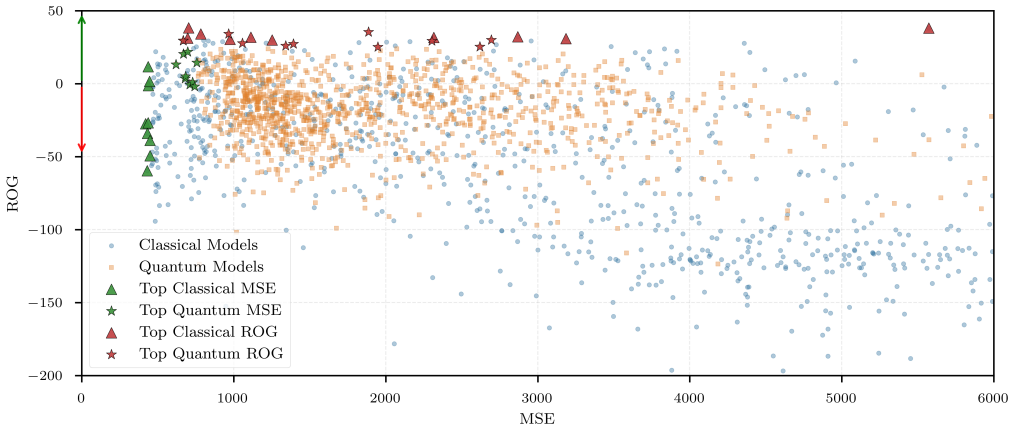
The central claim is that variational quantum circuits, when combined with particle swarm optimization, are viable reward models for offline contextual bandits in an industrial setting, and that they exhibit a generalization advantage over classical networks trained on the same data. The quantum models do not achieve lower regression error—their best test MSE is 2.066e-4 versus 1.877e-4 for the best classical model—but a much larger share of quantum configurations improves on the best grid-sampled configuration under ground-truth evaluation. The paper attributes this to better extrapolation beyond the training distribution, enabled by design choices such as parallel encoding, deeper circuit
What carries the argument
The central object is the variational quantum circuit as a regressor: an angle-encoding feature map (Pauli-X rotations with trainable scaling weights), a parameterized ansatz drawn from a hardware-efficient design or from the paired Circuit 11 and Circuit 9 designs, and a Pauli-Z expectation measurement. The circuit is trained by mean squared error on the reward data, and its output is then handed to particle swarm optimization, which searches the continuous steering space separately for each setpoint. Success is quantified by Relative Optimization Gain (ROG), the cumulative ground-truth reward improvement of the PSO-discovered configurations over the best configuration in the original grid
Load-bearing premise
The Industrial Benchmark's average reward after a fixed 100-step swing-in is a well-defined, memory-free function of the setpoint and steering variables, so the discretized grid can be regressed and the surrogate's optima correspond to realizable improvements.
What would settle it
Re-collect the dataset with a markedly longer swing-in (for example, 1000 steps) and re-run the same training and PSO pipeline; if the best configurations' ground-truth rankings change or the quantum models' positive ROG disappears, the static-snapshot collapse is the load-bearing assumption and the paper's result is an artifact of the 100-step window.
If this is right
- If the result holds, offline contextual bandits in industrial control do not require online quantum exploration; a static dataset plus a quantum surrogate can already find actions better than any recorded action.
- Quantum reward models can be competitive with feed-forward neural networks in noisy, sparse regression-to-optimization pipelines even when their pointwise prediction error is slightly worse.
- Hyperparameter design matters more than architecture class: parallel encoding, deeper circuits, and trainable output scaling determine whether a VQC generalizes past its training grid.
- The ROG metric provides a practical model-selection criterion that can disagree with MSE-based selection, favoring models that optimize well rather than merely fit well.
- Because offline contextual bandits reduce to supervised regression, any improvement in quantum regression transfers directly to offline bandit decision-making.
Where Pith is reading between the lines
- The reported gains suggest the true reward surface's optima lie between the discretized grid points; quantum models' periodic, frequency-rich encoding may be especially suited to interpolating such surfaces, a hypothesis the paper does not directly isolate.
- A natural next experiment is to vary the swing-in duration and grid resolution to measure how much of the quantum models' ROG advantage depends on the static-snapshot construction; the paper does not report this sensitivity.
- The classical baselines include sine activations, which are periodic like quantum rotations, but the paper does not compare quantum models directly against periodic-activation classical networks; such a comparison would clarify whether the advantage is quantum-specific.
- If quantum hardware matures, the same surrogate-plus-swarm loop could be augmented with a quantum search routine, as the paper mentions, though the continuous three-dimensional action space would need careful discretization.
Editorial analysis
A structured set of objections, weighed in public.
Referee Report
Summary. The paper proposes a hybrid classical-quantum pipeline for offline contextual bandits in the Industrial Benchmark (IB). The authors discretize the four-dimensional state/action space into a static regression dataset of 14,641 points, train VQC and feedforward-NN reward models over 1,152 hyperparameter configurations each, and then use particle swarm optimization (PSO) on the learned reward surrogate to propose continuous steering configurations, which are evaluated in the IB simulator. Performance is quantified by Relative Optimization Gain (ROG), a cumulative difference in ground-truth reward between PSO-discovered configurations and the best dataset configuration across 11 setpoints. The paper reports that the best quantum model reaches ROG 35.45 versus 38.37 for classical, and that a larger fraction of quantum configurations achieve ROG>0 (263/1152 vs 133/1152). It concludes that VQCs are a viable and competitive alternative for offline contextual bandit optimization in industrial settings.
Significance. If the findings are supported by appropriate statistical analysis, this is a useful proof-of-concept: it extends VQC benchmarking beyond regression accuracy to downstream optimization, uses a realistic simulator, and includes a large hyperparameter search with repeated retraining of selected configurations. The practice of grounding model selection in downstream optimization value (ROG) is a good idea; the issue is that the same metric is used as the reported outcome without selection correction. The paper is also honest about limitations such as simulation-only results and computational cost. It could be a contribution to quantum machine learning for industrial control, but the central comparative claim is currently not robustly established.
major comments (3)
- [Section V.B and VI.A] The headline ROG values (35.45 vs 38.37) are maxima over 1,152 hyperparameter configurations selected using the same ROG metric that is reported as the outcome. This two-stage selection inflates the expected best ROG even under a null hypothesis where no configuration has genuine optimization ability. No permutation null, bootstrap confidence intervals, or multiple-comparison correction is provided. The 263-vs-133 fraction, while less directly selected, still compares two samples without uncertainty. Please add (a) a null distribution for the best ROG obtained by permuting model-family labels or by drawing random hyperparameter subsets, (b) bootstrap CIs for the difference in mean/median ROG, and (c) the full distribution of ROG values rather than top-10 summaries. Without these, the central claim that quantum models are competitive with classical models is not established.
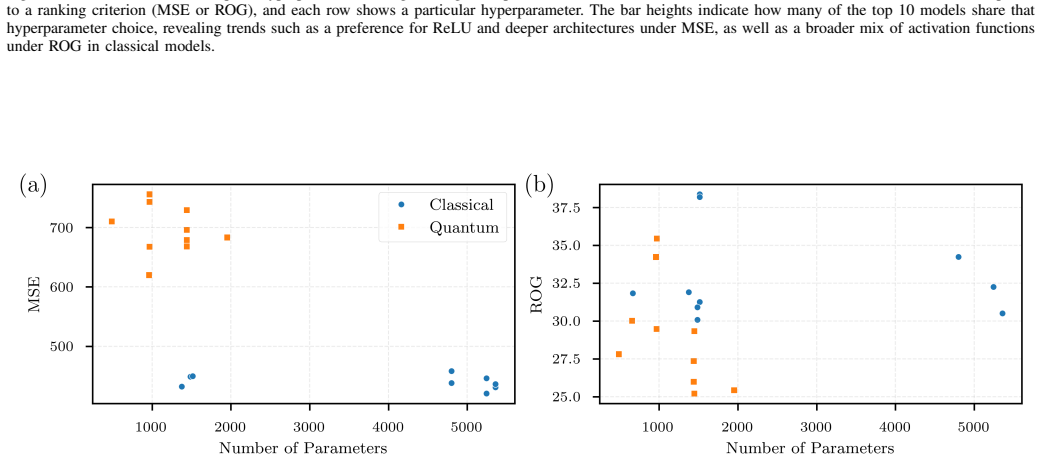
- [Section IV.B and Table I] The classical and quantum hyperparameter search spaces are not matched in several structural dimensions: layer counts (1-4 vs 20-60), presence of activation functions vs parallel encoding/output scaling, optimizer sets (Adam/SGD vs Adam), and resulting parameter counts (Table II: 4801-5359 vs 968-1448). The comparison therefore confounds model family with search-space richness and capacity. Please either match the spaces more closely (e.g., same parameter budget, same optimizer choices, classical analogues of data re-uploading) or explicitly restrict the conclusion to 'within our chosen search spaces.' The abstract and conclusion should be softened accordingly if the spaces remain unmatched.
- [Section III.A and III.D.2] The regression target is a 100-step average after a 100-step swing-in, and this static snapshot is the basis for both training and PSO. If the IB dynamics have not reached stationarity within that window, the target is contaminated by transient effects and the 'ground truth' used in ROG is not a well-defined function of (p,v,g,h). The paper provides no diagnostic supporting the swing-in length. Please add a stationarity check (e.g., compare first-half vs second-half averages, or vary the swing-in and averaging windows for a subset of grid points) or otherwise justify that the condensed mapping is stable. If the target is non-stationary, the positive ROG could reflect artifacts of the snapshot rather than genuine optimization.
minor comments (6)
- [Abstract] The abstract says models 'generalize well in noisy and sparse datasets,' but no explicit noise injection is described; clarify that noise arises from the stochastic IB dynamics and sparsity from the 11-level grid sampling.
- [Table II] The labels 'Classical (MSE)' and 'Classical (ROG)' are unclear; define in the caption that these are configurations selected by validation MSE and by ROG, respectively.
- [Figure 5] The caption states 'zoomed-in region' but the region is not clearly marked; specify how many points lie outside the displayed range and whether the fraction 263/1152 vs 133/1152 is computed on the full or zoomed set.
- [Appendix B] The text states that quantum models favor deeper circuits and parallel encoding, but no corresponding hyperparameter-frequency figure is shown for quantum models (Fig. 9 covers only classical models). Add a quantum version or explicitly state that the observation is qualitative.
- [References] Reference [15] is incomplete ('B. Metevier et al., in Advances in Neural Information Processing Systems' with no title or year); provide a full citation.
- [Reproducibility] No code or data availability statement is provided. Given the large hyperparameter search and environment-specific pipeline, a repository with the IB wrapper, circuit definitions, and evaluation scripts would strengthen reproducibility.
Circularity Check
No significant circularity: the reported ROG values are ground-truth measurements from the IB simulator, not outputs of the fitted models.
full rationale
The central ROG metric is defined in Eq. (4) as a difference of ground-truth simulator evaluations (GT_PSO(p) - GT_DB(p)), not as a function of the regression model's predictions. The trained models are used only to propose candidate configurations for PSO; the reported improvement is then measured by re-running the IB environment. Selecting the top models by ROG is a model-selection procedure that can produce optimistic point estimates, but it does not make the claim definitionally circular: the existence of configurations with positive ROG is an external empirical finding, and the 263-vs-133 comparison is computed over all 1,152 configurations without selecting on the reported metric. Self-citations (Hein et al.'s IB environment, Wiedemann et al. for future work) are background references to external, reproducible simulators or unrelated topics and are not load-bearing. No equation reduces to its own input: the regression target is the averaged IB reward, and the optimization target is the same ground-truth reward, but they are connected through an independently evaluated simulator, not by construction. The lack of confidence intervals or multiple-comparison corrections is a statistical robustness concern, not a circularity.
Axiom & Free-Parameter Ledger
free parameters (2)
- Encoding scaling weights w_dj =
learned during training
- Output scaling weight =
learned when output scaling is enabled
axioms (4)
- domain assumption The IB environment reward, after swing-in and averaging over 100 steps, is a stationary function of (p, v, g, h).
- domain assumption A regression model trained on the discretized grid can interpolate to continuous action regions where PSO searches.
- domain assumption The classical baseline architectures are representative of classical ML performance for this task.
- standard math VQCs can approximate the reward function (universal approximation).
Cite this review
Pith. "Pith review of Variational Quantum Circuits in Offline Contextual Bandit Problems." pith.science (2026). https://pith.science/paper/PKZW6JGL
@misc{pith2026250907633,
  author       = {Pith},
  title        = {Pith review of: Variational Quantum Circuits in Offline Contextual Bandit Problems},
  year         = {2026},
  howpublished = {\url{https://pith.science/paper/PKZW6JGL}},
  note         = {Machine review of arXiv:2509.07633}
}
read the original abstract
This paper explores the application of variational quantum circuits (VQCs) for solving offline contextual bandit problems in industrial optimization tasks. Using the Industrial Benchmark (IB) environment, we evaluate the performance of quantum regression models against classical models. Our findings demonstrate that quantum models can effectively fit complex reward functions, identify optimal configurations via particle swarm optimization (PSO), and generalize well in noisy and sparse datasets. These results provide a proof of concept for utilizing VQCs in offline contextual bandit problems and highlight their potential in industrial optimization tasks.
Figures




Reference graph
Works this paper leans on
-
[1]
A contextual-bandit approach to personalized news article recommendation,
L. Li, W. Chu, J. Langford, and R. E. Schapire, “A contextual-bandit approach to personalized news article recommendation,” inProceedings of the 19th Interna- tional Conference on World Wide Web, ser. WWW ’10, New York, NY , USA: Association for Computing Ma- chinery, Apr. 2010, pp. 661–670,ISBN: 978-1-60558- 799-8.DOI: 10.1145/1772690.1772758
arXiv 2010
-
[2]
The Netflix Rec- ommender System: Algorithms, Business Value, and Innovation,
C. A. Gomez-Uribe and N. Hunt, “The Netflix Rec- ommender System: Algorithms, Business Value, and Innovation,”ACM Trans. Manage. Inf. Syst., vol. 6, no. 4, 13:1–13:19, Dec. 2016,ISSN: 2158-656X.DOI: 10.1145/2843948
doi:10.1145/2843948 2016
-
[3]
Au- tomatic ad format selection via contextual bandits,
L. Tang, R. Rosales, A. Singh, and D. Agarwal, “Au- tomatic ad format selection via contextual bandits,” in Proceedings of the 22nd ACM International Conference on Information & Knowledge Management, ser. CIKM ’13, New York, NY , USA: Association for Computing Machinery, Oct. 2013, pp. 1587–1594,ISBN: 978-1- 4503-2263-8.DOI: 10.1145/2505515.2514700
-
[4]
Online decision mak- ing with high-dimensional covariates,
H. Bastani and M. Bayati, “Online decision mak- ing with high-dimensional covariates,”Operations Re- search, vol. 68, no. 1, pp. 276–294, 2020.DOI: 10.1287/ opre.2019.1902 Fig. 9. Overview of the most frequent hyperparameter settings among the top 10classicalmodels for each metric (MSE and ROG). Each column corresponds to a ranking criterion (MSE or ROG),...
arXiv 2020
-
[5]
Doubly robust policy evaluation and learning,
M. Dud ´ık, J. Langford, and L. Li, “Doubly robust policy evaluation and learning,” inProceedings of the 28th International Conference on International Conference on Machine Learning, ser. ICML’11, Madison, WI, USA: Omnipress, Jun. 2011, pp. 1097–1104,ISBN: 978- 1-4503-0619-5
work page 2011
-
[6]
Pessimistic Reward Mod- els for Off-Policy Learning in Recommendation,
O. Jeunen and B. Goethals, “Pessimistic Reward Mod- els for Off-Policy Learning in Recommendation,” in Proceedings of the 15th ACM Conference on Recom- mender Systems, ser. RecSys ’21, New York, NY , USA: Association for Computing Machinery, Sep. 2021, pp. 63–74,ISBN: 978-1-4503-8458-2.DOI: 10 . 1145 / 3460231.3474247
arXiv 2021
-
[7]
K. Mitarai, M. Negoro, M. Kitagawa, and K. Fujii, “Quantum circuit learning,”Phys. Rev. A, vol. 98, p. 032 309, 3 Sep. 2018.DOI: 10.1103/PhysRevA.98. 032309
-
[9]
Variational quantum circuits for deep reinforcement learning,
S. Y .-C. Chen, C.-H. H. Yang, J. Qi, P.-Y . Chen, X. Ma, and H.-S. Goan, “Variational quantum circuits for deep reinforcement learning,”IEEE Access, vol. 8, 2020. DOI: 10.1109/ACCESS.2020.3010470
-
[10]
Quantum agents in the Gym: A variational quantum algorithm for deep Q-learning,
A. Skolik, S. Jerbi, and V . Dunjko, “Quantum agents in the Gym: A variational quantum algorithm for deep Q-learning,”Quantum, vol. 6, May 2022
work page 2022
-
[11]
Quantum embeddings for machine learning,
S. Lloyd, M. Schuld, A. Ijaz, J. Izaac, and N. Killoran, “Quantum embeddings for machine learning,”arXiv preprint, Jan. 2020.DOI: 10.48550/arXiv.2001.03622
-
[12]
Effect of data encoding on the expressive power of variational quantum-machine-learning models,
M. Schuld, R. Sweke, and J. J. Meyer, “Effect of data encoding on the expressive power of variational quantum-machine-learning models,”Physical Review A, vol. 103, no. 3, p. 032 430, Mar. 2021.DOI: 10.1103/ PhysRevA.103.032430
work page 2021
-
[13]
Universal approximation of continuous functions with minimal quantum circuits,
A. P ´erez-Salinas, M. Y . Rad, A. Barthe, and V . Dunjko, “Universal approximation of continuous functions with minimal quantum circuits,”arXiv preprint, Nov. 2024. DOI: 10.48550/arXiv.2411.19152
-
[14]
Practical contextual bandits with regression oracles,
D. Foster, A. Agarwal, M. Dudik, H. Luo, and R. Schapire, “Practical contextual bandits with regression oracles,” inProceedings of the 35th International Con- ference on Machine Learning, ser. Proceedings of Ma- chine Learning Research, vol. 80, PMLR, Jul. 2018, pp. 1539–1548
work page 2018
-
[15]
Metevier et al., inAdvances in Neural Information Processing Systems
B. Metevier et al., inAdvances in Neural Information Processing Systems
-
[16]
D. Simchi-Levi and Y . Xu, “Bypassing the monster: A faster and simpler optimal algorithm for contextual bandits under realizability,”Math. Oper. Res., vol. 47, no. 3, 1904–1931, Aug. 2022,ISSN: 0364-765X.DOI: 10.1287/moor.2021.1193
arXiv 1904
-
[17]
Offline contextual bandits with overparameter- ized models,
D. Brandfonbrener, W. Whitney, R. Ranganath, and J. Bruna, “Offline contextual bandits with overparameter- ized models,” inInternational Conference on Machine Learning, PMLR, 2021, pp. 1049–1058
work page 2021
-
[18]
Offline neural contextual bandits: Pes- simism, optimization and generalization,
T. Nguyen-Tang, S. Gupta, A. T. Nguyen, and S. Venkatesh, “Offline neural contextual bandits: Pes- simism, optimization and generalization,” inInterna- tional Conference on Learning Representations, 2022
work page 2022
-
[19]
Expressive power of parametrized quantum circuits,
Y . Du, M.-H. Hsieh, T. Liu, and D. Tao, “Expressive power of parametrized quantum circuits,”Phys. Rev. Res., vol. 2, p. 033 125, 3 Jul. 2020.DOI: 10 . 1103 / PhysRevResearch.2.033125
work page 2020
-
[20]
Training a quantum neural network to solve the contextual multi-armed bandit problem,
W. Hu and J. Hu, “Training a quantum neural network to solve the contextual multi-armed bandit problem,” Natural Science, vol. 11, pp. 17–27, 2019.DOI: 10 . 4236/ns.2019.111003
-
[21]
J. Lumbreras, E. Haapasalo, and M. Tomamichel, “Multi-armed quantum bandits: Exploration versus ex- ploitation when learning properties of quantum states,” Quantum, vol. 6, p. 749, 2022,ISSN: 2521-327X.DOI: 10.22331/q-2022-06-29-749
-
[22]
B. Casal ´e, G. Di Molfetta, H. Kadri, and L. Ralaivola, “Quantum Bandits,”Quantum Machine Intelligence, vol. 2, no. 1, Jun. 2020
work page 2020
-
[23]
Quantum exploration algorithms for multi-armed bandits,
D. Wang, X. You, T. Li, and A. M. Childs, “Quantum exploration algorithms for multi-armed bandits,”Pro- ceedings of the AAAI Conference on Artificial Intelli- gence, vol. 35, no. 11, pp. 10 102–10 110, May 2021. DOI: 10.1609/aaai.v35i11.17212
-
[24]
Quantum contextual bandits and recommender sys- tems for quantum data,
S. Brahmachari, J. Lumbreras, and M. Tomamichel, “Quantum contextual bandits and recommender sys- tems for quantum data,”Quantum Machine Intelligence, vol. 6, no. 2, p. 58, Sep. 2024,ISSN: 2524-4914.DOI: 10.1007/s42484-024-00189-6
-
[25]
A benchmark environment motivated by industrial control problems,
D. Hein et al., “A benchmark environment motivated by industrial control problems,” in2017 IEEE Sympo- sium Series on Computational Intelligence (SSCI), Nov. 2017, pp. 1–8.DOI: 10.1109/SSCI.2017.8280935
-
[26]
M. Schuld and F. Petruccione,Machine Learning with Quantum Computers(Quantum Science and Technol- ogy). Cham: Springer International Publishing, 2021, ISBN: 978-3-030-83097-7.DOI: 10.1007/978- 3- 030- 83098-4
doi:10.1007/978- 2021
-
[27]
Struc- ture optimization for parameterized quantum circuits,
M. Ostaszewski, E. Grant, and M. Benedetti, “Struc- ture optimization for parameterized quantum circuits,” Quantum, vol. 5, p. 391, Jan. 2021.DOI: 10.22331/q- 2021-01-28-391
doi:10.22331/q- 2021
-
[28]
Data re-uploading for a universal quantum classifier,
A. P ´erez-Salinas, A. Cervera-Lierta, E. Gil-Fuster, and J. I. Latorre, “Data re-uploading for a universal quantum classifier,”Quantum, vol. 4, p. 226, Feb. 2020.DOI: 10.22331/q-2020-02-06-226
-
[29]
Quantum support vector machine for big data classification,
P. Rebentrost, M. Mohseni, and S. Lloyd, “Quantum support vector machine for big data classification,” Physical Review Letters, vol. 113, no. 13, p. 130 503, Sep. 2014.DOI: 10.1103/PhysRevLett.113.130503
-
[30]
Parametrized quantum policies for rein- forcement learning,
S. Jerbi, C. Gyurik, S. C. Marshall, H. J. Briegel, and V . Dunjko, “Parametrized quantum policies for rein- forcement learning,” inAdvances in Neural Information Processing Systems, 2021
work page 2021
-
[31]
Hardware-efficient variational quan- tum eigensolver for small molecules and quantum mag- nets,
A. Kandala et al., “Hardware-efficient variational quan- tum eigensolver for small molecules and quantum mag- nets,”Nature, no. 549, pp. 242–246, 2017.DOI: 10 . 1038/nature23879
work page 2017
-
[32]
S. Sim, P. D. Johnson, and A. Aspuru-Guzik, “Express- ibility and entangling capability of parameterized quan- tum circuits for hybrid quantum-classical algorithms,” Advanced Quantum Technologies, vol. 2, no. 12, Dec. 2019
work page 2019
-
[33]
Benchmarking quantum surrogate mod- els on scarce and noisy data,
J. Stein et al., “Benchmarking quantum surrogate mod- els on scarce and noisy data,” inProceedings of the 16th International Conference on Agents and Artificial Intelligence, 2024
work page 2024
-
[34]
TensorFlow Quantum: A soft- ware framework for quantum machine learning,
M. Broughton et al., “TensorFlow Quantum: A soft- ware framework for quantum machine learning,”arXiv preprint, Aug. 2021.DOI: 10.48550/arXiv.2003.02989
-
[35]
Implicit neural represen- tations with periodic activation functions,
V . Sitzmann, J. N. Martel, A. W. Bergman, D. B. Lindell, and G. Wetzstein, “Implicit neural represen- tations with periodic activation functions,” inAdvances in Neural Information Processing Systems, 2020
work page 2020
-
[36]
M. Abadi et al.,TensorFlow: Large-scale machine learning on heterogeneous systems, Software available from tensorflow.org, 2015
work page 2015
-
[37]
Chollet et al.,Keras, https://keras.io, 2015
F. Chollet et al.,Keras, https://keras.io, 2015
work page 2015
-
[38]
PennyLane: Automatic differenti- ation of hybrid quantum-classical computations,
V . Bergholm et al., “PennyLane: Automatic differenti- ation of hybrid quantum-classical computations,”arXiv preprint, 2018.DOI: 10.48550/arXiv.1811.04968
-
[39]
Nevergrad: Black-box optimization platform,
P. Bennet, C. Doerr, A. Moreau, J. Rapin, F. Teytaud, and O. Teytaud, “Nevergrad: Black-box optimization platform,”SIGEVOlution, vol. 14, no. 1, pp. 8–15, Apr. 2021.DOI: 10.1145/3460310.3460312
-
[40]
Grover’s Quantum Algorithm Applied to Global Op- timization,
W. P. Baritompa, D. W. Bulger, and G. R. Wood, “Grover’s Quantum Algorithm Applied to Global Op- timization,”SIAM Journal on Optimization, vol. 15, no. 4, pp. 1170–1184, Jan. 2005,ISSN: 1052-6234.DOI: 10.1137/040605072
-
[41]
S. Wiedemann, D. Hein, S. Udluft, and C. B. Mendl, “Quantum policy iteration via amplitude estimation and Grover search – towards quantum advantage for rein- forcement learning,”Transactions on Machine Learning Research, 2023, https : / / openreview . net / forum ? id = HG11PAmwQ6,ISSN: 2835-8856
work page 2023
-
[42]
Quantum error correction below the surface code threshold,
R. Acharya et al., “Quantum error correction below the surface code threshold,”Nature, pp. 1–3, Dec. 2024, ISSN: 1476-4687.DOI: 10.1038/s41586-024-08449-y
-
[43]
Interferometric single-shot par- ity measurement in InAs–Al hybrid devices,
M. Aghaee et al., “Interferometric single-shot par- ity measurement in InAs–Al hybrid devices,”Nature, vol. 638, no. 8051, pp. 651–655, Feb. 2025,ISSN: 1476- 4687.DOI: 10.1038/s41586-024-08445-2
-
[44]
Roadmap to fault tolerant quan- tum computation using topological qubit arrays,
D. Aasen et al., “Roadmap to fault tolerant quan- tum computation using topological qubit arrays,”arXiv preprint, Feb. 2025.DOI: 10.48550/arXiv.2502.12252
This paper was first reviewed by deepseek-v4-flash on August 4, 2026.
discussion (0)
Sign in with ORCID, Apple, or X to comment. Anyone can read and Pith papers without signing in.