REVIEW 4 major objections 5 minor 16 cited by
The paper argues that GW231123 is best explained as a 2G+2G hierarchical merger — both observed black holes being remnants of earlier mergers — not as a 2G+1G or 3G+2G event.
Reviewed by Pith at T0; open to challenge. T0 means a machine referee read the full paper against a public rubric. the ladder, T0–T4 →
GW231123 is claimed to be a 2G+2G hierarchical merger, but only under the NRSur7dq4 waveform; the conclusion flips with IMRPhenomXO4a.
T0 review reviewed 2026-08-04 challenge →
load-bearing objection The 2G+2G claim for GW231123 reverses under the paper's own alternative waveform; read this as a useful sensitivity study, not a settled origin. the 4 major comments →
The Hierarchical Merger Scenario for GW231123
The pith
A machine-rendered reading of the paper's core claim, the machinery that carries it, and where it could break.
The reading
Core claim
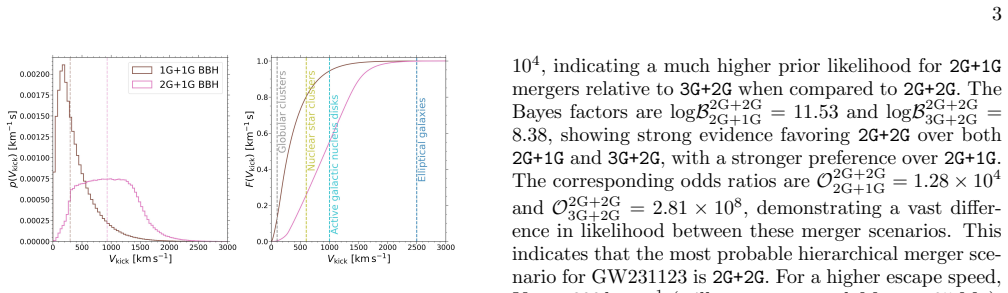
On the paper's own terms, assuming GW231123 is hierarchical, the 2G+2G hypothesis is strongly preferred over 2G+1G and 3G+2G. With the NRSur7dq4 posterior, escape speed 100 km/s, and a 1G maximum mass of 85 solar masses, the odds ratios are 1.28×10^4 versus 2G+1G and 2.81×10^8 versus 3G+2G. The primary is then a remnant of ~75+66 solar-mass progenitors, and the secondary of ~64+59 solar-mass progenitors, with remnant spins peaking near 0.69. The paper stresses that this depends on an informed 0.7-peaked spin prior and on the waveform: with IMRPhenomXO4a the 2G+2G versus 2G+1G odds fall to 0.03, favoring 2G+1G.
What carries the argument
The central tool is the Bayesian odds ratio O_i^j = (p(d|H_i)/p(d|H_j))×(p(H_i)/p(H_j)), comparing the three hypotheses 2G+1G, 2G+2G, and 3G+2G. The evidence terms are built from generation-specific priors synthesized by a parametric population model that starts from the inferred 1G mass/spin distribution and adds a retention condition: a merger remnant participates in the next merger only if its kick velocity stays below the host escape speed. The prior odds are set proportional to the retention probabilities of the required earlier mergers. The GW231123 posterior from NRSur7dq4 provides the data term, and the mass-dependent overlap between that posterior and the mass distributions of 1G, 2
Load-bearing premise
The 2G+2G conclusion rests on the assumption that the NRSur7dq4 posterior for GW231123 is the correct one; the paper's own comparison shows that with the IMRPhenomXO4a waveform the 2G+2G hypothesis becomes only 3% as probable as 2G+1G.
What would settle it
A re-analysis of GW231123 with a waveform model validated for asymmetric, precessing, high-mass binaries, or with an additional detector's data, would settle the central claim by fixing the secondary mass: if the secondary is near 111 solar masses the 2G+2G scenario wins, while a secondary near 55 solar masses makes 2G+1G win (odds 0.03).
If this is right
- If GW231123 is a 2G+2G event, ordinary hierarchical assembly in a low-escape-speed environment can place black holes in the pair-instability gap without invoking unusual stellar collapse physics.
- The four inferred first-generation progenitors have masses consistent with standard stellar-collapse black holes, so an apparent upper-mass-gap event does not by itself require new formation physics.
- The post-merger spins cluster near 0.69, which means parameter estimation for repeated-merger candidates should use an informed spin prior peaked near 0.7 instead of a uniform prior.
- Waveform choice is decisive: replacing NRSur7dq4 with IMRPhenomXO4a changes the odds ratio for 2G+2G versus 2G+1G by six orders of magnitude and reverses the favored channel.
- Higher escape speeds (300 km/s) weaken the preference for 2G+2G over 2G+1G but do not overturn it, while a lower 1G maximum mass strengthens the 2G+2G case.
Where Pith is reading between the lines
- Inference: A decisive next step would be to rerun this comparison with a waveform model that is validated for asymmetric, precessing, high-mass systems; the discriminating observable is the secondary-mass posterior, since it moves from ~111 to ~55 solar masses between the two waveform models.
- Inference: If high-generation black holes really spin near 0.7, a population-wide reanalysis of massive high-spin events with the informed prior could reclassify some previously reported events as hierarchical, a consequence the paper does not work out.
- Inference: The reversal under IMRPhenomXO4a could also mean the true arrangement is not among the three channels tested; a 3G+1G or 4G+2G scenario might accommodate the asymmetric mass posterior that makes 2G+1G look better.
Editorial analysis
A structured set of objections, weighed in public.
Referee Report
Summary. The paper analyzes the very massive, high-spin gravitational-wave event GW231123 under the hypothesis of hierarchical black-hole mergers. It compares three formation scenarios—2G+1G, 2G+2G, and 3G+2G—by computing prior odds from retention probabilities and Bayes factors from population-level mass/spin priors, using the published LVK posterior distributions obtained with the NRSur7dq4 and IMRPhenomXO4a waveform models. Under NRSur7dq4 with V_esc = 100 km/s and M_max = 85 M_sun, the authors report odds of ~1.28e4 and ~2.8e8 favoring 2G+2G over 2G+1G and 3G+2G, and they infer a progenitor scenario with four 1G BHs. They also report that using IMRPhenomXO4a reverses the 2G+2G versus 2G+1G comparison (odds 0.03) and that the post-merger spin values are dominated by the assumed spin prior. The paper is transparent about these caveats, but the abstract and conclusions present the NRSur7dq4-based odds as the primary result.
Significance. If the central claim were robust, the paper would provide a concrete, testable progenitor scenario for GW231123 and strengthen the case that hierarchical mergers are observable in current LIGO-Virgo-KAGRA data. The methodology is clearly formulated, the paper makes use of publicly available LVK posterior samples, and the authors are commendably explicit about the waveform-model reversal and the prior-dominated nature of the inferred post-merger spins. However, the headline odds ratio of >O(10^3) is conditional on a single waveform model, and the paper does not supply a physical or statistical reason to prefer NRSur7dq4 over IMRPhenomXO4a for this unusually massive event. The evidentiary integral in Eq. (2) is also not connected to a concrete numerical scheme. These issues affect the load-bearing claim and therefore need to be addressed before the result can be considered robust.
major comments (4)
- [Abstract; §III A, Table I] The abstract's claim that 'odds ratios of >O(10^3)' favor the 2G+2G scenario is contradicted by the paper's own Table I: for IMRPhenomXO4a, log B_{2G+1G}^{2G+2G} = -1.48 and O_{2G+1G}^{2G+2G} = 0.03, i.e., the 2G+1G scenario is preferred. The text notes this reversal but does not justify why NRSur7dq4 should be trusted over IMRPhenomXO4a for this event. Because the conclusion reverses under an alternative waveform model used in the LVK analysis, the paper must either (i) provide a quantitative justification for preferring NRSur7dq4 (e.g., a waveform-model Bayes factor, goodness-of-fit comparison, or evidence that IMRPhenomXO4a is inadequate for such high masses) or (ii) reframe the abstract and conclusions as a conditional statement. A caveat in the text is not sufficient while the unqualified odds statement remains in the abstract.
- [§II B, Eq. (2)] The evidence p(d|H_i) is defined as an eight-dimensional integral over masses and spins, but the manuscript never states how this integral is evaluated numerically. The Bayes factors in Table I are the central quantitative result, and they depend on both the prior volume and the normalization of the likelihood over the integration domain. The authors should specify the estimator used (e.g., importance sampling, nested sampling, harmonic mean), how the LVK posterior samples are reweighted to compute p(d|H_i), the integration bounds, and convergence checks. Without this, the numbers in Table I are not reproducible and the model comparison cannot be independently verified.
- [§III B, Fig. 3] The paper states that the post-merger spin distributions of ~0.69 are 'dominated by the prior' and 'reflect the effect of the spin prior that clusters around 0.7.' This is an explicit admission that the quoted spin values are not data-driven measurements. Presenting these values as results in the text and in Fig. 3 without a clear separation between 'prior input' and 'posterior output' is misleading, especially because the abstract uses high spins as motivation. The authors should clearly mark these as prior-driven predictions and, ideally, quantify the information gain from the data or remove them from the set of inferred quantities.
- [§II B, after Eq. (3)] The dismissal of the 'primary=1G, secondary=2G' case is argued by saying that when the mass difference is 'relatively large' the probability can be ignored. This is not a valid criterion in general. The actual reason is that the primary-mass posterior from both waveform models lies above the assumed maximum 1G BH mass of 85 M_sun, so a 1G primary is excluded by construction. The paper should replace the hand-waving statement with this explicit argument and note that the exclusion depends on the chosen M_max value.
minor comments (5)
- [§IV, item (1)] The conclusion quotes log Bayes factor 8.35 for 2G+2G versus 3G+2G, but Table I gives 8.38. Please correct the inconsistency.
- [Eq. (1) and surrounding text] The dataset is denoted 'd^1' in one place and 'd' elsewhere. Use a single symbol, e.g., 'd', and remove the superscript.
- [Footnote 1] The Zenodo link is given without a description. Please state whether it contains the LVK posterior samples, the analysis code, or both, and provide a version/DOI reference.
- [Table I, IMRPhenomXO4a row] The '/' for the 3G+2G comparison is explained as computational cost, but the paper should state whether the 3G+2G evidence was not computed or whether an upper/lower bound was used. This affects the interpretation of the row.
- [Fig. 1 caption] The caption mentions a maximum 1G BH mass of ~85 M_sun, but Section III A also tests M_max = 65 M_sun. Consider adding the 65 M_sun truncation to the figure or explaining why only 85 M_sun is shown.
Circularity Check
One secondary result—post-merger spins near 0.7—is explicitly prior-dominated; the central 2G+2G vs 2G+1G comparison is an independent Bayesian calculation, not a circular reduction.
specific steps
-
self definitional
[Section III B (Progenitors of GW231123), after Figure 3]
"The two progenitor mergers of GW231123 both show post-merger spin distributions sharply peaked near χ∼0.7, with 0.69+0.04−0.05 and 0.69+0.04−0.04, reflecting the effect of the spin prior that clusters around 0.7 [10]."
The 2G population prior used in the analysis (Appendix A and Figure 1) is constructed so that high-generation BH spin distributions peak near χ~0.7–0.9. The posterior for the post-merger (2G) remnant spin is then dominated by this prior because the GW data constrain only the final binary spins of GW231123, not the spins of the hypothetical 2G remnants. The paper's own conclusion (3) states these spins are 'dominated by the prior.' Thus the claimed peak at 0.69 is a direct restatement of the assumed spin prior, not an inference from the data.
full rationale
The only clear circular step is the spin result in Section III B: the post-merger spins of ~0.7 are explicitly attributed to the spin prior that clusters at that value, making that particular 'prediction' equivalent to an input assumption by the paper's own admission. This is a supporting result, not the central claim. The central claim—that GW231123 is a 2G+2G merger with odds >10^3 over 2G+1G—is obtained by a hierarchical Bayesian evidence computation: the likelihood from the NRSur7dq4 posterior is integrated against hypothesis-specific priors synthesized from the GWTC-3 1G population and a kick/remnant model. That is an independent calculation, not a reduction to a fitted parameter or a self-citation theorem. The authors do cite their own earlier population models (refs. [37,38]) for the 2G/3G priors, but those are physical models with stated assumptions, not an unverified uniqueness claim, and the odds are not a pure restatement of the priors. The dramatic reversal under IMRPhenomXO4a is a robustness/correctness issue—the paper itself reports it—but it is not circularity, because the waveform choice is an external input, not something derived from the hypotheses being compared. On balance, the paper has one self-definitional supporting result while the central model comparison retains independent content, so the circularity score is 4.
Axiom & Free-Parameter Ledger
free parameters (3)
- escape speed V_esc =
100, 300 km/s (chosen)
- maximum 1G BH mass M_max =
85, 65 M_sun (chosen)
- hierarchical remnant spin prior peak =
chi ~ 0.7
axioms (7)
- standard math Bayes theorem and marginal likelihood computation
- domain assumption GW231123 is a hierarchical merger
- domain assumption 2G/3G population model from Li et al. (2023) and Li & Fan (2025) is faithful
- ad hoc to paper Prior probability of each hypothesis is proportional to retention probability
- domain assumption Delay times between subsequent mergers are negligible
- ad hoc to paper The 1G+2G case with primary=1G, secondary=2G can be ignored
- domain assumption GWTC-3 1G population with Mmax truncation
Cite this review
Pith. "Pith review of The Hierarchical Merger Scenario for GW231123." pith.science (2026). https://pith.science/paper/7CARB4CO
@misc{pith2026250908298,
  author       = {Pith},
  title        = {Pith review of: The Hierarchical Merger Scenario for GW231123},
  year         = {2026},
  howpublished = {\url{https://pith.science/paper/7CARB4CO}},
  note         = {Machine review of arXiv:2509.08298}
}
read the original abstract
GW231123 exhibits exceedingly massive components and high spins, which challenges the formation of first-generation (1G) black holes from stellar collapse and implies that this event might originate from hierarchical mergers. Here we show that the \texttt{2G+2G} merger scenario for GW231123 is favored over a \texttt{2G+1G} (or \texttt{3G+2G}) merger, with odds ratios of $>$$\mathcal{O}(10^3)$. The primary (secondary) black hole is consistent with merging binary black holes with masses of $75^{+7}_{-7}\,M_\odot$ and $66^{+4}_{-10}\,M_\odot$ ($64^{+8}_{-10}\,M_\odot$ and $59^{+7}_{-9}\,M_\odot$; 90\% credible intervals), respectively. Our results reveal that the treatment of spin priors from the population level and waveform model choice are decisive in interpreting potential hierarchical gravitational-wave signals.
Figures


Forward citations
Cited by 16 Pith papers
-
Highly eccentric non-spinning binary black hole mergers: quadrupolar post-merger waveforms
Polynomial models for the (2,2) post-merger waveform amplitudes of eccentric non-spinning binary black holes are constructed from numerical-relativity data as functions of symmetric mass ratio and two merger-time dyna...
-
Short Gravitational-Wave Transients as Probes of Cosmic Domain Walls
Two LIGO transients are consistent with domain wall signals from a shared scalar field but binary black hole models remain favored, with a morphological degeneracy identified.
-
Across the Universe: GW231123 as a magnified and diffracted black hole merger
GW231123's extreme mass and spins may be explained by a point-mass microlens embedded in a galaxy, reducing the inferred source mass to about 100-180 solar masses.
-
A new group of low-spin $50-70M_\odot$ Black Holes and the high pair-instability mass cutoff
GWTC-4.0 data shows low-spin black holes up to 70 solar masses, moving the low-spin cutoff to 68.5 solar masses and favoring a high pair-instability mass gap.
-
A new group of low-spin $50-70M_\odot$ Black Holes and the high pair-instability mass cutoff
GWTC-4.0 reveals low-spin black holes up to ~68.5 Msun, implying a higher pair-instability mass cutoff and a lower 12C(alpha,gamma)16O rate.
-
Black Hole Binary Detection Landscape for the Laser Interferometer Lunar Antenna (LILA): Signal-to-Noise Calculations & Science Cases
LILA can detect IMBH binaries at redshifts 20-30, IMRIs, and provide months-to-years early warnings with high-SNR events for gravity tests.
-
How do the LIGO-Virgo-KAGRA's Heavy Black Holes Form? No evidence for core-collapse Intermediate-mass black holes in GWTC-4
No evidence for core-collapse formed low-spin IMBHs in GWTC-4, with 90% upper limit on merger rate of 0.077 Gpc^{-3} yr^{-1}, low-spin BH mass truncation at 65 solar masses consistent with pair-instability gap lower e...
-
How do the LIGO-Virgo-KAGRA's Heavy Black Holes Form? No evidence for core-collapse Intermediate-mass black holes in GWTC-4
No evidence for core-collapse IMBHs in GWTC-4; heavy BHs from hierarchical mergers, with low-spin mass distribution truncating at ~65 solar masses and PIMG upper edge estimated at 150 solar masses.
-
Ringdown Analysis of GW250114 with Orthonormal Modes
Orthonormal QNM analysis of GW250114 raises the significance of the first overtone of the ℓ=m=2 mode from 82.5% to 99.9% and detects no significant deviation from Kerr predictions.
-
Measuring Eccentricity and Addressing Waveform Systematics in GW231123
Reanalysis of GW231123 shows no significant eccentricity, with parameter estimate differences explained by waveform model disagreements at strong spin precession.
-
GW231123: Overlapping Gravitational Wave Signals?
GW231123 data favors an overlapping two-signal model over a single merger with Bayes factors of 100-10000, mitigating waveform-dependent discrepancies and suggesting possible gravitational lensing.
-
Searching for Electromagnetic Counterpart Candidates to GW231123
A crossmatch of GW231123's localization with ZTF AGN-flare catalogs yields six unconfirmed optical flare candidates, with association claims driven largely by the event's high primary mass.
-
Exploring Hierarchical Merger Scenarios for GW241011 and GW241110
GW241011 and GW241110 favor 2G+1G hierarchical-merger models over a fiducial 1G+1G population, with mild AGN-disk preference and one weak optical flare candidate.
-
Polarization Birefringence and Waveform Systematics in GW231123
Analysis of GW231123 with IMRPhenomXPHM, IMRPhenomXO4a and NRSur7dq4 yields no waveform-independent evidence for polarization birefringence, with 90% upper limits on the derived coefficient of 0.378, 0.097 and 0.273 r...
-
Remnant recoil and host environments of GWTC-4.0 binary black-hole mergers
Five O4 gravitational-wave events prefer dynamical cluster formation; typical recoil kicks eject remnants from globular clusters but allow possible retention in nuclear star clusters, disfavoring efficient hierarchica...
-
Considering lensing effect on gravitational wave signals from black holes in mass gap
Gravitational lensing could in principle explain apparent mass-gap black-hole mergers, but the required magnifications are μ≈12–39 for GW190521 and μ≈320–444 for GW231123 depending on assumptions—and the paper's abstr...
Reference graph
Works this paper leans on
-
[1]
The LIGO Scientific Collaboration, the Virgo Col- laboration, the KAGRA Collaboration, A. G. Abac, I. Abouelfettouh, F. Acernese, K. Ackley, C. Adam- cewicz, S. Adhicary, D. Adhikari, N. Adhikari, R. X. Ad- hikari, V. K. Adkins, S. Afroz, A. Agapito, D. Agarwal, M. Agathos, N. Aggarwal, S. Aggarwal, O. D. Aguiar, I. L. Ahrend, L. Aiello, A. Ain, P. Ajith,...
Pith/arXiv arXiv 2025
- [2]
-
[3]
M. Mapelli, Formation Channels of Single and Binary Stellar-Mass Black Holes, inHandbook of Gravitational Wave Astronomy(2021) p. 16
work page 2021
-
[4]
I. Mandel and A. Farmer, Merging stellar-mass binary black holes, Phys. Rep.955, 1 (2022), arXiv:1806.05820 [astro-ph.HE]
Pith/arXiv arXiv 2022
-
[5]
Y.-J. Li, Y.-Z. Wang, S.-P. Tang, and Y.-Z. Fan, Re- solving the Stellar-Collapse and Hierarchical-Merger Ori- gins of the Coalescing Black Holes, Phys. Rev. Lett.133, 051401 (2024), arXiv:2303.02973 [astro-ph.HE]
Pith/arXiv arXiv 2024
-
[6]
F. Antonini, I. M. Romero-Shaw, and T. Callister, Star Cluster Population of High Mass Black Hole Mergers in Gravitational Wave Data, Phys. Rev. Lett.134, 011401 (2025), arXiv:2406.19044 [astro-ph.HE]
Pith/arXiv arXiv 2025
-
[7]
R. M. O’Leary, Y. Meiron, and B. Kocsis, Dynamical Formation Signatures of Black Hole Binaries in the First Detected Mergers by LIGO, Astrophys. J. Lett824, L12 (2016), arXiv:1602.02809 [astro-ph.HE]
work page internal anchor Pith review Pith/arXiv arXiv 2016
-
[8]
D. Gerosa and E. Berti, Are merging black holes born from stellar collapse or previous mergers?, Phys. Rev. D 95, 124046 (2017), arXiv:1703.06223 [gr-qc]
Pith/arXiv arXiv 2017
-
[9]
M. Fishbach, D. E. Holz, and B. Farr, Are LIGO’s Black Holes Made from Smaller Black Holes?, Astrophys. J. Lett840, L24 (2017), arXiv:1703.06869 [astro-ph.HE]
Pith/arXiv arXiv 2017
-
[10]
D. Gerosa and M. Fishbach, Hierarchical mergers of stellar-mass black holes and their gravitational- wave signatures, Nature Astronomy5, 749 (2021), arXiv:2105.03439 [astro-ph.HE]
Pith/arXiv arXiv 2021
-
[11]
M. Arca Sedda, S. Naoz, and B. Kocsis, Quiescent and Active Galactic Nuclei as Factories of Merging Compact Objects in the Era of Gravitational Wave Astronomy, Universe9, 138 (2023), arXiv:2302.14071 [astro-ph.GA]
Pith/arXiv arXiv 2023
-
[12]
F. Antonini and M. Gieles, Merger rate of black hole binaries from globular clusters: Theoretical error bars and comparison to gravitational wave data from GWTC- 2, Phys. Rev. D102, 123016 (2020), arXiv:2009.01861 [astro-ph.HE]
Pith/arXiv arXiv 2020
-
[13]
C. L. Rodriguez, M. Zevin, P. Amaro-Seoane, S. Chat- terjee, K. Kremer, F. A. Rasio, and C. S. Ye, Black holes: The next generation—repeated mergers in dense star clusters and their gravitational-wave properties, Phys. Rev. D100, 043027 (2019), arXiv:1906.10260 [astro- ph.HE]
Pith/arXiv arXiv 2019
-
[14]
M. Mapelli, M. Dall’Amico, Y. Bouffanais, N. Giacobbo, M. Arca Sedda, M. C. Artale, A. Ballone, U. N. Di Carlo, G. Iorio, F. Santoliquido, and S. Torniamenti, Hierarchi- cal black hole mergers in young, globular and nuclear star clusters: the effect of metallicity, spin and cluster properties, Mon. Not. R. Astron. Soc.505, 339 (2021), arXiv:2103.05016 [as...
Pith/arXiv arXiv 2021
-
[15]
C. Kimball, C. Talbot, C. P. L. Berry, M. Zevin, 7 E. Thrane, V. Kalogera, R. Buscicchio, M. Car- ney, T. Dent, H. Middleton, E. Payne, J. Veitch, and D. Williams, Evidence for Hierarchical Black Hole Mergers in the Second LIGO-Virgo Gravitational Wave Catalog, Astrophys. J. Lett915, L35 (2021), arXiv:2011.05332 [astro-ph.HE]
Pith/arXiv arXiv 2021
-
[16]
Li, Constraining hierarchical mergers of binary black holes detectable with LIGO-Virgo, Astron
G.-P. Li, Constraining hierarchical mergers of binary black holes detectable with LIGO-Virgo, Astron. Astro- phys666, A194 (2022), arXiv:2208.11894 [astro-ph.HE]
Pith/arXiv arXiv 2022
-
[17]
M. Arca Sedda, M. Mapelli, M. Benacquista, and M. Spera, Isolated and dynamical black hole mergers with B-POP: the role of star formation and dynamics, star cluster evolution, natal kicks, mass and spins, and hi- erarchical mergers, Mon. Not. R. Astron. Soc.520, 5259 (2023), arXiv:2109.12119 [astro-ph.GA]
Pith/arXiv arXiv 2023
- [18]
-
[19]
S. E. Woosley, S. Blinnikov, and A. Heger, Pulsational pair instability as an explanation for the most lumi- nous supernovae, Nature (London)450, 390 (2007), arXiv:0710.3314 [astro-ph]
Pith/arXiv arXiv 2007
-
[20]
K. Belczynski, A. Heger, W. Gladysz, A. J. Ruiter, S. Woosley, G. Wiktorowicz, H. Y. Chen, T. Bu- lik, R. O’Shaughnessy, D. E. Holz, C. L. Fryer, and E. Berti, The effect of pair-instability mass loss on black-hole mergers, Astron. Astrophys594, A97 (2016), arXiv:1607.03116 [astro-ph.HE]
Pith/arXiv arXiv 2016
-
[21]
I. Maga˜ na Hernandez and A. Palmese, Astrophysics in- formed Gaussian processes for gravitational-wave pop- ulations: Evidence for the onset of the pair-instability supernova mass gap, arXiv e-prints , arXiv:2508.19208 (2025), arXiv:2508.19208 [astro-ph.HE]
Pith/arXiv arXiv 2025
- [22]
-
[23]
V. Delfavero, S. Ray, H. E. Cook, K. Nathaniel, B. McKernan, K. E. S. Ford, J. Postiglione, E. McPike, and R. O’Shaughnessy, Prospects for the formation of GW231123 from the AGN channel, arXiv e-prints , arXiv:2508.13412 (2025), arXiv:2508.13412 [gr-qc]
Pith/arXiv arXiv 2025
-
[24]
A. Tanikawa, S. Liu, W. Wu, M. S. Fujii, and L. Wang, GW231123 Formation from Population III Stars: Iso- lated Binary Evolution, arXiv e-prints , arXiv:2508.01135 (2025), arXiv:2508.01135 [astro-ph.SR]
Pith/arXiv arXiv 2025
-
[25]
I. Bartos and Z. Haiman, Accretion is All You Need: Black Hole Spin Alignment in Merger GW231123 Indicates Accretion Pathway, arXiv e-prints , arXiv:2508.08558 (2025), arXiv:2508.08558 [astro- ph.HE]
arXiv 2025
-
[26]
J. Stegmann, A. Olejak, and S. E. de Mink, Resolving Black Hole Family Issues Among the Massive Ances- tors of Very High-Spin Gravitational-Wave Events Like GW231123, arXiv e-prints , arXiv:2507.15967 (2025), arXiv:2507.15967 [astro-ph.HE]
arXiv 2025
-
[27]
O. Gottlieb, B. D. Metzger, D. Issa, S. E. Li, M. Renzo, and M. Isi, Spinning into the Gap: Direct-Horizon Collapse as the Origin of GW231123 from End-to-End GRMHD Simulations, arXiv e-prints , arXiv:2508.15887 (2025), arXiv:2508.15887 [astro-ph.HE]
arXiv 2025
- [28]
-
[29]
S. A. Popa and S. E. de Mink, Very Massive, Rapidly Spinning Binary Black Hole Progenitors through Chemically Homogeneous Evolution – The Case of GW231123, arXiv e-prints , arXiv:2509.00154 (2025), arXiv:2509.00154 [astro-ph.HE]
Pith/arXiv arXiv 2025
-
[30]
T. W. Baumgarte and S. L. Shapiro, Can ”premature collapse” form black holes in the upper and lower mass gaps?, (2025), arXiv:2509.04574 [astro-ph.HE]
arXiv 2025
-
[31]
X. Shan, H. Yang, S. Mao, and O. A. Hannuksela, The degeneracy between microlensing wave effect and precession in strongly lensed gravitational wave, arXiv e-prints , arXiv:2508.21262 (2025), arXiv:2508.21262 [astro-ph.CO]
Pith/arXiv arXiv 2025
-
[32]
C. Yuan, Z.-C. Chen, and L. Liu, GW231123 Mass Gap Event and the Primordial Black Hole Scenario, arXiv e-prints , arXiv:2507.15701 (2025), arXiv:2507.15701 [astro-ph.CO]
arXiv 2025
-
[33]
V. De Luca, G. Franciolini, and A. Riotto, GW231123: a Possible Primordial Black Hole Origin, arXiv e-prints , arXiv:2508.09965 (2025), arXiv:2508.09965 [astro- ph.CO]
Pith/arXiv arXiv 2025
-
[34]
S. Nojiri and S. D. Odintsov, Dynamical Black Hole in the accelerating Universe approaching the future singularity – Possible origin of (super-)massive black holes, arXiv e-prints , arXiv:2508.07524 (2025), arXiv:2508.07524 [gr- qc]
arXiv 2025
- [35]
-
[36]
R. Abbott, T. D. Abbott, F. Acernese, K. Ackley, C. Adams, N. Adhikari, R. X. Adhikari, V. B. Adya, C. Affeldt, D. Agarwal, and et al., Population of Merging Compact Binaries Inferred Using Gravitational Waves through GWTC-3, Physical Review X13, 011048 (2023), arXiv:2111.03634 [astro-ph.HE]
Pith/arXiv arXiv 2023
-
[37]
Comparing hierarchical black hole mergers in star clusters and active galactic nuclei
G.-P. Li, D.-B. Lin, and Y. Yuan, Comparing hierarchical black hole mergers in star clusters and active galactic nu- clei, Phys. Rev. D107, 063007 (2023), arXiv:2211.11150 [astro-ph.HE]
work page internal anchor Pith review Pith/arXiv arXiv 2023
-
[38]
G.-P. Li and X.-L. Fan, The Origin Channels of Hierarchical Binary Black Hole Mergers in the LIGO–Virgo–KAGRA O1, O2, and O3 Runs, Astrophys. J.981, 177 (2025), arXiv:2411.09195 [astro-ph.HE]
Pith/arXiv arXiv 2025
-
[39]
G.-P. Li and X.-L. Fan, The Nature of Gravitational Wave Events with Host Environment Escape Velocities, Astrophys. J.984, 63 (2025), arXiv:2502.11489 [astro- ph.HE]
Pith/arXiv arXiv 2025
-
[40]
M. Dominik, K. Belczynski, C. Fryer, D. E. Holz, E. Berti, T. Bulik, I. Mandel, and R. O’Shaughnessy, Double Compact Objects. I. The Significance of the Com- mon Envelope on Merger Rates, Astrophys. J.759, 52 (2012), arXiv:1202.4901 [astro-ph.HE]
Pith/arXiv arXiv 2012
-
[41]
I. Bartos, B. Kocsis, Z. Haiman, and S. M´ arka, Rapid and Bright Stellar-mass Binary Black Hole Mergers in Active Galactic Nuclei, Astrophys. J.835, 165 (2017), arXiv:1602.03831 [astro-ph.HE]
Pith/arXiv arXiv 2017
-
[42]
U. N. Di Carlo, M. Mapelli, Y. Bouffanais, N. Giacobbo, F. Santoliquido, A. Bressan, M. Spera, and F. Haardt, Binary black holes in the pair instability mass gap, Mon. Not. R. Astron. Soc.497, 1043 (2020), arXiv:1911.01434 [astro-ph.HE]. 8
Pith/arXiv arXiv 2020
-
[43]
M. Mapelli, F. Santoliquido, Y. Bouffanais, M. A. Arca Sedda, M. C. Artale, and A. Ballone, Mass and Rate of Hierarchical Black Hole Mergers in Young, Globular and Nuclear Star Clusters, Symmetry13, 1678 (2021), arXiv:2007.15022 [astro-ph.HE]
Pith/arXiv arXiv 2021
-
[44]
F. Antonini and F. A. Rasio, Merging Black Hole Binaries in Galactic Nuclei: Implications for Advanced-LIGO De- tections, Astrophys. J.831, 187 (2016), arXiv:1606.04889 [astro-ph.HE]
Pith/arXiv arXiv 2016
-
[45]
V. Varma, S. E. Field, M. A. Scheel, J. Blackman, D. Gerosa, L. C. Stein, L. E. Kidder, and H. P. Pfeiffer, Surrogate models for precessing binary black hole simu- lations with unequal masses, Physical Review Research 1, 033015 (2019), arXiv:1905.09300 [gr-qc]
Pith/arXiv arXiv 2019
-
[46]
J. E. Thompson, E. Hamilton, L. London, S. Ghosh, P. Kolitsidou, C. Hoy, and M. Hannam, Phenomenolog- ical gravitational-wave model for precessing black-hole binaries with higher multipoles and asymmetries, Phys. Rev. D109, 063012 (2024), arXiv:2312.10025 [gr-qc]
Pith/arXiv arXiv 2024
-
[47]
C. R. Harris, K. J. Millman, S. J. van der Walt, R. Gom- mers, P. Virtanen, D. Cournapeau, E. Wieser, J. Tay- lor, S. Berg, N. J. Smith, R. Kern, M. Picus, S. Hoyer, M. H. van Kerkwijk, M. Brett, A. Haldane, J. F. del R ´ ıo, M. Wiebe, P. Peterson, P. G´ erard-Marchant, K. Shep- pard, T. Reddy, W. Weckesser, H. Abbasi, C. Gohlke, and T. E. Oliphant, Array...
work page 2020
-
[48]
Virtanen, R
P. Virtanen, R. Gommers, T. E. Oliphant, M. Haber- land, T. Reddy, D. Cournapeau, E. Burovski, P. Pe- terson, W. Weckesser, J. Bright, S. J. van der Walt, M. Brett, J. Wilson, K. J. Millman, N. Mayorov, A. R. J. Nelson, E. Jones, R. Kern, E. Larson, C. J. Carey, ˙I. Po- lat, Y. Feng, E. W. Moore, J. VanderPlas, D. Laxalde, J. Perktold, R. Cimrman, I. Henr...
2020
-
[49]
J. D. Hunter, Matplotlib: A 2D Graphics Environment, Computing in Science and Engineering9, 90 (2007)
2007
-
[50]
D. Foreman-Mackey, D. W. Hogg, D. Lang, and J. Good- man, emcee: The MCMC Hammer, Publ. Astron. Soc. Pac.125, 306 (2013), arXiv:1202.3665 [astro-ph.IM]
Pith/arXiv arXiv 2013
-
[51]
F. Perez and B. E. Granger, IPython: A System for Inter- active Scientific Computing, Computing in Science and Engineering9, 21 (2007)
work page 2007
-
[52]
D. Foreman-Mackey, corner.py: Scatterplot matrices in Python, The Journal of Open Source Software1, 24 (2016)
work page 2016
-
[53]
M. L. Waskom, seaborn: statistical data visualization, Journal of Open Source Software6, 3021 (2021)
2021
-
[54]
Astropy Collaboration, A. M. Price-Whelan, P. L. Lim, N. Earl, N. Starkman, L. Bradley, D. L. Shupe, A. A. Patil, L. Corrales, C. E. Brasseur, M. N¨ othe, A. Do- nath, E. Tollerud, B. M. Morris, A. Ginsburg, E. Va- her, B. A. Weaver, J. Tocknell, W. Jamieson, M. H. van Kerkwijk, T. P. Robitaille, B. Merry, M. Bachetti, H. M. G¨ unther, T. L. Aldcroft, J. ...
Pith/arXiv arXiv 2022
This paper was first reviewed by deepseek-v4-flash on August 4, 2026.
discussion (0)
Sign in with ORCID, Apple, or X to comment. Anyone can read and Pith papers without signing in.