REVIEW 3 major objections 6 minor 79 references
The paper claims that for sufficiently large magnetic charge, scalarizing the Bardeen spacetime over the full domain ends not in a pure Bardeen black hole at the threshold but in a horizonless frozen configuration.
Reviewed by Pith at T0; open to challenge. T0 means a machine referee read the full paper against a public rubric. the ladder, T0–T4 →
2026-08-04 20:26 UTC pith:FZW5MWZF
load-bearing objection The full-spacetime scalarization extension is real work, but the headline 'frozen SBS' claim rests on machine-precision metric values and needs much stronger evidence before I'd take it as established. the 3 major comments →
Scalarization of Bardeen spacetime
The pith
A machine-rendered reading of the paper's core claim, the machinery that carries it, and where it could break.
Core claim
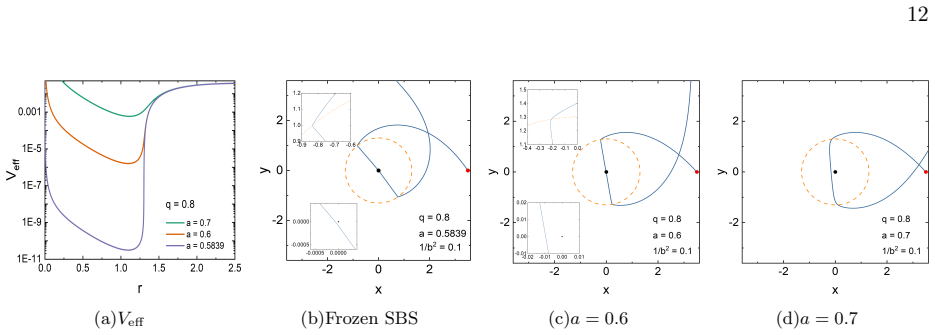
On its own terms, the paper establishes, by numerical solution of the coupled ODEs for metric and scalar field on the compactified radial interval, that the scalarized Bardeen spacetime comes in two families separated by the critical magnetic charge q_c≈0.7208 (for s=0.2). Below q_c, approaching the threshold from above sends the scalar field to zero and the metric to the pure Bardeen solution—spontaneous scalarization in the usual sense. Above q_c, approaching a_t from above leaves a nonzero scalar condensate localized inside a critical horizon r_cH; the metric functions become extremely small but nonzero there, so the spacetime is horizonless. The paper calls this state the frozen SBS and
What carries the argument
The central object is the scalarized Bardeen spacetime (SBS), a solution of the action I = ∫√−g (R/4 − 2∇_μΦ∇^μΦ + e^{−aΦ²}L(F)), where L(F) is the Bardeen nonlinear electrodynamics Lagrangian with magnetic charge q and the scalar field couples through f(Φ)=e^{−aΦ²}. The carrying parameters are the coupling a and the magnetic charge q. The threshold a_t is the smallest coupling admitting a nontrivial scalar profile, and the critical charge q_c separates the two regimes: below it the hair evaporates at threshold, above it the scalar condensate localizes near a critical horizon r_cH. The numerical work solves the coupled radial ODEs for the metric functions n(r), σ(r) and scalar φ(r) over the
Load-bearing premise
The claim that the frozen SBS is horizonless depends on the numerically computed values −g_tt ∼ 10^-16 and g^rr ∼ 10^-9 at r_cH being genuinely nonzero; if they are actually zero at a→a_t^+, the solution is an extremal black hole or singular limit and the central conclusion collapses.
What would settle it
Compute the same SBS branch at higher grid resolution with an adaptive mesh and Richardson extrapolation for q=0.8 near a=a_t, and test whether the minima of −g_tt and g^rr scale to exactly zero as a→a_t^+ or remain small but nonzero; then integrate null geodesics through r_cH to check completeness. Exact zeros or incomplete geodesics would refute the frozen-horizonless claim; nonzero plateaus would confirm it.
If this is right
- The pure Bardeen black hole is not the relevant endpoint near threshold for q≥q_c; observations of a scalarized object at that coupling should look like a frozen horizonless spacetime, not a Bardeen black hole.
- A "no-hair" statement emerges from the whole-spacetime viewpoint: for q≥q_c, hairy Bardeen black holes do not exist; scalar hair is confined to frozen horizonless configurations.
- Photon orbits near the critical horizon can show very large deflections and long coordinate-time delays, giving a potential observational discriminator between SBSs and ordinary black holes.
- For q<q_c the usual spontaneous scalarization picture is retained, so small-coupling scalar hair is a small perturbation of pure Bardeen spacetime.
- The scalar charge goes to zero at the threshold in both families, but for opposite reasons: field amplitude vanishes in one, localization outside the horizon in the other.
Where Pith is reading between the lines
- Editor's inference: if the frozen SBS is real, the same global-vs-exterior distinction may apply to other regular-black-hole scalarization models; the paper lists many frozen states in related settings, suggesting a general phenomenon worth testing.
- Editor's inference: the horizonless conclusion rests on the numerical levels 10^-16 and 10^-9; an independent convergence study with adaptive mesh and Richardson extrapolation could decide whether these are genuine or settle to zero. This is the sharpest check on the paper's main claim, and the paper itself flags the accuracy caveat in footnote 1.
- Editor's inference: the extreme coordinate-time delay near r_cH implies that time-domain observations, such as gravitational-wave ringdown or lensing of a background source, may be able to distinguish a frozen SBS from a Bardeen black hole even if their shadow sizes are similar.
- Editor's inference: a dynamical evolution of a Bardeen black hole with a scalar perturbation above a_t, tracking whether the final state is frozen SBS or pure Bardeen, would test whether the static branch is the true attractor.
Editorial analysis
A structured set of objections, weighed in public.
Referee Report
Summary. The paper studies spontaneous scalarization of the Bardeen spacetime, modeled as a nonlinear magnetic monopole, with a real massless scalar field coupled through e^{-a\phi^2}. The authors solve the static, spherically symmetric ODE system over the entire spacetime using a compactified radial coordinate and finite-element/Newton-Raphson methods. They report that scalarized Bardeen spacetimes (SBSs) exist for a > a_t for all magnetic charges q considered. For q < q_c the scalar field vanishes as a \to a_t^+ and the solution reduces to the pure Bardeen spacetime. For q \geq q_c, the limit a \to a_t^+ is claimed to give a horizonless 'frozen SBS' with a critical horizon r_cH where -g_{tt} ~ O(10^{-16}) and 1/g_{rr} ~ O(10^{-9}), leading to extreme photon deflection and time delay. The paper also analyzes photon orbits, light rings, and bound orbits around these solutions.
Significance. If the frozen SBS claim is correct, the paper would provide a novel example where scalarization of a regular Bardeen spacetime leads, in the threshold limit, not to a hairy black hole but to a horizonless ultracompact object with distinctive photon-orbit signatures. The ODE reduction to the Bardeen solution in the scalar-free limit is correct, and the regular-center boundary conditions are appropriate. However, the central new conclusion—the horizonless/frozen nature of the a \to a_t^+ limit for q \geq q_c—rests on metric values at the edge of numerical precision, with no convergence tests or error estimates. In addition, the 'spontaneous' scalarization mechanism is not supported by a stability analysis, and the claimed no-hair conclusion overreaches the numerical setup. The paper would be significant if the numerical evidence were strengthened, but in its present form the main claim is conditional.
major comments (3)
- [Sec. IV.C, Fig. 4, footnote 1] The central claim that the frozen SBS is horizonless is based on numerical values -g_{tt} ~ O(10^{-16}) and 1/g_{rr} ~ O(10^{-9}) at r_cH. With the stated relative error tolerance of 10^{-5} (Sec. IV) and double-precision arithmetic, a value of 10^{-16} is at machine epsilon and cannot be distinguished from zero. No convergence test, error bar, or high-precision run is reported. Therefore the statement 'because g_{rr} is not exactly zero, the solution does not possess an event horizon' is not established; the exact solution at a \to a_t^+ could be a regular Bardeen black hole with a true horizon at r_cH, or the limit could be singular. Since the photon-deflection and time-delay claims near r_cH depend on the horizonless interpretation, the authors should provide a coordinate-invariant check (e.g., null geodesic completeness through r_cH) or high-precision integration with controlled erro
- [Sec. V (Conclusion)] The conclusion states that 'hairy Bardeen BH solutions do not seem to emerge' and suggests a no-hair theorem from the whole-spacetime perspective. This is not established by the numerical setup. The ODE system is singular at n=0, and the integration from r=0 with regular-center boundary conditions n(0)=1 will generically not pass through n=0. To conclude that no hairy Bardeen black holes exist, the authors would need to perform a separate search using horizon boundary conditions (n=0, finite σ, appropriate regularity) or provide a rigorous argument. The comparison with Ref. [61], which solved only outside the horizon, is not sufficient to rule out such solutions.
- [Sec. I, Sec. IV.A, Eq. (5)] The paper repeatedly invokes 'spontaneous scalarization,' but no linear stability analysis of the pure Bardeen solution is performed. The threshold a_t is read off from the left endpoint of the nontrivial branch in Fig. 1, which establishes existence of static solutions, not that the trivial branch becomes unstable at a_t or that the scalarized branch is the dynamically selected endpoint. A linearized perturbation analysis of Eqs. (9)-(11) around \phi=0, or a time-evolution study, is needed to justify the 'spontaneous' mechanism and the identification of a_t as a scalarization threshold. This is a load-bearing point for the interpretation of the results.
minor comments (6)
- [Abstract] Typo: 'critical vaule' should be 'critical value'.
- [Sec. II, Eqs. (7)-(11)] The metric ansatz defines σ(r), but the surrounding text and equations use o(r) for the same function (e.g., 'meteic functions n(r) and o(r)', Eq. (10), Eq. (11), Eq. (22)). Please use a consistent notation, preferably σ.
- [Sec. II, after Eq. (2)] The field strength is written as F_{\mu\nu}=\partial_\mu A_\nu - \partial_\mu A_\nu; the second indices should be ν in both terms. Also, the index in Eq. (6) should be checked.
- [Footnote 1] This footnote contains an important limitation: it states that the minima of -g_{tt} and 1/g_{rr} can be made 'arbitrarily close to zero from the perspective of numerical computation (but never exactly zero)'. This is exactly the kind of caveat that should be in the main text and connected to a quantitative error estimate, as the central frozen-SBS conclusion depends on it.
- [Sec. IV.C, Fig. 4] The caption says only 'with a→a_t and q=0.8', but the exact numerical value of a used for the red curve (e.g., a=0.5839 mentioned later) should be stated in the caption for reproducibility.
- [Sec. IV.D, Eq. (22)] The right-hand side of Eq. (22) is written with o' and n without indicating the argument; please define the notation explicitly and verify the derivation of d²u/dφ², as this equation is used for all orbit plots.
Circularity Check
No significant circularity: scalarized Bardeen solutions and frozen SBS are outcomes of solving the stated ODEs, not re-statements of inputs or self-citation-dependent conclusions.
full rationale
The paper's derivation chain is self-contained. The field equations (9)-(11) follow from the action (1) with f(Φ)=e^{-αΦ^2} and nonlinear electrodynamics (2); these are solved numerically as a boundary-value problem on the compactified domain (Sec. III). The ADM mass and scalar charge (Eq. 16) are outputs read from the asymptotic solution, and the scalarization threshold a_t is identified as the left endpoint of the Q_s(a) branches (Sec. IV.A), not fitted to a pre-specified target. The central claim for q≥q_c that the a→a_t^+ limit is a horizonless 'frozen SBS' rests on the numerical metric profiles in Fig. 4, where n(r_cH)~10^-9 and -g_tt~10^-16; the paper explicitly reasons that a nonzero g_rr implies no event horizon (Sec. IV.C). This is a numerical claim subject to rounding/truncation error, and the lack of a convergence study is a correctness risk, but it is not circular: the 'frozen' label and the many self-citations to earlier frozen-star papers (refs. 62-76) serve as contextual analogy, not as the argument establishing existence. The photon-orbit analysis (Sec. IV.D) integrates the null geodesic equation (22) using the numerically obtained metric; it does not invert or fit the metric to the resulting orbits. No equation is defined in terms of the quantity it purports to predict, and no fitted parameter is renamed as a prediction. The self-citations are not load-bearing; they do not substitute for the numerical evidence. Hence the circularity score is 0.
Axiom & Free-Parameter Ledger
free parameters (1)
- s (Bardeen nonlinear electrodynamics coupling) =
0.2 (set by hand for numerics)
axioms (4)
- domain assumption Static, spherically symmetric metric ansatz with radial scalar field and magnetic monopole potential.
- domain assumption Regular center boundary conditions n(0)=1, dphi/dr(0)=0, with asymptotic flatness n(infinity)=1-2GM/r and phi(infinity)=0.
- domain assumption The coupling function f(Phi)=e^{-a Phi^2} and the Bardeen nonlinear electrodynamics Lagrangian are the matter model.
- domain assumption Numerical solutions with relative error below 10^-5 are accepted as true solutions, and near-zero metric values are interpreted as nonzero.
invented entities (1)
-
critical horizon r_cH
no independent evidence
Cite this review
Pith. "Pith review of Scalarization of Bardeen spacetime." pith.science (2026). https://pith.science/paper/FZW5MWZF
@misc{pith2026250908549,
  author       = {Pith},
  title        = {Pith review of: Scalarization of Bardeen spacetime},
  year         = {2026},
  howpublished = {\url{https://pith.science/paper/FZW5MWZF}},
  note         = {Machine review of arXiv:2509.08549}
}
read the original abstract
In this paper, we study the scalarization of the entire Bardeen spacetime which is constructed from a nonlinear magnetic monopole. We find that once the scalarization coupling parameter exceeds the scalarized threshold $a_t$, a scalarized Bardeen spacetime (SBS) solution exists for any magnetic charge $q$. However, the nature of the scalarization depends on the magnetic charge $q$. For $q$ less than a critical vaule $q_c$, when $a$ exceeds $a_t$, the scalar field emerges. As $a$ approaches $a_t$ from above (i.e., $a\to a_t^+$), the scalar field vanishes and the metric is reduced to a pure Bardeen spacetime. This behavior indicates that the solution exhibits the general ``spontaneous" scalarization phenomenon. Conversely, for $q \geq q_c$, in the limit $a \to a_t^+$, the scalar field is non-vanishing and the SBS approaches a ``frozen" SBS. Considering the importance of photon orbits in astronomical observations, we analyze the trajectories of photons around SBSs by analyzing null geodesics.
Figures




Reference graph
Works this paper leans on
-
[1]
Event horizons in static vacuum space-times,
W. Israel, “Event horizons in static vacuum space-times,” Phys. Rev.164(1967), 1776-1779
1967
-
[2]
Carter, Phys
B. Carter, Phys. Rev. Lett.26(1971), 331-333
1971
-
[3]
Introducing the black hole,
R. Ruffini and J. A. Wheeler, “Introducing the black hole,” Phys. Today24(1971) no.1, 30
1971
-
[4]
Particle - Like Solutions of the Einstein Yang-Mills Equations,
R. Bartnik and J. Mckinnon, “Particle - Like Solutions of the Einstein Yang-Mills Equations,” Phys. Rev. Lett.61(1988), 141-144
1988
-
[5]
Asymptotically flat black holes with scalar hair: a review,
C. A. R. Herdeiro and E. Radu, “Asymptotically flat black holes with scalar hair: a review,” Int. J. Mod. Phys. D24(2015) no.09, 1542014 [arXiv:1504.08209 [gr-qc]]
Pith/arXiv arXiv 2015
-
[6]
Hairy black holes in the XX-th and XXI-st centuries,
M. S. Volkov, “Hairy black holes in the XX-th and XXI-st centuries,” [arXiv:1601.08230 [gr-qc]]
-
[7]
Tensor - scalar gravity and binary pulsar experiments,
T. Damour and G. Esposito-Farese, “Tensor - scalar gravity and binary pulsar experiments,” Phys. Rev. D54(1996), 1474-1491 [arXiv:gr-qc/9602056 [gr-qc]]
Pith/arXiv arXiv 1996
-
[8]
Nonperturbative strong field effects in tensor - scalar theories of gravitation,
T. Damour and G. Esposito-Farese, “Nonperturbative strong field effects in tensor - scalar theories of gravitation,” Phys. Rev. Lett.70(1993), 2220-2223
1993
-
[9]
Theory and Experiment in Gravitational Physics,
C. M. Will, “Theory and Experiment in Gravitational Physics,” (Cambridge Univ. Press, Cambridge 1981)
1981
-
[10]
Effect of Gravitational Scalar Field on High-Density Star Structure,
A. Salmona, “Effect of Gravitational Scalar Field on High-Density Star Structure,” Phys. Rev.154 (1967), 1218-1223
1967
-
[11]
Neutron stars and incompressible fluid spheres in the Jordan- Brans-Dicke theory of gravitation,
W. Hilldebrandt and H. Heintzmann,, “Neutron stars and incompressible fluid spheres in the Jordan- Brans-Dicke theory of gravitation,” Gen. Relativ. Grav6(1998), 663-672
1998
-
[12]
Maximum mass of neutron stars-Dependence on the assumptions,
R.A. Saenz, “Maximum mass of neutron stars-Dependence on the assumptions,” Astrophys. J.212 (1977), 816-824
1977
-
[13]
M. Salgado, D. Sudarsky and U. Nucamendi, “On spontaneous scalarization,” Phys. Rev. D58(1998), 124003 [arXiv:gr-qc/9806070 [gr-qc]]
Pith/arXiv arXiv 1998
-
[14]
Spherical neutron star collapse in tensor - scalar theory of gravity,
J. Novak, “Spherical neutron star collapse in tensor - scalar theory of gravity,” Phys. Rev. D57(1998), 4789-4801 [arXiv:gr-qc/9707041 [gr-qc]]
Pith/arXiv arXiv 1998
-
[15]
D. D. Doneva and S. S. Yazadjiev, “New Gauss-Bonnet Black Holes with Curvature-Induced Scalariza- tion in Extended Scalar-Tensor Theories,” Phys. Rev. Lett.120(2018) no.13, 131103 [arXiv:1711.01187 [gr-qc]]. 17
Pith/arXiv arXiv 2018
-
[16]
Spontaneous scalarization of black holes and compact stars from a Gauss-Bonnet coupling,
H. O. Silva, J. Sakstein, L. Gualtieri, T. P. Sotiriou and E. Berti, “Spontaneous scalarization of black holes and compact stars from a Gauss-Bonnet coupling,” Phys. Rev. Lett.120(2018) no.13, 131104 [arXiv:1711.02080 [gr-qc]]
Pith/arXiv arXiv 2018
-
[17]
Evasion of No-Hair Theorems and Novel Black-Hole Solu- tions in Gauss-Bonnet Theories,
G. Antoniou, A. Bakopoulos and P. Kanti, “Evasion of No-Hair Theorems and Novel Black-Hole Solu- tions in Gauss-Bonnet Theories,” Phys. Rev. Lett.120(2018) no.13, 131102 [arXiv:1711.03390 [hep-th]]
Pith/arXiv arXiv 2018
-
[18]
Scalarized black holes in the presence of the coupling to Gauss-Bonnet gravity,
M. Minamitsuji and T. Ikeda, “Scalarized black holes in the presence of the coupling to Gauss-Bonnet gravity,” Phys. Rev. D99(2019) no.4, 044017 [arXiv:1812.03551 [gr-qc]]
Pith/arXiv arXiv 2019
-
[19]
Stability of scalarized black hole solutions in scalar-Gauss-Bonnet gravity,
H. O. Silva, C. F. B. Macedo, T. P. Sotiriou, L. Gualtieri, J. Sakstein and E. Berti, “Stability of scalarized black hole solutions in scalar-Gauss-Bonnet gravity,” Phys. Rev. D99(2019) no.6, 064011 [arXiv:1812.05590 [gr-qc]]
Pith/arXiv arXiv 2019
-
[20]
Gauss-Bonnet black holes with a massive scalar field,
D. D. Doneva, K. V. Staykov and S. S. Yazadjiev, “Gauss-Bonnet black holes with a massive scalar field,” Phys. Rev. D99(2019) no.10, 104045 [arXiv:1903.08119 [gr-qc]]
Pith/arXiv arXiv 2019
-
[21]
Self-interactions and Spontaneous Black Hole Scalarization,
C. F. B. Macedo, J. Sakstein, E. Berti, L. Gualtieri, H. O. Silva and T. P. Sotiriou, “Self-interactions and Spontaneous Black Hole Scalarization,” Phys. Rev. D99(2019) no.10, 104041 [arXiv:1903.06784 [gr-qc]]
Pith/arXiv arXiv 2019
-
[22]
J. L. Bl´ azquez-Salcedo, B. Kleihaus and J. Kunz, “Scalarized black holes,” Arab. J. Math.11(2022) no.1, 17-30 [arXiv:2106.15574 [gr-qc]]
Pith/arXiv arXiv 2022
-
[23]
Black hole scalarization with Gauss-Bonnet and Ricci scalar couplings,
G. Antoniou, A. Leh´ ebel, G. Ventagli and T. P. Sotiriou, “Black hole scalarization with Gauss-Bonnet and Ricci scalar couplings,” Phys. Rev. D104(2021) no.4, 044002 [arXiv:2105.04479 [gr-qc]]
Pith/arXiv arXiv 2021
-
[24]
Novel Black-Hole Solutions in Einstein-Scalar- Gauss-Bonnet Theories with a Cosmological Constant,
A. Bakopoulos, G. Antoniou and P. Kanti, “Novel Black-Hole Solutions in Einstein-Scalar- Gauss-Bonnet Theories with a Cosmological Constant,” Phys. Rev. D99(2019) no.6, 064003 [arXiv:1812.06941 [hep-th]]
Pith/arXiv arXiv 2019
-
[25]
Black Hole Spontaneous Scalarisation with a Positive Cosmo- logical Constant,
Y. Brihaye, C. Herdeiro and E. Radu, “Black Hole Spontaneous Scalarisation with a Positive Cosmo- logical Constant,” Phys. Lett. B802(2020), 135269 [arXiv:1910.05286 [gr-qc]]
Pith/arXiv arXiv 2020
-
[26]
Existence of solutions with a horizon in pure scalar-Gauss- Bonnet theories,
A. Bakopoulos, P. Kanti and N. Pappas, “Existence of solutions with a horizon in pure scalar-Gauss- Bonnet theories,” Phys. Rev. D101(2020) no.4, 044026 [arXiv:1910.14637 [hep-th]]
Pith/arXiv arXiv 2020
-
[27]
Large and ultracompact Gauss-Bonnet black holes with a self-interacting scalar field,
A. Bakopoulos, P. Kanti and N. Pappas, “Large and ultracompact Gauss-Bonnet black holes with a self-interacting scalar field,” Phys. Rev. D101(2020) no.8, 084059 [arXiv:2003.02473 [hep-th]]
Pith/arXiv arXiv 2020
-
[28]
No static regular black holes in Einstein- complex-scalar-Gauss-Bonnet gravity,
K. Lin, S. Zhang, C. Zhang, X. Zhao, B. Wang and A. Wang, “No static regular black holes in Einstein- complex-scalar-Gauss-Bonnet gravity,” Phys. Rev. D102(2020) no.2, 024034 [arXiv:2004.04773 [gr- qc]]
Pith/arXiv arXiv 2020
-
[29]
Spontaneous holographic scalarization of black holes in Einstein-scalar-Gauss-Bonnet theories,
H. Guo, S. Kiorpelidi, X. M. Kuang, E. Papantonopoulos, B. Wang and J. P. Wu, “Spontaneous holographic scalarization of black holes in Einstein-scalar-Gauss-Bonnet theories,” Phys. Rev. D102 (2020) no.8, 084029 [arXiv:2006.10659 [hep-th]]
Pith/arXiv arXiv 2020
-
[30]
Spontaneously Scalarized Kerr Black Holes in Extended Scalar-Tensor–Gauss-Bonnet Gravity,
P. V. P. Cunha, C. A. R. Herdeiro and E. Radu, “Spontaneously Scalarized Kerr Black Holes in Extended Scalar-Tensor–Gauss-Bonnet Gravity,” Phys. Rev. Lett.123(2019) no.1, 011101 [arXiv:1904.09997 [gr-qc]]
Pith/arXiv arXiv 2019
-
[31]
Spinning and excited black holes in Einstein-scalar- Gauss–Bonnet theory,
L. G. Collodel, B. Kleihaus, J. Kunz and E. Berti, “Spinning and excited black holes in Einstein-scalar- Gauss–Bonnet theory,” Class. Quant. Grav.37(2020) no.7, 075018 [arXiv:1912.05382 [gr-qc]]
Pith/arXiv arXiv 2020
-
[32]
Spin-induced black hole spontaneous scalar- ization,
A. Dima, E. Barausse, N. Franchini and T. P. Sotiriou, “Spin-induced black hole spontaneous scalar- ization,” Phys. Rev. Lett.125(2020) no.23, 231101 [arXiv:2006.03095 [gr-qc]]
Pith/arXiv arXiv 2020
-
[33]
Black hole scalarization induced by the spin: 2+1 time evolution,
D. D. Doneva, L. G. Collodel, C. J. Kr¨ uger and S. S. Yazadjiev, “Black hole scalarization induced by the spin: 2+1 time evolution,” Phys. Rev. D102(2020) no.10, 104027 [arXiv:2008.07391 [gr-qc]]
Pith/arXiv arXiv 2020
-
[34]
Spin-induced scalarization of Kerr black holes with a massive scalar field,
D. D. Doneva, L. G. Collodel, C. J. Kr¨ uger and S. S. Yazadjiev, “Spin-induced scalarization of Kerr black holes with a massive scalar field,” Eur. Phys. J. C80(2020) no.12, 1205 [arXiv:2009.03774 [gr-qc]]
Pith/arXiv arXiv 2020
-
[35]
Spin-induced scalarized black holes,
C. A. R. Herdeiro, E. Radu, H. O. Silva, T. P. Sotiriou and N. Yunes, “Spin-induced scalarized black holes,” Phys. Rev. Lett.126(2021) no.1, 011103 [arXiv:2009.03904 [gr-qc]]. 18
Pith/arXiv arXiv 2021
-
[36]
Spin-induced black-hole scalarization in Einstein- scalar-Gauss-Bonnet theory,
E. Berti, L. G. Collodel, B. Kleihaus and J. Kunz, “Spin-induced black-hole scalarization in Einstein- scalar-Gauss-Bonnet theory,” Phys. Rev. Lett.126(2021) no.1, 011104 [arXiv:2009.03905 [gr-qc]]
Pith/arXiv arXiv 2021
-
[37]
Spontaneous Scalarization of Charged Black Holes,
C. A. R. Herdeiro, E. Radu, N. Sanchis-Gual and J. A. Font, “Spontaneous Scalarization of Charged Black Holes,” Phys. Rev. Lett.121(2018) no.10, 101102 [arXiv:1806.05190 [gr-qc]]
Pith/arXiv arXiv 2018
-
[38]
Black hole scalarization from the breakdown of scale invariance,
C. A. R. Herdeiro and E. Radu, “Black hole scalarization from the breakdown of scale invariance,” Phys. Rev. D99(2019) no.8, 084039 [arXiv:1901.02953 [gr-qc]]
Pith/arXiv arXiv 2019
-
[39]
The scalarised Schwarzschild-NUT spacetime,
Y. Brihaye, C. Herdeiro and E. Radu, “The scalarised Schwarzschild-NUT spacetime,” Phys. Lett. B 788(2019), 295-301 [arXiv:1810.09560 [gr-qc]]
Pith/arXiv arXiv 2019
-
[40]
D. D. Doneva, F. M. Ramazano˘ glu, H. O. Silva, T. P. Sotiriou and S. S. Yazadjiev, “Spontaneous scalarization,” Rev. Mod. Phys.96(2024) no.1, 015004 [arXiv:2211.01766 [gr-qc]]
Pith/arXiv arXiv 2024
-
[41]
Observation of Gravitational Waves from a Binary Black Hole Merger,
B. P. Abbottet al.[LIGO Scientific and Virgo], “Observation of Gravitational Waves from a Binary Black Hole Merger,” Phys. Rev. Lett.116(2016) no.6, 061102 [arXiv:1602.03837 [gr-qc]]
Pith/arXiv arXiv 2016
-
[42]
First M87 Event Horizon Telescope Results. I. The Shadow of the Supermassive Black Hole,
K. Akiyamaet al.[Event Horizon Telescope], “First M87 Event Horizon Telescope Results. I. The Shadow of the Supermassive Black Hole,” Astrophys. J. Lett.875(2019), L1 [arXiv:1906.11238 [astro- ph.GA]]
Pith/arXiv arXiv 2019
-
[43]
Akiyamaet al.[Event Horizon Telescope], Astrophys
K. Akiyamaet al.[Event Horizon Telescope], Astrophys. J. Lett.875(2019) no.1, L2 doi:10.3847/2041- 8213/ab0c96 [arXiv:1906.11239 [astro-ph.IM]]
Pith/arXiv arXiv 2019
-
[44]
First M87 Event Horizon Telescope Results. III. Data Processing and Calibration,
K. Akiyamaet al.[Event Horizon Telescope], “First M87 Event Horizon Telescope Results. III. Data Processing and Calibration,” Astrophys. J. Lett.875(2019) no.1, L3 [arXiv:1906.11240 [astro-ph.GA]]
Pith/arXiv arXiv 2019
-
[45]
First M87 Event Horizon Telescope Results. IV. Imaging the Central Supermassive Black Hole,
K. Akiyamaet al.[Event Horizon Telescope], “First M87 Event Horizon Telescope Results. IV. Imaging the Central Supermassive Black Hole,” Astrophys. J. Lett.875(2019) no.1, L4 [arXiv:1906.11241 [astro-ph.GA]]
Pith/arXiv arXiv 2019
-
[46]
First M87 Event Horizon Telescope Results. V. Physical Origin of the Asymmetric Ring,
K. Akiyamaet al.[Event Horizon Telescope], “First M87 Event Horizon Telescope Results. V. Physical Origin of the Asymmetric Ring,” Astrophys. J. Lett.875(2019) no.1, L5 [arXiv:1906.11242 [astro- ph.GA]]
Pith/arXiv arXiv 2019
-
[47]
First M87 Event Horizon Telescope Results. VI. The Shadow and Mass of the Central Black Hole,
K. Akiyamaet al.[Event Horizon Telescope], “First M87 Event Horizon Telescope Results. VI. The Shadow and Mass of the Central Black Hole,” Astrophys. J. Lett.875(2019) no.1, L6 [arXiv:1906.11243 [astro-ph.GA]]
Pith/arXiv arXiv 2019
-
[48]
Gravitational collapse and space-time singularities,
R. Penrose, “Gravitational collapse and space-time singularities,” Phys. Rev. Lett.14(1965), 57-59
1965
-
[49]
The Singularities of gravitational collapse and cosmology,
S. W. Hawking and R. Penrose, “The Singularities of gravitational collapse and cosmology,” Proc. Roy. Soc. Lond. A314(1970), 529-548
1970
-
[50]
Bardeen, in Proceedings of GR5, Tiflis, U.S.S.R
J. Bardeen, in Proceedings of GR5, Tiflis, U.S.S.R. (1968)
1968
-
[51]
Solutions of the Schwarzschild-Nordstrom type for a point charge without singulari- ties,
M. F. Shirokov, “Solutions of the Schwarzschild-Nordstrom type for a point charge without singulari- ties,” Soviet Phys. JETP18, 236 (1948)
1948
-
[52]
Y. S. Duan, “Generalization of regular solutions of Einstein’s gravity equations and Maxwell’s equations for point-like charge,” Sov. Phys. JETP27(1954), 756-758 [arXiv:1705.07752 [gr-qc]]
Pith/arXiv arXiv 1954
-
[53]
Nachal’naia stadija rasshirenija Vselennoj i vozniknovenije neodnorodnosti rasprede- lenija veshchestva,
A. D. Sakharov, “Nachal’naia stadija rasshirenija Vselennoj i vozniknovenije neodnorodnosti rasprede- lenija veshchestva,” Sov. Phys. JETP22(1966), 241
1966
-
[54]
Algebraic Properties of the Energy-momentum Tensor and Vacuum-like States of Matter,
E. B. Gliner, “Algebraic Properties of the Energy-momentum Tensor and Vacuum-like States of Matter,” Sov. Phys. JETP22, 378 (1966)
1966
-
[55]
S. Ansoldi, “Spherical black holes with regular center: A Review of existing models including a recent realization with Gaussian sources,” [arXiv:0802.0330 [gr-qc]]
-
[56]
Regular Black Holes: A Short Topic Review,
C. Lan, H. Yang, Y. Guo and Y. G. Miao, “Regular Black Holes: A Short Topic Review,” Int. J. Theor. Phys.62(2023) no.9, 202 [arXiv:2303.11696 [gr-qc]]
Pith/arXiv arXiv 2023
-
[57]
Regular Rotating Black Holes: A Review,
R. Torres, “Regular Rotating Black Holes: A Review,” [arXiv:2208.12713 [gr-qc]]
-
[58]
Towards a Non-singular Paradigm of Black Hole Physics,
R. Carballo-Rubio, F. Di Filippo, S. Liberati, M. Visser, J. Arrechea, C. Barcel´ o, A. Bonanno, J. Borissova, V. Boyanov and V. Cardoso,et al.“Towards a Non-singular Paradigm of Black Hole Physics,” [arXiv:2501.05505 [gr-qc]]. 19
-
[59]
Regular black hole in general relativity coupled to nonlinear electro- dynamics,
E. Ayon-Beato and A. Garcia, “Regular black hole in general relativity coupled to nonlinear electro- dynamics,” Phys. Rev. Lett.80(1998), 5056-5059 [arXiv:gr-qc/9911046 [gr-qc]]
Pith/arXiv arXiv 1998
-
[60]
The Bardeen model as a nonlinear magnetic monopole,
E. Ayon-Beato and A. Garcia, “The Bardeen model as a nonlinear magnetic monopole,” Phys. Lett. B 493(2000), 149-152 [arXiv:gr-qc/0009077 [gr-qc]]
Pith/arXiv arXiv 2000
-
[61]
Spontaneous scalarization of Bardeen black holes,
L. Zhang, Q. Pan, Y. S. Myung and D. C. Zou, “Spontaneous scalarization of Bardeen black holes,” Phys. Rev. D110(2024) no.12, 124036 [arXiv:2409.11669 [gr-qc]]
Pith/arXiv arXiv 2024
-
[62]
From Bardeen-boson stars to black holes without event horizon,
X. E. Wang, “From Bardeen-boson stars to black holes without event horizon,” [arXiv:2305.19057 [gr-qc]]
-
[63]
Frozen Bardeen-Dirac stars and light ball,
L. X. Huang, S. X. Sun and Y. Q. Wang, “Frozen Bardeen-Dirac stars and light ball,” [arXiv:2312.07400 [gr-qc]]
-
[64]
Y. Yue and Y. Q. Wang, “Frozen Hayward-boson stars,” [arXiv:2312.07224 [gr-qc]]
-
[65]
Frozen boson stars in an infinite tower of higher-derivative gravity,
T. X. Ma and Y. Q. Wang, “Frozen boson stars in an infinite tower of higher-derivative gravity,” [arXiv:2406.08813 [gr-qc]]
-
[66]
Bardeen spacetime with charged scalar field,
L. X. Huang, S. X. Sun and Y. Q. Wang, “Bardeen spacetime with charged scalar field,” [arXiv:2407.11355 [gr-qc]]
-
[67]
Hayward spacetime with axion scalar field,
J. R. Chen and Y. Q. Wang, “Hayward spacetime with axion scalar field,” [arXiv:2407.17278 [hep-th]]
-
[68]
Bardeen-Dirac Stars in AdS Spacetime,
X. Y. Zhang, L. Zhao and Y. Q. Wang, “Bardeen-Dirac Stars in AdS Spacetime,” [arXiv:2409.14402 [gr-qc]]
-
[69]
Frozen gravitational stars in Einsteinian cubic gravity,
Y. Q. Wang, “Frozen gravitational stars in Einsteinian cubic gravity,” [arXiv:2410.04575 [gr-qc]]
-
[70]
Bardeen Spacetime with Charged Dirac Field,
S. X. Sun, L. X. Huang, Z. H. Zhao and Y. Q. Wang, “Bardeen Spacetime with Charged Dirac Field,” [arXiv:2411.12969 [gr-qc]]
-
[71]
Non-topological soliton Bardeen boson stars and its frozen state,
Z. H. Zhao, Y. Gu, S. Liu, L. X. Huang and Y. Q. Wang, “Non-topological soliton Bardeen boson stars and its frozen state,” [arXiv:2502.14153 [gr-qc]]
-
[72]
Orbits of photon in Bardeen-boson stars and their frozen states,
L. X. Huang, S. X. Sun, Y. P. Zhang, Z. H. Zhao and Y. Q. Wang, “Orbits of photon in Bardeen-boson stars and their frozen states,” [arXiv:2503.14984 [gr-qc]]
-
[73]
R. Zhang and Y. Q. Wang, “Spherically symmetric horizonless solutions and their frozen states in Bardeen spacetime with Proca field,” [arXiv:2503.16265 [gr-qc]]
-
[74]
Frozen states of charged boson stars,
Y. Brihaye and B. Hartmann, “Frozen states of charged boson stars,” [arXiv:2507.08946 [gr-qc]]
-
[75]
Light Rings, Accretion Disks and Shadows of Hayward Boson Stars in asymptotically AdS Spacetime,
Z. H. Zhao, Y. N. Gu, S. C. Liu, Z. Q. Liu and Y. Q. Wang, “Light Rings, Accretion Disks and Shadows of Hayward Boson Stars in asymptotically AdS Spacetime,” [arXiv:2507.09563 [gr-qc]]
-
[76]
S. S. Chicaiza-Medina and J. C. Degollado, “Hayward Boson Stars,” [arXiv:2508.11906 [gr-qc]]
-
[77]
Astrophysical signatures of boson stars: quasinormal modes and inspiral resonances,
C. F. B. Macedo, P. Pani, V. Cardoso and L. C. B. Crispino, “Astrophysical signatures of boson stars: quasinormal modes and inspiral resonances,” Phys. Rev. D88(2013) no.6, 064046 [arXiv:1307.4812 [gr-qc]]
Pith/arXiv arXiv 2013
-
[78]
Light-Ring Stability for Ultracompact Objects,
P. V. P. Cunha, E. Berti and C. A. R. Herdeiro, “Light-Ring Stability for Ultracompact Objects,” Phys. Rev. Lett.119(2017) no.25, 251102 [arXiv:1708.04211 [gr-qc]]
Pith/arXiv arXiv 2017
-
[79]
Image of a spherical black hole with thin accretion disk,
J. P. Luminet, “Image of a spherical black hole with thin accretion disk,” Astron. Astrophys.75(1979), 228-235
1979
This paper was first reviewed by deepseek-v4-flash on August 4, 2026.
discussion (0)
Sign in with ORCID, Apple, or X to comment. Anyone can read and Pith papers without signing in.