REVIEW 3 major objections 6 minor 63 references
This challenge report claims that instruction-tuned large multimodal models can perform open-ended visual quality comparison across image pairs and groups, with the top ensemble reaching 75.7% top-1 accuracy on a new 4,000-question benchmar
Reviewed by Pith at T0; open to challenge. T0 means a machine referee read the full paper against a public rubric. the ladder, T0–T4 →
A challenge report finding that ensemble-tuned LMMs reach 75.7% accuracy on a 4,000-question visual quality comparison benchmark, only ~0.2 points above a Qwen2.5-VL-72B baseline.
T0 review reviewed 2026-08-04 challenge →
load-bearing objection A useful, well-documented challenge report that overstates its case: the top methods are statistically indistinguishable from the Qwen2.5-VL-72B baseline. the 3 major comments →
VQualA 2025 Challenge on Visual Quality Comparison for Large Multimodal Models: Methods and Results
The pith
A machine-rendered reading of the paper's core claim, the machinery that carries it, and where it could break.
The reading
Core claim
The discovery the paper argues for is that open-ended visual quality comparison is learnable by instruction-tuned large multimodal models: fine-tuning on Co-Instruct-562K enables models to answer comparative questions like 'which image is sharper?' with explicit rationales, and aggregating several such models by majority voting improves accuracy. On MICBench's 2,000-question test set, the top ensemble achieves 0.7570 top-1 accuracy overall, with notably higher accuracy on three-image (0.8452) and four-image (0.8458) comparisons than on pairs (0.6713). The paper presents these results as demonstrating substantial advancements in visual quality comparison powered by multimodal reasoning and in
What carries the argument
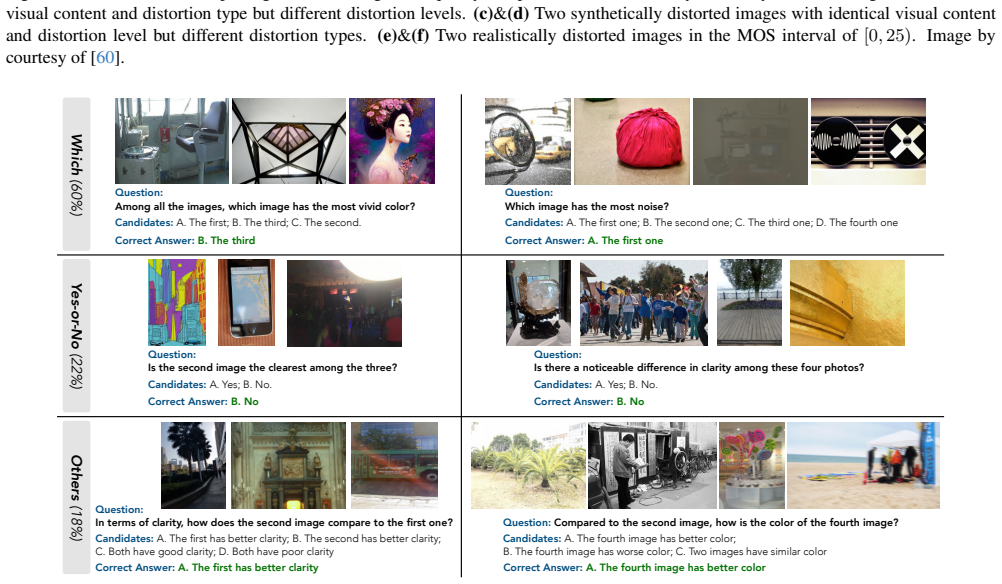
The load-bearing machinery is a coarse-to-fine pairing protocol that constructs comparable image groups—same content and distortion type with different levels, same content and level with different distortion types, or real distortions within the same MOS interval—and casts comparison as multiple-choice questions. The training side uses Co-Instruct-562K, a 562K-sample instruction corpus built by merging human single-image descriptions (Merge2Compare) and using a large multimodal teacher model to generate pseudo-labels on unlabeled groups (Teach2Compare). The evaluation side is MICBench, a 4,000-MCQ benchmark spanning two-, three-, and four-image groups with 'which', 'yes/no', and 'what/how'
Load-bearing premise
The benchmark's 4,000 questions and the training corpus are constructed from the same source databases and the same pairing protocol, so the central assumption is that top-1 accuracy on MICBench measures generalizable open-domain visual quality comparison ability rather than in-distribution performance on benchmark families the organizers already built and released.
What would settle it
Assemble a fresh comparison benchmark from image datasets and distortion types not used in Co-Instruct-562K or MICBench, then run the winning ensemble without any additional fine-tuning. If its accuracy drops to near chance or to the level of an untrained baseline while in-distribution MICBench accuracy remains near 75%, the leaderboard metric is measuring familiarity with the data pipeline, not generalizable comparison ability.
If this is right
- Instruction-tuned multimodal models can handle multi-image comparisons beyond pairs, including triplets and quadruplets, without task-specific quality heads.
- Ensembling several fine-tuned models through majority voting improves top-1 accuracy over any single model and was the winning strategy in this challenge.
- MICBench enables granular analysis by group size, distortion type, and question format, allowing separate tracking of coarse- versus fine-grained comparison skill.
- Large base models without challenge-specific training can reach near the top-team performance level, suggesting that model scale and general instruction tuning are strong contributors.
- The combination of Co-Instruct-562K training and MICBench evaluation offers a reusable protocol for future work on open-domain quality comparison.
Where Pith is reading between the lines
- Beyond the paper: If MICBench and Co-Instruct-562K are built from the same source databases and the same coarse-to-fine pairing protocol, then top-1 accuracy on MICBench may partly measure in-distribution fit to benchmark families the organizers already designed, rather than fully generalizable open-domain comparison ability.
- Beyond the paper: The higher accuracy on three- and four-image questions than on pairs is counterintuitive if difficulty scaled with the number of alternatives; it may reflect that group questions often ask to identify a standout image, while pairs require finer relative judgment. A testable extension is to break down accuracy by question type and quality-level spacing.
- Beyond the paper: The success of majority voting suggests individual multimodal models have complementary perceptual biases. An untested next step is to measure pairwise agreement among models and use disagreement to guide active data collection or more targeted preference optimization.
- Beyond the paper: The same comparative protocol could transfer to video quality assessment or AI-generated content quality, where asking which frame or clip is better is more natural than assigning scalar scores.
Editorial analysis
A structured set of objections, weighed in public.
Referee Report
Summary. This paper reports the organization and outcomes of the VQualA 2025 Visual Quality Comparison challenge. The track introduces a multi-image quality comparison benchmark (MICBench) with 4,000 human-annotated multiple-choice questions and uses it to rank five submitted LMM-based systems against three baseline LMMs. The paper describes the Co-Instruct-562K training corpus, the coarse-to-fine pairing protocol used to construct MICBench, and the methods of the top five teams. It claims that the results 'illustrate substantial advancements in visual quality comparison powered by multimodal reasoning and instruction-tuned models.'
Significance. The challenge fills a genuine gap: multi-image comparison is underexplored compared to single-image MOS regression, and the public release of MICBench and the detailed method descriptions are valuable to the community. The evaluation uses a held-out human-annotated test set, which is a real strength. However, the central quantitative claim is not supported by the reported statistics: the top ensemble (0.7570) is only 0.002 above the Qwen2.5-VL-72B baseline (0.7550) on 2,000 questions, and no confidence intervals or significance tests are provided. In addition, the training corpus and test benchmark share the same origin and construction protocol, so the claim of open-domain generalization requires additional evidence or explicit acknowledgment of this limitation. The paper is a useful challenge summary, but the interpretation of the leaderboard needs substantial revision.
major comments (3)
- [Section 4, Table 1] The differences among the top four teams and the Qwen2.5-VL-72B baseline are within 0.006, i.e., 12 correct answers out of 2,000. The winner-vs-baseline difference is 4 correct answers (0.002). With N=2000, the standard error of a proportion at p≈0.75 is about 0.0097, so the observed differences are less than one standard error. The paper reports no confidence intervals, bootstrap estimates, or paired significance tests. As written, the leaderboard does not demonstrate that any submitted method improves on the Qwen2.5-VL-72B baseline, and the term 'substantial advancements' is unjustified. The authors should either compute and report paired significance tests (e.g., McNemar) and confidence intervals, or temper the claim to note that the top methods are statistically indistinguishable from the strongest baseline at this test-set size.
- [Sections 3.1 and 3.2, Fig. 2] The evaluation set MICBench and the training set Co-Instruct-562K are built by the same organizers using the same source databases (Q-Instruct, etc.) and the same coarse-to-fine pairing protocol from Ref. [60] (see also Fig. 1). This raises a distribution-shift concern for the claim that the benchmark measures 'open-domain visual quality reasoning and comparison' (Sec. 1). If the test questions are drawn from the same pipeline as the training data, top-1 accuracy may reflect in-distribution familiarity rather than generalizable comparison ability. The paper should add an analysis of the overlap between training and test sources, or evaluate on an independent benchmark (e.g., a different IQA comparison set), or explicitly state this limitation and temper the generalization claim.
- [Section 3.2, benchmark construction] The paper states that MICBench MCQs are 'authored and verified by expert annotators' and that group-level questions are 'validated through controlled human annotation procedures,' but no inter-annotator agreement, number of annotators, or per-question filtering statistics are reported. Since the benchmark is the basis for all conclusions, the absence of label-reliability information is a significant omission. The authors should provide at least a summary of annotation agreement and the number of questions discarded or revised after validation.
minor comments (6)
- [Section 2.1] References [41] and [42] refer to the same SSIM paper; consolidate into a single citation.
- [Table 1 header] The 'Leader' column is ambiguous; indicate that it is the team leader or contact person.
- [Sections 3.1 and 5.5] Section 3.1 lists four subsets (202K/222K/77K/61K), while Section 5.5 names four different subsets (Q-Instruct-200K, Merge2Compare, Teach2Compare-general, Teach2Compare-QA); reconcile the naming.
- [Section 5.4] The Q-align-4bit model is not cited; add a citation and clarify whether it is the Q-Align model from Ref. [44].
- [Table 1 and Section 5.5] The 'Extra Data' column marks Labubu with ✓, but Section 5.5 says training is on Co-Instruct-562K; clarify what extra data is used and how it was incorporated.
- [General] The paper would benefit from a short 'limitations' paragraph acknowledging the statistical power and same-origin issues discussed in the major comments.
Circularity Check
No circularity found: the challenge result is an empirical, human-grounded measurement; self-citations support benchmark design but do not define the outcome.
full rationale
The paper's central conclusion ('These results illustrate substantial advancements...') is an interpretation of the leaderboard in Table 1, not a derivation. MICBench's ground truth is '4,000 human-annotated multiple-choice questions (MCQs)', and evaluation is 'comparing the model-predicted choice against the ground-truth answer key'. The top-1 accuracy is therefore an externally grounded measurement, not a quantity defined by the training data or by a fitted parameter. The in-distribution concern—teams train on Co-Instruct-562K and are tested on MICBench, whose pairwise protocol is 'following the coarse-to-fine pairing protocol proposed in [60]' and whose group format is 'inheriting the structural design and task format of MICBench in Co-Instruct [45]'—is a legitimate generalization-validity issue, but it does not make the reported accuracy equivalent to the training input by construction: the test labels come from human annotators, and no submission's score is computed from its own training objective. Similarly, the closeness of the top score (0.7570) to the Qwen2.5-VL-72B baseline (0.7550) without significance testing is a statistical-support concern, not a circularity. Self-citations to [45] and [60] are used as methodological building blocks for benchmark construction, but the evaluation itself is an independent empirical measurement. Hence no circular step can be exhibited under the required standard.
Axiom & Free-Parameter Ledger
free parameters (1)
- MOS interval [0,25) for realistic fine-grained pairs =
None (hand-chosen)
axioms (3)
- domain assumption Human expert annotations of MICBench are correct and consistent.
- domain assumption Top-1 MCQ accuracy is a valid measure of open-ended visual quality comparison ability.
- domain assumption Source image databases with MOS labels provide trustworthy perceptual ground truth for constructing comparisons.
Cite this review
Pith. "Pith review of VQualA 2025 Challenge on Visual Quality Comparison for Large Multimodal Models: Methods and Results." pith.science (2026). https://pith.science/paper/JSIFMBA3
@misc{pith2026250909190,
  author       = {Pith},
  title        = {Pith review of: VQualA 2025 Challenge on Visual Quality Comparison for Large Multimodal Models: Methods and Results},
  year         = {2026},
  howpublished = {\url{https://pith.science/paper/JSIFMBA3}},
  note         = {Machine review of arXiv:2509.09190}
}
read the original abstract
This paper presents a summary of the VQualA 2025 Challenge on Visual Quality Comparison for Large Multimodal Models (LMMs), hosted as part of the ICCV 2025 Workshop on Visual Quality Assessment. The challenge aims to evaluate and enhance the ability of state-of-the-art LMMs to perform open-ended and detailed reasoning about visual quality differences across multiple images. To this end, the competition introduces a novel benchmark comprising thousands of coarse-to-fine grained visual quality comparison tasks, spanning single images, pairs, and multi-image groups. Each task requires models to provide accurate quality judgments. The competition emphasizes holistic evaluation protocols, including 2AFC-based binary preference and multi-choice questions (MCQs). Around 100 participants submitted entries, with five models demonstrating the emerging capabilities of instruction-tuned LMMs on quality assessment. This challenge marks a significant step toward open-domain visual quality reasoning and comparison and serves as a catalyst for future research on interpretable and human-aligned quality evaluation systems.
Figures



Reference graph
Works this paper leans on
-
[1]
Claude 3.5 Sonnet: Faster, smarter, and more useful.https : / / www
Anthropic. Claude 3.5 Sonnet: Faster, smarter, and more useful.https : / / www . anthropic . com / news / claude-3-5-sonnet, 2024. Accessed: 2025-05-15. 1
2024
-
[2]
Qwen2.5-VL technical report.arXiv preprint arXiv:2502.13923, 2025
Shuai Bai, Keqin Chen, Xuejing Liu, Jialin Wang, Wenbin Ge, Sibo Song, Kai Dang, Peng Wang, Shijie Wang, Jun Tang, et al. Qwen2.5-VL technical report.arXiv preprint arXiv:2502.13923, 2025. 1
Pith/arXiv arXiv 2025
-
[3]
Beyond keypoint coding: Temporal evo- lution inference with compact feature representation for talk- ing face video compression
Bolin Chen, Zhao Wang, Binzhe Li, Rongqun Lin, Shiqi Wang, and Yan Ye. Beyond keypoint coding: Temporal evo- lution inference with compact feature representation for talk- ing face video compression. InData Compression Confer- ence, pages 13–22. IEEE, 2022. 1
2022
-
[4]
Compact temporal trajectory representation for talking face video compression.IEEE Transactions on Circuits and Systems for Video Technology, 33(11):7009–7023, 2023
Bolin Chen, Zhao Wang, Binzhe Li, Shiqi Wang, and Yan Ye. Compact temporal trajectory representation for talking face video compression.IEEE Transactions on Circuits and Systems for Video Technology, 33(11):7009–7023, 2023. 1
2023
-
[5]
Gap-closing matters: Percep- tual quality evaluation and optimization of low-light image enhancement.IEEE Transactions on Multimedia, 26:3430– 3443, 2023
Baoliang Chen, Lingyu Zhu, Hanwei Zhu, Wenhan Yang, Linqi Song, and Shiqi Wang. Gap-closing matters: Percep- tual quality evaluation and optimization of low-light image enhancement.IEEE Transactions on Multimedia, 26:3430– 3443, 2023. 2
2023
-
[6]
Deep feature statistics mapping for generalized screen content image quality assessment.IEEE Transactions on Image Processing, 2024
Baoliang Chen, Hanwei Zhu, Lingyu Zhu, Shiqi Wang, and Sam Kwong. Deep feature statistics mapping for generalized screen content image quality assessment.IEEE Transactions on Image Processing, 2024. 2
2024
-
[7]
Bolin Chen, Hanwei Zhu, Shanzhi Yin, Lingyu Zhu, Jie Chen, Ru-Ling Liao, Shiqi Wang, and Yan Ye. Pleno- generation: A scalable generative face video compression framework with bandwidth intelligence.arXiv preprint arXiv:2502.17085, 2025. 2
Pith/arXiv arXiv 2025
-
[8]
Debiased mapping for full- reference image quality assessment.IEEE Trans
Baoliang Chen, Hanwei Zhu, Lingyu Zhu, Shanshe Wang, Jingshan Pan, and Shiqi Wang. Debiased mapping for full- reference image quality assessment.IEEE Trans. Multime- dia, pages 1–12, 2025. 1
2025
-
[9]
Vquala 2025 chal- lenge on genai-bench aigc video quality assessment: Meth- ods and results
Ying Chen, Huasheng Wang, Pengxiang Xiao, Yukang Ding, Enpeng Liu, Chris Wei Zhou, and et al. Vquala 2025 chal- lenge on genai-bench aigc video quality assessment: Meth- ods and results. InProceedings of the IEEE/CVF Conference on Computer Vision (ICCV) Workshops, pages 1–11, 2025. 2
2025
-
[10]
Simoncelli
Keyan Ding, Kede Ma, Shiqi Wang, and Eero P. Simoncelli. Image quality assessment: Unifying structure and texture similarity.IEEE Transactions on Pattern Analysis and Ma- chine Intelligence, 44(5):2567–2581, 2022. 1, 2
2022
-
[11]
Per- ceptual quality assessment of HDR deghosting algorithms
Yuming Fang, Hanwei Zhu, Kede Ma, and Zhou Wang. Per- ceptual quality assessment of HDR deghosting algorithms. InIEEE International Conference on Image Processing, pages 3165–3169, 2017. 2
2017
-
[12]
Perceptual quality assessment of smartphone photog- raphy
Yuming Fang, Hanwei Zhu, Yan Zeng, Kede Ma, and Zhou Wang. Perceptual quality assessment of smartphone photog- raphy. InIEEE Conference on Computer Vision and Pattern Recognition, pages 3677–3686, 2020. 1
2020
-
[13]
Superpixel-based quality assessment of multi- exposure image fusion for both static and dynamic scenes
Yuming Fang, Yan Zeng, Wenhui Jiang, Hanwei Zhu, and Jiebin Yan. Superpixel-based quality assessment of multi- exposure image fusion for both static and dynamic scenes. IEEE Transactions on Image Processing, 30:2526–2537,
-
[14]
Vquala 2025 doc- ument image quality assessment challenge
Fan Huang, Xiongkuo Min, Zhichao Ma, Xiaohong Liu, Chris Wei Zhou, Guangtao Zhai, and et al. Vquala 2025 doc- ument image quality assessment challenge. InProceedings of the IEEE/CVF Conference on Computer Vision (ICCV) Workshops, pages 1–8, 2025. 2
2025
-
[15]
S 2-csnet: Scale-aware scalable sampling network for image compressive sensing
Chen Hui, Haiqi Zhu, Shuya Yan, Shaohui Liu, Feng Jiang, and Debin Zhao. S 2-csnet: Scale-aware scalable sampling network for image compressive sensing. InACM Multime- dia, pages 1–10. 1
-
[16]
Rate-adaptive neural network for image compressive sensing.IEEE Transactions on Mul- timedia, 26:2515–2530, 2023
Chen Hui, Shengping Zhang, Wenxue Cui, Shaohui Liu, Feng Jiang, and Debin Zhao. Rate-adaptive neural network for image compressive sensing.IEEE Transactions on Mul- timedia, 26:2515–2530, 2023. 1
2023
-
[17]
Aaron Hurst, Adam Lerer, Adam P Goucher, Adam Perel- man, Aditya Ramesh, Aidan Clark, AJ Ostrow, Akila Weli- hinda, Alan Hayes, Alec Radford, et al. GPT-4o system card. arXiv preprint arXiv:2410.21276, 2024. 1
Pith/arXiv arXiv 2024
-
[18]
Scope of va- lidity of psnr in image/video quality assessment.Electronics letters, 44(13):800–801, 2008
Quan Huynh-Thu and Mohammed Ghanbari. Scope of va- lidity of psnr in image/video quality assessment.Electronics letters, 44(13):800–801, 2008. 2
2008
-
[19]
Convolu- tional neural networks for no-reference image quality assess- ment
Le Kang, Peng Ye, Yi Li, and David Doermann. Convolu- tional neural networks for no-reference image quality assess- ment. InProceedings of the IEEE conference on computer vision and pattern recognition, pages 1733–1740, 2014. 2
2014
-
[20]
MUSIQ: Multi-scale image quality trans- former
Junjie Ke, Qifei Wang, Yilin Wang, Peyman Milanfar, and Feng Yang. MUSIQ: Multi-scale image quality trans- former. InIEEE International Conference on Computer Vi- sion, pages 5148–5157, 2021. 2
2021
-
[21]
Detect and locate: Expos- ing face manipulation by semantic-and noise-level telltales
Chenqi Kong, Baoliang Chen, Haoliang Li, Shiqi Wang, An- derson Rocha, and Sam Kwong. Detect and locate: Expos- ing face manipulation by semantic-and noise-level telltales. IEEE Transactions on Information Forensics and Security, 17:1741–1756, 2022. 1
2022
-
[22]
Chenqi Kong, Anwei Luo, Peijun Bao, Yi Yu, Haoliang Li, Zengwei Zheng, Shiqi Wang, and Alex C Kot. Moe-ffd: Mixture of experts for generalized and parameter-efficient face forgery detection.arXiv preprint arXiv:2404.08452,
-
[23]
Pixel-inconsistency modeling for image manipulation localization.IEEE Transactions on Pattern Analysis and Machine Intelligence, 2025
Chenqi Kong, Anwei Luo, Shiqi Wang, Haoliang Li, Ander- son Rocha, and Alex C Kot. Pixel-inconsistency modeling for image manipulation localization.IEEE Transactions on Pattern Analysis and Machine Intelligence, 2025. 1
2025
-
[24]
LLaV A-Onevision: Easy visual task transfer
Bo Li, Yuanhan Zhang, Dong Guo, Renrui Zhang, Feng Li, Hao Zhang, Kaichen Zhang, Peiyuan Zhang, Yanwei Li, Zi- wei Liu, et al. LLaV A-Onevision: Easy visual task transfer. arXiv preprint arXiv:2408.03326, 2024. 1
Pith/arXiv arXiv 2024
-
[25]
Vquala 2025 challenge on engagement prediction for short videos: Methods and results
Dasong Li, Sizhuo Ma, Hang Hua, Wenjie Li, Jian Wang, Chris Wei Zhou, Fengbin Guan, Xin Li, Zihao Yu, Yiting Lu, Ru-Ling Liao, Yan Ye, Zhibo Chen, Wei Sun, Linhan Cao, Yuqin Cao, Weixia Zhang, Wen Wen, Kaiwei Zhang, 9 Zijian Chen, Fangfang Lu, Xiongkuo Min, Guangtao Zhai, Erjia Xiao, Lingfeng Zhang, Zhenjie Su, Hao Cheng, Yu Liu, Renjing Xu, Long Chen, Xi...
2025
-
[26]
Weiqi Li, Xuanyu Zhang, Shijie Zhao, Yabin Zhang, Junlin Li, Li Zhang, and Jian Zhang. Q-insight: Understanding im- age quality via visual reinforcement learning.arXiv preprint arXiv:2503.22679, 2025. 3
Pith/arXiv arXiv 2025
-
[27]
Xudong Li, Zihao Huang, Runze Hu, Yan Zhang, Liujuan Cao, and Rongrong Ji. Boosting clip adaptation for image quality assessment via meta-prompt learning and gradient regularization.arXiv preprint arXiv:2409.05381, 2024. 3
arXiv 2024
-
[28]
Vquala 2025 challenge on image super-resolution generated content qual- ity assessment: Methods and results
Yixiao Li, Xin Li, Chris Wei Zhou, Shuo Xing, Hadi Amir- pour, Xiaoshuai Hao, Guanghui Yue, Baoquan Zhao, Weide Liu, Xiaoyuan Yang, Zhengzhong Tu, and et al. Vquala 2025 challenge on image super-resolution generated content qual- ity assessment: Methods and results. InProceedings of the IEEE/CVF Conference on Computer Vision (ICCV) Work- shops, pages 1–10...
2025
-
[29]
DeepWSD: Projecting degradations in perceptual space to Wasserstein distance in deep feature space
Xingran Liao, Baoliang Chen, Hanwei Zhu, Shiqi Wang, Mingliang Zhou, and Sam Kwong. DeepWSD: Projecting degradations in perceptual space to Wasserstein distance in deep feature space. InACM International Conference on Multimedia, pages 970–978, 2022. 2
2022
-
[30]
Perceptual visual quality met- rics: A survey.Journal of Visual Communication and Image Representation, 22(4):297–312, 2011
Weisi Lin and C-C Jay Kuo. Perceptual visual quality met- rics: A survey.Journal of Visual Communication and Image Representation, 22(4):297–312, 2011. 1
2011
-
[31]
Rankiqa: Learning from rankings for no-reference image quality assessment
Xialei Liu, Joost Van De Weijer, and Andrew D Bagdanov. Rankiqa: Learning from rankings for no-reference image quality assessment. InProceedings of the IEEE international conference on computer vision, pages 1040–1049, 2017. 2
2017
-
[32]
A quality-of-experience database for adaptive omni- directional video streaming.IEEE Journal of Selected Topics in Signal Processing, 17(5):949–963, 2023
Xuelin Liu, Jiebin Yan, Zheng Wan, Yuming Fang, and Zhou Wang. A quality-of-experience database for adaptive omni- directional video streaming.IEEE Journal of Selected Topics in Signal Processing, 17(5):949–963, 2023. 2
2023
-
[33]
Vquala 2025 challenge on face image quality assessment: Methods and results
Sizhuo Ma, Wei-Ting Chen, Qiang Gao, Jian Wang, Chris Wei Zhou, Wei Sun, Weixia Zhang, Linhan Cao, Jun Jia, Xiangyang Zhu, Dandan Zhu, Xiongkuo Min, Guang- tao Zhai, Baoying Chen, Xiongwei Xiao, Jishen Zeng, Wei Wu, Tiexuan Lou, Yuchen Tan, Chunyi Song, Zhiwei Xu, MohammadAli Hamidi, Hadi Amirpour, Mingyin Bai, Ji- awang Du, Zhenyu Jiang, Zilong Lu, Zigua...
2025
-
[34]
Image quality assessment us- ing contrastive learning.IEEE Transactions on Image Pro- cessing, 31:4149–4161, 2022
Pavan C Madhusudana, Neil Birkbeck, Yilin Wang, Balu Adsumilli, and Alan C Bovik. Image quality assessment us- ing contrastive learning.IEEE Transactions on Image Pro- cessing, 31:4149–4161, 2022. 2
2022
-
[35]
PieAPP: Perceptual image-error assessment through pairwise preference
Ekta Prashnani, Hong Cai, Yasamin Mostofi, and Pradeep Sen. PieAPP: Perceptual image-error assessment through pairwise preference. InIEEE Conference on Computer Vi- sion and Pattern Recognition, pages 1808–1817, 2018. 2
2018
-
[36]
Hamid R Sheikh and Alan C. Bovik. Image information and visual quality.IEEE Transactions on Image Processing, 15 (2):430–444, 2006. 2
2006
-
[37]
Blindly assess image qual- ity in the wild guided by a self-adaptive hyper network
Shaolin Su, Qingsen Yan, Yu Zhu, Cheng Zhang, Xin Ge, Jinqiu Sun, and Yanning Zhang. Blindly assess image qual- ity in the wild guided by a self-adaptive hyper network. In IEEE Conference on Computer Vision and Pattern Recogni- tion, pages 3664–3673, 2020. 2
2020
-
[38]
Xiangjie Sui, Hanwei Zhu, Xuelin Liu, Yuming Fang, Shiqi Wang, and Zhou Wang. Perceptual quality assessment of 360 images based on generative scanpath representation.arXiv preprint arXiv:2309.03472, 2023. 2
Pith/arXiv arXiv 2023
-
[39]
AI-generated image quality assess- ment in visual communication
Yu Tian, Yixuan Li, Baoliang Chen, Hanwei Zhu, Shiqi Wang, and Sam Kwong. AI-generated image quality assess- ment in visual communication. InAAAI Conference on Arti- ficial Intelligence, pages 7392–7400, 2025. 1
2025
-
[40]
Mstriq: No reference image quality assessment based on swin transformer with multi- stage fusion
Jing Wang, Haotian Fan, Xiaoxia Hou, Yitian Xu, Tao Li, Xuechao Lu, and Lean Fu. Mstriq: No reference image quality assessment based on swin transformer with multi- stage fusion. InProceedings of the IEEE/CVF Conference on Computer Vision and Pattern Recognition, pages 1269– 1278, 2022. 2
2022
-
[41]
Image quality assessment: from error visibility to structural similarity.IEEE Transactions on Image Process- ing, 13(4):600–612, 2004
Zhou Wang, Alan C Bovik, Hamid R Sheikh, and Eero P Si- moncelli. Image quality assessment: from error visibility to structural similarity.IEEE Transactions on Image Process- ing, 13(4):600–612, 2004. 2
2004
-
[42]
Bovik, Hamid R Sheikh, and Eero P
Zhou Wang, Alan C. Bovik, Hamid R Sheikh, and Eero P. Simoncelli. Image quality assessment: From error visibility to structural similarity.IEEE Transactions on Image Pro- cessing, 13(4):600–612, 2004. 2
2004
-
[43]
Q-Instruct: Improving low-level visual abil- ities for multi-modality foundation models
Haoning Wu, Zicheng Zhang, Erli Zhang, Chaofeng Chen, Liang Liao, Annan Wang, Kaixin Xu, Chunyi Li, Jingwen Hou, Guangtao Zhai, Geng Xue, Wenxiu Sun, Qiong Yan, and Weisi Lin. Q-Instruct: Improving low-level visual abil- ities for multi-modality foundation models. InIEEE Con- ference on Computer Vision and Pattern Recognition, pages 25490–25500, 2024. 1, 2, 3
2024
-
[44]
Q-Align: Teaching LMMs for visual scoring via discrete text-defined levels
Haoning Wu, Zicheng Zhang, Weixia Zhang, Chaofeng Chen, Liang Liao, Chunyi Li, Yixuan Gao, Annan Wang, Erli Zhang, Wenxiu Sun, Qiong Yan, Xiongkuo Min, Guang- tao Zhai, and Weisi Lin. Q-Align: Teaching LMMs for visual scoring via discrete text-defined levels. InInternational Con- ference on Machine Learning, pages 54015–54029, 2024. 3
2024
-
[45]
Towards open-ended visual quality comparison
Haoning Wu, Hanwei Zhu, Zicheng Zhang, Erli Zhang, Chaofeng Chen, Liang Liao, Chunyi Li, Annan Wang, Wenxiu Sun, Qiong Yan, et al. Towards open-ended visual quality comparison. InEuropean Conference on Computer Vision, pages 360–377, 2024. 1, 2, 3, 4, 5
2024
-
[46]
A comprehensive study of multimodal large language mod- 10 els for image quality assessment
Tianhe Wu, Kede Ma, Jie Liang, Yujiu Yang, and Lei Zhang. A comprehensive study of multimodal large language mod- 10 els for image quality assessment. InEuropean Conference on Computer Vision, pages 143–160. Springer, 2024. 1
2024
-
[47]
Tianhe Wu, Jian Zou, Jie Liang, Lei Zhang, and Kede Ma. Visualquality-r1: Reasoning-induced image quality assess- ment via reinforcement learning to rank.arXiv preprint arXiv:2505.14460, 2025. 3
arXiv 2025
-
[48]
Subjective and objective quality of experi- ence of free viewpoint videos.IEEE Transactions on Image Processing, 31:3896–3907, 2022
Jiebin Yan, Jing Li, Yuming Fang, Zhaohui Che, Xue Xia, and Yang Liu. Subjective and objective quality of experi- ence of free viewpoint videos.IEEE Transactions on Image Processing, 31:3896–3907, 2022. 2
2022
-
[49]
From patches to pictures (paq-2-piq): Mapping the perceptual space of pic- ture quality
Zhenqiang Ying, Haoran Niu, Praful Gupta, Dhruv Maha- jan, Deepti Ghadiyaram, and Alan Bovik. From patches to pictures (paq-2-piq): Mapping the perceptual space of pic- ture quality. InProceedings of the IEEE/CVF conference on computer vision and pattern recognition, pages 3575–3585,
-
[50]
Depicting beyond scores: Advanc- ing image quality assessment through multi-modal language models
Zhiyuan You, Zheyuan Li, Jinjin Gu, Zhenfei Yin, Tianfan Xue, and Chao Dong. Depicting beyond scores: Advanc- ing image quality assessment through multi-modal language models. InEuropean Conference on Computer Vision, pages 259–276, 2024. 3
2024
-
[51]
Teaching large language models to regress accurate image quality scores using score distribution
Zhiyuan You, Xin Cai, Jinjin Gu, Tianfan Xue, and Chao Dong. Teaching large language models to regress accurate image quality scores using score distribution. InIEEE Con- ference on Computer Vision and Pattern Recognition, 2025. 3
2025
-
[52]
The unreasonable effectiveness of deep features as a perceptual metric
Richard Zhang, Phillip Isola, Alexei A Efros, Eli Shecht- man, and Oliver Wang. The unreasonable effectiveness of deep features as a perceptual metric. InIEEE Conference on Computer Vision and Pattern Recognition, pages 586–595,
-
[53]
Blind image quality assessment using a deep bilinear convolutional neural network.IEEE Transactions on Cir- cuits and Systems for Video Technology, 30(1):36–47, 2020
Weixia Zhang, Kede Ma, Jia Yan, Dexiang Deng, and Zhou Wang. Blind image quality assessment using a deep bilinear convolutional neural network.IEEE Transactions on Cir- cuits and Systems for Video Technology, 30(1):36–47, 2020. 2
2020
-
[54]
Uncertainty-aware blind image quality assessment in the laboratory and wild.IEEE Transactions on Image Pro- cessing, 30:3474–3486, 2021
Weixia Zhang, Kede Ma, Guangtao Zhai, and Xiaokang Yang. Uncertainty-aware blind image quality assessment in the laboratory and wild.IEEE Transactions on Image Pro- cessing, 30:3474–3486, 2021. 2
2021
-
[55]
Blind image quality assessment via vision- language correspondence: A multitask learning perspective
Weixia Zhang, Guangtao Zhai, Ying Wei, Xiaokang Yang, and Kede Ma. Blind image quality assessment via vision- language correspondence: A multitask learning perspective. InIEEE Conference on Computer Vision and Pattern Recog- nition, pages 14071–14081, 2023. 2, 3
2023
-
[56]
Weisong Zhao, Jian Liu, Chenqi Kong, Yixuan Zhao, Changliang Guo, Chenguang Liu, Xiangyan Ding, Xumin Ding, Jiubin Tan, and Haoyu Li. Faster super-resolution imaging with auto-correlation two-step deconvolution.arXiv preprint arXiv:1809.07410, 2018. 2
Pith/arXiv arXiv 2018
-
[57]
Learning spatiotemporal interactions for user- generated video quality assessment.IEEE Transactions on Circuits and Systems for Video Technology, 33(3):1031– 1042, 2022
Hanwei Zhu, Baoliang Chen, Lingyu Zhu, and Shiqi Wang. Learning spatiotemporal interactions for user- generated video quality assessment.IEEE Transactions on Circuits and Systems for Video Technology, 33(3):1031– 1042, 2022. 2
2022
-
[58]
Hanwei Zhu, Baoliang Chen, Lingyu Zhu, Shiqi Wang, and Weisi Lin. DeepDC: Deep distance correlation as a perceptual image quality evaluator.arXiv preprint arXiv:2211.04927, 2022. 2
Pith/arXiv arXiv 2022
-
[59]
Video quality assessment for spatio- temporal resolution adaptive coding.IEEE Transactions on Circuits and Systems for Video Technology, 2024
Hanwei Zhu, Baoliang Chen, Lingyu Zhu, Peilin Chen, Linqi Song, and Shiqi Wang. Video quality assessment for spatio- temporal resolution adaptive coding.IEEE Transactions on Circuits and Systems for Video Technology, 2024. 2
2024
-
[60]
2afc prompting of large multimodal models for image quality assessment
Hanwei Zhu, Xiangjie Sui, Baoliang Chen, Xuelin Liu, Peilin Chen, Yuming Fang, and Shiqi Wang. 2afc prompting of large multimodal models for image quality assessment. IEEE Transactions on Circuits and Systems for Video Tech- nology, 34(12):12873–12878, 2024. 1, 2, 4
2024
-
[61]
Adaptive image quality assess- ment via teaching large multimodal model to compare
Hanwei Zhu, Haoning Wu, Yixuan Li, Zicheng Zhang, Bao- liang Chen, Lingyu Zhu, Yuming Fang, Guangtao Zhai, Weisi Lin, and Shiqi Wang. Adaptive image quality assess- ment via teaching large multimodal model to compare. In Advances in Neural Information Processing Systems, pages 32611–32629, 2024. 3
2024
-
[62]
Temporally consistent enhancement of low-light videos via spatial-temporal com- patible learning.International Journal of Computer Vision, 132(10):4703–4723, 2024
Lingyu Zhu, Wenhan Yang, Baoliang Chen, Hanwei Zhu, Xiandong Meng, and Shiqi Wang. Temporally consistent enhancement of low-light videos via spatial-temporal com- patible learning.International Journal of Computer Vision, 132(10):4703–4723, 2024. 2
2024
-
[63]
Unrolled decom- posed unpaired learning for controllable low-light video en- hancement
Lingyu Zhu, Wenhan Yang, Baoliang Chen, Hanwei Zhu, Zhangkai Ni, Qi Mao, and Shiqi Wang. Unrolled decom- posed unpaired learning for controllable low-light video en- hancement. InEuropean Conference on Computer Vision, pages 329–347. Springer, 2024. 2 Organizers Title:VQualA 2025 Challenge on Visual Quality Compar- ison for Large Multimodal Models: Method...
2024
This paper was first reviewed by deepseek-v4-flash on August 4, 2026.
discussion (0)
Sign in with ORCID, Apple, or X to comment. Anyone can read and Pith papers without signing in.