REVIEW 2 major objections 4 minor 2 cited by
LLMs asked for minimal counterfactual edits usually fail to flip their own predictions
Reviewed by Pith at T0; open to challenge. T0 means a machine referee read the full paper against a public rubric. the ladder, T0–T4 →
2026-08-04 19:07 UTC pith:P5LKYUFP
load-bearing objection The paper makes a real, measurable contribution—showing a validity-minimality trade-off in self-generated counterfactuals—but the headline numbers lack repeated-sample variance, so the quantitative strength is not fully pinned down. the 2 major comments →
LLMs Don't Know Their Own Decision Boundaries: The Unreliability of Self-Generated Counterfactual Explanations
The pith
A machine-rendered reading of the paper's core claim, the machinery that carries it, and where it could break.
Core claim
Using datasets that enumerate every combination of a small set of discrete features, the authors compute the exact decision boundary of each LLM and the distance to the true minimal counterfactual for every input. They then ask the model to explain its own prediction. Unconstrained SCEs are valid in roughly 90–100% of cases but land on average 0.06–0.50 of the dataset span beyond the boundary; minimal SCEs are valid only 10–67% of the time, and when valid are often exactly at the boundary. The paper's central claim is that LLMs do not know their own decision boundaries: they cannot both locate the boundary and stop at it, and even when explicitly instructed to self-predict, performance barel
What carries the argument
The evaluation is made possible by complete tabular datasets: every combination of two to four discrete features is enumerated, so the model's predictions over the whole input space can be elicited once and used as a lookup table for validity. Minimality is measured with Gower's distance, a normalized per-feature distance the paper shows LLMs can compute in context (reasoning models score 98–100% on a multiple-choice distance task). The key mechanism is the measured distance between the chosen counterfactual and the true nearest point that flips the prediction: excess distance for unconstrained prompts, and validity failure for minimal prompts.
Load-bearing premise
The results rest on assuming that a model's fresh-context answer to the revised input is the correct ground truth for 'valid', and that synthetic tabular datasets of two to four discrete features with Gower's distance capture how counterfactual explanations are actually used; if either assumption fails, the measured trade-off may not hold in real deployments.
What would settle it
Run the same experiment and find a model that, when explicitly asked for a minimal counterfactual, achieves both high validity (say >80%) and small excess distance (say <0.05) across all three datasets; or show that on a non-tabular version of the same task with the same input space the trade-off disappears.
If this is right
- Users asking an LLM for a counterfactual explanation without constraints will usually get a valid-sounding answer that reveals almost nothing about where the model's decision boundary actually sits.
- Asking for a minimal counterfactual is worse: in many cases the proposed edit does not change the model's answer at all, so the explanation is actively wrong.
- High-stakes deployments that rely on self-generated counterfactuals for actionability (e.g., 'lower blood pressure to 110') cannot assume the proposed change is necessary or sufficient.
- The failure is not explained by inability to compute distances or by inconsistent decision boundaries, and prompting models to self-predict inside their reasoning traces does not fix it.
- Any claim that LLMs can faithfully self-explain should be tested for minimality as well as validity, since the two trade off.
Where Pith is reading between the lines
- If the trade-off is a general property of LLM self-explanation, then counterfactual-exclamation benchmarks that only check validity overstate model capability; future benchmarks should include distance-to-boundary targets.
- The finding that explicit self-prediction instructions barely improve behavior suggests that standard training objectives never reward accurate self-modelling, implying that new training objectives—not just prompting—would be needed to make self-explanations trustworthy.
- A testable extension: fine-tune a model with a reward that requires it to predict its own fresh-context answer before proposing an edit, then re-measure validity and minimality; the paper's self-prediction ablation is prompt-only, so it leaves this open.
- A natural next experiment would apply the same complete-dataset methodology to non-tabular inputs (e.g., short texts from a template family) to see whether the trade-off persists when edits are lexical rather than numeric.
Editorial analysis
A structured set of objections, weighed in public.
Referee Report
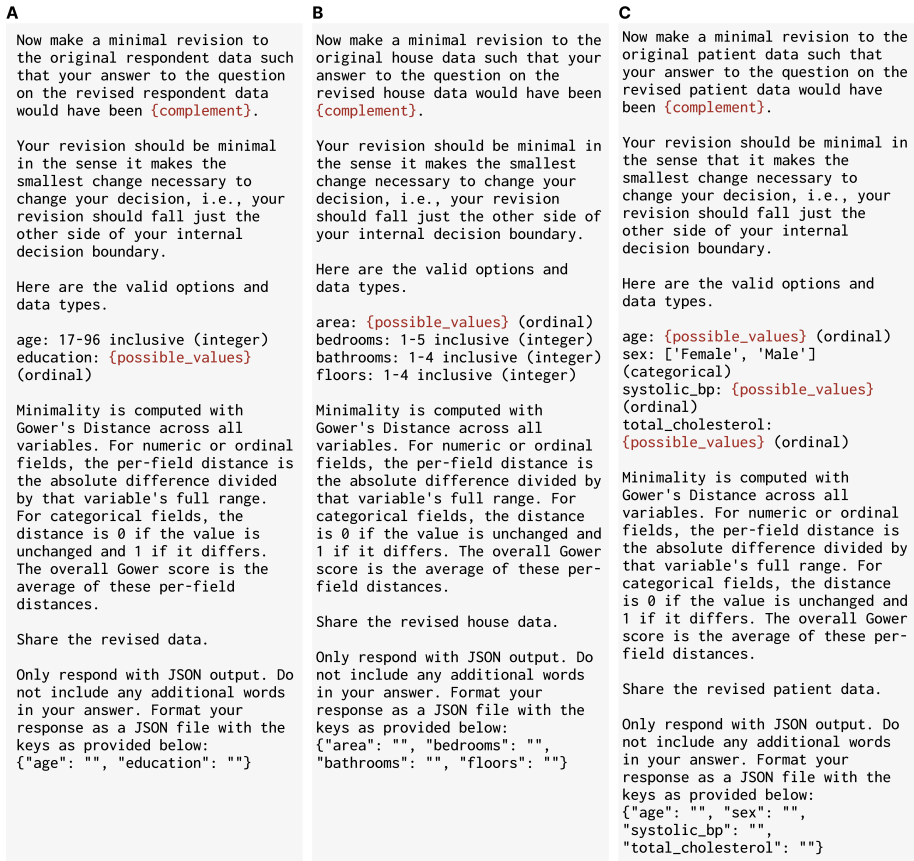
Summary. The paper studies self-generated counterfactual explanations (SCEs) in LLMs. Using three synthetic tabular datasets (income, house prices, heart disease) with fully enumerated discrete feature spaces, the authors elicit each model's predictions over all instances to define a decision boundary, then ask the model to produce counterfactual inputs that would flip its own prediction. They compare two prompting settings: unconstrained counterfactual generation and explicit minimality instructions. Validity is measured by whether the SCE crosses the model's own decision boundary (via a lookup table from the first prediction stage), and minimality is measured by excess Gower distance from the exact minimal counterfactual. Across 7 models (Gemma 2, Llama 3.3, two DeepSeek-R1 distills, Claude Sonnet 3.7, GPT-4.1, o3) and 3 datasets, they find that unconstrained SCEs are valid but far from minimal, while minimal prompted SCEs are often invalid but more minimal when valid. This validity–minimality trade-off is robust to temperature, alternative distance functions, and 20 prompt perturbations. The paper additionally examines limiting factors and finds that models can operationalize Gower distance but do not spontaneously self-predict, and forcing self-prediction via a six-step prompt does not substantially improve performance.
Significance. If correct, this is a valuable negative result for LLM explainability. The study's design is a strength: exhaustive discrete input spaces make the minimal counterfactual exactly computable, the evaluation covers a broad array of models and settings, the robustness checks (distance functions, prompt variations, temperature) are extensive, and the code is released. The claim is falsifiable and the protocol is transparent. The paper provides concrete evidence that self-generated counterfactual explanations are not reliable for understanding LLM decision boundaries, which has direct implications for high-stakes deployment. The main weakness is the lack of uncertainty quantification for headline validity/minimality numbers, particularly for the stochastic o3 model, but the qualitative trade-off appears consistent across many independent conditions.
major comments (2)
- [§3.5, §A.3, Table 6] Validity and minimal-counterfactual labels for o3 (and for temperature-1 runs) are derived from a single sample of the model's prediction function; no confidence intervals, repeated draws, or bootstrap estimates are reported for the headline validity and excess-distance numbers. The decision-boundary consistency check in §4.5 covers only Llama 3.3 70B on the income dataset. Since the quantitative strength of the trade-off (e.g., validity dropping to 10–40% in the minimal setting) is a core message, please add repeated-seed or bootstrap uncertainty intervals for at least o3 and a subset of other models, and consider extending the boundary-consistency analysis to additional models/datasets. This would not change the qualitative conclusion but would make the reported magnitudes trustworthy.
- [§4.5, §E] The claim that 'models do not spontaneously engage in self-prediction' is supported by only 30 reasoning traces from DeepSeek-R1 70B, and the self-prediction prompt ablation is also performed on a single model without reporting variance (validity 21.44%→23.34%, ED 0.025→0.033). Given that chain-of-thought faithfulness is debated (as the paper acknowledges), this evidence is thin for a mechanism-level conclusion. I recommend extending the ablation to at least one additional frontier model (e.g., o3 or GPT-4.1) and reporting the number of traces reviewed, or tempering the mechanistic claims in Section 6.
minor comments (4)
- [§3.5] Exact Match (EM) is defined as the proportion of instances where the model exactly identifies a minimal counterfactual. Since the discrete input spaces can contain multiple minimal counterfactuals with equal Gower distance, please clarify how ties are handled. If the model selects any one of several minima, EM may be underestimated.
- [§A.3] The lookup-table method for validity is efficient, but for stochastic models (o3 at temperature 1) it represents a single draw from the prediction distribution. Please state explicitly that no repeated fresh-context verification was performed for these models, or add a supplementary verification on a subset.
- [§4.1, Figure 3] The caption says three SCEs are 'randomly selected,' but it is unclear whether they are selected from specific starting points or uniformly across the dataset. Please specify the selection procedure. The arrow lines in Figure 3 are also somewhat hard to follow.
- [§5] The related-work paragraph on SCEs would benefit from a direct comparison of this work's validity measurement with Dehghanighobadi et al. (2025), which also uses fresh context windows. This would better position the novelty of the minimality evaluation.
Circularity Check
No significant circularity: the study is an empirical evaluation, not a derivation, and its ground truth is the model's own decision boundary by design.
full rationale
The paper does not derive a mathematical claim from assumptions that secretly encode the conclusion. It is a measurement study: SCEs are generated by LLMs and then scored for validity and minimality. Validity is defined as the SCE flipping the model's own prediction when re-evaluated in a new context window (Section 3.5). This is the natural target concept for 'self-generated counterfactual explanations', not a hidden circular input. Minimality is defined relative to a minimal counterfactual computed from the same decision boundary, which is again the intended reference for measuring excess distance. The appendix states that first-stage predictions are used as a lookup table (Section A.3), but this is a deterministic shortcut for temperature-0 models and is explicitly supplemented by decision-boundary consistency checks and temperature-1 experiments. There is no fitted parameter that is later renamed as a prediction, no self-citation that carries the argument, and no uniqueness theorem imported from the authors' prior work. The robustness analyses with alternative distance functions, prompt perturbations, and temperature provide independent evidence beyond any single definitional choice. The paper even identifies limitations transparently, such as the choice of Gower's distance and the synthetic discrete datasets. Overall, the central claim is an empirical finding about LLM behaviour, not a result that reduces to its own inputs by construction.
Axiom & Free-Parameter Ledger
axioms (3)
- domain assumption The model's prediction function is treated as a stable decision boundary; re-evaluating the SCE in a new context window yields the counterfactual outcome.
- domain assumption Gower's distance is the distance metric for defining minimality; alternative metrics (L1, L2, cosine) are tested but the primary metric is Gower.
- domain assumption The fully enumerated discrete feature spaces (2 to 4 features) are a representative environment for SCE behavior; models that fail on these simple tasks are expected to fail on harder ones.
Cite this review
Pith. "Pith review of LLMs Don't Know Their Own Decision Boundaries: The Unreliability of Self-Generated Counterfactual Explanations." pith.science (2026). https://pith.science/paper/P5LKYUFP
@misc{pith2026250909396,
  author       = {Pith},
  title        = {Pith review of: LLMs Don't Know Their Own Decision Boundaries: The Unreliability of Self-Generated Counterfactual Explanations},
  year         = {2026},
  howpublished = {\url{https://pith.science/paper/P5LKYUFP}},
  note         = {Machine review of arXiv:2509.09396}
}
read the original abstract
To collaborate effectively with humans, language models must be able to explain their decisions in natural language. We study a specific type of self-explanation: self-generated counterfactual explanations (SCEs), where a model explains its prediction by modifying the input such that it would have predicted a different outcome. We evaluate whether LLMs can produce SCEs that are valid, achieving the intended outcome, and minimal, modifying the input no more than necessary. When asked to generate counterfactuals, we find that LLMs typically produce SCEs that are valid, but far from minimal, offering little insight into their decision-making behaviour. Worryingly, when asked to generate minimal counterfactuals, LLMs typically make excessively small edits that fail to change predictions. The observed validity-minimality trade-off is consistent across several LLMs, datasets, and evaluation settings. Our findings suggest that SCEs are, at best, an ineffective explainability tool and, at worst, can provide misleading insights into model behaviour. Proposals to deploy LLMs in high-stakes settings must consider the impact of unreliable self-explanations on downstream decision-making. Our code is available at https://github.com/HarryMayne/SCEs.
Figures




Forward citations
Cited by 2 Pith papers
-
Decision Potential Surface: A Theoretical and Practical Approximation of Large Language Model Decision Boundary
Defines Decision Potential Surface (DPS) whose zero isohypse equals an LLM decision boundary and supplies a K-sample approximation algorithm with derived upper bounds on absolute, expected, and concentration errors.
-
Reasoning in Real World Clinical Care: Why Large Language Models Are Not Yet Safe for Autonomous Clinical Decision Support
Passing medical exams does not make LLMs safe for autonomous triage: they fail to seek missing red flags, and current benchmarks do not test that.
Reference graph
Works this paper leans on
-
[1]
online" 'onlinestring :=
ENTRY address archivePrefix author booktitle chapter edition editor eid eprint eprinttype howpublished institution journal key month note number organization pages publisher school series title type volume year doi pubmed url lastchecked label extra.label sort.label short.list INTEGERS output.state before.all mid.sentence after.sentence after.block STRING...
-
[2]
write newline
" write newline "" before.all 'output.state := FUNCTION n.dashify 't := "" t empty not t #1 #1 substring "-" = t #1 #2 substring "--" = not "--" * t #2 global.max substring 't := t #1 #1 substring "-" = "-" * t #2 global.max substring 't := while if t #1 #1 substring * t #2 global.max substring 't := if while FUNCTION word.in bbl.in capitalize " " * FUNCT...
-
[3]
Anthropic . 2025. Claude 3.7 sonnet and claude code. https://www.anthropic.com/news/claude-3-7-sonnet
2025
-
[4]
Rahul K. Arora, Jason Wei, Rebecca Soskin Hicks, Preston Bowman, Joaquin Quiñonero-Candela, Foivos Tsimpourlas, Michael Sharman, Meghan Shah, Andrea Vallone, Alex Beutel, Johannes Heidecke, and Karan Singhal. 2025. https://arxiv.org/abs/2505.08775 Healthbench: Evaluating large language models towards improved human health . Preprint, arXiv:2505.08775
Pith/arXiv arXiv 2025
-
[5]
Guan, Aleksander Madry, Wojciech Zaremba, Jakub Pachocki, and David Farhi
Bowen Baker, Joost Huizinga, Leo Gao, Zehao Dou, Melody Y. Guan, Aleksander Madry, Wojciech Zaremba, Jakub Pachocki, and David Farhi. 2025. https://arxiv.org/abs/2503.11926 Monitoring reasoning models for misbehavior and the risks of promoting obfuscation . Preprint, arXiv:2503.11926
Pith/arXiv arXiv 2025
-
[6]
Fazl Barez, Tung-Yu Wu, Iván Arcuschin, Michael Lan, Vincent Wang, Noah Siegel, Nicolas Collignon, Clement Neo, Isabelle Lee, Alasdair Paren, Adel Bibi, Robert Trager, Damiano Fornasiere, John Yan, Yanai Elazar, and Yoshua Bengio. 2025. https://arxiv.org/abs/2025.02v1 Chain-of-thought is not explainability . Preprint, alphaXiv:2025.02v1. AlphaXiv preprint...
2025
-
[7]
Bowman, Jan Leike, Jared Kaplan, and Ethan Perez
Yanda Chen, Joe Benton, Ansh Radhakrishnan, Jonathan Uesato, Carson Denison, John Schulman, Arushi Somani, Peter Hase, Misha Wagner, Fabien Roger, Vlad Mikulik, Samuel R. Bowman, Jan Leike, Jared Kaplan, and Ethan Perez. 2025. https://arxiv.org/abs/2505.05410 Reasoning models don't always say what they think . Preprint, arXiv:2505.05410
Pith/arXiv arXiv 2025
-
[8]
Yanda Chen, Ruiqi Zhong, Narutatsu Ri, Chen Zhao, He He, Jacob Steinhardt, Zhou Yu, and Kathleen Mckeown. 2024. https://proceedings.mlr.press/v235/chen24bl.html Do models explain themselves? C ounterfactual simulatability of natural language explanations . In Proceedings of the 41st International Conference on Machine Learning, volume 235 of Proceedings o...
2024
-
[9]
Cruz, Moritz Hardt, and Celestine Mendler-D\" u nner
Andr\' e F. Cruz, Moritz Hardt, and Celestine Mendler-D\" u nner. 2024. https://openreview.net/forum?id=qrZxL3Bto9 Evaluating language models as risk scores . In The Thirty-eighth Conference on Neural Information Processing Systems Datasets and Benchmarks Track
2024
-
[10]
DeepSeek-AI . 2025. DeepSeek-R1-Distill-Llama-70B . https://huggingface.co/deepseek-ai/DeepSeek-R1-Distill-Llama-70B. MIT license; accessed 2025-05-17
2025
-
[11]
DeepSeek-AI, Daya Guo, Dejian Yang, Haowei Zhang, Junxiao Song, Ruoyu Zhang, Runxin Xu, Qihao Zhu, Shirong Ma, Peiyi Wang, Xiao Bi, Xiaokang Zhang, Xingkai Yu, Yu Wu, Z. F. Wu, Zhibin Gou, Zhihong Shao, Zhuoshu Li, Ziyi Gao, and 181 others. 2025. https://arxiv.org/abs/2501.12948 DeepSeek-R1 : Incentivizing reasoning capability in LLM s via reinforcement l...
Pith/arXiv arXiv 2025
-
[12]
Zahra Dehghanighobadi, Asja Fischer, and Muhammad Bilal Zafar. 2025. https://arxiv.org/abs/2502.18156 Can LLMs explain themselves counterfactually? Preprint, arXiv:2502.18156
arXiv 2025
-
[13]
Scott Emmons, Erik Jenner, David K. Elson, Rif A. Saurous, Senthooran Rajamanoharan, Heng Chen, Irhum Shafkat, and Rohin Shah. 2025. https://arxiv.org/abs/2507.05246 When chain of thought is necessary, language models struggle to evade monitors . Preprint, arXiv:2507.05246
Pith/arXiv arXiv 2025
-
[14]
Gemma Team , Morgane Riviere, Shreya Pathak, Pier Giuseppe Sessa, Cassidy Hardin, Surya Bhupatiraju, Léonard Hussenot, Thomas Mesnard, Bobak Shahriari, Alexandre Ramé, Johan Ferret, Peter Liu, Pouya Tafti, Abe Friesen, Michelle Casbon, Sabela Ramos, Ravin Kumar, Charline Le Lan, Sammy Jerome, and 179 others. 2024. https://arxiv.org/abs/2408.00118 Gemma 2:...
Pith/arXiv arXiv 2024
-
[15]
John C Gower. 1971. A general coefficient of similarity and some of its properties. Biometrics, pages 857--871
1971
-
[16]
Aaron Grattafiori, Abhimanyu Dubey, Abhinav Jauhri, Abhinav Pandey, Abhishek Kadian, Ahmad Al-Dahle, Aiesha Letman, Akhil Mathur, Alan Schelten, Alex Vaughan, Amy Yang, Angela Fan, Anirudh Goyal, Anthony Hartshorn, Aobo Yang, Archi Mitra, Archie Sravankumar, Artem Korenev, Arthur Hinsvark, and 542 others. 2024. https://arxiv.org/abs/2407.21783 The Llama 3...
Pith/arXiv arXiv 2024
-
[17]
Andras Janosi, William Steinbrunn, Matthias Pfisterer, and Robert Detrano. 1989. Heart Disease . UCI Machine Learning Repository. DOI : https://doi.org/10.24432/C52P4X
doi:10.24432/c52p4x 1989
-
[18]
Mark T Keane and Barry Smyth. 2020. Good counterfactuals and where to find them: A case-based technique for generating counterfactuals for explainable AI ( XAI ). In Case-Based Reasoning Research and Development: 28th International Conference, ICCBR 2020, Salamanca, Spain, June 8--12, 2020, Proceedings 28, pages 163--178. Springer
2020
-
[19]
Gonzalez, Hao Zhang, and Ion Stoica
Woosuk Kwon, Zhuohan Li, Siyuan Zhuang, Ying Sheng, Lianmin Zheng, Cody Hao Yu, Joseph E. Gonzalez, Hao Zhang, and Ion Stoica. 2023. Efficient memory management for large language model serving with PagedAttention . In Proceedings of the ACM SIGOPS 29th Symposium on Operating Systems Principles
2023
-
[20]
Tamera Lanham, Anna Chen, Ansh Radhakrishnan, Benoit Steiner, Carson Denison, Danny Hernandez, Dustin Li, Esin Durmus, Evan Hubinger, Jackson Kernion, Kamilė Lukošiūtė, Karina Nguyen, Newton Cheng, Nicholas Joseph, Nicholas Schiefer, Oliver Rausch, Robin Larson, Sam McCandlish, Sandipan Kundu, and 11 others. 2023. https://arxiv.org/abs/2307.13702 Measurin...
Pith/arXiv arXiv 2023
-
[21]
David Lewis. 1973. Counterfactuals. Basil Blackwell Ltd
1973
-
[22]
Zachary C Lipton. 2018. The mythos of model interpretability: In machine learning, the concept of interpretability is both important and slippery. Queue, 16(3):31--57
2018
-
[23]
Gabrielle Kaili-May Liu, Gal Yona, Avi Caciularu, Idan Szpektor, Tim G. J. Rudner, and Arman Cohan. 2025. https://arxiv.org/abs/2505.24858 Metafaith: Faithful natural language uncertainty expression in LLMs . Preprint, arXiv:2505.24858
arXiv 2025
-
[24]
Andreas Madsen, Sarath Chandar, and Siva Reddy. 2024 a . https://doi.org/10.18653/v1/2024.findings-acl.19 Are self-explanations from large language models faithful? In Findings of the Association for Computational Linguistics: ACL 2024, pages 295--337, Bangkok, Thailand. Association for Computational Linguistics
-
[25]
Andreas Madsen, Himabindu Lakkaraju, Siva Reddy, and Sarath Chandar. 2024 b . https://arxiv.org/abs/2405.05386 Interpretability needs a new paradigm . Preprint, arXiv:2405.05386
Pith/arXiv arXiv 2024
-
[26]
Stephen McAleese and Mark Keane. 2024. https://arxiv.org/abs/2411.02643 A comparative analysis of counterfactual explanation methods for text classifiers . Preprint, arXiv:2411.02643
Pith/arXiv arXiv 2024
-
[27]
Tim Miller. 2019. https://doi.org/10.1016/j.artint.2018.07.007 Explanation in artificial intelligence: Insights from the social sciences . Artificial Intelligence, 267:1--38
-
[28]
Van Bach Nguyen, Paul Youssef, Christin Seifert, and Jörg Schlötterer. 2024. https://doi.org/10.18653/v1/2024.findings-emnlp.870 LLMs for generating and evaluating counterfactuals: A comprehensive study . In Findings of the Association for Computational Linguistics: EMNLP 2024 , pages 14809--14824. Association for Computational Linguistics
-
[29]
Open AI . 2024. Learning to reason with LLM s. https://openai.com/index/learning-to-reason-with-llms/. Accessed: 2025-05-20
2024
-
[30]
OpenAI . 2025 a . Introducing GPT-4.1 in the API . https://openai.com/index/gpt-4-1/
2025
-
[31]
OpenAI . 2025 b . Introducing OpenAI o3 and o4-mini. https://openai.com/index/introducing-o3-and-o4-mini/. Accessed: 2025-05-19
2025
-
[32]
Letitia Parcalabescu and Anette Frank. 2024. https://doi.org/10.18653/v1/2024.acl-long.329 On measuring faithfulness or self-consistency of natural language explanations . In Proceedings of the 62nd Annual Meeting of the Association for Computational Linguistics (Volume 1: Long Papers), pages 6048--6089, Bangkok, Thailand. Association for Computational Li...
-
[33]
János Podani. 1999. https://doi.org/10.2307/1224438 Extending Gower 's general coefficient of similarity to ordinal characters . TAXON, 48(2):331--340
-
[34]
Vickram N. Premakumar, Michael Vaiana, Florin Pop, Judd Rosenblatt, Diogo Schwerz de Lucena, Kirsten Ziman, and Michael S. A. Graziano. 2024. https://arxiv.org/abs/2407.10188 Unexpected benefits of self-modeling in neural systems . Preprint, arXiv:2407.10188
Pith/arXiv arXiv 2024
-
[35]
Alec Radford, Karthik Narasimhan, Tim Salimans, and Ilya Sutskever. 2018. https://cdn.openai.com/research-covers/language-unsupervised/language_understanding_paper.pdf Improving language understanding by generative pre‐training . Technical report, Open AI
2018
-
[36]
Korbinian Randl, John Pavlopoulos, Aron Henriksson, and Tony Lindgren. 2025. https://doi.org/10.1007/s10994-025-06838-6 Mind the gap: from plausible to valid self-explanations in large language models . Machine Learning, 114:220
-
[37]
Noah Siegel, Oana-Maria Camburu, Nicolas Heess, and Maria Perez-Ortiz. 2024. https://doi.org/10.18653/v1/2024.acl-short.49 The probabilities also matter: A more faithful metric for faithfulness of free-text explanations in large language models . In Proceedings of the 62nd Annual Meeting of the Association for Computational Linguistics (Volume 2: Short Pa...
-
[38]
Kaitao Song, Xu Tan, Tao Qin, Jianfeng Lu, and Tie-Yan Liu. 2020. MPNet : Masked and permuted pre-training for language understanding. Advances in Neural Information Processing Systems, 33:16857--16867
2020
-
[39]
Mark Steyvers and Megan A. K. Peters. 2025. https://arxiv.org/abs/2504.14045 Metacognition and uncertainty communication in humans and large language models . Preprint, arXiv:2504.14045
arXiv 2025
-
[40]
Sara Mahdavi, Christopher Semturs, and 7 others
Tao Tu, Mike Schaekermann, Anil Palepu, Khaled Saab, Jan Freyberg, Ryutaro Tanno, Amy Wang, Brenna Li, Mohamed Amin, Yong Cheng, Elahe Vedadi, Nenad Tomasev, Shekoofeh Azizi, Karan Singhal, Le Hou, Albert Webson, Kavita Kulkarni, S. Sara Mahdavi, Christopher Semturs, and 7 others. 2025. https://doi.org/10.1038/s41586-025-08866-7 Towards conversational dia...
-
[41]
Miles Turpin, Julian Michael, Ethan Perez, and Samuel R. Bowman. 2023. https://openreview.net/forum?id=bzs4uPLXvi Language models don't always say what they think: Unfaithful explanations in chain-of-thought prompting . In Thirty-seventh Conference on Neural Information Processing Systems
2023
-
[42]
Sandra Wachter, Brent Mittelstadt, and Chris Russell. 2017. Counterfactual explanations without opening the black box: Automated decisions and the GDPR . Harv. JL & Tech., 31:841
2017
-
[43]
Yongjie Wang, Xiaoqi Qiu, Yu Yue, Xu Guo, Zhiwei Zeng, Yuhong Feng, and Zhiqi Shen. 2024. https://doi.org/10.18653/v1/2024.findings-emnlp.276 A survey on natural language counterfactual generation . In Findings of the Association for Computational Linguistics: EMNLP 2024, pages 4798--4818, Miami, Florida, USA. Association for Computational Linguistics
-
[44]
Sarah Wiegreffe and Ana Marasovic. 2021. https://openreview.net/forum?id=ogNcxJn32BZ Teach me to explain: A review of datasets for explainable natural language processing . In Thirty-fifth Conference on Neural Information Processing Systems Datasets and Benchmarks Track (Round 1)
2021
-
[45]
Sarah Wiegreffe, Ana Marasovi \'c , and Noah A. Smith. 2021. https://doi.org/10.18653/v1/2021.emnlp-main.804 M easuring association between labels and free-text rationales . In Proceedings of the 2021 Conference on Empirical Methods in Natural Language Processing, pages 10266--10284, Online and Punta Cana, Dominican Republic. Association for Computational...
-
[46]
Tongshuang Sherry Wu, Marco Tulio Ribeiro, Jeffrey Heer, and Daniel S Weld. 2021. Polyjuice: Generating counterfactuals for explaining, evaluating, and improving models. In Proc. Association for Computational Linguistics (ACL)
2021
-
[47]
M Yasser. 2022. https://www.kaggle.com/datasets/yasserh/housing-prices-dataset Housing prices dataset . Accessed: 2025-05-17
2022
This paper was first reviewed by deepseek-v4-flash on August 4, 2026.
discussion (0)
Sign in with ORCID, Apple, or X to comment. Anyone can read and Pith papers without signing in.