REVIEW 4 major objections 4 minor 1 cited by
A multimodal retrieval-augmented generation system pairs post-disaster photos with insurance policy text, reporting a 9.6 percentage-point Top-1 retrieval gain and 0.900 Macro-F1 over four baselines.
Reviewed by Pith at T0; open to challenge. T0 means a machine referee read the full paper against a public rubric. the ladder, T0–T4 →
T0 review · deepseek-v4-flash
2026-08-04 20:58 UTC pith:4VYFJAUT
load-bearing objection Plausible framework, but the headline number is unverifiable and the paper needs a major experimental rewrite before review. the 4 major comments →
A Multimodal RAG Framework for Housing Damage Assessment: Collaborative Optimization of Image Encoding and Policy Vector Retrieval
The pith
A machine-rendered reading of the paper's core claim, the machinery that carries it, and where it could break.
Core claim
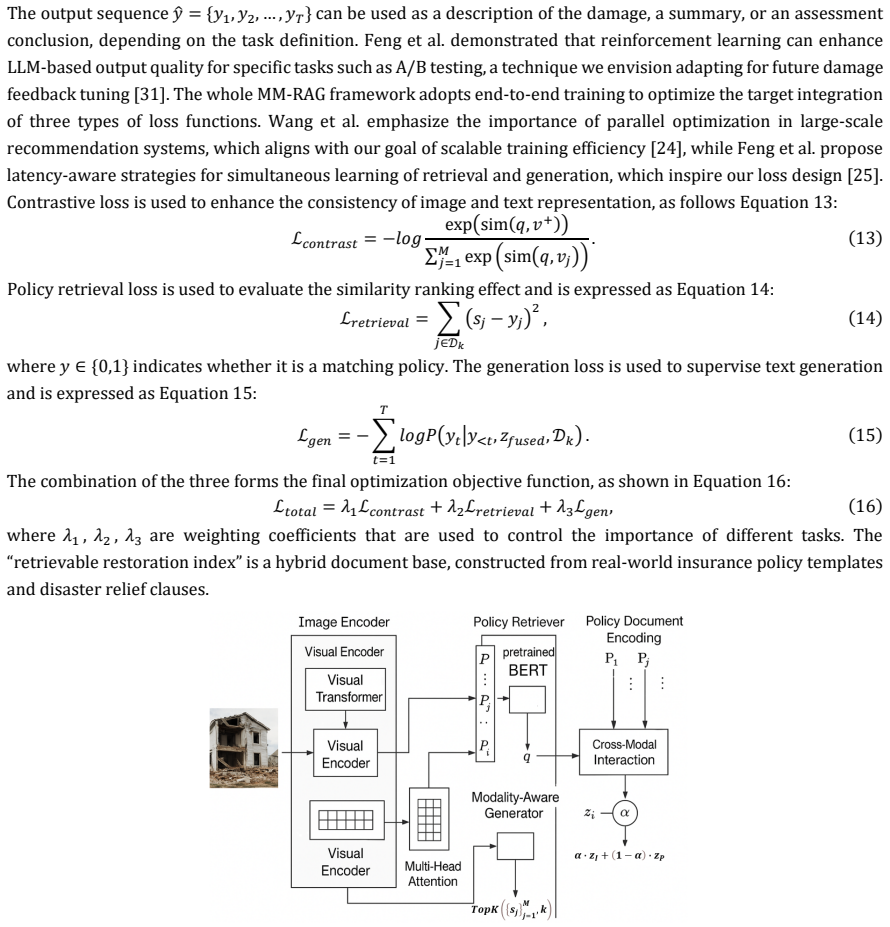
The central claim is that end-to-end multi-task training—contrastive image-policy alignment, supervised policy retrieval, and policy-grounded text generation—makes a multimodal RAG model better at both damage classification and policy matching than any of the four baselines, including a text-only RAG model and a late-fusion ResNet+BERT model. The ablation attributes 3.8 Macro-F1 points of the gain to the modal attention gating mechanism; retrieval accuracy grows with embedding dimension and Top-k width but with diminishing returns.
What carries the argument
The load-bearing machinery is the two-branch encoder plus a learned gate. The image branch converts a post-disaster photo into patch embeddings with ResNet and then a Transformer; the text branch converts each policy document into a fixed BERT vector, forming a retrievable restoration index. A cross-modal interaction module with multi-head attention aligns image and policy vectors, a sigmoid gate computes a scalar α = σ(W[z_I; z_P]+b), and the generator fuses α·z_I + (1−α)·z_P with retrieved documents to produce the assessment. The gate is the component that dynamically controls how much visual evidence versus text prior drives each output.
Load-bearing premise
The paper's results rest on the constructed xBD+Policy dataset being a valid proxy for real post-disaster insurance assessment, with correct image-policy matches and damage labels; the dataset is not released, and no external standard is used to validate it.
What would settle it
Release xBD+Policy (or replace it with an independently labeled post-disaster benchmark), run MM-RAG against the same four baselines, and compare Top-1 retrieval accuracy and Macro-F1; if the 9.6-percentage-point retrieval gain and 0.900 Macro-F1 do not reproduce, the central claim fails.
If this is right
- A single model can simultaneously return a damage severity grade and the insurance policy clause that applies to that grade.
- Fine-tuning with 60% of the training data already pushes MM-RAG above 0.87 accuracy, so high performance may be reachable with less labeled material than unimodal baselines.
- Widening policy retrieval from Top-1 to Top-20 candidates improves Macro-F1 for every method, but gains shrink, so a small candidate set is enough.
- Removing the attention gating mechanism costs 3.8 Macro-F1 points, identifying dynamic visual/text weighting as a measurable source of accuracy and stability.
Where Pith is reading between the lines
- Because policy vectors are encoded separately and then retrieved, the architecture implies that insurers could update or extend their policy index without retraining the visual encoder—a deployment option the paper does not discuss.
- The 9.6% Top-1 gain is measured on a dataset the authors constructed and did not release; whether it generalizes to other disaster imagery, policy languages, or regulatory regimes is an open question this paper does not answer.
- The same two-branch retrieve-then-fuse design could be applied to other photo-to-clause decisions, such as building-code compliance checks or flood-insurance underwriting from field photos; that is a testable extension, not a paper claim.
Editorial analysis
A structured set of objections, weighed in public.
Referee Report
Summary. The paper proposes MM-RAG, a multimodal retrieval-augmented generation framework for post-disaster housing damage assessment. It combines a ResNet-Transformer image encoder, a BERT-based policy document retriever, cross-modal attention, and a gated generator, optimized with contrastive, retrieval, and generation losses. Experiments on a self-constructed xBD+Policy dataset are reported for damage-level classification accuracy, Macro-F1, and retrieval accuracy, with the abstract claiming a 9.6% improvement in Top-1 retrieval accuracy over baselines.
Significance. If the empirical claims were substantiated, the work would address a relevant practical problem: linking visual building damage to insurance policy text for faster claims processing. The architecture is a plausible integration of established components (ResNet, Transformer, BERT, cross-modal attention, multi-task loss), and the multi-task formulation is standard. However, the current manuscript does not provide enough evidence to support the headline improvement: no code or data release, no Top-1 retrieval results, no dataset construction protocol, and several internal inconsistencies in the experimental reporting. The central idea is reasonable but the validation is incomplete.
major comments (4)
- [Abstract and §4.2 (Table 1)] The abstract claims a 9.6% Top-1 retrieval accuracy improvement, but Table 1 reports only Top-5 retrieval accuracy for embedding dimensions 64–512. No Top-1 results are given anywhere, and the 9.6% figure is not tied to any table or baseline. Furthermore, the text states that MM-RAG 'jumps from 0.82 to 0.94' as the embedding dimension increases to 768, but the table ends at 512 (0.92). The headline result is therefore unverifiable as written. Please report Top-1 results with clear baselines, or revise the claim.
- [§4.1 (xBD+Policy dataset)] The xBD+Policy dataset is constructed by the authors from xBD images and insurance policy templates, but the paper never specifies how image–policy pairs are created, how many distinct policies exist, how many images share a policy, or whether policy templates encode damage-level clues (e.g., coverage limits tied to severity). If the pairing is generated from the damage labels, the retrieval task collapses into damage classification and the reported retrieval accuracy is circular. The dataset is not released, and no external validation or annotator agreement is provided. A detailed construction protocol, statistics, and ideally a release or cross-check against an external assessment standard are required to support the central claim.
- [§3.1–3.2 (Equations 2, 6, 13, 15)] Several load-bearing equations are incorrect or ambiguous. In Eq. (2), R = H_p · W_p is called the number of patches, but Eq. (1) uses N for the number of patch embeddings and Eq. (3) also uses N. In Eq. (6), R is reused for similarity scores, conflicting with its earlier meaning. Eq. (13) lacks the logarithm needed for a contrastive (InfoNCE-style) loss, and Eq. (15) appears to miss a log before the probability. These are notational and mathematical errors that make the method difficult to reproduce. Please correct the equations and also report the loss weighting coefficients λ1, λ2, λ3 and other training hyperparameters.
- [§4.2 (Figures 2–4 and ablation)] The experimental analysis contains internal numerical inconsistencies. In Figure 4, the text states that removing gating gives Macro-F1 0.866 and the complete model gives 0.900, then claims a 'gain of 3.8 percentage points'; the actual difference is 3.4 points. The Visual-Only/Text-Only Macro-F1 scores (0.78/0.74) are quoted in the ablation text but are not shown in Figure 4 or any table. Figure 2 is titled 'with Error Margins,' yet no error bars or statistical tests are described, and no variance information is reported for any experiment. Please provide a consistent set of numbers, error bars, and significance tests.
minor comments (4)
- [General/References] The reference list includes many entries that appear unrelated to the topic (e.g., [14], [21]–[26]) and a large number of arXiv preprints and self-citations. Some are only loosely connected to the method. Please focus the related work on actual multimodal RAG and damage-assessment literature, and verify the citation of [5] and [6] ('Chengd' should likely be 'Cheng').
- [§3.1 (Eqs. 8–9)] Eqs. (8) and (9) use F_I^(i) and F_P^(i), but F_I is defined in Eq. (3) and F_P is not defined. Clarify whether the superscript (i) refers to a layer index and define the text feature sequence.
- [§4.1] The baselines are described only at a high level. For instance, Text-RAG is 'question or description forms a query,' but it is unclear what the query is for the damage images. Provide precise input forms and implementation details for all baselines.
- [Figures] Figures 2–4 lack axis labels and units in several places, and the curves are hard to read in the text. Please ensure all panels are self-contained and legible.
Circularity Check
No significant circularity; empirical claims are measured, not derived from definitions.
full rationale
The paper's central claims are empirical: MM-RAG outperforms baselines on the xBD+Policy dataset in retrieval accuracy and damage classification. The architecture and training objectives are specified in Eqs. 1-16 using standard components (ResNet-Transformer encoder, BERT retriever, cross-modal attention, gating, and multi-task contrastive/retrieval/generation losses). No parameter is fitted to the reported retrieval metric and then renamed as a prediction; the losses optimize image-policy matching and generation, and results are reported as accuracy/F1 on the constructed dataset. Self-citations in the references (e.g., [22], [24], [25], [27]) are motivational or inspirational and are not load-bearing for the framework's derivation or performance claims. The main weaknesses of the paper—the unreleased self-constructed xBD+Policy dataset, the lack of a Top-1 retrieval table despite the abstract's 9.6% claim, and the mismatch between the text's mention of dimension 768/0.94 and Table 1's 512/0.92—are verifiability and correctness concerns, not circularity. No circular step can be exhibited with the required quote-and-reduction evidence, and no derivation reduces to its inputs by construction.
Axiom & Free-Parameter Ledger
free parameters (3)
- Loss weighting coefficients λ1, λ2, λ3 =
not specified
- Top-k retrieval width =
1 to 20
- Embedding dimension =
64 to 768
axioms (3)
- domain assumption The xBD+Policy dataset faithfully pairs images with relevant policies and accurate damage labels.
- domain assumption Retrieved policy documents carry information that improves damage severity classification.
- domain assumption The three losses can be jointly optimized without harmful gradient interference.
invented entities (2)
-
xBD+Policy dataset
no independent evidence
-
Retrievable restoration index
no independent evidence
Cite this review
Pith. "Pith review of A Multimodal RAG Framework for Housing Damage Assessment: Collaborative Optimization of Image Encoding and Policy Vector Retrieval." pith.science (2026). https://pith.science/paper/4VYFJAUT
@misc{pith2026250909721,
  author       = {Pith},
  title        = {Pith review of: A Multimodal RAG Framework for Housing Damage Assessment: Collaborative Optimization of Image Encoding and Policy Vector Retrieval},
  year         = {2026},
  howpublished = {\url{https://pith.science/paper/4VYFJAUT}},
  note         = {Machine review of arXiv:2509.09721}
}
read the original abstract
After natural disasters, accurate evaluations of damage to housing are important for insurance claims response and planning of resources. In this work, we introduce a novel multimodal retrieval-augmented generation (MM-RAG) framework. On top of classical RAG architecture, we further the framework to devise a two-branch multimodal encoder structure that the image branch employs a visual encoder composed of ResNet and Transformer to extract the characteristic of building damage after disaster, and the text branch harnesses a BERT retriever for the text vectorization of posts as well as insurance policies and for the construction of a retrievable restoration index. To impose cross-modal semantic alignment, the model integrates a cross-modal interaction module to bridge the semantic representation between image and text via multi-head attention. Meanwhile, in the generation module, the introduced modal attention gating mechanism dynamically controls the role of visual evidence and text prior information during generation. The entire framework takes end-to-end training, and combines the comparison loss, the retrieval loss and the generation loss to form multi-task optimization objectives, and achieves image understanding and policy matching in collaborative learning. The results demonstrate superior performance in retrieval accuracy and classification index on damage severity, where the Top-1 retrieval accuracy has been improved by 9.6%.
Figures
Forward citations
Cited by 1 Pith paper
-
Graph-Driven Cross-Industry Real-Time Monitoring Framework for Anti-Money Laundering Detection in Converged Mobility-Energy Supply Chain Networks
GCRMF builds a cross-industry heterogeneous graph and applies temporal dual-graph attention with contrastive meta-path reasoning and self-supervised learning to improve AML detection F1 scores by over 17.8% in mobilit...
Reference graph
Works this paper leans on
-
[1]
Chen, Z., & Lim, S. (2021). Social media data -based typhoon disaster assessment. International Journal of Disaster Risk Reduction, 64, 102482
work page 2021
-
[2]
Cook, D. T., Liel, A. B., Haselton, C. B., & Koliou, M. (2022). A framework for operationalizing the assessment of post-earthquake functional recovery of buildings. Earthquake Spectra, 38(3), 1972-2007
work page 2022
-
[3]
B., Atalić, J., Kišiček, T., Uroš, M., Baniček, M., & Novak, M
Stepinac, M., Lourenço, P. B., Atalić, J., Kišiček, T., Uroš, M., Baniček, M., & Novak, M. Š. (2021). Damage classification of residential buildings in historical downtown after the ML5. 5 earthquake in Zagreb, Croatia in
work page 2021
-
[4]
Zhu, X., Liang, J., & Hauptmann, A. (2021). Msnet: A multilevel instance segmentation network for natural disaster damage assessment in aerial videos. In Proceedings of the IEEE/CVF winter conference on applications of computer vision, 2023-2032
work page 2021
-
[5]
KamacI-Karahan, E., & Kemeç, S. (2022). Residents’ satisfaction in post- disaster permanent housing: Beneficiaries vs. non-beneficiaries. International Journal of Disaster Risk Reduction, 73, 102901
work page 2022
-
[6]
Cheng, C. S., Behzadan, A. H., & Noshadravan, A. (2021). Deep learning for post ‐hurricane aerial damage assessment of buildings. Computer‐Aided Civil and Infrastructure Engineering, 36(6), 695-710
work page 2021
-
[7]
Romali, N. S., & Yusop, Z. (2021). Flood damage and risk assessment for urban area in Malaysia. Hydrology Research, 52(1), 142-159
work page 2021
-
[8]
D., Kousky, C., Liao, Y., Nolte, C., Pollack, A
Gourevitch, J. D., Kousky, C., Liao, Y., Nolte, C., Pollack, A. B., Porter, J. R., & Weill, J. A. (2023). Unpriced climate risk and the potential consequences of overvaluation in US housing markets. Nature climate change, 13(3), 250-257
work page 2023
-
[9]
Qin, D., Gao, P., Aslam, F., Sufian, M., & Alabduljabbar, H. (2022). A comprehensive review on fire damage assessment of reinforced concrete structures. Case Studies in Construction Materials, 16, e00843
work page 2022
-
[10]
Günaydin, M., Atmaca, B., Demir, S., Altunişik, A. C., Hüsem, M., Adanur, S., ... & Angin, Z. (2021). Seismic damage assessment of masonry buildings in Elazığ and Malatya following the 2020 Elazığ -Sivrice earthquake, Turkey. Bulletin of Earthquake Engineering, 19, 2421-2456
work page 2021
-
[11]
Rosenheim, N., Guidotti, R., Gardoni, P., & Peacock, W. G. (2021). Integration of detailed household and housing unit characteristic data with critical infrastructure for post -hazard resilience modeling. Sustainable and Resilient Infrastructure, 6(6), 385-401
work page 2021
-
[12]
Khajwal, A. B., & Noshadravan, A. (2021). An uncertainty -aware framework for reliable disaster damage assessment via crowdsourcing. International Journal of Disaster Risk Reduction, 55, 102110
work page 2021
- [13]
-
[14]
Liu, Z. (2022, January 20–22). Stock volatility prediction using LightGBM based algorithm. In 2022 International Conference on Big Data, Information and Computer Network (BDICN) (pp. 283–286). IEEE
work page 2022
-
[15]
Zhang, L., Wang, L., Huang, Y., & Chen, H. (2019). Segmentation of Thoracic Organs at Risk in CT Images Combining Coarse and Fine Network. SegTHOR@ ISBI, 11(16), 2-4
work page 2019
-
[16]
Shih, K., Deng, Z., Chen, X., Zhang, Y., & Zhang, L. (2025, May). DST-GFN: A Dual-Stage Transformer Network with Gated Fusion for Pairwise User Preference Prediction in Dialogue Systems. In 2025 8th International Conference on Advanced Electronic Materials, Computers and Software Engineering (AEMCSE) (pp. 715–719). IEEE
work page 2025
-
[17]
Yang, H., Tian, Y., Yang, Z., Wang, Z., Zhou, C., & Li, D. (2025). Research on Model Parallelism and Data Parallelism Optimization Methods in Large Language Model -Based Recommendation Systems . arXiv preprint arXiv:2506.17551
Pith/arXiv arXiv 2025
-
[18]
Wang, J., Ding, W., & Zhu, X. (2025). Financial analysis: Intelligent financial data analysis system based on llm - rag. arXiv preprint arXiv:2504.06279
Pith/arXiv arXiv 2025
-
[19]
Zhao, Y., Lyu, H., Peng, Y., Sun, A., Jiang, F., & Han, X. (2025). Research on Low -Latency Inference and Training Efficiency Optimization for Graph Neural Network and Large Language Model -Based Recommendation Systems. arXiv preprint arXiv:2507.01035
work page internal anchor Pith review Pith/arXiv arXiv 2025
-
[20]
Xiong, X., Zhang, X., Jiang, W., Liu, T., Liu, Y., & Liu, L. (2024). Lightweight dual-stream SAR-ATR framework based on an attention mechanism -guided heterogeneous graph network. IEEE Journal of Selected Topics in Applied Earth Observations and Remote Sensing, 1–22
work page 2024
-
[21]
Zheng, Z., Liu, K., & Zhu, X. (2025). Machine Learning-Based Prediction of Metal-Organic Framework Materials: A Comparative Analysis of Multiple Models. arXiv preprint arXiv:2507.04493
work page internal anchor Pith review Pith/arXiv arXiv 2025
-
[22]
Dai, Y., Feng, H., Wang, Z., & Gao, Y. (2025). Advanced Large Language Model Ensemble for Multimodal Customer Identification in Banking Marketing. Preprints. https://doi.org/10.20944/preprints202506.0994.v1
arXiv 2025
-
[23]
Haoyang Feng, Yanjun Dai, & Yuan Gao. (2025). A Reinforcement -Learning-Enhanced LLM Framework for Automated A/B Testing in Personalized Marketing. arXiv preprint arXiv:2506.06316
work page internal anchor Pith review Pith/arXiv arXiv 2025
- [24]
- [25]
-
[26]
Yan, Y., Wang, Y., Li, J., Zhang, J., & Mo, X. (2025). Crop yield time-series data prediction based on multiple hybrid machine learning models. arXiv preprint arXiv:2502.10405
work page internal anchor Pith review Pith/arXiv arXiv 2025
-
[27]
Liu, Z. (2025). Human-AI Co -Creation: A Framework for Collaborative Design in Intelligent Systems . arXiv:2507.17774
Pith/arXiv arXiv 2025
-
[2020]
International journal of disaster risk reduction, 56, 102140
discussion (0)
Sign in with ORCID, Apple, or X to comment. Anyone can read and Pith papers without signing in.