REVIEW 3 major objections 6 minor 42 references
ViSTR-GP: Online Cyberattack Detection via Vision-to-State Tensor Regression and Gaussian Processes in Automated Robotic Operations
T0 review · 3 major / 6 minor · reviewed 2026-08-04 · deepseek-v4-flash
Pith's one-line read A fixed overhead camera, a low-rank vision-to-joint surrogate, and a Gaussian residual model can catch replay attacks on industrial robots with end-effector deviations as small as 0.2 cm.
desk verdict A coherent camera-based side-channel detector for replay attacks on robots, but the empirical core needs held-out evaluation before the headline claim holds. read the letter →
The pith
A machine-rendered reading of the paper's core claim, the machinery that carries it, and where it could break.
The reading
What carries the argument
The load-bearing pieces are (1) the bilinear tensor-regression surrogate F_theta(X_t)=B_h X_t B_w, which compresses an HxW foreground mask into a J-vector of joint angles with few parameters; (2) the matrix-variate Gaussian process (MVGP) placed on the T x J residual matrix, whose squared-exponential temporal kernel and J x J column covariance capture both cycle-position dependence and cross-joint correlations; and (3) the frame-wise Mahalanobis statistic, (1/Omega_hat)(r - m_hat)^T Sigma_hat^{-1}(r - m_hat), whose chi-squared_J null distribution turns the predictive distribution into a per-frame alarm rule with a user-set false-alarm level. The TR map provides a low-bias, low-variance visua
What would settle it
Run a replay attack with a 0.1 cm end-effector deviation (or a deviation applied only to a wrist joint, leaving the arm silhouette nearly unchanged) on the same testbed. The paper's claim predicts frequent alarms within a few frames after onset; if the alarm frequency stays near the nominal 0.005 false-alarm rate or the median delay is comparable to the no-attack case, the detection floor is above the claimed subtlety. A second check: evaluate the trained surrogate on a held-out nominal cycle not used for fitting and compare RMSE to the reported in-sample 2.79 degrees.
Extended reading notes
Core claim
The central claim is that encoder-reported joint angles can be verified frame-by-frame against an independent physical channel: an overhead camera. The authors formalize detection as a cross-view residual test. A segmentation-and-tracking pipeline produces a foreground mask for each frame; a low-rank bilinear tensor-regression map F_theta(X) = B_h X B_w converts that mask into a J-dimensional joint-angle estimate. Residuals between reported angles and vision estimates are modeled as a matrix-variate Gaussian process, whose one-step-ahead predictive mean and covariance yield a frame-wise Mahalanobis test statistic that follows a chi-squared distribution under normal operation, giving an inter
Load-bearing premise
The bilinear mask-to-joint-angle map F_theta(X)=B_h X B_w is accurate enough over the robot's operating envelope that genuine 0.2–0.5 cm physical deviations produce residuals that stand out from the model's own prediction error; the paper's support for this is the RMSE computed on the same ten nominal cycles used to fit the map.
Editorial extensions
If this is right
- A plant can deploy the detector with only a fixed camera and a set of nominal operation cycles; no labeled attack data, no robot dynamics model, and no additional instrumentation are required.
- The cross-view residual makes replay attacks visible even when the reported encoder stream is nominal, since the physical deviation shows up in the residual.
- Per-frame chi-squared thresholds give operators an interpretable dial: choose a significance level and know the nominal false-alarm rate, and residual patterns localize which joints deviate.
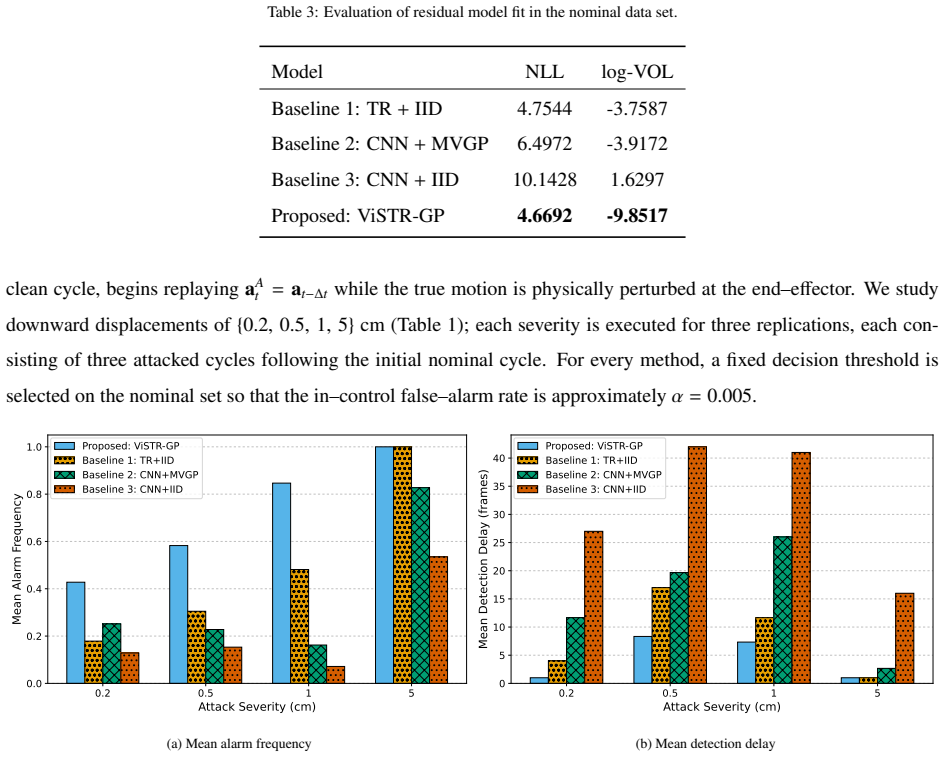
- Detections get faster and denser as attack severity grows, and the method's advantage over baselines is largest at 0.2–0.5 cm deviations—the regime where attacks are visually imperceptible.
- The framework is complementary to existing cyber defenses: it verifies motion physically when network data is untrustworthy.
Reading between the lines
- The paper trains and validates on the same set of ten nominal cycles (in-sample fit), so a natural next experiment is a held-out nominal cycle: if the 2.79 degree RMSE degrades substantially out-of-sample, the residual thresholds would need per-plant calibration, narrowing the claimed portability.
- The same cross-view residual logic should transfer to other low-bandwidth side-channels—motor-current signatures, acoustic fingerprints, or a second camera—which could make the detector robust against an adversary who can spoof one vision channel.
- The method is tailored to repetitive cyclic operations because the MVGP prior mean is the empirical per-frame average over nominal cycles; non-repetitive or free-form tasks would require a different nominal model, such as conditioning on the commanded trajectory.
- A testable lower bound: attack with 0.2 cm deviation in a direction that produces mostly wrist-rotation rather than mask displacement; if alarms stay near the nominal false-alarm rate, the effective sensitivity is limited by mask informativeness, not by the residual statistic.
Editorial analysis
A structured set of objections, weighed in public.
Referee Report
Summary. The paper proposes ViSTR-GP, an online detector of data-integrity attacks on industrial robots. A fixed overhead camera provides an independent side-channel; SAM-Track produces per-frame masks, a low-rank bilinear tensor-regression (TR) map estimates joint angles from each mask, and a matrix-variate Gaussian process (MVGP) models nominal residuals with temporal and cross-joint correlations. A per-frame chi-square statistic tests new residuals against the MVGP predictive distribution. The method is evaluated on a real Yaskawa work-cell with ten nominal cycles and replay attacks with end-effector deviations of 0.2, 0.5, 1, and 5 cm, and is compared with three baselines (TR+IID, CNN+MVGP, CNN+IID). The authors claim the framework recovers joint angles more accurately than a compact CNN and detects attacks earlier and with more frequent alarms, especially for the most subtle attacks.
Significance. If the empirical claims hold, this is a practically valuable contribution: it offers a low-cost side-channel defense that requires no labeled attack data, no high-fidelity dynamics models, and only one fixed camera beyond the existing infrastructure. The problem formulation is clear, the statistical pipeline is coherent, the decision rule has an interpretable operating point, and the attack scenarios are genuinely out-of-sample with respect to detector training. The use of a real physical testbed with sub-centimeter deviations is a strength, and the ablations (TR vs CNN, MVGP vs IID) are well designed to separate the contributions of the surrogate and residual model. However, the current evaluation does not establish the central claim because the state-estimation accuracy and the residual-model statistics are computed on the same nominal data used to fit the pipeline, no held-out nominal false-alarm rate is reported, and the detection results have no measure of variability. These are fixable with additional experiments, but they are load-bearing for the paper's headline conclusions.
major comments (3)
- [6.3, Table 2] State-estimation accuracy is reported 'on the full nominal data set' (Section 6.3, Table 2), which is the same data used to fit the TR map in Algorithm 1 and to estimate the MVGP parameters in Section 6.2. The CNN baseline, in contrast, is trained on an 80/20 split and evaluated on the validation portion. This unequal evaluation protocol gives TR an in-sample advantage and the reported 55%/58% RMSE/MAE reduction is not evidence of generalization. Please report leave-one-cycle-out or a fixed training/validation split for TR (and for the residual model), with per-fold errors, so that the comparison with CNN is on equal footing.
- [6.1 and 6.3, Fig. 8] All N=10 nominal cycles are used to fit the TR map, the MVGP parameters, and to select the decision threshold g̃_α. No held-out nominal cycles are used to estimate the false-alarm rate. If the MVGP predictive covariance is overfit to the training cycles, an unseen nominal cycle could cross the threshold more often than α=0.005, which would inflate the alarm frequency and shorten the measured detection delay under attack. The paper should evaluate attack cycles using a model trained only on nominal training cycles and report the empirical false-alarm rate on held-out nominal cycles, preferably per-cycle with confidence intervals. This is essential to support the claim that the 0.2 cm detection gains are a real separation of attack from model error rather than an in-sample artifact.
- [6.3, Fig. 8] The detection results in Fig. 8 are means over three replications per severity, with no error bars, no individual values, and no test of differences. At the subtle severities (0.2–0.5 cm), the differences among ViSTR-GP, TR+IID, and CNN+MVGP are visually modest, and with n=3 the claim that improvements are 'most evident in the most subtle attacks' is not statistically supported. Please report per-replication values, standard errors, or a paired comparison (e.g., sign test or bootstrap) across the attacked cycles.
minor comments (6)
- [Eq. (2), Algorithm 1] The notation for B_w is inconsistent: Eq. (2) and the text state B_w∈R^W, but the subsequent derivation (C_w = U_w^T B_w, B_w = (U_w^†)^T C_w) requires B_w to be a column vector in R^W. Please state the dimensions explicitly.
- [Section 4.2, Algorithm 2] The prediction equations in Section 4.2 use a single residual matrix R∈R^{T×J}, while the likelihood is defined over N replications R_i. It is unclear how R in Algorithm 2 is formed from the N training cycles and how the conditional mean uses all training data. Please clarify.
- [Sections 6.1 and 6.3] The threshold is described in Section 6.1 as 'adopted ... from the χ²_J distribution at α=0.005' but in Section 6.3 as 'selected on the nominal set so that the in-control false-alarm rate is approximately α=0.005.' These are different procedures; state which one is used and whether the χ² calibration is only nominal given estimated GP parameters.
- [Figures 9–10 and A.11–A.16] The x-axis extends to 1200 frames while T≈634. The caption/text refers to 'a normal cycle before and an attack cycle after' the attack onset; please clarify whether the plotted interval concatenates two cycles and mark cycle boundaries.
- [Section 1.2, contribution (iii)] The framework is described as 'model-free,' but it uses learned TR and MVGP models. 'Physics-model-free' or 'without high-fidelity physical models' would be more accurate and avoid confusion.
- [Data Availability] The data availability statement says 'available upon request.' For a paper whose central claims are empirical, a public repository (or at least a detailed data description with anonymized access) would substantially strengthen reproducibility.
Circularity Check
No circular derivation; attack detection is evaluated on separate replay cycles, though some accuracy/threshold metrics are in-sample.
full rationale
Walking the derivation chain: Eq. (2)-(6) and Algorithm 1 fit B_h, B_w to minimize reconstruction error over 10 nominal cycles; Section 4.2 fits an MVGP to the resulting nominal residuals; Section 4.3 defines the online test statistic as the Mahalanobis distance under that predictive distribution. The attack experiments in Section 6.3 use replay cycles that are separate from the ten nominal cycles used to fit the TR and MVGP, so the reported detection delays and alarm frequencies are not equal by construction to any training loss or fitted residual. The chi-square threshold is either read from the chi-square_J distribution (Section 4.3) or calibrated to the nominal false-alarm rate (Section 6.2); neither maneuver makes the attack results identical to the inputs. I checked the citation chain: SAM-Track, SAM/DeAOT, Tucker/ALS, and matrix-variate GP are standard external references; there is no load-bearing self-citation or imported uniqueness theorem from the authors' prior work. The main weakness is statistical rather than circular: Table 2 reports 'Frame-wise state-estimation accuracy on the full nominal data set' and Table 3 reports NLL/log-VOL on the same data used for fitting, and the CNN baseline uses an 80/20 split while the TR model does not, so in-sample fit quality and in-control calibration are not held-out estimates. This can inflate the apparent margins but does not reduce the derivation to its inputs; the central attack-detection claim is evaluated on out-of-sample attack cycles. The paper's own limitation statement (Section 7) about a single robot family/task and lack of cumulative statistics is a generalization caveat, not a circularity admission.
Assumptions & free parameters
free parameters (6)
- Tucker decomposition ranks P,Q =
not specified; selected to preserve greater than 95% Frobenius norm
- SE kernel hyperparameters (lengthscale, signal variance) =
estimated by MLE via gradient ascent
- GP noise variance sigma^2 =
estimated by MLE
- Output covariance matrix Sigma (J x J) =
estimated by MLE
- Decision threshold g_tilde_alpha =
significance level alpha=0.005, possibly calibrated to empirical false alarm rate
- Prior mean m(t) =
empirical mean over N=10 nominal runs
assumptions (6)
- domain assumption The overhead camera is tamper-proof and outside the attacker's reach
- domain assumption SAM-Track masks are accurate, stable, and require no tuning beyond one-time initialization
- domain assumption The bilinear map F_theta(X_t)=B_h X_t B_w adequately represents the image-to-joint-angle relationship
- domain assumption Nominal residuals follow a matrix-variate Gaussian process with a squared-exponential kernel and i.i.d. replications
- standard math Under H0, the Mahalanobis distance follows a chi-squared distribution with J degrees of freedom
- domain assumption Camera frames and encoder signals are synchronized at 30 Hz for the full cycle
Cite this review
Pith. "Pith review of ViSTR-GP: Online Cyberattack Detection via Vision-to-State Tensor Regression and Gaussian Processes in Automated Robotic Operations." pith.science (2026). https://pith.science/paper/DQTDK547
@misc{pith2026250910948,
  author       = {Pith},
  title        = {Pith review of: ViSTR-GP: Online Cyberattack Detection via Vision-to-State Tensor Regression and Gaussian Processes in Automated Robotic Operations},
  year         = {2026},
  howpublished = {\url{https://pith.science/paper/DQTDK547}},
  note         = {Machine review of arXiv:2509.10948}
}
read the original abstract
Industrial robotic systems are central to automating smart manufacturing operations. Connected and automated factories face growing cybersecurity risks that can potentially cause interruptions and damages to physical operations. Among these attacks, data-integrity attacks often involve sophisticated exploitation of vulnerabilities that enable an attacker to access and manipulate the operational data and are hence difficult to detect with only existing intrusion detection or model-based detection. This paper addresses the challenges in utilizing existing side-channels to detect data-integrity attacks in robotic manufacturing processes by developing an online detection framework, ViSTR-GP, that cross-checks encoder-reported measurements against a vision-based estimate from an overhead camera outside the controller's authority. In this framework, a one-time interactive segmentation initializes SAM-Track to generate per-frame masks. A low-rank tensor-regression surrogate maps each mask to measurements, while a matrix-variate Gaussian process models nominal residuals, capturing temporal structure and cross-joint correlations. A frame-wise test statistic derived from the predictive distribution provides an online detector with interpretable thresholds. We validate the framework on a real-world robotic testbed with synchronized video frame and encoder data, collecting multiple nominal cycles and constructing replay attack scenarios with graded end-effector deviations. Results on the testbed indicate that the proposed framework recovers joint angles accurately and detects data-integrity attacks earlier with more frequent alarms than all baselines. These improvements are most evident in the most subtle attacks. These results show that plants can detect data-integrity attacks by adding an independent physical channel, bypassing the controller's authority, without needing complex instrumentation.
Figures


Figures from the paper (7 more)





Reference graph
Works this paper leans on
-
[1]
N. Tuptuk, S. Hailes, Security of smart manufacturing systems, Journal of Manufacturing Systems 47 (2018) 93–106.doi:https://doi.org/10.1016/j.jmsy.2018.04.007. URLhttps://www.sciencedirect.com/science/article/pii/S0278612518300463
-
[2]
Z. DeSmit, A. E. Elhabashy, L. J. Wells, J. A. Camelio, An approach to cyber-physical vulnerability assessment for intelligent manufacturing systems, Journal of Manufacturing Systems 43 (2017) 339–351, high Performance Computing and Data Analytics for Cyber Manufacturing.doi:https://doi.org/10.1016/j.jmsy.2017. 03.004. URLhttps://www.sciencedirect.com/sci...
-
[4]
J. P. Farwell, R. Rohozinski, Stuxnet and the future of cyber war, Survival 53 (1) (2011) 23–40.arXiv:https: //doi.org/10.1080/00396338.2011.555586,doi:10.1080/00396338.2011.555586. URLhttps://doi.org/10.1080/00396338.2011.555586
arXiv 2011
-
[5]
R. M. Lee, M. J. Assante, T. Conway, German steel mill cyber attack, Industrial Control Systems 30 (62) (2014) 1–15
2014
-
[6]
B. Williams, M. Soulet, A. Siraj, A taxonomy of cyber attacks in smart manufacturing systems, in: 6th EAI international conference on management of manufacturing systems, Springer, 2022, pp. 77–97.doi:https: //doi.org/10.1007/978-3-030-96314-9_6
- [7]
-
[8]
K. Yang, Y . Zhang, T. Li, L. Sun, Asids: Acoustic side-channel based intrusion detection system for industrial robotic arms, Computers & Security 157 (2025) 104586.doi:https://doi.org/10.1016/j.cose.2025. 104586. URLhttps://www.sciencedirect.com/science/article/pii/S0167404825002755
-
[9]
D. Quarta, M. Pogliani, M. Polino, F. Maggi, A. M. Zanchettin, S. Zanero, An experimental security analysis of an industrial robot controller, in: 2017 IEEE Symposium on Security and Privacy (SP), 2017, pp. 268–286. doi:10.1109/SP.2017.20. 28
Show all 42 references
-
[10]
H. Pu, L. He, P. Cheng, M. Sun, J. Chen, Security of industrial robots: Vulnerabilities, attacks, and mitigations, IEEE Network 37 (1) (2023) 111–117.doi:10.1109/MNET.116.2200034
2023 doi
-
[11]
H. Pu, L. He, C. Zhao, D. K. Y . Yau, P. Cheng, J. Chen, Detecting replay attacks against industrial robots via power fingerprinting, in: Proceedings of the 18th Conference on Embedded Networked Sensor Systems, SenSys ’20, Association for Computing Machinery, New York, NY , US...
2020
-
[12]
H. Pu, L. He, P. Cheng, J. Chen, Y . Sun, Cormand2: A deception attack against industrial robots, Engineering 32 (2024) 186–201.doi:https://doi.org/10.1016/j.eng.2023.01.013. URLhttps://www.sciencedirect.com/science/article/pii/S2095809923001571
2024 doi
-
[13]
E. N. Yolaçan, H. Çav¸ si Zaim, Dcwm-lstm: A novel attack detection framework for robotic arms, IEEE Access 13 (2025) 20547–20560.doi:10.1109/ACCESS.2025.3535225
2025
-
[14]
Y . Zhou, L. Xie, H. Pan, Research on a pso-h-svm-based intrusion detection method for industrial robotic arms, Applied Sciences 12 (6) (2022).doi:10.3390/app12062765. URLhttps://www.mdpi.com/2076-3417/12/6/2765
2022 doi
-
[15]
Santoso, A
F. Santoso, A. Finn, A data-driven cyber–physical system using deep-learning convolutional neural networks: Study on false-data injection attacks in an unmanned ground vehicle under fault-tolerant conditions, IEEE Trans- actions on Systems, Man, and Cybernetics: Systems 53 (1)...
2023 doi
-
[16]
Alemzadeh, D
H. Alemzadeh, D. Chen, X. Li, T. Kesavadas, Z. T. Kalbarczyk, R. K. Iyer, Targeted attacks on teleoperated surgical robots: Dynamic model-based detection and mitigation, in: 2016 46th Annual IEEE/IFIP International Conference on Dependable Systems and Networks (DSN), 2016, pp....
2016 doi
-
[17]
J. B. Hector, P. Katsiaris, N. E. Carey, N. Cote, D. B. Rawat, On the security of cyber-physical robotic sys- tems using dynamic modeling and simulation, in: 2021 IEEE International Conference on Communications Workshops (ICC Workshops), 2021, pp. 1–6.doi:10.1109/ICCWorkshops5...
2021
-
[18]
Longari, J
S. Longari, J. Jannone, M. Polino, M. Carminati, A. Zanchettin, M. Tanelli, S. Zanero, Janus: A trusted execution environment approach for attack detection in industrial robot controllers, IEEE Transactions on Emerging Topics in Computing 13 (1) (2025) 185–195.doi:10.1109/TETC...
2025
-
[19]
Narayanan, R
V . Narayanan, R. B. Bobba, Learning based anomaly detection for industrial arm applications, in: Proceedings of the 2018 Workshop on Cyber-Physical Systems Security and PrivaCy, CPS-SPC ’18, Association for Computing 29 Machinery, New York, NY , USA, 2018, p. 13–23.doi:10.114...
2018
-
[20]
L. Li, X. Zhao, J. Fan, F. Liu, N. Liu, H. Zhao, A trustworthy security model for iiot attacks on industrial robots, Future Generation Computer Systems 153 (2024) 340–349.doi:https://doi.org/10.1016/j.future. 2023.11.027. URLhttps://www.sciencedirect.com/science/article/pii/S0...
2024 doi
-
[21]
X. Shao, L. Xie, C. Li, Z. Wang, A covert attack detection strategy combining physical dynamics and effec- tive features-based stacked transformer for the networked robot systems, Nonlinear Dynamics 112 (21) (2024) 19201–19221.doi:https://doi.org/10.1007/s11071-024-10041-y
2024 doi
-
[22]
Orabi, K
M. Orabi, K. P. Tran, P. Egger, S. Thomassey, Anomaly detection in smart manufacturing: An adaptive adversarial transformer-based model, Journal of Manufacturing Systems 77 (2024) 591–611.doi:https: //doi.org/10.1016/j.jmsy.2024.09.021. URLhttps://www.sciencedirect.com/science...
2024 doi
-
[23]
Zhang, C.-Y
M. Zhang, C.-Y . Chen, B.-C. Kao, Y . Qamsane, Y . Shao, Y . Lin, E. Shi, S. Mohan, K. Barton, J. Moyne, Z. M. Mao, Towards automated safety vetting of plc code in real-world plants, in: 2019 IEEE Symposium on Security and Privacy (SP), 2019, pp. 522–538.doi:10.1109/SP.2019.00034
2019
-
[24]
R. Sun, A. Mera, L. Lu, D. Choffnes, Sok: Attacks on industrial control logic and formal verification-based defenses, in: 2021 IEEE European Symposium on Security and Privacy (EuroS&P), 2021, pp. 385–402.doi: 10.1109/EuroSP51992.2021.00034
2021
-
[25]
H. Pu, L. He, C. Zhao, D. K. Y . Yau, P. Cheng, J. Chen, Fingerprinting movements of industrial robots for replay attack detection, IEEE Transactions on Mobile Computing 21 (10) (2022) 3629–3643.doi:10.1109/TMC. 2021.3059796
2022
-
[26]
G. Song, S. H. Hong, T. Kyzer, Y . Wang, Energy consumption auditing based on a generative adversarial network for anomaly detection of robotic manipulators, Future Generation Computer Systems 149 (2023) 376–389.doi: https://doi.org/10.1016/j.future.2023.07.034. URLhttps://www...
2023 doi
-
[27]
A. A. Mamun, C. Liu, C. Kan, W. Tian, Securing cyber-physical additive manufacturing systems by in-situ process authentication using streamline video analysis, Journal of Manufacturing Systems 62 (2022) 429–440. doi:https://doi.org/10.1016/j.jmsy.2021.12.007. URLhttps://www.sc...
2022 doi
-
[28]
A. K. Shaik, A. Mohammadi, H. Malik, A systematic review of sensor vulnerabilities and cyber-physical threats in industrial robotic systems, IET Cyber-Physical Systems: Theory & Applications 10 (1) (2025) e70023.arXiv:https://ietresearch.onlinelibrary.wiley.com/doi/pdf/10.1049...
2025 doi
-
[29]
J. Wang, P. Fu, R. X. Gao, Machine vision intelligence for product defect inspection based on deep learning and hough transform, Journal of Manufacturing Systems 51 (2019) 52–60.doi:https://doi.org/10.1016/j. jmsy.2019.03.002. URLhttps://www.sciencedirect.com/science/article/p...
2019 doi
-
[30]
K. Roth, L. Pemula, J. Zepeda, B. Schölkopf, T. Brox, P. Gehler, Towards total recall in industrial anomaly detection, in: Proceedings of the IEEE/CVF conference on computer vision and pattern recognition, 2022, pp. 14318–14328
2022
-
[31]
Z. You, L. Cui, Y . Shen, K. Yang, X. Lu, Y . Zheng, X. Le, A unified model for multi-class anomaly detection, Advances in Neural Information Processing Systems 35 (2022) 4571–4584
2022
-
[32]
W. Li, B. Zheng, X. Xu, J. Gan, F. Lu, X. Li, N. Ni, Z. Tian, X. Huang, S. Gao, et al., Multi-sensor object anomaly detection: Unifying appearance, geometry, and internal properties, in: Proceedings of the Computer Vision and Pattern Recognition Conference, 2025, pp. 9984–9993
2025
-
[33]
Schirmer, P
F. Schirmer, P. Kranz, J. Schmitt, T. Kaupp, Anomaly detection for dynamic human-robot assembly: Appli- cation of an lstm-based autoencoder to interpret uncertain human behavior in hrc, in: Companion of the 2023 ACM/IEEE International Conference on Human-Robot Interaction, 202...
2023
-
[34]
Okazaki, K
S. Okazaki, K. Kaminishi, Y . Wang, T. Fujiu, Y . Nakata, S. Hamamoto, K. Yokose, T. Hara, Y . Umeda, J. Ota, A spatio-temporal anomaly detection system to support understanding of abnormal phenomena in automated manufacturing lines, Available at SSRN 5298327 (2025)
2025
-
[35]
Inceoglu, E
A. Inceoglu, E. E. Aksoy, S. Sariel, Multimodal detection and classification of robot manipulation failures, IEEE Robotics and Automation Letters 9 (2) (2023) 1396–1403
2023
-
[36]
T. G. Kolda, B. W. Bader, Tensor decompositions and applications, SIAM Review 51 (3) (2009) 455–500. arXiv:https://doi.org/10.1137/07070111X,doi:10.1137/07070111X. URLhttps://doi.org/10.1137/07070111X
2009 doi
-
[37]
Z. Chen, B. Wang, A. N. Gorban, Multivariate gaussian and student-t process regression for multi-output pre- diction, Neural Computing and Applications 32 (8) (2020) 3005–3028.doi:https://doi.org/10.1007/ s00521-019-04687-8. 31
2020
-
[38]
F. Yan, Z. Xu, Yuan, Qi, Sparse matrix-variate gaussian process blockmodels for network modeling (2012). arXiv:1202.3769. URLhttps://arxiv.org/abs/1202.3769
2012 arXiv
-
[39]
Cheng, L
Y . Cheng, L. Li, Y . Xu, X. Li, Z. Yang, W. Wang, Y . Yang, Segment and track anything, arXiv preprint arXiv:2305.06558 (2023)
2023 arXiv
-
[40]
Kirillov, E
A. Kirillov, E. Mintun, N. Ravi, H. Mao, C. Rolland, L. Gustafson, T. Xiao, S. Whitehead, A. C. Berg, W.-Y . Lo, P. Dollár, R. Girshick, Segment anything, arXiv:2304.02643 (2023)
2023 arXiv
-
[41]
Z. Yang, Y . Yang, Decoupling features in hierarchical propagation for video object segmentation, Advances in Neural Information Processing Systems 35 (2022) 36324–36336
2022
-
[42]
de Leeuw, Block-relaxation algorithms in statistics, in: H.-H
J. de Leeuw, Block-relaxation algorithms in statistics, in: H.-H. Bock, W. Lenski, M. M. Richter (Eds.), Infor- mation Systems and Data Analysis, Springer Berlin Heidelberg, Berlin, Heidelberg, 1994, pp. 308–324
1994
-
[43]
Roberts, M
S. Roberts, M. Osborne, M. Ebden, S. Reece, N. Gibson, S. Aigrain, Gaussian processes for time-series mod- elling, Philosophical Transactions of the Royal Society A: Mathematical, Physical and Engineering Sciences 371 (1984) (2013) 20110550.arXiv:https://royalsocietypublishing...
1984
Reviewed August 4, 2026 · model on record in the stance chip above.
Discussion (0). Sign in to comment.