REVIEW 4 major objections 4 minor 8 cited by
A transformer pre-trained only on tabular regression can drive RL agents without any gradient updates.
Reviewed by Pith at T0; open to challenge. T0 means a machine referee read the full paper against a public rubric. the ladder, T0–T4 →
A pre-trained tabular regression transformer (TabPFN) can act as a Q-function approximator in fitted Q iteration, matching DQN on CartPole, MountainCar, and Acrobot without gradient updates.
T0 review reviewed 2026-08-04 challenge →
load-bearing objection A genuinely new empirical claim—TabPFN as a regression-only Q-function approximator in FQI—but the evidence is too thin and the reward-shaping comparison unverified; worth a serious referee but not acceptance yet. the 4 major comments →
ICR-RL: Deep Reinforcement Learning via In-Context Regression
The pith
A machine-rendered reading of the paper's core claim, the machinery that carries it, and where it could break.
The reading
Core claim
The central claim is that a transformer meta-trained for in-context regression on millions of synthetic i.i.d. tabular datasets can estimate Q-values accurately enough to support online RL. The authors implement this by embedding Fitted Q Iteration inside TabPFN's context: each transition (s, a, r, s') is a labeled example, and the Bellman target r + γ max_a' Q(s', a') is the label. A high-reward episode gate keeps only the top 5% of trajectories in the context, refitting the Q-estimate by re-running inference. They argue that even though the RL setting violates the i.i.d. and non-bootstrapped assumptions of TabPFN's prior, the model generalizes well enough to be competitive with DQN.
What carries the argument
TabPFN, a transformer pre-trained for in-context classification and regression on synthetic tabular data, serves as the Q-function approximator. The method casts Fitted Q Iteration as an in-context regression problem: the context is a set of (state-action, Bellman target) pairs, and Q for a query is obtained by one forward pass with no gradient updates. Context management is carried by a high-reward episode gate that admits only episodes whose return exceeds the 95th percentile, plus truncation heuristics (latest-trajectories, naive de-duplication, embedding de-duplication, reward-variance) for continual learning when the context budget is full.
Load-bearing premise
The hand-crafted shaped reward functions are assumed to preserve the optimal policy of the original Gymnasium tasks, but the paper provides no proof or potential-based guarantee that they do.
What would settle it
Run TabPFN-RL on the original unshaped versions of MountainCar-v0 or Acrobot-v1 (sparse reward, no shaping); if the agent fails to reach the goal or match DQN on the unshaped environment, the claim is limited to the shaped MDP. Alternatively, compute the optimal policy of the shaped MDP and check whether it is also optimal in the original MDP; any divergence would invalidate the comparison to DQN trained on the original returns.
If this is right
- TabPFN-RL is competitive with DQN on CartPole-v1, MountainCar-v0, and Acrobot-v1 without any gradient updates.
- The approach eliminates backpropagation in both training and inference, sidestepping many hyperparameter sensitivities of gradient-based RL.
- Naive de-duplication enables continual learning after the context budget is full, outperforming a stale context and a latest-trajectory baseline.
- The success suggests prior-fitted networks can extrapolate beyond their i.i.d. tabular prior to bootstrapped, non-stationary RL targets.
Where Pith is reading between the lines
- The claim is demonstrated only on three low-dimensional, dense-reward (after shaping) tasks; a natural next test is whether the recipe works on sparse-reward or high-dimensional tasks, where the prior mismatch is larger.
- If the hand-crafted reward shaping changes the optimal policy, the comparison to DQN on the original environment is not apples-to-apples; evaluating on the original sparse rewards would clarify the scope.
- The quadratic inference cost in context size may limit scaling; compressed-memory architectures (e.g., linear attention or state-space models) could make the approach practical beyond toy domains.
- The authors' theoretical discussion suggests bootstrapped targets violate TabPFN's prior; quantifying when this violation is harmless could yield a criterion for when prior-fitted networks are usable as value approximators.
Editorial analysis
A structured set of objections, weighed in public.
Referee Report
Summary. The paper proposes TabPFN-RL, a gradient-free deep RL method that repurposes the TabPFN transformer as a Q-function approximator in a fitted Q iteration (FQI) style. After an initial random transition batch, the algorithm fits Q-values through TabPFN's in-context inference, then performs epsilon-greedy online collection while retaining only high-reward episodes via a percentile gate. The authors report competitive or superior performance relative to DQN on CartPole-v1, MountainCar-v0, and Acrobot-v1, and propose several context-truncation heuristics for continual learning once the fixed context budget is full. The paper also discusses why TabPFN's i.i.d. tabular prior is violated by RL data yet still appears to work.
Significance. If the empirical claim is substantiated, the result is significant: it would demonstrate that a transformer pre-trained on i.i.d. tabular regression tasks can serve as a Q-function approximator for online RL without any gradient updates or task-specific fine-tuning. The framing of FQI as an in-context regression problem is a clean idea, and the explicit discussion of context-budget limits is a useful contribution. The paper is also honest about the prior mismatch between TabPFN's training distribution and RL settings. However, the current evidence is not sufficient to support the headline claims: the quantitative results are only shown qualitatively, the reward shaping changes the tasks in ways that are not justified, and the abstract claims comparisons to PPO/TRPO that do not appear in the body.
major comments (4)
- [Results, Figure 1] The central claim that TabPFN-RL 'matches or surpasses' DQN is not supported by the evidence presented. The text states that 10 seeds were run, but Figure 1 shows only single learning curves with no error bars, confidence intervals, or summary statistics. There is no table of final mean returns, standard deviations, or win rates. Without quantitative comparisons, the reader cannot assess whether the apparent closeness to DQN is meaningful. Moreover, the abstract claims comparisons with PPO and TRPO, but no PPO/TRPO experiments appear anywhere in the paper. This is a load-bearing issue because the paper's main contribution is empirical.
- [Appendix: Reward Shaping; Method] The shaped reward functions used for each environment are not potential-based, so there is no guarantee that the optimal policy of the shaped MDP coincides with that of the original Gymnasium task. For example, Acrobot's r_shaped = -cos(theta1)-cos(theta1+theta2) and MountainCar's r_shaped = (x-x_min)/(-x_min+x_max)+10|v|-1 change the reward landscape. If DQN is also trained on these shaped rewards (as the appendix says), the comparison is internally fair, but then the paper is not evaluating the standard Gymnasium benchmark, contrary to the title and text. The authors need to either prove policy invariance (e.g., via potential-based shaping) or rerun experiments on the original sparse-reward tasks and report both results.
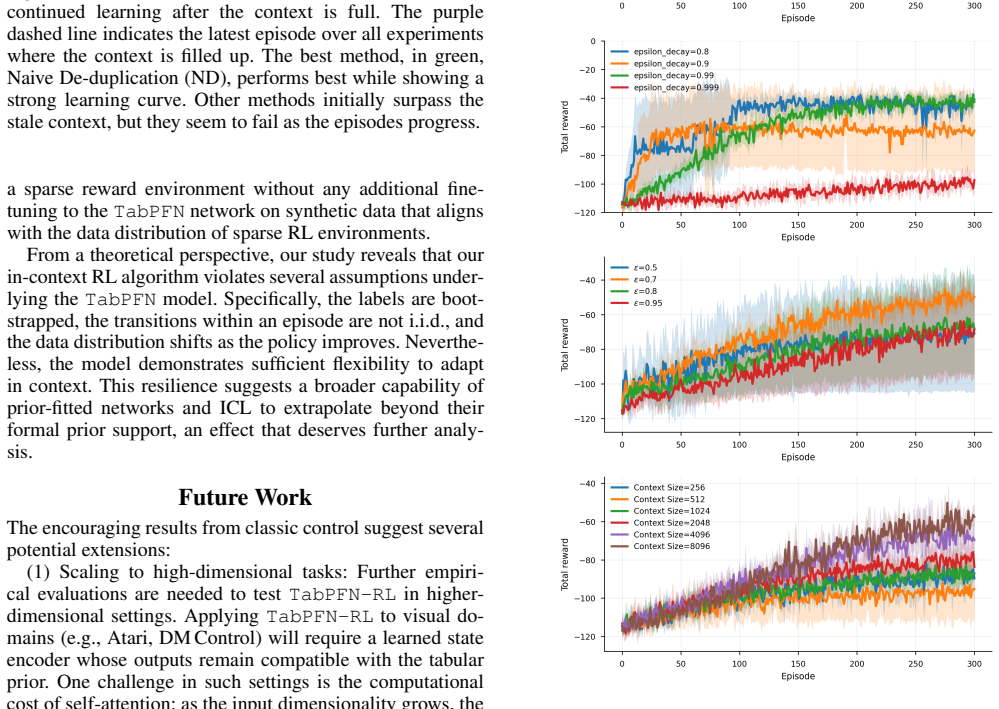
- [Algorithm 1, Eq. (3); Hyperparameters] The claim of 'no extensive hyperparameter tuning' is not supported. The algorithm has several free parameters per environment: initial epsilon, epsilon decay, context budget B, initial random transitions N, FQI iterations, reward shaping constants, and the episode-gate percentile. The appendix reports different epsilon and B values for each environment, and the ablation study in Figure 3 selects the best values on MountainCar. This is per-environment tuning, not a fixed, off-the-shelf configuration. The paper should clearly report the selection procedure and either provide a fixed configuration that works across tasks or drop the 'no tuning' claim.
- [Theoretical Limitations] The paper states it 'formalizes the intrinsic context size limit of in-context RL algorithms,' but the formal content is limited to the observation that a fixed-budget context cannot grow beyond B. This is a definitional statement rather than a theorem, and no formal analysis of the consequences for learning guarantees is provided. If the theoretical contribution is intended to be a substantive part of the paper, it needs formal statements with assumptions and proofs; otherwise, the wording should be softened to 'discussion' rather than 'formalization.'
minor comments (4)
- [Abstract vs. Body] The abstract mentions PPO and TRPO, but the experiments only include DQN. Either add the missing baselines or remove the claim.
- [Figure 3 caption / text] The text says context budgets vary 'from 256 to 8192 in multiples of two,8' and later reports the best size as '8096.' This appears to be a typo; the range should likely be 256 to 8192, and the best value should be checked.
- [Algorithm 1] In Algorithm 1, line 11 compares R_E to Quantile_0.95(R_hist), but the initial random transitions are not episodes; the definition of R_hist for the first online episodes should be clarified.
- [Discussion] The paper claims computational efficiency but reports no runtime or FLOP measurements. Given that TabPFN's inference cost grows quadratically with context, a runtime comparison with DQN would strengthen the practical claims.
Circularity Check
No circularity found: the central result is an empirical pipeline (TabPFN as FQI regressor) with no equation reducing the prediction to a fitted parameter or to self-citations.
full rationale
The paper's central claim is empirical: a pre-trained TabPFN transformer, used in-context as a Q-function regressor within Fitted Q Iteration, can compete with DQN on three classic-control environments without gradient training. The derivation chain is: define FQI target (Eq. 1), regress with TabPFN (Eq. 2), collect context via epsilon-greedy exploration, refit in-context on high-reward episodes (Eq. 3), and evaluate. No step defines an output quantity in terms of the input quantity by construction, and no fitted parameter is renamed as a prediction. The reward-shaping choices are explicitly disclosed in the Appendix and are a benchmark-validity concern, not a circularity concern. Self-citations (Battash et al., Svirsky & Lindenbaum, Yang et al.) appear only as background examples and are not load-bearing. The paper's own discussion acknowledges limitations (sparse rewards, hyperparameter sensitivity, reliance on reward shaping) without trying to pass them off as derived results. Thus the reported match with DQN is an independent empirical finding rather than a tautology.
Axiom & Free-Parameter Ledger
free parameters (7)
- Initial epsilon epsilon_0 =
0.95 (Acrobot), 0.7 (MountainCar, CartPole)
- Epsilon decay lambda =
0.9955 (Acrobot), 0.99 (MountainCar, CartPole)
- Context budget B =
8096 (best of 256..8192)
- Initial random transitions N =
200 (Acrobot), 200 (MountainCar), 128 (CartPole)
- Reward shaping constants =
e.g., c=10 in MountainCar; shaped reward formulas per environment
- Episode gate percentile =
0.95
- FQI iterations =
60
axioms (3)
- domain assumption TabPFN's prior transfers to RL Q-value regression despite violating its i.i.d. training distribution.
- ad hoc to paper The hand-crafted shaped rewards preserve the optimal policy of the original Gymnasium tasks.
- domain assumption Fitted Q Iteration with TabPFN as the function class yields convergent or useful value estimates.
Cite this review
Pith. "Pith review of ICR-RL: Deep Reinforcement Learning via In-Context Regression." pith.science (2026). https://pith.science/paper/TMJ4R5UW
@misc{pith2026250911259,
  author       = {Pith},
  title        = {Pith review of: ICR-RL: Deep Reinforcement Learning via In-Context Regression},
  year         = {2026},
  howpublished = {\url{https://pith.science/paper/TMJ4R5UW}},
  note         = {Machine review of arXiv:2509.11259}
}
read the original abstract
Recent advancements in machine learning have largely been driven by foundation models (FMs) trained on large, diverse datasets, enabling them to generalize effectively to new, related tasks. However, extending this paradigm to reinforcement learning (RL), where an agent interacts with an environment to select actions, remains a significant challenge. Most existing approaches train FMs directly on sets of control tasks, but developing diverse RL environments and scaling training across them can be costly and complex. In this study, we explore a simpler alternative approach based on a classical reduction from RL to regression. We demonstrate that a foundation model pre-trained for regression tasks, when used as an in-context regression (ICR) model, can be directly applied to RL problems. Building on this insight, we introduce a gradient-free method, ICR-RL, that requires no additional training and leverages an ICR foundation model to tackle RL tasks. We evaluate our approach by applying the ICR model with the recently proposed TabPFN, which is trained on a wide range of regression tasks. Experiments conducted on the Gymnasium classic-control benchmark indicate that ICR-RL can compete with commonly used methods, including DQN, PPO and TRPO. These results show that ICR foundation models can effectively solve RL tasks without fine-tuning, demonstrating their potential as a foundation for RL-oriented models.
Figures


Forward citations
Cited by 8 Pith papers
-
Beyond IID: How General Are Tabular Foundation Models, Really?
Tabular foundation models excel on tiny- to medium-sized IID data but are outperformed by traditional tree-based and deep learning models on non-IID, large, and high-dimensional datasets, based on evaluations across 1...
-
FlexTab: A Flexible Encoder-Decoder Architecture for In-Context Learning Across Diverse Tabular Tasks
FlexTab shows a shared encoder with task-specific decoders trained on unlabeled tables can achieve SOTA on classification, regression, anomaly detection and entity matching while staying competitive on relational enti...
-
FlexTab: A Flexible Encoder-Decoder Architecture for In-Context Learning Across Diverse Tabular Tasks
A task-agnostic encoder with task-specific decoders enables in-context learning across classification, regression, anomaly detection, clustering, entity matching, and entity classification on tabular data, achieving S...
-
TabQL: In-Context Q-Learning with Tabular Foundation Models
TabQL is a reinforcement learning framework that substitutes a tabular foundation model with in-context capabilities for the parametric Q-network in DQN, with a warm-up phase and theoretical analysis claiming improved...
-
TabPFN-3: Technical Report
TabPFN-3 delivers state-of-the-art tabular prediction performance on benchmarks up to 1M rows, is up to 20x faster than prior versions, and introduces test-time scaling that beats non-TabPFN models by hundreds of Elo points.
-
TabPFN-3: Technical Report
TabPFN-3 scales tabular foundation models to 1M rows with synthetic pretraining, test-time compute, and benchmark-leading performance on tabular, relational, and tabular-text tasks while being up to 20x faster than Ta...
-
TabPFN-2.5: Advancing the State of the Art in Tabular Foundation Models
TabPFN-2.5 scales tabular foundation models to 20x larger datasets, outperforms tuned tree models on TabArena, achieves near-perfect win rates against default XGBoost, and adds a distillation engine for fast productio...
-
Reinforcement Learning Foundation Models Should Already Be A Thing
A Graph Attention Network pretrained solely on synthetic MDPs solves held-out tabular RL benchmarks in context, outperforming UCB-VI and Q-learning online while matching VI-LCB offline.
Reference graph
Works this paper leans on
-
[1]
, " * write output.state after.block = add.period write newline
ENTRY address archivePrefix author booktitle chapter edition editor eid eprint howpublished institution isbn journal key month note number organization pages publisher school series title type volume year label extra.label sort.label short.list INTEGERS output.state before.all mid.sentence after.sentence after.block FUNCTION init.state.consts #0 'before.a...
-
[2]
write newline
" write newline "" before.all 'output.state := FUNCTION n.dashify 't := "" t empty not t #1 #1 substring "-" = t #1 #2 substring "--" = not "--" * t #2 global.max substring 't := t #1 #1 substring "-" = "-" * t #2 global.max substring 't := while if t #1 #1 substring * t #2 global.max substring 't := if while FUNCTION word.in bbl.in capitalize " " * FUNCT...
-
[3]
Adkins, J.; Bowling, M.; and White, A. 2024. A Method for Evaluating Hyperparameter Sensitivity in Reinforcement Learning. In Globerson, A.; Mackey, L.; Belgrave, D.; Fan, A.; Paquet, U.; Tomczak, J.; and Zhang, C., eds., Advances in Neural Information Processing Systems, volume 37, 124820--124842. Curran Associates, Inc
2024
-
[4]
Battash, B.; Wolf, L.; and Lindenbaum, O. 2024. Revisiting the noise model of stochastic gradient descent. In International Conference on Artificial Intelligence and Statistics, 4780--4788. PMLR
2024
-
[5]
Chen, L.; Lu, K.; Rutter, A.; and et al. 2021. D ecision T ransformer: R einforcement L earning via S equence M odeling. In Advances in Neural Information Processing Systems
2021
-
[6]
L.; Sutskever, I.; and Abbeel, P
Duan, Y.; Schulman, J.; Chen, X.; Bartlett, P. L.; Sutskever, I.; and Abbeel, P. 2016. RL ^2 : Fast Reinforcement Learning via Slow Reinforcement Learning. arXiv:1611.02779
Pith/arXiv arXiv 2016
-
[7]
Garg, S.; Tsipras, D.; Liang, P.; and Valiant, G. 2023. What Can Transformers Learn In-Context? A Case Study of Simple Function Classes. arXiv:2208.01066
Pith/arXiv arXiv 2023
-
[8]
H.; Tirumala, D.; Humplik, J.; Wulfmeier, M.; Tunyasuvunakool, S.; Siegel, N
Haarnoja, T.; Moran, B.; Lever, G.; Huang, S. H.; Tirumala, D.; Humplik, J.; Wulfmeier, M.; Tunyasuvunakool, S.; Siegel, N. Y.; Hafner, R.; Bloesch, M.; Hartikainen, K.; Byravan, A.; Hasenclever, L.; Tassa, Y.; Sadeghi, F.; Batchelor, N.; Casarini, F.; Saliceti, S.; Game, C.; Sreendra, N.; Patel, K.; Gwira, M.; Huber, A.; Hurley, N.; Nori, F.; Hadsell, R....
2024
-
[9]
Hochreiter, S.; and Schmidhuber, J. 1997. Long Short-Term Memory. Neural Comput., 9(8): 1735–1780
1997
-
[10]
B.; Müller, S.; Salinas, D.; and Hutter, F
Hoo, S. B.; Müller, S.; Salinas, D.; and Hutter, F. 2025. From Tables to Time: How TabPFN-v2 Outperforms Specialized Time Series Forecasting Models. arXiv:2501.02945
arXiv 2025
-
[11]
Janner, M.; Li, Q.; and Levine, S. 2021. T rajectory T ransformer: M odel- B ased R einforcement L earning with T ransformers. In International Conference on Learning Representations
2021
-
[12]
Katharopoulos, A.; Vyas, A.; Pappas, N.; and Fleuret, F. 2020. Transformers are RNNs: Fast Autoregressive Transformers with Linear Attention. arXiv:2006.16236
Pith/arXiv arXiv 2020
-
[13]
Laskin, M.; Srinivas, A.; and Abbeel, P. 2022. A lgorithm D istillation and R ecursive S elf- I mprovement in RL . In International Conference on Machine Learning
2022
-
[14]
A.; de Lope, J.; and Maravall, D
Mart \'i n H., J. A.; de Lope, J.; and Maravall, D. 2009. The kNN-TD Reinforcement Learning Algorithm. In Mira, J.; Ferr \'a ndez, J. M.; \'A lvarez, J. R.; de la Paz, F.; and Toledo, F. J., eds., Methods and Models in Artificial and Natural Computation. A Homage to Professor Mira's Scientific Legacy, 305--314. Berlin, Heidelberg: Springer Berlin Heidelbe...
2009
-
[15]
Mnih, V.; Kavukcuoglu, K.; Silver, D.; Graves, A.; Antonoglou, I.; Wierstra, D.; and Riedmiller, M. A. 2013. Playing Atari with Deep Reinforcement Learning. CoRR, abs/1312.5602
Pith/arXiv arXiv 2013
-
[16]
Salimans, T.; Ho, J.; Chen, X.; Sidor, S.; and Sutskever, I. 2017. E volution S trategies as a S calable A lternative to RL . In International Conference on Machine Learning
2017
-
[17]
Schulman, J.; Levine, S.; Moritz, P.; Jordan, M. I.; and Abbeel, P. 2017 a . Trust Region Policy Optimization. arXiv:1502.05477
Pith/arXiv arXiv 2017
-
[18]
Schulman, J.; Wolski, F.; Dhariwal, P.; Radford, A.; and Klimov, O. 2017 b . Proximal Policy Optimization Algorithms. arXiv:1707.06347
Pith/arXiv arXiv 2017
-
[19]
Svirsky, J.; and Lindenbaum, O. 2024. Interpretable Deep Clustering for Tabular Data. In International Conference on Machine Learning, 47314--47330. PMLR
2024
-
[20]
Towers, M.; Kwiatkowski, A.; Terry, J.; Balis, J. U.; Cola, G. D.; Deleu, T.; Goulão, M.; Kallinteris, A.; Krimmel, M.; KG, A.; Perez-Vicente, R.; Pierré, A.; Schulhoff, S.; Tai, J. J.; Tan, H.; and Younis, O. G. 2024. Gymnasium: A Standard Interface for Reinforcement Learning Environments. arXiv:2407.17032
Pith/arXiv arXiv 2024
-
[21]
Wang, S.; Tao, X.; Li, J.; and et al. 2025. O mni RL : Z ero- S hot I n- C ontext R einforcement L earning with a T ransformer
2025
-
[22]
Yang, J.; Lindenbaum, O.; and Kluger, Y. 2022. Locally sparse neural networks for tabular biomedical data. In International Conference on Machine Learning, 25123--25153. PMLR
2022
-
[23]
Yang, Y.; Wang, Q.; Li, C.; Hu, H.; Wu, C.; Jiang, Y.; Zhong, D.; Zhang, Z.; Zhao, Q.; Zhang, C.; and Bo, X. 2025. Fewer May Be Better: Enhancing Offline Reinforcement Learning with Reduced Dataset. arXiv:2502.18955
Pith/arXiv arXiv 2025
This paper was first reviewed by deepseek-v4-flash on August 4, 2026.
discussion (0)
Sign in with ORCID, Apple, or X to comment. Anyone can read and Pith papers without signing in.