Quantifying Local Point-Group-Symmetry Order in Complex Particle Systems
Pith reviewed 2026-05-18 17:06 UTC · model grok-4.3
The pith
Point Group Order Parameters continuously quantify local symmetry order in particle systems.
A machine-rendered reading of the paper's core claim, the machinery that carries it, and where it could break.
Core claim
PGOPs are constructed so that their value rises continuously toward one as a local particle configuration approaches the ideal symmetry operations of a chosen point group, thereby providing a direct, symmetry-focused measure of local order that can be applied to any finite point group.
What carries the argument
Point Group Order Parameters (PGOPs), which evaluate the degree of alignment between a local configuration and the rotational symmetries of a target point group.
If this is right
- PGOPs track the development of specific symmetries as crystallization proceeds in different materials.
- They distinguish local environments belonging to distinct point groups even when bond-orientational parameters give similar readings.
- The parameters apply uniformly to all finite point groups, enabling consistent comparison across crystal structures with different symmetries.
Where Pith is reading between the lines
- PGOPs could be combined with existing order parameters to create hybrid descriptors that resolve ambiguous local structures in simulations of supercooled liquids.
- The continuous nature of the parameters suggests they may detect partial or fluctuating symmetries that appear only briefly near phase boundaries.
- Implementation in analysis codes would allow routine symmetry classification of particle data without requiring prior knowledge of the target crystal structure.
Load-bearing premise
A local arrangement of particles can be matched to a point group symmetry in a continuous and physically meaningful way that reveals structural order beyond what bond angles alone show.
What would settle it
In a perfect crystal whose point-group symmetry is known from its space group, the corresponding PGOP remains near zero or fails to separate ordered from disordered neighborhoods.
Figures


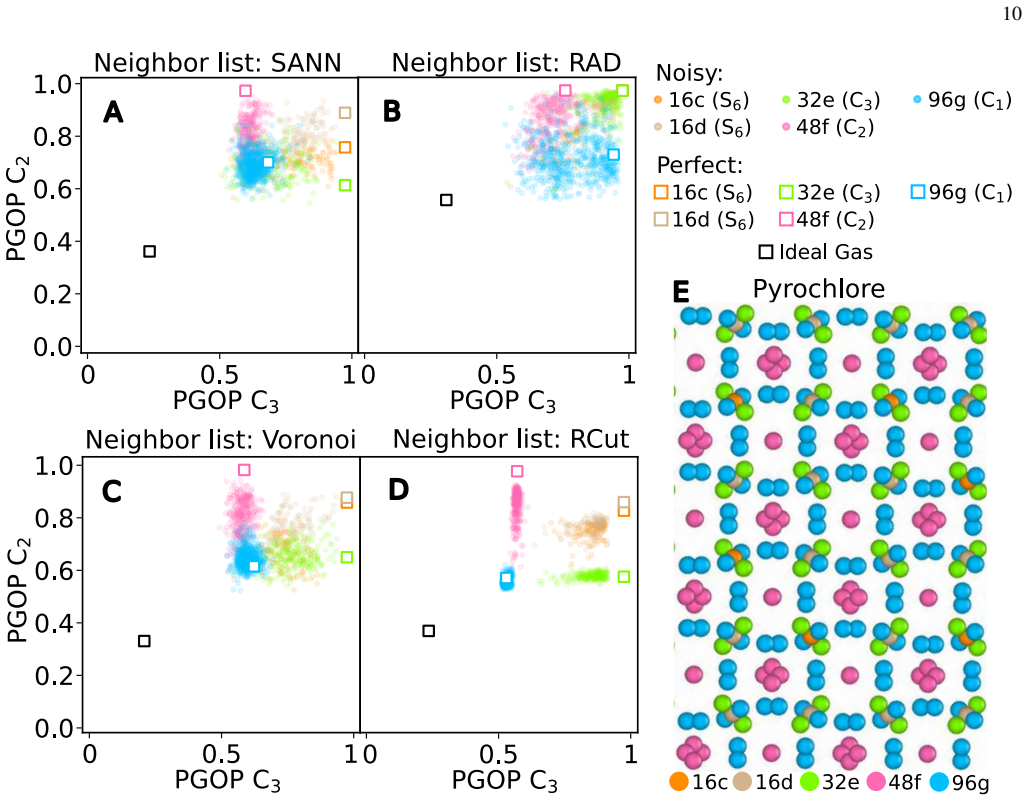

read the original abstract
Crystals and other condensed phases are defined primarily by their inherent symmetries, which play a crucial role in dictating their structural properties. In crystallization studies, local order parameters (OPs) that describe bond orientational order are widely employed to investigate crystal formation. Despite their utility, these traditional metrics do not directly quantify symmetry, an important aspect for understanding the development of order during crystallization. To address this gap, we introduce a new set of OPs, called Point Group Order Parameters (PGOPs), designed to continuously quantify point group symmetry order. We demonstrate the strength and utility of PGOP in detecting order across different crystalline systems and compare its performance to commonly used bond-orientational order metrics. PGOP calculations for all non-infinite point groups are implemented in the open-source package SPATULA (Symmetry Pattern Analysis Toolkit for Understanding Local Arrangements), written in parallelized C++ with a Python interface. The code is publicly available on GitHub at https://github.com/glotzerlab/spatula.
Editorial analysis
A structured set of objections, weighed in public.
Referee Report
Summary. The paper introduces Point Group Order Parameters (PGOPs) as a new class of local order parameters intended to continuously quantify the degree of point-group symmetry in particle configurations. It implements calculations for all non-infinite point groups in the open-source SPATULA package and compares PGOP performance to standard bond-orientational order metrics for detecting crystalline order in several systems.
Significance. If PGOPs can be shown to provide a continuous, physically meaningful symmetry measure that adds information beyond existing order parameters while remaining robust to thermal noise and defects, the work would offer a useful addition to the toolkit for crystallization studies and local structure analysis in condensed-matter simulations.
major comments (2)
- [Results / Methods (continuity test absent)] The central claim that PGOPs 'continuously quantify point group symmetry order' requires that the underlying distance or matching metric to reference configurations varies smoothly with small particle displacements. No section, figure, or supplementary material reports a controlled test of this property (e.g., incremental displacement series or analytic derivative) for any non-trivial point group. Without such a demonstration the continuous-quantification assertion remains unverified and the method risks reducing to a discrete classifier.
- [Abstract and Results] The abstract states that PGOPs 'demonstrate strength and utility in detecting order across different crystalline systems' and are compared to bond-orientational metrics, yet the manuscript provides no quantitative error analysis, statistical significance tests, or tabulated performance metrics (e.g., ROC curves, misclassification rates under controlled noise) that would allow readers to evaluate the claimed superiority or added value.
minor comments (2)
- [Methods] Notation for the PGOP definition should be clarified; it is unclear whether the final scalar value is normalized to [0,1] or left in raw distance units, which affects direct comparison with existing order parameters.
- [Code availability] The GitHub link and package description are helpful, but the manuscript should include a brief reproducibility statement specifying the exact version of SPATULA used for all reported figures.
Simulated Author's Rebuttal
We thank the referee for the constructive comments and the opportunity to clarify and strengthen our manuscript. We address each major comment point by point below. Where appropriate, we have revised the manuscript to incorporate additional demonstrations and quantitative analyses.
read point-by-point responses
-
Referee: [Results / Methods (continuity test absent)] The central claim that PGOPs 'continuously quantify point group symmetry order' requires that the underlying distance or matching metric to reference configurations varies smoothly with small particle displacements. No section, figure, or supplementary material reports a controlled test of this property (e.g., incremental displacement series or analytic derivative) for any non-trivial point group. Without such a demonstration the continuous-quantification assertion remains unverified and the method risks reducing to a discrete classifier.
Authors: We appreciate the referee's emphasis on verifying the continuous nature of the PGOPs. The underlying formulation relies on a continuous distance metric between the local particle configuration and the reference point-group template, which is constructed to vary smoothly under infinitesimal displacements by design. Nevertheless, we agree that an explicit numerical demonstration strengthens the central claim. In the revised manuscript we will add a supplementary figure that plots PGOP values versus controlled incremental displacements for representative non-trivial point groups (e.g., octahedral and icosahedral), confirming smooth, monotonic behavior without discontinuities. revision: yes
-
Referee: [Abstract and Results] The abstract states that PGOPs 'demonstrate strength and utility in detecting order across different crystalline systems' and are compared to bond-orientational metrics, yet the manuscript provides no quantitative error analysis, statistical significance tests, or tabulated performance metrics (e.g., ROC curves, misclassification rates under controlled noise) that would allow readers to evaluate the claimed superiority or added value.
Authors: We acknowledge that the original manuscript presents the comparative performance primarily through visual inspection of order-parameter distributions and spatial maps. While these figures illustrate clear distinctions, we concur that tabulated quantitative metrics would allow readers to assess added value more rigorously. In the revision we will include a new table summarizing misclassification rates under controlled thermal noise for PGOPs versus standard bond-orientational parameters across the tested crystalline systems, together with a brief discussion of sensitivity. revision: yes
Circularity Check
No significant circularity; PGOPs defined as new computational order parameters
full rationale
The paper introduces PGOPs as a novel set of order parameters explicitly designed to quantify point-group symmetry in a continuous manner, implemented directly in the SPATULA package. No load-bearing step reduces by construction to a fitted parameter, self-citation chain, or renamed input; the central definition and comparison to bond-orientational metrics remain independent of the target result. The derivation is self-contained as a computational definition without the enumerated circular patterns.
Axiom & Free-Parameter Ledger
axioms (1)
- domain assumption Point groups provide a complete description of rotational symmetries relevant to local particle arrangements in crystalline systems.
invented entities (1)
-
Point Group Order Parameters (PGOPs)
no independent evidence
Lean theorems connected to this paper
-
IndisputableMonolith/Foundation/AlexanderDuality.leanalexander_duality_circle_linking unclear?
unclearRelation between the paper passage and the cited Recognition theorem.
We introduce a new set of OPs, called Point Group Order Parameters (PGOPs), designed to continuously quantify point group symmetry order... replace the delta functions... with normalized Gaussian functions... Bhattacharyya coefficient... average of these maxima over all symmetrized particles and symmetry operators.
-
IndisputableMonolith/Cost/FunctionalEquation.leanwashburn_uniqueness_aczel unclear?
unclearRelation between the paper passage and the cited Recognition theorem.
PGOP(r,R,S,Q) = 1/NR NS max_Q [sum_S sum_Ri max_Rj [BC {F(Rj-r), F(Qi S QT_i (Ri-r)) }]]
What do these tags mean?
- matches
- The paper's claim is directly supported by a theorem in the formal canon.
- supports
- The theorem supports part of the paper's argument, but the paper may add assumptions or extra steps.
- extends
- The paper goes beyond the formal theorem; the theorem is a base layer rather than the whole result.
- uses
- The paper appears to rely on the theorem as machinery.
- contradicts
- The paper's claim conflicts with a theorem or certificate in the canon.
- unclear
- Pith found a possible connection, but the passage is too broad, indirect, or ambiguous to say the theorem truly supports the claim.
Reference graph
Works this paper leans on
-
[1]
Yu. A. Izyumov and V. N. Syromyatnikov. Phase Transitions and Crystal Symmetry . Springer Netherlands, Dordrecht, 1990
work page 1990
-
[2]
B. Souvignier, H. Wondratschek, M. I. Aroyo, G. Chapuis, and A. M. Glazer. Space groups and their descriptions. In International Tables for Crystallography , pages 42--74. John Wiley & Sons, Ltd, 2016
work page 2016
-
[3]
Crystal nucleation as the ordering of multiple order parameters
John Russo and Hajime Tanaka. Crystal nucleation as the ordering of multiple order parameters. The Journal of Chemical Physics , 145(21):211801, December 2016
work page 2016
-
[4]
Teich, Michael Engel, and Sharon C
Sangmin Lee, Erin G. Teich, Michael Engel, and Sharon C. Glotzer. Entropic colloidal crystallization pathways via fluid–fluid transitions and multidimensional prenucleation motifs. Proceedings of the National Academy of Sciences , 116(30):14843--14851, July 2019
work page 2019
-
[5]
Paul J. Steinhardt, David R. Nelson, and Marco Ronchetti. Bond-orientational order in liquids and glasses. Physical Review B , 28(2):784--805, July 1983
work page 1983
-
[6]
Walter Mickel, Sebastian C. Kapfer, Gerd E. Schröder-Turk, and Klaus Mecke. Shortcomings of the bond orientational order parameters for the analysis of disordered particulate matter. The Journal of Chemical Physics , 138(4):044501, January 2013
work page 2013
-
[7]
Accurate determination of crystal structures based on averaged local bond order parameters
Wolfgang Lechner and Christoph Dellago. Accurate determination of crystal structures based on averaged local bond order parameters. The Journal of Chemical Physics , 129(11):114707, September 2008
work page 2008
-
[8]
Bartók, Risi Kondor, and Gábor Csányi
Albert P. Bartók, Risi Kondor, and Gábor Csányi. On representing chemical environments. Physical Review B , 87(18):184115, May 2013
work page 2013
-
[9]
Miguel A. Caro. Optimizing many-body atomic descriptors for enhanced computational performance of machine learning based interatomic potentials. Physical Review B , 100(2):024112, July 2019
work page 2019
-
[10]
Cristina Caruso, Annalisa Cardellini, Martina Crippa, Daniele Rapetti, and Giovanni M. Pavan. Time SOAP : Tracking high-dimensional fluctuations in complex molecular systems via time variations of SOAP spectra. The Journal of Chemical Physics , 158(21):214302, June 2023
work page 2023
-
[11]
James P. Darby, James R. Kermode, and Gábor Csányi. Compressing local atomic neighbourhood descriptors. npj Computational Materials , 8(1):166, August 2022
work page 2022
-
[12]
Bartók, Sandip De, Carl Poelking, Noam Bernstein, James R
Albert P. Bartók, Sandip De, Carl Poelking, Noam Bernstein, James R. Kermode, Gábor Csányi, and Michele Ceriotti. Machine learning unifies the modeling of materials and molecules. Science Advances , 3(12):e1701816, December 2017
work page 2017
-
[13]
Wilkins, Gábor Csányi, and Michele Ceriotti
Andrea Grisafi, David M. Wilkins, Gábor Csányi, and Michele Ceriotti. Symmetry- Adapted Machine Learning for Tensorial Properties of Atomistic Systems . Physical Review Letters , 120(3):036002, January 2018
work page 2018
-
[14]
Carl S. Adorf, Timothy C. Moore, Yannah J. U. Melle, and Sharon C. Glotzer. Analysis of Self - Assembly Pathways with Unsupervised Machine Learning Algorithms . The Journal of Physical Chemistry B , 124(1):69--78, January 2020
work page 2020
-
[15]
Chung, Rodrigo Freitas, Gowoon Cheon, and Evan J
Heejung W. Chung, Rodrigo Freitas, Gowoon Cheon, and Evan J. Reed. Data-centric framework for crystal structure identification in atomistic simulations using machine learning. Physical Review Materials , 6(4):043801, April 2022
work page 2022
-
[16]
Robust structural identification via polyhedral template matching
Peter Mahler Larsen, Søren Schmidt, and Jakob Schiøtz. Robust structural identification via polyhedral template matching. Modelling and Simulation in Materials Science and Engineering , 24(5):055007, June 2016
work page 2016
- [17]
-
[18]
Nguyen, Ahmet Alatas, Jing Kong, and Mingda Li
Zhantao Chen, Nina Andrejevic, Tess Smidt, Zhiwei Ding, Qian Xu, Yen‐Ting Chi, Quynh T. Nguyen, Ahmet Alatas, Jing Kong, and Mingda Li. Direct Prediction of Phonon Density of States With Euclidean Neural Networks . Advanced Science , 8(12):2004214, June 2021
work page 2021
-
[19]
The perfect marriage and much more: Combining dimension reduction, distance measures and covariance
Ravi Kashyap. The perfect marriage and much more: Combining dimension reduction, distance measures and covariance. Physica A: Statistical Mechanics and its Applications , 536:120938, December 2019
work page 2019
-
[20]
Damasceno, Michael Engel, and Sharon C
Pablo F. Damasceno, Michael Engel, and Sharon C. Glotzer. Predictive Self - Assembly of Polyhedra into Complex Structures . Science , 337(6093):453--457, July 2012
work page 2012
-
[21]
Understanding water’s anomalies with locally favoured structures
John Russo and Hajime Tanaka. Understanding water’s anomalies with locally favoured structures. Nature Communications , 5(1), April 2014. Publisher: Springer Science and Business Media LLC
work page 2014
-
[22]
Benjamin A. Schultz, Pablo F. Damasceno, Michael Engel, and Sharon C. Glotzer. Symmetry Considerations for the Targeted Assembly of Entropically Stabilized Colloidal Crystals via Voronoi Particles . ACS Nano , 9(3):2336--2344, March 2015. Publisher: American Chemical Society (ACS)
work page 2015
-
[23]
Amir Haji-Akbari, Michael Engel, and Sharon C. Glotzer. Degenerate Quasicrystal of Hard Triangular Bipyramids . Physical Review Letters , 107(21), November 2011. Publisher: American Physical Society (APS)
work page 2011
-
[24]
Daniel F. Tracey, Eva G. Noya, and Jonathan P. K. Doye. Programming patchy particles to form three-dimensional dodecagonal quasicrystals. The Journal of Chemical Physics , 154(19), May 2021. Publisher: AIP Publishing
work page 2021
-
[25]
Teich, Greg Van Anders, and Sharon C
Erin G. Teich, Greg Van Anders, and Sharon C. Glotzer. Identity crisis in alchemical space drives the entropic colloidal glass transition. Nature Communications , 10(1):64, January 2019
work page 2019
-
[26]
Improved algorithms for symmetry analysis: structure preserving permutations
Gil Alon and Inbal Tuvi-Arad. Improved algorithms for symmetry analysis: structure preserving permutations. Journal of Mathematical Chemistry , 56(1):193--212, January 2018
work page 2018
-
[27]
Mark Pinsky and David Avnir. Continuous Symmetry Measures . 5. The Classical Polyhedra . Inorganic Chemistry , 37(21):5575--5582, October 1998
work page 1998
-
[28]
Hagit Zabrodsky, Shmuel Peleg, and David Avnir. Continuous symmetry measures. Journal of the American Chemical Society , 114(20):7843--7851, September 1992
work page 1992
-
[29]
Logan, Srinivas Mushnoori, Meenakshi Dutt, and Alexei V
Jack A. Logan, Srinivas Mushnoori, Meenakshi Dutt, and Alexei V. Tkachenko. Symmetry-specific orientational order parameters for complex structures. The Journal of Chemical Physics , 156(5):054108, February 2022
work page 2022
-
[30]
Point Group Analysis in Particle Simulation Data , June 2021
Michael Engel. Point Group Analysis in Particle Simulation Data , June 2021. arXiv:2106.14846 [cond-mat]
-
[31]
On the Development of Tools for the Study of Colloidal Self - Assembly
Brandon Butler. On the Development of Tools for the Study of Colloidal Self - Assembly . PhD thesis, University of Michigan, 2024
work page 2024
-
[32]
Analyzing Particle Systems for Machine Learning and Data Visualization with freud
Bradley Dice, Vyas Ramasubramani, Eric Harper, Matthew Spellings, Joshua Anderson, and Sharon Glotzer. Analyzing Particle Systems for Machine Learning and Data Visualization with freud. In Proceedings of the 18th Python in Science Conference , pages 27--33, Austin, Texas, 2019
work page 2019
-
[33]
Vyas Ramasubramani, Bradley D. Dice, Eric S. Harper, Matthew P. Spellings, Joshua A. Anderson, and Sharon C. Glotzer. freud: A software suite for high throughput analysis of particle simulation data. Computer Physics Communications , 254:107275, September 2020
work page 2020
-
[34]
A. Bhattacharyya. On the Measure of Divergence Between Two Statistical Populations Defined by Their Probability Distributions . Bulletin of the Calcutta Mathematical Society , 35:99--110, 1943
work page 1943
-
[35]
A. Bhattacharyya. On a Measure of Divergence between Two Multinomial Populations . Sankhyā: The Indian Journal of Statistics (1933-1960) , 7(4):401--406, 1946. Publisher: Springer
work page 1933
-
[36]
Van Meel, Laura Filion, Chantal Valeriani, and Daan Frenkel
Jacobus A. Van Meel, Laura Filion, Chantal Valeriani, and Daan Frenkel. A parameter-free, solid-angle based, nearest-neighbor algorithm. The Journal of Chemical Physics , 136(23):234107, June 2012
work page 2012
- [37]
- [38]
-
[39]
Nouvelles applications des paramètres continus à la théorie des formes quadratiques
Georges Voronoi. Nouvelles applications des paramètres continus à la théorie des formes quadratiques. Deuxième mémoire. Recherches sur les parallélloèdres primitifs. Journal für die reine und angewandte Mathematik (Crelles Journal) , 1908(134):198--287, July 1908
work page 1908
-
[40]
Pelin S. Bulutoglu, Akshat S. Zalte, Nandkishor K. Nere, Doraiswami Ramkrishna, and David S. Corti. A comprehensive modeling approach for polymorph selection in Lennard - Jones crystallization. The Journal of Chemical Physics , 158(13):134505, April 2023
work page 2023
-
[41]
Vladimir G. Baidakov and Kseniia R. Protsenko. Spontaneous Crystallization of a Supercooled Lennard - Jones Liquid : Molecular Dynamics Simulation . The Journal of Physical Chemistry B , 123(38):8103--8112, September 2019
work page 2019
-
[42]
Entire crystallization process of Lennard - Jones liquids: A large-scale molecular dynamics study
Wenze Ouyang, Bin Sun, Zhiwei Sun, and Shenghua Xu. Entire crystallization process of Lennard - Jones liquids: A large-scale molecular dynamics study. The Journal of Chemical Physics , 152(5):054903, February 2020
work page 2020
-
[43]
Ruiz-Montero, and Daan Frenkel
Pieter Rein Ten Wolde, Maria J. Ruiz-Montero, and Daan Frenkel. Numerical calculation of the rate of crystal nucleation in a Lennard - Jones system at moderate undercooling. The Journal of Chemical Physics , 104(24):9932--9947, June 1996
work page 1996
-
[44]
Sarah E. M. Lundrigan and Ivan Saika-Voivod. Test of classical nucleation theory and mean first-passage time formalism on crystallization in the Lennard - Jones liquid. The Journal of Chemical Physics , 131(10):104503, September 2009
work page 2009
-
[45]
Vladimir G. Baidakov, Azat O. Tipeev, Konstantin S. Bobrov, and Gennady V. Ionov. Crystal nucleation rate isotherms in Lennard - Jones liquids. The Journal of Chemical Physics , 132(23):234505, June 2010
work page 2010
-
[46]
Freezing of a Lennard - Jones Fluid : From Nucleation to Spinodal Regime
Federica Trudu, Davide Donadio, and Michele Parrinello. Freezing of a Lennard - Jones Fluid : From Nucleation to Spinodal Regime . Physical Review Letters , 97(10):105701, September 2006
work page 2006
-
[47]
Butler, Domagoj Fijan, and Sharon C
Brandon L. Butler, Domagoj Fijan, and Sharon C. Glotzer. Change point detection of events in molecular simulations using dupin. Computer Physics Communications , 304:109297, November 2024
work page 2024
-
[48]
Anderson, Jens Glaser, and Sharon C
Joshua A. Anderson, Jens Glaser, and Sharon C. Glotzer. HOOMD -blue: A Python package for high-performance molecular dynamics and hard particle Monte Carlo simulations. Computational Materials Science , 173:109363, February 2020
work page 2020
-
[49]
Visualization and analysis of atomistic simulation data with OVITO –the Open Visualization Tool
Alexander Stukowski. Visualization and analysis of atomistic simulation data with OVITO –the Open Visualization Tool . Modelling and Simulation in Materials Science and Engineering , 18(1):015012, January 2010
work page 2010
-
[50]
P. M. L. Tammes. On the Origin of Number and Arrangement of the Places of Exit on the Surface of Pollen - Grains . Recueil des travaux botaniques néerlandais , 27(1):1--84, 1930
work page 1930
-
[51]
Der Massbegriff in der Theorie der Kontinuierlichen Gruppen
Alfred Haar. Der Massbegriff in der Theorie der Kontinuierlichen Gruppen . The Annals of Mathematics , 34(1):147, January 1933
work page 1933
-
[52]
Mehl, David Hicks, Cormac Toher, Ohad Levy, Robert M
Michael J. Mehl, David Hicks, Cormac Toher, Ohad Levy, Robert M. Hanson, Gus Hart, and Stefano Curtarolo. The AFLOW Library of Crystallographic Prototypes : Part 1. Computational Materials Science , 136:S1--S828, August 2017
work page 2017
-
[53]
Mehl, Eric Gossett, Cormac Toher, Ohad Levy, Robert M
David Hicks, Michael J. Mehl, Eric Gossett, Cormac Toher, Ohad Levy, Robert M. Hanson, Gus Hart, and Stefano Curtarolo. The AFLOW Library of Crystallographic Prototypes : Part 2. Computational Materials Science , 161:S1--S1011, April 2019
work page 2019
-
[54]
Mehl, Marco Esters, Corey Oses, Ohad Levy, Gus L.W
David Hicks, Michael J. Mehl, Marco Esters, Corey Oses, Ohad Levy, Gus L.W. Hart, Cormac Toher, and Stefano Curtarolo. The AFLOW Library of Crystallographic Prototypes : Part 3. Computational Materials Science , 199:110450, November 2021
work page 2021
-
[55]
Hagen Eckert, Simon Divilov, Michael J. Mehl, David Hicks, Adam C. Zettel, Marco Esters, Xiomara Campilongo, and Stefano Curtarolo. The AFLOW library of crystallographic prototypes: Part 4. Computational Materials Science , 240:112988, May 2024. Publisher: Elsevier BV
work page 2024
-
[56]
Michael P. Howard, Joshua A. Anderson, Arash Nikoubashman, Sharon C. Glotzer, and Athanassios Z. Panagiotopoulos. Efficient neighbor list calculation for molecular simulation of colloidal systems using graphics processing units. Computer Physics Communications , 203:45--52, June 2016
work page 2016
-
[57]
Canonical sampling through velocity rescaling
Giovanni Bussi, Davide Donadio, and Michele Parrinello. Canonical sampling through velocity rescaling. The Journal of Chemical Physics , 126(1), January 2007. Publisher: AIP Publishing
work page 2007
-
[58]
S. L. Altmann. On the symmetries of spherical harmonics. Mathematical Proceedings of the Cambridge Philosophical Society , 53(2):343--367, April 1957
work page 1957
-
[59]
Russell S. Drago. Physical methods for chemists . Saunders College Pub, Ft. Worth, 2nd ed edition, 1992
work page 1992
-
[60]
Pauli Virtanen, Ralf Gommers, Travis E. Oliphant, Matt Haberland, Tyler Reddy, David Cournapeau, Evgeni Burovski, Pearu Peterson, Warren Weckesser, Jonathan Bright, Stéfan J. Van Der Walt, Matthew Brett, Joshua Wilson, K. Jarrod Millman, Nikolay Mayorov, Andrew R. J. Nelson, Eric Jones, Robert Kern, Eric Larson, C J Carey, İlhan Polat, Yu Feng, Eric W. Mo...
work page 2020
-
[61]
F. Albert Cotton. Chemical applications of group theory . Wiley, New York, 3rd ed edition, 1990
work page 1990
-
[62]
Robert L. Flurry. Symmetry groups: theory and chemical applications . Prentice-Hall, Englewood Cliffs, N.J, 1980
work page 1980
-
[63]
G. S. Ezra. Symmetry Properties of Molecules , volume 28 of Lecture Notes in Chemistry . Springer Berlin Heidelberg, Berlin, Heidelberg, 1982
work page 1982
-
[64]
S. L. Altmann. Semidirect Products and Point Groups . Reviews of Modern Physics , 35(3):641--644, July 1963
work page 1963
-
[65]
Vorlesungen über die Zahlentheorie der Quaternionen
Adolf Hurwitz. Vorlesungen über die Zahlentheorie der Quaternionen . Springer Berlin Heidelberg, Berlin, Heidelberg, 1919
work page 1919
-
[66]
L. E. Dickson. On the Theory of Numbers and Generalized Quaternions . American Journal of Mathematics , 46(1):1, January 1924. Publisher: JSTOR
work page 1924
-
[67]
Untersuchungen über die Summen von Quadraten
Rudolf Otto Sigismund Lipschitz. Untersuchungen über die Summen von Quadraten . M. Cohen & Sohn (F. Cohen), Bonn, 1886. Pages: 147
-
[68]
Memorandum respecting a new system of roots of unity
William Rowan Hamilton. Memorandum respecting a new system of roots of unity. Philosophical Magazine , 12:446, 1856
-
[69]
R. Fisher. Dispersion on a Sphere . Proceedings of the Royal Society A: Mathematical, Physical and Engineering Sciences , 217(1130):295--305, May 1953
work page 1953
-
[70]
Geoffrey S. Watson. Distributions on the circle and sphere. Journal of Applied Probability , 19(A):265--280, 1982
work page 1982
-
[71]
Optimal Arrangements of n Points on a Sphere and in a Circle
Bor Plestenjak and Vladimir Batagelj. Optimal Arrangements of n Points on a Sphere and in a Circle . Proceedings (Preddvor) , pages 83--87, 2001
work page 2001
-
[72]
R. E. Miles. On Random Rotations in R 3. Biometrika , 52(3/4):636, December 1965
work page 1965
-
[73]
Alessandro Laio and Michele Parrinello. Escaping free-energy minima. Proceedings of the National Academy of Sciences , 99(20):12562--12566, October 2002
work page 2002
discussion (0)
Sign in with ORCID, Apple, or X to comment. Anyone can read and Pith papers without signing in.