Generation of Volume-Law Entanglement by Local-Measurement-Only Quantum Dynamics
Pith reviewed 2026-05-18 15:35 UTC · model grok-4.3
The pith
Non-commuting local measurements generate volume-law entanglement in fermionic chains without unitary dynamics
A machine-rendered reading of the paper's core claim, the machinery that carries it, and where it could break.
Core claim
In a one-dimensional model with a main fermionic chain and auxiliary detector qubits, long-time states with volume-law entanglement or mutual information are generated between different parts of the main chain purely through non-unitary measurement dynamics, and such large-entanglement generation can be achieved using only the measurements of one-body operators.
What carries the argument
Generalized measurements via local coupling to detector qubits that implement non-commuting projections on the fermionic chain, driving entanglement growth in the absence of unitary evolution.
If this is right
- Volume-law entanglement arises from one-body operator measurements alone in a measurement-only setting.
- Higher-body operator measurements introduce kinetic constraints that reduce entanglement generation.
- Entanglement measures along quantum trajectories approach stationary distributions with limited ergodicity.
- Non-random measurement protocols allow controlled entanglement generation in non-unitary many-body dynamics.
Where Pith is reading between the lines
- The protocol suggests a route to entanglement generation in quantum hardware that relies primarily on local measurement controls.
- It links to measurement-induced phase transitions but reverses their typical role from entanglement suppression to creation.
- Similar measurement-only constructions could be explored in two-dimensional lattices or with feedback rules based on outcomes.
- Direct tests involve tracking subsystem entanglement entropy scaling in exact or approximate simulations of the dynamics.
Load-bearing premise
That non-commuting generalized measurements on local one-body operators, implemented by coupling to ancilla qubits with no unitary component, suffice to produce volume-law entangled states.
What would settle it
Numerical evolution of the measurement protocol on a finite chain where the long-time entanglement entropy of a subsystem scales linearly with boundary length instead of subsystem volume.
Figures






read the original abstract
Repeated local measurements typically have adversarial effects on entangling unitary dynamics, as local measurements usually degrade entanglement. However, recent works on measurement-only dynamics have shown that strongly entangled states can be generated solely through non-commuting random multi-site and multi-spin projective measurements. In this work, we explore a generalized measurement setup in a system without intrinsic unitary dynamics and show that volume-law entangled states can be generated through local, non-random, yet non-commuting measurements. Specifically, we construct a one-dimensional model comprising a main fermionic chain and an auxiliary (ancilla) chain, where generalized measurements are performed by locally coupling the system to detector qubits. Our results demonstrate that long-time states with volume-law entanglement or mutual information are generated between different parts of the main chain purely through non-unitary measurement dynamics. Remarkably, we find that such large-entanglement generation can be achieved using only the measurements of one-body operators. Moreover, we show that measurements of non-local higher-body operators can be used to control and reduce entanglement generation by introducing kinetic constraints to the dynamics. We discuss the statistics of entanglement measures along the quantum trajectories, the approach to stationary distributions of entanglement or long-time steady states, and the associated notions of limited ergodicity in the measurement-only dynamics. Our findings highlight the potential of non-random measurement protocols for controlled entanglement generation and the study of non-unitary many-body dynamics.
Editorial analysis
A structured set of objections, weighed in public.
Referee Report
Summary. The manuscript constructs a one-dimensional fermionic chain coupled locally to an auxiliary ancilla chain of detector qubits. Generalized measurements of one-body operators are applied repeatedly in the absence of intrinsic unitary dynamics. The central claim is that this protocol generates long-time states on the main chain that exhibit volume-law scaling of bipartite entanglement entropy and mutual information, and that measurements of non-local higher-body operators can be used to impose kinetic constraints that reduce the generated entanglement. The work further examines trajectory statistics, approach to stationary distributions, and limited ergodicity under the measurement-only dynamics.
Significance. If the claims are substantiated, the result is significant: it demonstrates that volume-law entanglement can be produced by purely non-unitary dynamics using only local, non-random, one-body measurements, contrary to the usual expectation that local measurements drive area-law or logarithmic scaling. The ancilla-mediated generalized measurement protocol and the control via higher-body operators provide a concrete, falsifiable construction that could be relevant to studies of measurement-induced phases and controlled entanglement generation.
major comments (2)
- [§2] §2 (model construction): local one-body operators on disjoint sites commute, so the non-commutativity required for volume-law generation must arise either from the sequential choice of measurement bases or from the ancilla-coupling protocol itself. The manuscript must explicitly demonstrate that the effective back-action after tracing out the ancilla remains strictly local and does not introduce implicit non-local correlations that could mimic unitary evolution.
- [Numerical results] Numerical evidence for volume-law scaling (results section): the abstract and main text assert linear scaling of entanglement or mutual information, yet no details are provided on the number of trajectories sampled, error bars, finite-size scaling collapse, or post-selection criteria for long-time states. Without these, it is impossible to rule out that the reported volume law is an artifact of trajectory selection or insufficient sampling.
minor comments (2)
- Notation for the generalized measurement operators and the ancilla coupling strength should be defined more explicitly in the main text rather than deferred to appendices.
- Figure captions for entanglement scaling plots should include the subsystem sizes used and the fitting ranges for the linear regime.
Simulated Author's Rebuttal
We thank the referee for their careful reading of the manuscript and for the constructive comments, which help clarify key aspects of the work. We address each major comment below and outline the revisions we will make.
read point-by-point responses
-
Referee: [§2] §2 (model construction): local one-body operators on disjoint sites commute, so the non-commutativity required for volume-law generation must arise either from the sequential choice of measurement bases or from the ancilla-coupling protocol itself. The manuscript must explicitly demonstrate that the effective back-action after tracing out the ancilla remains strictly local and does not introduce implicit non-local correlations that could mimic unitary evolution.
Authors: We agree that an explicit demonstration of the locality of the effective back-action is necessary for rigor. The non-commutativity arises from the sequential application of measurements in different bases via the ancilla protocol. In the revised manuscript we will expand §2 with a detailed derivation of the effective Kraus operators obtained after tracing out the ancilla qubits. This derivation will confirm that the back-action remains strictly local (acting only on the sites directly coupled to the ancilla) and does not generate implicit non-local correlations that could be mistaken for unitary evolution. We will also add a short paragraph clarifying how the ancilla-mediated generalized measurements produce the required non-commuting operations without violating locality. revision: yes
-
Referee: [Numerical results] Numerical evidence for volume-law scaling (results section): the abstract and main text assert linear scaling of entanglement or mutual information, yet no details are provided on the number of trajectories sampled, error bars, finite-size scaling collapse, or post-selection criteria for long-time states. Without these, it is impossible to rule out that the reported volume law is an artifact of trajectory selection or insufficient sampling.
Authors: We acknowledge that the numerical section lacks sufficient methodological detail. In the revised manuscript we will add a dedicated paragraph (or subsection) in the results section that specifies: (i) the number of trajectories sampled for each data point (typically 1000–2000 for the system sizes shown), (ii) the statistical error bars obtained from trajectory averaging, (iii) finite-size scaling collapse performed across multiple chain lengths, and (iv) the post-selection criteria used to identify long-time states (e.g., averaging after a fixed number of measurement steps once entanglement has saturated). These additions will allow readers to assess the robustness of the volume-law scaling and rule out sampling artifacts. revision: yes
Circularity Check
No circularity: explicit model construction and trajectory simulation generate the reported volume-law states
full rationale
The paper presents a concrete Hamiltonian-free protocol with ancilla-coupled generalized measurements on a fermionic chain and reports the resulting entanglement scaling from direct evolution of quantum trajectories. No parameter is fitted to the target volume-law scaling and then re-used as a prediction; the central result follows from the defined measurement operators and the stochastic update rules rather than from any self-referential definition or prior self-citation that would close the loop. The non-commutativity is introduced explicitly by the choice of sequential local one-body operators and the ancilla coupling, which is an input to the construction rather than an output derived from the entanglement measure itself. Consequently the derivation chain remains open and externally verifiable by independent simulation of the same protocol.
Axiom & Free-Parameter Ledger
axioms (1)
- domain assumption Projective measurements on non-commuting operators drive the system into a steady distribution of entanglement values
Lean theorems connected to this paper
-
IndisputableMonolith/Foundation/RealityFromDistinction.leanreality_from_one_distinction unclear?
unclearRelation between the paper passage and the cited Recognition theorem.
long-time states with volume-law entanglement or mutual information are generated between different parts of the main chain purely through non-unitary measurement dynamics... using only the measurements of one-body operators
-
IndisputableMonolith/Cost/FunctionalEquation.leanwashburn_uniqueness_aczel unclear?
unclearRelation between the paper passage and the cited Recognition theorem.
non-commutativity of the measurements as one of the necessary ingredients for producing entangled states
What do these tags mean?
- matches
- The paper's claim is directly supported by a theorem in the formal canon.
- supports
- The theorem supports part of the paper's argument, but the paper may add assumptions or extra steps.
- extends
- The paper goes beyond the formal theorem; the theorem is a base layer rather than the whole result.
- uses
- The paper appears to rely on the theorem as machinery.
- contradicts
- The paper's claim conflicts with a theorem or certificate in the canon.
- unclear
- Pith found a possible connection, but the passage is too broad, indirect, or ambiguous to say the theorem truly supports the claim.
Reference graph
Works this paper leans on
-
[1]
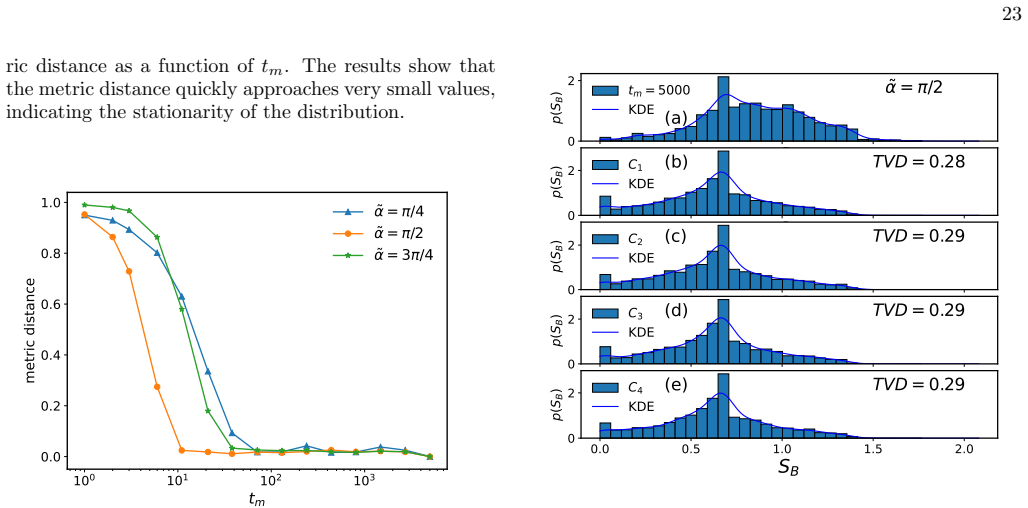
The evolution of TVD as a function oft m is shown in Fig. 5. We observe that after an initial transient pe- riod, the TVD becomes very small and remains approxi- mately constant, indicating that the successive distribu- tions have become very similar and are approaching a stationary distribution. Additionally, we find that, as ˜α approaches 0, the time sc...
-
[2]
Random superposition and other initial states We perform a similar analysis for the initial random superposition state|Ψ rs⟩, Eq. (9). The evolution of the resulting probability distribution ofS B for an ensemble of quantum trajectories is shown in Fig. 6. Initially, the delta-function distribution peaked at a finiteS B corre- sponding to a random state, ...
-
[3]
Entanglement distribution over time Here, we compare the distribution ofS B constructed from a long interval of time at long times for an individ- ual trajectory with the stationary distributions for an en- semble of trajectories, shown, e.g., in Fig. 6(e). In Fig. 7, the time-window distributions, along with the metric dis- tances from the stationary dis...
-
[4]
Initial-state dependence of the stationary distribution As shown in Figs. 4 and 6, different types of initial states, particularly states with very different values of the entanglement entropy—like the product and super- position states—lead to distinct stationary distributions. However, initial states of the same type, having similar entanglement entropy...
-
[5]
Random superposition initial state We now discuss the distribution of entanglement en- tropyS B in the stationary states obtained starting from an entangled superposition state, such as a random su- perposition state|Ψ rs⟩, Eq. (9). Since the dynamics lead to a discrete set of stationary states over an ensemble of trajectories in the three-body measuremen...
-
[6]
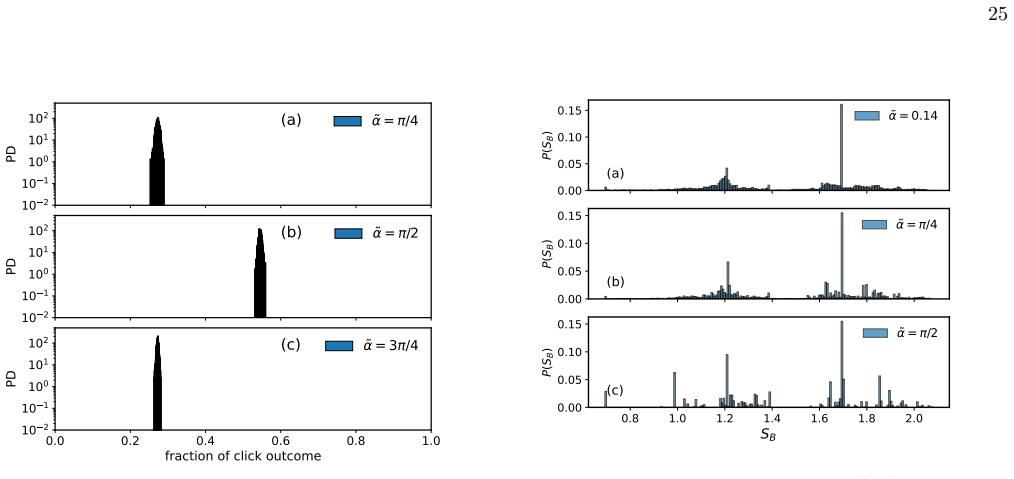
Product initial state In Fig. 11, we show the probability distributionP(S B), for stationary states obtained from an ensemble of quan- tum trajectories, starting from the initial unentangled product state|Ψ p⟩, Eq. (7). Unlike the previous case with the random superposition initial state|Ψ rs⟩, where the distribution was peaked at nonzero values, we ob- s...
work page 2000
-
[7]
Product Initial State In Fig. 12(a), we plot the average entanglement en- tropy for the half-subsystem of the main chain,S B, as a function of the system sizeLfor different values of the parameter ˜αin the stationary state at long times. Here, the initial state is the product state|Ψ p⟩, Eq. (7). We observe the volume-law scaling,S B ∝L, up to the max- im...
-
[8]
Random superposition initial state We now consider how the measurement-only dynamics in the one-body measurement model affect an initially entangled state, such as a random superposition state, which follows a maximal (Page value [99]) volume-law scaling of entanglement entropy. In Fig. 13(a), the aver- age entanglement entropyS B is shown at long times a...
-
[9]
Random superposition initial state In Fig. 14(a), we present the steady-state trajectory- averaged entanglement entropyS B for random superpo- sition initial states as a function of system sizeL. The results show a linear dependence ofS B onLwithin the range of system sizes accessible in our numerics. This in- dicates that the entanglement entropy between...
-
[10]
Product Initial State Finally, in Fig. 15(a), the long-time average entan- glement entropyS B is shown as a function of system sizeLfor an unentangled initial state. As discussed in Sec. II B, the majority of quantum trajectories in this case did not generate entanglement when starting from a product state. We find that the stationary average en- tropyS B...
work page 2022
-
[11]
(1b) for one-body measurement model here: H (i,i+1) sd =α(c † i +c † i+1)a i σx i + H.c
One-body measurement model For better readability, we write the system-detector Hamiltonian, Eq. (1b) for one-body measurement model here: H (i,i+1) sd =α(c † i +c † i+1)a i σx i + H.c. The Hamiltonian (1b) acts on the system-detector basis states|n⟩ i|σ⟩(where|σ⟩represents the spin stateσ=↑,↓) as follows: H (i,i+1) sd |00⟩|1⟩|σ⟩=α(|10⟩|0⟩+|01⟩|0⟩)| σ⟩,(A...
-
[12]
Three-body measurement model Again, for the reader’s convenience, we present the system-detector Hamiltonian for the three-body mea- surement model, given by Eq. (4), here: ˜H (i,i+1) s−d =α a† i (ci +c i+1)n ini+1 ⊗σ − + (c† i +c † i+1)a i (1−n i)(1−n i+1) ⊗σ −+ H.c. . 22 This Hamiltonian acts on the basis states in theN p = 1 particle sector and|σ=↑⟩spi...
-
[13]
Entanglement along quantum trajectories In Fig. 16, we show theB-subsystem entanglement en- tropyS B as a function of discrete measurement timet m on a log-normal scale for three representative quantum trajectories (C i,i= 1,2,3) under the measurement-only dynamics for a random superposition initial state in the one-body measurement model. Similar to the ...
-
[14]
To this end, we compute the metric distance (TVD) in- troduced earlier
Stationarity check for long-time distribution We examine whether the long-time distribution for the initial state|Ψ rs⟩reaches a stationary distribution, simi- lar to the product initial state discussed in the main text. To this end, we compute the metric distance (TVD) in- troduced earlier. Using KDE, we smooth the distribution ofS B at various time inst...
-
[15]
Entanglement distribution over a time-window In the main text (Fig. 7), we presented the distribution of entanglement entropyS B over a time windowt m ∈ [1000,5000] for a few trajectories, comparing it to the stationary distribution att m = 5000 for an initial random superposition state. Here, we perform a similar analysis for a product ini- tial state un...
-
[16]
Initial state dependence of the stationary distribution In the main text (Fig. 8), we discussed that the sta- tionary distributions for an ensemble of trajectories orig- inating from a set of random product states lead to very similar stationary distributions. Here, we perform a sim- ilar analysis for a set of random superposition states. It is well known...
-
[17]
Entanglement distribution from quantum trajectories originating from different initial states of a given type Here, we consider the distribution of entanglement en- tropyS B for an ensemble of trajectories, where each tra- jectory originates from a different initial state of a given type, such as a set of random superposition states. We investigate whethe...
work page 2000
-
[18]
Stationary distribution for|Ψ s⟩ In Fig. 24, we show the probability distributionP(S B) for different values of the parameter ˜α= 0.14, π/4, π/2 for equal amplitude superposition state|Ψ s⟩. The distri- bution is very similar to that for random superposition states, as shown in Fig. 10 in the main text. For each ˜α, the distribution exhibits a discrete na...
-
[19]
Born weights and ‘click’ outcome distribution TheunnormalizedBorn weight of a quantum trajec- toryC k is determined by the product of local Born prob- abilities at each measurement stept i,m, as given by: P[C k] = Y i,m Pσi,m(ti,m),(F1) whereP σi,m(ti,m) =∥|Ψ σi,m(ti,m)⟩∥2 is the local Born probability for measurement oni-th block at the mea- 0.00 0.05 0....
work page 2000
-
[20]
IPR of stationary distribution The stationary state distribution for different initial states in the three-body measurement model appears dis- crete compared to the continuous stationary distribution observed in the one-body measurement model. The dis- tinction between a discrete (localized) and continuous (delocalized) distribution can be quantified usin...
work page 2000
-
[21]
One-body measurement model In Fig. 28, we present the system-size scaling of the av- erage entanglement entropy for the stationary distribu- tion under measurement-only dynamics in the one-body measurement model, for the equal superposition state as the initial state. Figure 28(a) shows theB-subsystem entanglement en- tropyS B as a function of system size...
-
[22]
Three-body measurement model In Fig. 29, we present the system-size scaling of the average entanglement entropy for the stationary state distribution under three-body measurement model measurement-only dynamics, for the equal superposition state as the initial state. All plots in Fig. 29(a, b, c) are shown on a semi-logarithmic scale. From Figs. 29(a) and...
-
[23]
Entanglement en- tropy and quantum field theory,
Pasquale Calabrese and John Cardy, “Entanglement en- tropy and quantum field theory,” Journal of Statisti- cal Mechanics: Theory and Experiment2004, P06002 (2004)
work page 2004
-
[24]
Entanglement entropy in free quantum field theory,
H Casini and M Huerta, “Entanglement entropy in free quantum field theory,” Journal of Physics A: Mathemat- ical and Theoretical42, 504007 (2009)
work page 2009
-
[25]
Colloquium: Area laws for the entanglement entropy,
J. Eisert, M. Cramer, and M. B. Plenio, “Colloquium: Area laws for the entanglement entropy,” Rev. Mod. Phys.82, 277–306 (2010)
work page 2010
-
[26]
Colloquium: Many-body local- ization, thermalization, and entanglement,
Dmitry A. Abanin, Ehud Altman, Immanuel Bloch, and Maksym Serbyn, “Colloquium: Many-body local- ization, thermalization, and entanglement,” Rev. Mod. Phys.91, 021001 (2019)
work page 2019
-
[27]
Shinsei Ryu and Tadashi Takayanagi, “Holographic derivation of entanglement entropy from the anti–de sit- ter space/conformal field theory correspondence,” Phys. Rev. Lett.96, 181602 (2006)
work page 2006
-
[28]
Measurement-induced steering of quantum systems,
Sthitadhi Roy, J. T. Chalker, I. V. Gornyi, and Yu- val Gefen, “Measurement-induced steering of quantum systems,” Phys. Rev. Res.2, 033347 (2020)
work page 2020
-
[29]
Quantum entanglement growth un- der random unitary dynamics,
Adam Nahum, Jonathan Ruhman, Sagar Vijay, and Jeongwan Haah, “Quantum entanglement growth un- der random unitary dynamics,” Phys. Rev. X7, 031016 (2017)
work page 2017
-
[30]
Verified quantum information scrambling,
K. A. Landsman, C. Figgatt, T. Schuster, N. M. Linke, B. Yoshida, N. Y. Yao, and C. Monroe, “Verified quantum information scrambling,” Nature567, 61–65 (2019)
work page 2019
-
[31]
The Zeno’s paradox in quantum theory,
B. Misra and E. C. G. Sudarshan, “The Zeno’s paradox in quantum theory,” Jour- nal of Mathematical Physics18, 756–763 (1977), https://pubs.aip.org/aip/jmp/article- pdf/18/4/756/19182345/756 1 online.pdf
work page 1977
-
[32]
Wayne M. Itano, D. J. Heinzen, J. J. Bollinger, and D. J. Wineland, “Quantum zeno effect,” Phys. Rev. A 41, 2295–2300 (1990)
work page 1990
-
[33]
Measurement-induced phase transitions in the dynam- ics of entanglement,
Brian Skinner, Jonathan Ruhman, and Adam Nahum, “Measurement-induced phase transitions in the dynam- ics of entanglement,” Phys. Rev. X9, 031009 (2019)
work page 2019
-
[34]
Measurement-driven entanglement transition in hybrid quantum circuits,
Yaodong Li, Xiao Chen, and Matthew P. A. Fisher, “Measurement-driven entanglement transition in hybrid quantum circuits,” Phys. Rev. B100, 134306 (2019)
work page 2019
-
[35]
Unitary-projective entanglement dynamics,
Amos Chan, Rahul M. Nandkishore, Michael Pretko, and Graeme Smith, “Unitary-projective entanglement dynamics,” Phys. Rev. B99, 224307 (2019)
work page 2019
-
[36]
En- tanglement transition from variable-strength weak mea- surements,
M. Szyniszewski, A. Romito, and H. Schomerus, “En- tanglement transition from variable-strength weak mea- surements,” Phys. Rev. B100, 064204 (2019)
work page 2019
-
[37]
Theory of the phase transition in random unitary circuits with measurements,
Yimu Bao, Soonwon Choi, and Ehud Altman, “Theory of the phase transition in random unitary circuits with measurements,” Phys. Rev. B101, 104301 (2020)
work page 2020
-
[38]
Quantum error correction in scrambling dy- namics and measurement-induced phase transition,
Soonwon Choi, Yimu Bao, Xiao-Liang Qi, and Ehud Altman, “Quantum error correction in scrambling dy- namics and measurement-induced phase transition,” Phys. Rev. Lett.125, 030505 (2020)
work page 2020
-
[39]
Uni- versality of entanglement transitions from stroboscopic to continuous measurements,
M. Szyniszewski, A. Romito, and H. Schomerus, “Uni- versality of entanglement transitions from stroboscopic to continuous measurements,” Phys. Rev. Lett.125, 210602 (2020)
work page 2020
-
[40]
Measurement-induced criti- cality in random quantum circuits,
Chao-Ming Jian, Yi-Zhuang You, Romain Vasseur, and Andreas W. W. Ludwig, “Measurement-induced criti- cality in random quantum circuits,” Phys. Rev. B101, 104302 (2020)
work page 2020
-
[41]
Dynamical pu- rification phase transition induced by quantum mea- surements,
Michael J. Gullans and David A. Huse, “Dynamical pu- rification phase transition induced by quantum mea- surements,” Phys. Rev. X10, 041020 (2020)
work page 2020
-
[42]
Measurement-induced quantum criticality under continuous monitoring,
Yohei Fuji and Yuto Ashida, “Measurement-induced quantum criticality under continuous monitoring,” Phys. Rev. B102, 054302 (2020)
work page 2020
-
[43]
Qicheng Tang and W. Zhu, “Measurement-induced phase transition: A case study in the nonintegrable model by density-matrix renormalization group calcu- lations,” Phys. Rev. Res.2, 013022 (2020)
work page 2020
-
[44]
Entangle- ment transition in a monitored free-fermion chain: From extended criticality to area law,
O. Alberton, M. Buchhold, and S. Diehl, “Entangle- ment transition in a monitored free-fermion chain: From extended criticality to area law,” Phys. Rev. Lett.126, 170602 (2021)
work page 2021
-
[45]
Entan- glement negativity at measurement-induced criticality,
Shengqi Sang, Yaodong Li, Tianci Zhou, Xiao Chen, Timothy H. Hsieh, and Matthew P.A. Fisher, “Entan- glement negativity at measurement-induced criticality,” PRX Quantum2, 030313 (2021)
work page 2021
-
[46]
Xhek Turkeshi, Alberto Biella, Rosario Fazio, Marcello Dalmonte, and Marco Schir´ o, “Measurement-induced entanglement transitions in the quantum ising chain: From infinite to zero clicks,” Phys. Rev. B103, 224210 (2021)
work page 2021
-
[47]
Measurement-Induced Phase Transition in the Monitored Sachdev-Ye-Kitaev Model,
Shao-Kai Jian, Chunxiao Liu, Xiao Chen, Brian Swingle, and Pengfei Zhang, “Measurement-Induced Phase Transition in the Monitored Sachdev-Ye-Kitaev Model,” Phys. Rev. Lett.127, 140601 (2021)
work page 2021
-
[48]
Adam Nahum, Sthitadhi Roy, Brian Skinner, and Jonathan Ruhman, “Measurement and Entanglement Phase Transitions in All-To-All Quantum Circuits, on Quantum Trees, and in Landau-Ginsburg Theory,” PRX Quantum2, 010352 (2021)
work page 2021
-
[49]
Measurement-induced tran- sition in long-range interacting quantum circuits,
Maxwell Block, Yimu Bao, Soonwon Choi, Ehud Alt- man, and Norman Y. Yao, “Measurement-induced tran- sition in long-range interacting quantum circuits,” Phys. Rev. Lett.128, 010604 (2022)
work page 2022
-
[50]
Measurement-induced phase transi- tions in (d+ 1)-dimensional stabilizer circuits,
Piotr Sierant, Marco Schir` o, Maciej Lewenstein, and Xhek Turkeshi, “Measurement-induced phase transi- tions in (d+ 1)-dimensional stabilizer circuits,” Phys. Rev. B106, 214316 (2022)
work page 2022
-
[51]
En- tanglement dynamics in monitored systems and the role of quantum jumps,
Youenn Le Gal, Xhek Turkeshi, and Marco Schir` o, “En- tanglement dynamics in monitored systems and the role of quantum jumps,” PRX Quantum5, 030329 (2024)
work page 2024
-
[52]
Measurement-induced phase transition for free fermions above one dimension,
Igor Poboiko, Igor V. Gornyi, and Alexander D. Mir- lin, “Measurement-induced phase transition for free fermions above one dimension,” Phys. Rev. Lett.132, 110403 (2024)
work page 2024
-
[53]
Matthew P.A. Fisher, Vedika Khemani, Adam Nahum, and Sagar Vijay, “Random quantum circuits,” Annu. Rev. Condens. Matter Phys.14, 335–379 (2023)
work page 2023
-
[54]
Entanglement dynamics in hybrid quantum circuits,
Andrew C. Potter and Romain Vasseur, “Entanglement dynamics in hybrid quantum circuits,” inEntanglement in Spin Chains: From Theory to Quantum Technology Applications, edited by Abolfazl Bayat, Sougato Bose, and Henrik Johannesson (Springer International Pub- lishing, Cham, 2022) pp. 211–249. 30
work page 2022
-
[55]
Optimized steering: Quantum state engineering and exceptional points,
Parveen Kumar, Kyrylo Snizhko, Yuval Gefen, and Bernd Rosenow, “Optimized steering: Quantum state engineering and exceptional points,” Phys. Rev. A105, L010203 (2022)
work page 2022
-
[56]
Controlling entan- glement at absorbing state phase transitions in random circuits,
Piotr Sierant and Xhek Turkeshi, “Controlling entan- glement at absorbing state phase transitions in random circuits,” Phys. Rev. Lett.130, 120402 (2023)
work page 2023
-
[57]
Measurement-driven navigation in many-body Hilbert space: Active-decision steering,
Yaroslav Herasymenko, Igor Gornyi, and Yuval Gefen, “Measurement-driven navigation in many-body Hilbert space: Active-decision steering,” PRX Quantum4, 020347 (2023)
work page 2023
-
[58]
Adithya Sriram, Tibor Rakovszky, Vedika Khemani, and Matteo Ippoliti, “Topology, criticality, and dynami- cally generated qubits in a stochastic measurement-only Kitaev model,” Phys. Rev. B108, 094304 (2023)
work page 2023
-
[59]
Quantum state preparation via engineered ancilla resetting,
Daniel Alcalde Puente, Felix Motzoi, Tommaso Calarco, Giovanna Morigi, and Matteo Rizzi, “Quantum state preparation via engineered ancilla resetting,” Quantum 8, 1299 (2024)
work page 2024
-
[60]
Kevin C. Smith, Eleanor Crane, Nathan Wiebe, and S.M. Girvin, “Deterministic Constant-Depth Prepara- tion of the AKLT State on a Quantum Processor Us- ing Fusion Measurements,” PRX Quantum4, 020315 (2023)
work page 2023
-
[61]
Engineering unsteerable quantum states with active feedback,
Samuel Morales, Yuval Gefen, Igor Gornyi, Alex Za- zunov, and Reinhold Egger, “Engineering unsteerable quantum states with active feedback,” Phys. Rev. Res. 6, 013244 (2024)
work page 2024
-
[62]
High-fidelity realization of the AKLT state on a NISQ-era quantum processor,
Tianqi Chen, Ruizhe Shen, Ching Hua Lee, and Bo Yang, “High-fidelity realization of the AKLT state on a NISQ-era quantum processor,” SciPost Phys.15, 170 (2023)
work page 2023
-
[63]
Entanglement steering in adaptive cir- cuits with feedback,
Vikram Ravindranath, Yiqiu Han, Zhi-Cheng Yang, and Xiao Chen, “Entanglement steering in adaptive cir- cuits with feedback,” Phys. Rev. B108, L041103 (2023)
work page 2023
-
[64]
Quantum state engineering by steering in the presence of errors,
E. Medina-Guerra, Parveen Kumar, I. V. Gornyi, and Yuval Gefen, “Quantum state engineering by steering in the presence of errors,” Phys. Rev. Res.6, 023159 (2024)
work page 2024
-
[65]
FL state prepa- ration on quantum computers via quantum steering,
Daniel Volya and Prabhat Mishra, “FL state prepa- ration on quantum computers via quantum steering,” IEEE Transactions on Quantum Engineering , 1–14 (2024)
work page 2024
-
[66]
Efficient preparation of the AKLT State with Measurement-based Imaginary Time Evolution,
Tianqi Chen and Tim Byrnes, “Efficient preparation of the AKLT State with Measurement-based Imaginary Time Evolution,” Quantum8, 1557 (2024)
work page 2024
-
[67]
Dongheng Qian and Jing Wang, “Steering-induced phase transition in measurement-only quantum cir- cuits,” Physical Review B109(2024), 10.1103/phys- revb.109.024301
-
[68]
Dilute measurement-induced cooling into many-body ground states,
Josias Langbehn, Kyrylo Snizhko, Igor Gornyi, Gio- vanna Morigi, Yuval Gefen, and Christiane P. Koch, “Dilute measurement-induced cooling into many-body ground states,” PRX Quantum5, 030301 (2024)
work page 2024
-
[69]
Entan- glement phase transitions in measurement-only dynam- ics,
Matteo Ippoliti, Michael J. Gullans, Sarang Gopalakr- ishnan, David A. Huse, and Vedika Khemani, “Entan- glement phase transitions in measurement-only dynam- ics,” Phys. Rev. X11, 011030 (2021)
work page 2021
-
[70]
Majorana loop models for measurement-only quantum circuits,
Kai Klocke and Michael Buchhold, “Majorana loop models for measurement-only quantum circuits,” Phys. Rev. X13, 041028 (2023)
work page 2023
-
[71]
Measurement-induced entanglement transitions in many-body localized sys- tems,
Oliver Lunt and Arijeet Pal, “Measurement-induced entanglement transitions in many-body localized sys- tems,” Phys. Rev. Research2, 043072 (2020)
work page 2020
-
[72]
Entangle- ment entropy scaling transition under competing moni- toring protocols,
Mathias Van Regemortel, Ze-Pei Cian, Alireza Seif, Hossein Dehghani, and Mohammad Hafezi, “Entangle- ment entropy scaling transition under competing moni- toring protocols,” Phys. Rev. Lett.126, 123604 (2021)
work page 2021
-
[73]
Measurement-induced transitions be- yond Gaussianity: A single particle description,
Luca Lumia, Emanuele Tirrito, Rosario Fazio, and Mario Collura, “Measurement-induced transitions be- yond Gaussianity: A single particle description,” Phys. Rev. Res.6, 023176 (2024)
work page 2024
-
[74]
Transport and entanglement growth in long-range random Clifford circuits,
Jonas Richter, Oliver Lunt, and Arijeet Pal, “Transport and entanglement growth in long-range random Clifford circuits,” Phys. Rev. Res.5, L012031 (2023)
work page 2023
-
[75]
Measurement-induced transitions for interacting fermions,
Igor Poboiko, Paul P¨ opperl, Igor V. Gornyi, and Alexander D. Mirlin, “Measurement-induced transitions for interacting fermions,” Phys. Rev. B111, 024204 (2025)
work page 2025
-
[76]
Field theory of monitored in- teracting fermion dynamics with charge conservation,
Haoyu Guo, Matthew S. Foster, Chao-Ming Jian, and Andreas W. W. Ludwig, “Field theory of monitored in- teracting fermion dynamics with charge conservation,” Phys. Rev. B112, 064304 (2025)
work page 2025
-
[77]
Entanglement in a fermion chain under continuous monitoring,
Xiangyu Cao, Antoine Tilloy, and Andrea De Luca, “Entanglement in a fermion chain under continuous monitoring,” SciPost Phys.7, 024 (2019)
work page 2019
-
[78]
Emergent conformal symmetry in nonuni- tary random dynamics of free fermions,
Xiao Chen, Yaodong Li, Matthew P. A. Fisher, and An- drew Lucas, “Emergent conformal symmetry in nonuni- tary random dynamics of free fermions,” Phys. Rev. Res.2, 033017 (2020)
work page 2020
-
[79]
Growth of entanglement entropy under local projective measurements,
Michele Coppola, Emanuele Tirrito, Dragi Karevski, and Mario Collura, “Growth of entanglement entropy under local projective measurements,” Phys. Rev. B 105, 094303 (2022)
work page 2022
-
[80]
Federico Carollo and Vincenzo Alba, “Entangled mul- tiplets and spreading of quantum correlations in a con- tinuously monitored tight-binding chain,” Phys. Rev. B 106, L220304 (2022)
work page 2022
discussion (0)
Sign in with ORCID, Apple, or X to comment. Anyone can read and Pith papers without signing in.