CosmoGen: A genetic algorithm framework for the exploration of dark energy dynamics
Pith reviewed 2026-05-18 15:16 UTC · model grok-4.3
The pith
A genetic algorithm framework can mechanically generate dark energy models that alleviate the H0 and S8 cosmological tensions.
A machine-rendered reading of the paper's core claim, the machinery that carries it, and where it could break.
Core claim
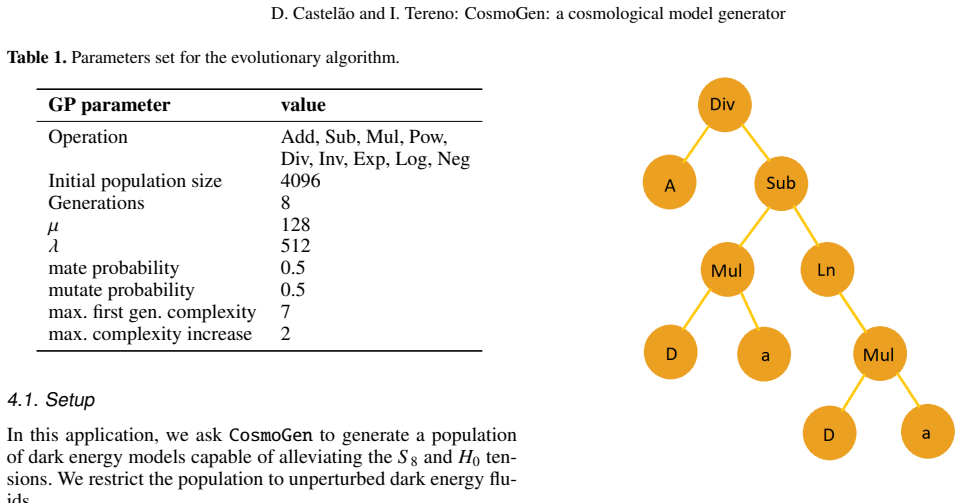
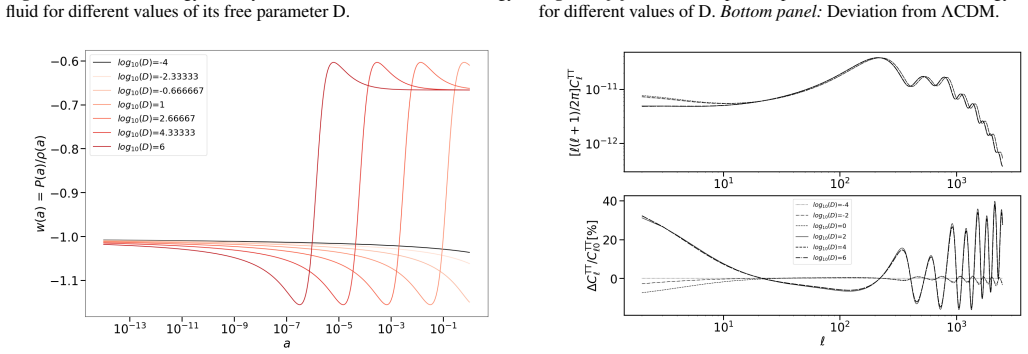
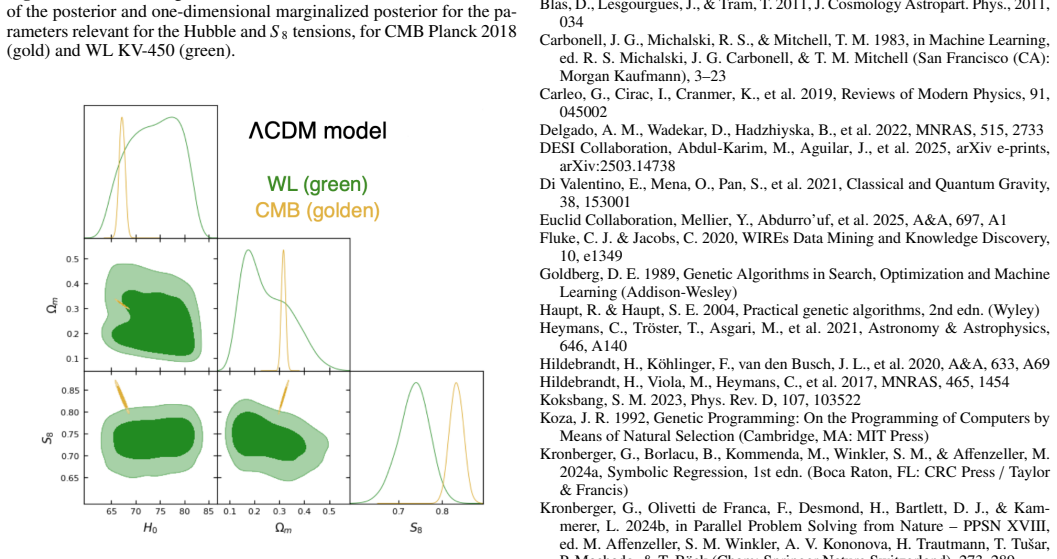
CosmoGen implements evolutionary algorithms for symbolic regression where fitness is determined by how well the model reproduces structure formation and background cosmological quantities. Applied to dark energy fluid models aimed at mitigating the S8 and H0 tensions, the framework produces models with high fitness values. Bayesian analysis of one such illustrative model confirms that it alleviates the tensions, although the Bayes factor still shows a weaker preference compared to the standard LambdaCDM model.
What carries the argument
CosmoGen, a genetic algorithm framework for symbolic regression of dark energy dynamics, with fitness evaluation based on computations of structure formation and background cosmological quantities.
If this is right
- High-fitness models can be passed to standard Bayesian pipelines for detailed parameter constraints and model comparison.
- The generated dark energy expressions demonstrate the capacity to ease discrepancies in Hubble constant and structure growth measurements.
- The same evolutionary procedure can be reused for other cosmological sectors once appropriate fitness functions are defined.
Where Pith is reading between the lines
- Adding explicit physical constraints such as stability or causality to the fitness function could improve the Bayesian ranking of evolved models.
- Running the framework on larger populations or with additional tension metrics might surface models that outperform LambdaCDM more decisively.
- The approach could be tested on early-universe data to check whether models evolved for late-time tensions remain viable across cosmic history.
Load-bearing premise
The evolutionary process guided by structure formation and background quantities will automatically produce models that are mathematically consistent and avoid introducing new conceptual problems.
What would settle it
A full Bayesian parameter estimation and evidence comparison on multiple generated models using current cosmological datasets that finds no consistent reduction in the H0 or S8 tensions relative to LambdaCDM would falsify the central claim.
Figures




read the original abstract
The standard Lambda cold dark matter ($\Lambda$CDM) paradigm of the physical Universe suffers from well-known conceptual problems and is challenged by observational data. Alternative models exist in the literature, both phenomenological and physically motivated, but many of them suffer from similar or new problems. We propose a method to mechanically generate alternative models in a data-informed procedure tuned to mitigate specific problems. We implemented a computational framework, dubbed CosmoGen, based on evolutionary algorithms for symbolic regression. The evolutionary process is guided by the computation of structure formation and background cosmological quantities. As a proof-of-concept, we applied the procedure to the specific case of dark energy fluid models and asked the framework to generate models capable of alleviating the cosmological tensions $S_8$ and $H_0$. The system generated models with high fitness values, and through a Bayesian analysis of an illustrative model, we show that the model indeed alleviates the tensions, even though the Bayes factor indicates a weaker preference for $\Lambda$CDM.
Editorial analysis
A structured set of objections, weighed in public.
Referee Report
Summary. The manuscript introduces CosmoGen, a genetic algorithm framework for symbolic regression to generate alternative dark energy fluid models. Guided by computations of background cosmology and structure formation, the method targets alleviation of the S8 and H0 tensions. As a proof-of-concept, it reports generation of high-fitness models and presents a Bayesian analysis of one illustrative model showing tension reduction, although the Bayes factor indicates a weaker preference relative to ΛCDM.
Significance. If the generated models satisfy basic physical consistency requirements, the framework provides a systematic, data-driven alternative to manual construction of dark energy models, potentially useful for exploring dynamics that address cosmological tensions. The approach is novel in its use of evolutionary algorithms tuned to observables, but its impact depends on demonstrating that high-fitness outputs remain viable beyond the fitness criteria.
major comments (2)
- [Fitness function (methods section describing evolutionary process and fitness criteria)] Fitness function (methods section describing evolutionary process and fitness criteria): The fitness is defined via matching to background and structure-formation observables for S8/H0 alleviation, but lacks explicit penalties or constraints for perturbation-level instabilities such as c_s² < 0, ghost modes, or gradient instabilities. This is load-bearing for the central claim because symbolic regression can yield expressions that satisfy coarse fitness yet produce unphysical linear perturbation equations, undermining the viability of the generated models.
- [Bayesian analysis of illustrative model (results section)] Bayesian analysis of illustrative model (results section): The claim of tension alleviation is presented for one selected model, but the manuscript does not detail the post-generation selection criteria, any filtering for mathematical consistency, or error handling in the evolutionary outputs. This weakens the robustness of the proof-of-concept demonstration.
minor comments (1)
- [Abstract] The abstract states that the Bayes factor indicates a weaker preference for ΛCDM; including the numerical value of the Bayes factor would improve clarity and allow readers to assess the strength of the comparison directly.
Simulated Author's Rebuttal
We thank the referee for their constructive and detailed review of our manuscript. We have carefully considered the major comments and provide point-by-point responses below. Where appropriate, we have revised the manuscript to address the concerns and improve the clarity and robustness of the presented framework.
read point-by-point responses
-
Referee: Fitness function (methods section describing evolutionary process and fitness criteria): The fitness is defined via matching to background and structure-formation observables for S8/H0 alleviation, but lacks explicit penalties or constraints for perturbation-level instabilities such as c_s² < 0, ghost modes, or gradient instabilities. This is load-bearing for the central claim because symbolic regression can yield expressions that satisfy coarse fitness yet produce unphysical linear perturbation equations, undermining the viability of the generated models.
Authors: We agree that explicit safeguards against perturbation-level instabilities are important for ensuring the physical viability of models generated by symbolic regression. The current fitness function prioritizes agreement with background cosmology and structure-formation observables relevant to the S8 and H0 tensions, but does not yet incorporate direct penalties for conditions such as c_s² < 0 or the presence of ghost or gradient instabilities. In the revised manuscript we will augment the fitness function in the methods section with additional penalty terms that penalize these instabilities, thereby guiding the evolutionary process toward physically consistent solutions. We will also report the fraction of generated models that survive these checks. revision: yes
-
Referee: Bayesian analysis of illustrative model (results section): The claim of tension alleviation is presented for one selected model, but the manuscript does not detail the post-generation selection criteria, any filtering for mathematical consistency, or error handling in the evolutionary outputs. This weakens the robustness of the proof-of-concept demonstration.
Authors: We acknowledge that additional transparency regarding model selection would strengthen the proof-of-concept section. In the revised manuscript we will expand the results section to describe the post-generation selection criteria applied to the illustrative model. This will include the specific filters used to enforce mathematical consistency (e.g., removal of expressions containing singularities or undefined operations), the criteria for choosing the model among the high-fitness population, and the procedures employed to handle invalid or erroneous outputs from the genetic algorithm. A short discussion of the robustness of the selected model with respect to these filters will also be added. revision: yes
Circularity Check
No significant circularity: computational search framework with external fitness criteria
full rationale
The paper presents CosmoGen as an evolutionary symbolic regression framework that mechanically generates dark energy fluid models by optimizing against externally defined fitness functions computed from background cosmology and structure formation observables. The goal is to produce high-fitness models targeting S8 and H0 tension alleviation, followed by separate Bayesian analysis on an illustrative example. No derivation chain reduces by construction to its inputs; fitness is defined from independent cosmological data rather than self-referential parameters, and the method is explicitly a data-informed search procedure rather than a first-principles derivation or renamed empirical fit. No self-citations, uniqueness theorems, or ansatzes are invoked as load-bearing steps in the provided description, rendering the approach self-contained.
Axiom & Free-Parameter Ledger
axioms (1)
- domain assumption Standard LambdaCDM background evolution and linear structure formation calculations provide sufficient guidance for model fitness.
Reference graph
Works this paper leans on
-
[1]
Abroshan, M., Mishra, S., & Khalili, M. M. 2023, in Proceedings of the AAAI Conference on Artificial Intelligence
work page 2023
-
[2]
Albrecht, A., Bernstein, G., Cahn, R., et al. 2006, arXiv e-prints, astro
work page 2006
- [3]
-
[4]
Audren, B., Lesgourgues, J., Benabed, K., & Prunet, S. 2013, J. Cosmology As- tropart. Phys., 2013, 001
work page 2013
-
[5]
J., Desmond, H., & Ferreira, P
Bartlett, D. J., Desmond, H., & Ferreira, P. G. 2024, IEEE Transactions on Evo- lutionary Computation, 28, 950
work page 2024
-
[6]
Blas, D., Lesgourgues, J., & Tram, T. 2011, J. Cosmology Astropart. Phys., 2011, 034
work page 2011
-
[7]
Carbonell, J. G., Michalski, R. S., & Mitchell, T. M. 1983, in Machine Learning, ed. R. S. Michalski, J. G. Carbonell, & T. M. Mitchell (San Francisco (CA): Morgan Kaufmann), 3–23
work page 1983
-
[8]
2019, Reviews of Modern Physics, 91, 045002
Carleo, G., Cirac, I., Cranmer, K., et al. 2019, Reviews of Modern Physics, 91, 045002
work page 2019
-
[9]
DESI DR2 Results II: Measurements of Baryon Acoustic Oscillations and Cosmological Constraints
Delgado, A. M., Wadekar, D., Hadzhiyska, B., et al. 2022, MNRAS, 515, 2733 DESI Collaboration, Abdul-Karim, M., Aguilar, J., et al. 2025, arXiv e-prints, arXiv:2503.14738 Di Valentino, E., Mena, O., Pan, S., et al. 2021, Classical and Quantum Gravity, 38, 153001 Euclid Collaboration, Mellier, Y ., Abdurro’uf, et al. 2025, A&A, 697, A1
work page internal anchor Pith review Pith/arXiv arXiv 2022
-
[10]
Fluke, C. J. & Jacobs, C. 2020, WIREs Data Mining and Knowledge Discovery, 10, e1349
work page 2020
-
[11]
Goldberg, D. E. 1989, Genetic Algorithms in Search, Optimization and Machine Learning (Addison-Wesley)
work page 1989
-
[12]
Haupt, R. & Haupt, S. E. 2004, Practical genetic algorithms, 2nd edn. (Wyley)
work page 2004
-
[13]
2021, Astronomy & Astrophysics, 646, A140
Heymans, C., Tröster, T., Asgari, M., et al. 2021, Astronomy & Astrophysics, 646, A140
work page 2021
- [14]
-
[15]
Hildebrandt, H., Viola, M., Heymans, C., et al. 2017, MNRAS, 465, 1454
work page 2017
-
[16]
Koksbang, S. M. 2023, Phys. Rev. D, 107, 103522
work page 2023
-
[17]
Koza, J. R. 1992, Genetic Programming: On the Programming of Computers by Means of Natural Selection (Cambridge, MA: MIT Press)
work page 1992
-
[18]
2023, Machine Learn- ing: Science and Technology, 4, 045002
Lemos, P., Jeffrey, N., Cranmer, M., Ho, S., & Battaglia, P. 2023, Machine Learn- ing: Science and Technology, 4, 045002
work page 2023
-
[19]
The Cosmic Linear Anisotropy Solving System (CLASS) I: Overview
Lesgourgues, J. 2011, arXiv e-prints, arXiv:1104.2932
work page internal anchor Pith review Pith/arXiv arXiv 2011
-
[20]
Li, Y ., Ni, Y ., Croft, R. A. C., et al. 2021, Proceedings of the National Academy of Science, 118, e2022038118
work page 2021
-
[21]
Linder, E. V . 2003, Phys. Rev. Lett., 90, 091301 LSST Science Collaboration, Abell, P. A., Allison, J., et al. 2009, arXiv e-prints, arXiv:0912.0201
work page internal anchor Pith review Pith/arXiv arXiv 2003
- [22]
-
[23]
1999, ApJ, 517, 565 Planck Collaboration, Ade, P
Perlmutter, S., Aldering, G., Goldhaber, G., et al. 1999, ApJ, 517, 565 Planck Collaboration, Ade, P. A. R., Aghanim, N., et al. 2014, A&A, 571, A16 Planck Collaboration, Aghanim, N., Akrami, Y ., et al. 2020, A&A, 641, A6
work page 1999
-
[24]
Riess, A. G., Filippenko, A. V ., Challis, P., et al. 1998, AJ, 116, 1009
work page 1998
- [25]
-
[26]
Riess, A. G., Yuan, W., Macri, L. M., et al. 2022, ApJ, 934, L7 Roman ROTAC and CCSDC. 2025, arXiv e-prints, arXiv:2505.10574
-
[27]
Sutton, R. & Barto, A. 2018, Reinforcement Learning, second edition: An Intro- duction, Adaptive Computation and Machine Learning series (MIT Press)
work page 2018
-
[28]
2008, Contemporary Physics, 49, 71–104
Trotta, R. 2008, Contemporary Physics, 49, 71–104
work page 2008
-
[29]
Turing, A. M. 1950, Mind, LIX, 433
work page 1950
-
[30]
Udrescu, S.-M. & Tegmark, M. 2020, Science Advances, 6, eaay2631 Article number, page 9 A&A proofs:manuscript no. main
work page 2020
-
[31]
2017, in Advances in Neural Infor- mation Processing Systems (NeurIPS), 5998–6008
Vaswani, A., Shazeer, N., Parmar, N., et al. 2017, in Advances in Neural Infor- mation Processing Systems (NeurIPS), 5998–6008
work page 2017
- [32]
- [33]
-
[34]
2023, The European Physical Journal C, 83 [arXiv:2304.05807]
Wang, D., Koussour, M., Malik, A., Myrzakulov, N., & Mustafa, G. 2023, The European Physical Journal C, 83 [arXiv:2304.05807]
-
[35]
Webb, S. A. & Goode, S. R. 2025, in IAU Symposium, V ol. 19, IAU Symposium, ed. J. McIver, A. Mahabal, & C. Fluke, 40–49
work page 2025
-
[36]
1989, Reviews of Modern Physics, 61, 1
Weinberg, S. 1989, Reviews of Modern Physics, 61, 1
work page 1989
-
[37]
H., Stölzner, B., Asgari, M., et al
Wright, A. H., Stölzner, B., Asgari, M., et al. 2025, KiDS-Legacy: Cosmological constraints from cosmic shear with the complete Kilo-Degree Survey
work page 2025
-
[38]
Zlatev, I., Wang, L., & Steinhardt, P. J. 1999, Phys. Rev. Lett., 82, 896 Article number, page 10 D. Castelão and I. Tereno: CosmoGen: a cosmological model generator Appendix A: Robustness tests We show the top ranked models from two other runs of CosmoGenin Tables A.1 and A.2. There are some models in common between the results of the various runs. We no...
work page 1999
discussion (0)
Sign in with ORCID, Apple, or X to comment. Anyone can read and Pith papers without signing in.