REVIEW 3 major objections 4 minor 17 references
SD-TWIN framework predicts IIoT attacks 15 seconds ahead with F2 score 0.822.
Reviewed by Pith at T0; open to challenge. T0 means a machine referee read the full paper against a public rubric. the ladder, T0–T4 →
A T+15 second anomaly prediction framework for IIoT, built on SDN telemetry and a digital twin, with reported LightGBM-GPU F2 score 0.822 on CICAPT-IIoT2024.
T0 review reviewed 2026-08-04 challenge →
load-bearing objection The T+15 labeling idea and SDN/digital-twin framing are worth a look, but the random stratified split on temporally adjacent records means the headline F2/AUC numbers do not demonstrate generalization to unseen future attacks. the 3 major comments →
A Novel Short-Term Anomaly Prediction for IIoT with Software Defined Twin Network
The pith
A machine-rendered reading of the paper's core claim, the machinery that carries it, and where it could break.
The reading
Core claim
The central claim is that time-aware labeling—assigning each network flow a label indicating whether any anomaly occurs within the following 15 seconds—enables a digital-twin pipeline to predict imminent IIoT attacks, and that a GPU-accelerated LightGBM model is the best candidate for that prediction task. On CICAPT-IIoT2024, the model reports precision 0.615, recall 0.952, F2 0.822, and AUC 0.9982, which the authors describe as balancing high anomaly recall with strong classification performance. On the more conventional CIC-IDS2017 dataset, a grid-searched random forest reaches F2 0.912 and recall 0.920. The paper further shows that SHAP attributions differ by environment: packet-length fe
What carries the argument
The load-bearing mechanism is the temporal labeling strategy: for each record, a binary label `label_t+15` is generated by forward-index search on timestamps to mark whether any attack occurs within 15 seconds after the current flow. This converts a standard detection dataset into a forecasting problem. The SD-TWIN architecture then couples this predictor with an SDN controller (ONOS) that collects flow counters, streams them via Kafka, runs inference in a FastAPI micro-service, and can push mitigation rules back to the network.
Load-bearing premise
The result depends on the assumption that a random stratified split of chronologically ordered records accurately measures the model's ability to predict future anomalies; if temporally adjacent training and test samples are near-duplicates, the reported F2 and AUC overstate real-world forecasting skill.
What would settle it
Re-run the exact same training and evaluation procedure on CICAPT-IIoT2024 but split the data by time (e.g., train on the first 70% of timestamps, test on the last 30%, or split by attack session). If the GPU-LightGBM model's F2 score drops substantially below 0.822—say, below 0.6—while a chronological baseline with the same hyperparameters holds, the central empirical claim is falsified.
If this is right
- If the reported F2 and AUC hold under realistic evaluation, the framework gives operators a 15-second early-warning window to drop, rate-limit, or reroute traffic before an attack manifests.
- The time-aware labeling recipe can be applied to other public security datasets, turning existing intrusion-detection benchmarks into predictive-forecasting benchmarks.
- The contrast in SHAP features suggests that IIoT anomaly prediction should emphasize temporal persistence metrics, while enterprise detection should emphasize packet-shape features.
- The architecture's modular layers (physical, telemetry, twin/analytics, visualization) provide a reference design for deploying ML-based predictions inside SDN-managed industrial networks.
- The automatic retraining trigger and hot-swap mechanism, if operationalized, would let the twin adapt to evolving attack patterns without downtime.
Where Pith is reading between the lines
- The random stratified train/test split is a serious threat to the reported numbers: because labels are derived from the next 15 seconds of the same session, temporally adjacent records are near-duplicates, so the model may memorize session patterns rather than generalize to unseen future anomalies. A chronological or session-held-out split would likely produce materially lower F2/AUC.
- The paper labels anomalies only as binary (attack/benign) and uses random undersampling; extending the framework to attack-type-aware labels and more advanced imbalance handling (e.g., SMOTE or class weights) would clarify whether the recall-centric performance holds across specific APT techniques.
- The SD-TWIN deployment is validated on emulated Mininet traffic, not on a physical IIoT testbed; the reported training/inference times may not translate to real constrained gateways, despite the mention of Raspberry Pi surrogate models.
- The T+15 window is fixed and dataset-specific; testing different look-ahead windows (e.g., T+5, T+30) and measuring how F2 decays with horizon would give operators a practical sense of how far ahead the twin can reliably predict.
Editorial analysis
A structured set of objections, weighed in public.
Referee Report
Summary. This paper presents SD-TWIN, an SDN-based digital twin architecture for short-term anomaly prediction in IIoT. The authors generate a temporal label_t+15 for each network flow record, indicating whether an anomaly occurs within the next 15 seconds, and evaluate six machine/deep learning models on CICAPT-IIoT2024 and CIC-IDS2017. They report that a GPU-accelerated LightGBM achieves the best F2 (0.822) and AUC (0.9982) on the IIoT dataset, and that Random Forest with grid search performs well on CIC-IDS2017. The paper also describes a four-layer deployment with ONOS, Kafka, FastAPI, Redis Streams, and SHAP explanations, and discusses training-time trade-offs.
Significance. If the performance numbers were valid, the paper would make a useful contribution: it adapts standard intrusion datasets to a predictive T+15 formulation, connects the prediction to SDN-based mitigation actions, and provides an IIoT/enterprise comparison. The temporal labeling and recall-oriented evaluation are appropriate for early-warning applications. However, the headline empirical claim is currently undermined by the evaluation protocol (random split after temporal labeling), so the significance is conditional on a corrected temporal evaluation. The paper does not include code or deployment measurements, which limits reproducibility.
major comments (3)
- [Section III-B, Table I] The evaluation protocol invalidates the headline forecasting numbers. The dataset is sorted chronologically and each row is assigned label_t+15 indicating an anomaly within the next 15 seconds. This makes consecutive rows within any 15-second window have identical or near-identical features and the same label. Splitting these rows with random stratified sampling places temporally adjacent near-duplicates in both training and test sets. Because a test record's label can be recovered from near-duplicate training records from the same attack/benign session, reported F2=0.822 and AUC=0.9982 for LGBM-GPU measure memorization of interleaved sessions, not generalization to unseen future anomalies. The same protocol is applied to CIC-IDS2017. A valid evaluation for T+15 prediction must use a temporal split (e.g., train on an early segment, test on a later segment with a gap of at least 15 s, or
- [Section II and abstract] The abstract and Section II claim a 'real-time SD-TWIN deployment' and real-time prediction service. However, no online evaluation is reported: there are no latency, throughput, end-to-end delay, or sustained-run measurements; Table I and Fig. 3 report only offline training times. The FastAPI/Redis/gRPC components are described architecturally but not benchmarked. This unsupported claim should be removed or substantiated with deployment experiments.
- [Section III-C.2] The preprocessing description is ambiguous about when Random UnderSampling (RUS) is applied. Section III-C.2 says RUS is applied 'before model fitting,' but if RUS is applied before the train/test split, the test set no longer reflects the original class distribution and test instances are selected by the same under-sampling procedure, which itself can leak information. Even if RUS is intended on the training set only, this needs to be stated and the split order clarified. The same clarification is needed for the decision-threshold optimization: thresholds are chosen from a precision-recall curve, but the text does not specify which partition is used.
minor comments (4)
- [Section I and II] There are several typographical and grammatical errors, e.g., 'we've belived', 'data aggeragated', 'This challenges can be handle'. These should be corrected.
- [Section IV, Eq. (4)] The AUC definition as an integral over TPR(FPR) is mathematically acceptable but omits the standard empirical estimator; consider using a more precise definition or referencing a standard implementation.
- [Table I] AUC for LGBM-GPU is shown as 0.998 in the table but as 0.9982 in the text; use consistent rounding throughout.
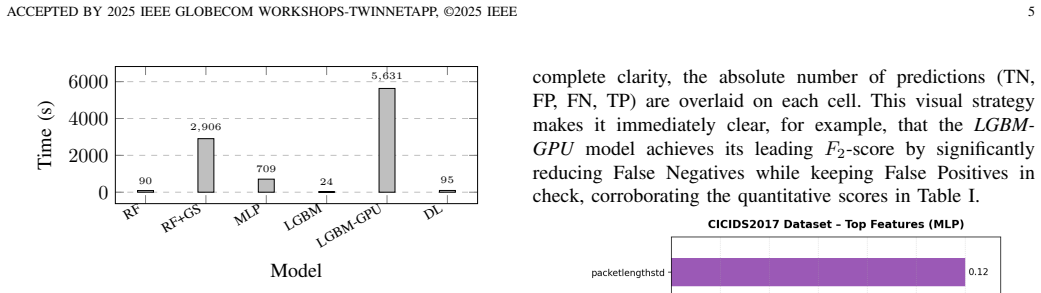
- [Fig. 3] The caption compares 'training time' but LGBM-GPU's 5631 s includes feature-selection heuristics and threshold scanning, not just model fitting. Please label this as optimization/training time or separate the stages.
Circularity Check
Random stratified split temporally interleaves train/test near-duplicates, so the reported T+15 prediction metrics measure memorization, not forecasting.
specific steps
-
fitted input called prediction
[Section III-B (CICAPT-IIoT2024 Preprocessing); Table I]
"CICAPT-IIoT2024 dataset was first sorted chronologically using the ts (timestamp) field to ensure temporal coherence. A binary label label_t+15 was generated for each row to indicate whether any attack occurs within the subsequent 15-second window. ... After label generation, features irrelevant to short-term anomaly dynamics—such as source and destination IP addresses, low-variance or redundant attributes, and original attack labels—were removed to reduce dimensionality and prevent data leakage. Remaining categorical attributes were label-encoded, and the dataset was split into training and t"
The label definition makes the target a forward-looking time-window indicator: every record whose timestamp falls inside the same 15-second attack window receives the same label_t+15. Because rows are sorted chronologically and the split is random stratified, records from the same attack window (same flow/session, near-identical features) are distributed across both train and test. Thus for a test record, a near-duplicate training record with the same label exists by construction. The model can achieve high AUC/F2 by retrieving the memorized neighbor label; the reported LGBM-GPU F2=0.822 and AUC=0.9982 in Table I do not require extrapolating to an unseen future. The 'prediction' is therefore an interpolation/memorization benchmark, not a T+15 forecast. The preprocessing step that removes I
full rationale
The proposed architecture and time-aware labeling are not themselves circular; the SD-TWIN pipeline, model selection, and SHAP analysis have independent content. However, the paper's central empirical claim—that LGBM-GPU achieves F2=0.822 and AUC=0.9982 for proactive T+15 anomaly prediction—is undermined by the evaluation protocol. Since the datasets are sorted chronologically and labeled with a forward 15-second window, a random stratified split interleaves temporally adjacent near-duplicates between training and testing. The test labels are therefore available in the training set through near-identical records, so the reported metrics measure memorization rather than generalization to unseen future anomalies. This is a construction-level reduction of 'prediction' to retrieval from fitted data. The paper's own limitation section (Section V) notes only binary labels and random under-sampling, and does not disclose or mitigate this temporal leakage. The self-citations in the paper ([3], [4]) are background references and are not load-bearing. The abstract's 'real-time SD-TWIN deployment' claim is also not supported by deployment measurements, but that is a correctness risk, not circularity. Because the central empirical result reduces by the split construction, the circularity score is 6.
Axiom & Free-Parameter Ledger
free parameters (4)
- T+15 lookahead window =
15 seconds
- Decision threshold (LGBM) =
earliest PR-curve point with precision > 0.20 and recall > 0.50
- Decision threshold (LGBM-GPU and DL) =
PR-curve point maximizing F2 score
- Random under-sampling ratio =
not stated
axioms (4)
- domain assumption Temporal ordering of dataset records is meaningful and the ts field permits correct T+15 label generation.
- domain assumption CICAPT-IIoT2024 and CIC-IDS2017 labels are reliable ground truth for the IIoT/enterprise scenarios.
- domain assumption Stratified random splitting preserves the validity of a predictive-learning evaluation.
- standard math Standard definitions of precision, recall, F2, and AUC apply to the binary temporal labels.
Cite this review
Pith. "Pith review of A Novel Short-Term Anomaly Prediction for IIoT with Software Defined Twin Network." pith.science (2026). https://pith.science/paper/R7F4UTQX
@misc{pith2026250920068,
  author       = {Pith},
  title        = {Pith review of: A Novel Short-Term Anomaly Prediction for IIoT with Software Defined Twin Network},
  year         = {2026},
  howpublished = {\url{https://pith.science/paper/R7F4UTQX}},
  note         = {Machine review of arXiv:2509.20068}
}
read the original abstract
Secure monitoring and dynamic control in an IIoT environment are major requirements for current development goals. We believe that dynamic, secure monitoring of the IIoT environment can be achieved through integration with the Software-Defined Network (SDN) and Digital Twin (DT) paradigms. The current literature lacks implementation details for SDN-based DT and time-aware intelligent model training for short-term anomaly detection against IIoT threats. Therefore, we have proposed a novel framework for short-term anomaly detection that uses an SDN-based DT. Using a comprehensive dataset, time-aware labeling of features, and a comprehensive evaluation of various machine learning models, we propose a novel SD-TWIN-based anomaly detection algorithm. According to the performance of a new real-time SD-TWIN deployment, the GPU- accelerated LightGBM model is particularly effective, achieving a balance of high recall and strong classification performance.
Figures




Reference graph
Works this paper leans on
-
[1]
S. K. Jagatheesaperumal and M. Rahouti, ”Building digital twins of cyber physical systems with metaverse for industry 5.0 and beyond,”IT Prof., vol. 25, no. 1, pp. 34–40, Jan.–Feb. 2023
2023
-
[2]
Olsson, A
J. Olsson, A. Shorov, L. Abdelrazek, J. Whitefield, ”5g zero trust: a zero trust architecture for telecom”. Ericsson Technol. Rev. 5, 2–11, 2021
2021
-
[3]
Erel-Ozcevik
M. Erel-Ozcevik. ”Token as a Service for Software-Defined Zero Trust Networking”, Journal of Network and Systems Management, 33:10,
-
[4]
SDoff: A software- defined offloading controller for heterogeneous networks,
Z. Arslan, M. Erel, Y . Ozcevik, and B. Canberk, “SDoff: A software- defined offloading controller for heterogeneous networks,” inProc. IEEE Wireless Commun. Netw. Conf. (WCNC), Istanbul, Turkey, Apr. 2014, pp. 2827–2832, doi: 10.1109/WCNC.2014.6952897
arXiv 2014
-
[5]
Z. Li, T. Xue, L. Yu, and B. Yang, ”Performance analysis of virtual-real synchronization in digital twin network: Trade-offs between timeliness, distortion, and sustainability,” inProc. 3rd Int. Conf. Intell. Commun. Comput. (ICC), 2023, pp. 289–295
2023
-
[6]
Yigit, K
Y . Yigit, K. Gursu, A. Al Dubai, L. Maglaras, and B. Canberk, ”Digital twin-enabled lightweight attack detection for software-defined edge networks,” inProc. IEEE Wireless Commun. Netw. Conf. (WCNC), 2025, in press
2025
-
[7]
Al-Hawawreh and M
M. Al-Hawawreh and M. S. Hossain, ”Digital twin-driven secured edge- private cloud Industrial Internet of Things (IIoT) framework,”J. Netw. Comput. Appl., vol. 226, p. 103888, 2024
2024
-
[8]
Yigit, O
Y . Yigit, O. K. Kinaci, T. Q. Duong, and B. Canberk, ”TwinPot: Digital twin-assisted honeypot for cyber-secure smart seaports,” inProc. IEEE Int. Conf. Commun. Workshops (ICC Workshops), 2023, pp. 740–745
2023
-
[9]
K. Benidiset al., ”Deep learning for time series forecasting: Tutorial and literature survey,”arXiv preprint arXiv:2004.10240, 2022
Pith/arXiv arXiv 2004
-
[10]
Singh and G
R. Singh and G. Srivastav, ”Novel framework for anomaly detection using machine learning technique on CIC-IDS2017 dataset,” inProc. Int. Conf. Technol. Adv. Innov. (ICTAI), 2021, pp. 632–636
2021
-
[11]
Spatio- temporal estimation for interference management in femtocell net- works,
D. M. Gutierrez-Estevez, B. Canberk, and I. F. Akyildiz, “Spatio- temporal estimation for interference management in femtocell net- works,” inProc. IEEE 23rd Int. Symp. Personal, Indoor and Mobile Radio Commun. (PIMRC), 2012, pp. 1137–1142, doi: 10.1109/PIMRC.2012.6362517
arXiv 2012
-
[12]
FSC: Two-Scale AI-Driven Fair Sensitiv- ity Control for 802.11ax Networks,
E. Ak and B. Canberk, “FSC: Two-Scale AI-Driven Fair Sensitiv- ity Control for 802.11ax Networks,” inProc. IEEE Global Com- mun. Conf. (GLOBECOM), Taipei, Taiwan, Dec. 2020, pp. 1–6. doi: 10.1109/GLOBECOM42002.2020.9322153
arXiv 2020
-
[13]
Ghiasvand, S
E. Ghiasvand, S. Ray, S. Iqbal, S. Dadkhah, and A. A. Ghorbani, ”CICAPT-IIOT: A provenance-based APT attack dataset for IIoT environment,” inProc. 21st EAI Int. Conf. Mobile Ubiquitous Syst.: Comput., Netw. Serv. (MobiQuitous), 2024. [Online]. Available: https://www.cs.unb.ca/ ∼sray/papers/CICAPT IIoT paper Mobiquitous24 author copy.png
2024
-
[14]
E. Ghiasvand, S. Ray, S. Iqbal, S. Dadkhah, and A. A. Ghorbani, ”Resilience against APTs: A provenance-based IIoT dataset for cyber- security research,”arXiv preprint arXiv:2407.11278, 2024
Pith/arXiv arXiv 2024
-
[15]
Sharafaldin, A
I. Sharafaldin, A. H. Lashkari, and A. A. Ghorbani, ”Toward generating a new intrusion detection dataset and intrusion traffic characterization,” inProc. 4th Int. Conf. Inf. Syst. Secur . Privacy (ICISSP), 2018, pp. 108–116
2018
-
[16]
A. Masaracchia, D. V . Huynh, G. C. Alexandropoulos, B. Canberk, O. A. Dobre, and T. Q. Duong, “Toward the Metaverse Realization in 6G: Orchestration of RIS-Enabled Smart Wireless Environments via Digital Twins,”IEEE Internet of Things Magazine, vol. 7, no. 2, pp. 22–28, Mar. 2024, doi: 10.1109/IOTM.001.2300128
-
[2025]
https://doi.org/10.1007/s10922-024-09894-w
This paper was first reviewed by deepseek-v4-flash on August 4, 2026.
discussion (0)
Sign in with ORCID, Apple, or X to comment. Anyone can read and Pith papers without signing in.