REVIEW 5 major objections 5 minor 1 cited by
This paper claims that a transformer layer's activation entropy predicts how much that layer can be safely quantized, and that greedily sending the lowest-entropy layers to 1-2 bits while keeping the rest at 4 bits yields a better memory-pe
Reviewed by Pith at T0; open to challenge. T0 means a machine referee read the full paper against a public rubric. the ladder, T0–T4 →
T0 review · deepseek-v4-flash
2026-08-04 14:38 UTC pith:FQTITAF5
load-bearing objection A practical entropy-guided layerwise quantization recipe for MLLMs, with good ablations but some overstated numbers and an untested ordering-stability assumption. the 5 major comments →
LUQ: Layerwise Ultra-Low Bit Quantization for Multimodal Large Language Models
The pith
A machine-rendered reading of the paper's core claim, the machinery that carries it, and where it could break.
Core claim
The central discovery is that the Shannon entropy of a transformer layer's output activations, estimated by K-means clustering on a small calibration set, is a usable proxy for that layer's tolerance to ultra-low-bit quantization. Layers whose activations form low-entropy clusters encode simpler functions and survive 1-2 bit weights with little loss; high-entropy layers, especially those processing visual tokens, degrade sharply. LUQ exploits this by sorting layers by entropy and quantizing the lowest-entropy ones first to 1-2 bits with a one-bit PTQ method (BiLLM) while the rest stay at 4-bit GPTQ, with a validation threshold or memory budget deciding the cutoff. The paper also reports that
What carries the argument
The load-bearing object is the layerwise activation entropy H_i, computed as the Shannon entropy of the empirical cluster-assignment distribution obtained by running K-means with K=100 (chosen by a rank-stability elbow analysis) on the layer's output tokens from a 128-sequence multimodal calibration set. This single scalar ranks all layers; the greedy permutation orders layers by ascending H_i, and at each step the next lowest-entropy layer is quantized to 1-2 bits via a one-bit PTQ method, while non-selected layers stay at 4-bit GPTQ. A validation check or binary search sets the cutoff. The paper argues that entropy tracks functional complexity, so low-H layers can be aggressively compresse
Load-bearing premise
The entire method rests on the assumption that activation entropy measured on the unquantized model with a 128-sequence calibration set gives a stable and correct ordering of which layers can tolerate 1-2 bit quantization even after earlier layers have already been quantized.
What would settle it
Compare LUQ's selected layers against a random selection of the same number of layers, or against layers chosen by the actual per-layer output perturbation caused by quantizing each layer in isolation. If the entropy-selected set does not outperform random or error-based selection on the same benchmarks, entropy is not the active ingredient.
If this is right
- If correct, LUQ gives a practical way to deploy 7B multimodal LLMs on memory-constrained devices: LLaVA-1.5 runs at 2.54 average bits and Qwen-2.5-VL at 2.75 bits with only modest VQA loss.
- Because LUQ is agnostic to the underlying PTQ method, any future improvement in 1-bit weight quantizers would automatically translate into better accuracy at the same memory footprint.
- Mixed-modal calibration becomes a recommended practice for sub-4-bit MLLM quantization, since it consistently improves accuracy compared with text-only calibration in that regime.
- The entropy-versus-robustness relationship, if it holds, gives a principled way to choose layerwise precision for other compression tasks like pruning or knowledge distillation.
Where Pith is reading between the lines
- A natural testable extension is to compare the entropy-based layer ordering against a ranking based on actual per-layer output perturbation under quantization; if they diverge, entropy is a weak proxy for the true sensitivity.
- The method measures entropy once on the unquantized model, but in principle the ordering could be recomputed after each quantization step; the paper's static ordering assumes relative layer complexity is stable under quantization, which is not directly tested.
- The abstract's 'less than 10% degradation on MME' is optimistic for reasoning-heavy sub-scores: the paper's own Table 1 shows MME Cognition dropping 26.6% for LLaVA-1.5 (from 347 to 257). A careful reader should look at per-benchmark numbers rather than the headline average.
- The entropy signal might be partially confounded with layer depth: the paper's own ablation shows depth-based selection performs competitively, so isolating the entropy contribution over a broader set of models would clarify the mechanism.
Editorial analysis
A structured set of objections, weighed in public.
Referee Report
Summary. The manuscript presents LUQ, a post-training quantization strategy for multimodal LLMs that assigns ultra-low-bit (1-bit BiLLM) quantization to layers selected by low activation entropy and 4-bit GPTQ quantization to the remaining layers. The authors measure Shannon entropy of intermediate activations on a 128-sequence mixed-modal calibration set, sort layers by entropy, and greedily quantize the lowest-entropy layers until a memory or performance threshold is reached. They also propose mixed text/image calibration. On LLaVA-1.5 7B and Qwen-2.5-VL 7B across 9 VQA benchmarks, they report average bit-width reductions of roughly 40% and 31.5% relative to 4-bit baselines while maintaining competitive accuracy, and they claim a better memory-performance frontier than uniform GPTQ/AWQ/BiLLM.
Significance. If the entropy-ordering signal is stable and reproducible, LUQ offers a simple way to identify quantization-tolerant layers in MLLMs and improves the memory-performance trade-off compared to uniform precision. The paper includes a direct high-entropy vs low-entropy ablation (Fig. 6a) and continuous trade-off curves (Figs. 4/5), which are more informative than single operating points and support the sign of the proposed effect. However, the current evidence is incomplete: the entropy ordering is not tested for stability across calibration samples or under quantized forward passes, the LLaVA operating point is selected using the same MME benchmark on which it is evaluated, and several headline numbers in the abstract are not supported by Table 1. These issues prevent the central claim from being accepted as established.
major comments (5)
- [Sec. 3.2, Sec. 3.3, Eq. (6), Appendix B] The entropy ordering π is computed once on the unquantized model from a single 128-sequence calibration set and is fixed for the whole greedy procedure (Eqs. (6)-(7)). The only stability analysis is with respect to the K-means cluster count K (Appendix B); there is no test of ranking stability across calibration draws or after earlier layers have been quantized. If the ordering is sample-dependent or shifts when activations change, the greedy selection loses its justification and LUQ reduces to arbitrary layer choice. The Limitations section admits entropy is 'only an estimate of function complexity,' but the manuscript does not quantify the uncertainty of this estimate. Please add bootstrap resampling of the calibration set and a check of whether the ordering persists when activations are recomputed under quantized layers.
- [Sec. 4.2, Table 1, Abstract] The LLaVA configuration is obtained by imposing a 100-point MME Perception threshold relative to GPTQ-4, and the same benchmark is then reported as evidence. This is a selection-on-test issue. Moreover, the abstract's 'less than 10% degradation on MME' is not sustained by Table 1: for LLaVA, MME Cognition drops 25.9% vs GPTQ-4 (257 vs 347) and 26.6% vs FP16 (257 vs 350), while total MME drops 12.8% vs FP16 (1622 vs 1860) and 9.7% vs GPTQ-4 (1622 vs 1797). Please select k* on a separate validation benchmark or held-out split, and state the reference point for the percentage degradation in the abstract. The relationship between Eq. (8), which evaluates on the calibration set, and the Sec. 4.2 threshold on MME should also be clarified.
- [Abstract, Sec. 1, Table 1] The claimed '40% less memory' for LLaVA is not supported by the reported average bit-widths. 2.54 bits vs 4.0 bits is a 36.5% reduction, not 40%. Since only the LLM backbone is quantized, the whole-model memory saving is smaller still. Please compute the percentages from actual memory measurements (including vision encoder and embeddings) or revise the claim.
- [Sec. 3.2] The notation for X_i and X'_i is confusing: N is used for both the number of calibration sequences and the sequence length, and it is unclear whether entropy is computed over pooled tokens or per-sequence. Please use distinct symbols for number of sequences, sequence length, and hidden dimension, state the total number of tokens used in K-means, and report whether the entropy values are averaged over multiple K-means seeds. This matters because the layer selection is based on small entropy differences.
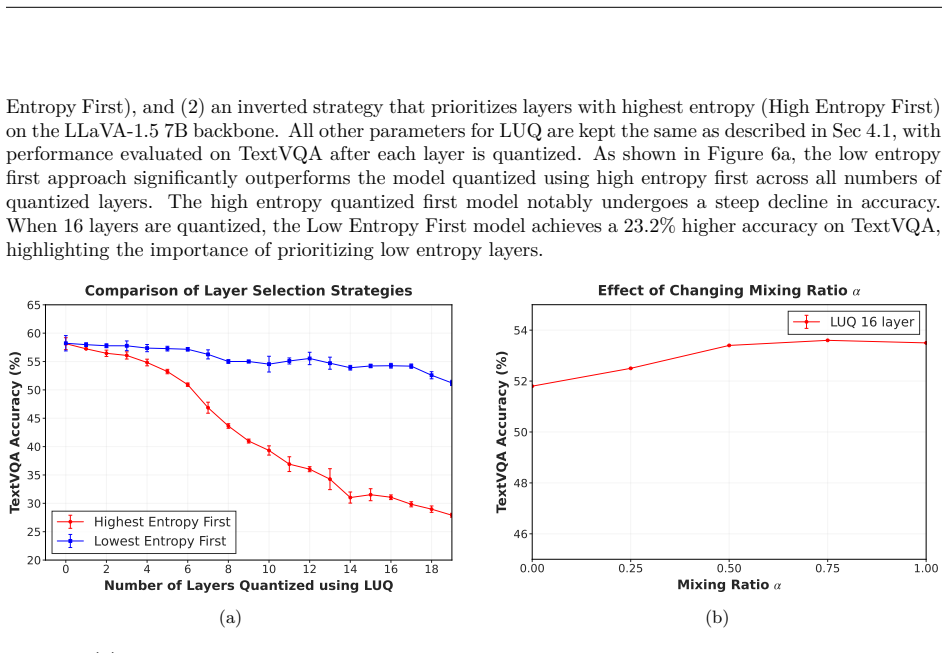
- [Sec. 4.4.1] The low-vs-high entropy ablation is useful, but without a random layer ordering baseline it does not fully establish that the entropy ordering, rather than 'any non-depth ordering,' is responsible for the gains. Since the central claim is that entropy specifically predicts robustness, please include a random-ordering baseline repeated over multiple seeds in the ablation.
minor comments (5)
- [Appendix B] The text refers to 'Equation 7' when defining the layer ordering used for stability; the ordering is defined in Eq. (6), and the notation π_k is not defined.
- [Throughout] Typos include 'and and' in the benchmark enumeration (Sec. 4.1), 'which is which is' in the Acknowledgment, and missing spaces around math in several places.
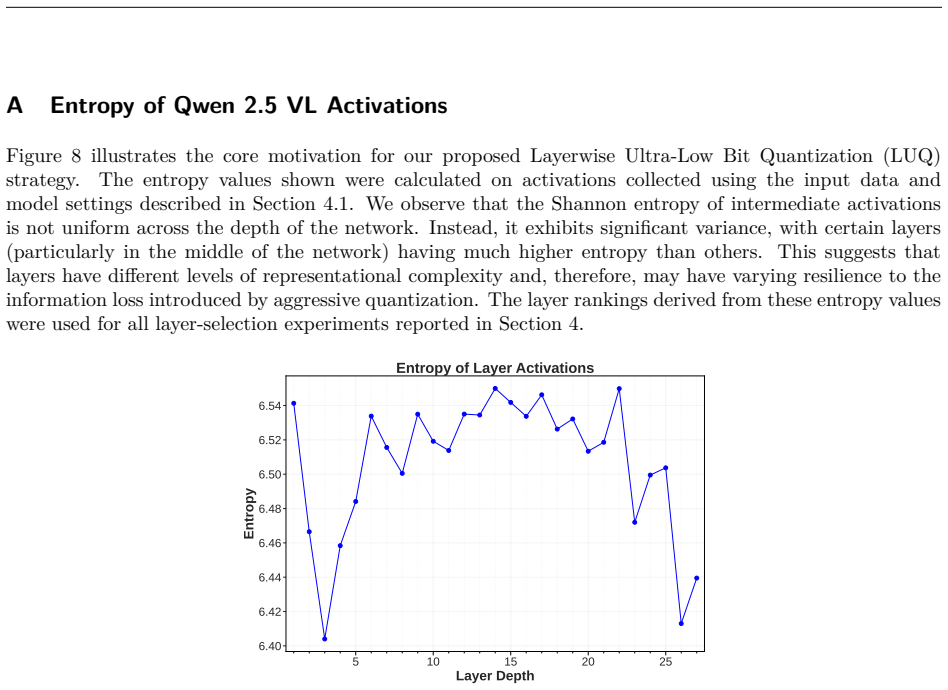
- [Figure 8] The entropy values shown span a very narrow range (about 6.40-6.54). Given that selection is driven by these differences, please report the scale of the entropy differences and, ideally, confidence intervals from repeated calibration samples.
- [Table 1] Results are reported as the mean over 3 runs, but no standard deviations are given. For comparisons within 1-2 points, variance information is needed to assess whether the differences are meaningful.
- [Sec. 4.2] The text says 'the performance cost is only 5.8% on Perception and 25.9% on Cognition' for LLaVA, which is in tension with the abstract's 'less than 10% on MME' claim. Please make the reference points consistent.
Circularity Check
No significant circularity: entropy-based layer selection is defined independently of target benchmarks, and the reported MME operating point is a validation choice, not a fitted prediction.
full rationale
LUQ's derivation chain is not circular. The layer-complexity signal H_i is computed from output activations via K-means and Shannon entropy (Eqs. 2-5) on a calibration set, with no reference to any VQA benchmark; the ordering π is fixed by Eq. (6) before quantization. The central claim that low-entropy layers tolerate ultra-low-bit quantization is tested by direct ablations: low-entropy-first vs. high-entropy-first (Fig. 6a) and entropy vs. layer depth (Table 2), neither of which tunes the ordering on the evaluation metric. The LLaVA operating point in Sec. 4.2 is set by a threshold on MME Perception, so the reported MME Perception number is a validation-selected operating point rather than an independent hold-out prediction; however, this is a model-selection/hyperparameter choice, not a reduction of the method's output to its input. The same holds for the calibration-set reuse (entropy, quantizer fitting, and optional binary-search thresholding): it creates overfitting risk, not definitional circularity. The paper's own Limitation (3) concedes entropy 'only is an estimate of function complexity,' which is a validity caveat, not a circular step. There are no load-bearing self-citations, imported uniqueness theorems, or ansatz-by-citation moves. Hence score 0.
Axiom & Free-Parameter Ledger
free parameters (4)
- Number of K-means clusters K =
100
- Calibration mixing ratio alpha =
0.5 (1:1 text/multimodal)
- Performance threshold tau / memory budget =
LLaVA: 100-point MME Perception drop; Qwen: 2.5 GB budget
- Calibration set size =
128 sequences x 2048 tokens
axioms (5)
- domain assumption Activation entropy is a proxy for layerwise functional complexity and quantization robustness
- domain assumption Entropy ordering computed on the clean model remains valid after earlier layers are quantized
- domain assumption K-means with K=100 faithfully discretizes layer activation distributions
- domain assumption The 128-sequence calibration set is representative of the deployment distribution
- domain assumption BiLLM and GPTQ behave as described in their original papers when used as base quantizers
Cite this review
Pith. "Pith review of LUQ: Layerwise Ultra-Low Bit Quantization for Multimodal Large Language Models." pith.science (2026). https://pith.science/paper/FQTITAF5
@misc{pith2026250923729,
  author       = {Pith},
  title        = {Pith review of: LUQ: Layerwise Ultra-Low Bit Quantization for Multimodal Large Language Models},
  year         = {2026},
  howpublished = {\url{https://pith.science/paper/FQTITAF5}},
  note         = {Machine review of arXiv:2509.23729}
}
read the original abstract
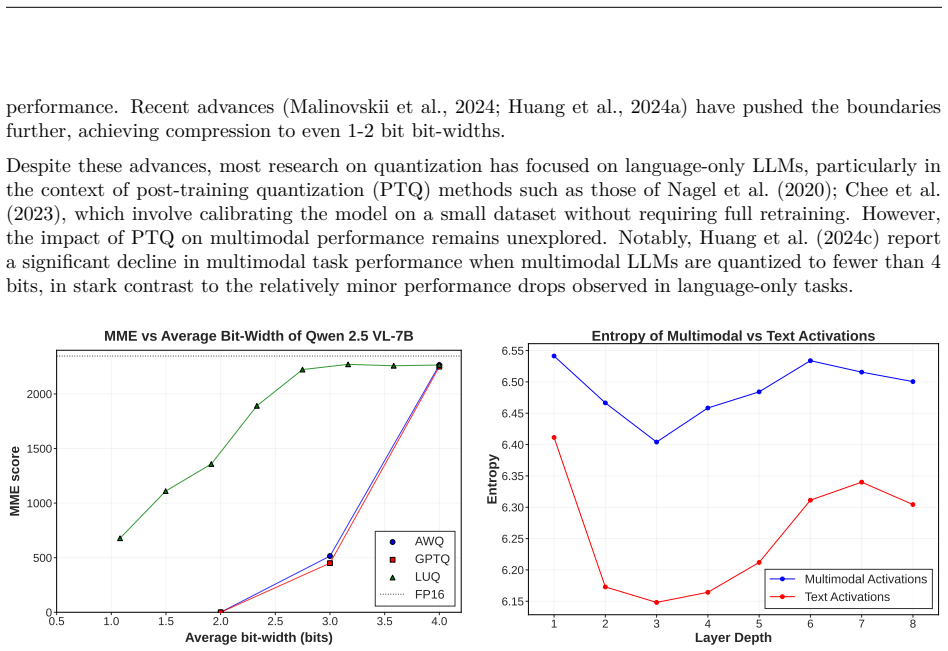
Large Language Models (LLMs) with multimodal capabilities have revolutionized vision-language tasks, but their deployment often requires huge memory and computational resources. Post-training quantization (PTQ) has successfully compressed language models to as low as 1-bit precision, its effectiveness for multimodal LLMs (MLLMs) remains unexplored. In this paper, we present the first method for ultra-low-bit (<4-bit) quantization of MLLMs. Our analysis reveals that multimodal tokens and intermediate layer activations produced by them exhibit significantly higher entropy compared to text tokens, indicating greater functional complexity that makes MLLMs less tolerant to ultra-low bit quantization. However, this entropy varies significantly across layers, with some layers producing lower-entropy activation distributions that we empirically show can better tolerate ultra-low bit quantization. Existing PTQ methods optimize weight quantization within each layer but apply the same target precision uniformly, ignoring this variation in complexity across layers. Building on this insight, we propose LUQ: Layerwise Ultra-Low Bit Quantization, which characterizes each transformer layer's functional complexity via its output activation entropy and selectively applies ultra-low bit quantization to layers encoding simpler, more compressible functions. We also show that multimodal calibration (image and text tokens) boosts VQA performance in the ultra-low bit regime. Evaluated on LLaVA-1.5 and Qwen-2.5-VL across 9 VQA benchmarks, LUQ models use 40% and 31% less memory than their 4-bit counterparts while exhibiting less than 10% degradation on MME.
Figures




Forward citations
Cited by 1 Pith paper
-
Towards Joint Quantization and Token Pruning of Vision-Language Models
QUOTA jointly optimizes low-bit quantization and visual token pruning for VLMs by deriving pruning decisions from quantized operators, achieving 95.65% average performance retention with only 30% of visual tokens vers...
Reference graph
Works this paper leans on
-
[1]
Phi-3 technical report: A highly capable language model locally on your phone
Marah Abdin, Jyoti Aneja, Hany Awadalla, Ahmed Awadallah, Ammar Ahmad Awan, Nguyen Bach, Amit Bahree, Arash Bakhtiari, Jianmin Bao, Harkirat Behl, et al. Phi-3 technical report: A highly capable language model locally on your phone. arXiv preprint arXiv:2404.14219, 2024
Pith/arXiv arXiv 2024
-
[2]
Josh Achiam, Steven Adler, Sandhini Agarwal, Lama Ahmad, Ilge Akkaya, Florencia Leoni Aleman, Diogo Almeida, Janko Altenschmidt, Sam Altman, Shyamal Anadkat, et al. Gpt-4 technical report. arXiv preprint arXiv:2303.08774, 2023
Pith/arXiv arXiv 2023
-
[3]
Shuai Bai, Keqin Chen, Xuejing Liu, Jialin Wang, Wenbin Ge, Sibo Song, Kai Dang, Peng Wang, Shijie Wang, Jun Tang, et al. Qwen2. 5-vl technical report. arXiv preprint arXiv:2502.13923, 2025
Pith/arXiv arXiv 2025
-
[4]
Why do some inputs break low-bit llm quantization?, 2025
Ting-Yun Chang, Muru Zhang, Jesse Thomason, and Robin Jia. Why do some inputs break low-bit llm quantization?, 2025. URL https://arxiv.org/abs/2506.12044
arXiv 2025
-
[5]
Quip: 2-bit quantization of large language models with guarantees
Jerry Chee, Yaohui Cai, Volodymyr Kuleshov, and Christopher M De Sa. Quip: 2-bit quantization of large language models with guarantees. In A. Oh, T. Naumann, A. Globerson, K. Saenko, M. Hardt, and S. Levine (eds.), Advances in Neural Information Processing Systems, volume 36, pp.\ 4396--4429. Curran Associates, Inc., 2023. URL https://proceedings.neurips....
2023
-
[6]
Matthieu Courbariaux, Itay Hubara, Daniel Soudry, Ran El-Yaniv, and Yoshua Bengio. Binarized neural networks: Training deep neural networks with weights and activations constrained to+ 1 or-1. arXiv preprint arXiv:1602.02830, 2016
Pith/arXiv arXiv 2016
-
[7]
Qlora: Efficient finetuning of quantized llms
Tim Dettmers, Artidoro Pagnoni, Ari Holtzman, and Luke Zettlemoyer. Qlora: Efficient finetuning of quantized llms. In A. Oh, T. Naumann, A. Globerson, K. Saenko, M. Hardt, and S. Levine (eds.), Advances in Neural Information Processing Systems, volume 36, pp.\ 10088--10115. Curran Associates, Inc., 2023. URL https://proceedings.neurips.cc/paper_files/pape...
2023
-
[8]
Gptq: Accurate post-training compression for generative pretrained transformers
Elias Frantar, Saleh Ashkboos, Torsten Hoefler, and Dan Alistarh. Gptq: Accurate post-training compression for generative pretrained transformers. arXiv preprint arXiv:2210.17323, 2022
Pith/arXiv arXiv 2022
-
[9]
Mme: a comprehensive evaluation benchmark for multimodal large language models
Chaoyou Fu, Peixian Chen, Yunhang Shen, Yulei Qin, Mengdan Zhang, Xu Lin, Zhenyu Qiu, Wei Lin, Jinrui Yang, Xiawu Zheng, et al. Mme: a comprehensive evaluation benchmark for multimodal large language models. corr abs/2306.13394 (2023), 2023
Pith/arXiv arXiv 2023
-
[10]
Making the v in vqa matter: Elevating the role of image understanding in visual question answering
Yash Goyal, Tejas Khot, Douglas Summers-Stay, Dhruv Batra, and Devi Parikh. Making the v in vqa matter: Elevating the role of image understanding in visual question answering. In Proceedings of the IEEE conference on computer vision and pattern recognition, pp.\ 6904--6913, 2017
2017
-
[11]
Aaron Grattafiori, Abhimanyu Dubey, Abhinav Jauhri, Abhinav Pandey, Abhishek Kadian, Ahmad Al-Dahle, Aiesha Letman, Akhil Mathur, Alan Schelten, Alex Vaughan, et al. The llama 3 herd of models. arXiv preprint arXiv:2407.21783, 2024
Pith/arXiv arXiv 2024
-
[12]
The unreasonable ineffectiveness of the deeper layers
Andrey Gromov, Kushal Tirumala, Hassan Shapourian, Paolo Glorioso, and Dan Roberts. The unreasonable ineffectiveness of the deeper layers. In The Thirteenth International Conference on Learning Representations, 2025. URL https://openreview.net/forum?id=ngmEcEer8a
2025
-
[13]
Billm: Pushing the limit of post-training quantization for llms
Wei Huang, Yangdong Liu, Haotong Qin, Ying Li, Shiming Zhang, Xianglong Liu, Michele Magno, and Xiaojuan Qi. Billm: Pushing the limit of post-training quantization for llms. arXiv preprint arXiv:2402.04291, 2024 a
Pith/arXiv arXiv 2024
-
[14]
Slim-llm: Salience-driven mixed-precision quantization for large language models, 2024 b
Wei Huang, Haotong Qin, Yangdong Liu, Yawei Li, Xianglong Liu, Luca Benini, Michele Magno, and Xiaojuan Qi. Slim-llm: Salience-driven mixed-precision quantization for large language models, 2024 b
2024
-
[15]
An empirical study of llama3 quantization: From llms to mllms
Wei Huang, Xingyu Zheng, Xudong Ma, Haotong Qin, Chengtao Lv, Hong Chen, Jie Luo, Xiaojuan Qi, Xianglong Liu, and Michele Magno. An empirical study of llama3 quantization: From llms to mllms. Visual Intelligence, 2 0 (1): 0 36, 2024 c
2024
-
[16]
Gqa: A new dataset for real-world visual reasoning and compositional question answering
Drew A Hudson and Christopher D Manning. Gqa: A new dataset for real-world visual reasoning and compositional question answering. In Proceedings of the IEEE/CVF conference on computer vision and pattern recognition, pp.\ 6700--6709, 2019
2019
-
[17]
Beware of calibration data for pruning large language models
Yixin Ji, Yang Xiang, Juntao Li, Qingrong Xia, Ping Li, Xinyu Duan, Zhefeng Wang, and Min Zhang. Beware of calibration data for pruning large language models. arXiv preprint arXiv:2410.17711, 2024
Pith/arXiv arXiv 2024
-
[18]
A new measure of rank correlation
Maurice G Kendall. A new measure of rank correlation. Biometrika, 30 0 (1/2): 0 81--89, 1938. doi:10.1093/biomet/30.1-2.81
-
[19]
Owq: Outlier-aware weight quantization for efficient fine-tuning and inference of large language models
Changhun Lee, Jungyu Jin, Taesu Kim, Hyungjun Kim, and Eunhyeok Park. Owq: Outlier-aware weight quantization for efficient fine-tuning and inference of large language models. In Proceedings of the AAAI Conference on Artificial Intelligence, volume 38, pp.\ 13355--13364, 2024
2024
-
[20]
Evaluating object hallucination in large vision-language models
Yifan Li, Yifan Du, Kun Zhou, Jinpeng Wang, Wayne Xin Zhao, and Ji-Rong Wen. Evaluating object hallucination in large vision-language models. arXiv preprint arXiv:2305.10355, 2023
Pith/arXiv arXiv 2023
-
[21]
Awq: Activation-aware weight quantization for on-device llm compression and acceleration
Ji Lin, Jiaming Tang, Haotian Tang, Shang Yang, Wei-Ming Chen, Wei-Chen Wang, Guangxuan Xiao, Xingyu Dang, Chuang Gan, and Song Han. Awq: Activation-aware weight quantization for on-device llm compression and acceleration. Proceedings of Machine Learning and Systems, 6: 0 87--100, 2024
2024
-
[22]
Improved baselines with visual instruction tuning
Haotian Liu, Chunyuan Li, Yuheng Li, and Yong Jae Lee. Improved baselines with visual instruction tuning. In Proceedings of the IEEE/CVF Conference on Computer Vision and Pattern Recognition, pp.\ 26296--26306, 2024 a
2024
-
[23]
Yuan Liu, Haodong Duan, Yuanhan Zhang, Bo Li, Songyang Zhang, Wangbo Zhao, Yike Yuan, Jiaqi Wang, Conghui He, Ziwei Liu, Kai Chen, and Dahua Lin. Mmbench: Is your multi-modal model an all-around player? In Computer Vision – ECCV 2024: 18th European Conference, Milan, Italy, September 29–October 4, 2024, Proceedings, Part VI, pp.\ 216–233, Berlin, Hei...
-
[24]
Llm-qat: Data-free quantization aware training for large language models
Zechun Liu, Barlas Oguz, Changsheng Zhao, Ernie Chang, Pierre Stock, Yashar Mehdad, Yangyang Shi, Raghuraman Krishnamoorthi, and Vikas Chandra. Llm-qat: Data-free quantization aware training for large language models. arXiv preprint arXiv:2305.17888, 2023
Pith/arXiv arXiv 2023
-
[25]
Logan, IV, Nelson F
Robert L. Logan, IV, Nelson F. Liu, Matthew E. Peters, Matt Gardner, and Sameer Singh. In Proceedings of the 57th Annual Meeting of the Association for Computational Linguistics (Volume 1: Long Papers), Florence, Italy, July 2019. Association for Computational Linguistics
2019
-
[26]
Mathvista: Evaluating mathematical reasoning of foundation models in visual contexts
Pan Lu, Hritik Bansal, Tony Xia, Jiacheng Liu, Chunyuan Li, Hannaneh Hajishirzi, Hao Cheng, Kai-Wei Chang, Michel Galley, and Jianfeng Gao. Mathvista: Evaluating mathematical reasoning of foundation models in visual contexts. In The Twelfth International Conference on Learning Representations, 2024. URL https://openreview.net/forum?id=KUNzEQMWU7
2024
-
[27]
Pv-tuning: Beyond straight-through estimation for extreme llm compression
Vladimir Malinovskii, Denis Mazur, Ivan Ilin, Denis Kuznedelev, Konstantin Burlachenko, Kai Yi, Dan Alistarh, and Peter Richtarik. Pv-tuning: Beyond straight-through estimation for extreme llm compression. Advances in Neural Information Processing Systems, 37: 0 5074--5121, 2024
2024
-
[28]
C hart QA : A benchmark for question answering about charts with visual and logical reasoning
Ahmed Masry, Do Xuan Long, Jia Qing Tan, Shafiq Joty, and Enamul Hoque. C hart QA : A benchmark for question answering about charts with visual and logical reasoning. In Smaranda Muresan, Preslav Nakov, and Aline Villavicencio (eds.), Findings of the Association for Computational Linguistics: ACL 2022, pp.\ 2263--2279, Dublin, Ireland, May 2022. Associati...
-
[29]
Minesh Mathew, Dimosthenis Karatzas, and C.V. Jawahar. Docvqa: A dataset for vqa on document images. In Proceedings of the IEEE/CVF Winter Conference on Applications of Computer Vision (WACV), pp.\ 2200--2209, January 2021
2021
-
[30]
Up or down? adaptive rounding for post-training quantization
Markus Nagel, Rana Ali Amjad, Mart Van Baalen, Christos Louizos, and Tijmen Blankevoort. Up or down? adaptive rounding for post-training quantization. In International Conference on Machine Learning, pp.\ 7197--7206. PMLR, 2020
2020
-
[31]
Layer-wise quantization for quantized optimistic dual averaging
Anh Duc Nguyen, Ilia Markov, Zhengqing Wu, Ali Ramezani-Kebrya, Kimon Antonakopoulos, Dan Alistarh, and Volkan Cevher. Layer-wise quantization for quantized optimistic dual averaging. In Forty-second International Conference on Machine Learning, 2025. URL https://openreview.net/forum?id=J6LYjEOxbz
2025
-
[32]
Learning transferable visual models from natural language supervision
Alec Radford, Jong Wook Kim, Chris Hallacy, Aditya Ramesh, Gabriel Goh, Sandhini Agarwal, Girish Sastry, Amanda Askell, Pamela Mishkin, Jack Clark, et al. Learning transferable visual models from natural language supervision. In International conference on machine learning, pp.\ 8748--8763. PMLR, 2021
2021
-
[33]
kneedle
Ville Satopaa, Jeannie Albrecht, David Irwin, and Barath Raghavan. Finding a" kneedle" in a haystack: Detecting knee points in system behavior. In 2011 31st international conference on distributed computing systems workshops, pp.\ 166--171. IEEE, 2011
2011
-
[34]
Omniquant: Omnidirectionally calibrated quantization for large language models
Wenqi Shao, Mengzhao Chen, Zhaoyang Zhang, Peng Xu, Lirui Zhao, Zhiqian Li, Kaipeng Zhang, Peng Gao, Yu Qiao, and Ping Luo. Omniquant: Omnidirectionally calibrated quantization for large language models. In The Twelfth International Conference on Learning Representations, 2024. URL https://openreview.net/forum?id=8Wuvhh0LYW
2024
-
[35]
Towards vqa models that can read
Amanpreet Singh, Vivek Natarajan, Meet Shah, Yu Jiang, Xinlei Chen, Dhruv Batra, Devi Parikh, and Marcus Rohrbach. Towards vqa models that can read. In Proceedings of the IEEE/CVF conference on computer vision and pattern recognition, pp.\ 8317--8326, 2019
2019
-
[36]
Layer by layer: Uncovering hidden representations in language models
Oscar Skean, Md Rifat Arefin, Dan Zhao, Niket Nikul Patel, Jalal Naghiyev, Yann LeCun, and Ravid Shwartz-Ziv. Layer by layer: Uncovering hidden representations in language models. In Forty-second International Conference on Machine Learning, 2025. URL https://openreview.net/forum?id=WGXb7UdvTX
2025
-
[37]
Gemini 1.5: Unlocking multimodal understanding across millions of tokens of context
Gemini Team, Petko Georgiev, Ving Ian Lei, Ryan Burnell, Libin Bai, Anmol Gulati, Garrett Tanzer, Damien Vincent, Zhufeng Pan, Shibo Wang, et al. Gemini 1.5: Unlocking multimodal understanding across millions of tokens of context. arXiv preprint arXiv:2403.05530, 2024
Pith/arXiv arXiv 2024
-
[38]
Gemma Team, Aishwarya Kamath, Johan Ferret, Shreya Pathak, Nino Vieillard, Ramona Merhej, Sarah Perrin, Tatiana Matejovicova, Alexandre Ram \'e , Morgane Rivi \`e re, et al. Gemma 3 technical report. arXiv preprint arXiv:2503.19786, 2025
Pith/arXiv arXiv 2025
-
[39]
Peng Wang, Xiao Li, Can Yaras, Zhihui Zhu, Laura Balzano, Wei Hu, and Qing Qu. Understanding deep representation learning via layerwise feature compression and discrimination, 2025. URL https://arxiv.org/abs/2311.02960
Pith/arXiv arXiv 2025
-
[40]
Smoothquant: Accurate and efficient post-training quantization for large language models
Guangxuan Xiao, Ji Lin, Mickael Seznec, Hao Wu, Julien Demouth, and Song Han. Smoothquant: Accurate and efficient post-training quantization for large language models. In International Conference on Machine Learning, pp.\ 38087--38099. PMLR, 2023
2023
-
[41]
Rptq: Reorder-based post-training quantization for large language models, 2023
Zhihang Yuan, Lin Niu, Jiawei Liu, Wenyu Liu, Xinggang Wang, Yuzhang Shang, Guangyu Sun, Qiang Wu, Jiaxiang Wu, and Bingzhe Wu. Rptq: Reorder-based post-training quantization for large language models, 2023
2023
-
[42]
PB - LLM : Partially binarized large language models
Zhihang Yuan, Yuzhang Shang, and Zhen Dong. PB - LLM : Partially binarized large language models. In The Twelfth International Conference on Learning Representations, 2024. URL https://openreview.net/forum?id=BifeBRhikU
2024
-
[43]
A survey on model compression for large language models
Xunyu Zhu, Jian Li, Yong Liu, Can Ma, and Weiping Wang. A survey on model compression for large language models. Transactions of the Association for Computational Linguistics, 12: 0 1556--1577, 2024
2024
-
[44]
write newline
" write newline "" before.all 'output.state := FUNCTION n.dashify 't := "" t empty not t #1 #1 substring "-" = t #1 #2 substring "--" = not "--" * t #2 global.max substring 't := t #1 #1 substring "-" = "-" * t #2 global.max substring 't := while if t #1 #1 substring * t #2 global.max substring 't := if while FUNCTION format.date year duplicate empty "emp...
discussion (0)
Sign in with ORCID, Apple, or X to comment. Anyone can read and Pith papers without signing in.