REVIEW 3 major objections 4 minor 63 references
On the Separability of Information in Diffusion Models
T0 review · 3 major / 4 minor · reviewed 2026-08-04 · deepseek-v4-flash
Pith's one-line read Diffusion models store most of their information in fine texture, not in what identifies the image.
desk verdict A genuinely interesting toy-model story about where information lives in diffusion models, but the headline image-domain I(X;Y) numbers violate the label entropy bound, so the quantitative claim needs a working estimator before it can be trusted. read the letter →
The pith
A machine-rendered reading of the paper's core claim, the machinery that carries it, and where it could break.
The reading
What carries the argument
The load-bearing objects are the neural entropy S_NN (the squared norm of the learned drift, integrated over the diffusion schedule), the total-correlation term TC(X) that appears when the data distribution is compared with the product of its marginals, and the mutual-information integral I(X;Y) written as the expected squared difference of conditional and unconditional scores. The identity that the extra information a conditional model stores over an unconditional one equals I(X;Y) turns a training-time entropy difference into the side information a conditional model must store. The probe is a split-band diffusion autoencoder: it partitions the denoising loss so that a 'perceptual' latent s
What would settle it
Take a synthetic image distribution whose class label is defined entirely by a fine texture pattern, with identical large-scale structure across classes. Train the split-band autoencoder with small τ and measure I(Z_per;Y): the paper's claim predicts it stays near zero; a clearly nonzero value would falsify the claim that early perceptual detail carries no class information. A second check is to artificially shuffle Z_per across classes: if reconstructions remain class-consistent, the separation holds; if they become class-inconsistent, leakage is present.
Extended reading notes
Core claim
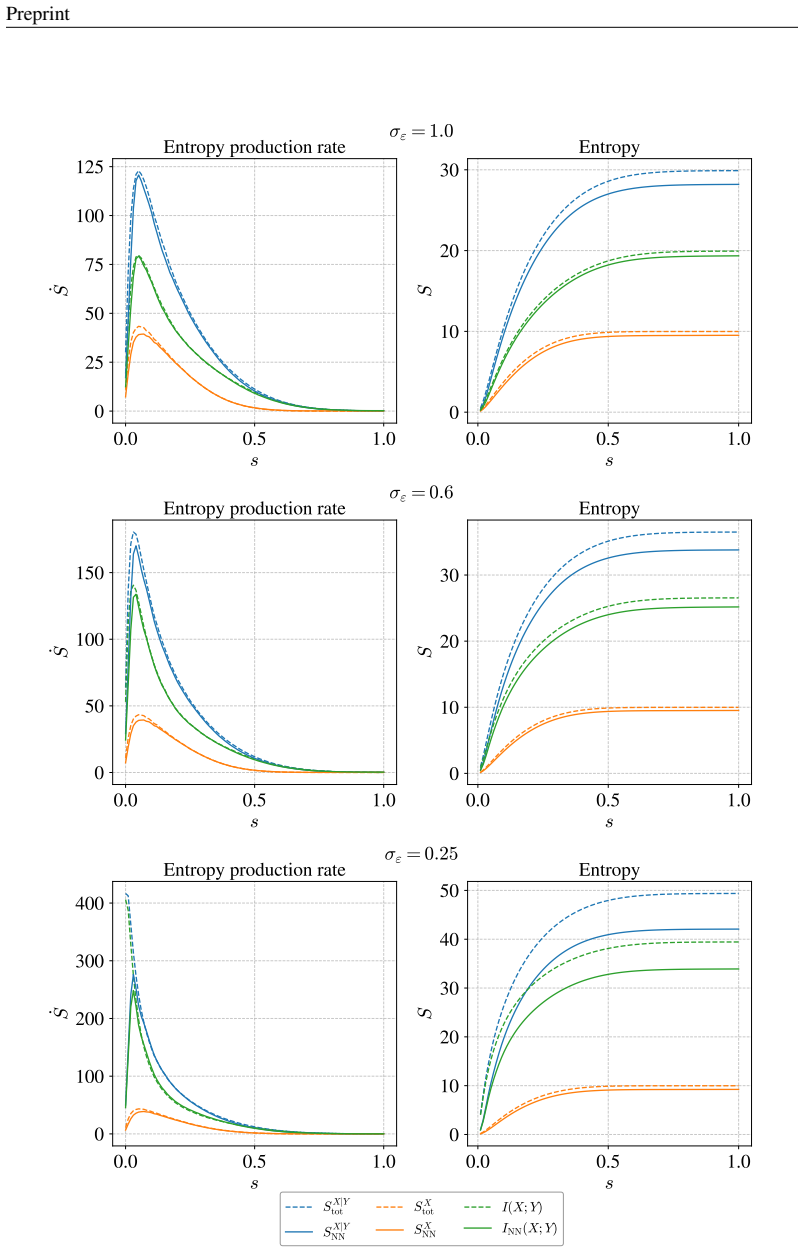
The paper's central claim is that the information a diffusion model stores—its neural entropy S_NN—is dominated by total correlation, TC(X), the joint statistical dependence among pixels that must be reinstated to reproduce fine textures. In pixel-space image models this term is vast because natural images lie on a low-dimensional manifold, so locating the manifold precisely consumes most of the information budget. The mutual information I(X;Y) that binds images to class labels is orders of magnitude smaller, and it enters through a different, later stage of the denoising process than the early manifold-pinning stage. Because the classifier-free guidance vector is the difference of condition
Load-bearing premise
The load-bearing assumption is that the split-band diffusion autoencoder cleanly separates the model's information into perceptual and semantic channels with no leakage, and that the mutual-information estimator remains accurate at the very low values where class information lives.
Editorial extensions
If this is right
- If the claim is right, compressing or pruning a pixel-space diffusion model will first erode texture and high-frequency detail; semantic class structure will survive until much more information is removed.
- Score-difference estimates of I(X;Y) remain reliable even when the neural entropy is enormous, because the manifold-pinning parts of the conditional and unconditional scores cancel.
- Classifier-free guidance raises I(X;Y) but only up to a plateau set by the conditioning variable's own capacity—the information-bottleneck saturation visible in the paper's Gaussian experiments.
- Weak label-image binding is a property of the data, so guidance cannot manufacture class information that was never present; it amplifies a small signal along with noise.
- The temporal separation predicts that conditioning information matters most in the later semantic stage of generation, not in the early texture-resolving stage.
Reading between the lines
- A testable extension would be to condition only the semantic sub-interval of the denoising schedule and leave the perceptual sub-interval unconditional; the paper's account predicts little or no loss in class fidelity and a possible saving in compute.
- If textures are largely class-agnostic, then swapping perceptual latents between images of different classes while keeping semantic latents fixed should preserve class-conditional appearance; a failure would indicate leakage between the split bands.
- The same score-difference estimator used for CFG could be turned into a calibration tool: the guidance strength at which I(X;Y) saturates would estimate the effective information capacity of the conditioning channel.
- One could read the paper's temporal decomposition as a principled way to design hierarchical or multi-stage generative models, where early stages model manifold geometry and later stages model semantics.
Editorial analysis
A structured set of objections, weighed in public.
Referee Report
Summary. The paper introduces a Kelly-criterion interpretation of diffusion models, in which the information a diffusion model must inject during generation is measured by a 'neural entropy' S_NN, and the extra information needed for conditional generation equals the mutual information I(X;Y). The authors derive an estimator for I(X;Y) based on the difference between conditional and unconditional score networks (MINDE, Eq. (14)), validate it on a joint Gaussian model with known ground truth, and then apply it to MNIST and CIFAR-10. They report that in image models I(X;Y) is only about 10^-3 of S_NN, that the bulk of S_NN is a total-correlation term TC(X) tied to low-level perceptual detail, and that the small class-specific information is sourced from a later, 'semantic' diffusion stage. This is used to explain why classifier-free guidance works. The Gaussian toy model and the derivation of MINDE are the sound core of the paper; the image-domain quantitative claims are the point of failure.
Significance. If correct, the paper would provide a useful information-theoretic decomposition of what diffusion models learn, and a novel explanation for the effectiveness of classifier-free guidance in terms of where class information lives in the diffusion process. The Kelly-gambling framing is pedagogically attractive and connects several existing results (Premkumar 2025; Franzese et al. 2024). The Gaussian experiments are a genuine strength: they compare neural estimates against analytic ground truth and honestly display the estimator's failure regime. The central image-domain claim, however, is currently supported by an estimator that produces information-theoretically impossible values, so the significance of the paper depends on whether that claim can be repaired.
major comments (3)
- [Sec. 6, Fig. 14, Eq. (14)] The reported image-domain mutual information values violate a hard information-theoretic bound. For MNIST and CIFAR-10, Y is a 10-class label, so I(X;Y) ≤ H(Y) ≤ log(10) ≈ 2.30 nats. Fig. 14 reports I(X;Y)=4.1 nats for MNIST and 7.54 nats for CIFAR-10. Eq. (13) is exact and cannot violate this bound, so the error lies in the neural-network approximation Eq. (14) as applied in the image regime. Since the 10^-3 ratio S_NN/I(X;Y) and the CFG explanation in Secs. 4 and 6 are built on these numbers, the central quantitative claim is currently unsupported. The authors should either replace Eq. (14) by an estimator whose calibration is demonstrated in a setting where the true I is known (including a discrete-label setting), or report upper bounds/qualitative statements only.
- [Sec. F.3, Eqs. (19) and (74)] The split-band DAE conclusion that z_per contains no class-specific information assumes a clean separation that the objective does not enforce. Equation (19) trains a single shared denoising network e_θ; z_per is used only for s∈(0,τ) in the loss, but nothing prevents z_per from encoding global/semantic structure that is useful for small-s denoising, nor prevents z_sem from indirectly influencing early denoising through the shared network. The statement that 'Z_per encodes only the information that was absorbed from s∈(0,τ)' is therefore an assumption, not a consequence of the loss. Moreover, I(Z_per;Y) and I(Z_sem;Y) are estimated with the same MINDE estimator, so Fig. 16 inherits the validity problem of Major Comment 1. The claim that textures carry no class information needs a probe whose information separation is independently verified.
- [Sec. 3, Eq. (12)] The identification of S_NN with 'information stored in the network' is definitional rather than empirical. S_NN is defined as an integral of ||e_θ||^2, and S_NN ≈ S_tot holds only for an ideal entropy-matching network. The Gaussian experiments in Figs. 9-11 show that for real networks S_NN can deviate significantly from S_tot in exactly the regimes relevant to images (low-rank/flattened data and strongly correlated Y). In the image experiments there is no ground truth, so the absolute values S_NN=2017.9 and 7776.2 nats are not established as information content. Since Fig. 14 compares these absolute values with I(X;Y), the ratio S_NN/I(X;Y) is not yet a measured quantity. A calibrated or relative interpretation is needed.
minor comments (4)
- [Eq. (1)] The limit in the definition of the doubling rate R is written as n→0; it should be n→∞.
- [Sec. 4, after Eq. (14)] The text says the approximation holds 'up to terms that vanish as T→0'; from the derivation in Sec. D.1 and the assumption p_0≈p_eq, the correct statement is for large T (T→∞).
- [Sec. F.3, Fig. 16 caption/text] The sentence 'whereas Z_sem does the opposite' appears to refer to Z_per; the caption and the surrounding text should be reconciled.
- [Sec. 6] The claim that 'the CFG vector is strongest in the interval where the scores are well-behaved' is stated as a consequence, but the paper does not directly measure the CFG vector's strength or the score behavior in image models. Adding a direct image experiment, or clearly labeling this as a conjecture, would strengthen the paper.
Circularity Check
No material circularity; one minor self-citation for the neural-entropy measure. The derivation chain is self-contained, but the central image-domain MI estimate is invalidated by exceeding the discrete-label entropy bound (a correctness risk, not a circular step).
-
self citation load bearing
[Sec. 3 (Neural Entropy), Eq. (12) and following paragraph]
"However, Premkumar (2025) demonstrates that the amount of information stored in a real network eθ is measured through its neural entropy, S X NN := Z T 0 ds σ(s)2 2 Ep h ∥eθ( ˜xs, s)∥2 i ≈ S X tot."
The paper's quantitative framework depends on identifying the L2 norm of the network output with 'information stored in a real network,' and this identification is imported from the author's own prior work. The internal ideal-limit argument (eθ→e*θ ⇒ S_NN→S_tot) and Gaussian checks give partial support, but for image models the paper explicitly says it cannot gauge whether S_NN and I(X;Y) are close to target values. Thus a load-bearing premise of the central claim rests on a self-citation plus an unvalidated limit, rather than on an independent check. This is not a formal reduction of a prediction to a fitted parameter, so it is scored as minor.
full rationale
The derivation chain S_tot (Eq. 4) -> factorized Stot with TC(X) (Eq. 8) -> conditional entropy difference R = S(X)-S(X|Y) = I(X;Y) (Eq. 11) -> MINDE (Eq. 13) -> neural-score estimator (Eq. 14) is mathematically self-contained: Eq. (13) is re-derived in Sec. D.1 from the path-integral identity and Eq. (14) is the standard substitution of fitted scores for exact scores. No fitted parameter is renamed as a prediction, and the CFG explanation is not tautological because the paper explicitly rejects the naive substitution of the modified score into Eq. (13) and instead measures I under CFG on Gaussian data. The split-band DAE (Eqs. 19/74) is an experimental probe whose latents are not fit to Y; the finding that I(Z_per;Y)≈0 is an empirical result, not a construction. The only circular-adjacent element is the self-citation used to define neural entropy, which is why the score is 2 rather than 0. Separately, the paper's reported image-domain values (MNIST 4.1 nats, CIFAR-10 7.54 nats) violate the hard bound I(X;Y) <= H(Y) <= log(10) ≈ 2.30 nats for 10-class labels; the paper itself admits it has no true image scores to validate the estimator. That is a serious correctness risk for the central quantitative claim, but it is not a circularity and does not raise the circularity score.
Assumptions & free parameters
free parameters (3)
- tau (DAE band split) =
scanned 0.1T to 0.9T
- Objective weight lambda(s) =
lambda=1 for training; lambda=sigma^2/2 for evaluation
- VP noise schedule beta(s) =
not stated in text
assumptions (6)
- ad hoc to paper Neural entropy S_NN = S_tot and its interpretation as information stored in the network (Eq. 12)
- domain assumption The MINDE score-difference estimator (Eq. 14) is accurate for images
- ad hoc to paper Split-band DAE conditioning cleanly separates model information into perceptual (0,tau) and semantic (tau,T) channels (Eqs. 19 and 74)
- domain assumption Image densities are supported on a lower-dimensional manifold, so TC(X) and S_tot diverge, with the divergence concentrated near s=0
- standard math Large-T limit: p0 = p_eq(T), boundary terms and S0 shifts vanish in Eqs. (7), (10), (49)
- standard math Textbook identities: KL factorization (Eq. 8), MI bounds for discrete Y, Tweedie/Miyasawa relation, pointwise convex minimization
invented entities (3)
-
Neural entropy S_NN as 'information stored in the network'
independent evidence
-
Perceptual latent z_per (split-band DAE probe)
-
Semantic latent z_sem (split-band DAE probe)
independent evidence
Cite this review
Pith. "Pith review of On the Separability of Information in Diffusion Models." pith.science (2026). https://pith.science/paper/6NSW3RAY
@misc{pith2026250923937,
  author       = {Pith},
  title        = {Pith review of: On the Separability of Information in Diffusion Models},
  year         = {2026},
  howpublished = {\url{https://pith.science/paper/6NSW3RAY}},
  note         = {Machine review of arXiv:2509.23937}
}
read the original abstract
Diffusion models transform noise into data by injecting information that was captured in their neural network during the training phase. In this paper, we ask: \textit{what} is this information? We find that, in pixel-space diffusion models, (1) a large fraction of the total information in the neural network is committed to reconstructing small-scale perceptual details of the image, and (2) the correlations between images and their class labels are informed by the semantic content of the images, and are largely agnostic to the low-level details. We argue that these properties are intrinsically tied to the manifold structure of the data itself. Finally, we show that these facts explain the efficacy of classifier-free guidance: the guidance vector amplifies the mutual information between images and conditioning signals early in the generative process, influencing semantic structure, but tapers out as perceptual details are filled in.
Figures


Figures from the paper (13 more)




Reference graph
Works this paper leans on
-
[1]
Alexander A. Alemi, Ian Fischer, Joshua V. Dillon, and Kevin Murphy. Deep variational information bottleneck. CoRR, abs/1612.00410, 2016. URL http://arxiv.org/abs/1612.00410
arXiv 2016
-
[2]
Christopher M. Bishop. Pattern Recognition and Machine Learning. Information Science and Statistics. Springer, New York, 2006. ISBN 978-0387310732
2006
-
[3]
JAX : composable transformations of P ython+ N um P y programs, 2018
James Bradbury, Roy Frostig, Peter Hawkins, Matthew James Johnson, Chris Leary, Dougal Maclaurin, George Necula, Adam Paszke, Jake Vander P las, Skye Wanderman- M ilne, and Qiao Zhang. JAX : composable transformations of P ython+ N um P y programs, 2018. URL http://github.com/jax-ml/jax
2018
-
[4]
Classifier-free guidance is a predictor-corrector
Arwen Bradley and Preetum Nakkiran. Classifier-free guidance is a predictor-corrector. In NeurIPS Workshop on Score-Based Methods, 2024. URL https://arxiv.org/abs/2408.09000
arXiv 2024
-
[5]
Bradley C. A. Brown, Anthony L. Caterini, Brendan Leigh Ross, Jesse C. Cresswell, and Gabriel Loaiza - Ganem. Verifying the union of manifolds hypothesis for image data. In The Eleventh International Conference on Learning Representations, ICLR 2023, Kigali, Rwanda, May 1-5, 2023 . OpenReview.net, 2023. URL https://openreview.net/forum?id=Rvee9CAX4fi
2023
-
[6]
e l Chetrite, Paolo Muratore-Ginanneschi, and Kay Schwieger. E. S chr \
Rapha \"e l Chetrite, Paolo Muratore-Ginanneschi, and Kay Schwieger. E. S chr \"o dinger's 1931 paper `` On the Reversal of the Laws of Nature '' [`` \"U ber die Umkehrung der Naturgesetze '', Sitzungsberichte der preussischen Akademie der Wissenschaften, physikalisch-mathematische Klasse, 8 N9 144--153] . The European Physical Journal H, 46 0 (1): 0 28, ...
-
[7]
Text-to-Image Diffusion Models are Zero-Shot Classifiers
Kevin Clark and Priyank Jaini. Text-to-Image Diffusion Models are Zero-Shot Classifiers . In Alice Oh, Taesup Naumann, Amir Globerson, Kate Saenko, Moritz Hardt, and Sergey Levine (eds.), Advances in Neural Information Processing Systems, volume 36, pp.\ 58921--58937. Curran Associates, Inc., 2023. URL https://proceedings.neurips.cc/paper_files/paper/2023...
2023
-
[8]
Cover and Joy A
Thomas M. Cover and Joy A. Thomas. Elements of Information Theory (Wiley Series in Telecommunications and Signal Processing). Wiley-Interscience, USA, 2006. ISBN 0471241954
2006
Show all 63 references
-
[9]
Diffusion models beat gans on image synthesis
Prafulla Dhariwal and Alexander Nichol. Diffusion models beat gans on image synthesis. In M. Ranzato, A. Beygelzimer, Y. Dauphin, P.S. Liang, and J. Wortman Vaughan (eds.), Advances in Neural Information Processing Systems, volume 34, pp.\ 8780--8794. Curran Associates, Inc., ...
2021
-
[10]
Tweedie's formula and selection bias
Bradley Efron. Tweedie's formula and selection bias. Journal of the American Statistical Association, 106 0 (496): 0 1602--1614, 2011
2011
-
[11]
MINDE : Mutual information neural diffusion estimation
Giulio Franzese, Mustapha Bounoua, and Pietro Michiardi. MINDE : Mutual information neural diffusion estimation. In Proceedings of the International Conference on Learning Representations (ICLR), pp.\ 16685--16716, 2024. URL https://proceedings.iclr.cc/paper_files/paper/2024/f...
2024
-
[12]
Generalized jarzynski's equality of inhomogeneous multidimensional diffusion processes
Hao Ge and Da-Quan Jiang. Generalized jarzynski's equality of inhomogeneous multidimensional diffusion processes. Journal of Statistical Physics, 131 0 (4): 0 675--689, 5 2008. ISSN 1572-9613. doi:10.1007/s10955-008-9520-4. URL https://doi.org/10.1007/s10955-008-9520-4
2008 doi
-
[13]
Burgess, Xavier Glorot, Matthew M
Irina Higgins, Lo \" c Matthey, Arka Pal, Christopher P. Burgess, Xavier Glorot, Matthew M. Botvinick, Shakir Mohamed, and Alexander Lerchner. -vae: Learning basic visual concepts with a constrained variational framework. In 5th International Conference on Learning Representat...
2017
- [14]
-
[15]
Denoising diffusion probabilistic models
Jonathan Ho, Ajay Jain, and Pieter Abbeel. Denoising diffusion probabilistic models. In Hugo Larochelle, Marc'Aurelio Ranzato, Raia Hadsell, Maria - Florina Balcan, and Hsuan - Tien Lin (eds.), Advances in Neural Information Processing Systems 33: Annual Conference on Neural I...
2020
-
[16]
Courville
Chin - Wei Huang, Jae Hyun Lim, and Aaron C. Courville. A variational perspective on diffusion-based generative models and score matching. In Marc'Aurelio Ranzato, Alina Beygelzimer, Yann N. Dauphin, Percy Liang, and Jennifer Wortman Vaughan (eds.), Advances in Neural Informat...
2021
-
[17]
David A. Huffman. A method for the construction of minimum-redundancy codes. Proceedings of the IRE, 40 0 (9): 0 1098--1101, 1952. doi:10.1109/JRPROC.1952.273898
1952
-
[18]
Simoncelli, and St \' e phane Mallat
Zahra Kadkhodaie, Florentin Guth, Eero P. Simoncelli, and St \' e phane Mallat. Generalization in diffusion models arises from geometry-adaptive harmonic representation. CoRR, abs/2310.02557, 2023. doi:10.48550/ARXIV.2310.02557. URL https://doi.org/10.48550/arXiv.2310.02557
-
[19]
Elucidating the Design Space of Diffusion-Based Generative Models
Tero Karras, Miika Aittala, Timo Aila, and Samuli Laine. Elucidating the Design Space of Diffusion-Based Generative Models . In Sanmi Koyejo, S. Mohamed, A. Agarwal, Danielle Belgrave, K. Cho, and A. Oh (eds.), Advances in Neural Information Processing Systems 35: Annual Confe...
2022
-
[20]
J. L. Kelly. A New Interpretation of Information Rate . The Bell System Technical Journal, 35 0 (4): 0 917--926, 1956. doi:10.1002/j.1538-7305.1956.tb03809.x
1956
-
[21]
Understanding Diffusion Objectives as the ELBO with Simple Data Augmentation
Diederik Kingma and Ruiqi Gao. Understanding Diffusion Objectives as the ELBO with Simple Data Augmentation . In A. Oh, T. Naumann, A. Globerson, K. Saenko, M. Hardt, and S. Levine (eds.), Advances in Neural Information Processing Systems, volume 36, pp.\ 65484--65516. Curran ...
2023
-
[22]
Kingma and Max Welling
Diederik P. Kingma and Max Welling. Auto-encoding variational bayes. In Yoshua Bengio and Yann LeCun (eds.), 2nd International Conference on Learning Representations, ICLR 2014, Banff, AB, Canada, April 14-16, 2014, Conference Track Proceedings , 2014. URL http://arxiv.org/abs...
2014 arXiv
-
[23]
Learning multiple layers of features from tiny images
Alex Krizhevsky. Learning multiple layers of features from tiny images. Technical report, University of Toronto, 2009. https://www.cs.toronto.edu/ kriz/learning-features-2009-TR.pdf
2009
-
[24]
Gradient-based learning applied to document recognition
Yann LeCun, Léon Bottou, Yoshua Bengio, and Patrick Haffner. Gradient-based learning applied to document recognition. Proceedings of the IEEE, 86 0 (11): 0 2278--2324, 1998. doi:10.1109/5.726791
1998 doi
-
[25]
Li, Mihir Prabhudesai, Shivam Duggal, Ellis Brown, and Deepak Pathak
Alexander C. Li, Mihir Prabhudesai, Shivam Duggal, Ellis Brown, and Deepak Pathak. Your diffusion model is secretly a zero-shot classifier. In Proceedings of the IEEE/CVF International Conference on Computer Vision (ICCV), pp.\ 2206--2217, October 2023
2023
-
[26]
Critical windows: Non-asymptotic theory for feature emergence in diffusion models
Marvin Li and Sitan Chen. Critical windows: Non-asymptotic theory for feature emergence in diffusion models. In Proceedings of the 41st International Conference on Machine Learning (ICML), ICML'24, pp.\ 1097:1--1097:25. JMLR.org, 2024
2024
-
[27]
Yaron Lipman, Ricky T. Q. Chen, Heli Ben - Hamu, Maximilian Nickel, and Matthew Le. Flow matching for generative modeling. In The Eleventh International Conference on Learning Representations, ICLR 2023, Kigali, Rwanda, May 1-5, 2023 . OpenReview.net, 2023. URL https://openrev...
2023
-
[28]
Discrete diffusion modeling by estimating the ratios of the data distribution
Aaron Lou, Chenlin Meng, and Stefano Ermon. Discrete diffusion modeling by estimating the ratios of the data distribution. In Forty-first International Conference on Machine Learning, ICML 2024, Vienna, Austria, July 21-27, 2024 . OpenReview.net, 2024 a . URL https://openrevie...
2024
-
[29]
Discrete diffusion modeling by estimating the ratios of the data distribution
Aaron Lou, Chenlin Meng, and Stefano Ermon. Discrete diffusion modeling by estimating the ratios of the data distribution. In Forty-first International Conference on Machine Learning, ICML 2024, Vienna, Austria, July 21-27, 2024 . OpenReview.net, 2024 b . URL https://openrevie...
2024
-
[30]
David J. C. MacKay. Information Theory, Inference & Learning Algorithms. Cambridge University Press, USA, 2002. ISBN 0521642981
2002
-
[31]
Interacting particle solutions of fokker--planck equations through gradient--log--density estimation
Dimitra Maoutsa, Sebastian Reich, and Manfred Opper. Interacting particle solutions of fokker--planck equations through gradient--log--density estimation. Entropy, 22 0 (8): 0 802, 2020. doi:10.3390/e22080802. URL https://www.mdpi.com/1099-4300/22/8/802
2020 doi
-
[32]
An empirical Bayes estimator of the mean of a normal population
Koichi Miyasawa. An empirical Bayes estimator of the mean of a normal population . Bulletin of the International Statistical Institute, 38: 0 181--188, 1961
1961
-
[33]
Large Language Diffusion Models , 2025
Shen Nie, Fengqi Zhu, Zebin You, Xiaolu Zhang, Jingyang Ou, Jun Hu, Jun Zhou, Yankai Lin, Ji-Rong Wen, and Chongxuan Li. Large Language Diffusion Models , 2025. URL https://arxiv.org/abs/2502.09992
2025 arXiv
-
[34]
Stochastic control and nonequilibrium thermodynamical systems
Michele Pavon. Stochastic control and nonequilibrium thermodynamical systems. Applied Mathematics and Optimization, 19 0 (1): 0 187--202, 1989. doi:10.1007/BF01448198. URL https://doi.org/10.1007/BF01448198
1989 doi
-
[35]
Diffusion Autoencoders: Toward a Meaningful and Decodable Representation
Konpat Preechakul, Nattanat Chatthee, Suttisak Wizadwongsa, and Supasorn Suwajanakorn. Diffusion Autoencoders: Toward a Meaningful and Decodable Representation . In Proceedings of the IEEE/CVF Conference on Computer Vision and Pattern Recognition (CVPR), pp.\ 10619--10629, June 2022
2022
-
[36]
Neural Entropy , 2025
Akhil Premkumar. Neural Entropy , 2025. URL https://arxiv.org/abs/2409.03817
2025
-
[37]
Tyrrell Rockafellar and Roger J.-B
R. Tyrrell Rockafellar and Roger J.-B. Wets. Variational analysis / R. Tyrrell Rockafellar, Roger J.-B. Wets. Grundlehren der mathematischen Wissenschaften, 317. Springer, Berlin ;, 1998. ISBN 3540627723. URL http://swbplus.bsz-bw.de/bsz063165805cov.htm
1998
-
[38]
High-resolution image synthesis with latent diffusion models
Robin Rombach, Andreas Blattmann, Dominik Lorenz, Patrick Esser, and Bj \" o rn Ommer. High-resolution image synthesis with latent diffusion models. In IEEE/CVF Conference on Computer Vision and Pattern Recognition, CVPR 2022, New Orleans, LA, USA, June 18-24, 2022 , pp.\ 1067...
2022
-
[39]
U-net: Convolutional networks for biomedical image segmentation
Olaf Ronneberger, Philipp Fischer, and Thomas Brox. U-net: Convolutional networks for biomedical image segmentation. CoRR, abs/1505.04597, 2015. URL http://arxiv.org/abs/1505.04597
2015 arXiv
-
[40]
D. L. Ruderman. The statistics of natural images. Network: Computation in Neural Systems, 5 0 (4): 0 517--548, November 1994. doi:10.1088/0954-898X/5/4/006. URL https://dx.doi.org/10.1088/0954-898X/5/4/006
1994 doi
-
[41]
J. J. Sakurai and Jim Napolitano. Modern Quantum Mechanics. Cambridge University Press, Cambridge, 3 edition, 2020
2020
-
[42]
Progressive distillation for fast sampling of diffusion models
Tim Salimans and Jonathan Ho. Progressive distillation for fast sampling of diffusion models. CoRR, abs/2202.00512, 2022. URL https://arxiv.org/abs/2202.00512
2022 arXiv
-
[43]
Entropy production along a stochastic trajectory and an integral fluctuation theorem
Udo Seifert. Entropy production along a stochastic trajectory and an integral fluctuation theorem. Phys. Rev. Lett., 95: 0 040602, Jul 2005. doi:10.1103/PhysRevLett.95.040602. URL https://link.aps.org/doi/10.1103/PhysRevLett.95.040602
2005 doi
-
[44]
Stochastic Thermodynamics, Fluctuation Theorems and Molecular Machines
Udo Seifert. Stochastic Thermodynamics, Fluctuation Theorems and Molecular Machines . Reports on Progress in Physics, 75 0 (12): 0 126001, Nov 2012. doi:10.1088/0034-4885/75/12/126001. URL https://dx.doi.org/10.1088/0034-4885/75/12/126001
2012 doi
-
[45]
C. E. Shannon. A mathematical theory of communication. The Bell System Technical Journal, 27 0 (3): 0 379--423, 1948. doi:10.1002/j.1538-7305.1948.tb01338.x
1948
-
[46]
Noiseless coding of correlated information sources
David Slepian and Jack Wolf. Noiseless coding of correlated information sources. IEEE Transactions on Information Theory, 19 0 (4): 0 471--480, 1973. doi:10.1109/TIT.1973.1055037
1973
-
[47]
Deep unsupervised learning using nonequilibrium thermodynamics
Jascha Sohl-Dickstein, Eric Weiss, Niru Maheswaranathan, and Surya Ganguli. Deep unsupervised learning using nonequilibrium thermodynamics. In Francis Bach and David Blei (eds.), Proceedings of the 32nd International Conference on Machine Learning, volume 37 of Proceedings of ...
2015
-
[48]
Maximum Likelihood Training of Score-Based Diffusion Models
Yang Song, Conor Durkan, Iain Murray, and Stefano Ermon. Maximum Likelihood Training of Score-Based Diffusion Models . In Marc'Aurelio Ranzato, Alina Beygelzimer, Yann N. Dauphin, Percy Liang, and Jennifer Wortman Vaughan (eds.), Advances in Neural Information Processing Syste...
2021
-
[49]
Kingma, Abhishek Kumar, Stefano Ermon, and Ben Poole
Yang Song, Jascha Sohl - Dickstein, Diederik P. Kingma, Abhishek Kumar, Stefano Ermon, and Ben Poole. Score-Based Generative Modeling through Stochastic Differential Equations . In 9th International Conference on Learning Representations, ICLR 2021, Virtual Event, Austria, May...
2021
-
[50]
Edward O. Thorp. The Kelly Criterion in Blackjack Sports Betting, and the Stock Market . In Leonard C MacLean, Edward O Thorp, and William T Ziemba (eds.), THE KELLY CAPITAL GROWTH INVESTMENT CRITERION THEORY and PRACTICE , World Scientific Book Chapters, chapter 54, pp.\ 789-...
2011
-
[51]
Naftali Tishby, Fernando C. N. Pereira, and William Bialek. The Information Bottleneck Method . CoRR, physics/0004057, 2000. URL http://arxiv.org/abs/physics/0004057
2000 arXiv
-
[52]
Score-based Generative Modeling in Latent Space
Arash Vahdat, Karsten Kreis, and Jan Kautz. Score-based Generative Modeling in Latent Space . In Marc'Aurelio Ranzato, Alina Beygelzimer, Yann Dauphin, Percy Liang, and Jennifer Wortman Vaughan (eds.), Advances in Neural Information Processing Systems, volume 34, pp.\ 11287--1...
2021
-
[53]
Vaikuntanathan and C
S. Vaikuntanathan and C. Jarzynski. Dissipation and Lag in Irreversible Processes . Europhysics Letters, 87 0 (6): 0 60005, oct 2009. doi:10.1209/0295-5075/87/60005. URL https://dx.doi.org/10.1209/0295-5075/87/60005
2009 doi
-
[54]
Visualizing data using t-sne
Laurens van der Maaten and Geoffrey Hinton. Visualizing data using t-sne. Journal of Machine Learning Research, 9 0 (86): 0 2579--2605, 2008. URL http://jmlr.org/papers/v9/vandermaaten08a.html
2008
-
[55]
Zhou Wang and Alan C. Bovik. Mean Squared Error: Love It or Leave It? A New Look at Signal Fidelity Measures . IEEE Signal Processing Magazine, 26 0 (1): 0 98--117, 2009. doi:10.1109/MSP.2008.930649
2009
-
[56]
Information theoretical analysis of multivariate correlation
Satosi Watanabe. Information theoretical analysis of multivariate correlation. IBM Journal of Research and Development, 4 0 (1): 0 66--82, 1960. doi:10.1147/rd.41.0066
1960 doi
-
[57]
Energy-based diffusion language models for text generation
Minkai Xu, Tomas Geffner, Karsten Kreis, Weili Nie, Yilun Xu, Jure Leskovec, Stefano Ermon, and Arash Vahdat. Energy-based diffusion language models for text generation. CoRR, abs/2410.21357, 2024. doi:10.48550/ARXIV.2410.21357. URL https://doi.org/10.48550/arXiv.2410.21357
-
[58]
A theory of usable information under computational constraints
Yilun Xu, Shengjia Zhao, Jiaming Song, Russell Stewart, and Stefano Ermon. A theory of usable information under computational constraints. In 8th International Conference on Learning Representations, ICLR 2020, Addis Ababa, Ethiopia, April 26-30, 2020 . OpenReview.net, 2020. U...
2020
-
[59]
Characteristic guidance: Non-linear correction for diffusion model at large guidance scale
Candi Zheng and Yuan Lan. Characteristic guidance: Non-linear correction for diffusion model at large guidance scale. In Forty-first International Conference on Machine Learning, ICML 2024, Vienna, Austria, July 21-27, 2024 . OpenReview.net, 2024. URL https://openreview.net/fo...
2024
-
[60]
write newline
" write newline "" before.all 'output.state := FUNCTION n.dashify 't := "" t empty not t #1 #1 substring "-" = t #1 #2 substring "--" = not "--" * t #2 global.max substring 't := t #1 #1 substring "-" = "-" * t #2 global.max substring 't := while if t #1 #1 substring * t #2 gl...
-
[61]
@esa (Ref
\@ifxundefined[1] #1\@undefined \@firstoftwo \@secondoftwo \@ifnum[1] #1 \@firstoftwo \@secondoftwo \@ifx[1] #1 \@firstoftwo \@secondoftwo [2] @ #1 \@temptokena #2 #1 @ \@temptokena \@ifclassloaded agu2001 natbib The agu2001 class already includes natbib coding, so you should ...
-
[62]
\@lbibitem[] @bibitem@first@sw\@secondoftwo \@lbibitem[#1]#2 \@extra@b@citeb \@ifundefined br@#2\@extra@b@citeb \@namedef br@#2 \@nameuse br@#2\@extra@b@citeb \@ifundefined b@#2\@extra@b@citeb @num @parse #2 @tmp #1 NAT@b@open@#2 NAT@b@shut@#2 \@ifnum @merge>\@ne @bibitem@firs...
-
[63]
@open @close @open @close and [1] URL: #1 \@ifundefined chapter * \@mkboth \@ifxundefined @sectionbib * \@mkboth * \@mkboth\@gobbletwo \@ifclassloaded amsart * \@ifclassloaded amsbook * \@ifxundefined @heading @heading NAT@ctr thebibliography [1] @ \@biblabel @NAT@ctr \@bibset...
Reviewed August 4, 2026 · model on record in the stance chip above.
Discussion (0). Sign in to comment.