Multimodal axion emissions from Abelian-Higgs cosmic strings
Pith reviewed 2026-05-18 07:28 UTC · model grok-4.3
The pith
Axions produced from Abelian-Higgs cosmic strings can match the dark matter relic density for GeV-scale masses while generating observable dark radiation.
A machine-rendered reading of the paper's core claim, the machinery that carries it, and where it could break.
Core claim
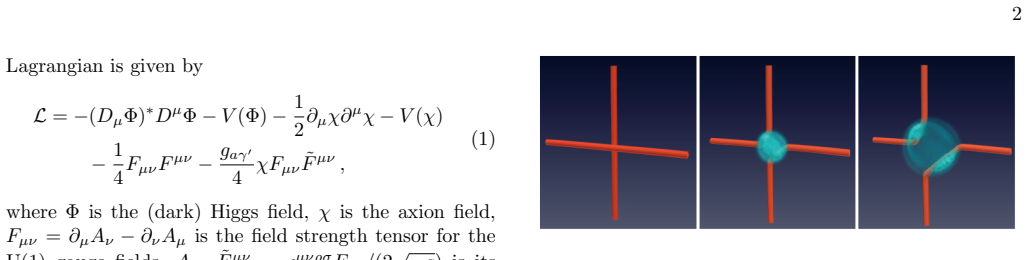
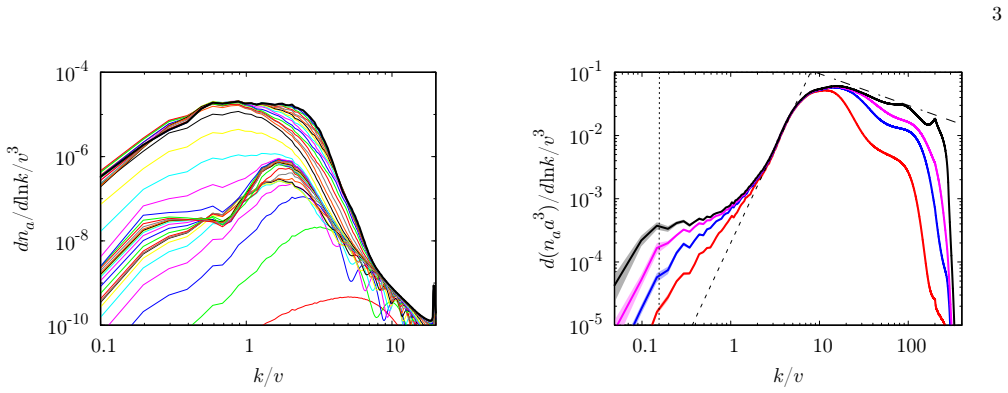
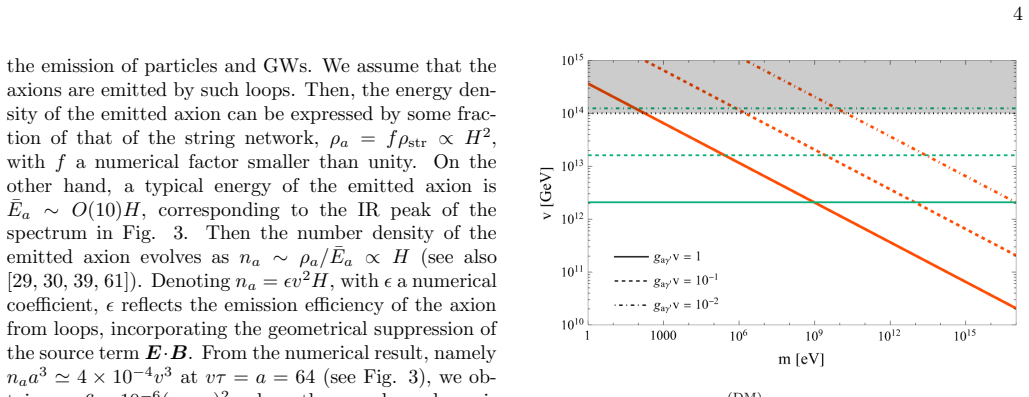
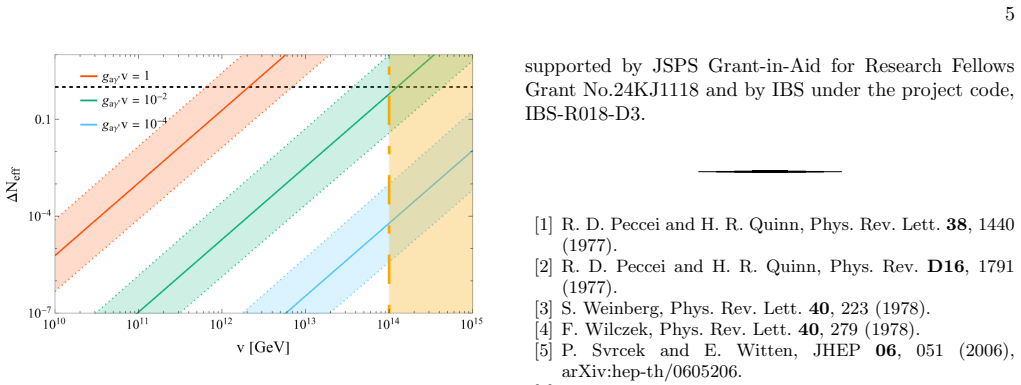
Numerical simulations of string collisions demonstrate that a sizable number of axions are produced at the moment of reconnection, with additional emissions continuing from moving kinks. Large-scale lattice simulations of the full string network reveal multimodal axion production, with separate contributions in the low-energy regime that can constitute cold dark matter and the high-energy regime that constitutes dark radiation. The analysis concludes that an axion with mass of GeV or heavier simultaneously accounts for the present dark matter density and predicts a measurable dark radiation signal.
What carries the argument
The axion-gauge coupling, which converts the electric fields induced around moving cosmic strings into axion radiation while magnetic flux remains confined inside the strings.
If this is right
- Low-energy axions from the string network contribute to the cold dark matter density.
- High-energy axions from the same network contribute to dark radiation.
- Axions heavier than or equal to 1 GeV can simultaneously saturate the observed dark matter abundance.
- The accompanying dark radiation component reaches levels accessible to next-generation cosmological probes.
Where Pith is reading between the lines
- The mechanism ties the evolution of cosmic string networks directly to two distinct cosmological observables that can be measured independently.
- Adjusting the string tension or the axion coupling strength could shift the division between the dark matter and dark radiation components.
- If confirmed, the scenario would provide a new way to constrain the formation epoch or tension of cosmic strings through combined dark matter and dark radiation data.
Load-bearing premise
The axion coupling to the gauge fields must be strong enough, and the lattice model must correctly represent string reconnections and kink motion, to produce the reported amounts of axions in each energy range.
What would settle it
Future measurements of the dark radiation density that find no excess at the level expected from GeV-mass axions emitted by cosmic strings.
Figures
read the original abstract
We show that axions can be produced from Abelian-Higgs cosmic strings due to the axion-gauge coupling. The strong magnetic field is confined in the string, and the electric field is induced around the moving string, allowing axion productions from the dynamics of cosmic strings. Our numerical analysis on the string collision shows that a sizable number of axions can be produced at the reconnection, and further emissions occur from moving kinks afterward. Large-scale lattice simulations of the string network further reveal multimodal axion emissions in the sense that axions are produced in both the low-energy and high-energy regimes. The former can contribute to the cold dark matter and the latter can be regarded as dark radiation. We found that the axion with GeV or heavier mass can explain the current relic dark matter abundance and simultaneously predicts a sizable amount of dark radiation which can be probed by future observations.
Editorial analysis
A structured set of objections, weighed in public.
Referee Report
Summary. The manuscript claims that axions are produced from Abelian-Higgs cosmic strings via the axion-gauge coupling, with string collisions and moving kinks generating a sizable number of axions. Large-scale lattice simulations of the string network reveal multimodal emissions: low-energy axions that can contribute to cold dark matter and high-energy axions that act as dark radiation. For axion masses of GeV or heavier, the mechanism is reported to saturate the observed relic dark matter density while predicting a detectable amount of dark radiation.
Significance. If the reported spectra and relic-density normalizations survive continuum extrapolation, the work would identify a new string-based production channel for axions that simultaneously addresses the dark-matter abundance and yields observable dark radiation, providing a concrete link between cosmic-string dynamics and upcoming cosmological probes.
major comments (2)
- Numerical analysis on string collision and large-scale lattice simulations: the multimodal spectrum and the extracted relic densities for GeV-scale axions rest on the assumption that the discretized equations of motion accurately capture kink propagation and reconnection without artificial dispersion. No resolution scan or continuum extrapolation holding the physical core width fixed is described, so the high-energy tail used for the dark-radiation prediction may be distorted by lattice-spacing effects.
- Relic-density extraction from the spectra: the claim that GeV or heavier axions explain the current dark-matter abundance depends on the normalization of the low-energy peak; without reported checks that this peak remains stable under grid refinement, the quantitative match to the observed density is not yet demonstrated to be robust.
minor comments (1)
- The abstract and introduction would benefit from an explicit statement of the axion-gauge coupling strength and the range of string tensions explored in the simulations.
Simulated Author's Rebuttal
We thank the referee for the careful reading of our manuscript and the constructive comments on the numerical aspects of our work. We address the two major comments point by point below.
read point-by-point responses
-
Referee: Numerical analysis on string collision and large-scale lattice simulations: the multimodal spectrum and the extracted relic densities for GeV-scale axions rest on the assumption that the discretized equations of motion accurately capture kink propagation and reconnection without artificial dispersion. No resolution scan or continuum extrapolation holding the physical core width fixed is described, so the high-energy tail used for the dark-radiation prediction may be distorted by lattice-spacing effects.
Authors: We agree that demonstrating robustness against lattice artifacts is essential for the high-energy tail of the axion spectrum. Our simulations use a lattice spacing chosen to be substantially smaller than the physical string core width set by the model parameters, following standard practices in Abelian-Higgs string network studies. Nevertheless, we acknowledge that an explicit resolution scan with fixed physical core width was not included. In the revised manuscript we will add results from additional runs at higher resolutions and discuss the stability of the high-energy tail under these refinements. revision: yes
-
Referee: Relic-density extraction from the spectra: the claim that GeV or heavier axions explain the current dark-matter abundance depends on the normalization of the low-energy peak; without reported checks that this peak remains stable under grid refinement, the quantitative match to the observed density is not yet demonstrated to be robust.
Authors: We concur that stability of the low-energy peak normalization under grid refinement is necessary to support the quantitative relic-density claim. The low-energy axions are generated by the large-scale network dynamics, which we have checked for volume scaling. To strengthen this, the revised version will incorporate explicit grid-refinement tests confirming that the low-energy peak remains stable, thereby supporting the conclusion that GeV-scale axions can saturate the observed dark-matter density. revision: yes
Circularity Check
No significant circularity: results from direct lattice simulation of string dynamics
full rationale
The paper reports axion production spectra obtained from numerical evolution of the Abelian-Higgs lattice equations with axion-gauge coupling. No analytic derivation is presented that reduces a claimed prediction back to a fitted parameter or to a self-citation chain. The multimodal spectrum, relic-density normalization, and dark-radiation estimate are direct outputs of the discretized field equations rather than quantities defined in terms of themselves. Self-citations, if present, are not load-bearing for the central numerical claims.
Axiom & Free-Parameter Ledger
Lean theorems connected to this paper
-
IndisputableMonolith/Cost/FunctionalEquation.leanwashburn_uniqueness_aczel unclear?
unclearRelation between the paper passage and the cited Recognition theorem.
We have performed numerical lattice simulations to solve Eqs. (3)-(5)... spectrum exhibits enhancements in both the ultraviolet (UV) (k≳10v) and infrared (IR) regions
What do these tags mean?
- matches
- The paper's claim is directly supported by a theorem in the formal canon.
- supports
- The theorem supports part of the paper's argument, but the paper may add assumptions or extra steps.
- extends
- The paper goes beyond the formal theorem; the theorem is a base layer rather than the whole result.
- uses
- The paper appears to rely on the theorem as machinery.
- contradicts
- The paper's claim conflicts with a theorem or certificate in the canon.
- unclear
- Pith found a possible connection, but the passage is too broad, indirect, or ambiguous to say the theorem truly supports the claim.
Reference graph
Works this paper leans on
-
[1]
R. D. Peccei and H. R. Quinn, Phys. Rev. Lett.38, 1440 (1977)
work page 1977
-
[2]
R. D. Peccei and H. R. Quinn, Phys. Rev.D16, 1791 (1977)
work page 1977
- [3]
-
[4]
Instantons and Spin Forces between Massive Quarks
F. Wilczek, Phys. Rev. Lett.40, 279 (1978)
work page 1978
-
[5]
P. Svrcek and E. Witten, JHEP06, 051 (2006), arXiv:hep-th/0605206
work page internal anchor Pith review Pith/arXiv arXiv 2006
-
[6]
A. Arvanitaki, S. Dimopoulos, S. Dubovsky, N. Kaloper, and J. March-Russell, Phys. Rev. D81, 123530 (2010), arXiv:0905.4720 [hep-th]
work page internal anchor Pith review Pith/arXiv arXiv 2010
-
[7]
The type IIB string axiverse and its low-energy phenomenology
M. Cicoli, M. Goodsell, and A. Ringwald, JHEP10, 146 (2012), arXiv:1206.0819 [hep-th]
work page internal anchor Pith review Pith/arXiv arXiv 2012
- [8]
-
[9]
L. F. Abbott and P. Sikivie, Phys. Lett. B120, 133 (1983)
work page 1983
- [10]
-
[11]
R. L. Davis, Phys. Lett. B180, 225 (1986)
work page 1986
-
[12]
D. H. Lyth, Phys. Lett. B275, 279 (1992)
work page 1992
-
[13]
Axions : Theory and Cosmological Role
M. Kawasaki and K. Nakayama, Ann. Rev. Nucl. Part. Sci.63, 69 (2013), arXiv:1301.1123 [hep-ph]
work page internal anchor Pith review Pith/arXiv arXiv 2013
-
[14]
D. J. E. Marsh, Phys. Rept.643, 1 (2016), arXiv:1510.07633 [astro-ph.CO]
work page internal anchor Pith review Pith/arXiv arXiv 2016
-
[15]
The landscape of QCD axion models
L. Di Luzio, M. Giannotti, E. Nardi, and L. Visinelli, Phys. Rept.870, 1 (2020), arXiv:2003.01100 [hep-ph]
work page internal anchor Pith review Pith/arXiv arXiv 2020
- [16]
- [17]
-
[18]
T. W. B. Kibble, J. Phys. A9, 1387 (1976)
work page 1976
-
[19]
A. Vilenkin and E. P. S. Shellard,Cosmic Strings and Other Topological Defects(Cambridge University Press, 2000)
work page 2000
-
[20]
T. W. B. Kibble, Nucl. Phys. B252, 227 (1985), [Erra- tum: Nucl.Phys.B 261, 750 (1985)]
work page 1985
-
[21]
D. P. Bennett, Phys. Rev. D33, 872 (1986), [Erratum: Phys.Rev.D 34, 3932 (1986)]
work page 1986
-
[22]
D. P. Bennett, Phys. Rev. D34, 3592 (1986)
work page 1986
-
[23]
D. P. Bennett and F. R. Bouchet, Phys. Rev. D41, 2408 (1990)
work page 1990
- [24]
- [25]
- [26]
- [27]
- [28]
-
[29]
A. J. Long and L.-T. Wang, Phys. Rev. D99, 063529 (2019), arXiv:1901.03312 [hep-ph]
work page internal anchor Pith review Pith/arXiv arXiv 2019
-
[30]
N. Kitajima and K. Nakayama, JHEP08, 068 (2023), arXiv:2212.13573 [hep-ph]
-
[31]
N. Kitajima and K. Nakayama, Phys. Lett. B846, 138213 (2023), arXiv:2306.17390 [hep-ph]. 6
-
[32]
Y. Cui, M. Lewicki, D. E. Morrissey, and J. D. Wells, Phys. Rev. D97, 123505 (2018), arXiv:1711.03104 [hep- ph]
work page internal anchor Pith review Pith/arXiv arXiv 2018
-
[33]
Cosmological Backgrounds of Gravitational Waves
C. Caprini and D. G. Figueroa, Class. Quant. Grav.35, 163001 (2018), arXiv:1801.04268 [astro-ph.CO]
work page internal anchor Pith review Pith/arXiv arXiv 2018
-
[34]
P. Auclairet al., JCAP04, 034 (2020), arXiv:1909.00819 [astro-ph.CO]
-
[35]
Evolution of Axionic Strings and Spectrum of Axions Radiated from Them
M. Yamaguchi, M. Kawasaki, and J. Yokoyama, Phys. Rev. Lett.82, 4578 (1999), arXiv:hep-ph/9811311
work page internal anchor Pith review Pith/arXiv arXiv 1999
-
[36]
C. Hagmann, S. Chang, and P. Sikivie, Phys. Rev. D 63, 125018 (2001), arXiv:hep-ph/0012361
work page internal anchor Pith review Pith/arXiv arXiv 2001
-
[37]
Improved estimation of radiated axions from cosmological axionic strings
T. Hiramatsu, M. Kawasaki, T. Sekiguchi, M. Yam- aguchi, and J. Yokoyama, Phys. Rev. D83, 123531 (2011), arXiv:1012.5502 [hep-ph]
work page internal anchor Pith review Pith/arXiv arXiv 2011
-
[38]
Axion dark matter: strings and their cores
L. Fleury and G. D. Moore, JCAP01, 004 (2016), arXiv:1509.00026 [hep-ph]
work page internal anchor Pith review Pith/arXiv arXiv 2016
-
[39]
Axions from Strings: the Attractive Solution
M. Gorghetto, E. Hardy, and G. Villadoro, JHEP07, 151 (2018), arXiv:1806.04677 [hep-ph]
work page internal anchor Pith review Pith/arXiv arXiv 2018
-
[40]
M. Kawasaki, T. Sekiguchi, M. Yamaguchi, and J. Yokoyama, PTEP2018, 091E01 (2018), arXiv:1806.05566 [hep-ph]
-
[41]
C. J. A. P. Martins, Phys. Lett. B788, 147 (2019), arXiv:1811.12678 [astro-ph.CO]
work page internal anchor Pith review Pith/arXiv arXiv 2019
-
[42]
M. Buschmann, J. W. Foster, and B. R. Safdi, Phys. Rev. Lett.124, 161103 (2020), arXiv:1906.00967 [astro- ph.CO]
-
[43]
M. Hindmarsh, J. Lizarraga, A. Lopez-Eiguren, and J. Urrestilla, Phys. Rev. Lett.124, 021301 (2020), arXiv:1908.03522 [astro-ph.CO]
-
[44]
M. Gorghetto, E. Hardy, and G. Villadoro, SciPost Phys. 10, 050 (2021), arXiv:2007.04990 [hep-ph]
-
[45]
M. Hindmarsh, J. Lizarraga, A. Lopez-Eiguren, and J. Urrestilla, Phys. Rev. D103, 103534 (2021), arXiv:2102.07723 [astro-ph.CO]
-
[46]
M. Buschmann, J. W. Foster, A. Hook, A. Peterson, D. E. Willcox, W. Zhang, and B. R. Safdi, Nature Com- mun.13, 1049 (2022), arXiv:2108.05368 [hep-ph]
- [47]
-
[48]
K. Saikawa, J. Redondo, A. Vaquero, and M. Kaltschmidt, JCAP10, 043 (2024), arXiv:2401.17253 [hep-ph]
- [49]
-
[50]
J. Correia, M. Hindmarsh, J. Lizarraga, A. Lopez- Eiguren, K. Rummukainen, and J. Urrestilla, Phys. Rev. D111, 063532 (2025), arXiv:2410.18064 [hep-ph]
-
[51]
P. Sikivie, Phys. Rev. Lett.51, 1415 (1983), [Erratum: Phys.Rev.Lett. 52, 695 (1984)]
work page 1983
-
[52]
P. Sikivie, Phys. Rev. D32, 2988 (1985), [Erratum: Phys.Rev.D 36, 974 (1987)]
work page 1985
-
[53]
I. G. Irastorza and J. Redondo, Prog. Part. Nucl. Phys. 102, 89 (2018), arXiv:1801.08127 [hep-ph]
work page internal anchor Pith review Pith/arXiv arXiv 2018
-
[54]
N. Kitajima, S. Nakagawa, and F. Takahashi, Phys. Rev. D105, 103011 (2022), arXiv:2111.06696 [hep-ph]
-
[55]
S. Nakagawa, F. Takahashi, and W. Yin, Phys. Rev. D 107, 063016 (2023), arXiv:2209.01107 [astro-ph.CO]
- [56]
-
[57]
K. J. M. Moriarty, E. Myers, and C. Rebbi, Phys. Lett. B207, 411 (1988)
work page 1988
-
[58]
E. P. S. Shellard, Nucl. Phys. B283, 624 (1987)
work page 1987
-
[59]
Decay of Cosmic String Loops Due to Particle Radiation
D. Matsunami, L. Pogosian, A. Saurabh, and T. Vachaspati, Phys. Rev. Lett.122, 201301 (2019), arXiv:1903.05102 [hep-ph]
work page internal anchor Pith review Pith/arXiv arXiv 2019
-
[60]
T. Hiramatsu, M. Lilley, and D. Yamauchi, JCAP06, 030 (2024), arXiv:2312.16091 [hep-ph]
- [61]
-
[62]
Tristram et al., Cosmological parameters derived from the final Planck data release (PR4), Astron
M. Tristramet al., Astron. Astrophys.682, A37 (2024), arXiv:2309.10034 [astro-ph.CO]
- [63]
-
[64]
Planck 2018 results. VI. Cosmological parameters
N. Aghanimet al.(Planck), Astron. Astrophys.641, A6 (2020), [Erratum: Astron.Astrophys. 652, C4 (2021)], arXiv:1807.06209 [astro-ph.CO]
work page internal anchor Pith review Pith/arXiv arXiv 2020
-
[65]
S. Roy Choudhury and T. Okumura, Astrophys. J. Lett. 976, L11 (2024), arXiv:2409.13022 [astro-ph.CO]
work page internal anchor Pith review arXiv 2024
-
[66]
Constraints on dark radiation from cosmological probes
G. Rossi, C. Y` eche, N. Palanque-Delabrouille, and J. Lesgourgues, Phys. Rev. D92, 063505 (2015), arXiv:1412.6763 [astro-ph.CO]
work page internal anchor Pith review Pith/arXiv arXiv 2015
-
[67]
Watanabe, (2025), arXiv:2510.05630 [hep-ph]
Y. Watanabe, (2025), arXiv:2510.05630 [hep-ph]
discussion (0)
Sign in with ORCID, Apple, or X to comment. Anyone can read and Pith papers without signing in.