REVIEW 3 major objections 5 minor 1 cited by
Synthetic object-level captions generated by a vision-language model supply the missing training signal for dense video object captioning, letting one end-to-end model outperform prior methods on three benchmarks.
Reviewed by Pith at T0; open to challenge. T0 means a machine referee read the full paper against a public rubric. the ladder, T0–T4 →
T0 review · deepseek-v4-flash
2026-08-04 09:27 UTC pith:LYH7GWOG
load-bearing objection Solid, well-ablated DVOC paper that ships synthetic data and a unified segmentation/tracking/captioning model; the SOTA claims are plausible but rest on a thin manual validation of the synthetic captions. the 3 major comments →
CaptionFormer: Unified Segmentation, Tracking, and Captioning for Spatio-Temporal Objects
The pith
A machine-rendered reading of the paper's core claim, the machinery that carries it, and where it could break.
Core claim
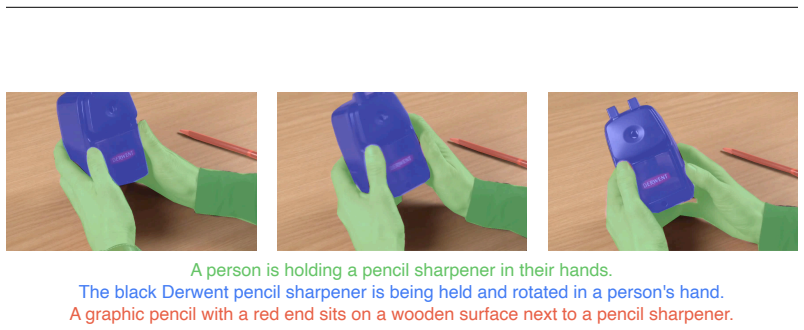
MaskCaptioner is the first end-to-end model to jointly detect, segment, track, and caption object trajectories in a video. The central claim is that automatically generated object-level captions — produced by feeding a vision-language model with videos in which each object is marked with a bounding box, plus a prompt containing the object's category, coordinates, area, and surrounding categories — are accurate enough to serve as dense supervision. Extending LVIS and LV-VIS with these captions (LVISCap and LV-VISCap) lets a single model train on unified (mask, box, category, caption) annotations, and it achieves the best reported CHOTA on VidSTG, VLN, and BenSMOT while also extending DVOC eva
What carries the argument
The load-bearing mechanism is a two-part pipeline. First, a caption-generation stage converts existing segmentation annotations into DVOC annotations: for each object, the paper draws its bounding box on sampled video frames, and prompts a vision-language model with the marked video plus textual cues (category, normalized box coordinates, area, and other categories present), obtaining a one-sentence caption describing that object's appearance, action, or interactions. Second, the model itself is an end-to-end video-instance-segmentation architecture extended with a box head and a captioning head: clip-level transformer queries produce masks and boxes, a top-K memory-bank matching step tracks
Load-bearing premise
The load-bearing premise is that the vision-language model's synthetic captions are accurate and balanced enough — especially on rare categories — that training on them transfers to human-annotated benchmarks; this was checked only on a small subset with a single human evaluator.
What would settle it
On a held-out set of videos with human-written object captions, train the same model with and without LVISCap/LV-VISCap and have several independent raters judge the generated captions blind; if the synthetic-pretrained model does not clearly beat the baseline on human-rated caption quality, especially for rare categories, the central claim that VLM captions supply effective DVOC supervision would fail.
If this is right
- Object-level video captioning no longer depends on expensive manual trajectory captions; existing segmentation datasets can be upgraded to DVOC training sets with a vision-language model.
- An end-to-end model trained on unified masks, boxes, categories, and captions beats disjoint pipelines that compose separately trained detectors, trackers, and captioners.
- Captioning accuracy grows roughly logarithmically with the number of synthetic captions, so further data generation is a concrete route to better results.
- Temporal aggregation of object queries across clips improves caption quality without altering detection or tracking performance.
- DVOC evaluation can be extended from boxes to masks by substituting mask IoU for box IoU in the CHOTA metric.
Where Pith is reading between the lines
- The same prompting recipe could plausibly generate grounded training data for neighbouring tasks such as referring-expression segmentation or grounded video question answering, which also suffer from scarce object-level captions.
- The logarithmic CapA-versus-data curve suggests a testable scaling law: a much larger synthetic corpus or a stronger caption generator should keep improving captioning, possibly beyond human-annotation levels.
- Outputting masks rather than boxes may matter for downstream uses such as video editing, robotics, or assistive systems, where pixel-level object descriptions are needed; the paper does not explore those applications.
- Current benchmarks mostly contain short, single-action trajectories, so temporal aggregation is under-stressed; realistic long-video benchmarks with multi-action trajectories would better expose whether per-trajectory captioning can describe extended activity.
Editorial analysis
A structured set of objections, weighed in public.
Referee Report
Summary. The paper addresses Dense Video Object Captioning (DVOC), the joint detection, tracking, and captioning of object trajectories in video. To overcome the scarcity of object-level caption annotations, the authors propose using Gemini 2.0 Flash to generate synthetic captions for existing segmentation datasets, producing LVISCap and LV-VISCap. They then introduce MaskCaptioner (called CaptionFormer in the abstract and title), an end-to-end architecture built on OVFormer with an added box head and a BLIP-2-based captioning head, trained with clip-level and video-level losses. The model is evaluated on LV-VISCap and on three DVOC benchmarks repurposed from VidSTG, VLN, and BenSMOT, reporting state-of-the-art CHOTA or component metrics. The paper includes extensive ablations of prompting strategy, pretraining data, temporal aggregation, tracking module, and clip length, and it releases code and datasets.
Significance. If the results hold, this is a significant step: MaskCaptioner is the first model that can jointly segment, track, and caption all object trajectories in a video in an end-to-end framework, and the LVISCap/LV-VISCap datasets provide a scalable recipe for obtaining object-level video caption supervision. The reported gains over DVOC-DS and OW-VISCapTor on VidSTG, VLN, and BenSMOT are substantial, and the ablation of temporal aggregation and the log-linear scaling of CapA with training data are informative. The release of code and datasets is a strength that will facilitate reproduction and follow-up work. The main risk is the reliability and unbiasedness of the synthetic captions, which the current validation only partially addresses.
major comments (3)
- [Section 3.1, Table 1; Section 4.2.3, Table 6] The central claim that LVISCap/LV-VISCap pretraining drives the SOTA gains rests on the quality and representativeness of the synthetic captions, but the validation is thin. Table 1 reports ratings from a single expert human evaluator on a subset of LV-VIS, and Table 6 uses only 50 videos and 233 trajectories for the automatic-vs-manual comparison, apparently without independent annotators or inter-annotator agreement. Further, no category-stratified analysis (especially for rare LVIS classes) or comparison of linguistic diversity between synthetic and human captions is provided. The gap between automatic CapA (33.0) and manual CapA (22.5) without LVISCap suggests a systematic style difference; the relative gain is reassuring but the sample is too small to dismiss template-like or category-shortcut behavior. A larger, independent, class-stratified human evaluation, plus distributional an
- [Section 4.2.2, Tables 3-5] The SOTA comparisons are reported as point estimates without error bars, confidence intervals, or significance tests, and the baselines are cited from prior papers. Given that the headline improvements (e.g., +5.2 CapA on VLN, +14.7 CIDEr on BenSMOT, +6.7 CapA on VidSTG) are the basis for the paper's main claim, the absence of any variance estimate is a load-bearing concern. If multiple runs are too expensive, the authors should at least report results over several seeds for the main comparisons or justify why a single run is representative. This is particularly important because the captioning head is trained with a frozen detector in a second stage, which may introduce variability.
- [Section 3.3, Section 4.1] The paper claims 'end-to-end' training, but for most experiments the model is trained in two stages, freezing the segmentation/detection part before training the captioning head; only LV-VIS experiments are tuned end-to-end. This should be stated more prominently and qualified in the contributions. If the 'first end-to-end model' claim is intended architecturally, the paper should clarify that the experiments on the three main benchmarks use the two-stage procedure, which weakens the empirical claim of joint end-to-end optimization.
minor comments (5)
- [Title/Abstract vs. Full Text] The abstract and title refer to 'CaptionFormer', while the full text uses 'MaskCaptioner' throughout. This inconsistency must be fixed before publication.
- [Figure 4] The x-axis is labeled 'Percentage of LVIScap captions used for training (log scale)' and includes a point at 0, which cannot appear on a logarithmic scale. Please clarify the exact fractions used or switch to a linear scale.
- [Table 7] The table reports 'mAP' but the surrounding text discusses detection and tracking accuracy. Please specify what mAP is computed over (masks, boxes, or trajectories) and the evaluation protocol.
- [Appendix A.4.3] The implementation details state 'For all experiments except LV-VIS tuning, we first train the segmentation/detection model' and then list training steps for LVIS/VidSTG/LV-VIS. It is confusing that LV-VIS appears both as an exception and in the list; clarify which experiments use end-to-end training.
- [Section 4.2.3, Table 6] The caption says 'automatic vs manual annotations' but the manual annotation concerns captions only, not detections or masks. Rephrase to avoid implying the full DVOC annotation was manually verified.
Circularity Check
No significant circularity: the central DVOC claims are evaluated on external human-annotated benchmarks, and the synthetic-data evaluation is explicitly controlled.
full rationale
The paper's chain is empirical rather than definitional: synthetic captions are generated with a VLM from LVIS/LV-VIS mask/box/category annotations, MaskCaptioner is trained on those captions, and the headline SOTA results are measured on VidSTG, VLN, and BenSMOT, which are existing benchmarks with human annotations and a published CHOTA protocol from prior work. The synthetic LVISCap/LV-VISCap validation used in Table 2 is in-distribution and could in principle reward mimicry of the generator, but the paper acknowledges this in the 'Annotation bias' paragraph of Section 4.2.3 and provides a manual-annotation comparison on 50 videos/233 trajectories (Table 6) showing that the LVISCap gain persists when evaluating on human captions. That control is small and possibly single-annotator, which is a validity limitation rather than a circularity. No equation or fitted parameter is renamed as a prediction, and the VLM-generated captions are inputs, not outputs of MaskCaptioner. Self-citations to Zhou et al. (2025) define the task, metric, and benchmark splits; they do not supply the claimed result, so they are not load-bearing. No specific circular step is present.
Axiom & Free-Parameter Ledger
free parameters (4)
- T_agg (number of clips for temporal caption aggregation) =
32 (VidSTG), 8 (VLN), 8 (BenSMOT)
- K_match (top-K matched clips for tracking memory) =
7 (VidSTG), 5 (VLN), 7 (BenSMOT)
- T_infer (inference clip length) =
5 (LV-VIS), 1 (VidSTG/VLN/BenSMOT)
- Loss weights lambda =
lambda_dice, lambda_ce, lambda_l1 = 5; lambda_giou, lambda_cls, lambda_obj = 2; lambda_lm = 1
axioms (4)
- domain assumption Gemini 2.0 Flash provides accurate object-level captions when prompted with drawn bounding boxes, category labels, and coordinates.
- domain assumption The CHOTA metric and the repurposed VidSTG/VLN/BenSMOT benchmarks are valid for comparing DVOC methods.
- domain assumption BLIP-2's query transformer can be repurposed from image-level to video-level captioning using aggregated queries.
- domain assumption Training on synthetic captions does not introduce a harmful distribution shift; the manual-annotation check is representative.
Cite this review
Pith. "Pith review of CaptionFormer: Unified Segmentation, Tracking, and Captioning for Spatio-Temporal Objects." pith.science (2026). https://pith.science/paper/LYH7GWOG
@misc{pith2026251014904,
  author       = {Pith},
  title        = {Pith review of: CaptionFormer: Unified Segmentation, Tracking, and Captioning for Spatio-Temporal Objects},
  year         = {2026},
  howpublished = {\url{https://pith.science/paper/LYH7GWOG}},
  note         = {Machine review of arXiv:2510.14904}
}
read the original abstract
Dense Video Object Captioning (DVOC) is the task of jointly detecting, tracking, and captioning object trajectories in a video, requiring the ability to understand spatio-temporal details and describe them in natural language. Due to the complexity of the task and the high cost associated with manual annotation, previous approaches resort to training strategies with limited data, potentially leading to suboptimal performance. To circumvent this issue, we propose to generate captions about spatio-temporally localized entities leveraging a state-of-the-art VLM, and extend the LVIS and LV-VIS datasets with our synthetic captions (LVISCap and LV-VISCap). Moreover, we introduce an end-to-end model, CaptionFormer, capable of jointly detecting, segmenting, tracking and captioning object trajectories. CaptionFormer achieves state-of-the-art DVOC results on three existing benchmarks, VidSTG, VLN and BenSMOT. The datasets and code are available at https://www.gabriel.fiastre.fr/captionformer/.
Figures


Forward citations
Cited by 1 Pith paper
-
Watch, Remember, Reason: Human-View Video Understanding with MLLMs
This is a survey that frames video MLLM research via a human-view formulation of perceptual representations, memory states, reasoning traces, and predictions, then reviews methods, datasets, benchmarks, and open problems.
Reference graph
Works this paper leans on
-
[1]
Marah Abdin, Jyoti Aneja, Hany Awadalla, Ahmed Awadallah, Ammar Ahmad Awan, Nguyen Bach, Amit Bahree, Arash Bakhtiari, Jianmin Bao, Harkirat Behl, et al. Phi-3 technical report: A highly capable language model locally on your phone.arXiv preprint arXiv:2404.14219,
-
[4]
Qwen technical report.arXiv preprint arXiv:2309.16609,
Jinze Bai, Shuai Bai, Yunfei Chu, Zeyu Cui, Kai Dang, Xiaodong Deng, Yang Fan, Wenbin Ge, Yu Han, Fei Huang, et al. Qwen technical report.arXiv preprint arXiv:2309.16609,
-
[6]
Microsoft COCO Captions: Data collection and evaluation server.arXiv preprint arXiv:1504.00325,
Xinlei Chen, Hao Fang, Tsung-Yi Lin, Ramakrishna Vedantam, Saurabh Gupta, Piotr Dollár, and C Lawrence Zitnick. Microsoft COCO Captions: Data collection and evaluation server.arXiv preprint arXiv:1504.00325,
-
[7]
Bowen Cheng, Anwesa Choudhuri, Ishan Misra, Alexander Kirillov, Rohit Girdhar, and Alexander G. Schwing. Mask2Former for video instance segmentation.arXiv preprint arXiv:2112.10764,
-
[9]
MOT16: A benchmark for multi-object tracking.arXiv preprint arXiv:1603.00831,
Anton Milan, Laura Leal-Taixé, Ian Reid, Stefan Roth, and Konrad Schindler. MOT16: A benchmark for multi-object tracking.arXiv preprint arXiv:1603.00831,
-
[12]
Gemini Team, Petko Georgiev, Ving Ian Lei, Ryan Burnell, Libin Bai, Anmol Gulati, Garrett Tanzer, Damien Vincent, Zhufeng Pan, Shibo Wang, et al. Gemini 1.5: Unlocking multimodal understanding across millions of tokens of context.arXiv preprint arXiv:2403.05530,
-
[13]
OPT: Open Pre-trained Transformer language models.arXiv preprint arXiv:2205.01068, 2022a
13 Susan Zhang, Stephen Roller, Naman Goyal, Mikel Artetxe, Moya Chen, Shuohui Chen, Christopher Dewan, Mona Diab, Xian Li, Xi Victoria Lin, et al. OPT: Open Pre-trained Transformer language models.arXiv preprint arXiv:2205.01068, 2022a. Yifu Zhang, Peize Sun, Yi Jiang, Dongdong Yu, Fucheng Weng, Zehuan Yuan, Ping Luo, Wenyu Liu, and Xinggang Wang. ByteTr...
-
[14]
Objects as points.arXiv preprint arXiv:1904.07850,
Xingyi Zhou, Dequan Wang, and Philipp Krähenbühl. Objects as points.arXiv preprint arXiv:1904.07850,
Pith/arXiv arXiv 1904
-
[15]
We attribute this difference to the numerous objects that disappear for a significant number of frames in the long videos of VidSTG
is important for tracking objects effectively on the challenging VidSTG dataset (Zhang et al., 2020), as seen in the AssA, CapA and CHOTA scores. We attribute this difference to the numerous objects that disappear for a significant number of frames in the long videos of VidSTG. The top-K approach uses a memory bank of tracked queries that helps keeping tr...
2020
-
[16]
pair of tongs
52.766.871.0 63.0 A.3 FAILURECASES AND LIMITATIONS A.3.1 FAILURE CASES (ii) Inconsistent object categories (ii) Detection/segmentation error The knife is being used to cut a steak on a wooden cutting board. The steak is being cut with a knife on a wooden cutting board. A person is holding a steak with tongs on a wooden cutting board. The wooden chopping b...
2025
-
[17]
bottle":
is a spatio-temporal video grounding dataset, containing 6,924 videos with 44,808 exhaustive trajectories annotations over 80 categories, as well as object sentence descrip- tions (for some objects and some timestamps only), which serve as queries for grounding. Zhou et al. (2025) repurposed the dataset for DVOC by using queries as captions, and by exclud...
2025
-
[18]
For VidSTG/VLN/BenSMOT experiments we use video-level tuning for captioning with temporal aggregation, with Tagg = 32/8/8 respectively
Experiments on LV-VIS are end-to-end trainings with clip-level supervision only. For VidSTG/VLN/BenSMOT experiments we use video-level tuning for captioning with temporal aggregation, with Tagg = 32/8/8 respectively. For all experiments we train the model with a clips of size T= 2 , and at inference use T= 5/1/1/1 , Tmatch = 1/100/20/40, Kmatch = 1/7/5/7 ...
2025
-
[2016]
Dreamix: Video diffusion models are general video editors.arXiv preprint arXiv:2302.01329,
Eyal Molad, Eliahu Horwitz, Dani Valevski, Alex Rav Acha, Yossi Matias, Yael Pritch, Yaniv Leviathan, and Yedid Hoshen. Dreamix: Video diffusion models are general video editors.arXiv preprint arXiv:2302.01329,
-
[2019]
Gemini: a family of highly capable multimodal models.arXiv preprint arXiv:2312.11805,
Gemini Team, Rohan Anil, Sebastian Borgeaud, Jean-Baptiste Alayrac, Jiahui Yu, Radu Soricut, Johan Schalkwyk, Andrew M Dai, Anja Hauth, Katie Millican, et al. Gemini: a family of highly capable multimodal models.arXiv preprint arXiv:2312.11805,
-
[2020]
Shikra: Unleashing multimodal LLM’s referential dialogue magic.arXiv preprint arXiv:2306.15195,
Keqin Chen, Zhao Zhang, Weili Zeng, Richong Zhang, Feng Zhu, and Rui Zhao. Shikra: Unleashing multimodal LLM’s referential dialogue magic.arXiv preprint arXiv:2306.15195,
-
[2023]
Michael Ahn, Anthony Brohan, Noah Brown, Yevgen Chebotar, Omar Cortes, Byron David, Chelsea Finn, Chuyuan Fu, Keerthana Gopalakrishnan, Karol Hausman, et al. Do as I can, not as I say: Grounding language in robotic affordances.arXiv preprint arXiv:2204.01691,
-
[2024]
Josh Achiam, Steven Adler, Sandhini Agarwal, Lama Ahmad, Ilge Akkaya, Florencia Leoni Aleman, Diogo Almeida, Janko Altenschmidt, Sam Altman, Shyamal Anadkat, et al. GPT-4 technical report. arXiv preprint arXiv:2303.08774,
-
[2025]
The Llama 3 herd of models.arXiv preprint arXiv:2407.21783,
Aaron Grattafiori, Abhimanyu Dubey, Abhinav Jauhri, Abhinav Pandey, Abhishek Kadian, Ahmad Al-Dahle, Aiesha Letman, Akhil Mathur, Alan Schelten, Alex Vaughan, et al. The Llama 3 herd of models.arXiv preprint arXiv:2407.21783,
discussion (0)
Sign in with ORCID, Apple, or X to comment. Anyone can read and Pith papers without signing in.