Geometry-Driven Charge and Spin Transport in β12 Borophene Quantum Dots
Pith reviewed 2026-05-18 06:22 UTC · model grok-4.3
The pith
Armchair edges in β12 borophene quantum dots produce wider and more stable fully spin-polarized transport windows than zigzag edges.
A machine-rendered reading of the paper's core claim, the machinery that carries it, and where it could break.
Core claim
In β12 borophene quantum dots formed as circular discs or regular hexagons and coupled to semi-infinite nanoribbon leads, armchair edge terminations produce broader and more stable intervals of full spin polarization than zigzag terminations. Critical lead-width thresholds of approximately 1.01 nm for zigzag and 0.87 nm for armchair mark the point where complete spin filtering sets in, and this filtering occurs once the proximity-induced exchange field exceeds a moderate value.
What carries the argument
The five-band tight-binding Hamiltonian parameterized from first-principles data, used inside the non-equilibrium Green's function formalism to compute geometry-dependent spin-resolved transmission probabilities.
If this is right
- Armchair-connected structures maintain full spin polarization over wider ranges of lead width than zigzag-connected structures.
- Complete spin filtering occurs once the proximity-induced exchange field exceeds a moderate threshold value.
- Confinement geometry and edge termination together determine the stability of the polarized transmission windows.
- These geometric controls supply practical design guidelines for borophene-based nanoscale spintronic devices.
Where Pith is reading between the lines
- Edge engineering alone might allow tuning of spin current without altering overall device size or requiring large external fields.
- The identified lead-width thresholds imply that fabrication tolerances near 1 nm will be decisive for reliable spin filtering performance.
- The same geometry dependence could be tested in related boron allotropes to check whether the armchair advantage generalizes.
Load-bearing premise
The five-band tight-binding Hamiltonian parameterized from first-principles data accurately describes the electronic structure and transport in these confined β12 borophene geometries.
What would settle it
Fabricating β12 borophene quantum dots with armchair and zigzag leads of varying widths and measuring whether the spin polarization remains fully polarized above the calculated thresholds of 0.87 nm and 1.01 nm.
Figures


read the original abstract
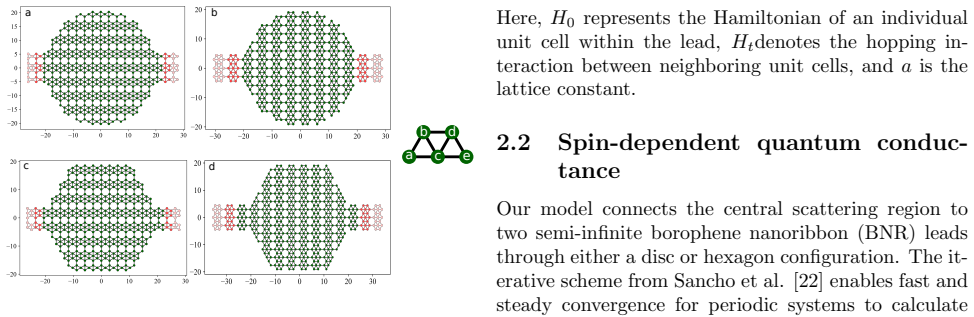
Theoretical research has been conducted to study how geometry affects charge and spin transport in $\beta\mathrm{12}$ borophene quantum dots, which are confined systems. The study examined two distinct central regions, which included a circular disc and a regular hexagonal area that connected to semi-infinite zigzag and armchair borophene nanoribbon leads. The system was described by a five-band tight-binding Hamiltonian parameterized using first-principles data, and the transport properties were calculated within the non-equilibrium Green's function framework. Spin resolved transmissions and spin polarization were computed for a range of lead widths and proximity-induced exchange field strengths. The analysis revealed distinct transport characteristics determined by geometry and edge configuration: armchair-connected structures exhibited broader and more stable fully spin-polarized windows compared with zigzag-connected counterparts. Furthermore, critical lead-width thresholds ($\approx 1.01$ nm for zigzag and $\approx 0.87$ nm for armchair) and a moderate exchange field above which complete spin filtering occurs were identified. The results highlight the strong influence of edge termination and confinement geometry on transport properties and provide useful design guidelines for developing borophene-based nanoscale spintronic devices.
Editorial analysis
A structured set of objections, weighed in public.
Referee Report
Summary. The manuscript examines geometry-dependent charge and spin transport in β12 borophene quantum dots (circular and hexagonal) connected to semi-infinite zigzag or armchair nanoribbon leads. A five-band tight-binding Hamiltonian, parameterized from first-principles data, is combined with the non-equilibrium Green's function formalism to compute spin-resolved transmissions and polarization as functions of lead width and proximity-induced exchange field. The central findings are that armchair-connected structures show broader and more stable fully spin-polarized windows than zigzag-connected ones, together with specific critical lead-width thresholds (≈1.01 nm zigzag, ≈0.87 nm armchair) above which complete spin filtering occurs for moderate exchange fields.
Significance. If the numerical results are robust, the work supplies concrete design guidelines for borophene-based spintronic devices by demonstrating how edge termination and confinement geometry control spin-filtering windows. The explicit identification of lead-width thresholds and the comparative stability of armchair versus zigzag configurations constitute falsifiable predictions that could be tested experimentally. The use of a pre-parameterized five-band TB model within NEGF is a standard, reproducible approach that allows direct comparison with other 2D-material transport studies.
major comments (1)
- [§2] §2 (Model and Methods): The five-band tight-binding Hamiltonian is parameterized exclusively from first-principles data on extended or periodic β12 borophene. No validation is presented for the finite quantum-dot geometries or the dot-lead junctions (circular or hexagonal). Because the reported critical widths (≈1.01 nm zigzag, ≈0.87 nm armchair) and the existence of stable fully spin-polarized windows are direct numerical outputs of this Hamiltonian, any geometry-specific shifts in on-site energies or interface hoppings would quantitatively alter or eliminate those thresholds. A direct DFT comparison for at least one representative QD-lead configuration is required to establish that the bulk parameterization remains accurate under confinement.
minor comments (2)
- Figure captions and the main text should explicitly state the number of k-points, energy broadening, and convergence criteria used in the NEGF calculations to allow reproduction of the transmission curves.
- The abstract states that spin-resolved transmissions were computed, yet the main text would benefit from a brief statement confirming that the exchange field is applied uniformly only to the central dot region (as implied by the proximity-induced setup).
Simulated Author's Rebuttal
We thank the referee for the thorough review and constructive feedback on our manuscript. We address the major comment point by point below, providing clarifications on our methodology while acknowledging limitations where appropriate. We have revised the manuscript to incorporate additional discussion that strengthens the presentation of the model.
read point-by-point responses
-
Referee: §2 (Model and Methods): The five-band tight-binding Hamiltonian is parameterized exclusively from first-principles data on extended or periodic β12 borophene. No validation is presented for the finite quantum-dot geometries or the dot-lead junctions (circular or hexagonal). Because the reported critical widths (≈1.01 nm zigzag, ≈0.87 nm armchair) and the existence of stable fully spin-polarized windows are direct numerical outputs of this Hamiltonian, any geometry-specific shifts in on-site energies or interface hoppings would quantitatively alter or eliminate those thresholds. A direct DFT comparison for at least one representative QD-lead configuration is required to establish that the bulk parameterization remains accurate under confinement.
Authors: We appreciate the referee's emphasis on model validation for confined systems. The five-band tight-binding Hamiltonian was fitted to first-principles calculations on the periodic β12 borophene lattice to reproduce the electronic structure near the Fermi level, including the characteristic Dirac-like features. In the quantum-dot calculations, the same on-site energies and hopping integrals are employed, with confinement and edge terminations explicitly encoded via the finite atomic geometry and the choice of zigzag or armchair lead orientations. This transferability assumption is standard in NEGF-TB studies of 2D materials (e.g., graphene nanoribbons and phosphorene nanostructures), where bulk-derived parameters successfully capture transport in finite devices because the dominant interactions remain local. We acknowledge that explicit re-fitting or DFT benchmarking of the dot-lead interface would provide additional reassurance. However, performing self-consistent DFT on representative QD-lead junctions (hundreds of atoms) lies outside the computational scope of the present tight-binding study. To address the concern directly, we have added a dedicated paragraph in §2 discussing the rationale for parameter transferability, citing analogous literature validations, and noting that edge-specific effects are already incorporated through the explicit lattice termination rather than through modified hoppings. revision: partial
Circularity Check
No circularity: numerical transport results from external parameterization and NEGF
full rationale
The paper adopts a five-band tight-binding Hamiltonian parameterized from first-principles data (external to the present work) and computes spin-resolved transmissions and polarization via the non-equilibrium Green's function method applied to finite quantum-dot geometries with varying lead widths and exchange fields. The reported critical thresholds (≈1.01 nm zigzag, ≈0.87 nm armchair) and geometry-dependent fully spin-polarized windows are direct numerical outputs of this standard computational pipeline, not algebraic identities, self-definitions, or fitted quantities renamed as predictions. No self-citation chains, uniqueness theorems, or ansatzes smuggled via prior author work appear in the derivation. The study is self-contained against external benchmarks (DFT parameterization and NEGF formalism) and does not reduce its central claims to its own inputs by construction.
Axiom & Free-Parameter Ledger
free parameters (1)
- proximity-induced exchange field strength
axioms (2)
- domain assumption The five-band tight-binding Hamiltonian parameterized from first-principles data faithfully reproduces the band structure and edge states of β12 borophene in both bulk and confined geometries.
- standard math Non-equilibrium Green's function formalism in the coherent-transport limit correctly yields spin-resolved transmission probabilities for the described lead-dot-lead geometry.
Reference graph
Works this paper leans on
-
[1]
Z. Jia, M. Zhao, Q. Chen, Y. Tian, L. Liu, F. Zhang, D. Zhang, Y. Ji, B. Camargo, K. Ye, R. Sun, Z. Wang, Y. Jiang, Spintronic devices upon 2D magnetic materials and heterojunctions, ACS Nano 19 (10) (2025) 9452–9483
work page 2025
-
[2]
S. Zeng, C. Liu, P. Zhou, Transistor engineering based on 2D materials in the post-silicon era, Nat Rev Electr Eng 1 (5) (2024) 335–348
work page 2024
-
[3]
B. Yang, B. Bhujel, D. G. Chica, E. J. Telford, X. Roy, F. Ibrahim, M. Chshiev, M. Cosset- Ch´ eneau, B. J. van Wees, Electrostatically con- trolled spin polarization in Graphene-CrSBr mag- netic proximity heterostructures, Nat. Commun. 15 (1) (2024) 4459
work page 2024
- [4]
-
[5]
X. Wu, C. Tian, L. Zhong, J. Quan, J. Yang, Z. Shao, G. Gao, Prediction of two-dimensional dirac materials with intrinsic magnetism, quan- tum anomalous hall effect and high curie temper- ature, J. Mater. Chem. C Mater. Opt. Electron. Devices (2024)
work page 2024
-
[6]
A. J. Mannix, X.-F. Zhou, B. Kiraly, J. D. Wood, D. Alducin, B. D. Myers, X. Liu, B. L. Fisher, U. Santiago, J. R. Guest, M. J. Ya- caman, A. Ponce, A. R. Oganov, M. C. Her- sam, N. P. Guisinger, Synthesis of borophenes: Anisotropic, two-dimensional boron polymorphs, Science 350 (6267) (2015) 1513–1516
work page 2015
-
[7]
B. Feng, J. Zhang, Q. Zhong, W. Li, S. Li, H. Li, P. Cheng, S. Meng, L. Chen, K. Wu, Experimental realization of two-dimensional boron sheets, Nat. Chem. 8 (6) (2016) 563–568
work page 2016
-
[8]
X. Yan, S. Wang, Y. Sun, Y. Liu, Y. Wang, G. Yang, Semiconducting bilayer borophene with high carrier mobility, J. Phys. Chem. Lett. 14 (43) (2023) 9698–9704
work page 2023
-
[9]
L. Niu, O. J. Conquest, C. Verdi, C. Stampfl, Elec- tronic and optical properties of 2D heterostructure bilayers of graphene, borophene and 2D boron car- bides from first principles, Nanomaterials (Basel) 14 (20) (Oct. 2024)
work page 2024
- [10]
- [11]
-
[12]
Y. Wang, J. Liu, F. Jiang, K. Zhou, W. Wang, First-principles investigation on the optoelec- tronic characteristics of multilayer borophene, Opt. Quantum Electron. 56 (11) (Nov. 2024)
work page 2024
-
[13]
S. Ali, A. U. Rahman, M. Sun, Superior opti- cal and thermoelectric properties of bilayerβ 12- like phase borophene synthesized on cu(111) film, Mater. Adv. (2024)
work page 2024
- [14]
-
[15]
J. Lai, L. Wang, F. Li, H. Zhang, Q. Zhang, Klein tunneling inβ12 borophene, Nanomaterials (Basel) 14 (9) (2024) 790
work page 2024
-
[16]
M. Davoudiniya, J. Fransson, B. Sanyal, Lat- tice tuning of charge and spin transport inβ 12- borophene nanoribbons (2025). arXiv:2507.22571
-
[17]
M. Davoudiniya, K. Mirabbaszadeh, Effects of strain and electric fields on the electronic trans- port properties of single-layerβ12-borophene nanoribbons, Phys. Chem. Chem. Phys. 23 (34) (2021) 18647–18658
work page 2021
-
[18]
F. Norouzi, M. Farokhnezhad, M. Esmaeilzadeh, B. Szafran, Controllable spin filtering and half- metallicity inβ12 -borophene nanoribbons, Phys. Rev. B. 104 (24) (Dec. 2021)
work page 2021
-
[19]
Ezawa, Triplet fermions and dirac fermions in borophene, Phys
M. Ezawa, Triplet fermions and dirac fermions in borophene, Phys. Rev. B. 96 (3) (Jul. 2017)
work page 2017
-
[20]
B. Feng, O. Sugino, R.-Y. Liu, J. Zhang, R. Yukawa, M. Kawamura, T. Iimori, H. Kim, Y. Hasegawa, H. Li, L. Chen, K. Wu, H. Ku- migashira, F. Komori, T.-C. Chiang, S. Meng, I. Matsuda, Dirac fermions in borophene, Phys. Rev. Lett. 118 (9) (Mar. 2017)
work page 2017
-
[21]
B. Bishnoi, B. Ghosh, Spin transport in silicene and germanene, RSC Adv. 3 (48) (2013) 26153
work page 2013
-
[22]
F. Teichert, A. Zienert, J. Schuster, M. Schreiber, An improved green’s function algorithm applied to quantum transport in carbon nanotubes, Comput. Mater. Sci. 169 (109014) (2019) 109014
work page 2019
-
[23]
Giustino, Electron-phonon interactions from first principles, Rev
F. Giustino, Electron-phonon interactions from first principles, Rev. Mod. Phys. 89 (1) (Feb. 2017)
work page 2017
-
[24]
Datta, Quantum Transport, Cambridge Univer- sity Press, Cambridge, England, 2012
S. Datta, Quantum Transport, Cambridge Univer- sity Press, Cambridge, England, 2012
work page 2012
-
[25]
M. P. L. Sancho, J. M. L. Sancho, J. Rubio, Quick iterative scheme for the calculation of transfer ma- trices: application to mo (100), J. Phys. 14 (5) (1984) 1205–1215
work page 1984
-
[26]
D. C. Leitao, F. J. F. van Riel, M. Rasly, P. D. R. Araujo, M. Salvador, E. Paz, B. Koopmans, En- hanced performance and functionality in spin- tronic sensors, Npj Spintron. 2 (1) (Nov. 2024)
work page 2024
-
[27]
M. A. Bazrafshan, F. Khoeini, Electronic trans- port and thermoelectric properties of phosphorene nanodisk under an electric field, Front. Phys. 10 (Jan. 2023)
work page 2023
- [28]
- [29]
-
[30]
V. Sverdlov, H. Seiler, A.-M. B. El-Sayed, Y. Il- larionov, H. Kosina, Edge modes and their con- ductance in narrow nanoribbons of 2D materi- als in a topological phase, Solid State Electron. 193 (108266) (2022) 108266
work page 2022
-
[31]
S. Izadi Vishkayi, M. Bagheri Tagani, Edge- dependent electronic and magnetic characteristics of freestandingβ12-borophene nanoribbons, Na- nomicro Lett. 10 (1) (2018) 14
work page 2018
-
[32]
C.-Z. Chang, J. Zhang, X. Feng, J. Shen, Z. Zhang, M. Guo, K. Li, Y. Ou, P. Wei, L.-L. Wang, Z.-Q. Ji, Y. Feng, S. Ji, X. Chen, J. Jia, X. Dai, Z. Fang, S.-C. Zhang, K. He, Y. Wang, L. Lu, X.-C. Ma, Q.-K. Xue, Experimental obser- vation of the quantum anomalous hall effect in a magnetic topological insulator, Science 340 (6129) (2013) 167–170
work page 2013
-
[33]
B. Feng, B. Fu, S. Kasamatsu, S. Ito, P. Cheng, C.-C. Liu, Y. Feng, S. Wu, S. K. Mahatha, P. Sheverdyaeva, P. Moras, M. Arita, O. Sug- ino, T.-C. Chiang, K. Shimada, K. Miyamoto, T. Okuda, K. Wu, L. Chen, Y. Yao, I. Mat- suda, Experimental realization of two-dimensional dirac nodal line fermions in monolayer Cu2Si, Nat. Commun. 8 (1) (Oct. 2017)
work page 2017
-
[34]
P. Yan, T. Ouyang, C. He, J. Li, C. Zhang, C. Tang, J. Zhong, Newly discovered graphyne allotrope with rare and robust dirac node loop, Nanoscale 13 (6) (2021) 3564–3571
work page 2021
-
[35]
T. Pei, J. O. Thomas, S. Sopp, M.-Y. Tsang, N. Dotti, J. Baugh, N. F. Chilton, S. Cardona- Serra, A. Gaita-Ari˜ no, H. L. Anderson, L. Bo- gani, Exchange-induced spin polarization in a sin- gle magnetic molecule junction, Nat. Commun. 13 (1) (2022) 4506. 9
work page 2022
-
[36]
D. Chen, R. Qiao, X. Xu, W. Dong, L. Wang, R. Ma, C. Liu, Z. Zhang, M. Wu, L. Liu, L. Bao, H.-T. Wang, P. Gao, K. Liu, D. Yu, Sub-10 nm stable graphene quantum dots embedded in hexagonal boron nitride, Nanoscale 11 (10) (2019) 4226–4230
work page 2019
-
[37]
D. R. da Costa, M. Zarenia, A. Chaves, J. M. Pereira, G. A. Farias, F. M. Peeters, Hexagonal- shaped monolayer-bilayer quantum disks in graphene: A tight-binding approach, Phys. Rev. B. 94 (3) (Jul. 2016)
work page 2016
-
[38]
M. W. Lee, J. Kim, J. S. Suh, Characteristics of graphene quantum dots determined by edge struc- tures: three kinds of dots fabricated using thermal plasma jet, RSC Adv. 5 (83) (2015) 67669–67675
work page 2015
-
[39]
I. Romanovsky, C. Yannouleas, U. Landman, Graphene flakes with defective edge termina- tions: Universal and topological aspects, and one-dimensional quantum behavior, Phys. Rev. B Condens. Matter Mater. Phys. 86 (16) (Oct. 2012)
work page 2012
-
[40]
Konˆ opka, Conductance of graphene flakes con- tacted at their corners, J
M. Konˆ opka, Conductance of graphene flakes con- tacted at their corners, J. Phys. Condens. Matter 27 (43) (2015) 435005
work page 2015
-
[41]
N. Rahmani-Ivriq, A. A. Kordbacheh, The ef- fect of rashba spin–orbit interaction on the spin-polarized transport of zigzag phosphorene nanoribbons, J. Phys. D Appl. Phys. 53 (46) (2020) 465302
work page 2020
-
[42]
K. Shakouri, H. Simchi, M. Esmaeilzadeh, H. Mazidabadi, F. M. Peeters, Tunable spin and charge transport in silicene nanoribbons, Phys. Rev. B Condens. Matter Mater. Phys. 92 (3) (Jul. 2015)
work page 2015
- [43]
discussion (0)
Sign in with ORCID, Apple, or X to comment. Anyone can read and Pith papers without signing in.