REVIEW 4 major objections 6 minor 8 cited by
RoboBench introduces a benchmark for multimodal large language models as robot 'embodied brains' and finds current models lag humans by 20–40 points on implicit instructions, planning, affordance prediction, and failure diagnosis.
Reviewed by Pith at T0; open to challenge. T0 means a machine referee read the full paper against a public rubric. the ladder, T0–T4 →
2026-08-04 08:55 UTC pith:HM3IKCI5
load-bearing objection RoboBench is a real contribution—a broad, realistic benchmark for embodied cognition—but the planning metric's Gemini-annotator/Gemini-judge loop and sloppy statistics need addressing before I'd trust the leaderboard. the 4 major comments →
Robobench: A Comprehensive Evaluation Benchmark for Multimodal Large Language Models as Embodied Brain
The pith
A machine-rendered reading of the paper's core claim, the machinery that carries it, and where it could break.
Core claim
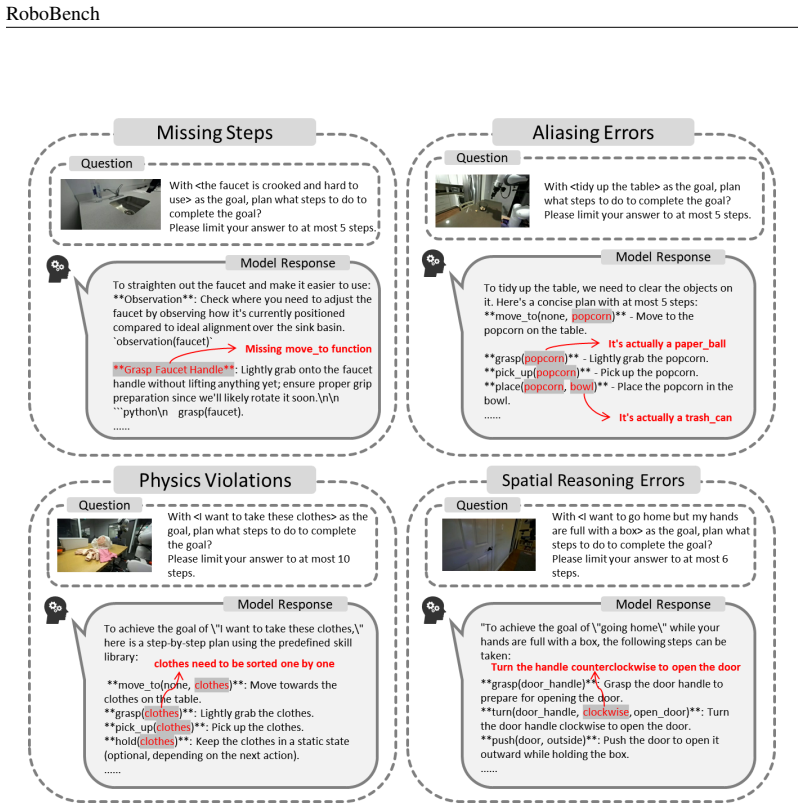
On its own terms, the paper claims that RoboBench is a benchmark covering the whole manipulation pipeline of an embodied brain and that it evaluates planning by embodied feasibility rather than symbolic matching. The authors report that Gemini-2.5-Pro leads all tested models but still lags human performance by double-digit gaps; that implicit instructions cause an average 30% score drop relative to explicit ones; that temporal grounding and robot-view recognition are weak; that dual-arm coordination and uncommon-object planning are the hardest planning subareas; and that execution-level failure diagnosis is the most difficult dimension, with models scoring 10–20 and humans only 47.30. They a
What carries the argument
The load-bearing machinery is the MLLM-as-world-simulator evaluation for long-horizon planning (Q1). A task is represented as a partially ordered set of atomic actions ⟨skill, object, args⟩, with a manually annotated directed acyclic graph (DAG) encoding precedence and allowable concurrency. The metric computes NodeCorrectness by one-to-one action matching, then TaskCompletion by having an MLLM roll out the predicted plan: it builds an initial world state from the first frame, extracts critical object-state milestones (e.g., drawer=open, apple on plate), enforces DAG order, and marks each milestone as achieved and protected when its preconditions hold. The final long-horizon score is (NodeCo
Load-bearing premise
The benchmark's ground truth and scoring are only as trustworthy as AI-generated annotations and an MLLM judge: the planning step sequences, temporal segmentations, functional attributes, and implicit rewrites come from Gemini/GPT with later human refinement, and the Q1 planning scores come from an MLLM world-simulation rollout with no real-robot verification—so if those annotations or simulated rollouts are systematically wrong, the measured gaps are not reliable.
What would settle it
Run the evaluated models' predicted plans on real robots (or a high-fidelity simulator) for a sample of RoboBench Q1 tasks and compare execution success against the MLLM world-simulator scores. If plans the simulator scores highly frequently fail in reality, or if swapping in a judge from a different model family reverses model rankings, the central claim fails.
If this is right
- If RoboBench is correct, the reported 20–40 point gaps to humans on implicit instruction understanding, planning, affordance prediction, and failure diagnosis are genuine limitations of current MLLMs, not artifacts of a matching-based metric.
- A model's embodied cognition can be decomposed into five dimensions, so developers can target the weakest link; the results suggest, for example, that open-source embodied models like RoboBrain-2.0-7B gain from domain training on perception, planning, and affordance but still fail at failure analysis.
- Multi-view inputs improve planning scores only marginally (e.g., GPT-4o from 33.66 to 38.51), so adding cameras alone will not close the gap to human performance.
- Planning evaluation should adopt rollout-based world-simulation over text-similarity or pairwise LLM scoring, because the former aligns with human judgments (r = 0.83) better than the latter (r = 0.73).
Where Pith is reading between the lines
- Editorial inference: because the planning DAGs and implicit-instruction rewrites are generated by Gemini/GPT and only later human-refined, models from those same families may benefit from annotator bias; a stronger leaderboard would use a judge from a different model family or a human-scored subset for every dimension.
- Editorial inference: the world-simulator's claim of 'embodied feasibility' rests on an MLLM's imagined physics; if that imagination is systematically wrong, the metric could reward plans that are linguistically coherent but physically impossible. A direct test would compare simulator scores against real-robot execution on the same plans.
- Editorial inference: the 30% drop on implicit instructions suggests a cheap training signal: pair explicit and implicit rewrites during instruction tuning, then measure whether Q1 planning scores improve—if they do, the bottleneck is partially a distribution problem, not a fundamental planning deficit.
- Editorial inference: the same DAG-plus-rollout method could be lifted into other benchmarks that already have hierarchical task structures, provided the critical-state annotations are reliable; this would make planning scores comparable across benchmarks.
Editorial analysis
A structured set of objections, weighed in public.
Referee Report
Summary. RoboBench is a benchmark for evaluating MLLMs as the cognitive 'brain' of robotic manipulation. It claims to cover five dimensions — instruction comprehension, perception reasoning, generalized planning, affordance prediction, and failure analysis — with 14 capabilities, 25 tasks, and 6,092 QA pairs, drawing on real robotic datasets and in-house collection. For long-horizon planning it proposes an MLLM-as-world-simulator metric: Q1 plans are matched to a reference action list and scored by node correctness plus a simulated task-completion rollout against a DAG of object-state milestones; Q2 and Q3 are next-step and state-estimation tasks. The paper evaluates 14 (abstract: 18) MLLMs plus a text-only LLM and human reference, reports consistent human-model gaps, and validates the Q1 metric against expert holistic scores on 438 tasks (r=0.83 vs. an LLM pairwise baseline's r=0.73).
Significance. The contribution is potentially valuable. The dimensional coverage is broader than most prior embodied-cognition benchmarks, the planning representation (DAG + object-state milestones) is a real step beyond BLEU/multiple-choice evaluation, and the human-correlation study is a genuine attempt to validate the metric. If the construction and scoring loops can be shown to be non-circular, the headline findings — especially the 20–40 point human gaps on implicit instruction, planning, affordance, and failure diagnosis — would be an informative benchmark result for the community. The authors also provide detailed prompts and an error taxonomy, which aids reproducibility.
major comments (4)
- [§3.2, §4 (Q1), Appendix F.2.1] Section 3.2 states that Gemini generates the structured planning annotations (task summaries, step instructions, timestamps) that are later human-refined, and the Q1 scoring prompt in Appendix F.2.1 explicitly receives 'GT action list: Ground Truth actions from Gemini video segmentation' as reference. Section 4, however, describes G as 'manually annotated.' This provenance discrepancy matters because the Q1 judge is also an MLLM (identity not given) and the benchmark's strongest planning/leaderboard claims depend on judge behavior. If the judge is of the same family as the annotator, Gemini-subject scores can reflect alignment with the annotator's ontology/aliases rather than physical executability. The human study validates only 438 of 1,973 Q1 tasks and does not test judge-family invariance. I request: (i) state the judge model and settings; (ii) re-score a meaningful sample with two i
- [§4, Eq. (1)] NodeCorrectness is recall-only: the numerator is |V* ∩ V_hat| and the denominator is |V*|; extra predicted nodes are never penalized. The paper's own error analysis (Fig. 6a/Table 8) identifies redundant steps as a principal failure type. A model that outputs the full GT sequence plus one or more spurious actions receives full NodeCorrectness, and if the world-simulator judge finds the critical states achieved (robot motions are explicitly ignored in TaskCompletion), the score is not reduced. This weakens the claim that Q1 measures structural correctness and embodied feasibility. Please add a precision term or an explicit penalty for inserting nodes, and evaluate how Q1 scores change on plans with inserted/redundant actions.
- [§5.4] The reported metric validation is a single Pearson r on 438 sampled Q1 tasks against holistic expert scores. The paper does not give the sampling protocol, the number/qualifications of experts, inter-annotator agreement, confidence intervals, or a per-model breakdown; without these, the comparison r=0.83 vs r=0.73 may not be statistically distinguishable. Moreover, the study validates holistic human preference, not real-robot executability. Please add CIs/bootstrap, inter-annotator statistics, and a scatter/stratified analysis by model; if feasible, validate a subset of Q1 rollouts against simulator or real-robot execution.
- [§3.2 Quality Control] Quality control removes items that all evaluated models answer correctly and manually corrects items all models fail. This is a model-dependent difficulty calibration, not an intrinsic property of the task; it makes the benchmark composition depend on the particular model cohort and can inflate apparent performance gaps. The paper does not report how many items were removed/corrected, nor whether the procedure was applied before or after the main experiments. Please report these numbers and, ideally, freeze the benchmark after filtering; otherwise the leaderboard is not reproducible.
minor comments (6)
- [Abstract/§5.1/Table 7] Abstract says 18 MLLMs, main experiments report 14, and Table 7 lists 13 models. Align the counts and the model list.
- [§3.2/Table 2] Table 2 reports 'Total items 4038' while the text says '6092 samples and 4333 unique items'. Clarify whether 'items' are videos, QA instances, or unique tasks.
- [§4] The Q1 reference graph G is called 'manually annotated' in §4 but is described as Gemini-generated plus human-refined in §3.2. Use consistent terminology and specify the human refinement protocol.
- [§4 (affordance score)] The affordance score uses 100*(1-d)^alpha with alpha=2.5 and no sensitivity analysis. Report whether rankings change for reasonable values of alpha.
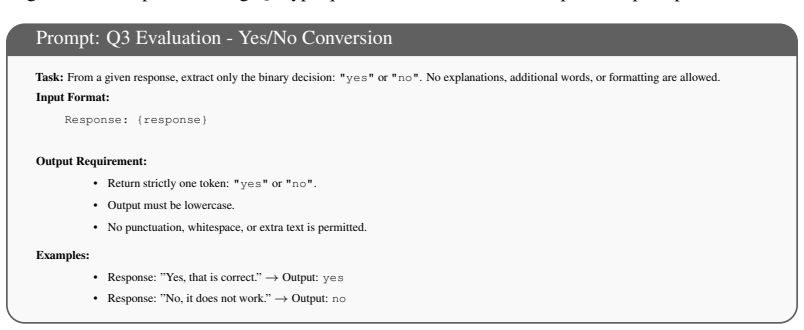
- [Appendix F.2.2-F.2.3] Q2/Q3 evaluation prompts do not specify the judge model, temperature, or decoding settings; repeated-judge reliability should be reported.
- [Figure 6] The correlation plots show no confidence intervals or error bars; bootstrap CIs for r=0.83 and r=0.73 should be added.
Circularity Check
No demonstrated circularity: Q1 planning reference annotations are Gemini-generated with human refinement and the evaluator MLLM is not specified, so the annotator/judge loop is not established as a reduction.
full rationale
RoboBench is a benchmark-construction paper rather than a fitted derivation, so the enumerated circularity patterns largely do not apply. The closest candidate is the Q1 planning loop: Section 3.2 states 'Gemini Comanici et al. (2025) generates structured annotations - task summaries, step-wise instructions with timestamps, and metadata (objects, actions, scenes, embodiments) - which are refined by human annotators,' and Section 4's TaskCompletion uses 'reference action list A*' and 'reference DAG G' as inputs to an MLLM judge; the Figure 26 scoring prompt even labels the GT as 'Ground Truth actions from Gemini video segmentation.' Had the paper also specified that the judge is Gemini and had its headline planning scores been the derived quantity, this could amount to a self-agreement loop. But the paper never identifies the MLLM judge, the DAG is described as manually annotated, human annotators refine the Gemini outputs, and Section 5.4 validates the metric against 438 human-scored Q1 tasks (r=0.83 vs 0.73 for an LLM baseline), which is an external check rather than a reduction to inputs. The absence of real-robot verification and the noted numeric inconsistencies (18 vs 14 vs 13 models; 6092/4333 vs Table 2's 4038 total items) are validity/reporting concerns, not circularity under the hard-rule standard. No load-bearing self-citation or uniqueness theorem is invoked. Therefore no circular step can be exhibited from the paper's own equations, and the score is low.
Axiom & Free-Parameter Ledger
free parameters (1)
- affordance_score_exponent_alpha =
2.5
axioms (4)
- domain assumption Gemini/GPT-generated annotations are accurate enough to serve as ground truth after human refinement
- domain assumption An MLLM can simulate physical world-state transitions from a first-frame image reliably enough to score task completion
- ad hoc to paper Removing items all models answer correctly and manually correcting items all models fail yields a valid difficulty-calibrated benchmark
- domain assumption Human expert holistic scores on 438 sampled Q1 tasks are a valid gold standard for planning quality and generalize to all 6,092 questions
Cite this review
Pith. "Pith review of Robobench: A Comprehensive Evaluation Benchmark for Multimodal Large Language Models as Embodied Brain." pith.science (2026). https://pith.science/paper/HM3IKCI5
@misc{pith2026251017801,
  author       = {Pith},
  title        = {Pith review of: Robobench: A Comprehensive Evaluation Benchmark for Multimodal Large Language Models as Embodied Brain},
  year         = {2026},
  howpublished = {\url{https://pith.science/paper/HM3IKCI5}},
  note         = {Machine review of arXiv:2510.17801}
}
read the original abstract
Building robots that can perceive, reason, and act in dynamic, unstructured environments remains a central challenge. Recent embodied systems often follow a dual-system paradigm, where System 2 performs high-level reasoning and System 1 handles low-level control. We refer to System 2 as the embodied brain, the cognitive core for decision-making in manipulation. Although evaluating this embodied brain is crucial, existing benchmarks mainly measure execution success or cover only limited aspects of high-level cognition and task realism. We introduce RoboBench, a benchmark for evaluating multimodal large language models (MLLMs) as embodied brains. RoboBench covers five dimensions: Instruction Comprehension, Perception Reasoning, Generalized Planning, Affordance Prediction, and Failure Analysis. It spans 14 capabilities, 25 tasks, and 6,092 QA pairs. To improve realism, it draws from large-scale real robotic data and in-house collection across diverse embodiments, attribute-rich objects, multi-view scenes, and memory-driven navigation. For planning, RoboBench introduces an MLLM-as-world-simulator framework that assesses whether predicted plans can achieve critical object-state changes under physical and visual constraints, enabling more faithful evaluation of long-horizon reasoning than symbolic matching. Experiments on 18 state-of-the-art MLLMs reveal persistent limitations in implicit instruction understanding, spatiotemporal reasoning, cross-scenario planning, fine-grained affordance understanding, and failure diagnosis. We further analyze how embodied cognitive abilities relate to downstream robotic control. RoboBench offers a comprehensive scaffold for quantifying high-level cognition and guiding next-generation MLLMs toward more robust robotic intelligence.
Figures




Forward citations
Cited by 8 Pith papers
-
An Exam for Active Observers
On a new 17-task benchmark of active visual observation, the best frontier multimodal model solves 10.6% of items and humans solve 96.1%.
-
OVO-S-Bench: A Hierarchical Benchmark for Streaming Spatial Intelligence in Multimodal LLMs
OVO-S-Bench provides 1680 human-annotated questions on 348 videos to measure streaming spatial intelligence in MLLMs across instantaneous perception, spatiotemporal tracking, spatial simulation, and allocentric mapping.
-
RoboInter1.5: A Holistic Intermediate Representation Suite for Embodied World Modeling and Robotic Manipulation
Dense per-frame intermediate representations (traces, masks, grasp poses, subtasks) improve embodied VQA, VLA action generation, and world-model video prediction in the new 230k-episode RoboInter-Data suite.
-
Probing Collision Grounding in Vision-Language Models for Safe Human-Robot Collaboration
TouchSafeBench evaluates VLMs on collision grounding, finding best Macro-F1 below 50% and that explicit depth does not yield reliable robot-body contact inference.
-
Unified Embodied VLM Reasoning with Robotic Action via Autoregressive Discretized Pre-training
A 6K-question embodied-reasoning benchmark plus a flow-matching action tokenizer let one 3B vision-language model reason and manipulate better than continuous- or discrete-action VLA baselines.
-
Towards Spatial Trace with Reasoning in Vision-Language Models for Robotics
A 3D-aware VLM, RoboTracer, generates metric-grounded spatial traces for robot manipulation using scale supervision and metric-sensitive reinforcement rewards.
-
RoboAgent: Chaining Basic Capabilities for Embodied Task Planning
RoboAgent chains basic vision-language capabilities inside a single VLM via a scheduler and trains it in three stages (behavior cloning, DAgger, RL) to improve embodied task planning.
-
A Practical Recipe Towards Improving Sim-and-Real Correlation for VLA Evaluation
Authors perform a cross-simulator, cross-policy empirical study of sim-to-real correlation for VLA policies and distill guidance on using simulation for policy improvement.
Reference graph
Works this paper leans on
-
[1]
Three prompts are used to cover different robot types: single-arm, dual-arm, and mobile-manipulator robots, shown in Figure 13, 14 and 15
Video to Natural Language Task DescriptionRobot videos are converted into natural language task descriptions, including sequential step descriptions. Three prompts are used to cover different robot types: single-arm, dual-arm, and mobile-manipulator robots, shown in Figure 13, 14 and 15
-
[2]
Two function lists are used: Manipulation (Figure 16) and Navigation (Figure 17), followed by a conversion prompt (Figure 18) referencing these lists
NL Steps → Predefined Function SequenceNatural language step descriptions are mapped to a sequence of predefined functions. Two function lists are used: Manipulation (Figure 16) and Navigation (Figure 17), followed by a conversion prompt (Figure 18) referencing these lists
-
[3]
The prompt is presented in Figure 19
Function InstantiationInstantiate function arguments with objects extracted from step descrip- tions. The prompt is presented in Figure 19
-
[4]
21 RoboBench Figure 9: Frequency of each action name in RoboBench planning tasks
Explicit → Implicit Instruction ConversionTo facilitate natural language task formulation for embodied robots, we convert explicit task instructions into implicit forms that imply the required action without directly naming the target object or task (Figure 20). 21 RoboBench Figure 9: Frequency of each action name in RoboBench planning tasks. Figure 10: S...
-
[5]
These structured annotations provide the foundation for evaluating compositional reasoning and downstream task performance
Fine-grained Attribute ExtractionWe design prompts to extract fine-grained, step-level information from video frames, includingobjects(Figure 21),actions(Figure 22), andscene labels (Figure 23). These structured annotations provide the foundation for evaluating compositional reasoning and downstream task performance. F.1.2 PERCEPTIONTASKS: FUNCTIONALATTRI...
-
[6]
This task could be a clear goal or a series of related activities (e.g., assembling furniture, repairing equipment, preparing food, etc.)
Task Identification: First, identify the main task the robotic arm is performing. This task could be a clear goal or a series of related activities (e.g., assembling furniture, repairing equipment, preparing food, etc.). Briefly describe the primary task in one sentence
-
[7]
Step Extraction: Once the task is identified, extract the key steps required to complete it, ensuring that each step is clearly described and logically ordered. Each step may include: • Specific actions (e.g., tightening screws, stirring mixtures, pressing buttons, etc.) • Frame window: Specify the start and end frame for each step (from0to{maxframeid}, s...
-
[8]
task_summary
Failure Identification: If the robotic arm attempts an action but does not succeed, clearly indicate this in the step description. For example, if the robotic arm tries to pick up a block but fails, the step description should be something like Attempt to pick up a block but fails. 6.Output Format: Provide the task description and steps in two parts, form...
-
[9]
Your first task is to accurately identify which hand is the left arm ([left]) and which hand is the right arm ([right])
Left-Right Hand Identification: The video is recorded from a first-person view of the dual-arm robotic system. Your first task is to accurately identify which hand is the left arm ([left]) and which hand is the right arm ([right]). This is crucial as you proceed with the task analysis. Use visual cues such as the relative position of the hands, their orie...
-
[10]
This task could be a clear goal or a series of related activities (e.g., assembling furniture, repairing equipment, preparing food, etc.)
Task Identification: Once the left and right arms are correctly identified, determine the main task the robotic system is performing. This task could be a clear goal or a series of related activities (e.g., assembling furniture, repairing equipment, preparing food, etc.). Briefly describe the primary task in one sentence
-
[11]
task_summary
Step Extraction: After identifying the task and distinguishing the left and right arms, extract the key steps required to complete the task, ensuring that each step is clearly described and logically ordered.Make sure the following criteria are met: • Thefirst stepmust always start with start frame equal to 0, and thelast stepmust end with end frame equal...
-
[12]
If you don’t know what scene tags to fill in, you can fill in ¡unknown¿ as the answer
-
[13]
Primary Tag
The Primary Tag, Secondary Tag, and Tertiary Tag must fill in the background information of the several frames of images I gave you. Please do not fill in other information!!! Again, your result must use the following format: • Before providing your tag answers, please explain the reasoning behind the labels you have given. [ { "Primary Tag": "the primary...
-
[14]
task summary
Extract Key Information:Identify the task goal from the prompt field and assign it to the "task summary" field. Extract action functions from theprevious stepandresponsefields to construct the sequence of necessary steps in"plan step"
-
[15]
plan step
Strict Action Function Format:Use only the predefined action functions listed below. Do not modify function names or introduce new ones. Ensure all function names match exactly. Arguments ( object, target object, carry object, direction) should be generalized but faithful to the task. 3.Maintain Execution Order:The"plan step"list should follow the correct...
-
[16]
reason" field explaining how the
Reasoning Explanation:Provide a "reason" field explaining how the "task summary" and "plan step" were derived, including how you determined the format (single-arm vs dual-arm). Predefined Action Functions:""" + PREDEFINED ACTIONS + """ Output Format (JSON): For Single-Arm Tasks: { "task_summary": "<task goal>", "plan_step": ["<action_function_1>", "<actio...
-
[17]
Flexible matching in Standard Mode; strict in CSS Mode
Node Correctness: Match skill-object-parameter nodes between GT and model outputs.Scoring:floor((correct/total) * 10). Flexible matching in Standard Mode; strict in CSS Mode
-
[18]
node_correctness
Task Completion Degree: Count achieved critical object state changes (turn, place, pick up, push/pull). Ignore robot motions (e.g., move to, grasp).Scoring:floor((achieved/total) * 10). Flexible Equivalence (Standard Mode Only):Functional equivalence (e.g., drawer∼drawer handle, lamp switch∼power button) is accepted. Output Format (JSON): { "node_correctn...
-
[19]
Award 1 iff the skills are exactly identical (strict match after normalization); otherwise award0
Skill usage accuracy (0 or 1 point).Consider only the skill/action token (e.g., grasp, push, move to) in both steps. Award 1 iff the skills are exactly identical (strict match after normalization); otherwise award0. Normalization rule:lowercase, strip extra spaces/underscores for comparison (e.g.,Pick Up→pickupfor matching purposes). 2.Operation object re...
-
[20]
skill_usage_accuracy
Parameter accuracy (0, 0.5, or 1 point).Evaluate additional parameters (e.g., target positions, directions, contents).Important:if Skill score = 0 or Object score = 0, Parameter score = 0. Otherwise: •1.0: Parameters fully correct and precise for execution. •0.5: Parameters partially correct or imprecise but salvageable. •0.0: Parameters incorrect or irre...
This paper was first reviewed by deepseek-v4-flash on August 4, 2026.
discussion (0)
Sign in with ORCID, Apple, or X to comment. Anyone can read and Pith papers without signing in.