REVIEW 3 major objections 5 minor 3 cited by
Future space-based gravitational-wave detectors will be limited not by their instrumental noise but by the unresolved astrophysical foreground, which this paper computes for LISA, µAres, AMIGO, and the Decihertz Observatory.
Reviewed by Pith at T0; open to challenge. T0 means a machine referee read the full paper against a public rubric. the ladder, T0–T4 →
T0 review · deepseek-v4-flash
2026-08-04 08:47 UTC pith:TK3BROAH
load-bearing objection First consistent foreground comparison for µAres/AMIGO/DO; the qualitative ranking is solid, but DO's 'one order below noise' claim rests on perfect subtraction and should be taken with a grain of salt. the 3 major comments →
Assessing the performance of future space-based detectors: Astrophysical foregrounds and individual sources
The pith
A machine-rendered reading of the paper's core claim, the machinery that carries it, and where it could break.
Core claim
The authors claim that a self-consistent, iteratively computed unresolved gravitational-wave background (GWB) is the correct estimate of the astrophysical noise floor for each detector. Combining catalogs of massive black hole binaries (MBHBs), extreme mass-ratio inspirals, stellar-origin binary black holes, Galactic binaries, and extragalactic double white dwarfs, they subtract resolvable sources one iteration at a time and recompute the leftover background until it converges. The resulting residual foreground overwhelms µAres's instrumental noise by 2–3 orders of magnitude below ~1 mHz, while for the Decihertz Observatory the cleaned background sits about one order of magnitude below the n
What carries the argument
The central mechanism is the iterative source-subtraction algorithm: at each pass, every catalog source's signal-to-noise ratio is computed against detector noise plus the previous background estimate, sources above threshold are declared resolved and removed, and the remaining unresolved population defines a new background power spectral density. Repeating to convergence (20 iterations) yields the residual astrophysical noise used to build effective sensitivity curves and final detectability counts. The background calculation itself uses per-frequency characteristic-strain sums for circular and eccentric binaries, with contributions weighted by the number of wave cycles completed during the
Load-bearing premise
The load-bearing premise is that every resolved source is identified and subtracted perfectly using its true waveform parameters, so the predicted residual background—and the cleaned sensitivity curves built from it—would rise if realistic parameter-estimation errors left subtraction residuals behind.
What would settle it
Run the same source catalogs through an end-to-end analysis that fits and subtracts each resolvable source with realistic noise-induced parameter errors; if the leftover noise from imperfect subtraction exceeds the predicted residual GWB near 0.1 Hz for the Decihertz Observatory, or keeps µAres's background above the MBHB-dominated level, the paper's effective-sensitivity predictions are wrong.
If this is right
- µAres's effective low-frequency sensitivity is set by the massive-black-hole-binary and Galactic foreground, not by instrumental noise: its performance worsens by 2–3 orders of magnitude below ~1 mHz, yet it remains the best band for watching MBHBs hundreds of years before merger.
- The Decihertz Observatory is the cleanest of the four concepts: iterative cleaning pushes EMRI and stellar-origin-black-hole backgrounds roughly ten times below detector noise near 0.1 Hz, making it the best placed to detect a subdominant cosmological stochastic background.
- AMIGO's tenfold sensitivity gain is partly wasted: Galactic binaries and extragalactic double white dwarfs dominate above ~3 mHz and cannot be removed by resolving individual sources, limiting the gain to frequencies below ~0.1 mHz and above ~10 mHz.
- The detector-specific counts—DO detecting essentially all merging light-seed MBHBs and SOBBHs to z≈10, µAres adding ~250 non-merging MBHBs, and all missions resolving roughly 10^4 galactic binaries—are the concrete science-return predictions that follow from the cleaned noise curves.
- The paper identifies which proposed science cases survive foreground cleaning: DO's high-redshift seed-black-hole observations and µAres's multimessenger inspiral monitoring are the two most foreground-resistant scientific niches.
Where Pith is reading between the lines
- Extension: The 'one order below noise' margin claimed for the Decihertz Observatory is an upper bound on cleanliness; if realistic imperfect subtraction were included, the residual astrophysical background would rise toward the detector noise, weakening the case that cosmological backgrounds are cleanly observable there.
- Extension: The irreducible extragalactic double-white-dwarf foreground is population-model dependent, so measuring its amplitude with LISA first would calibrate and sharpen the predicted AMIGO performance above 3 mHz.
- Extension: The same iterative-cleaning logic could be applied to networks of space detectors (LISA with TianQin or Taiji) or to next-generation ground observatories, where subtraction residuals are similarly the dominant uncertainty in foreground estimation.
- Extension: The sky- and inclination-averaged detector responses used here may misestimate the anisotropic Galactic foreground; a full response calculation could change which detector appears cleanest at the lowest frequencies.
Editorial analysis
A structured set of objections, weighed in public.
Referee Report
Summary. This paper presents a unified forward-modeling framework to estimate the unresolved astrophysical gravitational-wave background (GWB) for LISA, µAres, AMIGO, and the Decihertz Observatory, and then assesses the numbers and properties of individually resolvable sources. Five source classes are considered: massive black hole binaries (two seed models), extreme mass-ratio inspirals, stellar-origin binary black holes, Galactic binaries, and extragalactic double white dwarfs. The unresolved GWB is computed with the iterative source-subtraction algorithm of Karnesis et al. [30], using published catalogs and standard sky-averaged SNR formulas. The paper reports residual GWB curves, effective sensitivity curves, resolved-source counts, and population properties for each detector. The central quantitative claims are that the MBHB+GB foreground degrades µAres sensitivity by 2-3 orders of magnitude below ~1 mHz, and that DO reduces the SOBBH/EMRI foregrounds to about one order of magnitude below its noise near 0.1 Hz, with corresponding implications for detecting subdominant cosmological backgrounds.
Significance. The work is a useful, clearly structured scoping study for post-LISA mission design. Its strengths are that the SNR and GWB formalisms are standard and explicitly stated, the inputs are published catalogs rather than outputs tuned to the conclusions, and the iterative subtraction is tested for convergence (0.2% variation in GB counts after 20 iterations). The comparison of four detectors with the same pipeline is a genuine service to the Voyage 2050 discussion. However, the central predictions are only as good as the perfect-subtraction idealization, which the authors themselves flag as unrealistic. The qualitative conclusion for µAres is robust because its residual foreground sits orders of magnitude above the instrumental noise, but the quantitative claim for DO (foreground reduced below noise near 0.1 Hz) is exactly where realistic subtraction residuals matter most. I list below the load-bearing points that need to be addressed before the paper's conclusions can be accepted as stated.
major comments (3)
- [Sec. IV D and Sec. VI, Figs. 3-4] The paper's central quantitative claims are computed under the assumption of perfect source identification and subtraction, i.e. subtracting waveforms with known true parameters. Sec. VI acknowledges this is 'not realistic' and may 'prevent the actual reduction of the astrophysical background much below the detector noise limit.' This caveat is not cosmetic: the cleaned sensitivity curves in Figs. 3-4, the effective noise used for all resolved-source counts, and the statement that DO 'succeeds in decreasing the GWB level to about one order of magnitude below the noise curve at frequencies of the order of 0.1 Hz' are all outputs of that idealization. Residual subtraction noise adds positive power, so the claimed DO curve is a lower bound, not an estimate; it is precisely where the claimed residual is smallest that the correction is largest. The authors should quantify this effect (e.g. by
- [Sec. III C and Sec. IV C, Eqs. (9) and (11)] The Galactic binary catalog is undersampled by a factor of 1:100 for GW frequencies below 0.5 mHz, but I could not find any statement that the GWB sum is reweighted to compensate. If the algorithm simply sums over catalog entries without weights, the unresolved GB background below 0.5 mHz is underestimated by two orders of magnitude, and the same applies to the low-frequency GB resolved-source counts. This is not a minor implementation detail: the GB foreground is claimed to dominate at low frequencies for µAres and AMIGO (Figs. 3-4, Sec. VI), and the resolved-GB frequency distributions in Fig. 17 extend below 0.5 mHz. Please state explicitly how the undersampling factor is corrected in the PSD calculation and in the source counts, or rerun the affected cases with a properly weighted/full catalog and update the conclusions that depend on the low-frequency GB contribution.
- [Sec. V A, Table I] The GWB and resolved-source results carry no systematic uncertainty estimates. The MBHB population is bracketed by HS/LS models, but the EMRI, GB, SOBBH, and extragalactic-DWD populations are each represented by a single model, despite the known sensitivity of their GWB levels to model assumptions (e.g. [58,59] for DWDs). As a result, strong statements such as 'Each contribution is individually detectable by the different missions' in Table I have no quantified support. The paper should either propagate the range of published population models or explicitly state that these are single-model point estimates not robust to population uncertainties, especially for the deci-Hz conclusions where the claimed foreground is already close to the noise level.
minor comments (5)
- [Eq. (4)] The functions F(e_n) and g_n(e_n) are used but not defined. A reader should not need to guess from the reference; please give the explicit expressions or exactly point to the numbered equations in [46].
- [Figs. 3-4] The text says a running mean is applied to smooth the GWB curves, but the window size and type are not specified. This makes the figures non-reproducible. Please state the smoothing prescription.
- [Sec. IV D] Convergence is reported only in terms of the number of resolved GB sources (0.2% change in the final iteration). Please also report the convergence of the GWB itself, e.g. the relative change in S_h at representative frequencies, since source counts and background power need not converge at the same rate.
- [Sec. IV C, Eq. (13)] The approximation gamma(f)=1 is acknowledged as indicative, but Table I presents the resulting GWB SNRs as definite numbers. Please add an explicit caveat in the table caption or text that these values are optimistic because of the unity overlap-reduction approximation.
- [Introduction] There are a few typographical/formatting artifacts, e.g. 'L VK operates' in the introduction, and the table header in Table I is unwieldy. A careful proofread would help.
Circularity Check
No significant circularity: forward algorithm on published catalogs; the acknowledged perfect-subtraction idealization is a model limitation, not a circular reduction.
full rationale
No circularity is present in the derivation chain. The central results — the residual astrophysical GWB curves (Figs. 3-4), the GWB SNR table (Table I), and the resolved source counts (Sec. V B) — are forward outputs of an iterative fixed-point subtraction algorithm (Sec. IV D, following Karnesis et al. [30]) applied to independent, published population catalogs. No target quantity is fitted, and the residual background is not equal by construction to any input curve. The inputs themselves are published results with stated assumptions: MBHB catalogs from Bonetti et al. [42] (Sec. III A), EMRI catalog from Babak et al. [45] and formalism from Bonetti & Sesana [46] (Sec. III B), GB catalogs from Toonen et al. [49] and Korol et al. [53,54] (Sec. III C), SOBBH catalogs from extrapops following Babak et al. [32] (Sec. III D), and the extragalactic DWD analytic fit from Hofman & Nelemans [58] (Sec. III E). Although several of these are prior work by the current authors, they are not tuned to the present results and carry independent external grounding; for example, the EMRI GWB estimate is explicitly cross-checked against the independent computation of Pozzoli et al. [33] in Sec. IV B. The Sec. VI caveat — 'our methodology assumes perfect source identification and subtraction, meaning that the waveform removed from the background uses the known true parameters. This is not realistic... This may prevent the actual reduction of the astrophysical background much below the detector noise limit' — is a genuine and correctly flagged limitation affecting robustness of the DO sub-noise residual claim and of the effective sensitivity curves; it is an acknowledged modeling idealization, not a circular derivation from the inputs. The paper's self-citations are therefore not load-bearing in a circular sense. The honest finding is 'no significant circularity' (score 1, reflecting minor but non-circular reuse of the authors' own published inputs).
Axiom & Free-Parameter Ledger
free parameters (4)
- Extragalactic DWD GWB fit parameters (amplitude, spectral shape) =
not stated in paper
- SNR detection thresholds =
8 (MBHB/GB/SOBBH); 20 (EMRI)
- GB catalog undersampling factor at f_GW < 0.5 mHz =
1:100
- Iteration limit =
i = 20
axioms (5)
- domain assumption All MBHB, GB, SOBBH sources are circular (eccentricity zero); only the dominant n=2 harmonic is considered.
- domain assumption Resolved sources are removed with their true waveforms (perfect source subtraction).
- domain assumption Extragalactic DWD background is irreducible and isotropic, modeled by the Hofman-Nelemans fit.
- domain assumption EMRI population model M1 is a fiducial representative of true EMRI rates.
- domain assumption GWB SNR uses γ(f)≈1 (low-frequency approximation).
read the original abstract
The space mission LISA, scheduled for launch in 2035, aims to detect gravitational wave (GW) signals in the milli-Hz band. In the context of the ESA Voyage 2050 Call for new mission concepts, other frequency ranges are explored by the Gravitational-Wave Space 2050 Working Group to conceive new proposals for a post-LISA space-based detector. In this work, we give a preliminary estimate of the observational potential of three mission designs proposed in the literature, namely $\mu$Ares, AMIGO and the Decihertz Observatory. The analysis framework includes astrophysical GW sources, such as massive black hole binaries and extreme mass-ratio inspirals, and compact binaries, such as stellar black holes and white dwarfs. For each detector, we first present a consistent computation of the unresolved gravitational wave background (GWB) produced by the sum of all anticipated astrophysical populations using an iterative subtraction algorithm. We then investigate which types of systems are the most appealing by measuring the number of GW signals detected and exploring the source properties.
Figures




Forward citations
Cited by 3 Pith papers
-
Cosmic string gravitational wave backgrounds at LISA: II. Reconstruction of conventional signals over astrophysical foregrounds
When realistic astrophysical foregrounds are included, LISA can reconstruct the cosmic-string tension to 10% precision only for Gμ ≳ 10^{-11}, 10^5 times larger than foreground-free forecasts.
-
Reviving Motivated Inflationary Potentials with $K$-inflation in the light of ACT
K-inflation with non-canonical kinetic term G(φ) shifts α-attractor T-models and natural inflation into the Planck-ACT-LB-BK18 allowed region while satisfying Swampland conjectures and producing testable GW spectra.
-
The deci-Hz gravitational wave signal from the collapse of rotating very massive stars
Collapse of a rotating 300 solar mass star produces a strong, characteristic deci-Hz gravitational wave signal potentially detectable to 200 Mpc at a rate of 0.5 per year.
Reference graph
Works this paper leans on
-
[1]
The resulting SNR distributions for the four missions are shown in Fig
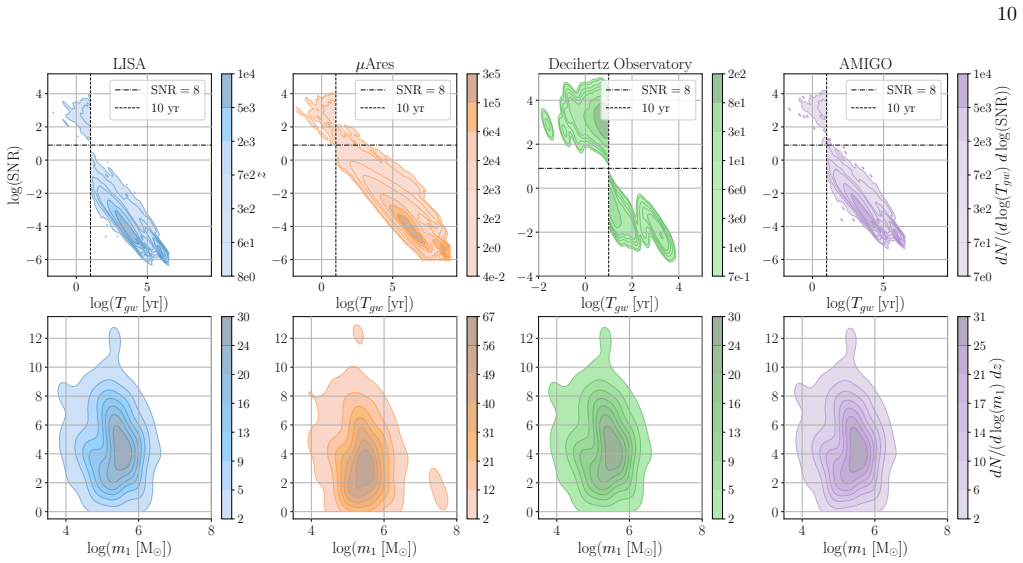
Massive black hole binaries Heavy seeds.We first concentrate on the HS catalog, which contains≈1.4×10 7 sources. The resulting SNR distributions for the four missions are shown in Fig. 5. The different heights of the histograms come from the fact that for each detector we considered only MBHBs emitting at frequencies falling within its frequency band, set...
2092
-
[2]
Extreme mass-ratio inspirals Mock populations of EMRIs are difficult to construct due to our limited knowledge on the number and prop- −8 −6 −4 −2 0 2 4 log(SNR) 101 103 105 N LISA µAres Decihertz Observatory AMIGO log(20) FIG. 11. SNR distribution for the EMRI catalog. erties of these systems. Therefore our results are closely tied to the fiducial model ...
2030
-
[3]
In our model, they amount to nearly 26 million of events included in the catalog, whose SNR histograms is displayed in Fig
Stellar-origin binary black holes Compact binaries of stellar BHs are already the pri- mary target of terrestrial observatories, but they could be potentially detected also by space-based interferome- ters. In our model, they amount to nearly 26 million of events included in the catalog, whose SNR histograms is displayed in Fig. 13. As expected, almost al...
-
[4]
Dipartimenti di Eccellenza 2023-2027
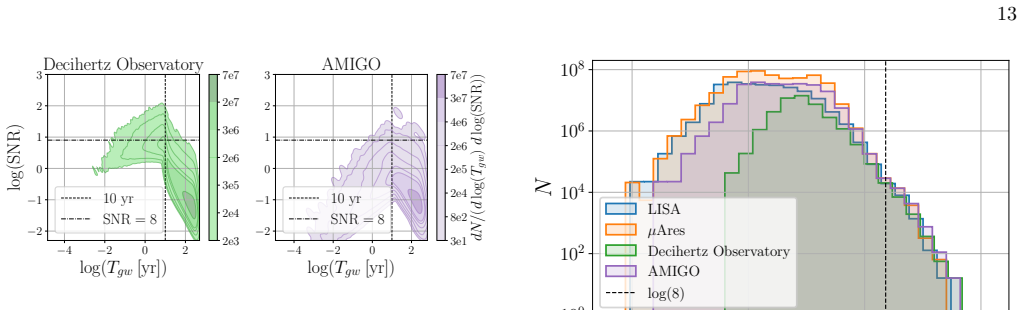
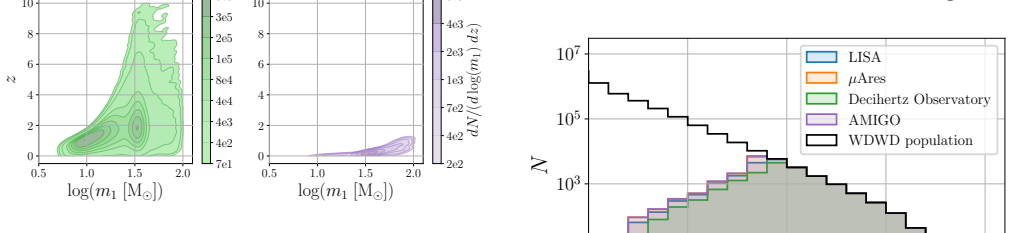
Galactic binaries Our last astrophysical population consists of around 500 million of compact binaries inhabiting the Milky Way, whose quasi-monochromatic GW signals span a fre- quency range from 10 −6 Hz to a few tens of mHz. The SNR distribution of the ”in-band” sources for each de- tector is presented in Fig. 16. All resolved sources are WDWD binaries,...
2050
-
[5]
Punturoet al., The Einstein Telescope: a third- generation gravitational wave observatory, Classical and Quantum Gravity27, 194002 (2010)
M. Punturoet al., The Einstein Telescope: a third- generation gravitational wave observatory, Classical and Quantum Gravity27, 194002 (2010)
2010
-
[6]
Reitzeet al., Cosmic Explorer: The U.S
D. Reitzeet al., Cosmic Explorer: The U.S. Contribution to Gravitational-Wave Astronomy beyond LIGO, Bul- letin of the AAS51, 35 (2019), arXiv:1907.04833 [astro- ph.IM]. 16
Pith/arXiv arXiv 2019
-
[7]
M. V. Sazhin, Opportunities for detecting ultralong grav- itational waves, Soviet Ast.22, 36 (1978)
1978
-
[8]
EPTA Collaborationet al., The second data release from the European Pulsar Timing Array. III. Search for gravitational wave signals, A&A678, A50 (2023), arXiv:2306.16214 [astro-ph.HE]
Pith/arXiv arXiv 2023
-
[9]
B. P. Abbottet al., Observation of Gravitational Waves from a Binary Black Hole Merger, Phys. Rev. Lett.116, 061102 (2016), arXiv:1602.03837 [gr-qc]
Pith/arXiv arXiv 2016
-
[10]
LIGO Scientific Collaborationet al., Advanced LIGO, Classical and Quantum Gravity32, 074001 (2015), arXiv:1411.4547 [gr-qc]
Pith/arXiv arXiv 2015
-
[11]
F. Acerneseet al., Advanced Virgo: a second-generation interferometric gravitational wave detector, Classical and Quantum Gravity32, 024001 (2015), arXiv:1408.3978 [gr-qc]
Pith/arXiv arXiv 2015
-
[12]
T. Akutsuet al., Overview of KAGRA: Detector de- sign and construction history, Progress of Theoreti- cal and Experimental Physics2021, 05A101 (2021), arXiv:2005.05574 [physics.ins-det]
arXiv 2021
-
[13]
EPTA Collaborationet al., The second data release from the European Pulsar Timing Array. IV. Implications for massive black holes, dark matter, and the early Universe, A&A685, A94 (2024), arXiv:2306.16227 [astro-ph.CO]
Pith/arXiv arXiv 2024
-
[14]
G. Agazieet al., The NANOGrav 15 yr Data Set: Con- straints on Supermassive Black Hole Binaries from the Gravitational-wave Background, ApJ952, L37 (2023), arXiv:2306.16220 [astro-ph.HE]
Pith/arXiv arXiv 2023
-
[15]
M. Colpiet al., LISA Definition Study Report, arXiv e-prints , arXiv:2402.07571 (2024), arXiv:2402.07571 [astro-ph.CO]
Pith/arXiv arXiv 2024
-
[16]
ESA, Capturing the ripples of spacetime: LISA gets go- ahead (2024)
2024
-
[17]
G. Agazieet al., The NANOGrav 15 yr Data Set: Ev- idence for a Gravitational-wave Background, ApJ951, L8 (2023), arXiv:2306.16213 [astro-ph.HE]
Pith/arXiv arXiv 2023
-
[18]
D. J. Reardonet al., Search for an Isotropic Gravitational-wave Background with the Parkes Pulsar Timing Array, ApJ951, L6 (2023), arXiv:2306.16215 [astro-ph.HE]
Pith/arXiv arXiv 2023
-
[19]
H. Xuet al., Searching for the Nano-Hertz Stochastic Gravitational Wave Background with the Chinese Pulsar Timing Array Data Release I, Research in Astronomy and Astrophysics23, 075024 (2023), arXiv:2306.16216 [astro-ph.HE]
Pith/arXiv arXiv 2023
-
[20]
S. Burke-Spolaoret al., The astrophysics of nanohertz gravitational waves, A&A Rev.27, 5 (2019), arXiv:1811.08826 [astro-ph.HE]
Pith/arXiv arXiv 2019
-
[21]
A. Sesanaet al., Unveiling the gravitational universe atµ-Hz frequencies, Experimental Astronomy51, 1333 (2021), arXiv:1908.11391 [astro-ph.IM]
Pith/arXiv arXiv 2021
-
[22]
Martens, M
W. Martens, M. Khan, and J.-B. Bayle, LISAmax: Im- proving the low-frequency gravitational-wave sensitivity by two orders of magnitude, Classical and Quantum Gravity40, 195022 (2023)
2023
-
[23]
Arca Seddaet al., The missing link in gravitational- wave astronomy: discoveries waiting in the decihertz range, Classical and Quantum Gravity37, 215011 (2020)
M. Arca Seddaet al., The missing link in gravitational- wave astronomy: discoveries waiting in the decihertz range, Classical and Quantum Gravity37, 215011 (2020)
2020
-
[24]
T. Regimbau, The astrophysical gravitational wave stochastic background, Research in Astronomy and Astrophysics11, 369 (2011), arXiv:1101.2762 [astro- ph.CO]
Pith/arXiv arXiv 2011
-
[25]
P. Amaro-Seoaneet al., Astrophysics with the Laser In- terferometer Space Antenna, Living Reviews in Relativ- ity26, 2 (2023), arXiv:2203.06016 [gr-qc]
Pith/arXiv arXiv 2023
-
[26]
Hu and Y.-L
W.-R. Hu and Y.-L. Wu, The Taiji Program in Space for gravitational wave physics and the nature of gravity, National Science Review4, 685 (2017)
2017
-
[27]
J. Luoet al., TianQin: a space-borne gravitational wave detector, Classical and Quantum Gravity33, 035010 (2016), arXiv:1512.02076 [astro-ph.IM]
Pith/arXiv arXiv 2016
-
[28]
F. Favataet al., Introducing the Voyage 2050 White Pa- pers, contributions from the science community to ESA’s long-term plan for the Scientific Programme, Experimen- tal Astronomy51, 551 (2021)
2050
-
[29]
G. Boileauet al., Spectral separation of the stochastic gravitational-wave background for LISA in the context of a modulated Galactic foreground, MNRAS508, 803 (2021), arXiv:2105.04283 [gr-qc]
Pith/arXiv arXiv 2021
-
[30]
N. Karnesiset al., Characterization of the stochastic signal originating from compact binary populations as measured by LISA, Phys. Rev. D104, 043019 (2021), arXiv:2103.14598 [astro-ph.IM]
Pith/arXiv arXiv 2021
-
[31]
M. Georgousiet al., Gravitational waves from double white dwarfs as probes of the milky way, MNRAS519, 2552 (2023), arXiv:2204.07349 [astro-ph.GA]
Pith/arXiv arXiv 2023
-
[32]
S. Babaket al., Stochastic gravitational wave background from stellar origin binary black holes in LISA, J. Cosmol- ogy Astropart. Phys.2023, 034 (2023), arXiv:2304.06368 [astro-ph.CO]
Pith/arXiv arXiv 2023
-
[33]
J. D. Romano and N. J. Cornish, Detection methods for stochastic gravitational-wave backgrounds: a unified treatment, Living Reviews in Relativity20, 2 (2017), arXiv:1608.06889 [gr-qc]
Pith/arXiv arXiv 2017
-
[34]
and extragalactic compact binaries as DWDs [35, 36] and SOBBHs [32]. In this paper, we present a self-consistent computation of astrophysical GWBs from the source populations listed above, carried out within a unified framework that relies on the source-subtraction algorithm of Karnesiset al. [30]. We demonstrate the versatility of the calculation by appl...
-
[35]
C. Capriniet al., Reconstructing the spectral shape of a stochastic gravitational wave background with LISA, J. Cosmology Astropart. Phys.2019, 017 (2019), arXiv:1906.09244 [astro-ph.CO]
Pith/arXiv arXiv 2019
-
[36]
A. I. Renziniet al., Stochastic Gravitational-Wave Backgrounds: Current Detection Efforts and Future Prospects, Galaxies10, 34 (2022)
2022
-
[37]
T. B. Littenberget al., Global analysis of the gravita- tional wave signal from Galactic binaries, Phys. Rev. D 101, 123021 (2020)
2020
-
[38]
LISA Science Study Team, LISA Science Requirements Document (2010)
2010
-
[39]
Baghiet al., Detection and characterization of instru- mental transients in LISA Pathfinder and their projection to LISA, Phys
Q. Baghiet al., Detection and characterization of instru- mental transients in LISA Pathfinder and their projection to LISA, Phys. Rev. D105, 042002 (2022)
2022
-
[40]
Baghiet al., Gravitational-wave parameter estima- tion with gaps in LISA: A Bayesian data augmentation method, Phys
Q. Baghiet al., Gravitational-wave parameter estima- tion with gaps in LISA: A Bayesian data augmentation method, Phys. Rev. D100, 022003 (2019)
2019
-
[41]
F. Pozzoliet al., Computation of stochastic background from extreme-mass-ratio inspiral populations for LISA, Phys. Rev. D108, 103039 (2023), arXiv:2302.07043 [astro-ph.GA]
Pith/arXiv arXiv 2023
-
[42]
A. Sesana, A. Vecchio, and C. N. Colacino, The stochastic gravitational-wave background from massive black hole binary systems: implications for observations with Pulsar Timing Arrays, MNRAS390, 192 (2008), arXiv:0804.4476 [astro-ph]
Pith/arXiv arXiv 2008
-
[43]
A. J. Farmer and E. S. Phinney, The gravitational wave background from cosmological compact binaries, MN- RAS346, 1197 (2003), arXiv:astro-ph/0304393 [astro- ph]
Pith/arXiv arXiv 2003
-
[44]
Staelens and G
S. Staelens and G. Nelemans, Likelihood of white dwarf binaries to dominate the astrophysical gravitational wave background in the mHz band, Astronomy & Astrophysics 683, A139 (2024)
2024
-
[45]
Baibhavet al., Probing the nature of black holes: Deep in the mHz gravitational-wave sky, Experimental Astronomy51, 1385–1416 (2021)
V. Baibhavet al., Probing the nature of black holes: Deep in the mHz gravitational-wave sky, Experimental Astronomy51, 1385–1416 (2021)
2021
-
[46]
employed in this work. C. GWB computation Given the set of different catalogs of astrophysical sources, we estimate the total PSD of the stochastic back- ground generated by all of them. The procedure closely follows the one explained in [46], further simplified in the case of circular orbits. In order to correctly assess the contribution of each single s...
-
[47]
K. G¨ ultekinet al., The M-σand M-L Relations in Galac- tic Bulges, and Determinations of Their Intrinsic Scatter, ApJ698, 198 (2009), arXiv:0903.4897 [astro-ph.GA]
Pith/arXiv arXiv 2009
-
[48]
V. Korolet al., Observationally driven Galactic double white dwarf population for LISA, MNRAS511, 5936 (2022), arXiv:2109.10972 [astro-ph.HE]
Pith/arXiv arXiv 2022
-
[49]
M. C. Digman and N. J. Cornish, LISA Gravitational Wave Sources in a Time-varying Galactic Stochastic Background, ApJ940, 10 (2022)
2022
-
[50]
Bonettiet al., Post-Newtonian evolution of massive black hole triplets in galactic nuclei - IV
M. Bonettiet al., Post-Newtonian evolution of massive black hole triplets in galactic nuclei - IV. Implications for LISA, MNRAS486, 4044 (2019), arXiv:1812.01011 [astro-ph.GA]
Pith/arXiv arXiv 2019
-
[51]
E. Barausse, The evolution of massive black holes and their spins in their galactic hosts, MNRAS423, 2533 (2012), arXiv:1201.5888 [astro-ph.CO]. 17
Pith/arXiv arXiv 2012
-
[52]
Kleinet al., Science with the space-based inter- ferometer eLISA: Supermassive black hole binaries, Phys
A. Kleinet al., Science with the space-based inter- ferometer eLISA: Supermassive black hole binaries, Phys. Rev. D93, 024003 (2016)
2016
-
[53]
Babaket al., Science with the space-based interferom- eter LISA
S. Babaket al., Science with the space-based interferom- eter LISA. V. Extreme mass-ratio inspirals, Phys. Rev. D 95, 103012 (2017), arXiv:1703.09722 [gr-qc]
Pith/arXiv arXiv 2017
-
[54]
M. Bonetti and A. Sesana, Gravitational wave back- ground from extreme mass ratio inspirals, Phys. Rev. D 102, 103023 (2020), arXiv:2007.14403 [astro-ph.GA]
Pith/arXiv arXiv 2020
-
[55]
R. Abbottet al.(LIGO Scientific Collaboration, Virgo Collaboration, and KAGRA Collaboration), Population of Merging Compact Binaries Inferred Using Gravita- tional Waves through GWTC-3, Physical Review X13, 011048 (2023)
2023
-
[56]
Torrado, extrapops: Fast simulation and analysis of extra-galactic binary GW sources (2023)
J. Torrado, extrapops: Fast simulation and analysis of extra-galactic binary GW sources (2023)
2023
-
[57]
S. Toonen, G. Nelemans, and S. Portegies Zwart, Su- pernova Type Ia progenitors from merging double white dwarfs. Using a new population synthesis model, A&A 546, A70 (2012), arXiv:1208.6446 [astro-ph.HE]
Pith/arXiv arXiv 2012
-
[58]
Paczynski, Common Envelope Binaries, inStructure and Evolution of Close Binary Systems, IAU Symposium, Vol
B. Paczynski, Common Envelope Binaries, inStructure and Evolution of Close Binary Systems, IAU Symposium, Vol. 73, edited by P. Eggleton, S. Mitton, and J. Whelan (1976) p. 75
1976
-
[59]
R. F. Webbink, Double white dwarfs as progenitors of R Coronae Borealis stars and type I supernovae., ApJ277, 355 (1984)
1984
-
[60]
S. Toonen and G. Nelemans, The effect of common- envelope evolution on the visible population of post- common-envelope binaries, A&A557, A87 (2013), arXiv:1309.0327 [astro-ph.SR]
Pith/arXiv arXiv 2013
-
[61]
and the approach of Bonetti and Sesana [46], espe- 5 cially relevant for eccentric binaries. For each class of binaries, the SNR is calculated as SNR2 = Z h2 c f Snoise(f) dlnf ,(3) whereS noise(fn) is the detector PSD andh 2 c is the total characteristic strain of the signal, defined by the sum of the characteristic strain of allnharmonics. For EMRIs, th...
-
[62]
V. Korolet al., Prospects for detection of detached dou- ble white dwarf binaries with Gaia, LSST and LISA, MN- RAS470, 1894 (2017), arXiv:1703.02555 [astro-ph.HE]
Pith/arXiv arXiv 2017
-
[63]
V. Korolet al., Expected insights into Type Ia super- novae from LISA’s gravitational wave observations, A&A 691, A44 (2024), arXiv:2407.03935 [astro-ph.HE]
Pith/arXiv arXiv 2024
-
[64]
E. S. Phinney, A Practical Theorem on Gravita- tional Wave Backgrounds, arXiv e-prints , astro (2001), arXiv:astro-ph/0108028 [astro-ph]
Pith/arXiv arXiv 2001
-
[65]
P. Madau and T. Fragos, Radiation Backgrounds at Cos- mic Dawn: X-Rays from Compact Binaries, ApJ840, 39 (2017), arXiv:1606.07887 [astro-ph.GA]
Pith/arXiv arXiv 2017
-
[66]
S. Hofman and G. Nelemans, On the uncertainty of the White Dwarf Astrophysical Gravitational Wave Background, arXiv e-prints , arXiv:2407.10642 (2024), arXiv:2407.10642 [astro-ph.HE]
Pith/arXiv arXiv 2024
-
[67]
G. Boileauet al., Gravitational-Wave Background from Extragalactic Double White Dwarfs for LISA, arXiv e- prints , arXiv:2506.18390 (2025), arXiv:2506.18390 [gr- qc]
arXiv 2025
-
[68]
Santamar ´ ıaet al., Matching post-Newtonian and nu- merical relativity waveforms: Systematic errors and a new phenomenological model for nonprecessing black hole binaries, Phys
L. Santamar ´ ıaet al., Matching post-Newtonian and nu- merical relativity waveforms: Systematic errors and a new phenomenological model for nonprecessing black hole binaries, Phys. Rev. D82, 064016 (2010)
2010
-
[69]
L. S. Finn and K. S. Thorne, Gravitational waves from a compact star in a circular, inspiral orbit, in the equatorial plane of a massive, spinning black hole, as observed by LISA, Phys. Rev. D62, 124021 (2000)
2000
-
[70]
Babaket al., The Mock LISA Data Challenges: from challenge 3 to challenge 4, Class
S. Babaket al., The Mock LISA Data Challenges: from challenge 3 to challenge 4, Class. Quantum Grav.27, 084009 (2010), arXiv:0912.0548 [gr-qc]
Pith/arXiv arXiv 2010
-
[71]
Sesana, Prospects for Multiband Gravitational-Wave Astronomy after GW150914, Phys
A. Sesana, Prospects for Multiband Gravitational-Wave Astronomy after GW150914, Phys. Rev. Lett.116, 231102 (2016), arXiv:1602.06951 [gr-qc]
Pith/arXiv arXiv 2016
-
[72]
A. Franchiniet al., Emission signatures from sub- parsec post-Newtonian binaries embedded in circumbi- nary discs, A&A686, A288 (2024), arXiv:2401.10331 [astro-ph.HE]
Pith/arXiv arXiv 2024
-
[73]
Zhouet al., Subtracting compact binary foregrounds to search for subdominant gravitational-wave back- grounds in next-generation ground-based observatories, Phys
B. Zhouet al., Subtracting compact binary foregrounds to search for subdominant gravitational-wave back- grounds in next-generation ground-based observatories, Phys. Rev. D108, 064040 (2023)
2023
-
[74]
A. Sesana and F. M. Khan, Scattering experiments meet N-body - I. A practical recipe for the evolution of massive black hole binaries in stellar environments, MNRAS454, L66 (2015), arXiv:1505.02062 [astro-ph.GA]
Pith/arXiv arXiv 2015
-
[75]
E. Bortolas, M. Mapelli, and M. Spera, Star cluster dis- ruption by a massive black hole binary, MNRAS474, 1054 (2018), arXiv:1710.09418 [astro-ph.GA]
Pith/arXiv arXiv 2018
-
[76]
Roediget al., Evolution of binary black holes in self gravitating discs
C. Roediget al., Evolution of binary black holes in self gravitating discs. Dissecting the torques, A&A545, A127 (2012), arXiv:1202.6063 [astro-ph.CO]
Pith/arXiv arXiv 2012
-
[77]
Y. Tang, A. MacFadyen, and Z. Haiman, On the orbital evolution of supermassive black hole binaries with cir- cumbinary accretion discs, MNRAS469, 4258 (2017)
2017
-
[78]
A. Spadaroet al., Stars or gas? Constraining the hard- ening processes of massive black-hole binaries with LISA, Phys. Rev. D111, 023004 (2025), arXiv:2409.13011 [astro-ph.HE]
Pith/arXiv arXiv 2025
-
[79]
A. Mangiagliet al., Massive black hole binaries in LISA: Multimessenger prospects and electromag- netic counterparts, Phys. Rev. D106, 103017 (2022), arXiv:2207.10678 [astro-ph.HE]
Pith/arXiv arXiv 2022
-
[81]
Haiman, Electromagnetic chirp of a compact binary black hole: A phase template for the gravitational wave inspiral, Phys
Z. Haiman, Electromagnetic chirp of a compact binary black hole: A phase template for the gravitational wave inspiral, Phys. Rev. D96, 023004 (2017)
2017
discussion (0)
Sign in with ORCID, Apple, or X to comment. Anyone can read and Pith papers without signing in.