REVIEW 3 major objections 5 minor 5 cited by
Current Video-LLMs cannot keep temporal judgments consistent across synchronized ego and exo views of the same event; naive multi-view training underperforms single-view training, and a reinforcement-learning method that rewards viewpoint-s
Reviewed by Pith at T0; open to challenge. T0 means a machine referee read the full paper against a public rubric. the ladder, T0–T4 →
T0 review · deepseek-v4-flash
2026-08-04 07:17 UTC pith:UZ62NATT
load-bearing objection A useful benchmark and a credible negative result about cross-view consistency in Video-LLMs, with one alignment assumption that deserves scrutiny before the numbers are taken at face value. the 3 major comments →
EgoExo-Con: Exploring View-Invariant Video Temporal Understanding
The pith
A machine-rendered reading of the paper's core claim, the machinery that carries it, and where it could break.
Core claim
The paper's central claim is that existing Video-LLMs do not possess view-invariant temporal understanding: models answer temporal verification and temporal grounding questions with roughly similar per-view accuracy on ego and exo videos, yet the consistency scores—requiring a correct answer in both views—are barely half the single-view numbers, and in some cases near random. It further shows that simply training on synchronized multi-view data does not fix this; models tuned on both views often underperform those tuned on one view, which the paper attributes to conflicting priors across viewpoints. The proposed remedy, View-GRPO, combines group-relative policy optimization with a reasoning
What carries the argument
The load-bearing machinery is the consistency metric itself: V-EgoExo and G-EgoExo require the model to be correct on both an egocentric and an exocentric clip for the same event and the same temporal interval, turning 'consistent' from a subjective notion into an explicit conjunction of two correct outputs. On top of that, View-GRPO adapts group-relative policy optimization by adding three reward terms—format, accuracy (binary for verification, temporal IoU for grounding), and reasoning similarity judged by an LLM—so that the policy is pushed to produce viewpoint-specific reasoning chains that nevertheless lead to the same temporal conclusion.
Load-bearing premise
The benchmark assumes the synchronized ego-exo pairs are aligned well enough that one query interval is genuinely correct in both views; if synchronization or annotation noise shifts event onsets/offsets between views, the consistency metric undercounts models regardless of their true ability.
What would settle it
On a random subset, have independent annotators mark event start and end in each view separately, then compute cross-view human consistency under the same 'correct in both, same interval' rule. If human consistency is far below the reported 89.4% for verification and 67.3% for grounding, synchronization noise is inflating the difficulty; if humans stay near the reported numbers, the model failures are real.
If this is right
- Consistency scores, not single-view accuracy, expose a real gap: open-source Video-LLMs hover at roughly half their single-view performance on both temporal verification and grounding.
- Naive multi-view supervised fine-tuning is not a reliable fix; it often underperforms single-view training, so more synchronized data alone does not produce view-invariant temporal reasoning.
- View-GRPO improves cross-view consistency beyond SFT and plain GRPO, with the largest gains on the consistency metrics themselves.
- Unfreezing the visual encoder during multi-view tuning does not help and can hurt, suggesting the bottleneck is not visual adaptation alone.
- Even strong closed-source models trail human cross-view consistency by a large margin, so the benchmark maps unresolved headroom for future models.
Where Pith is reading between the lines
- If the reasoning reward is the active ingredient, a lighter proxy—such as requiring the model to output the same predicted span before and after light temporal perturbation—might test view-invariance without needing expensive LLM judges.
- The finding that single-view accuracy stays stable while consistency collapses suggests the field should report consistency alongside accuracy for any paired-view benchmark; otherwise apparent robustness may just be view-specific bias.
- The benchmark's design could be extended to more than two views or to synthetic viewpoint interpolation, which would separate pure viewpoint invariance from dataset-specific ego/exo cues.
- Since the weakest point is synchronization, a natural next step is to measure annotator agreement on start/end times within each view; if that agreement is low, consistency metrics should be softened to tolerances.
Editorial analysis
A structured set of objections, weighed in public.
Referee Report
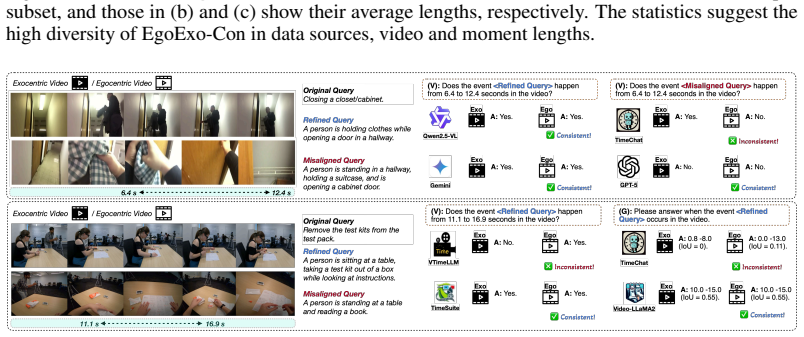
Summary. The paper introduces EgoExo-Con, a benchmark of 491 synchronized egocentric/exocentric video pairs and 3,178 temporal event queries derived from CharadesEgo, EgoExo-4D, and LEMMA. It defines temporal verification and temporal grounding tasks, plus consistency metrics that require a model to answer correctly on both views of the same event. The paper reports that current Video-LLMs achieve cross-view consistency scores that are roughly half of their single-view scores, that naive multi-view supervised fine-tuning often underperforms single-view fine-tuning, and that a proposed method, View-GRPO (a GRPO variant with an additional LLM-judge-based reasoning reward and GPT-5-generated reasoning chains), improves both single-view and cross-view performance on Qwen2.5-VL 3B/7B. The benchmark, analysis, and method are presented as a package.
Significance. If the benchmark's assumptions hold, EgoExo-Con fills a real gap: it measures whether Video-LLMs rely on view-specific appearance cues rather than view-invariant temporal structure. The finding that consistency is much lower than single-view accuracy is falsifiable and consistent across a wide panel of open- and closed-source models. The human validation of samples, the inclusion of a random baseline, and the release of resources are concrete strengths. View-GRPO is also a plausible method contribution, though its gains rest on a single training run and an uncalibrated LLM judge. The core results are interesting and likely useful to the community, but the validity of the central consistency claim depends on a cross-view temporal-alignment assumption that is not yet quantitatively validated.
major comments (3)
- [§3.2 and §4.1] The consistency metric V-EgoExo/G-EgoExo requires one and the same ground-truth (start, end) interval to be correct in both the ego and exo video. The dataset construction (�3.2) reports human validation that queries are visible and accurately grounded in both views, but it does not report inter-annotator agreement on timestamps, nor an alignment-error analysis between the two views. Viewpoint-dependent occlusion can make the perceived onset/offset of the same physical event differ between cameras, so a model that correctly localizes the event in each view individually could be scored as inconsistent. The human grounding consistency of 67.3% vs. single-view grounding of about 72-73% (Table 1) suggests that some interval ambiguity exists even for humans. Without a per-view ground-truth interval or a quantitative alignment-error measurement, the magnitude of the reported consistency defici
- [Table 3] All View-GRPO gains (e.g., +11.7 points on V-ExoEgo and +11.4 on G-ExoEgo for Qwen2.5-VL-7B) are reported as single-run point estimates with no error bars, multiple seeds, or significance tests. Because GRPO training is stochastic and the training set is relatively small (3.3k videos), the claimed superiority of View-GRPO over SFT and basic GRPO could be within run-to-run noise. The paper should report at least 2-3 seeds with mean/std for the main comparisons, or otherwise provide a stability analysis of the RL training.
- [§4.2, Table 1] Closed-source models (GPT-5, Gemini-2.5 Flash) and human performance are evaluated only on a randomly sampled ~30% subset, while open-source models are evaluated on the full EgoExo-Con. The table compares these numbers directly. If the 30% subset is not exactly matched in difficulty, the reported 'gap' between closed-source models and open-source models, and between models and humans, is confounded. Please report open-source model performance on the same 30% subset, or evaluate all models on the full set, for fair comparison.
minor comments (5)
- [§4.1] The consistency metric definition states "i.e., IoU<0.5" but the surrounding text and the grounding definition imply the correct condition should be IoU >= 0.5. Please fix this typo.
- [Table 1] Some cells are poorly formatted, e.g., "28.227.3" and "42.127.8" should be separated into two numbers. Similar issues appear in Table 5.
- [§5.2 and Appendix B.3] The View30K size is inconsistent: §5.2 says 30k reasoning instances, while Appendix B.3 says 61k reasoning per task. Please clarify whether the numbers refer to different filtering stages or tasks.
- [References] Duplicate references for Feng et al. (2025a/2025b) and Grauman et al. (2024a/2024b) should be consolidated.
- [§4.2, point (5)] The claim that "temporal reasoning outweighs increasing frames" is based on comparing different model architectures, training data, and frame counts, not a controlled ablation. Please soften the wording or add a controlled experiment.
Circularity Check
Benchmark is an external measurement; only minor non-load-bearing self-citation in prompt sourcing.
specific steps
-
other
[Appendix B.1, Prompt Templates]
"following the previous work (Jung et al., 2025b), we also include templates like ... we borrow the prompts from the previous work (Jung et al., 2025b) for the general-purpose models and closed-sourced models"
The authors reuse prompt templates from their own earlier paper (TimeChat-VT, Jung et al. 2025b). This is a self-citation, but it is not load-bearing for the central claims: the benchmark results and View-GRPO improvements are empirical measurements on a newly constructed test set, and the reused prompts do not define the consistency metrics or the RL objective. At most it introduces a small prompt-design choice inherited from prior work, which does not make the main derivation circular.
full rationale
The paper's central derivation chain is empirical, not analytic. EgoExo-Con is a newly constructed benchmark with human-refined queries and synchronized ego-exo pairs. The headline findings—that Video-LLMs are less consistent across views than within a single view, and that naive multi-view SFT underperforms single-view training—are read directly from Tables 1 and 2. The consistency metrics (V-EgoExo, G-EgoExo) are defined as requiring correct answers in both views; they are measurements, not quantities fitted from model outputs. View-GRPO is trained on View30K with rewards for format, accuracy, and reasoning-similarity, and then evaluated on EgoExo-Con; the reported improvements are empirical outcomes, not consequences of defining the evaluation metric in terms of the training objective. The only self-citation in a position to influence results is the reuse of prompt templates from Jung et al. 2025b (TimeChat-VT) for baseline evaluation. That is a minor methodological inheritance, not a reduction of the paper's claims to its inputs. No equation is shown to equal itself by construction, no fitted parameter is renamed as a prediction, and no uniqueness or ansatz is imported from the authors' prior work. The benchmark is externally grounded in CharadesEgo, LEMMA, and Ego-Exo4D, and the human-consistency reference provides an independent upper bound. Overall, the derivation is self-contained; the small self-citation does not affect the validity of the main findings.
Axiom & Free-Parameter Ledger
free parameters (3)
- tIoU filter threshold for View30K reasoning data =
0.7
- reward weights for r_acc, r_form, r_sim =
1, 1, 1 (equal)
- frame sampling rate for View-GRPO training =
2 FPS
axioms (5)
- domain assumption Synchronized ego-exo pairs depict the same event with a shared temporal interval valid in both views
- domain assumption Current Video-LLM temporal reasoning, not low-level appearance differences or annotation noise, is the main driver of cross-view inconsistency
- domain assumption GPT-4o/GPT-5 generated queries and reasoning chains are faithful enough after human filtering
- ad hoc to paper LLM-judge similarity score r_sim is a valid training reward for temporal reasoning
- domain assumption Long videos can be segmented into clips surrounding ground-truth moments without changing the temporal understanding question
read the original abstract
Do Video-LLMs have consistent temporal understanding when videos capture the same event from different viewpoints? To study this question, we introduce EgoExo-Con(sistency), a benchmark of synchronized egocentric and exocentric video pairs with human-refined queries that ensure all concepts are visible in both viewpoints. EgoExo-Con emphasizes two temporal understanding tasks: Temporal Verification and Temporal Grounding. It evaluates not only correctness but consistency across viewpoints. Our analysis reveals two critical limitations of existing Video-LLMs: (1) models often fail to maintain consistency, with results far worse than their single-view performances. (2) When naively finetuned with synchronized videos of both viewpoints, the models show improved consistency but often underperform those trained on a single view. For improvements, we propose View-GRPO, a novel reinforcement learning framework that effectively strengthens view-specific temporal reasoning while encouraging consistent comprehension across viewpoints. Our method demonstrates its superior temporal understanding capabilities, especially for improving cross-view consistency. All resources have been made available at https://minjoong507.github.io/projects/EgoExo-Con/
Figures




Forward citations
Cited by 5 Pith papers
-
EgoExoMem: Cross-View Memory Reasoning over Synchronized Egocentric and Exocentric Videos
EgoExoMem is the first benchmark for cross-view memory reasoning on synchronized egocentric-exocentric videos, where E2-Select raises MLLM accuracy from 55.3% to 58.2% over baselines.
-
Seeing Together: Multi-Robot Cooperative Egocentric Spatial Reasoning with Multimodal Large Language Models
SP-CoR is a multimodal LLM framework using dynamics-aware sampling, spectral-physics view fusion, and prompt distillation that outperforms baselines on the new CoopSR benchmark and EgoTeam dataset for multi-robot coop...
-
EvoGround: Self-Evolving Video Agents for Video Temporal Grounding
A proposer-solver agent pair achieves supervised-level video temporal grounding and fine-grained captioning from 2.5K unlabeled videos via self-reinforcing evolution.
-
EgoVITA: Learning to Plan and Verify for Egocentric Video Reasoning
EgoVITA, a GRPO-based plan-then-verify framework with dense visual-grounding rewards, improves egocentric video reasoning by up to +7.7 points and keeps exocentric video performance intact.
-
EgoExoMem: Cross-View Memory Reasoning over Synchronized Egocentric and Exocentric Videos
EgoExoMem introduces the first cross-view ego–exo video memory benchmark (2.6K MCQs, eight QA types) and E²-Select, a training-free dual-view frame selector scoring 58.2%.
Reference graph
Works this paper leans on
-
[1]
write newline
" write newline "" before.all 'output.state := FUNCTION n.dashify 't := "" t empty not t #1 #1 substring "-" = t #1 #2 substring "--" = not "--" * t #2 global.max substring 't := t #1 #1 substring "-" = "-" * t #2 global.max substring 't := while if t #1 #1 substring * t #2 global.max substring 't := if while FUNCTION format.date year duplicate empty "emp...
-
[2]
Josh Achiam, Steven Adler, Sandhini Agarwal, Lama Ahmad, Ilge Akkaya, Florencia Leoni Aleman, Diogo Almeida, Janko Altenschmidt, Sam Altman, Shyamal Anadkat, et al. Gpt-4 technical report. arXiv preprint arXiv:2303.08774, 2023
Pith/arXiv arXiv 2023
-
[3]
Shuai Bai, Keqin Chen, Xuejing Liu, Jialin Wang, Wenbin Ge, Sibo Song, Kai Dang, Peng Wang, Shijie Wang, Jun Tang, et al. Qwen2. 5-vl technical report. arXiv preprint arXiv:2502.13923, 2025
Pith/arXiv arXiv 2025
-
[4]
Egothink: Evaluating first-person perspective thinking capability of vision-language models
Sijie Cheng, Zhicheng Guo, Jingwen Wu, Kechen Fang, Peng Li, Huaping Liu, and Yang Liu. Egothink: Evaluating first-person perspective thinking capability of vision-language models. In Proceedings of the IEEE/CVF Conference on Computer Vision and Pattern Recognition, pp.\ 14291--14302, 2024 a
2024
-
[5]
Videollama 2: Advancing spatial-temporal modeling and audio understanding in video-llms
Zesen Cheng, Sicong Leng, Hang Zhang, Yifei Xin, Xin Li, Guanzheng Chen, Yongxin Zhu, Wenqi Zhang, Ziyang Luo, Deli Zhao, et al. Videollama 2: Advancing spatial-temporal modeling and audio understanding in video-llms. arXiv preprint arXiv:2406.07476, 2024 b
Pith/arXiv arXiv 2024
-
[6]
Gheorghe Comanici, Eric Bieber, Mike Schaekermann, Ice Pasupat, Noveen Sachdeva, Inderjit Dhillon, Marcel Blistein, Ori Ram, Dan Zhang, Evan Rosen, et al. Gemini 2.5: Pushing the frontier with advanced reasoning, multimodality, long context, and next generation agentic capabilities. arXiv preprint arXiv:2507.06261, 2025
Pith/arXiv arXiv 2025
-
[7]
Lost in time: A new temporal benchmark for videollms
Daniel Cores, Michael Dorkenwald, Manuel Mucientes, Cees GM Snoek, and Yuki M Asano. Lost in time: A new temporal benchmark for videollms. arXiv preprint arXiv:2410.07752, 2024
Pith/arXiv arXiv 2024
-
[8]
Grounded question-answering in long egocentric videos
Shangzhe Di and Weidi Xie. Grounded question-answering in long egocentric videos. In Proceedings of the IEEE/CVF Conference on Computer Vision and Pattern Recognition, pp.\ 12934--12943, 2024
2024
-
[10]
Video-r1: Reinforcing video reasoning in mllms
Kaituo Feng, Kaixiong Gong, Bohao Li, Zonghao Guo, Yibing Wang, Tianshuo Peng, Junfei Wu, Xiaoying Zhang, Benyou Wang, and Xiangyu Yue. Video-r1: Reinforcing video reasoning in mllms. arXiv preprint arXiv:2503.21776, 2025 b
Pith/arXiv arXiv 2025
-
[11]
Video-mme: The first-ever comprehensive evaluation benchmark of multi-modal llms in video analysis
Chaoyou Fu, Yuhan Dai, Yongdong Luo, Lei Li, Shuhuai Ren, Renrui Zhang, Zihan Wang, Chenyu Zhou, Yunhang Shen, Mengdan Zhang, et al. Video-mme: The first-ever comprehensive evaluation benchmark of multi-modal llms in video analysis. arXiv preprint arXiv:2405.21075, 2024
Pith/arXiv arXiv 2024
-
[12]
Tall: Temporal activity localization via language query
Jiyang Gao, Chen Sun, Zhenheng Yang, and Ram Nevatia. Tall: Temporal activity localization via language query. In Proceedings of the IEEE international conference on computer vision, pp.\ 5267--5275, 2017
2017
-
[13]
Aaron Grattafiori, Abhimanyu Dubey, Abhinav Jauhri, Abhinav Pandey, Abhishek Kadian, Ahmad Al-Dahle, Aiesha Letman, Akhil Mathur, Alan Schelten, Alex Vaughan, et al. The llama 3 herd of models. arXiv preprint arXiv:2407.21783, 2024
Pith/arXiv arXiv 2024
-
[14]
Ego-exo4d: Understanding skilled human activity from first-and third-person perspectives
Kristen Grauman, Andrew Westbury, Lorenzo Torresani, Kris Kitani, Jitendra Malik, Triantafyllos Afouras, Kumar Ashutosh, Vijay Baiyya, Siddhant Bansal, Bikram Boote, et al. Ego-exo4d: Understanding skilled human activity from first-and third-person perspectives. In Proceedings of the IEEE/CVF Conference on Computer Vision and Pattern Recognition, pp.\ 193...
2024
-
[15]
Ego-exo4d: Understanding skilled human activity from first-and third-person perspectives
Kristen Grauman, Andrew Westbury, Lorenzo Torresani, Kris Kitani, Jitendra Malik, Triantafyllos Afouras, Kumar Ashutosh, Vijay Baiyya, Siddhant Bansal, Bikram Boote, et al. Ego-exo4d: Understanding skilled human activity from first-and third-person perspectives. In Proceedings of the IEEE/CVF Conference on Computer Vision and Pattern Recognition, pp.\ 193...
2024
-
[16]
Vtg-llm: Integrating timestamp knowledge into video llms for enhanced video temporal grounding
Yongxin Guo, Jingyu Liu, Mingda Li, Xiaoying Tang, Xi Chen, and Bo Zhao. Vtg-llm: Integrating timestamp knowledge into video llms for enhanced video temporal grounding. arXiv preprint arXiv:2405.13382, 2024
Pith/arXiv arXiv 2024
-
[17]
Egoexobench: A benchmark for first-and third-person view video understanding in mllms
Yuping He, Yifei Huang, Guo Chen, Baoqi Pei, Jilan Xu, Tong Lu, and Jiangmiao Pang. Egoexobench: A benchmark for first-and third-person view video understanding in mllms. arXiv preprint arXiv:2507.18342, 2025
Pith/arXiv arXiv 2025
-
[18]
Lora: Low-rank adaptation of large language models
Edward J Hu, Yelong Shen, Phillip Wallis, Zeyuan Allen-Zhu, Yuanzhi Li, Shean Wang, Lu Wang, Weizhu Chen, et al. Lora: Low-rank adaptation of large language models. ICLR, 2022
2022
-
[19]
Vtimellm: Empower llm to grasp video moments
Bin Huang, Xin Wang, Hong Chen, Zihan Song, and Wenwu Zhu. Vtimellm: Empower llm to grasp video moments. In Proceedings of the IEEE/CVF Conference on Computer Vision and Pattern Recognition, pp.\ 14271--14280, 2024
2024
-
[20]
Lemma: A multi-view dataset for le arning m ulti-agent m ulti-task a ctivities
Baoxiong Jia, Yixin Chen, Siyuan Huang, Yixin Zhu, and Song-Chun Zhu. Lemma: A multi-view dataset for le arning m ulti-agent m ulti-task a ctivities. In European Conference on Computer Vision, pp.\ 767--786. Springer, 2020
2020
-
[21]
Background-aware moment detection for video moment retrieval
Minjoon Jung, Youwon Jang, Seongho Choi, Joochan Kim, Jin-Hwa Kim, and Byoung-Tak Zhang. Background-aware moment detection for video moment retrieval. In Proceedings of the Winter Conference on Applications of Computer Vision, pp.\ 8575--8585, February 2025 a
2025
-
[22]
On the consistency of video large language models in temporal comprehension
Minjoon Jung, Junbin Xiao, Byoung-Tak Zhang, and Angela Yao. On the consistency of video large language models in temporal comprehension. In Proceedings of the Computer Vision and Pattern Recognition Conference, pp.\ 13713--13722, 2025 b
2025
-
[23]
Mvbench: A comprehensive multi-modal video understanding benchmark
Kunchang Li, Yali Wang, Yinan He, Yizhuo Li, Yi Wang, Yi Liu, Zun Wang, Jilan Xu, Guo Chen, Ping Luo, et al. Mvbench: A comprehensive multi-modal video understanding benchmark. In Proceedings of the IEEE/CVF Conference on Computer Vision and Pattern Recognition, pp.\ 22195--22206, 2024 a
2024
-
[24]
Ego-exo: Transferring visual representations from third-person to first-person videos
Yanghao Li, Tushar Nagarajan, Bo Xiong, and Kristen Grauman. Ego-exo: Transferring visual representations from third-person to first-person videos. In Proceedings of the IEEE/CVF Conference on Computer Vision and Pattern Recognition, pp.\ 6943--6953, 2021
2021
-
[25]
Egoexo-fitness: Towards egocentric and exocentric full-body action understanding
Yuan-Ming Li, Wei-Jin Huang, An-Lan Wang, Ling-An Zeng, Jing-Ke Meng, and Wei-Shi Zheng. Egoexo-fitness: Towards egocentric and exocentric full-body action understanding. In European Conference on Computer Vision, pp.\ 363--382. Springer, 2024 b
2024
-
[26]
Universal video temporal grounding with generative multi-modal large language models
Zeqian Li, Shangzhe Di, Zhonghua Zhai, Weilin Huang, Yanfeng Wang, and Weidi Xie. Universal video temporal grounding with generative multi-modal large language models. arXiv preprint arXiv:2506.18883, 2025
arXiv 2025
-
[27]
Improved visual-spatial reasoning via r1-zero-like training
Zhenyi Liao, Qingsong Xie, Yanhao Zhang, Zijian Kong, Haonan Lu, Zhenyu Yang, and Zhijie Deng. Improved visual-spatial reasoning via r1-zero-like training. arXiv preprint arXiv:2504.00883, 2025
Pith/arXiv arXiv 2025
-
[28]
Is your video language model a reliable judge? arXiv preprint arXiv:2503.05977, 2025
Ming Liu and Wensheng Zhang. Is your video language model a reliable judge? arXiv preprint arXiv:2503.05977, 2025
Pith/arXiv arXiv 2025
-
[29]
Put myself in your shoes: Lifting the egocentric perspective from exocentric videos
Mi Luo, Zihui Xue, Alex Dimakis, and Kristen Grauman. Put myself in your shoes: Lifting the egocentric perspective from exocentric videos. In European Conference on Computer Vision, pp.\ 407--425. Springer, 2024
2024
-
[30]
Viewpoint rosetta stone: Unlocking unpaired ego-exo videos for view-invariant representation learning
Mi Luo, Zihui Xue, Alex Dimakis, and Kristen Grauman. Viewpoint rosetta stone: Unlocking unpaired ego-exo videos for view-invariant representation learning. In Proceedings of the Computer Vision and Pattern Recognition Conference, pp.\ 15802--15812, 2025
2025
-
[31]
Egoschema: A diagnostic benchmark for very long-form video language understanding
Karttikeya Mangalam, Raiymbek Akshulakov, and Jitendra Malik. Egoschema: A diagnostic benchmark for very long-form video language understanding. Advances in Neural Information Processing Systems, 36: 0 46212--46244, 2023
2023
-
[32]
Chrono: A simple blueprint for representing time in mllms
Boris Meinardus, Hector Rodriguez, Anil Batra, Anna Rohrbach, and Marcus Rohrbach. Chrono: A simple blueprint for representing time in mllms. arXiv preprint arXiv:2406.18113, 2024
arXiv 2024
-
[33]
Introducing gpt-5
OpenAI. Introducing gpt-5. 2025
2025
-
[34]
Egoexor: An ego-exo-centric operating room dataset for surgical activity understanding
Ege \"O zsoy, Arda Mamur, Felix Tristram, Chantal Pellegrini, Magdalena Wysocki, Benjamin Busam, and Nassir Navab. Egoexor: An ego-exo-centric operating room dataset for surgical activity understanding. arXiv preprint arXiv:2505.24287, 2025
Pith/arXiv arXiv 2025
-
[35]
Momentor: Advancing video large language model with fine-grained temporal reasoning
Long Qian, Juncheng Li, Yu Wu, Yaobo Ye, Hao Fei, Tat-Seng Chua, Yueting Zhuang, and Siliang Tang. Momentor: Advancing video large language model with fine-grained temporal reasoning. arXiv preprint arXiv:2402.11435, 2024
Pith/arXiv arXiv 2024
-
[36]
A Yang Qwen, Baosong Yang, B Zhang, B Hui, B Zheng, B Yu, Chengpeng Li, D Liu, F Huang, H Wei, et al. Qwen2. 5 technical report. arXiv preprint, 2024
2024
-
[37]
Timechat: A time-sensitive multimodal large language model for long video understanding
Shuhuai Ren, Linli Yao, Shicheng Li, Xu Sun, and Lu Hou. Timechat: A time-sensitive multimodal large language model for long video understanding. In Proceedings of the IEEE/CVF Conference on Computer Vision and Pattern Recognition, pp.\ 14313--14323, 2024
2024
-
[38]
Assembly101: A large-scale multi-view video dataset for understanding procedural activities
Fadime Sener, Dibyadip Chatterjee, Daniel Shelepov, Kun He, Dipika Singhania, Robert Wang, and Angela Yao. Assembly101: A large-scale multi-view video dataset for understanding procedural activities. In Proceedings of the IEEE/CVF Conference on Computer Vision and Pattern Recognition, pp.\ 21096--21106, 2022
2022
-
[39]
Deepseekmath: Pushing the limits of mathematical reasoning in open language models
Zhihong Shao, Peiyi Wang, Qihao Zhu, Runxin Xu, Junxiao Song, Xiao Bi, Haowei Zhang, Mingchuan Zhang, YK Li, Yang Wu, et al. Deepseekmath: Pushing the limits of mathematical reasoning in open language models. arXiv preprint arXiv:2402.03300, 2024
Pith/arXiv arXiv 2024
-
[40]
Longvu: Spatiotemporal adaptive compression for long video-language understanding
Xiaoqian Shen, Yunyang Xiong, Changsheng Zhao, Lemeng Wu, Jun Chen, Chenchen Zhu, Zechun Liu, Fanyi Xiao, Balakrishnan Varadarajan, Florian Bordes, et al. Longvu: Spatiotemporal adaptive compression for long video-language understanding. arXiv preprint arXiv:2410.17434, 2024
Pith/arXiv arXiv 2024
-
[41]
Actor and observer: Joint modeling of first and third-person videos
Gunnar A Sigurdsson, Abhinav Gupta, Cordelia Schmid, Ali Farhadi, and Karteek Alahari. Actor and observer: Joint modeling of first and third-person videos. In proceedings of the IEEE conference on computer vision and pattern recognition, pp.\ 7396--7404, 2018
2018
-
[42]
Learning from semantic alignment between unpaired multiviews for egocentric video recognition
Qitong Wang, Long Zhao, Liangzhe Yuan, Ting Liu, and Xi Peng. Learning from semantic alignment between unpaired multiviews for egocentric video recognition. In Proceedings of the IEEE/CVF International Conference on Computer Vision, pp.\ 3307--3317, 2023
2023
-
[43]
Weiyun Wang, Zhangwei Gao, Lixin Gu, Hengjun Pu, Long Cui, Xingguang Wei, Zhaoyang Liu, Linglin Jing, Shenglong Ye, Jie Shao, et al. Internvl3. 5: Advancing open-source multimodal models in versatility, reasoning, and efficiency. arXiv preprint arXiv:2508.18265, 2025 a
Pith/arXiv arXiv 2025
-
[44]
Videoagent: Long-form video understanding with large language model as agent
Xiaohan Wang, Yuhui Zhang, Orr Zohar, and Serena Yeung-Levy. Videoagent: Long-form video understanding with large language model as agent. arXiv preprint arXiv:2403.10517, 2024 a
Pith/arXiv arXiv 2024
-
[45]
Time-r1: Post-training large vision language model for temporal video grounding
Ye Wang, Ziheng Wang, Boshen Xu, Yang Du, Kejun Lin, Zihan Xiao, Zihao Yue, Jianzhong Ju, Liang Zhang, Dingyi Yang, et al. Time-r1: Post-training large vision language model for temporal video grounding. arXiv preprint arXiv:2503.13377, 2025 b
Pith/arXiv arXiv 2025
-
[46]
Yi Wang, Xinhao Li, Ziang Yan, Yinan He, Jiashuo Yu, Xiangyu Zeng, Chenting Wang, Changlian Ma, Haian Huang, Jianfei Gao, et al. Internvideo2. 5: Empowering video mllms with long and rich context modeling. arXiv preprint arXiv:2501.12386, 2025 c
Pith/arXiv arXiv 2025
-
[47]
Hawkeye: Training video-text llms for grounding text in videos
Yueqian Wang, Xiaojun Meng, Jianxin Liang, Yuxuan Wang, Qun Liu, and Dongyan Zhao. Hawkeye: Training video-text llms for grounding text in videos. arXiv preprint arXiv:2403.10228, 2024 b
Pith/arXiv arXiv 2024
-
[48]
Longvideobench: A benchmark for long-context interleaved video-language understanding
Haoning Wu, Dongxu Li, Bei Chen, and Junnan Li. Longvideobench: A benchmark for long-context interleaved video-language understanding. Advances in Neural Information Processing Systems, 37: 0 28828--28857, 2024
2024
-
[49]
Next-qa: Next phase of question-answering to explaining temporal actions
Junbin Xiao, Xindi Shang, Angela Yao, and Tat-Seng Chua. Next-qa: Next phase of question-answering to explaining temporal actions. In Proceedings of the IEEE/CVF conference on computer vision and pattern recognition, pp.\ 9777--9786, 2021
2021
-
[50]
Can i trust your answer? visually grounded video question answering
Junbin Xiao, Angela Yao, Yicong Li, and Tat-Seng Chua. Can i trust your answer? visually grounded video question answering. In Proceedings of the IEEE/CVF Conference on Computer Vision and Pattern Recognition, pp.\ 13204--13214, 2024
2024
-
[51]
Egoblind: Towards egocentric visual assistance for the blind people
Junbin Xiao, Nanxin Huang, Hao Qiu, Zhulin Tao, Xun Yang, Richang Hong, Meng Wang, and Angela Yao. Egoblind: Towards egocentric visual assistance for the blind people. arXiv preprint arXiv:2503.08221, 2025
arXiv 2025
-
[52]
Text2reward: Reward shaping with language models for reinforcement learning
Tianbao Xie, Siheng Zhao, Chen Henry Wu, Yitao Liu, Qian Luo, Victor Zhong, Yanchao Yang, and Tao Yu. Text2reward: Reward shaping with language models for reinforcement learning. arXiv preprint arXiv:2309.11489, 2023
Pith/arXiv arXiv 2023
-
[53]
Video question answering via gradually refined attention over appearance and motion
Dejing Xu, Zhou Zhao, Jun Xiao, Fei Wu, Hanwang Zhang, Xiangnan He, and Yueting Zhuang. Video question answering via gradually refined attention over appearance and motion. In Proceedings of the 25th ACM international conference on Multimedia, pp.\ 1645--1653, 2017
2017
-
[54]
Learning fine-grained view-invariant representations from unpaired ego-exo videos via temporal alignment
Zihui Sherry Xue and Kristen Grauman. Learning fine-grained view-invariant representations from unpaired ego-exo videos via temporal alignment. Advances in Neural Information Processing Systems, 36: 0 53688--53710, 2023
2023
-
[55]
An Yang, Anfeng Li, Baosong Yang, Beichen Zhang, Binyuan Hui, Bo Zheng, Bowen Yu, Chang Gao, Chengen Huang, Chenxu Lv, et al. Qwen3 technical report. arXiv preprint arXiv:2505.09388, 2025
Pith/arXiv arXiv 2025
-
[56]
Mmego: Towards building egocentric multimodal llms for video qa
Hanrong Ye, Haotian Zhang, Erik Daxberger, Lin Chen, Zongyu Lin, Yanghao Li, Bowen Zhang, Haoxuan You, Dan Xu, Zhe Gan, et al. Mmego: Towards building egocentric multimodal llms for video qa. In The Thirteenth International Conference on Learning Representations, 2015
2015
-
[57]
Activitynet-qa: A dataset for understanding complex web videos via question answering
Zhou Yu, Dejing Xu, Jun Yu, Ting Yu, Zhou Zhao, Yueting Zhuang, and Dacheng Tao. Activitynet-qa: A dataset for understanding complex web videos via question answering. In Proceedings of the AAAI Conference on Artificial Intelligence, 2019
2019
-
[58]
Timesuite: Improving mllms for long video understanding via grounded tuning
Xiangyu Zeng, Kunchang Li, Chenting Wang, Xinhao Li, Tianxiang Jiang, Ziang Yan, Songze Li, Yansong Shi, Zhengrong Yue, Yi Wang, et al. Timesuite: Improving mllms for long video understanding via grounded tuning. arXiv preprint arXiv:2410.19702, 2024
Pith/arXiv arXiv 2024
-
[59]
Videollama 3: Frontier multimodal foundation models for image and video understanding
Boqiang Zhang, Kehan Li, Zesen Cheng, Zhiqiang Hu, Yuqian Yuan, Guanzheng Chen, Sicong Leng, Yuming Jiang, Hang Zhang, Xin Li, et al. Videollama 3: Frontier multimodal foundation models for image and video understanding. arXiv preprint arXiv:2501.13106, 2025 a
Pith/arXiv arXiv 2025
-
[60]
Exo2ego: Exocentric knowledge guided mllm for egocentric video understanding
Haoyu Zhang, Qiaohui Chu, Meng Liu, Yunxiao Wang, Bin Wen, Fan Yang, Tingting Gao, Di Zhang, Yaowei Wang, and Liqiang Nie. Exo2ego: Exocentric knowledge guided mllm for egocentric video understanding. arXiv preprint arXiv:2503.09143, 2025 b
arXiv 2025
-
[61]
Long context transfer from language to vision
Peiyuan Zhang, Kaichen Zhang, Bo Li, Guangtao Zeng, Jingkang Yang, Yuanhan Zhang, Ziyue Wang, Haoran Tan, Chunyuan Li, and Ziwei Liu. Long context transfer from language to vision. arXiv preprint arXiv:2406.16852, 2024 a
Pith/arXiv arXiv 2024
-
[62]
Tinyllava-video-r1: Towards smaller lmms for video reasoning
Xingjian Zhang, Siwei Wen, Wenjun Wu, and Lei Huang. Tinyllava-video-r1: Towards smaller lmms for video reasoning. arXiv preprint arXiv:2504.09641, 2025 c
Pith/arXiv arXiv 2025
-
[63]
Video instruction tuning with synthetic data
Yuanhan Zhang, Jinming Wu, Wei Li, Bo Li, Zejun Ma, Ziwei Liu, and Chunyuan Li. Video instruction tuning with synthetic data. arXiv preprint arXiv:2410.02713, 2024 b
Pith/arXiv arXiv 2024
-
[64]
Judging llm-as-a-judge with mt-bench and chatbot arena
Lianmin Zheng, Wei-Lin Chiang, Ying Sheng, Siyuan Zhuang, Zhanghao Wu, Yonghao Zhuang, Zi Lin, Zhuohan Li, Dacheng Li, Eric Xing, et al. Judging llm-as-a-judge with mt-bench and chatbot arena. Advances in neural information processing systems, 36: 0 46595--46623, 2023
2023
-
[65]
Mlvu: Benchmarking multi-task long video understanding
Junjie Zhou, Yan Shu, Bo Zhao, Boya Wu, Zhengyang Liang, Shitao Xiao, Minghao Qin, Xi Yang, Yongping Xiong, Bo Zhang, et al. Mlvu: Benchmarking multi-task long video understanding. In Proceedings of the Computer Vision and Pattern Recognition Conference, pp.\ 13691--13701, 2025
2025
discussion (0)
Sign in with ORCID, Apple, or X to comment. Anyone can read and Pith papers without signing in.