Improving Neutrino Oscillation Measurements through Event Classification
Pith reviewed 2026-05-17 21:33 UTC · model grok-4.3
The pith
Classifying neutrino events by interaction type before energy reconstruction improves oscillation accuracy and sensitivity by 10-20%.
A machine-rendered reading of the paper's core claim, the machinery that carries it, and where it could break.
Core claim
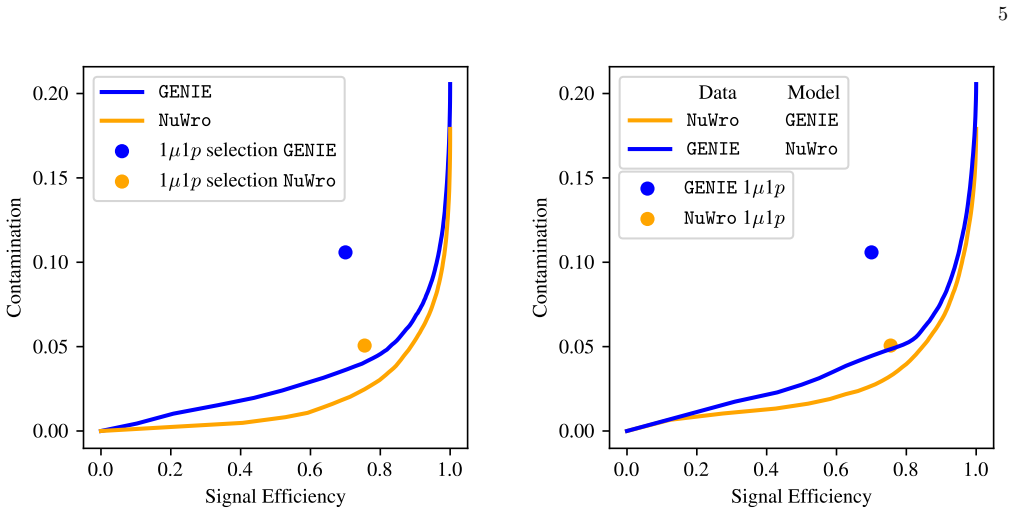
By classifying events according to their underlying interaction type prior to energy reconstruction, using supervised machine-learning techniques trained on labeled generator events, the method exploits intrinsic kinematic differences among quasi-elastic scattering, meson-exchange current, resonance production, and deep-inelastic scattering processes. A cross-generator testing framework shows the classification is robust to microphysics mismodeling. Applied to a simulated DUNE nu_mu disappearance analysis, the approach improves accuracy and sensitivity at the 10-20% level and highlights a practical path toward reducing reconstruction-driven systematics in future oscillation measurements.
What carries the argument
Supervised machine learning classifier trained on generator-labeled events to identify interaction channels from observable kinematics, applied before energy reconstruction.
If this is right
- The classification reduces reconstruction-driven systematics in neutrino oscillation analyses.
- Application to a DUNE nu_mu disappearance analysis produces 10-20% gains in accuracy and sensitivity.
- The method remains effective when tested across different event generators with mismatched microphysics.
- It offers a concrete technique for lowering interaction modeling uncertainties in next-generation long-baseline experiments.
Where Pith is reading between the lines
- The same classification step could be tested on data from other long-baseline or atmospheric neutrino detectors to check for similar gains.
- The approach might be combined with existing calorimetric or kinematic reconstruction methods to produce hybrid algorithms with still lower systematics.
- If the kinematic separation holds in real detector data, the technique could reduce reliance on detailed generator tuning in oscillation fits.
- Extending the classifier to neutral-current or electron-neutrino channels would test whether the same logic applies across different oscillation channels.
Load-bearing premise
A supervised machine learning model trained on events from one neutrino generator can accurately classify interaction types from kinematics and still deliver benefits when applied to events generated with different microphysics.
What would settle it
A side-by-side comparison of energy resolution and oscillation parameter uncertainties in independent DUNE simulations, one using the trained classifier and one using standard calorimetric reconstruction, with the test generator withheld from training.
Figures




read the original abstract
Precise neutrino energy reconstruction is essential for next-generation long-baseline oscillation experiments, yet current methods remain limited by large uncertainties in neutrino-nucleus interaction modeling. Even so, it is well established that different interaction channels produce systematically varying amounts of missing energy and therefore yield different reconstruction performance--information that standard calorimetric approaches do not exploit. We introduce a strategy that incorporates this structure by classifying events according to their underlying interaction type prior to energy reconstruction. Using supervised machine-learning techniques trained on labeled generator events, we leverage intrinsic kinematic differences among quasi-elastic scattering, meson-exchange current, resonance production, and deep-inelastic scattering processes. A cross-generator testing framework demonstrates that this classification approach is robust to microphysics mismodeling and, when applied to a simulated DUNE $\nu_\mu$ disappearance analysis, yields improved accuracy and sensitivity at the 10-20% level. These results highlight a practical path toward reducing reconstruction-driven systematics in future oscillation measurements.
Editorial analysis
A structured set of objections, weighed in public.
Referee Report
Summary. The paper proposes classifying neutrino interaction channels (QE, MEC, RES, DIS) via supervised ML on kinematic observables prior to energy reconstruction, exploiting channel-dependent missing energy. Cross-generator tests are used to argue robustness to microphysics mismodeling, and a simulated DUNE ν_μ disappearance analysis is reported to yield 10-20% gains in reconstruction accuracy and oscillation sensitivity.
Significance. If substantiated, the approach could reduce a key systematic in long-baseline oscillation measurements by incorporating interaction-channel structure that standard calorimetric methods ignore. The cross-generator validation is a constructive element that partially addresses model dependence, though the practical impact hinges on classification fidelity under realistic detector conditions and the breadth of nuclear-model variations tested.
major comments (2)
- [Cross-generator testing framework] Cross-generator testing framework: the robustness claim is load-bearing for the central result, yet the manuscript does not specify the nuclear-model and FSI differences between the generators employed; if the generators primarily vary parameters within similar impulse-approximation frameworks, the observed stability and 10-20% sensitivity gain may not generalize to realistic mismodeling.
- [DUNE ν_μ disappearance analysis] DUNE ν_μ disappearance analysis: the reported 10-20% improvement in accuracy and sensitivity lacks a full error budget that propagates classification uncertainties and possible post-selection biases; without this, it is unclear whether the gain survives when the classifier is applied to data rather than generator truth.
minor comments (2)
- [Abstract] Clarify the precise definition of 'accuracy' and 'sensitivity' used for the 10-20% figure (e.g., bias reduction versus uncertainty reduction on δ_CP or sin²θ₂₃).
- Provide the ML architecture, feature list, and training/validation split details to enable independent reproduction of the classification performance.
Simulated Author's Rebuttal
We thank the referee for their careful reading and constructive comments on our manuscript. We address each major comment below and have revised the manuscript to strengthen the presentation of our results.
read point-by-point responses
-
Referee: Cross-generator testing framework: the robustness claim is load-bearing for the central result, yet the manuscript does not specify the nuclear-model and FSI differences between the generators employed; if the generators primarily vary parameters within similar impulse-approximation frameworks, the observed stability and 10-20% sensitivity gain may not generalize to realistic mismodeling.
Authors: We agree that explicit specification of the nuclear-model and FSI differences is necessary to substantiate the robustness claim. In the revised manuscript we have added a new subsection detailing the generators employed, including their distinct treatments of two-particle-two-hole excitations, resonance production, and final-state interaction cascades. These differences extend beyond parameter variations within a single impulse-approximation framework, supporting the observed stability of the classification performance. revision: yes
-
Referee: DUNE ν_μ disappearance analysis: the reported 10-20% improvement in accuracy and sensitivity lacks a full error budget that propagates classification uncertainties and possible post-selection biases; without this, it is unclear whether the gain survives when the classifier is applied to data rather than generator truth.
Authors: We acknowledge that a complete error budget is required to evaluate the practical impact of the method. The revised manuscript now includes a propagation of the classifier output uncertainties into the oscillation fit and an explicit discussion of post-selection biases. While the analysis remains simulation-based with access to generator truth, we have added a dedicated paragraph outlining the steps needed for data-driven application and the associated additional validation. revision: yes
Circularity Check
No significant circularity; method validated via independent cross-generator testing
full rationale
The paper proposes training a supervised classifier on labeled events from neutrino generators to identify interaction channels (QE/MEC/RES/DIS) from kinematics, then applies the classifier to improve energy reconstruction in a simulated DUNE analysis. Validation occurs via cross-generator testing on a held-out generator, with performance gains measured directly on the simulated oscillation analysis. No load-bearing steps reduce by construction to self-definitions, fitted inputs renamed as predictions, or self-citation chains; the central claims rest on empirical performance differences between generators rather than internal tautologies. This structure is self-contained against external simulation benchmarks.
Axiom & Free-Parameter Ledger
axioms (2)
- domain assumption Neutrino interaction generators accurately model kinematic differences between channels for training purposes.
- domain assumption The classification can be performed based on observable kinematics without significant bias.
Reference graph
Works this paper leans on
-
[1]
For the mock data used as a proxy for exper- imental measurements, we assume sin 2 θ23 = 0 .45 and ∆m2 31 = 2 .4 × 10−3 eV2. We simulate an exposure of 480 kton-MW-years in neutrino mode (corresponding to, e.g., 10 years of DUNE running with a 40 kton detector fiducial mass and a beam power of 1.2 MW). The anal- ysis considers only νµ disappearance data a...
work page 2024
-
[2]
B. Abi et al. (DUNE), (2020), arXiv:2002.03005 [hep-ex]
-
[3]
Hyper-Kamiokande Design Report
K. Abe et al. (Hyper-Kamiokande), (2018), arXiv:1805.04163 [physics.ins-det]
work page internal anchor Pith review Pith/arXiv arXiv 2018
-
[4]
Understanding the energy resolution of liquid argon neutrino detectors
A. Friedland and S. W. Li, Phys. Rev. D 99, 036009 (2019), arXiv:1811.06159 [hep-ph]
work page internal anchor Pith review Pith/arXiv arXiv 2019
- [5]
-
[6]
A. M. Ankowski, P. Coloma, P. Huber, C. Mariani, and E. Vagnoni, Phys. Rev. D 92, 091301 (2015), arXiv:1507.08561 [hep-ph]
work page internal anchor Pith review Pith/arXiv arXiv 2015
- [7]
- [8]
-
[9]
NuSTEC White Paper: Status and Challenges of Neutrino-Nucleus Scattering
L. Alvarez-Ruso et al. (NuSTEC), Prog. Part. Nucl. Phys. 100, 1 (2018), arXiv:1706.03621 [hep-ph]
work page internal anchor Pith review Pith/arXiv arXiv 2018
- [10]
- [11]
-
[12]
E. D. Bloom and F. J. Gilman, Phys. Rev. Lett. 25, 1140 (1970)
work page 1970
- [13]
-
[14]
Modeling Deep Inelastic Cross Sections in the Few GeV Region
A. Bodek and U. K. Yang, Nucl. Phys. B Proc. Suppl. 112, 70 (2002), arXiv:hep-ex/0203009
work page internal anchor Pith review Pith/arXiv arXiv 2002
- [15]
-
[16]
A. M. Ankowski and J. T. Sobczyk, Phys. Rev. C 74, 054316 (2006), arXiv:nucl-th/0512004
work page internal anchor Pith review Pith/arXiv arXiv 2006
-
[17]
Unitary Isobar Model - MAID2007
D. Drechsel, S. S. Kamalov, and L. Tiator, Eur. Phys. J. A 34, 69 (2007), arXiv:0710.0306 [nucl-th]
work page internal anchor Pith review Pith/arXiv arXiv 2007
-
[18]
A. Bodek and U.-k. Yang, (2010), arXiv:1011.6592 [hep- ph]
work page internal anchor Pith review Pith/arXiv arXiv 2010
-
[19]
Nucleon resonances within a dynamical coupled-channels model of pi N and gamma N reactions
H. Kamano, S. X. Nakamura, T. S. H. Lee, and T. Sato, Phys. Rev. C 88, 035209 (2013), arXiv:1305.4351 [nucl- th]
work page internal anchor Pith review Pith/arXiv arXiv 2013
-
[20]
S. X. Nakamura, H. Kamano, and T. Sato, Phys. Rev. D 92, 074024 (2015), arXiv:1506.03403 [hep-ph]
work page internal anchor Pith review Pith/arXiv arXiv 2015
-
[21]
M. Kabirnezhad, Phys. Rev. D 97, 013002 (2018), arXiv:1711.02403 [hep-ph]
- [22]
-
[23]
The GENIE Neutrino Monte Carlo Generator
C. Andreopoulos et al., Nucl. Instrum. Meth. A 614, 87 (2010), arXiv:0905.2517 [hep-ph]
work page internal anchor Pith review Pith/arXiv arXiv 2010
- [24]
-
[25]
O. Buss, T. Gaitanos, K. Gallmeister, H. van Hees, M. Kaskulov, O. Lalakulich, A. B. Larionov, T. Leit- ner, J. Weil, and U. Mosel, Phys. Rept. 512, 1 (2012), arXiv:1106.1344 [hep-ph]
work page internal anchor Pith review Pith/arXiv arXiv 2012
- [26]
-
[27]
Neutrino-Induced Reactions on Nuclei
K. Gallmeister, U. Mosel, and J. Weil, Phys. Rev. C 94, 035502 (2016), arXiv:1605.09391 [nucl-th]
work page internal anchor Pith review Pith/arXiv arXiv 2016
-
[28]
J. Isaacson, W. I. Jay, A. Lovato, P. A. N. Machado, and N. Rocco, Phys. Rev. D 107, 033007 (2023), arXiv:2205.06378 [hep-ph]. 11
-
[29]
S. Yu, in Meeting of the Division of Particles and Fields of the American Physical Society (2019) arXiv:1910.06953 [physics.ins-det]
- [30]
-
[31]
A. Shmakov, A. Yankelevich, J. Bian, and P. Baldi (NOvA), (2023), arXiv:2303.06201 [cs.LG]
-
[32]
R. Abbasi et al. (IceCube), (2025), arXiv:2505.16777 [astro-ph.HE]
-
[33]
Improved Energy Reconstruction in NOvA with Regression Convolutional Neural Networks
P. Baldi, J. Bian, L. Hertel, and L. Li, Phys. Rev. D 99, 012011 (2019), arXiv:1811.04557 [physics.ins-det]
work page internal anchor Pith review Pith/arXiv arXiv 2019
-
[34]
M. A. Acero et al. (NOvA), Phys. Rev. D 98, 032012 (2018), arXiv:1806.00096 [hep-ex]
work page internal anchor Pith review Pith/arXiv arXiv 2018
-
[35]
Vinton, Measurement of muon neutrino disappearance with a NOvA experiment, Ph.D
L. Vinton, Measurement of muon neutrino disappearance with a NOvA experiment, Ph.D. thesis, Sussex U., Sussex U. (2018)
work page 2018
-
[36]
The GENIE Neutrino Monte Carlo Generator: Physics and User Manual
C. Andreopoulos, C. Barry, S. Dytman, H. Gallagher, T. Golan, R. Hatcher, G. Perdue, and J. Yarba, (2015), arXiv:1510.05494 [hep-ph]
work page internal anchor Pith review Pith/arXiv arXiv 2015
- [37]
-
[38]
Inclusive Charged--Current Neutrino--Nucleus Reactions
J. Nieves, I. Ruiz Simo, and M. J. Vicente Vacas, Phys. Rev. C 83, 045501 (2011), arXiv:1102.2777 [hep-ph]
work page internal anchor Pith review Pith/arXiv arXiv 2011
-
[39]
C. H. Llewellyn Smith, Phys. Rept. 3, 261 (1972)
work page 1972
-
[40]
M. Martini, M. Ericson, G. Chanfray, and J. Marteau, Phys. Rev. C 80, 065501 (2009), arXiv:0910.2622 [nucl- th]
work page internal anchor Pith review Pith/arXiv arXiv 2009
- [41]
-
[42]
M. A. Shifman, in 8th International Symposium on Heavy Flavor Physics, Vol. 3 (World Scientific, Singapore, 2000) pp. 1447–1494, arXiv:hep-ph/0009131
work page internal anchor Pith review Pith/arXiv arXiv 2000
-
[43]
I. I. Y. Bigi and N. Uraltsev, Int. J. Mod. Phys. A 16, 5201 (2001), arXiv:hep-ph/0106346
work page internal anchor Pith review Pith/arXiv arXiv 2001
-
[44]
Quark-hadron duality in electron scattering
W. Melnitchouk, R. Ent, and C. Keppel, Phys. Rept. 406, 127 (2005), arXiv:hep-ph/0501217
work page internal anchor Pith review Pith/arXiv arXiv 2005
-
[45]
Quark-hadron duality in neutrino scattering
O. Lalakulich, W. Melnitchouk, and E. A. Paschos, Phys. Rev. C 75, 015202 (2007), arXiv:hep-ph/0608058
work page internal anchor Pith review Pith/arXiv arXiv 2007
-
[46]
Quark--hadron duality in lepton scattering off nuclei
O. Lalakulich, N. Jachowicz, C. Praet, and J. Rycke- busch, Phys. Rev. C 79, 015206 (2009), arXiv:0808.0085 [nucl-th]
work page internal anchor Pith review Pith/arXiv arXiv 2009
-
[47]
Acciarriet al.(DUNE), (2015), arXiv:1512.06148 [physics.ins-det]
R. Acciarri et al. (DUNE), (2015), arXiv:1512.06148 [physics.ins-det]
-
[48]
A. Friedland and S. W. Li, Phys. Rev. D 102, 096005 (2020), arXiv:2007.13336 [hep-ph]
-
[49]
Acciarriet al.(MicroBooNE), JINST12, P02017 (2017), arXiv:1612.05824 [physics.ins-det]
R. Acciarri et al. (MicroBooNE), JINST 12, P02017 (2017), arXiv:1612.05824 [physics.ins-det]
-
[50]
Demonstration of MeV-Scale Physics in Liquid Argon Time Projection Chambers Using ArgoNeuT
R. Acciarri et al. (ArgoNeuT), Phys. Rev. D 99, 012002 (2019), arXiv:1810.06502 [hep-ex]
work page internal anchor Pith review Pith/arXiv arXiv 2019
-
[51]
B. Bhandari et al. (CAPTAIN), Phys. Rev. Lett. 123, 042502 (2019), arXiv:1903.05276 [hep-ex]
-
[52]
W. Castiglioni, W. Foreman, I. Lepetic, B. R. Little- john, M. Malaker, and A. Mastbaum, Phys. Rev. D 102, 092010 (2020), arXiv:2006.14675 [physics.ins-det]
-
[53]
S. Andringa et al. (ARTIE), Phys. Rev. C 108, L011601 (2023), arXiv:2212.05448 [nucl-ex]
-
[54]
S. Martynenko et al. (CAPTAIN), Phys. Rev. D 107, 072009 (2023), arXiv:2209.13488 [nucl-ex]
-
[55]
P. Abratenko et al. (MicroBooNE), Eur. Phys. J. C 84, 1052 (2024), arXiv:2406.10583 [hep-ex]
-
[56]
P. Abratenko et al. (MicroBooNE), Phys. Rev. D 102, 112013 (2020), arXiv:2010.02390 [hep-ex]
- [57]
-
[58]
G. E. Hinton, N. Srivastava, A. Krizhevsky, I. Sutskever, and R. R. Salakhutdinov, (2012), arXiv:1207.0580 [cs.NE]
work page internal anchor Pith review Pith/arXiv arXiv 2012
-
[59]
F. Pedregosa, G. Varoquaux, A. Gramfort, V. Michel, B. Thirion, O. Grisel, M. Blondel, P. Prettenhofer, R. Weiss, V. Dubourg, J. Vanderplas, A. Passos, D. Cour- napeau, M. Brucher, M. Perrot, and E. Duchesnay, Jour- nal of Machine Learning Research 12, 2825 (2011)
work page 2011
-
[60]
D. P. Kingma and J. Ba (2014) arXiv:1412.6980 [cs.LG]
work page internal anchor Pith review Pith/arXiv arXiv 2014
- [61]
-
[62]
P. Abratenko et al. (MicroBooNE), Phys. Rev. D 105, 112003 (2022), arXiv:2110.14080 [hep-ex]
- [63]
- [64]
-
[65]
G. Biau and E. Scornet, “A random forest guided tour,” (2015), arXiv:1511.05741 [math.ST]
work page internal anchor Pith review Pith/arXiv arXiv 2015
discussion (0)
Sign in with ORCID, Apple, or X to comment. Anyone can read and Pith papers without signing in.