Statistics Meet Systematics: Resolution of the Massive Early JWST Galaxy Tension
Pith reviewed 2026-05-17 21:38 UTC · model grok-4.3
The pith
Systematic uncertainties in stellar mass estimates from JWST data largely control and reduce the inferred star-formation efficiencies of early massive galaxies.
A machine-rendered reading of the paper's core claim, the machinery that carries it, and where it could break.
Core claim
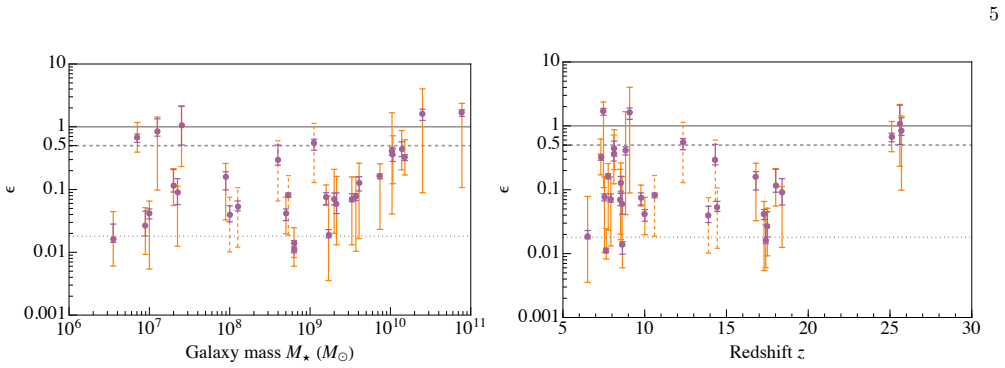
The paper claims that the star-formation efficiency inferred for the massive high-redshift galaxies detected by JWST is largely set by systematic uncertainties in stellar-mass estimates derived from spectral energy distribution modeling; because of the Eddington-like bias inherent in those uncertainties, the asymmetry of the scatter is amplified by orders of magnitude in some cases, bringing the efficiencies into agreement with the expectations of standard early galaxy formation models within Lambda-CDM.
What carries the argument
A galaxy model framework that connects the linear power spectrum to galaxy growth efficiencies while propagating observational sample variance, halo-mass-function scatter, and systematic stellar-mass uncertainties from spectral energy distribution fits.
If this is right
- The apparent tension with Lambda-CDM structure formation is resolved once the modeled uncertainties are included.
- Inferred efficiencies fall into the range predicted by standard galaxy formation models.
- The same uncertainty treatment can be applied to the inferred UV luminosity function at high redshift.
- As future observations reduce random and systematic errors, the framework provides a quantitative test of Lambda-CDM.
Where Pith is reading between the lines
- Spectroscopic follow-up that calibrates stellar mass systematics independently would either strengthen or refute the resolution of the tension.
- Similar Eddington-like bias effects may appear in other high-redshift observables that rely on steep selection functions.
- If the assumed magnitude of the systematics proves overstated, the need for revised galaxy-formation physics would return.
Load-bearing premise
The dominant systematic uncertainties in the stellar mass estimates must be both large enough and signed in the direction that amplifies the scatter asymmetry as modeled.
What would settle it
An independent calibration of stellar masses for the same JWST sample, for example through dynamical or lensing mass measurements, that yields systematic errors significantly smaller than or opposite in sign to those required by the model.
Figures
read the original abstract
The discovery of massive, high redshift galaxies with the James Webb Space Telescope (JWST) has been argued to challenge $\Lambda$CDM (cold dark matter): such systems would require extremely rare halos and baryon-to-stellar-mass conversion efficiencies unphysically approaching -- or exceeding -- $100\%$. If confirmed at galaxy-formation--forbidden efficiencies, these galaxies could signal new physics beyond standard cosmological structure formation. We develop a galaxy model framework that ties the linear power spectrum to the inferred efficiencies of galaxy growth while incorporating multiple sources of uncertainties in order to test the structure formation models. The sources of error include (i) observational sample variance, (ii) asymmetric scatter induced by the steepness of the high-mass halo tail, and (iii) systematic uncertainties in stellar mass estimates. We find that the inferred star-formation efficiency is largely controlled by systematic uncertainties in the stellar mass estimates derived from spectral energy distribution modeling of JWST-detected galaxies. Because of the inherent Eddington-like bias, systematic uncertainties amplify the asymmetry of the scatter, in some cases by orders of magnitude, thereby bringing the inferred efficiencies into closer agreement with expectations from early galaxy formation models. We also present how these uncertainties can be applied to the inferred UV luminosity function. Our framework can be used to test $\Lambda$CDM as errors are reduced and further detections are made.
Editorial analysis
A structured set of objections, weighed in public.
Referee Report
Summary. The paper develops a galaxy formation modeling framework that connects the linear power spectrum to inferred star-formation efficiencies while incorporating observational sample variance, asymmetric scatter from the steep high-mass end of the halo mass function, and systematic uncertainties in stellar-mass estimates derived from SED modeling of JWST-detected galaxies. The central result is that Eddington-like bias, when amplified by these systematics, can reduce the inferred efficiencies by orders of magnitude, bringing them into agreement with standard early-galaxy-formation expectations and thereby resolving the apparent tension with ΛCDM.
Significance. If the quantitative implementation holds, the work offers a statistically grounded resolution to the JWST massive-galaxy tension without new physics, by demonstrating how systematics can dominate over sample variance and halo-mass scatter. The framework is reusable for future data releases and provides a concrete way to propagate uncertainties into the UV luminosity function. Credit is due for the unified treatment of multiple error sources and the emphasis on falsifiable predictions as errors decrease.
major comments (2)
- [Modeling framework and results] The load-bearing claim that systematic offsets in log M_star from SED modeling are both large enough and correctly signed (biased high) to amplify scatter by orders of magnitude and reconcile efficiencies with models lacks an independent calibration from the JWST sample itself. No cross-check against dynamical masses, alternative SFH priors, or other observables is shown to anchor the magnitude and direction of the assumed systematics (see the modeling framework and results sections).
- [Error sources and efficiency inference] It is stated that the inferred efficiency is 'largely controlled' by the systematics, yet the relative contribution of sample variance versus halo-mass scatter versus the SED systematics is not quantified with explicit variance decomposition or sensitivity tests that would demonstrate dominance (see the error-propagation description).
minor comments (2)
- [Abstract and results] The abstract and text use 'in some cases by orders of magnitude' without specifying the parameter range or galaxy subset that produces this amplification; a table or figure panel showing the scaling with assumed systematic offset would improve clarity.
- [Notation and definitions] Notation for the efficiency parameter and the precise definition of the Eddington bias amplification factor should be introduced earlier and used consistently when comparing to literature values.
Simulated Author's Rebuttal
We thank the referee for their constructive and detailed report. The comments highlight important areas for strengthening the presentation of our modeling framework and error analysis. We address each major comment below and have incorporated revisions to improve clarity and rigor without altering the core conclusions.
read point-by-point responses
-
Referee: [Modeling framework and results] The load-bearing claim that systematic offsets in log M_star from SED modeling are both large enough and correctly signed (biased high) to amplify scatter by orders of magnitude and reconcile efficiencies with models lacks an independent calibration from the JWST sample itself. No cross-check against dynamical masses, alternative SFH priors, or other observables is shown to anchor the magnitude and direction of the assumed systematics (see the modeling framework and results sections).
Authors: We agree that anchoring the assumed systematic offsets with direct cross-checks would strengthen the argument. The offsets adopted in the manuscript are motivated by multiple independent lines of evidence in the literature on high-redshift SED modeling, including the effects of outshining by young stars, uncertainties in star-formation history priors, and dust attenuation, which systematically bias stellar-mass estimates high. Direct dynamical-mass comparisons remain limited for the current JWST sample at z>8, but in the revised manuscript we have added a new paragraph in the modeling framework section that references available ALMA dynamical-mass constraints for lower-redshift analogs and performs explicit sensitivity tests on both the amplitude and sign of the bias. These tests demonstrate that even conservative bias values produce order-of-magnitude reductions in inferred efficiency, consistent with the main result. revision: yes
-
Referee: [Error sources and efficiency inference] It is stated that the inferred efficiency is 'largely controlled' by the systematics, yet the relative contribution of sample variance versus halo-mass scatter versus the SED systematics is not quantified with explicit variance decomposition or sensitivity tests that would demonstrate dominance (see the error-propagation description).
Authors: We thank the referee for this suggestion. Although the framework shows the dominant impact of systematics through the end-to-end propagation, we acknowledge that an explicit decomposition would make the claim more transparent. In the revised manuscript we have expanded the error-propagation section to include a quantitative variance decomposition and a set of sensitivity tests in which each error source is varied independently while holding the others fixed. The resulting table and accompanying text confirm that the SED systematics contribute the largest fraction to the reduction in inferred efficiency, while sample variance and halo-mass scatter play secondary roles. revision: yes
Circularity Check
Framework starts from external linear power spectrum and adds modeled error sources without reducing efficiencies to fitted inputs by construction.
full rationale
The derivation begins with the linear power spectrum (external cosmological input) and incorporates observational sample variance, asymmetric scatter from the halo mass function tail, and assumed systematic offsets in stellar-mass estimates from SED modeling. The central result—that Eddington-like bias amplified by these systematics can bring inferred efficiencies into agreement with models—is obtained by propagating these error sources forward through the framework rather than by fitting a parameter to the JWST data and then relabeling it as a prediction. No self-definitional equations, fitted-input-called-prediction steps, or load-bearing self-citations appear in the abstract or described chain; the size and sign of the systematics remain an explicit modeling assumption rather than a derived quantity.
Axiom & Free-Parameter Ledger
axioms (2)
- domain assumption ΛCDM linear power spectrum and halo mass function provide the correct abundance of massive halos at high redshift
- domain assumption Stellar-mass estimates from SED modeling carry systematic offsets whose magnitude and sign are independent of the halo abundance
Lean theorems connected to this paper
-
IndisputableMonolith/Cost/FunctionalEquation.leanwashburn_uniqueness_aczel unclear?
unclearRelation between the paper passage and the cited Recognition theorem.
We model this effect by convolving the volume averaged HMF with an error function: ρ⋆LH(>M⋆,z)=ϵfb∫... ½erfc[ln(M⋆/ϵfb)−lnM−lnM_bias / √(2σ²lnM)] (Eq. 8). Systematic uncertainties... augment the asymmetry in scatter... bringing the inferred efficiencies... in line with... early galaxy formation models.
-
IndisputableMonolith/Foundation/RealityFromDistinction.leanreality_from_one_distinction unclear?
unclearRelation between the paper passage and the cited Recognition theorem.
The inferred star-formation efficiency is largely controlled by systematic uncertainties in the stellar mass estimates derived from spectral energy distribution modeling
What do these tags mean?
- matches
- The paper's claim is directly supported by a theorem in the formal canon.
- supports
- The theorem supports part of the paper's argument, but the paper may add assumptions or extra steps.
- extends
- The paper goes beyond the formal theorem; the theorem is a base layer rather than the whole result.
- uses
- The paper appears to rely on the theorem as machinery.
- contradicts
- The paper's claim conflicts with a theorem or certificate in the canon.
- unclear
- Pith found a possible connection, but the passage is too broad, indirect, or ambiguous to say the theorem truly supports the claim.
Reference graph
Works this paper leans on
-
[1]
Boylan-Kolchin, Stress testing ΛCDM with high-redshift galaxy candidates, Nature Astron
M. Boylan-Kolchin, Nature Astron.7, 731 (2023), arXiv:2208.01611 [astro-ph.CO]
- [2]
- [3]
- [4]
-
[5]
K. Chworowskyet al., Astron. J.168, 113 (2024), arXiv:2311.14804 [astro-ph.GA]
- [6]
- [7]
-
[8]
J. McCaffrey, S. Hardin, J. H. Wise, and J. A. Re- gan, The Open Journal of Astrophysics6, 47 (2023), arXiv:2304.13755 [astro-ph.GA]
- [9]
-
[10]
E. Di Valentinoet al.(CosmoVerse Network), Phys. Dark Univ.49, 101965 (2025), arXiv:2504.01669 [astro- ph.CO]
work page internal anchor Pith review Pith/arXiv arXiv 2025
- [11]
-
[12]
M. Biagetti, G. Franciolini, and A. Riotto, Astrophys. J. 944, 113 (2023), arXiv:2210.04812 [astro-ph.CO]
-
[13]
G. H¨ utsi, M. Raidal, J. Urrutia, V. Vaskonen, and H. Veerm¨ ae, Phys. Rev. D107, 043502 (2023), arXiv:2211.02651 [astro-ph.CO]
-
[14]
A. Zhitnitsky, Phys. Dark Univ.40, 101217 (2023), arXiv:2302.00010 [hep-ph]
- [15]
-
[16]
S. Bird, C.-F. Chang, Y. Cui, and D. Yang, Phys. Lett. B858, 139062 (2024), arXiv:2307.10302 [hep-ph]
- [17]
-
[18]
Self-Calibration of Cluster Dark Energy Studies: Observable-Mass Distribution
M. Lima and W. Hu, Phys. Rev. D72, 043006 (2005), arXiv:astro-ph/0503363
work page internal anchor Pith review Pith/arXiv arXiv 2005
- [19]
-
[20]
A. G. Butkevich, A. V. Berdyugin, and P. Teerikorpi, Mon. Not. R. Astr. Soc.362, 321 (2005)
work page 2005
-
[21]
Eddington-Malmquist bias in a cosmological context
P. Teerikorpi, Astron. Astrophys.576, A75 (2015), arXiv:1503.02812 [astro-ph.CO]
work page internal anchor Pith review Pith/arXiv arXiv 2015
-
[22]
I. Labbeet al., Nature616, 266 (2023), arXiv:2207.12446 [astro-ph.GA]
-
[23]
P. Arrabal Haroet al., Astrophys. J. Lett.951, L22 (2023), arXiv:2304.05378 [astro-ph.GA]. 7
- [24]
-
[25]
M. Castellanoet al., Astrophys. J.972, 143 (2024), arXiv:2403.10238 [astro-ph.GA]
-
[26]
Carnianiet al., Nature (London)633, 318 (2024), arXiv:2405.18485 [astro-ph.GA]
S. Carnianiet al., Nature (London)633, 318 (2024), arXiv:2405.18485 [astro-ph.GA]
- [27]
- [28]
-
[29]
Halo Models of Large Scale Structure
A. Cooray and R. K. Sheth, Phys. Rept.372, 1 (2002), arXiv:astro-ph/0206508
work page internal anchor Pith review Pith/arXiv arXiv 2002
-
[30]
D. Blas, J. Lesgourgues, and T. Tram, JCAP07, 034, arXiv:1104.2933 [astro-ph.CO]
work page internal anchor Pith review Pith/arXiv arXiv
-
[31]
Planck 2018 results. VI. Cosmological parameters
N. Aghanimet al.(Planck), Astron. Astrophys.641, A6 (2020), [Erratum: Astron.Astrophys. 652, C4 (2021)], arXiv:1807.06209 [astro-ph.CO]
work page internal anchor Pith review Pith/arXiv arXiv 2020
-
[32]
J. R. Krishan and K. N. Abazajian, Code support- ing calculations in “the scatter of the many out- weighs the scatter of the few: Systematic error asymmetry in steeply-falling mass functions for high- redshift jwst galaxies”, Available athttps://github. com/jaykrishnan9121/JWST_Early_Galaxies
-
[33]
J. L. Tinker, A. V. Kravtsov, A. Klypin, K. Abazajian, M. S. Warren, G. Yepes, S. Gottlober, and D. E. Holz, Astrophys. J.688, 709 (2008), arXiv:0803.2706 [astro- ph]
work page internal anchor Pith review Pith/arXiv arXiv 2008
-
[34]
R. K. Sheth and G. Tormen, Mon. Not. Roy. Astron. Soc. 308, 119 (1999), arXiv:astro-ph/9901122
work page internal anchor Pith review Pith/arXiv arXiv 1999
-
[35]
M. S. Warren, K. Abazajian, D. E. Holz, and L. Teodoro, Astrophys. J.646, 881 (2006), arXiv:astro-ph/0506395
work page internal anchor Pith review Pith/arXiv arXiv 2006
- [36]
- [37]
-
[38]
Sample Variance Considerations for Cluster Surveys
W. Hu and A. V. Kravtsov, Astrophys. J.584, 702 (2003), arXiv:astro-ph/0203169
work page internal anchor Pith review Pith/arXiv arXiv 2003
-
[39]
A. S. Eddington, Mon. Not. R. Astr. Soc.73, 359 (1913)
work page 1913
-
[40]
K. G. Malmquist, Meddelanden fran Lunds Astronomiska Observatorium Serie I100, 1 (1922)
work page 1922
-
[41]
The Effect of Surface Brightness Dimming in the Selection of High-z Galaxies
V. Calvi, M. Stiavelli, L. Bradley, A. Pizzella, and S. Kim, Astrophys. J.796, 102 (2014), arXiv:1410.2281 [astro-ph.GA]. 8 TABLE I. Summary of JWST galaxy data used in this analysis from Refs. [22, 24–28]. Galaxy IDs correspond to those provided in the original studies. Systematic errors are those provided by the authors, or as noted below. Reference gal...
work page internal anchor Pith review Pith/arXiv arXiv 2014
discussion (0)
Sign in with ORCID, Apple, or X to comment. Anyone can read and Pith papers without signing in.