REVIEW 3 major objections 3 minor 48 references
For each ℓ, polar perturbations in a Schwarzschild interior have ℓ−1 bound states; ℓ−2 match axial exactly, and the extra one is the algebraically special mode.
Reviewed by Pith at T0; open to challenge. T0 means a machine referee read the full paper against a public rubric. the ladder, T0–T4 →
T0 review · deepseek-v4-flash
2026-08-03 21:25 UTC pith:IO5ENEPK
load-bearing objection Solid, careful subfield result on polar interior bound states with a clean isospectrality claim, though the SUSY proof skips a domain argument and the area quantization step is heuristic. the 3 major comments →
Gravitational Bound State Perturbations Inside Black Holes and Isospectrality
The pith
A machine-rendered reading of the paper's core claim, the machinery that carries it, and where it could break.
Core claim
In the interior of the Schwarzschild black hole, the polar perturbations admit ℓ−1 bound states for each ℓ, and the spectra of all but one of these coincide to 40 decimal places with the axial bound states, so isospectrality holds. The exceptional mode is the algebraically special mode with ω = i(ℓ−1)ℓ(ℓ+1)(ℓ+2)/6, which is the normalizable ground state of the polar sector; the SUSY partner Hamiltonian has no corresponding state. The equally spaced high-ℓ spectrum gives area quantization ΔA=16πl_Pl².
What carries the argument
The central object is the superpotential W_ℓ(r) = 3(1−r)/(r²(3+2λr)) − 2λ(λ+1)/3, with 2λ=(ℓ−1)(ℓ+2). It generates SUSY ladder operators D^±_ℓ = ±d/dr* + W_ℓ, whose partner Hamiltonians H^± have potentials U^± = V^± − ω_sp², where V^± are the Regge-Wheeler and Zerilli potentials. Since W_ℓ has opposite signs at the endpoints, SUSY is unbroken; the ground state of H^+ is annihilated by D^+ and equals the algebraically special mode, while D^± map eigenstates between the two sectors for n≥1, establishing isospectrality.
Load-bearing premise
The isospectrality proof assumes that normalizable solutions of the partner Hamiltonians H^+ and H^- are connected by the ladder operators for n≥1 even though the potentials diverge at r=0; if the singularity at r=0 changes the operator domains, the exact spectrum matching could fail.
What would settle it
Use an independent high-precision spectral method (e.g., Leaver-style continued fractions) to compute the polar bound-state frequencies of the Zerilli equation for ℓ=5,6 and compare each to the axial spectrum of the Regge-Wheeler equation to more than 40 digits; any discrepancy in the ℓ−2 excited states would falsify the claimed exact isospectrality. Also verify that the Wronskian of the radial solution and its derivative vanishes only at the listed ω_sp.
If this is right
- The axial and polar gravitational perturbations inside a Schwarzschild black hole are isospectral in their bound state spectrum, extending the exterior Chandrasekhar transformation to the interior.
- The polar spectrum has one extra bound state, the algebraically special mode, which serves as ground state; thus the interior bound states are not fully degenerate.
- The number of bound states is finite (ℓ−1 polar, ℓ−2 axial), unlike the infinite QNM tower outside.
- Highly excited states have universal equal spacing independent of spin, giving ΔA=16π l_Pl² via Bohr correspondence.
- The singular behavior of the potentials at r=0 does not break the SUSY partner correspondence; normalizability distinguishes the sectors.
Where Pith is reading between the lines
- If the isospectrality is robust, a similar SUSY construction may apply to other spherically symmetric black holes (Reissner-Nordström, de Sitter) where interior bound states exist, and the extra mode may be a generic feature.
- The exact 40-digit coincidence suggests there is an exact algebraic relation; one could try to derive closed-form eigenvalues, not just numerical.
- The area quantization ΔA=16π l_Pl² differs from Maggiore's 8π; if interior bound states are physical, this gives a testable prediction for BH entropy spacing.
- The ASM as ground state implies the most stable perturbation inside the BH is the algebraically special mode; this might affect late-time dynamics of the interior.
Editorial analysis
A structured set of objections, weighed in public.
Referee Report
Summary. The paper studies polar gravitational perturbations in the Schwarzschild interior and claims that for each spherical-harmonic index ℓ there are exactly ℓ−1 polar bound states: ℓ−2 of them are isospectral to the axial bound states, and the remaining polar mode is the algebraically special mode (ASM) with frequency ω_sp = i(ℓ−1)ℓ(ℓ+1)(ℓ+2)/6, which is the polar ground state. Exact isospectrality is argued via a SUSY partner-potential construction, supplemented by high‑precision numerical solutions of the Zerilli equation via a Frobenius recursion and an independent Wronskian method. The paper further notes that the most excited states become equally spaced as ℓ→∞ and uses Bohr’s correspondence principle to obtain the black-hole area quantization ΔA = 16π l_Pl².
Significance. If the central claims hold, the paper establishes an exact and nontrivial property of the Schwarzschild interior: gravitational isospectrality survives the singular behavior of the potentials at r=0, with the ASM playing the role of an extra polar ground state. The paper contains a closed-form expression for the ASM mode function, a five-term recursion for the polar equation, and numerical spectra confirmed to 40 digits with two independent methods. These are valuable, concrete results. However, the analytic proof of exact isospectrality is incomplete at the singular endpoint, and there is an apparent sign inconsistency in the recursion; both issues need to be resolved before the central claims can be accepted as proven.
major comments (3)
- [Isospectrality from SUSY Analysis / Appendix B, Eqs. (13)–(15)] The proof that H⁺ and H⁻ are isospectral via ladder operators is incomplete at the singular endpoint r=0. Near r=0, U⁺ ∼ −1/(4r*²) and U⁻ ∼ +3/(4r*²). Thus H⁻ is limit-point at r=0 and its eigenfunctions must behave as r³, while H⁺ is limit-circle with the physical boundary condition selecting Z⁺ ∼ r. Applying D⁺ to a function Z⁺ ∼ c r gives, from the leading asymptotics of (r−1)/r ∂_r and W = −3f + iω_sp, the finite constant −(8λ/3)c, not r³; such a constant is not in the L² domain of H⁻. Therefore the mapping (15) is not justified. The sentence in Appendix B that singular behaviours ``do not affect the isospectrality'' is an assertion, not a proof. The 40-digit numerical agreement is strong evidence, but the exact degeneracy claim remains analytically unproven.
- [Gravitational Perturbations Inside the BH, after Eq. (5)] The paper states that the Chandrasekhar transformations (3)–(4) are regular at r=0 and that, except for the ASM, regular Z⁺ maps to regular Z⁻. This is not demonstrated. The SUSY analysis does not close the gap because the ladder operators D± are not the same as the transformation (4). In particular, starting from a regular polar solution Z⁺ ∼ r, the first-order equation (4) could source a singular homogeneous axial solution; the authors need to show that the particular solution satisfies Z⁻ ∼ r³ for all n≥1. Without this, the count of ℓ−1 polar bound states with exactly one extra ASM rests mainly on numerical enumeration.
- [Appendix A, Eq. (A9)] Eq. (A9) states c₁ = (2λ/3)c₀, but substituting the ASM solution (7) into the ansatz (A5) gives c₁ = −(2λ/3)c₀. Explicitly, Z_sp(r) = N r(1−r)^β(3+2λr)e^{β r} (β = ω_spⁱ) expands as 3N r + 2λN r² + …, whereas the ansatz prefactor contributes a term 4λ/3 c₀ to the r² coefficient; matching yields c₁ = −(2λ/3)c₀. The printed + sign would make the ASM incompatible with the recursion, contradicting the reported 40-digit agreement. The authors should correct this sign (or explain the notational convention) and re-verify the recursion.
minor comments (3)
- [Isospectrality from SUSY Analysis, Eq. (12) and text] The relation between E and ω is misprinted: ``(E±_{ℓ,n})² = (ω±_{ℓ,n})² − ω_sp²'' should read E±_{ℓ,n} = (ω±_{ℓ,n})² − ω_sp², otherwise the denominators in Eq. (13) are inconsistent.
- [Numerical Results and Implications] "In Tables I" should be "In Table I"; the table is singular.
- [Appendix A, Eq. (A5)] The ansatz writes (r−1)^{−iω}, but for r∈(0,1) and ω=iω_I this is (1−r)^{ω_I} times a constant phase; writing explicitly (1−r)^{−iω} as in Eq. (7) would avoid ambiguity about branches.
Circularity Check
No significant circularity: the isospectrality claim follows from a SUSY partner-potential identity and independent numerical solution, not from fitting the target spectra.
full rationale
The main derivation chain is self-contained. The superpotential W in Eq. (8) is fixed by the Chandrasekhar identity (3) for the RW/Zerilli potentials; the relation U±=V±−ω_sp² is then a direct algebraic identity, and the eigenvalue mapping E−_{ℓ,n−1}=E+_{ℓ,n} is the standard SUSY partner theorem, not a fit to the numerically observed polar spectra. The ASM frequency ω_sp in Eq. (6) enters only as the constant shift forced by the known potentials, so the SUSY ground state at E=0 genuinely yields a mode at that frequency rather than importing a fitted target as a free parameter. The polar spectra in Table I are obtained by solving the Zerilli equation with a Frobenius/recursion method and checked by an independent Wronskian code; they are not reverse-engineered from the isospectrality claim. The area-quantization result ΔA=16π l_Pl² is a transparent semi-classical consequence of the numerically observed equal spacing (item f) and is conditional on that observation, but it is not circular. Two non-circular caveats should be noted. First, the count of ℓ−2 axial bound states and the equal-spacing property are taken from the same-first-author prior work [8]; the eigenvalue equality itself is independently proven by the SUSY identity, so this self-citation is secondary rather than load-bearing for the central isospectrality claim. Second, Appendix B asserts without proof that the singular behaviour of the potentials at r=0 does not affect the SUSY partner correspondence; this is a missing operator-domain argument and a correctness risk, not a definitional reduction of a prediction to its input. Overall, no step reduces by construction to its own input.
Axiom & Free-Parameter Ledger
free parameters (2)
- global normalization constants N± =
not quantified; set by normalization
- c0 normalization =
set to 1 (implicitly)
axioms (4)
- domain assumption The RW/Zerilli potentials and master equations (2) describe interior gravitational perturbations with bound-state boundary conditions regular at r=0 and exponentially falling at r=1.
- domain assumption SUSY partner potentials U± = V± − ω_sp² share the same spectrum except for the non-normalizable partner ground state.
- domain assumption Numerical implementation assumes the five-term recursion (A8) converges to the true solution and that the truncation criterion is equivalent to imposing the correct boundary condition at r=1.
- domain assumption Bohr correspondence principle can be applied to interior bound states for area quantization.
read the original abstract
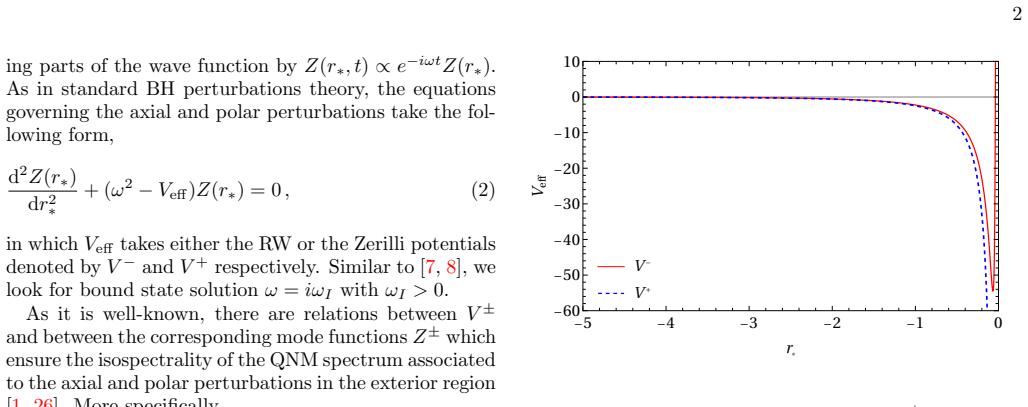
We study the bound state solutions for the polar perturbations in the interior of the Schwarzschild black hole. It is shown that for a given value of the spherical harmonic index $\ell$, there are a total of $\ell-1$ bound states for polar perturbations. We show both analytically and numerically that the spectrum of $\ell-2$ of these perturbations coincides exactly with the spectrum of axial perturbations. Consequently, the isospectrality between the bound states of axial and polar perturbations in the interior of the black hole is preserved. Furthermore, the additional mode found in the spectrum of polar perturbations is the algebraically special mode, which also furnishes the ground state of polar perturbations. It is shown that the spectrum of the highly excited states is equally spaced, which, in the semi-classical approximation, yields the black hole area quantization $\Delta A = 16 \pi l_{\mathrm{Pl}}^2$.
Figures


Reference graph
Works this paper leans on
-
[1]
Chandrasekhar,The mathematical theory of black holes(1985), ISBN 978-0-19-850370-5
S. Chandrasekhar,The mathematical theory of black holes(1985), ISBN 978-0-19-850370-5
1985
-
[2]
B. P. Abbott et al. (LIGO Scientific, Virgo), Phys. Rev. Lett.116, 061102 (2016), 1602.03837
Pith/arXiv arXiv 2016
-
[3]
B. P. Abbott et al. (LIGO Scientific, Virgo), Phys. Rev. Lett.119, 161101 (2017), 1710.05832
Pith/arXiv arXiv 2017
-
[4]
R. Abbott et al. (LIGO Scientific, Virgo), Astrophys. J. Lett.896, L44 (2020), 2006.12611
Pith/arXiv arXiv 2020
- [6]
- [7]
- [8]
-
[9]
P. P. Fiziev (2006), gr-qc/0603003
Pith/arXiv arXiv 2006
- [10]
-
[11]
Nollert, Class
H.-P. Nollert, Class. Quant. Grav.16, R159 (1999)
1999
-
[12]
K. D. Kokkotas and B. G. Schmidt, Living Rev. Rel.2, 2 (1999), gr-qc/9909058
Pith/arXiv arXiv 1999
-
[13]
E. Berti, V. Cardoso, and A. O. Starinets, Class. Quant. Grav.26, 163001 (2009), 0905.2975
Pith/arXiv arXiv 2009
-
[14]
R. A. Konoplya and A. Zhidenko, Rev. Mod. Phys.83, 793 (2011), 1102.4014
Pith/arXiv arXiv 2011
- [15]
-
[16]
Iyer and C
S. Iyer and C. M. Will, Phys. Rev. D35, 3621 (1987)
1987
-
[17]
L. Motl and A. Neitzke, Adv. Theor. Math. Phys.7, 307 (2003), hep-th/0301173
Pith/arXiv arXiv 2003
-
[18]
N. Andersson and C. J. Howls, Class. Quant. Grav.21, 1623 (2004), gr-qc/0307020
Pith/arXiv arXiv 2004
-
[19]
V. Cardoso, R. Konoplya, and J. P. S. Lemos, Phys. Rev. D68, 044024 (2003), gr-qc/0305037
Pith/arXiv arXiv 2003
-
[20]
A. J. M. Medved, D. Martin, and M. Visser, Class. Quant. Grav.21, 1393 (2004), gr-qc/0310009
Pith/arXiv arXiv 2004
-
[21]
E. Berti, V. Cardoso, and C. M. Will, Phys. Rev. D73, 064030 (2006), gr-qc/0512160
Pith/arXiv arXiv 2006
-
[22]
R. A. Konoplya, A. Zhidenko, and A. F. Zinhailo, Class. Quant. Grav.36, 155002 (2019), 1904.10333
Pith/arXiv arXiv 2019
- [23]
-
[24]
Regge and J
T. Regge and J. A. Wheeler, Phys. Rev.108, 1063 (1957)
1957
-
[25]
F. J. Zerilli, Phys. Rev. Lett.24, 737 (1970)
1970
-
[26]
Chandrasekhar and S
S. Chandrasekhar and S. L. Detweiler, Proc. Roy. Soc. Lond. A344, 441 (1975)
1975
-
[27]
Anderson and R
A. Anderson and R. H. Price, Phys. Rev. D43, 3147 (1991)
1991
-
[28]
Mashhoon, inProceedings of the Third Marcel Gross- mann Meeting on Recent Developments of General Rel- ativity”, edited by Hu Ning (North-Holland, New York, 1983), pp
B. Mashhoon, inProceedings of the Third Marcel Gross- mann Meeting on Recent Developments of General Rel- ativity”, edited by Hu Ning (North-Holland, New York, 1983), pp. 599-608.(1982)
1983
-
[29]
Blome and B
H.-J. Blome and B. Mashhoon, Phys. Lett. A100, 231 (1981)
1981
-
[30]
Ferrari and B
V. Ferrari and B. Mashhoon, Phys. Rev. D30, 295 (1984)
1984
-
[31]
Ferrari and B
V. Ferrari and B. Mashhoon, Phys. Rev. Lett.52, 1361 (1984)
1984
-
[32]
Liu and B
H. Liu and B. Mashhoon, Class. Quant. Grav.13, 233 (1996)
1996
-
[33]
S. H. V¨ olkel, Phys. Rev. Lett.134, 241401 (2025), 2505.17186
Pith/arXiv arXiv 2025
- [34]
-
[35]
Chandrasekhar, Proc
S. Chandrasekhar, Proc. Roy. Soc. Lond. A392, 1 (1984)
1984
-
[36]
W. E. Couch and E. T. Newman, J. Math. Phys.14, 285 (1973)
1973
-
[37]
R. M. Wald, J. Math. Phys.14, 1453 (1973)
1973
-
[38]
V. Cardoso and J. P. S. Lemos, Phys. Rev. D64, 084017 (2001), gr-qc/0105103
Pith/arXiv arXiv 2001
-
[39]
Gangopadhyaya, J
A. Gangopadhyaya, J. V. Mallow, and C. Rasinariu, Supersymmetric Quantum Mechanics: An Introduction (World Scientific, 2017), ISBN 978-981-4313-08-7, 978- 981-322-103-1, 978-981-322-104-8
2017
-
[40]
Cooper, A
F. Cooper, A. Khare, and U. Sukhatme, Physics Reports 251, 267 (1995)
1995
-
[41]
A. Maassen van den Brink, Phys. Rev. D62, 064009 (2000), gr-qc/0001032
Pith/arXiv arXiv 2000
-
[42]
E. W. Leaver, Proc. Roy. Soc. Lond. A402, 285 (1985)
1985
-
[43]
Nollert, Phys
H.-P. Nollert, Phys. Rev. D47, 5253 (1993)
1993
- [44]
- [45]
-
[46]
J. D. Bekenstein, Lett. Nuovo Cim.11, 467 (1974)
1974
-
[47]
J. D. Bekenstein and V. F. Mukhanov, Phys. Lett. B 360, 7 (1995), gr-qc/9505012
Pith/arXiv arXiv 1995
-
[48]
V. F. Mukhanov, JETP Lett.44, 63 (1986)
1986
-
[49]
A. Coates, S. H. V¨ olkel, and K. D. Kokkotas, Class. Quant. Grav.39, 045007 (2022), 2201.03245
Pith/arXiv arXiv 2022
discussion (0)
Sign in with ORCID, Apple, or X to comment. Anyone can read and Pith papers without signing in.