ToG-Bench: Task-Oriented Spatio-Temporal Grounding in Egocentric Videos
Pith reviewed 2026-05-17 02:45 UTC · model grok-4.3
The pith
ToG-Bench requires models to localize objects needed for intended tasks in egocentric videos, including implicit and multi-object cases.
A machine-rendered reading of the paper's core claim, the machinery that carries it, and where it could break.
Core claim
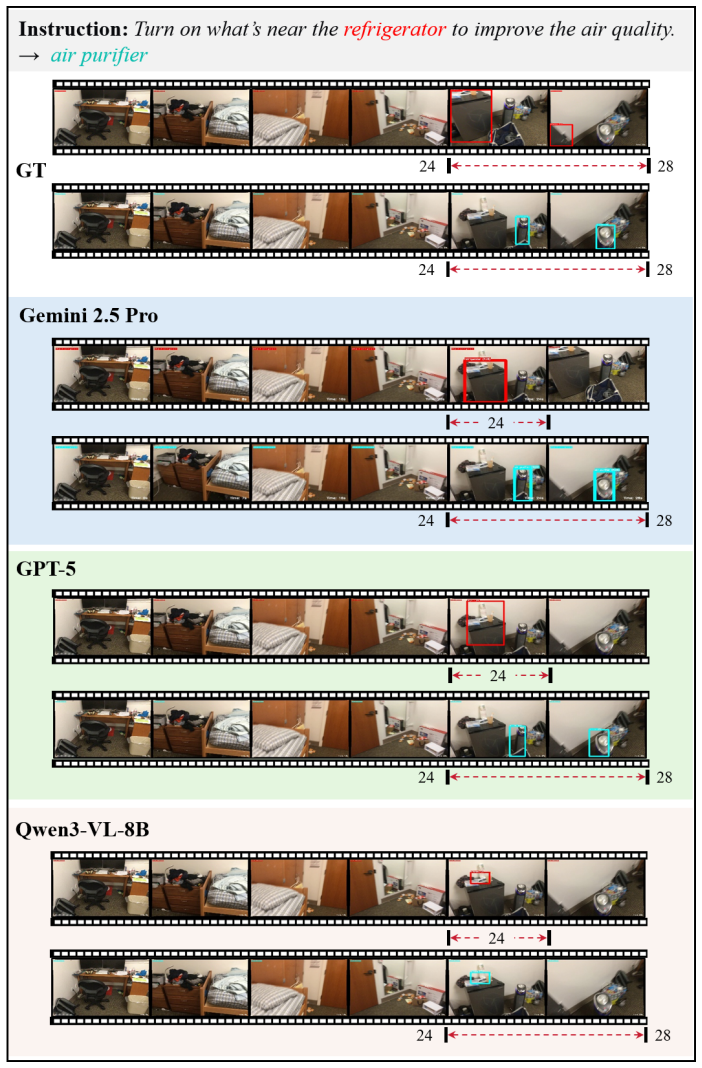
We introduce ToG-Bench, the first task-oriented spatio-temporal video grounding benchmark for egocentric videos, characterized by task-oriented grounding that identifies objects based on intended tasks, explicit-implicit dual grounding that handles both mentioned and inferred targets, and one-to-many grounding that allows multiple objects per instruction.
What carries the argument
The three key features of ToG-Bench: task-oriented grounding based on intended tasks, explicit-implicit dual grounding, and one-to-many grounding that links single instructions to multiple objects.
If this is right
- Task-level metrics are required to properly score multi-object and explicit-implicit cases rather than single-target accuracy.
- Current multimodal large language models exhibit substantial gaps when required to bridge perception with goal-directed interaction.
- Embodied agents need additional reasoning layers to move from descriptive localization to task-driven object selection.
- Performance on ToG-Bench highlights the remaining distance between existing video grounding methods and practical embodied use.
Where Pith is reading between the lines
- Robotic systems trained only on descriptive grounding may fail when given goal-oriented commands in real environments.
- The benchmark could be extended to longer video sequences or active exploration settings to test sequential decision making.
- Models that succeed here might transfer better to downstream tasks such as instruction-following manipulation.
Load-bearing premise
The semi-automated pipeline that combines foundation model annotation and human refinement produces accurate, unbiased task-oriented instructions that faithfully capture the intended explicit-implicit and one-to-many distinctions.
What would settle it
Systematic evaluation of whether state-of-the-art multimodal models achieve high accuracy on the explicit-implicit and one-to-many subsets of ToG-Bench while still struggling on standard descriptive grounding would confirm or refute the claimed distinct challenges.
Figures






read the original abstract
A core capability towards general embodied intelligence lies in localizing task-relevant objects from an egocentric perspective, formulated as Spatio-Temporal Video Grounding (STVG). Despite recent progress, existing STVG studies remain largely confined to object-centric and descriptive instructions, neglecting the task-oriented reasoning that is crucial for embodied agents to accomplish goal-directed interactions. To bridge this gap, we introduce \textbf{ToG-Bench}, the first task-oriented spatio-temporal video grounding benchmark for egocentric videos. ToG-Bench is characterized by three key features: (1) \textbf{Task-oriented Grounding}, which requires identifying and localizing objects based on intended tasks rather than straightforward descriptions; (2) \textbf{Explicit-Implicit Dual Grounding}, where target objects can be either explicitly mentioned or implicitly inferred by contextual reasoning; (3) \textbf{One-to-Many Grounding}, where a single instruction may correspond to multiple objects involved in task execution. Built upon videos sourced from ScanNet, ToG-Bench comprises 100 annotated clips with 2,704 task-oriented grounding instructions, constructed via a semi-automated pipeline that combines foundation model annotation and human refinement. In addition, we introduce a set of task-level evaluation metrics tailored for multi-object and explicit-implicit object grounding, and systematically benchmark seven state-of-the-art MLLMs. Extensive experiments reveal the intrinsic challenges of task-oriented STVG and substantial performance gaps across explicit-implicit and multi-object grounding, highlighting the difficulty of bridging perception and interaction in embodied scenarios. Data and code will be released at: \href{https://github.com/qaxuDev/ToG-Bench}{https://github.com/qaxuDev/ToG-Bench}..
Editorial analysis
A structured set of objections, weighed in public.
Referee Report
Summary. The paper introduces ToG-Bench, the first task-oriented spatio-temporal video grounding benchmark for egocentric videos. It is built from 100 ScanNet clips yielding 2,704 instructions via a semi-automated pipeline that combines foundation-model pre-annotation with human refinement. The benchmark is defined by three features: task-oriented grounding (objects localized by intended task rather than description), explicit-implicit dual grounding, and one-to-many grounding. The authors propose tailored task-level metrics for multi-object and explicit-implicit cases and evaluate seven MLLMs, reporting performance gaps that highlight challenges in bridging perception and interaction.
Significance. If the annotations faithfully realize the claimed distinctions, ToG-Bench would fill a clear gap in existing STVG benchmarks by emphasizing goal-directed reasoning required for embodied agents. The systematic MLLM evaluation and public data/code release would provide a useful testbed and improve reproducibility. The work's impact hinges on whether the semi-automated construction reliably produces the explicit-implicit and one-to-many properties rather than surface cues.
major comments (1)
- [§3 (Dataset Construction)] §3 (Dataset Construction): The central claim that ToG-Bench exhibits task-oriented, explicit-implicit dual, and one-to-many grounding rests entirely on the semi-automated pipeline. No inter-annotator agreement, no ablation removing the foundation-model stage, and no quantitative check that implicit cases require genuine contextual inference (versus surface cues) are reported. This is load-bearing; without such validation the novelty of the benchmark, the tailored metrics, and the reported MLLM gaps all rest on untested labeling assumptions.
minor comments (2)
- [Abstract] Abstract: The statement that experiments 'reveal the intrinsic challenges of task-oriented STVG and substantial performance gaps' would be strengthened by a single concrete quantitative example (e.g., a metric delta between explicit and implicit subsets).
- [§4 (Experiments)] §4 (Experiments): The task-level evaluation metrics for multi-object and explicit-implicit grounding should include explicit formulas or pseudocode to ensure they can be reproduced from the released annotations.
Simulated Author's Rebuttal
We thank the referee for the constructive feedback and for recognizing the potential of ToG-Bench to address gaps in task-oriented spatio-temporal grounding. We address the major comment on dataset validation point by point below, with planned revisions.
read point-by-point responses
-
Referee: The central claim that ToG-Bench exhibits task-oriented, explicit-implicit dual, and one-to-many grounding rests entirely on the semi-automated pipeline. No inter-annotator agreement, no ablation removing the foundation-model stage, and no quantitative check that implicit cases require genuine contextual inference (versus surface cues) are reported. This is load-bearing; without such validation the novelty of the benchmark, the tailored metrics, and the reported MLLM gaps all rest on untested labeling assumptions.
Authors: We agree that rigorous validation of the semi-automated pipeline is necessary to support the benchmark's core distinctions. The manuscript describes the pipeline of foundation-model pre-annotation followed by human refinement but does not include the requested quantitative checks. In the revised version we will add: (1) inter-annotator agreement computed on a stratified subset of instructions to quantify labeling consistency; (2) an ablation comparing annotation quality and feature coverage with versus without the foundation-model stage; and (3) a quantitative analysis of implicit cases, for example by measuring how often implicit targets cannot be resolved from single frames or isolated object descriptions and by reporting the distribution of required contextual inference steps. These additions will directly substantiate the task-oriented, explicit-implicit, and one-to-many properties as well as the tailored metrics. revision: yes
Circularity Check
No circularity: benchmark built from external ScanNet videos via new annotations
full rationale
The paper introduces ToG-Bench by sourcing 100 clips from the external ScanNet dataset and constructing 2,704 instructions through a semi-automated pipeline of foundation-model pre-annotation followed by human refinement. No mathematical derivations, fitted parameters, predictions, or first-principles results appear in the provided text. The three key features (task-oriented grounding, explicit-implicit dual grounding, one-to-many grounding) are defined upfront and then realized by the annotation process rather than being derived from or equivalent to any internal fitted quantities or self-citations. The work is therefore self-contained against external benchmarks and data sources, with no load-bearing steps that reduce to the enumerated circularity patterns.
Axiom & Free-Parameter Ledger
axioms (1)
- domain assumption ScanNet videos provide suitable egocentric video data for task-oriented grounding.
Lean theorems connected to this paper
-
IndisputableMonolith/Foundation/RealityFromDistinction.leanreality_from_one_distinction unclear?
unclearRelation between the paper passage and the cited Recognition theorem.
We introduce ToG-Bench, the first task-oriented spatio-temporal video grounding benchmark... semi-automated pipeline that combines foundation model annotation and human refinement
What do these tags mean?
- matches
- The paper's claim is directly supported by a theorem in the formal canon.
- supports
- The theorem supports part of the paper's argument, but the paper may add assumptions or extra steps.
- extends
- The paper goes beyond the formal theorem; the theorem is a base layer rather than the whole result.
- uses
- The paper appears to rely on the theorem as machinery.
- contradicts
- The paper's claim conflicts with a theorem or certificate in the canon.
- unclear
- Pith found a possible connection, but the passage is too broad, indirect, or ambiguous to say the theorem truly supports the claim.
Forward citations
Cited by 1 Pith paper
-
EgoSound: Benchmarking Sound Understanding in Egocentric Videos
EgoSound is a new benchmark with 7315 QA pairs across seven tasks to evaluate egocentric sound understanding in multimodal large language models.
Reference graph
Works this paper leans on
-
[1]
Josh Achiam, Steven Adler, Sandhini Agarwal, Lama Ah- mad, Ilge Akkaya, Florencia Leoni Aleman, Diogo Almeida, Janko Altenschmidt, Sam Altman, Shyamal Anadkat, et al. Gpt-4 technical report.arXiv preprint arXiv:2303.08774,
work page internal anchor Pith review Pith/arXiv arXiv
-
[2]
Shuai Bai, Yuxuan Cai, Ruizhe Chen, Keqin Chen, Xionghui Chen, Zesen Cheng, Lianghao Deng, Wei Ding, Chang Gao, Chunjiang Ge, et al. Qwen3-vl technical report.arXiv preprint arXiv:2511.21631, 2025. 2, 5, 6, 7
work page internal anchor Pith review Pith/arXiv arXiv 2025
-
[3]
Shuai Bai, Keqin Chen, Xuejing Liu, Jialin Wang, Wenbin Ge, Sibo Song, Kai Dang, Peng Wang, Shijie Wang, Jun Tang, et al. Qwen2. 5-vl technical report.arXiv preprint arXiv:2502.13923, 2025. 5, 6, 7
work page internal anchor Pith review Pith/arXiv arXiv 2025
-
[4]
Weakly-supervised spatio-temporally grounding natural sentence in video
Zhenfang Chen, Lin Ma, Wenhan Luo, and Kwan-Yee Ken- neth Wong. Weakly-supervised spatio-temporally grounding natural sentence in video. InProceedings of the 57th Annual Meeting of the Association for Computational Linguistics, pages 1884–1894, 2019. 2
work page 2019
-
[5]
V-star: Bench- marking video-llms on video spatio-temporal reasoning
Zixu Cheng, Jian Hu, Ziquan Liu, Chenyang Si, Wei Li, and Shaogang Gong. V-star: Benchmarking video- llms on video spatio-temporal reasoning.arXiv preprint arXiv:2503.11495, 2025. 6
-
[6]
Gheorghe Comanici, Eric Bieber, Mike Schaekermann, Ice Pasupat, Noveen Sachdeva, Inderjit Dhillon, Marcel Blis- tein, Ori Ram, Dan Zhang, Evan Rosen, et al. Gemini 2.5: Pushing the frontier with advanced reasoning, multimodality, long context, and next generation agentic capabilities.arXiv preprint arXiv:2507.06261, 2025. 2, 3, 5, 6, 7
work page internal anchor Pith review Pith/arXiv arXiv 2025
-
[7]
Scannet: Richly-annotated 3d reconstructions of indoor scenes
Angela Dai, Angel X Chang, Manolis Savva, Maciej Hal- ber, Thomas Funkhouser, and Matthias Nießner. Scannet: Richly-annotated 3d reconstructions of indoor scenes. In Proceedings of the IEEE conference on computer vision and pattern recognition, pages 5828–5839, 2017. 2, 3, 11
work page 2017
-
[8]
Jiafei Duan, Samson Yu, Hui Li Tan, Hongyuan Zhu, and Cheston Tan. A survey of embodied ai: From simulators to research tasks.IEEE Transactions on Emerging Topics in Computational Intelligence, 6(2):230–244, 2022. 1
work page 2022
-
[9]
Yuqian Fu, Runze Wang, Yanwei Fu, Danda Pani Paudel, Xuanjing Huang, and Luc Van Gool. Objectrelator: Enabling cross-view object relation understanding in ego-centric and exo-centric videos.ICCV, 2025. 1
work page 2025
-
[10]
Tall: Temporal activity localization via language query
Jiyang Gao, Chen Sun, Zhenheng Yang, and Ram Nevatia. Tall: Temporal activity localization via language query. In Proceedings of the IEEE international conference on com- puter vision, pages 5267–5275, 2017. 2
work page 2017
-
[11]
Ego4d: Around the world in 3,000 hours of egocentric video
Kristen Grauman, Andrew Westbury, Eugene Byrne, Zachary Chavis, Antonino Furnari, Rohit Girdhar, Jackson Hamburger, Hao Jiang, Miao Liu, Xingyu Liu, et al. Ego4d: Around the world in 3,000 hours of egocentric video. In Proceedings of the IEEE/CVF conference on computer vi- sion and pattern recognition, pages 18995–19012, 2022. 2
work page 2022
-
[12]
Ego-exo4d: Understanding skilled human activity from first-and third-person perspectives
Kristen Grauman, Andrew Westbury, Lorenzo Torresani, Kris Kitani, Jitendra Malik, Triantafyllos Afouras, Kumar Ashutosh, Vijay Baiyya, Siddhant Bansal, Bikram Boote, et al. Ego-exo4d: Understanding skilled human activity from first-and third-person perspectives. InProceedings of the IEEE/CVF Conference on Computer Vision and Pattern Recognition, pages 193...
work page 2024
-
[13]
Trace: Temporal grounding video llm via causal event modeling.ICLR, 2025
Yongxin Guo, Jingyu Liu, Mingda Li, Qingbin Liu, Xi Chen, and Xiaoying Tang. Trace: Temporal grounding video llm via causal event modeling.ICLR, 2025. 2
work page 2025
-
[14]
Vtimellm: Empower llm to grasp video moments
Bin Huang, Xin Wang, Hong Chen, Zihan Song, and Wenwu Zhu. Vtimellm: Empower llm to grasp video moments. In Proceedings of the IEEE/CVF Conference on Computer Vi- sion and Pattern Recognition, pages 14271–14280, 2024. 2
work page 2024
-
[15]
Described spatial-temporal video detection.arXiv preprint arXiv:2407.05610, 2024
Wei Ji, Xiangyan Liu, Yingfei Sun, Jiajun Deng, You Qin, Ammar Nuwanna, Mengyao Qiu, Lina Wei, and Roger Zim- mermann. Described spatial-temporal video detection.arXiv preprint arXiv:2407.05610, 2024. 2, 12
-
[16]
Dense-captioning events in videos
Ranjay Krishna, Kenji Hata, Frederic Ren, Li Fei-Fei, and Juan Carlos Niebles. Dense-captioning events in videos. In Proceedings of the IEEE international conference on com- puter vision, pages 706–715, 2017. 2
work page 2017
-
[17]
Llava-st: A multimodal large language model for fine-grained spatial- temporal understanding
Hongyu Li, Jinyu Chen, Ziyu Wei, Shaofei Huang, Tian- rui Hui, Jialin Gao, Xiaoming Wei, and Si Liu. Llava-st: A multimodal large language model for fine-grained spatial- temporal understanding. InProceedings of the Computer Vi- sion and Pattern Recognition Conference, pages 8592–8603,
-
[18]
Kailing Li, Qi’ao Xu, Tianwen Qian, Yuqian Fu, Yang Jiao, and Xiaoling Wang. Clivis: Unleashing cognitive map through linguistic-visual synergy for embodied visual rea- soning.arXiv preprint arXiv:2506.17629, 2025. 1
-
[19]
Ground- inggpt: Language enhanced multi-modal grounding model
Zhaowei Li, Qi Xu, Dong Zhang, Hang Song, Yiqing Cai, Qi Qi, Ran Zhou, Junting Pan, Zefeng Li, Vu Tu, et al. Ground- inggpt: Language enhanced multi-modal grounding model. InProceedings of the 62nd Annual Meeting of the Associa- tion for Computational Linguistics (Volume 1: Long Papers), pages 6657–6678, 2024. 2
work page 2024
-
[20]
Fine-grained spatiotemporal grounding on ego- centric videos
Shuo Liang, Yiwu Zhong, Zi-Yuan Hu, Yeyao Tao, and Li- wei Wang. Fine-grained spatiotemporal grounding on ego- centric videos. InProceedings of the IEEE/CVF Interna- tional Conference on Computer Vision, pages 9385–9395,
-
[21]
Grounding dino: Marrying dino with grounded pre-training for open-set object detection
Shilong Liu, Zhaoyang Zeng, Tianhe Ren, Feng Li, Hao Zhang, Jie Yang, Qing Jiang, Chunyuan Li, Jianwei Yang, Hang Su, et al. Grounding dino: Marrying dino with grounded pre-training for open-set object detection. InEuro- pean conference on computer vision, pages 38–55. Springer,
-
[22]
S2ORC: The semantic scholar open re- search corpus
Kyle Lo, Lucy Lu Wang, Mark Neumann, Rodney Kinney, and Daniel Weld. S2ORC: The semantic scholar open re- search corpus. InProceedings of the 58th Annual Meeting of the Association for Computational Linguistics, pages 4969– 4983, Online, 2020. Association for Computational Linguis- tics. 6
work page 2020
-
[23]
A survey: Learn- ing embodied intelligence from physical simulators and world models,
Xiaoxiao Long, Qingrui Zhao, Kaiwen Zhang, Zihao Zhang, Dingrui Wang, Yumeng Liu, Zhengjie Shu, Yi Lu, Shouzheng Wang, Xinzhe Wei, et al. A survey: Learning embodied intelligence from physical simulators and world models.arXiv preprint arXiv:2507.00917, 2025. 1
-
[24]
Put myself in your shoes: Lifting the egocentric perspective 9 from exocentric videos
Mi Luo, Zihui Xue, Alex Dimakis, and Kristen Grauman. Put myself in your shoes: Lifting the egocentric perspective 9 from exocentric videos. InEuropean Conference on Com- puter Vision, pages 407–425. Springer, 2024. 2
work page 2024
-
[25]
OpenAI. Introducing gpt-5, 2025. Accessed: 2025-09-07. 2, 5, 6, 7
work page 2025
-
[26]
Chiara Plizzari, Gabriele Goletto, Antonino Furnari, Sid- dhant Bansal, Francesco Ragusa, Giovanni Maria Farinella, Dima Damen, and Tatiana Tommasi. An outlook into the fu- ture of egocentric vision.International Journal of Computer Vision, 132(11):4880–4936, 2024. 1
work page 2024
-
[27]
Sam 2: Seg- ment anything in images and videos
Nikhila Ravi, Valentin Gabeur, Yuan-Ting Hu, Ronghang Hu, Chaitanya Ryali, Tengyu Ma, Haitham Khedr, Roman R¨adle, Chloe Rolland, Laura Gustafson, et al. Sam 2: Seg- ment anything in images and videos. InInternational Con- ference on Learning Representations, 2024. 3
work page 2024
-
[28]
Human-centric spatio-temporal video grounding with visual transformers
Zongheng Tang, Yue Liao, Si Liu, Guanbin Li, Xiaojie Jin, Hongxu Jiang, Qian Yu, and Dong Xu. Human-centric spatio-temporal video grounding with visual transformers. IEEE Transactions on Circuits and Systems for Video Tech- nology, 32(12):8238–8249, 2021. 1, 2, 12
work page 2021
-
[29]
Jiankang Wang, Zhihan Zhang, Zhihang Liu, Yang Li, Jian- nan Ge, Hongtao Xie, and Yongdong Zhang. Spacevllm: Endowing multimodal large language model with spatio- temporal video grounding capability.arXiv preprint arXiv:2503.13983, 2025. 2
-
[30]
InternVL3.5: Advancing Open-Source Multimodal Models in Versatility, Reasoning, and Efficiency
Weiyun Wang, Zhangwei Gao, Lixin Gu, Hengjun Pu, Long Cui, Xingguang Wei, Zhaoyang Liu, Linglin Jing, Shenglong Ye, Jie Shao, et al. Internvl3. 5: Advancing open-source multimodal models in versatility, reasoning, and efficiency. arXiv preprint arXiv:2508.18265, 2025. 5, 6, 7
work page internal anchor Pith review Pith/arXiv arXiv 2025
-
[31]
Videogrounding- dino: Towards open-vocabulary spatio-temporal video grounding
Syed Talal Wasim, Muzammal Naseer, Salman Khan, Ming- Hsuan Yang, and Fahad Shahbaz Khan. Videogrounding- dino: Towards open-vocabulary spatio-temporal video grounding. InProceedings of the IEEE/CVF Conference on Computer Vision and Pattern Recognition, pages 18909– 18918, 2024. 1
work page 2024
-
[32]
Spatio-temporal person retrieval via natural language queries
Masataka Yamaguchi, Kuniaki Saito, Yoshitaka Ushiku, and Tatsuya Harada. Spatio-temporal person retrieval via natural language queries. InProceedings of the IEEE international conference on computer vision, pages 1453–1462, 2017. 1, 2, 12
work page 2017
-
[33]
Tubedetr: Spatio-temporal video ground- ing with transformers
Antoine Yang, Antoine Miech, Josef Sivic, Ivan Laptev, and Cordelia Schmid. Tubedetr: Spatio-temporal video ground- ing with transformers. InProceedings of the IEEE/CVF Con- ference on Computer Vision and Pattern Recognition, pages 16442–16453, 2022. 1
work page 2022
-
[34]
Omnistvg: Toward spatio-temporal omni-object video grounding.arXiv preprint arXiv:2503.10500, 2025
Jiali Yao, Xinran Deng, Xin Gu, Mengrui Dai, Bing Fan, Zhipeng Zhang, Yan Huang, Heng Fan, and Libo Zhang. Omnistvg: Toward spatio-temporal omni-object video grounding.arXiv preprint arXiv:2503.10500, 2025. 2, 6
-
[35]
VideoLLaMA 3: Frontier Multimodal Foundation Models for Image and Video Understanding
Boqiang Zhang, Kehan Li, Zesen Cheng, Zhiqiang Hu, Yuqian Yuan, Guanzheng Chen, Sicong Leng, Yuming Jiang, Hang Zhang, Xin Li, et al. Videollama 3: Frontier multi- modal foundation models for image and video understand- ing.arXiv preprint arXiv:2501.13106, 2025. 5, 6, 7
work page internal anchor Pith review Pith/arXiv arXiv 2025
-
[36]
Where does it exist: Spatio-temporal video grounding for multi-form sentences
Zhu Zhang, Zhou Zhao, Yang Zhao, Qi Wang, Huasheng Liu, and Lianli Gao. Where does it exist: Spatio-temporal video grounding for multi-form sentences. InProceedings of the IEEE/CVF Conference on Computer Vision and Pat- tern Recognition, pages 10668–10677, 2020. 1, 2, 6, 12
work page 2020
-
[37]
InternVL3: Exploring Advanced Training and Test-Time Recipes for Open-Source Multimodal Models
Jinguo Zhu, Weiyun Wang, Zhe Chen, Zhaoyang Liu, Shen- glong Ye, Lixin Gu, Hao Tian, Yuchen Duan, Weijie Su, Jie Shao, et al. Internvl3: Exploring advanced training and test-time recipes for open-source multimodal models.arXiv preprint arXiv:2504.10479, 2025. 5, 6, 7 10 ToG-Bench: Task-Oriented Spatio-Temporal Grounding in Egocentric Videos Supplementary ...
work page internal anchor Pith review Pith/arXiv arXiv 2025
-
[38]
Comparison with Existing Benchmarks As summarized in Tab
Benchmark Comparison and Statistics 6.1. Comparison with Existing Benchmarks As summarized in Tab. 6, ToG-Bench complements ex- isting benchmarks by integrating three key dimensions in egocentric video: (1)task-oriented groundingdriven by functional intent rather than surface-level appearance, (2) explicit–implicit dual grounding, enabling evaluation un- ...
-
[39]
Extended Experimental Analysis 7.1. Experiment Setup Our evaluation follows a zero-shot, single-round inference protocol on NVIDIA A100 40GB GPUs. Video frames are sampled at 0.25 fps with no limit on frame count. To en- sure deterministic outputs, we setdo sample=Falsefor greedy decoding in all experiments. Results are reported under identical settings t...
-
[40]
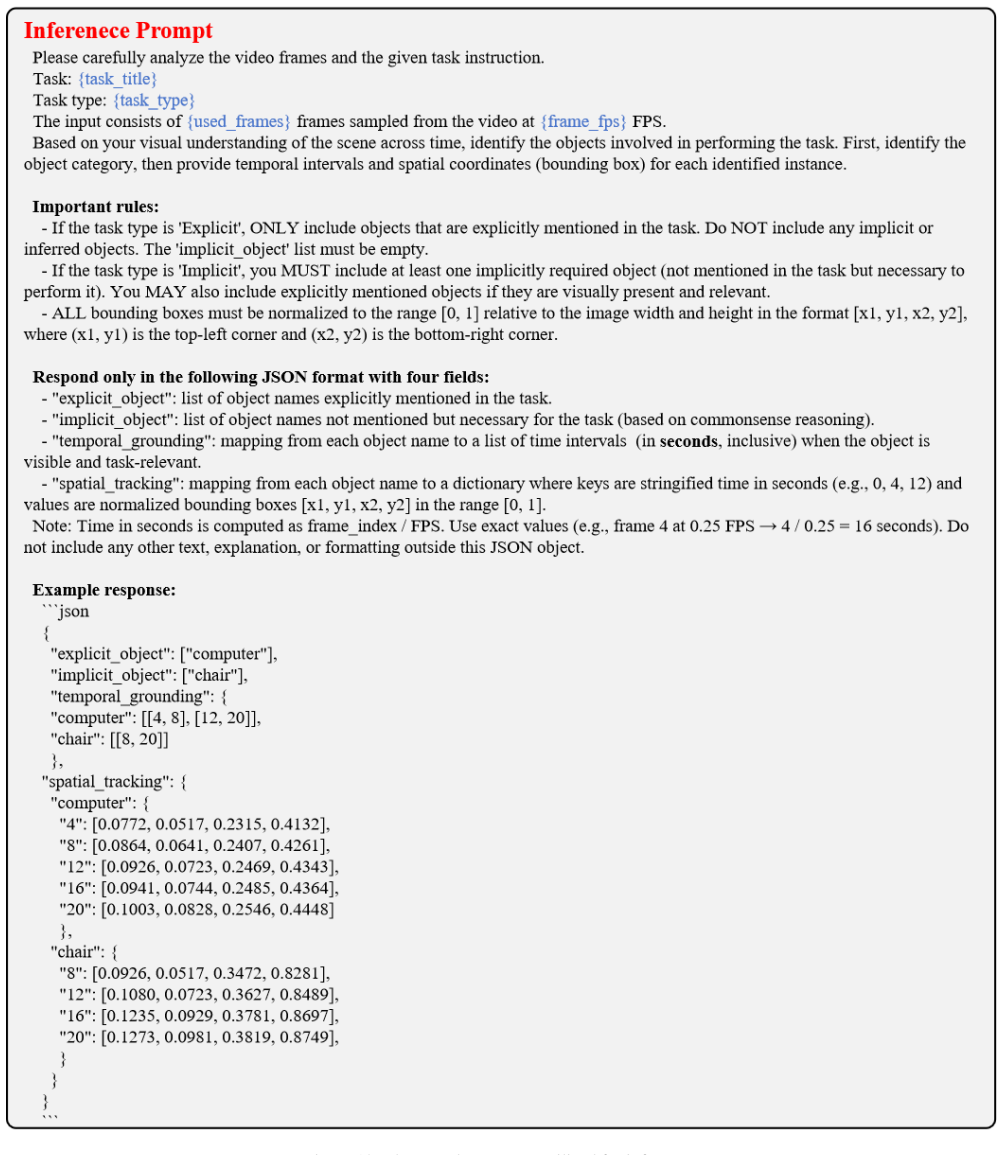
Inference and Annotation Prompts 8.1. Detailed System Prompt for Inference All MLLMs utilize the same structured prompt (Fig. 13) to ensure uniform output formatting. The prompt requires the model to: • Analyze frames and instruction to identify objects with explicitorimplicit. • Output JSON with four fields:explicit object, implicit object,temporal groun...
discussion (0)
Sign in with ORCID, Apple, or X to comment. Anyone can read and Pith papers without signing in.