Recognition: 2 theorem links
· Lean TheoremJet Charge with Global Event Shapes: Probing Quark Flavor Dynamics
Pith reviewed 2026-05-17 01:05 UTC · model grok-4.3
The pith
A factorization theorem for simultaneous jet charge and 1-jettiness measurements in DIS introduces a universal charged jet function.
A machine-rendered reading of the paper's core claim, the machinery that carries it, and where it could break.
Core claim
We derive a factorization theorem for simultaneous measurements of τ₁ and Q in the resummation region, τ₁ ≪ P_{J_T}, which contains a new universal charged jet function, generalizing the standard jet function to include a jet charge measurement. Therefore these universal functions can be extracted from a global analysis of N-jettiness and thrust at e⁺e⁻ colliders. The 1-Jettiness distribution binned according to jet charge allows for enhanced quark flavor separation of the initial state PDFs, while the jet charge distribution binned by 1-Jettiness probes quark flavor dynamics in the final state hadronization process.
What carries the argument
The charged jet function, a generalization of the standard jet function that incorporates an explicit measurement of the jet region's net electric charge and enables factorization of the joint observable.
If this is right
- The 1-jettiness distribution binned by jet charge enhances separation of quark flavors in both unpolarized and longitudinally polarized initial-state PDFs.
- The jet charge distribution binned by 1-jettiness isolates flavor dependence in the final-state hadronization process.
- The measurements apply directly to existing HERA data and planned Electron-Ion Collider analyses.
- The new charged jet function can be determined from a global fit to N-jettiness and thrust observables at e⁺e⁻ colliders.
Where Pith is reading between the lines
- This joint observable may tighten constraints on polarized PDFs at the EIC by exploiting the additional flavor sensitivity of jet charge.
- Direct comparison of charged jet functions extracted from e⁺e⁻ versus DIS data would provide a clean test of universality across different hard processes.
- The same factorization structure could be extended to other global event shapes or to processes with multiple jets.
Load-bearing premise
The charged jet function is universal and can be extracted from global analyses of N-jettiness and thrust at e⁺e⁻ colliders without significant process dependence or higher-order corrections that spoil the separation of initial- and final-state dynamics.
What would settle it
If jet charge distributions measured in DIS, when compared against predictions that use charged jet functions fitted solely from e⁺e⁻ data, show systematic discrepancies beyond expected higher-order or power corrections, the claimed universality would be falsified.
Figures
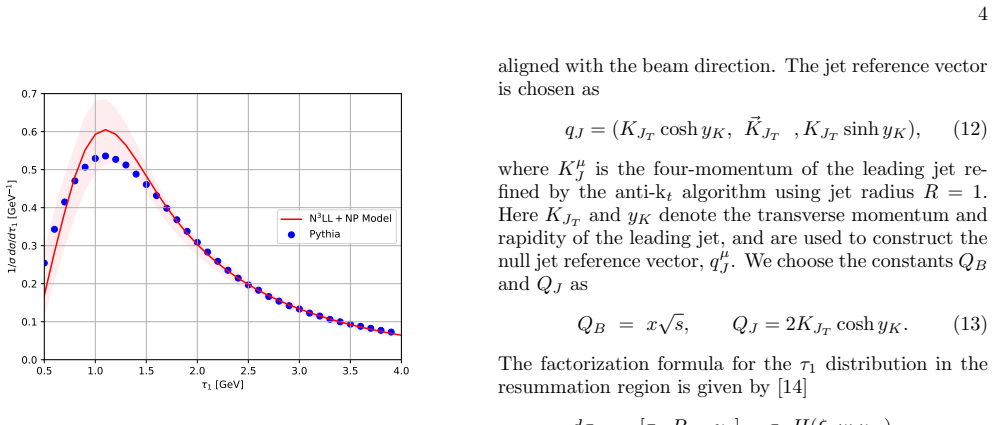


read the original abstract
We propose measuring the jet electric charge of jet regions, defined within the framework of global event shapes, as a probe of quark flavor dynamics within the nucleon and the hadronization process. In particular, we consider a measurement of the jet region charge while simultaneously keeping track of the energy flow throughout the event, as characterized by the global event shape. As a concrete example, we focus on the measurement of the 1-Jettiness jet charge ($Q$), the jet charge of the jet region ($J$) defined within the framework of the 1-Jettiness global event shape ($\tau_1$) for the Deep Inelastic Scattering (DIS) process, $e^- + p \to e^- + J + X$, with unpolarized or longitudinally polarized protons. The 1-Jettiness distribution, binned according to jet charge, allows for enhanced quark flavor separation of the initial state unpolarized or polarized PDFs. On the other hand, the jet charge distribution binned by 1-Jettiness can serve as a probe of quark flavor dynamics in the final state hadronization process. We derive a factorization theorem for simultaneous measurements of $\tau_1$ and $Q$ in the resummation region, $\tau_1 \ll P_{J_T}$, where $P_{J_T}$ denotes the transverse momentum of the jet region. The factorization theorem contains a new universal charged jet function, generalizing the standard jet function to include a jet charge measurement. Therefore these universal functions can be extracted from a global analysis of N-jettiness and thrust at $e^+e^-$ colliders. We provide simulation studies to demonstrate the sensitivity of the 1-Jettiness jet charge observable to quark flavor dynamics in nucleon structure and explore the possibility of probing the final state hadronization process. This observable is well-suited for applications with existing HERA data and the future Electron-Ion Collider (EIC).
Editorial analysis
A structured set of objections, weighed in public.
Referee Report
Summary. The manuscript proposes measuring the electric charge Q of jet regions defined via the global 1-jettiness event shape τ₁ in unpolarized or polarized DIS (e⁻ + p → e⁻ + J + X). It derives a factorization theorem for the joint (τ₁, Q) distribution in the resummation region τ₁ ≪ P_{J_T} that introduces a new universal charged jet function generalizing the standard jet function. The authors assert that this function can be extracted from N-jettiness and thrust analyses at e⁺e⁻ colliders, and they present Monte Carlo simulation studies demonstrating sensitivity of the binned observables to initial-state quark flavor in PDFs and to final-state hadronization, with suggested applications to HERA and EIC data.
Significance. If the factorization holds and the charged jet function proves universal, the proposal would supply a new handle on quark flavor separation in nucleon structure functions and on hadronization dynamics by correlating a local charge measurement with a global event shape. The simulation studies constitute a concrete strength by showing practical sensitivity; combined with the claim of extractability from e⁺e⁻ data, the work could usefully complement existing jet-charge and N-jettiness programs at the EIC.
major comments (2)
- [Factorization theorem section] Section on the factorization theorem (around the derivation of the joint τ₁–Q theorem): the separation of the charged jet function J_Q from initial-state PDFs and beam-remnant contributions is asserted on the basis of the global 1-jettiness definition, but no explicit power-counting or matching calculation is shown that quantifies possible charge-flow leakage from target fragmentation or initial-state radiation into the jet region. This directly affects the claimed universality and the extraction strategy from e⁺e⁻ data.
- [Simulation studies] Simulation studies section: the reported sensitivity to quark flavor is shown only at the level of qualitative distributions; no quantitative figure of merit (e.g., reduction in PDF uncertainty or χ² improvement when including the new observable) or comparison against existing HERA jet-charge data is provided, leaving the practical impact on the central claim unquantified.
minor comments (2)
- [Abstract and Introduction] The abstract and introduction should explicitly state the perturbative order at which the factorization theorem is derived and the resummation accuracy achieved.
- [Observable definition] Notation for the jet region boundary and the precise definition of Q (sum of charges inside the 1-jettiness jet region) should be clarified with an equation or diagram to avoid ambiguity when comparing to standard jet-charge definitions.
Simulated Author's Rebuttal
We thank the referee for their careful reading of our manuscript and for the constructive comments, which we believe will improve the clarity and rigor of the presentation. We address each major comment below and describe the revisions we intend to implement.
read point-by-point responses
-
Referee: [Factorization theorem section] Section on the factorization theorem (around the derivation of the joint τ₁–Q theorem): the separation of the charged jet function J_Q from initial-state PDFs and beam-remnant contributions is asserted on the basis of the global 1-jettiness definition, but no explicit power-counting or matching calculation is shown that quantifies possible charge-flow leakage from target fragmentation or initial-state radiation into the jet region. This directly affects the claimed universality and the extraction strategy from e⁺e⁻ data.
Authors: We agree that an explicit power-counting analysis would strengthen the justification for the separation. In the revised manuscript we will add a dedicated subsection to the factorization theorem section that derives the power suppression of charge-flow leakage from target fragmentation and initial-state radiation into the jet region, using the global definition of 1-jettiness in the τ₁ ≪ P_{J_T} limit. This addition will also clarify the universality of the charged jet function and support its extraction from e⁺e⁻ data. revision: yes
-
Referee: [Simulation studies] Simulation studies section: the reported sensitivity to quark flavor is shown only at the level of qualitative distributions; no quantitative figure of merit (e.g., reduction in PDF uncertainty or χ² improvement when including the new observable) or comparison against existing HERA jet-charge data is provided, leaving the practical impact on the central claim unquantified.
Authors: We acknowledge that the present simulation results are qualitative. In the revised version we will augment the simulation studies section with quantitative figures of merit, including estimated reductions in PDF uncertainties and χ² improvements when the new observable is included in fits, as well as a direct comparison to existing HERA jet-charge data to better quantify the practical impact. revision: yes
Circularity Check
No significant circularity in the factorization derivation
full rationale
The paper derives a factorization theorem for simultaneous τ₁ and Q measurements in the resummation region using standard SCET techniques for global event shapes, introducing a new charged jet function as a generalization of the standard jet function. This is presented as a first-principles result that separates initial- and final-state dynamics, with universality asserted to enable extraction from e⁺e⁻ data. No step reduces by construction to a fitted input, self-definition, or load-bearing self-citation; the central claim retains independent theoretical content beyond the inputs.
Axiom & Free-Parameter Ledger
axioms (2)
- domain assumption Factorization of the cross section into hard, jet, and soft functions holds in the region τ₁ ≪ P_{J_T}
- domain assumption The charged jet function is universal and process-independent
Lean theorems connected to this paper
-
IndisputableMonolith/Cost/FunctionalEquation.leanwashburn_uniqueness_aczel unclear?
unclearRelation between the paper passage and the cited Recognition theorem.
The factorization theorem contains a new universal charged jet function, generalizing the standard jet function to include a jet charge measurement. ... dσresum [Q, τ₁, P_{J_T}, y_J] ∼ H ⊗ B ⊗ G ⊗ S
-
IndisputableMonolith/Foundation/ArithmeticFromLogic.leanreality_from_one_distinction unclear?
unclearRelation between the paper passage and the cited Recognition theorem.
We derive a factorization theorem for simultaneous measurements of τ₁ and Q in the resummation region, τ₁ ≪ P_{J_T}
What do these tags mean?
- matches
- The paper's claim is directly supported by a theorem in the formal canon.
- supports
- The theorem supports part of the paper's argument, but the paper may add assumptions or extra steps.
- extends
- The paper goes beyond the formal theorem; the theorem is a base layer rather than the whole result.
- uses
- The paper appears to rely on the theorem as machinery.
- contradicts
- The paper's claim conflicts with a theorem or certificate in the canon.
- unclear
- Pith found a possible connection, but the passage is too broad, indirect, or ambiguous to say the theorem truly supports the claim.
Reference graph
Works this paper leans on
- [1]
-
[2]
Resummed event-shape variables in DIS
M. Dasgupta and G. P. Salam, JHEP08, 032 (2002), hep-ph/0208073
work page internal anchor Pith review Pith/arXiv arXiv 2002
- [3]
-
[4]
J. D. Bjorken and S. J. Brodsky, Phys. Rev. D1, 1416 (1970)
work page 1970
- [5]
- [6]
-
[7]
I. W. Stewart, F. J. Tackmann, and W. J. Waalewijn, Phys.Rev.Lett.105, 092002 (2010), 1004.2489
work page internal anchor Pith review Pith/arXiv arXiv 2010
-
[8]
Z.-B. Kang, S. Mantry, and J.-W. Qiu, Phys.Rev.D86, 114011 (2012), 1204.5469
work page internal anchor Pith review Pith/arXiv arXiv 2012
-
[9]
Z.-B. Kang, X. Liu, S. Mantry, and J.-W. Qiu, Phys. Rev. D88, 074020 (2013), 1303.3063
work page internal anchor Pith review Pith/arXiv arXiv 2013
-
[10]
D. Kang, C. Lee, and I. W. Stewart, Phys. Rev. D88, 054004 (2013), 1303.6952
work page internal anchor Pith review Pith/arXiv arXiv 2013
-
[11]
Z.-B. Kang, X. Liu, and S. Mantry, Phys. Rev. D90, 014041 (2014), 1312.0301
work page internal anchor Pith review Pith/arXiv arXiv 2014
-
[12]
D. Kang, C. Lee, and I. W. Stewart, JHEP11, 132 (2014), 1407.6706
work page internal anchor Pith review Pith/arXiv arXiv 2014
- [13]
- [14]
- [15]
-
[16]
A precise determination of alpha_s from LEP thrust data using effective field theory
T. Becher and M. D. Schwartz, JHEP07, 034 (2008), 0803.0342
work page internal anchor Pith review Pith/arXiv arXiv 2008
- [17]
-
[18]
Precision Thrust Cumulant Moments at N^3LL
R. Abbate, M. Fickinger, A. H. Hoang, V. Mateu, 17 and I. W. Stewart, Phys. Rev. D86, 094002 (2012), 1204.5746
work page internal anchor Pith review Pith/arXiv arXiv 2012
-
[19]
Jets from Massive Unstable Particles: Top-Mass Determination
S. Fleming, A. H. Hoang, S. Mantry, and I. W. Stewart, Phys. Rev. D77, 074010 (2008), hep-ph/0703207
work page internal anchor Pith review Pith/arXiv arXiv 2008
- [20]
- [21]
-
[22]
Resummation of heavy jet mass and comparison to LEP data
Y.-T. Chien and M. D. Schwartz, JHEP08, 058 (2010), 1005.1644
work page internal anchor Pith review Pith/arXiv arXiv 2010
- [23]
-
[24]
The RHIC Cold QCD Plan for 2017 to 2023: A Portal to the EIC
E.-C. Aschenaueret al., (2016), 1602.03922
work page internal anchor Pith review Pith/arXiv arXiv 2016
-
[25]
STAR, L. Adamczyket al., Phys. Rev. D97, 032004 (2018), 1708.07080
work page internal anchor Pith review Pith/arXiv arXiv 2018
-
[26]
Impact of gluon polarization on Higgs plus jet production at the LHC
D. Boer and C. Pisano, Phys. Rev. D91, 074024 (2015), 1412.5556
work page internal anchor Pith review Pith/arXiv arXiv 2015
-
[27]
X. Liu, F. Ringer, W. Vogelsang, and F. Yuan, Phys. Rev. Lett.122, 192003 (2019), 1812.08077
work page internal anchor Pith review Pith/arXiv arXiv 2019
-
[28]
M. Arratia, Z.-B. Kang, A. Prokudin, and F. Ringer, Phys. Rev. D102, 074015 (2020), 2007.07281
- [29]
-
[30]
E.-C. Aschenauer, K. Lee, B. Page, and F. Ringer, Phys. Rev. D101, 054028 (2020), 1910.11460
-
[31]
M. Arratia, Y. Song, F. Ringer, and B. Jacak, Phys. Rev. C101, 065204 (2020), 1912.05931
-
[32]
M. Arratia, Y. Makris, D. Neill, F. Ringer, and N. Sato, (2020), 2006.10751
- [33]
-
[34]
The Electron-Ion Collider: Assessing the Energy Dependence of Key Measurements
E. Aschenaueret al., Rept. Prog. Phys.82, 024301 (2019), 1708.01527
work page internal anchor Pith review Pith/arXiv arXiv 2019
-
[35]
Accessing the Gluon Sivers Function at a future Electron-Ion Collider
L. Zheng, E. Aschenauer, J. Lee, B.-W. Xiao, and Z.-B. Yin, Phys. Rev. D98, 034011 (2018), 1805.05290
work page internal anchor Pith review Pith/arXiv arXiv 2018
- [36]
-
[37]
D. Krohn, M. D. Schwartz, T. Lin, and W. J. Waalewijn, Phys. Rev. Lett.110, 212001 (2013), 1209.2421
work page internal anchor Pith review Pith/arXiv arXiv 2013
-
[38]
W. J. Waalewijn, Phys. Rev. D86, 094030 (2012), 1209.3019
work page internal anchor Pith review Pith/arXiv arXiv 2012
-
[39]
Fermilab-Serpukhov-Moscow-Michigan, J. Bergeet al., Phys. Lett. B91, 311 (1980)
work page 1980
- [40]
- [41]
- [42]
-
[43]
Amsterdam-Bologna-Padua-Pisa-Saclay-Turin, S. Barlag et al., Z. Phys. C11, 283 (1982), [Erratum: Z.Phys.C 14, 281 (1982)]
work page 1982
-
[44]
R. Ericksonet al., Phys. Rev. Lett.42, 822 (1979), [Er- ratum: Phys.Rev.Lett. 42, 1246 (1979)]
work page 1979
- [45]
- [46]
- [47]
-
[48]
D0, V. Abazovet al., Phys. Rev. Lett.98, 041801 (2007), hep-ex/0608044
work page internal anchor Pith review Pith/arXiv arXiv 2007
-
[49]
CDF, T. Aaltonenet al., Phys. Rev. D88, 032003 (2013), 1304.4141
work page internal anchor Pith review Pith/arXiv arXiv 2013
-
[50]
Measurement of the top quark charge in pp collisions at sqrt(s) = 7 TeV with the ATLAS detector
ATLAS, G. Aadet al., JHEP11, 031 (2013), 1307.4568
work page internal anchor Pith review Pith/arXiv arXiv 2013
-
[51]
Identification techniques for highly boosted W bosons that decay into hadrons
CMS, V. Khachatryanet al., JHEP12, 017 (2014), 1410.4227
work page internal anchor Pith review Pith/arXiv arXiv 2014
- [52]
-
[53]
Measurement of jet charge in dijet events from sqrt(s)=8 TeV pp collisions with the ATLAS detector
ATLAS, G. Aadet al., Phys. Rev. D93, 052003 (2016), 1509.05190
work page internal anchor Pith review Pith/arXiv arXiv 2016
-
[54]
CMS, A. M. Sirunyanet al., JHEP10, 131 (2017), 1706.05868
work page internal anchor Pith review Pith/arXiv arXiv 2017
-
[55]
Jet Charge and Machine Learning
K. Fraser and M. D. Schwartz, JHEP10, 093 (2018), 1803.08066
work page internal anchor Pith review Pith/arXiv arXiv 2018
- [56]
-
[57]
Multiple Collisions and Induced Gluon Bremsstrahlung in QCD
M. Gyulassy and X.-n. Wang, Nucl. Phys. B420, 583 (1994), nucl-th/9306003
work page internal anchor Pith review Pith/arXiv arXiv 1994
-
[58]
X.-N. Wang, M. Gyulassy, and M. Plumer, Phys. Rev. D51, 3436 (1995), hep-ph/9408344
work page internal anchor Pith review Pith/arXiv arXiv 1995
-
[59]
Probing the hardest branching of jets in heavy ion collisions
Y.-T. Chien and I. Vitev, Phys. Rev. Lett.119, 112301 (2017), 1608.07283
work page internal anchor Pith review Pith/arXiv arXiv 2017
-
[60]
Review of Jet Measurements in Heavy Ion Collisions
M. Connors, C. Nattrass, R. Reed, and S. Salur, Rev. Mod. Phys.90, 025005 (2018), 1705.01974
work page internal anchor Pith review Pith/arXiv arXiv 2018
- [61]
- [62]
- [63]
- [64]
- [65]
-
[66]
Quark and Gluon Tagging at the LHC
J. Gallicchio and M. D. Schwartz, Phys. Rev. Lett.107, 172001 (2011), 1106.3076
work page internal anchor Pith review Pith/arXiv arXiv 2011
- [67]
- [68]
-
[69]
Probing heavy ion collisions using quark and gluon jet substructure
Y.-T. Chien and R. Kunnawalkam Elayavalli, (2018), 1803.03589
work page internal anchor Pith review Pith/arXiv arXiv 2018
-
[70]
A. Buckley, G. Callea, A. J. Larkoski, and S. Marzani, (2020), 2006.10480
-
[71]
Z.-B. Kang, X. Liu, S. Mantry, M. Spraker, and T. Wil- son, Phys. Rev. D103, 074028 (2021)
work page 2021
-
[72]
ATLAS-CONF-2013086, (unpub- lished) (2013)
CERN Report No. ATLAS-CONF-2013086, (unpub- lished) (2013)
work page 2013
- [73]
-
[74]
I. W. Stewart, F. J. Tackmann, and W. J. Waalewijn, Phys.Rev.D81, 094035 (2010), 0910.0467
work page internal anchor Pith review Pith/arXiv arXiv 2010
-
[75]
C. W. Bauer, S. Fleming, and M. E. Luke, Phys.Rev. D63, 014006 (2000), hep-ph/0005275
work page internal anchor Pith review Pith/arXiv arXiv 2000
-
[76]
C. W. Bauer, S. Fleming, D. Pirjol, and I. W. Stewart, Phys.Rev.D63, 114020 (2001), hep-ph/0011336
work page internal anchor Pith review Pith/arXiv arXiv 2001
-
[77]
C. W. Bauer and I. W. Stewart, Phys.Lett.B516, 134 (2001), hep-ph/0107001
work page internal anchor Pith review Pith/arXiv arXiv 2001
-
[78]
C. W. Bauer, D. Pirjol, and I. W. Stewart, Phys.Rev. D65, 054022 (2002), hep-ph/0109045
work page internal anchor Pith review Pith/arXiv arXiv 2002
- [79]
-
[80]
Soft-collinear effective theory and heavy-to-light currents beyond leading power
M. Beneke, A. Chapovsky, M. Diehl, and T. Feldmann, Nucl.Phys.B643, 431 (2002), hep-ph/0206152
work page internal anchor Pith review Pith/arXiv arXiv 2002
discussion (0)
Sign in with ORCID, Apple, or X to comment. Anyone can read and Pith papers without signing in.