REVIEW 5 major objections 5 minor 73 references
A hybrid quantum-classical workflow predicts hydration sites in protein binding pockets, reproducing crystallographic water positions on real drug-target complexes and suggesting 900-variable instances are within reach.
Reviewed by Pith at T0; open to challenge. T0 means a machine referee read the full paper against a public rubric. the ladder, T0–T4 →
T0 review · deepseek-v4-flash
2026-08-03 17:40 UTC pith:MLPMBYHV
load-bearing objection Real NISQ demonstration for hydration-site QUBOs up to 123 qubits, but 'quantum utility in reach' is extrapolated from classical SA, not shown on quantum hardware. the 5 major comments →
Practical protein-pocket hydration-site prediction for drug discovery on a quantum computer
The pith
A machine-rendered reading of the paper's core claim, the machinery that carries it, and where it could break.
Core claim
The central claim is that water placement in protein pockets, a recurring and costly step in computer-aided drug design, can be reformulated as a QUBO problem whose optimum is the most likely set of hydration sites, and that this QUBO can be solved on today's quantum computers with accuracy matching classical approaches. The paper demonstrates this end-to-end: computing a 3D-RISM density, discretizing it onto a variable grid, building the QUBO matrix from a Gaussian-mixture fit, and sampling solutions on superconducting hardware via a hybrid variational solver with error suppression. On all 11 test instances (41 to 123 qubits), the quantum solver found the provable optimum; for a 123-variabl
What carries the argument
The load-bearing object is the QUBO formulation of the hydration-site selection problem. Binary variables sit on a 3D grid; each variable indicates whether a water molecule is placed at that grid point. The linear QUBO coefficients encode the energy of placing a single water (derived from the 3D-RISM density and a Gaussian-mixture approximation), and the quadratic coefficients penalize pairs of waters that are too close, enforcing a physically reasonable minimum separation. This QUBO matrix is fed into a hybrid quantum-classical optimizer — a commercial solver that runs a QAOA-like variational ansatz with pre-calibrated pulse-level compilation and automated error suppression — and the measur
Load-bearing premise
The forecast that accuracy improves with qubit count and that quantum utility is in reach rests on the assumption that the quantum solver would reproduce the simulated-annealing results on 900-variable instances, since hardware experiments were only possible up to 123 qubits and the large-scale scaling curve was obtained classically.
What would settle it
Run the same QUBO instances at 900 variables (or the largest hardware permits) on the quantum device and compare the best cost and derived hydration-site accuracy against the simulated-annealing baselines; if the quantum solver fails to match or beat them, the transfer assumption collapses. A cheaper near-term test: on the 123-variable instance where the quantum solver and simulated annealing tie, collect success probabilities over many random problem instances with identical parameters; if the quantum solver's success probability does not at least match simulated annealing's, the projected ad
If this is right
- At roughly 100-qubit scale, a quantum solver can find provably optimal hydration-site configurations for real protein-ligand complexes, reproducing crystallographic water positions with precision on par with fast classical methods.
- For a 123-variable instance, the quantum solver outperforms an exact classical solver (which halts with a ~40% optimality gap) and matches simulated annealing, demonstrating a concrete setting where a NISQ device beats a classical exact method.
- Hydration-site prediction accuracy improves with QUBO size: at about 900 to 1450 variables the method identifies 60 to 90 percent of crystal waters, a level the authors argue is practically relevant for drug lead optimization and docking preparation.
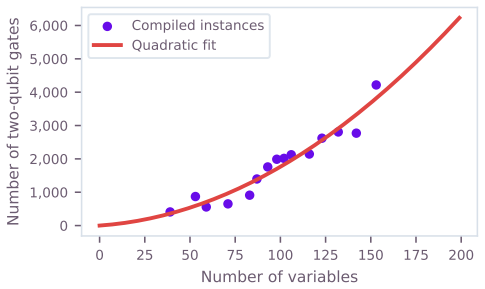
- The quantum resources for the 900-variable threshold are estimated at about 100,000 two-qubit gates, which the authors project will be available on superconducting devices with early error correction around 2029, making quantum-utility tests feasible by 2028.
- The QUBO approach matches or outperforms popular fast hydration-site prediction tools (including a deep learning method and a 3D-RISM-based method) on the tested protein-ligand complexes.
Where Pith is reading between the lines
- The strong correlation between QUBO size and prediction accuracy likely reflects the finer discretization of the 3D-RISM density (smaller grid spacing and threshold) rather than the optimizer's power per se; the paper's own large-scale data come from simulated annealing, so the quantum-hardware contribution to the trend is unverified.
- If the resource forecast holds, the same QUBO pipeline could be applied to other discrete choices in drug discovery — ligand side-chain placement, protonation states, cocrystal water networks — wherever the underlying scoring function can be expressed as pairwise interactions.
- The method inherits all approximations of 3D-RISM (force field, water model, grid); a testable extension is to swap in a machine-learned density predictor as a drop-in replacement for the costly 3D-RISM step, potentially reducing preprocessing time and decoupling the workflow's accuracy from the integral-equation approximation.
- A fair head-to-head at the 900-variable scale — quantum solver versus simulated annealing with matched sampling budgets and multiple seeds — would settle whether quantum hardware adds anything beyond the classical heuristic used for the large-scale extrapolation; the paper's current evidence is an estimate, not a measurement.
Editorial analysis
A structured set of objections, weighed in public.
Referee Report
Summary. The paper reports an end-to-end workflow for protein-pocket hydration-site prediction built on 3D-RISM water densities discretized into QUBO instances, solved with Q-CTRL's Fire Opal solver on IBM Heron devices. Hardware experiments cover instances of 41–116 variables (plus one 123-variable case); for all small instances the quantum solver finds the optimal solution, and its success probability is comparable to or better than simulated annealing on the examples shown. At 123 variables, CPLEX fails to certify optimality within a three-hour cutoff, and the Q-CTRL solver finds a lower-cost solution. Accuracy against crystallographic waters, reported in detail for the 3b7e system, improves as the QUBO size grows; for large instances solved with classical SA, the fraction of identified crystal waters reaches ~0.9. A gate-count extrapolation leads the authors to project that 900-variable instances require on the order of 100,000 two-qubit gates, implying that the problem may become addressable with early error correction. The paper also compares its method favorably against several classical hydration-prediction tools.
Significance. If the small-instance results are representative, this is a useful end-to-end demonstration of a concrete CADD task on gate-model NISQ hardware, with external validation against crystallographic waters and explicit comparison to classical solvers. The methodological value is the full pipeline—classical density computation, QUBO encoding, hardware execution, and hydration-accuracy evaluation—together with a transparent resource model that can be refined as hardware improves. The main limitation is that the headline claims about systematic accuracy improvement with qubit number and 'full quantum utility in reach' go beyond what is demonstrated: the accuracy trend at scale is computed with classical simulated annealing, not with the quantum solver, and the resource forecast rests on a short-range gate-count extrapolation.
major comments (5)
- [Problem scale-up / Figure 5 / Abstract] The abstract states that 'accuracy can be systematically improved with increasing number of qubits,' but the monotone improvement of C from ~0.6 to ~0.9 shown in Figure 5 (bottom) is computed from classical simulated-annealing solutions on 900–6824-variable QUBOs. The quantum solver is benchmarked only up to 123 variables (Figures 2–4), and at that largest shared scale (Figure 3b) SA and the Q-CTRL solver produce the same best cost, with SA achieving a higher sampling probability. The transfer from SA at 900+ variables to the quantum solver at 900 qubits is an assumption, not a demonstrated result. The abstract's 'full quantum utility is in reach' therefore overstates the evidence; the forecast section itself correctly acknowledges that a quantitative comparison with classical heuristics at target scale 'is not yet possible.' Please reframe the abstract and conclusions as a projection, n
- [Advantage forecasting / Figure 8] The estimate of ~100,000 two-qubit gates for a 900-variable instance is obtained by a quadratic fit to compiled two-qubit gate counts for instances of at most 156 variables. The fit has no stated uncertainty, no discussion of QAOA depth or connectivity assumptions, and no validation at intermediate scales. This extrapolation is load-bearing for the claimed 'quantum utility threshold' of 900 variables. In addition, the choice of 900 variables as the competitiveness threshold is derived from a single protein (3b7e) and a particular choice of grid parameters; no evidence is given that this threshold is representative of other protein-ligand complexes. Please provide a more conservative resource estimate and explicitly state the assumptions underlying the quadratic scaling.
- [Performance evaluation / Comparison to other methods] The abstract claims that 'our results reproduced experimental predictions on real-life protein-ligand complexes.' In the main text, however, the hydration-accuracy metrics (C, P*, <P>, <CS>) are reported for the 3b7e system only; the other five proteins from Table 1 are used to show that optimal QUBO solutions can be found, but their hydration-accuracy results are not summarized. If these results are in the Supplementary Information (as suggested by 'Figures S3–S6'), the main text should at least provide a compact summary, otherwise the cross-system claim is not verifiable from the paper. This is a central claim and should be supported in the main text.
- [Hardware deployment / Figure 3] The evidence for an 'advantageous situation' where quantum optimization beats exact classical solvers consists of a single 123-variable instance in which CPLEX on a laptop with a three-hour cutoff reaches a 40% optimality gap (Figure 3a). This is not sufficient to conclude that exact solvers 'typically scale poorly' for this problem class. The paper does not compare against state-of-the-art classical QUBO heuristics (e.g., GUROBI, tuned SA, or specialized local-search solvers) at the same instance scale. The 'quantum utility' framing would be more defensible if the authors showed that a range of instances at this scale are hard for a variety of classical exact and heuristic approaches, rather than relying on a single CPLEX run with a fixed time cutoff.
- [Methods, Eq. (5)] The definition of the averaged precision <P> in Eq. (5) is unclear and likely contains a mathematical typo. As typeset, the expression is (1/n) * sum_i ( [some cluster sum] / n ), which introduces a spurious 1/n factor and makes the metric depend on the total number of crystal waters n rather than the cluster sizes. The text says the metric should penalize large, diffuse clusters, but the written formula does not obviously do so. Since the accuracy comparisons in Figures 5 and 7 rely on this metric, please provide a mathematically precise definition and explain how it encodes the claimed penalties.
minor comments (5)
- [Problem scale-up] Typographical issues: '55-7 fold increase' should likely read '5-7 fold increase'; 'Table??' should be a properly numbered reference; 'GGM' in the Methods section should be 'GMM'; '3D spacer' should be '3D space'.
- [Methods, Eq. (1)] The integral in Eq. (1) is written over 'C' without specifying the domain or measure; please define the integration region (presumably the localized cubic subdomain).
- [Discussion / Abstract] The paper uses 'quantum utility' (defined by IBM as outperforming exact solvers) and 'quantum advantage' (outperforming heuristics) almost interchangeably in the Discussion. These are distinct regimes; please define and use the terms consistently.
- [Advantage forecasting] The statement 'we therefore regard it as plausible that the Q-CTRL solver will achieve performance at least comparable to SA once hardware is sufficiently stable' is reasonable, but it is presented in the abstract as a definite result. Aligning the abstract with this cautious wording would strengthen the paper.
- [Comparison to other methods] In Figure 7, the error bars and significance of the differences between methods are not discussed; consider adding a brief comment on whether the observed differences are statistically meaningful given the reported 95% confidence intervals.
Circularity Check
No significant circularity: the QUBO evaluation is externally benchmarked against crystal waters; the main extrapolations are projections, not reductions.
full rationale
The derivation chain is: 3D-RISM density -> GMM fit objective (Eq. 1) -> QUBO (Eq. 2) -> quantum/classical optimization -> comparison to crystal waters. The QUBO coefficients are computed from g(r), not from the crystal-water positions used for evaluation, so the accuracy metrics (C, P, <P>, <CS>) are an external benchmark rather than a restatement of the objective. The QUBO-to-Ising mapping is cited to the authors' prior work [41], but that work is a published derivation with stated assumptions (L2 fit to a Gaussian mixture), and the present paper independently tests the resulting predictions against experimental waters, so the self-citation is not circular. The 'accuracy improves with qubit count' claim combines quantum results at <=123 variables with classical SA results at 900-6824 variables; the transfer of the trend to a 900-qubit quantum device is explicitly acknowledged as not yet testable ('a quantitative comparison with classical heuristics, such as SA, at the target scale is not yet possible'). This is an extrapolation/projection, not a prediction forced by construction. Similarly, the quadratic two-qubit-gate fit is an empirical extrapolation of compilation data, not a result equivalent to the target. No uniqueness theorem, fitted parameter renamed as prediction, or ansatz smuggled via self-citation was found.
Axiom & Free-Parameter Ledger
free parameters (6)
- Grid spacing δ per instance =
0.95-1.25 Å (Table 2)
- Density threshold τg =
0.10-0.17 (Table 2)
- Gaussian variance σ² =
0.8-1.0 Ų (Table 2)
- Binding-pocket subdomain size =
15 Å cube
- Evaluation radius Rs =
3 Å
- Gate-count quadratic fit coefficients =
not reported
axioms (5)
- domain assumption The 3D-RISM density g(r) contains the thermodynamic information needed to locate stable hydration sites.
- domain assumption Minimizing the L2 difference between g(r) and a uniform-variance Gaussian mixture yields physically meaningful water positions.
- domain assumption Crystallographic waters in the PDB files are correct reference hydration sites within a 3 Å radius.
- ad hoc to paper The quadratic scaling of two-qubit gate count observed for ≤156 variables continues to 900 variables.
- domain assumption Classical simulated annealing will degrade relative to the quantum solver at larger problem sizes.
read the original abstract
Demonstrating the practical utility of Noisy Intermediate-Scale Quantum (NISQ) hardware for recurrent tasks in Computer-Aided Drug Discovery is of paramount importance. We tackle this challenge by performing three-dimensional protein pockets hydration-site prediction on a quantum computer. Formulating the water placement problem as a Quadratic Unconstrained Binary Optimization (QUBO), we use a hybrid approach coupling a classical three-dimensional reference-interaction site model (3D-RISM) to an efficient quantum optimization solver, to run various hardware experiments up to 123 qubits. Matching the precision of classical approaches, our results reproduced experimental predictions on real-life protein-ligand complexes. Furthermore, through a detailed resource estimation analysis, we show that accuracy can be systematically improved with increasing number of qubits, indicating that full quantum utility is in reach. Finally, we provide evidence that advantageous situations could be found for systems where classical optimization struggles to provide optimal solutions. The method has potential for assisting simulations of protein-ligand complexes for drug lead optimization and setup of docking calculations.
Figures



Reference graph
Works this paper leans on
-
[1]
An Updated Review of Computer-Aided Drug Design and Its Application to COVID-19
Arun Bahadur Gurung et al. “An Updated Review of Computer-Aided Drug Design and Its Application to COVID-19”. In:BioMed Research International2021.1 (2021), p. 8853056
2021
-
[2]
CADD, AI and ML in drug discovery: A comprehensive review
Divya Vemula et al. “CADD, AI and ML in drug discovery: A comprehensive review”. In:European Journal of Pharmaceutical Sciences181 (2023), p. 106324.ISSN: 0928-0987
2023
-
[3]
A Guide to In Silico Drug Design
Yiqun Chang et al. “A Guide to In Silico Drug Design”. In:Pharmaceutics15.1 (2023)
2023
-
[4]
Shedding Light on Important Waters for Drug Design: Simulations versus Grid-Based Methods
Denis Bucher, Pieter Stouten, and Nicolas Triballeau. “Shedding Light on Important Waters for Drug Design: Simulations versus Grid-Based Methods”. In:J. Chem. Inf. and Mod.58.3 (2018), pp. 692–699
2018
-
[5]
Marharyta Blazhynska et al. “From Water Networks to Binding Affinities:Resolving Solvation Dynamics for Accurate Protein-Ligand Predictions”. In:bioRxiv(2025).DOI:10.1101/2025.10.17.683050
-
[6]
Rapid and accurate prediction and scoring of water molecules in protein binding sites
Gregory A Ross, Garrett M Morris, and Philip C Biggin. “Rapid and accurate prediction and scoring of water molecules in protein binding sites”. In:PLOS ONE7.3 (2012), e32036
2012
-
[7]
Analysis of Ligand-Bound Water Molecules in High-Resolution Crystal Structures of Protein−Ligand Complexes
Yipin Lu et al. “Analysis of Ligand-Bound Water Molecules in High-Resolution Crystal Structures of Protein−Ligand Complexes”. In:Journal of Chemical Information and Modeling47.2 (2007), pp. 668–675
2007
-
[8]
Prediction of the Water Content in Protein Binding Sites
Julien Michel, Julian Tirado-Rives, and William L. Jorgensen. “Prediction of the Water Content in Protein Binding Sites”. In:J. Phy. Chem. B113.40 (2009), pp. 13337–13346
2009
-
[9]
Calculated hydration free energies become less accurate with increases in molecular weight
Stefan M Ivanov. “Calculated hydration free energies become less accurate with increases in molecular weight”. In: PLOS ONE19.9 (2024), e0309996
2024
-
[10]
Water molecules at protein–drug interfaces: computational prediction and analysis methods
Marley L. Samways et al. “Water molecules at protein–drug interfaces: computational prediction and analysis methods”. In:Chem. Soc. Rev.50 (16 2021), pp. 9104–9120
2021
-
[11]
Lambda-ABF: Simplified, Portable, Accurate, and Cost-Effective Alchemical Free-Energy Computation
Louis Lagardère et al. “Lambda-ABF: Simplified, Portable, Accurate, and Cost-Effective Alchemical Free-Energy Computation”. In:Journal of Chemical Theory and Computation20.11 (2024), pp. 4481–4498
2024
-
[12]
Lambda-ABF-OPES: Faster Convergence with High Accuracy in Alchemical Free Energy Calcula- tions
Narjes Ansari et al. “Lambda-ABF-OPES: Faster Convergence with High Accuracy in Alchemical Free Energy Calcula- tions”. In:The Journal of Physical Chemistry Letters16.19 (2025), pp. 4626–4634
2025
-
[13]
Efficient Drug Lead Discovery and Optimization
William L. Jorgensen. “Efficient Drug Lead Discovery and Optimization”. In:Accounts of Chemical Research42.6 (2009), pp. 724–733
2009
-
[14]
Molecular Dynamics: Survey of Methods for Simulating the Activity of Proteins
Stewart A. Adcock and J. Andrew McCammon. “Molecular Dynamics: Survey of Methods for Simulating the Activity of Proteins”. In:Chemical Reviews106.5 (2006), pp. 1589–1615
2006
-
[15]
Enhanced Sampling Methods for Molecular Dynamics Simulations [Article v1.0]
Jérôme Hénin et al. “Enhanced Sampling Methods for Molecular Dynamics Simulations [Article v1.0]”. In:Living Journal of Computational Molecular Science4.1 (Dec. 2022), p. 1583
2022
-
[16]
Strategies to calculate water binding free energies in protein–ligand complexes
Michael S Bodnarchuk et al. “Strategies to calculate water binding free energies in protein–ligand complexes”. In: Journal of Chemical Information and Modeling54.6 (2014), pp. 1623–1633
2014
-
[17]
The role of water molecules in computational drug design
Stephanie de Beer, Nico PE Vermeulen, and Chris Oostenbrink. “The role of water molecules in computational drug design”. In:Current topics in medicinal chemistry10.1 (2010), pp. 55–66
2010
-
[18]
On the Thermodynamics of Water Displacement from Binding Sites and its Contributions to Supramolecular and Biomolecular Affinity
Jeffry Setiadi et al. “On the Thermodynamics of Water Displacement from Binding Sites and its Contributions to Supramolecular and Biomolecular Affinity”. In:Angewandte Chemie International Edition(2025), e202505713
2025
-
[19]
Enhancing sampling of water rehydration upon ligand binding using variants of grand canonical Monte Carlo
Yunhui Ge et al. “Enhancing sampling of water rehydration upon ligand binding using variants of grand canonical Monte Carlo”. In:Journal of computer-aided molecular design36.10 (2022), pp. 767–779
2022
-
[20]
High-resolution mining of the SARS-CoV-2 main protease conformational space: supercomputer- driven unsupervised adaptive sampling
Théo Jaffrelot Inizan et al. “High-resolution mining of the SARS-CoV-2 main protease conformational space: supercomputer- driven unsupervised adaptive sampling”. In:Chem. Sci.12 (13 2021), pp. 4889–4907
2021
-
[21]
Interfacial Water Many-Body Effects Drive Structural Dynamics and Allosteric Interactions in SARS-CoV-2 Main Protease Dimerization Interface
Dina El Ahdab et al. “Interfacial Water Many-Body Effects Drive Structural Dynamics and Allosteric Interactions in SARS-CoV-2 Main Protease Dimerization Interface”. In:The Journal of Physical Chemistry Letters12.26 (2021), pp. 6218–6226
2021
-
[22]
Histidine 73 methylation coordinates β-actin plasticity in response to key environmental factors
Adrien Schahl et al. “Histidine 73 methylation coordinates β-actin plasticity in response to key environmental factors”. In:Nature Communications16.1 (2025), p. 2304
2025
-
[23]
Computationally driven discovery of SARS-CoV-2 Mpro inhibitors: from design to experimental validation
Léa El Khoury et al. “Computationally driven discovery of SARS-CoV-2 Mpro inhibitors: from design to experimental validation”. In:Chem. Sci.13 (13 2022), pp. 3674–3687. 17/20
2022
-
[24]
Targeting RNA with small molecules using state-of-the-art methods provides highly predictive affinities of riboswitch inhibitors
Narjes Ansari et al. “Targeting RNA with small molecules using state-of-the-art methods provides highly predictive affinities of riboswitch inhibitors”. In:Communications Biology8.1 (2025), p. 1405
2025
-
[25]
Tinker-HP: a massively parallel molecular dynamics package for multiscale simulations of large complex systems with advanced point dipole polarizable force fields
Louis Lagardère et al. “Tinker-HP: a massively parallel molecular dynamics package for multiscale simulations of large complex systems with advanced point dipole polarizable force fields”. In:Chem. Sci.9 (4 2018), pp. 956–972
2018
-
[26]
Tinker-HP: Accelerating Molecular Dynamics Simulations of Large Complex Systems with Advanced Point Dipole Polarizable Force Fields Using GPUs and Multi-GPU Systems
Olivier Adjoua et al. “Tinker-HP: Accelerating Molecular Dynamics Simulations of Large Complex Systems with Advanced Point Dipole Polarizable Force Fields Using GPUs and Multi-GPU Systems”. In:Journal of Chemical Theory and Computation17.4 (2021), pp. 2034–2053
2021
-
[27]
A GPU-accelerated fast multipole method for GROMACS: performance and accuracy
Bartosz Kohnke, Carsten Kutzner, and Helmut Grubmüller. “A GPU-accelerated fast multipole method for GROMACS: performance and accuracy”. In:Journal of Chemical Theory and Computation16.11 (2020), pp. 6938–6949
2020
-
[28]
Scalable molecular dynamics on CPU and GPU architectures with NAMD
James C Phillips et al. “Scalable molecular dynamics on CPU and GPU architectures with NAMD”. In:The Journal of chemical physics153.4 (2020)
2020
-
[29]
Recent Developments in Amber Biomolecular Simulations
David A. Case et al. “Recent Developments in Amber Biomolecular Simulations”. In:Journal of Chemical Information and Modeling65.15 (2025), pp. 7835–7843
2025
-
[30]
Filippo Bigi et al.FlashMD: long-stride, universal prediction of molecular dynamics. 2025. arXiv: 2505.19350 [physics.chem-ph].URL:https://arxiv.org/abs/2505.19350
arXiv 2025
-
[31]
Michael Plainer et al.Consistent Sampling and Simulation: Molecular Dynamics with Energy-Based Diffusion Models
-
[32]
Machine Learning for Molecular Simulation
Frank Noé et al. “Machine Learning for Molecular Simulation”. In:Annual Review of Physical Chemistry71.V olume 71, 2020 (2020), pp. 361–390.ISSN: 1545-1593.DOI: https : / / doi . org / 10 . 1146 / annurev - physchem - 042018 - 052331.URL: https : / / www . annualreviews . org / content / journals / 10 . 1146 / annurev-physchem-042018-052331
2020
-
[33]
Anastasia Agathangelou, Dilhan Manawadu, and Ivano Tavernelli.Quantum Algorithm for Protein Side-Chain Op- timisation: Comparing Quantum to Classical Methods. 2025. arXiv: 2507.19383 [quant-ph] .URL: https: //arxiv.org/abs/2507.19383
Pith/arXiv arXiv 2025
-
[34]
Quantum Speedup for Nonreversible Markov Chains
Baptiste Claudon, Jean-Philip Piquemal, and Pierre Monmarché. “Quantum Speedup for Nonreversible Markov Chains”. In:Nature Communications(2025).URL:https://doi.org/10.1038/s41467-025-65761-5
-
[35]
Quantum Circuits for the Metropolis-Hastings Algorithm
Baptiste Claudon et al. “Quantum Circuits for the Metropolis-Hastings Algorithm”. In:arXiv preprint arXiv:2506.11576 (2025). arXiv: 2506.11576 [quant-ph].URL: https://dx.doi.org/10.48550/arXiv.2506.11576
-
[36]
Resource-efficient quantum algorithm for protein folding
Anton Robert et al. “Resource-efficient quantum algorithm for protein folding”. In:npj Quantum Information7.1 (Feb. 2021), p. 38
2021
-
[37]
Quantum algorithm for protein-ligand docking sites identification in the interaction space
Ioannis Liliopoulos et al. “Quantum algorithm for protein-ligand docking sites identification in the interaction space”. In: Journal of Computer-Aided Molecular Design39.1 (July 2025), p. 40.ISSN: 1573-4951.DOI: 10.1007/s10822- 025-00620-5.URL:https://doi.org/10.1007/s10822-025-00620-5
-
[38]
Molecular docking via quantum approximate optimization algorithm
Qi-Ming Ding, Yi-Ming Huang, and Xiao Yuan. “Molecular docking via quantum approximate optimization algorithm”. In:Phys. Rev. Appl.21 (3 Mar. 2024), p. 034036.DOI: 10.1103/PhysRevApplied.21.034036.URL: https: //link.aps.org/doi/10.1103/PhysRevApplied.21.034036
-
[39]
A hybrid quantum computing pipeline for real world drug discovery
Weitang Li et al. “A hybrid quantum computing pipeline for real world drug discovery”. In:Scientific Reports14.1 (July 2024), p. 16942
2024
-
[40]
A brief review on quantum computing based drug design
Poulami Das et al. “A brief review on quantum computing based drug design”. In:WIREs Data Mining and Knowledge Discovery14.6 (2024), e1553
2024
-
[41]
Leveraging analog quantum computing with neutral atoms for solvent configuration prediction in drug discovery
Mauro D’Arcangelo et al. “Leveraging analog quantum computing with neutral atoms for solvent configuration prediction in drug discovery”. In:Physical Review Research6.4 (2024), p. 043020
2024
-
[42]
Experimental Benchmarking of an Automated Deterministic Error-Suppression Workflow for Quantum Algorithms
Pranav S. Mundada et al. “Experimental Benchmarking of an Automated Deterministic Error-Suppression Workflow for Quantum Algorithms”. In:Phys. Rev. Appl.20 (2 Aug. 2023), p. 024034
2023
-
[43]
Natasha Sachdeva et al.Quantum optimization using a 127-qubit gate-model IBM quantum computer can outperform quantum annealers for nontrivial binary optimization problems. 2024. arXiv: 2406.01743 [quant-ph] .URL: https://arxiv.org/abs/2406.01743
Pith/arXiv arXiv 2024
-
[44]
Water Networks in Complexes between Proteins and FDA-Approved Drugs
Marley L. Samways et al. “Water Networks in Complexes between Proteins and FDA-Approved Drugs”. In:Journal of Chemical Information and Modeling63.1 (2023), pp. 387–396. 18/20
2023
-
[45]
Natasha Sachdeva et al.Quantum optimization using a 127-qubit gate-model IBM quantum computer can outperform quantum annealers for nontrivial binary optimization problems. arXiv:2406.01743 [quant-ph]. June 2024.DOI: 10. 48550/arXiv.2406.01743.URL:http://arxiv.org/abs/2406.01743(visited on 06/25/2024)
-
[46]
en.URL:https://www.ibm.com/quantum/technology (visited on 11/12/2025)
IBM Quantum Computing | Technology and roadmap. en.URL:https://www.ibm.com/quantum/technology (visited on 11/12/2025)
2025
-
[47]
Placement of Water Molecules in Protein Structures: From Large-Scale Evaluations to Single-Case Examples
Eva Nittinger et al. “Placement of Water Molecules in Protein Structures: From Large-Scale Evaluations to Single-Case Examples”. In:Journal of Chemical Information and Modeling58.8 (2018), pp. 1625–1637
2018
-
[48]
Performance of 3D-RISM-KH in Predicting Hydration Free Energy: Effect of Solute Parameters
Dipankar Roy and Andriy Kovalenko. “Performance of 3D-RISM-KH in Predicting Hydration Free Energy: Effect of Solute Parameters”. In:J. Phy. Chem. A123.18 (2019), pp. 4087–4093
2019
-
[49]
HydraProt: A New Deep Learning Tool for Fast and Accurate Prediction of Water Molecule Positions for Protein Structures
Andreas Zamanos, George Ioannakis, and Ioannis Z. Emiris. “HydraProt: A New Deep Learning Tool for Fast and Accurate Prediction of Water Molecule Positions for Protein Structures”. In:J. Chem. Inf. and Modeling64.7 (2024), pp. 2594–2611
2024
-
[50]
Placevent: an algorithm for prediction of explicit solvent atom distribution-application to HIV-1 protease and F-ATP synthase
Daniel J Sindhikara, Norio Yoshida, and Fumio Hirata. “Placevent: an algorithm for prediction of explicit solvent atom distribution-application to HIV-1 protease and F-ATP synthase”. en. In:J Comput Chem33.18 (Apr. 2012), pp. 1536–1543
2012
-
[51]
W ATGEN: An algorithm for modeling water networks at protein–protein interfaces
Huynh-Hoa Bui, Alexandra J. Schiewe, and Ian S. Haworth. “W ATGEN: An algorithm for modeling water networks at protein–protein interfaces”. In:J. Comp. Chem.28.14 (2007), pp. 2241–2251
2007
-
[52]
Dowser++, a new method of hydrating protein structures
A. Morozenko and A. A. Stuchebrukhov. “Dowser++, a new method of hydrating protein structures”. In:Proteins: Structure, Function, and Bioinformatics84.10 (2016), pp. 1347–1357
2016
-
[53]
Optimization by Simulated Annealing: An Experimental Evaluation; Part I, Graph Partitioning
David S. Johnson et al. “Optimization by Simulated Annealing: An Experimental Evaluation; Part I, Graph Partitioning”. In:Operations Research37.6 (Dec. 1989). Publisher: INFORMS, pp. 865–892.ISSN: 0030-364X.DOI: 10.1287/ opre.37.6.865 .URL: https://pubsonline.informs.org/doi/abs/10.1287/opre.37.6.865 (visited on 11/21/2025)
-
[54]
David S. Johnson et al. “Optimization by Simulated Annealing: An Experimental Evaluation; Part II, Graph Coloring and Number Partitioning”. In:Operations Research39.3 (June 1991). Publisher: INFORMS, pp. 378–406.ISSN: 0030-364X. DOI: 10.1287/opre.39.3.378 .URL: https://pubsonline.informs.org/doi/10.1287/opre. 39.3.378(visited on 11/21/2025)
-
[55]
The Theory and Practice of Simulated Annealing
Darrall Henderson, Sheldon H. Jacobson, and Alan W. Johnson. “The Theory and Practice of Simulated Annealing”. en. In:Handbook of Metaheuristics. Ed. by Fred Glover and Gary A. Kochenberger. Boston, MA: Springer US, 2003, pp. 287– 319.ISBN: 978-0-306-48056-0.DOI: 10.1007/0-306-48056-5_10 .URL: https://doi.org/10.1007/0- 306-48056-5_10(visited on 11/21/2025)
-
[56]
Michael Streif and Martin Leib.Comparison of QAOA with Quantum and Simulated Annealing. en. Jan. 2019.URL: https://arxiv.org/abs/1901.01903v1(visited on 11/21/2025)
Pith/arXiv arXiv 2019
-
[57]
Leo Zhou et al.Quantum Approximate Optimization Algorithm: Performance, Mechanism, and Implementation on Near-Term Devices. en. Dec. 2018.DOI: 10.1103/PhysRevX.10.021067.URL: https://arxiv.org/abs/ 1812.01041v2(visited on 11/21/2025)
Pith/arXiv arXiv 2018
-
[58]
Three-Dimensional Molecular Theory of Solvation Coupled with Molecular Dynamics in Amber
Tyler Luchko et al. “Three-Dimensional Molecular Theory of Solvation Coupled with Molecular Dynamics in Amber”. In:Journal of Chemical Theory and Computation6.3 (2010), pp. 607–624
2010
-
[59]
AmberTools
David A. Case et al. “AmberTools”. In:J. Chem. Inf. Mod.63.20 (2023), pp. 6183–6191
2023
-
[60]
ff14SB: Improving the Accuracy of Protein Side Chain and Backbone Parameters from ff99SB
James A. Maier et al. “ff14SB: Improving the Accuracy of Protein Side Chain and Backbone Parameters from ff99SB”. In:Journal of Chemical Theory and Computation11.8 (2015), pp. 3696–3713
2015
-
[61]
The missing term in effective pair potentials
H. J. C. Berendsen, J. R. Grigera, and T. P. Straatsma. “The missing term in effective pair potentials”. In:The Journal of Physical Chemistry91.24 (1987), pp. 6269–6271
1987
-
[62]
3D-RISM-AI: A Machine Learning Approach to Predict Protein–Ligand Binding Affinity Using 3D-RISM
Kazu Osaki et al. “3D-RISM-AI: A Machine Learning Approach to Predict Protein–Ligand Binding Affinity Using 3D-RISM”. In:J. Phys. Chem. B126.33 (2022), pp. 6148–6158
2022
-
[63]
Solvation entropy, enthalpy and free energy prediction using a multi-task deep learning functional in 1D-RISM
Daniel J. Fowles and David S. Palmer. “Solvation entropy, enthalpy and free energy prediction using a multi-task deep learning functional in 1D-RISM”. In:Phys. Chem. Chem. Phys.25 (9 2023), pp. 6944–6954
2023
-
[64]
Optimal water networks in protein cavities with GAsol and 3D-RISM
Lucia Fusani et al. “Optimal water networks in protein cavities with GAsol and 3D-RISM”. In:Bioinformatics34.11 (2018), pp. 1947–1948. 19/20
2018
-
[65]
Edward Farhi, Jeffrey Goldstone, and Sam Gutmann.A Quantum Approximate Optimization Algorithm. arXiv:1411.4028 [quant-ph]. Nov. 2014.URL:http://arxiv.org/abs/1411.4028(visited on 11/24/2023)
Pith/arXiv arXiv 2014
-
[66]
en.DOI: 10.1126/sciadv.adm6761 .URL: https://www.science.org/doi/10.1126/sciadv
Evidence of scaling advantage for the quantum approximate optimization algorithm on a classically intractable problem. en.DOI: 10.1126/sciadv.adm6761 .URL: https://www.science.org/doi/10.1126/sciadv. adm6761(visited on 04/17/2025)
-
[67]
Sami Boulebnane and Ashley Montanaro.Solving boolean satisfiability problems with the quantum approximate optimization algorithm. arXiv:2208.06909 [quant-ph]. Aug. 2022.DOI: 10.48550/arXiv.2208.06909 .URL: http://arxiv.org/abs/2208.06909(visited on 11/13/2025)
-
[68]
Sivaprasad Omanakuttan et al.Threshold for Fault-tolerant Quantum Advantage with the Quantum Approximate Optimization Algorithm. arXiv:2504.01897 [quant-ph]. Apr. 2025.DOI: 10.48550/arXiv.2504.01897 .URL: http://arxiv.org/abs/2504.01897(visited on 04/03/2025)
-
[69]
Noise-induced barren plateaus in variational quantum algorithms
Samson Wang et al. “Noise-induced barren plateaus in variational quantum algorithms”. en. In:Nature Communications 12.1 (Nov. 2021). Publisher: Nature Publishing Group, p. 6961.ISSN: 2041-1723.DOI: 10.1038/s41467-021- 27045-6.URL:https://www.nature.com/articles/s41467-021-27045-6(visited on 11/13/2025)
-
[70]
Scaling of the quantum approximate optimization algorithm on superconducting qubit based hardware
Johannes Weidenfeller et al. “Scaling of the quantum approximate optimization algorithm on superconducting qubit based hardware”. en-GB. In:Quantum6 (Dec. 2022). Publisher: Verein zur Förderung des Open Access Publizierens in den Quantenwissenschaften, p. 870.DOI: 10.22331/q- 2022- 12- 07- 870 .URL: https://quantum- journal.org/papers/q-2022-12-07-870/(vi...
doi:10.22331/q- 2022
-
[71]
Short-depth QAOA circuits and quantum annealing on higher-order ising models
Elijah Pelofske, Andreas Bärtschi, and Stephan Eidenbenz. “Short-depth QAOA circuits and quantum annealing on higher-order ising models”. en. In:npj Quantum Information10.1 (Mar. 2024). Publisher: Nature Publishing Group, p. 30. ISSN: 2056-6387.DOI: 10.1038/s41534-024-00825-w .URL: https://www.nature.com/articles/ s41534-024-00825-w(visited on 11/13/2025)
-
[72]
Accelerating the schedule for quantum-enhanced rail | Q-CTRL. en. Section: Case Studies. Aug. 2025.URL: https: //q- ctrl.com/case- study/accelerating- the- schedule- for- quantum- enhanced- rail (visited on 11/12/2025). 20/20
2025
-
[2025]
arXiv:2506.17139 [cs.LG].URL:https://arxiv.org/abs/2506.17139
discussion (0)
Sign in with ORCID, Apple, or X to comment. Anyone can read and Pith papers without signing in.