Recognition: 2 theorem links
· Lean TheoremA search for successful and choked jets in nearby broad-lined Type Ic supernovae
Pith reviewed 2026-05-16 23:36 UTC · model grok-4.3
The pith
Radio observations of nearby broad-lined Type Ic supernovae tighten the upper limit on events with relativistic jets comparable to SN 1998bw.
A machine-rendered reading of the paper's core claim, the machinery that carries it, and where it could break.
Core claim
The central discovery is that the fraction of SNe Ic-BL producing relativistic jets as powerful as SN 1998bw is further constrained to be small based on the lack of strong radio signals in the new sample. The authors identify SN 2024rjw as radio-loud due to CSM interaction and support similar for SN 2020jqm, and establish new upper limits on velocity and energy for radio-emitting ejecta consistent with choked jet cocoons, particularly highlighting SN 2022xxf.
What carries the argument
Synchrotron radio emission modeling from fast ejecta to constrain jet energy, velocity, and the presence of successful or choked jets versus CSM interaction.
If this is right
- The fraction of SNe Ic-BL as relativistic as 1998bw is reduced.
- SN 2024rjw and SN 2020jqm are likely powered by CSM interaction rather than jets.
- SN 2022xxf shows properties consistent with cocoon emission from a choked jet.
- These results help map the continuum from ordinary SNe Ic-BL to engine-driven explosions and GRBs.
- Improved sample aids future searches for electromagnetic counterparts to high-energy neutrinos.
Where Pith is reading between the lines
- If the constraints hold across larger samples, most core-collapse events in massive stars do not launch successful jets even at low energies.
- Choked jet models may need refinement to match the observed radio limits in cocoon candidates.
- Multi-messenger observations could test whether neutrino production correlates with the radio-quiet or cocoon events identified here.
- The CSM interaction interpretation implies specific progenitor mass-loss histories that can be checked with optical spectroscopy.
Load-bearing premise
The assumption that non-detections or specific radio signatures rule out relativistic jets, relying on standard models of jet propagation and emission that may not fully apply to these events.
What would settle it
A future nearby SN Ic-BL detected with radio luminosity and duration matching or exceeding that of SN 1998bw would increase the allowed fraction of relativistic events.
Figures
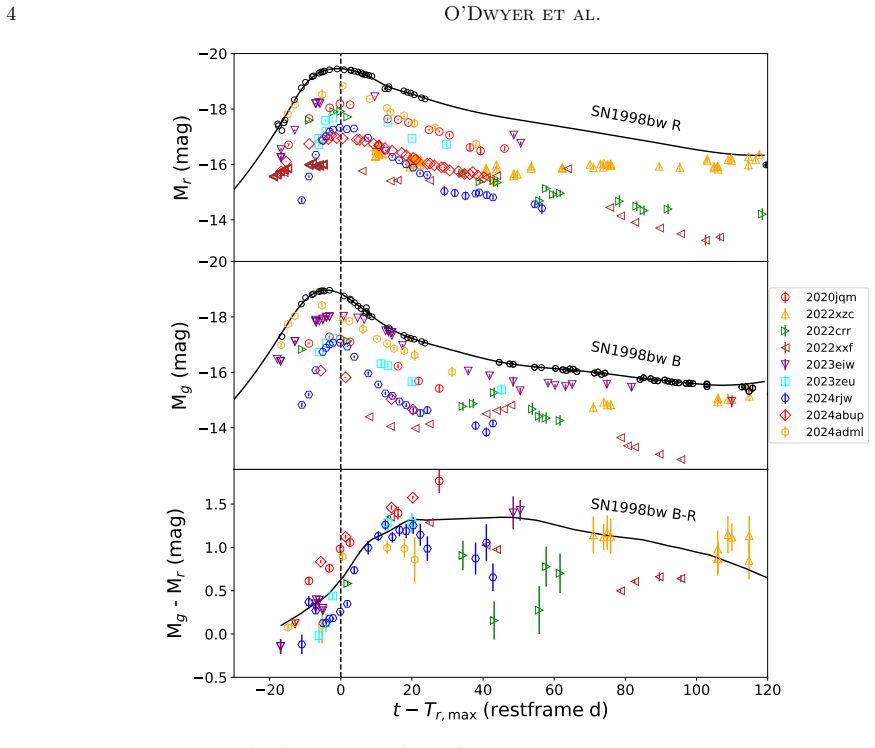


read the original abstract
The observational link between long gamma-ray bursts (GRBs) and broad-lined stripped-envelope core-collapse supernovae (SNe Ic-BL) is well established. Significant progress has been made in constraining what fraction of SNe Ic-BL may power high- or low-luminosity GRBs when viewed at small off-axis angles. However, the GRB-SN connection still lacks a complete understanding in the broader context of massive-star evolution and explosion physics. Models predict a continuum of outcomes for the fastest ejecta, from choked to ultra-relativistic jets, and observations from radio to X-rays are key to probing these scenarios across a range of viewing angles and velocities. Here, we present results from a coordinated radio-to-X-ray campaign targeting nearby (z<=0.1) SNe Ic-BL designed to explore this diversity. With eight new radio-monitored events and updated data for one previously observed SN, we further tighten constraints on the fraction of SNe Ic-BL as relativistic as SN 1998bw/GRB 980425. We identify SN 2024rjw as a new radio-loud event likely powered by strong interaction with circumstellar material (CSM), and add evidence supporting a similar interpretation for SN 2020jqm. We also establish new limits on the properties of radio-emitting ejecta with velocities consistent with cocoons from choked jets, highlighting SN 2022xxf as a promising cocoon-dominated candidate. These results refine our understanding of the continuum linking ordinary SNe Ic-BL, engine-driven explosions, and GRBs, and contribute to building a sample that will inform future multi-messenger searches for electromagnetic counterparts to high-energy neutrinos.
Editorial analysis
A structured set of objections, weighed in public.
Referee Report
Summary. The manuscript reports results from a radio-to-X-ray observational campaign targeting nearby (z ≤ 0.1) broad-lined Type Ic supernovae. With eight new radio-monitored events plus updated data for one prior SN, the authors tighten constraints on the fraction of SNe Ic-BL that are relativistic like SN 1998bw/GRB 980425. They classify SN 2024rjw as a new radio-loud event likely powered by CSM interaction, add supporting evidence for a similar interpretation of SN 2020jqm, and derive new limits on radio-emitting ejecta velocities consistent with cocoons from choked jets, highlighting SN 2022xxf as a candidate.
Significance. If the event classifications and velocity/energy limits hold, the work strengthens empirical constraints on the diversity of fastest-ejecta outcomes in SNe Ic-BL and expands the sample available for multi-messenger searches. The addition of new, well-monitored events directly addresses the need for a more complete observational picture of the GRB-SN connection across viewing angles.
major comments (1)
- [Results and modeling sections (discussion of SN 2024rjw, SN 2020jqm, and SN 2022xxf)] The central claim of a tightened relativistic fraction rests on the exclusion of v ≳ 0.3c jets for most of the nine events and on cocoon limits for candidates such as SN 2022xxf. These conclusions are obtained by converting observed radio flux, peak time, and frequency into velocity and energy using standard synchrotron models; the manuscript does not report a sensitivity analysis to variations in the microphysical parameters (ε_e, ε_B, p) or CSM density profile. If these assumptions shift the inferred velocities across the relativistic threshold, the fraction constraint is directly affected.
minor comments (2)
- [Abstract and §3 (or equivalent methods/results)] The abstract states that the modeling assumptions are 'standard but untested' for this sample; the main text should explicitly list the numerical values adopted for ε_e, ε_B, p, and the CSM density power-law index so that readers can reproduce the velocity limits.
- [Figures showing radio data and model fits] Radio light-curve figures should include the assumed microphysical parameters and CSM density in the caption or legend to facilitate direct comparison with future observations.
Simulated Author's Rebuttal
We thank the referee for their constructive and detailed review. We address the major comment below and have revised the manuscript to incorporate a sensitivity analysis as requested.
read point-by-point responses
-
Referee: [Results and modeling sections (discussion of SN 2024rjw, SN 2020jqm, and SN 2022xxf)] The central claim of a tightened relativistic fraction rests on the exclusion of v ≳ 0.3c jets for most of the nine events and on cocoon limits for candidates such as SN 2022xxf. These conclusions are obtained by converting observed radio flux, peak time, and frequency into velocity and energy using standard synchrotron models; the manuscript does not report a sensitivity analysis to variations in the microphysical parameters (ε_e, ε_B, p) or CSM density profile. If these assumptions shift the inferred velocities across the relativistic threshold, the fraction constraint is directly affected.
Authors: We thank the referee for highlighting this important point. We agree that a sensitivity analysis strengthens the robustness of the velocity inferences and the resulting constraint on the relativistic fraction. In the revised manuscript we have added a new subsection (Section 5.3) and Appendix B that perform this analysis. We re-derived velocities and energies for SN 2024rjw, SN 2020jqm, SN 2022xxf and the non-relativistic sample while varying ε_e from 0.01–0.1, ε_B from 0.001–0.1, p from 2.5–3.5, and testing both wind (ρ ∝ r^{-2}) and constant-density CSM profiles. Across this parameter space the inferred velocities for the eight non-relativistic events remain below 0.3c (maximum shift < factor of 1.8), and the cocoon limits for SN 2022xxf are stable. The CSM-interaction classification for SN 2024rjw and SN 2020jqm is likewise unaffected. We have also updated the methods section to state the fiducial parameters explicitly. These additions confirm that the tightened relativistic fraction constraint is robust. revision: yes
Circularity Check
No significant circularity: purely observational constraints from radio data
full rationale
The paper reports new radio observations of eight SNe Ic-BL plus updated data for one prior event, classifies a subset as CSM-interaction powered (e.g., SN 2024rjw) or cocoon candidates (e.g., SN 2022xxf), and tightens the upper limit on the relativistic fraction relative to SN 1998bw. All quantitative limits are obtained by direct comparison of measured flux densities, peak times, and frequencies against standard synchrotron and jet-propagation models; no parameter is fitted to the present sample and then re-labeled as a 'prediction,' no self-citation supplies a uniqueness theorem or ansatz that the central claim depends on, and no equation equates an output to its own input by construction. The modeling assumptions are external and stated as such; they do not create a closed loop within the paper's own derivations.
Axiom & Free-Parameter Ledger
Lean theorems connected to this paper
-
IndisputableMonolith/Foundation/RealityFromDistinction.leanreality_from_one_distinction unclear?
unclearRelation between the paper passage and the cited Recognition theorem.
We also compare our data with ... afterglowpy cocoon models ... with input parameters β_s = 0.71−0.79, n=1 cm^{-3}, ...
What do these tags mean?
- matches
- The paper's claim is directly supported by a theorem in the formal canon.
- supports
- The theorem supports part of the paper's argument, but the paper may add assumptions or extra steps.
- extends
- The paper goes beyond the formal theorem; the theorem is a base layer rather than the whole result.
- uses
- The paper appears to rely on the theorem as machinery.
- contradicts
- The paper's claim conflicts with a theorem or certificate in the canon.
- unclear
- Pith found a possible connection, but the passage is too broad, indirect, or ambiguous to say the theorem truly supports the claim.
Forward citations
Cited by 1 Pith paper
-
Magnetar Engines in Broad-lined Type Ic Supernovae and a Unified Picture for Magnetar-powered Stripped-envelope Supernovae
Broad-lined Type Ic supernovae are powered by magnetar engines, showing a universal ejecta-mass versus initial-spin correlation across stripped-envelope supernova types that supports a common progenitor framework.
Reference graph
Works this paper leans on
-
[1]
G., Ackermann, M., Adams, J., et al
Aartsen, M. G., Ackermann, M., Adams, J., et al. 2015, ApJL, 805, L5, doi: 10.1088/2041-8205/805/1/L5
-
[2]
G., Abraham, K., Ackermann, M., et al
Aartsen, M. G., Abraham, K., Ackermann, M., et al. 2016, ApJ, 824, 115, doi: 10.3847/0004-637X/824/2/115
-
[3]
Aartsen, M. G., et al. 2020, Phys. Rev. Lett., 125, 121104, doi: 10.1103/PhysRevLett.125.121104
-
[4]
2012, A&A, 539, A60, doi: 10.1051/0004-6361/201118071
Abbasi, R., Abdou, Y., Abu-Zayyad, T., et al. 2012, A&A, 539, A60, doi: 10.1051/0004-6361/201118071
-
[5]
Abbasi, R., et al. 2021, doi: 10.21234/CPKQ-K003
-
[6]
2022, ApJ, 939, 116, doi: 10.3847/1538-4357/ac9785 —
Abbasi, R., Ackermann, M., Adams, J., et al. 2022, ApJ, 939, 116, doi: 10.3847/1538-4357/ac9785 —. 2023, ApJL, 949, L12, doi: 10.3847/2041-8213/acd2c9
-
[7]
Abbasi, R., et al. 2024, Phys. Rev. D, 110, 022001, doi: 10.1103/PhysRevD.110.022001
-
[8]
2024, The Astrophysical Journal, 962, 68, doi: 10.3847/1538-4357/ad11df Angus
Anand, S., Barnes, J., Yang, S., et al. 2024, The Astrophysical Journal, 962, 68, doi: 10.3847/1538-4357/ad11df Angus. 2024, TNS, https: //www.wis-tns.org/object/2024rjw/classification-cert
-
[9]
2024, Transient Name Server Classification Report, 2024-2929, 1
Angus, C. 2024, Transient Name Server Classification Report, 2024-2929, 1
work page 2024
-
[10]
Arnett, W. D. 1982, ApJ, 253, 785, doi: 10.1086/159681 ATLAS. 2022, TNS, https://www.wis-tns.org/object/2022crr —. 2024, TNS, https://www.wis-tns.org/object/2024abup Balcon. 2024, TNS, https: //www.wis-tns.org/object/2024abup/classification-cert
-
[11]
Barthelmy, S. D., Barbier, L. M., Cummings, J. R., et al. 2005, SSRv, 120, 143, doi: 10.1007/s11214-005-5096-3
work page internal anchor Pith review doi:10.1007/s11214-005-5096-3 2005
-
[12]
Bellm, E. C., Kulkarni, S. R., Graham, M. J., et al. 2019, PASP, 131, 018002, doi: 10.1088/1538-3873/aaecbe
-
[13]
Blagorodnova, N., Neill, J. D., Walters, R., et al. 2018, PASP, 130, 035003, doi: 10.1088/1538-3873/aaa53f
-
[14]
Burrows, D. N., Hill, J. E., Nousek, J. A., et al. 2005, SSRv, 120, 165, doi: 10.1007/s11214-005-5097-2
work page internal anchor Pith review doi:10.1007/s11214-005-5097-2 2005
-
[15]
Campana, S., Mangano, V., Blustin, A. J., et al. 2006, Nature, 442, 1008, doi: 10.1038/nature04892
-
[16]
2017, Advances in Astronomy, 2017, 8929054, 10.1155/2017/8929054
Cano, Z., Wang, S.-Q., Dai, Z.-G., & Wu, X.-F. 2017, Advances in Astronomy, 2017, 8929054, doi: https://doi.org/10.1155/2017/8929054
-
[17]
Cardelli, J. A., Clayton, G. C., & Mathis, J. S. 1989, ApJ, 345, 245, doi: 10.1086/167900
-
[18]
Cenko, S. B., Fox, D. B., Moon, D.-S., et al. 2006, PASP, 118, 1396, doi: 10.1086/508366 Chambers. 2023, TNS, https://www.wis-tns.org/object/2023eiw/discovery-cert
-
[19]
Chambers, K. C., Magnier, E. A., Metcalfe, N., et al. 2016, arXiv e-prints, arXiv:1612.05560, doi: 10.48550/arXiv.1612.05560
work page internal anchor Pith review Pith/arXiv arXiv doi:10.48550/arxiv.1612.05560 2016
-
[20]
2024, PhRvD, 109, 103041, doi: 10.1103/PhysRevD.109.103041
Chang, P.-W., Zhou, B., Murase, K., & Kamionkowski, M. 2024, PhRvD, 109, 103041, doi: 10.1103/PhysRevD.109.103041
-
[21]
Chevalier, R. A. 1998, ApJ, 499, 810, doi: 10.1086/305676
-
[22]
Osten, R. A. 2024, Frontiers in Astronomy and Space Sciences, 11, 1401792, doi: 10.3389/fspas.2024.1401792
-
[23]
Corsi, A., Ofek, E. O., Gal-Yam, A., et al. 2014, ApJ, 782, 42, doi: 10.1088/0004-637X/782/1/42
-
[24]
Corsi, A., Gal-Yam, A., Kulkarni, S. R., et al. 2016, ApJ, 830, 42, doi: 10.3847/0004-637X/830/1/42
-
[25]
Corsi, A., Cenko, S. B., Kasliwal, M. M., et al. 2017, ApJ, 847, 54, doi: 10.3847/1538-4357/aa85e5
-
[26]
Corsi, A., Ho, A. Y. Q., Cenko, S. B., et al. 2023, ApJ, 953, 179, doi: 10.3847/1538-4357/acd3f2
-
[27]
Coughlin, M. W., Bloom, J. S., Nir, G., et al. 2023, The Astrophysical Journal Supplement Series, 267, 31, doi: 10.3847/1538-4365/acdee1 Das. 2022, TNS, https: //www.wis-tns.org/object/2022xzc/classification-cert Davis. 2022, TNS, https: //www.wis-tns.org/object/2022crr/classification-cert De Colle, F., Kumar, P., & Aguilera-Dena, D. R. 2018, ApJ, 863, 32...
-
[28]
Dekany, R., Smith, R. M., Riddle, R., et al. 2020, PASP, 132, 038001, doi: 10.1088/1538-3873/ab4ca2 Dhvanil. 2023, TNS, https: //www.wis-tns.org/object/2023zeu/classification-cert
-
[29]
Djupvik, A. A., & Andersen, J. 2010, in Astrophysics and Space Science Proceedings, Vol. 14, Highlights of Spanish Astrophysics V, ed. J. M. Diego, L. J. Goicoechea, J. I. Gonz´ alez-Serrano, & J. Gorgas, 211, doi: 10.1007/978-3-642-11250-8 21 Duarte. 2024, TNS, https: //www.wis-tns.org/object/2024adml/classification-cert
-
[30]
2022, , 517, 582, 10.1093/mnras/stac2184
Eisenberg, M., Gottlieb, O., & Nakar, E. 2022, MNRAS, 517, 582, doi: 10.1093/mnras/stac2184
-
[31]
2018, JCAP, 2018, 008, doi: 10.1088/1475-7516/2018/12/008
Esmaili, A., & Murase, K. 2018, JCAP, 2018, 008, doi: 10.1088/1475-7516/2018/12/008
-
[32]
Evans, P. A., Beardmore, A. P., Page, K. L., et al. 2009, MNRAS, 397, 1177, doi: 10.1111/j.1365-2966.2009.14913.x
-
[33]
2024, arXiv e-prints, arXiv:2411.11503, doi: 10.48550/arXiv.2411.11503 Fremling
Finneran, G., Cotter, L., & Martin-Carrillo, A. 2024, arXiv e-prints, arXiv:2411.11503, doi: 10.48550/arXiv.2411.11503 Fremling. 2023, TNS, https://www.wis-tns.org/object/2023zeu/discovery-cert 22O’Dwyer et al
-
[34]
Fremling, C., Miller, A. A., Sharma, Y., et al. 2020, ApJ, 895, 32, doi: 10.3847/1538-4357/ab8943 Fremling, e. a. 2022, TNS, https://www.wis-tns.org/object/2022xzc/discovery-cert
-
[35]
2004, ApJ, 611, 1005, doi: 10.1086/422091
Gehrels, N., Chincarini, G., Giommi, P., et al. 2004, ApJ, 611, 1005, doi: 10.1086/422091
-
[36]
Graham, M. J., Kulkarni, S. R., Bellm, E. C., et al. 2019, PASP, 131, 078001, doi: 10.1088/1538-3873/ab006c
-
[37]
Graham, M. L., Bellm, E., Guy, L., et al. 2024, LSST Alerts: Key Numbers, Zenodo, doi: 10.71929/rubin/2997858 Hern´ andez, A. C. V., & Andernach, H. 2018, A Search for Extended Radio Sources in 1.3 sr of the VLA Sky Survey (VLASS). https://arxiv.org/abs/1808.07178
-
[38]
Ho, A. Y. Q., Goldstein, D. A., Schulze, S., et al. 2019, The Astrophysical Journal, 887, 169, doi: 10.3847/1538-4357/ab55ec
-
[39]
Ho, A. Y. Q., Kulkarni, S. R., Perley, D. A., et al. 2020a, The Astrophysical Journal, 902, 86, doi: 10.3847/1538-4357/aba630
-
[40]
Ho, A. Y. Q., Corsi, A., Cenko, S. B., et al. 2020b, The Astrophysical Journal, 893, 132, doi: 10.3847/1538-4357/ab7f3b Ivezi´ c,ˇZ., Kahn, S. M., Tyson, J. A., et al. 2019, ApJ, 873, 111, doi: 10.3847/1538-4357/ab042c
-
[41]
Iwamoto, K., Mazzali, P. A., Nomoto, K., et al. 1998, Nature, 395, 672, doi: 10.1038/27155
-
[42]
Kim, Y.-L., Rigault, M., Neill, J. D., et al. 2022, PASP, 134, 024505, doi: 10.1088/1538-3873/ac50a0
-
[43]
Kulkarni, S. R., Frail, D. A., Wieringa, M. H., et al. 1998, Nature, 395, 663, doi: 10.1038/27139
-
[44]
2023, A&A, 678, A209, doi: 10.1051/0004-6361/202346526
Kuncarayakti, H., Sollerman, J., Izzo, L., et al. 2023, A&A, 678, A209, doi: 10.1051/0004-6361/202346526
-
[45]
2018, ApJL, 866, L22, doi: 10.3847/2041-8213/aae5f3
Sironi, L. 2018, ApJL, 866, L22, doi: 10.3847/2041-8213/aae5f3
-
[46]
Lazzati, D., Morsony, B. J., Blackwell, C. H., & Begelman, M. C. 2012, ApJ, 750, 68, doi: 10.1088/0004-637X/750/1/68
-
[47]
Li, W., Leaman, J., Chornock, R., et al. 2011, MNRAS, 412, 1441, doi: 10.1111/j.1365-2966.2011.18160.x
-
[48]
Li, Z.-Y., & Chevalier, R. A. 1999, ApJ, 526, 716, doi: 10.1086/308031
-
[49]
Liang, E., Zhang, B., Virgili, F., & Dai, Z. G. 2007, The Astrophysical Journal, 662, 1111–1118, doi: 10.1086/517959 Lidman. 2024, TNS, https://www.wis-tns.org/object/2024abup
-
[50]
Liu, Y.-Q., Modjaz, M., Bianco, F. B., & Graur, O. 2016, ApJ, 827, 90, doi: 10.3847/0004-637X/827/2/90
-
[51]
Lyman, J. D., Bersier, D., & James, P. A. 2014, MNRAS, 437, 3848, doi: 10.1093/mnras/stt2187
-
[52]
Lyman, J. D., Bersier, D., James, P. A., et al. 2016, MNRAS, 457, 328, doi: 10.1093/mnras/stv2983
-
[53]
Margutti, R., Soderberg, A. M., Wieringa, M. H., et al. 2013, ApJ, 778, 18, doi: 10.1088/0004-637X/778/1/18
-
[54]
Masci, F. J., Laher, R. R., Rusholme, B., et al. 2019, PASP, 131, 018003, doi: 10.1088/1538-3873/aae8ac
work page internal anchor Pith review doi:10.1088/1538-3873/aae8ac 2019
-
[55]
Mazzali, P. A., Iwamoto, K., & Nomoto, K. 2000, ApJ, 545, 407, doi: 10.1086/317808
-
[56]
A., Deng, J., Maeda, K., et al
Mazzali, P. A., Deng, J., Maeda, K., et al. 2002, ApJL, 572, L61, doi: 10.1086/341504
-
[57]
A., Deng, J., Tominaga, N., et al
Mazzali, P. A., Deng, J., Tominaga, N., et al. 2003, ApJL, 599, L95, doi: 10.1086/381259
-
[58]
Mazzali, P. A., Deng, J., Pian, E., et al. 2006a, ApJ, 645, 1323, doi: 10.1086/504415
-
[59]
A., Deng , J., Nomoto , K., et al
Mazzali, P. A., Deng, J., Nomoto, K., et al. 2006b, Nature, 442, 1018, doi: 10.1038/nature05081
-
[60]
2007, in Astronomical Society of the Pacific Conference Series, Vol
Golap, K. 2007, in Astronomical Society of the Pacific Conference Series, Vol. 376, Astronomical Data Analysis Software and Systems XVI, ed. R. A. Shaw, F. Hill, & D. J. Bell, 127
work page 2007
-
[61]
Meegan, C., Lichti, G., Bhat, P. N., et al. 2009, ApJ, 702, 791, doi: 10.1088/0004-637X/702/1/791
-
[62]
Milisavljevic, D., Margutti, R., Parrent, J. T., et al. 2015, The Astrophysical Journal, 799, 51, doi: 10.1088/0004-637x/799/1/51
-
[63]
Modjaz, M., Liu, Y. Q., Bianco, F. B., & Graur, O. 2016, ApJ, 832, 108, doi: 10.3847/0004-637X/832/2/108
-
[64]
2009, , 702, 226, 10.1088/0004-637X/702/1/226
Modjaz, M., Li, W., Butler, N., et al. 2009, ApJ, 702, 226, doi: 10.1088/0004-637X/702/1/226 Munoz-Arancibia. 2024, TNS, https: //www.wis-tns.org/object/2024adml/discovery-cert
-
[65]
Murphy, E. J., Condon, J. J., Schinnerer, E., et al. 2011, ApJ, 737, 67, doi: 10.1088/0004-637X/737/2/67
-
[66]
Muthukrishna, D., Parkinson, D., & Tucker, B. E. 2019, ApJ, 885, 85, doi: 10.3847/1538-4357/ab48f4
-
[67]
2015, , 807, 172, 10.1088/0004-637X/807/2/172
Nakar, E. 2015, The Astrophysical Journal, 807, 172, doi: 10.1088/0004-637X/807/2/172
-
[68]
2017, , 834, 28, 10.3847/1538-4357/834/1/28
Nakar, E., & Piran, T. 2017, ApJ, 834, 28, doi: 10.3847/1538-4357/834/1/28
-
[69]
2012, , 747, 88, 10.1088/0004-637X/747/2/88
Nakar, E., & Sari, R. 2012, ApJ, 747, 88, doi: 10.1088/0004-637X/747/2/88
-
[70]
Oke, J. B., & Gunn, J. E. 1982, PASP, 94, 586, doi: 10.1086/131027
-
[71]
Oke, J. B., Cohen, J. G., Carr, M., et al. 1995, PASP, 107, 375, doi: 10.1086/133562
-
[72]
Pais, M., Piran, T., & Nakar, E. 2023, MNRAS, 519, 1941, doi: 10.1093/mnras/stac3640 A search for successful and choked jets in nearby SNe Ic-BL23
-
[73]
Palliyaguru, N. T., Corsi, A., Frail, D. A., et al. 2019, ApJ, 872, 201, doi: 10.3847/1538-4357/aaf64d Pan-STARRS. 2023, TNS, https://www.wis-tns.org/object/2023eiw
-
[74]
2001, The Astrophysical Journal, 555, 900, doi: 10.1086/321526
Patat, F., Cappellaro, E., Danziger, J., et al. 2001, The Astrophysical Journal, 555, 900, doi: 10.1086/321526
-
[75]
A., Fremling, C., Sollerman, J., et al
Perley, D. A., Fremling, C., Sollerman, J., et al. 2020, ApJ, 904, 35, doi: 10.3847/1538-4357/abbd98
-
[76]
Perley, R. A., Chandler, C. J., Butler, B. J., & Wrobel, J. M. 2011, ApJL, 739, L1, doi: 10.1088/2041-8205/739/1/L1
-
[77]
Pian, E., Mazzali, P. A., Masetti, N., et al. 2006, Nature, 442, 1011, doi: 10.1038/nature05082
-
[78]
Rigault, M., Neill, J. D., Blagorodnova, N., et al. 2019, A&A, 627, A115, doi: 10.1051/0004-6361/201935344
-
[79]
2020, ApJ, 896, 166, doi: 10.3847/1538-4357/ab93cf
Ryan, G., van Eerten, H., Piro, L., & Troja, E. 2020, ApJ, 896, 166, doi: 10.3847/1538-4357/ab93cf
-
[80]
Sauer, D. N., Mazzali, P. A., Deng, J., et al. 2006, MNRAS, 369, 1939, doi: 10.1111/j.1365-2966.2006.10438.x
discussion (0)
Sign in with ORCID, Apple, or X to comment. Anyone can read and Pith papers without signing in.