Recognition: 2 theorem links
· Lean TheoremFinite-gap potentials as a semiclassical limit of the thermodynamic Bethe Ansatz
Pith reviewed 2026-05-16 20:14 UTC · model grok-4.3
The pith
The semiclassical limit of thermodynamic Bethe Ansatz equations reconstructs the algebro-geometric spectra of finite-gap periodic potentials.
A machine-rendered reading of the paper's core claim, the machinery that carries it, and where it could break.
Core claim
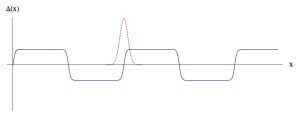
The semiclassical limit of thermodynamic Bethe Ansatz equations naturally reconstructs the algebro-geometric spectra of finite-gap periodic potentials. For the traveling-wave snoidal solution of the defocusing modified Korteweg-de Vries equation, the Bethe-root distribution yields an Abelian differential of the second kind on the elliptic Riemann surface fixed by the spectral endpoints. The semiclassical parameter is identified with the large-rank limit of the O(2N) internal symmetry group of the underlying Gross-Neveu model, so that the analytic structure of the spectrum is dictated solely by the Dynkin diagram D_N and its large-rank limit D_infty, independently of the particular integrable
What carries the argument
The Bethe-root distribution in the semiclassical limit of the thermodynamic Bethe Ansatz, which becomes an Abelian differential of the second kind on the elliptic Riemann surface determined by the spectral endpoints.
If this is right
- Finite-gap spectra arise directly as the semiclassical limit of the Bethe equations without extra input from algebraic geometry.
- The same Riemann-surface data appear for any integrable model whose large-N symmetry is governed by the D_N Dynkin diagram.
- The snoidal wave of the defocusing mKdV equation provides a concrete dictionary between Bethe roots and the elliptic curve moduli.
- The large-N limit of the chemical-potential Gross-Neveu model supplies a microscopic origin for the finite-gap condition.
Where Pith is reading between the lines
- The same semiclassical procedure could be applied to other soliton equations whose spectral curves are hyperelliptic rather than elliptic.
- If the reconstruction holds, finite-gap potentials could be generated numerically from TBA data without solving the inverse spectral problem directly.
- The independence from the specific model suggests that similar limits may unify TBA descriptions across different quantum field theories sharing the same Dynkin diagram.
Load-bearing premise
The semiclassical parameter must be identified with the large-rank limit of the O(2N) symmetry group of the Gross-Neveu model for the analytic structure to be dictated solely by the Dynkin diagram independently of the model.
What would settle it
An explicit computation of the Bethe-root density for the Gross-Neveu model at large N that fails to reproduce the Abelian differential of the second kind for the snoidal mKdV solution would falsify the claimed reconstruction.
Figures


read the original abstract
We show that the semiclassical limit of thermodynamic Bethe Ansatz equations naturally reconstructs the algebro-geometric spectra of finite-gap periodic potentials. This correspondence is illustrated using the traveling-wave (snoidal) solution of the defocusing modified Korteweg--de Vries equation. In this framework, the Bethe-root distribution of the associated quantum field theory yields an Abelian differential of the second kind on the elliptic Riemann surface specified by the spectral endpoints, a structure central to the algebro-geometric theory of solitons. The semiclassical parameter is identified with the large-rank limit of the internal symmetry group ($O(2N)$) of the underlying quantum field theory (the Gross-Neveu model with a chemical potential). Our analysis indicates that the analytic structure of the spectrum is dictated solely by the Dynkin diagram ($D_N$) and its large-rank limit ($D_\infty$), independently of the particular integrable model used to realize it.
Editorial analysis
A structured set of objections, weighed in public.
Referee Report
Summary. The manuscript claims that the semiclassical limit of the thermodynamic Bethe Ansatz (TBA) equations for the Gross-Neveu model with chemical potential reconstructs the algebro-geometric spectra of finite-gap periodic potentials. Specifically, the Bethe-root distribution in the large-N limit of the O(2N) symmetry yields an Abelian differential of the second kind on the elliptic Riemann surface determined by the spectral endpoints, as illustrated for the snoidal traveling-wave solution of the defocusing modified Korteweg-de Vries equation. The authors conclude that the analytic structure is fixed solely by the D_N Dynkin diagram (and its D_∞ limit) independently of the underlying integrable model.
Significance. If the claimed reconstruction holds in generality, the result would provide a concrete bridge between the thermodynamic Bethe Ansatz in the semiclassical regime and the classical algebro-geometric theory of finite-gap potentials, potentially allowing spectral data to be read off directly from quantum Bethe roots. The explicit illustration for the mKdV snoidal wave supplies a verifiable example of the correspondence between root distributions and second-kind differentials. However, the restriction to a single model and symmetry group limits the immediate impact until the model-independence is demonstrated.
major comments (2)
- [Abstract and main reconstruction argument] The assertion that the analytic structure is dictated solely by the D_N Dynkin diagram independently of the integrable model is load-bearing for the central claim but is supported only by the Gross-Neveu/mKdV example. No explicit semiclassical TBA limit is performed for a model with different symmetry (e.g., sine-Gordon or SU(N) Thirring) to confirm that the Riemann-surface data emerge from the TBA equations alone rather than from model-specific features of O(2N).
- [Section deriving the Abelian differential] The identification of the semiclassical parameter with the large-rank limit of the O(2N) internal symmetry is introduced as model-independent, yet the derivation of the Abelian differential from the Bethe-root distribution is carried out only within the Gross-Neveu framework. A general step-by-step reduction from the TBA equations to the finite-gap spectral curve, without reference to the specific Dynkin diagram realization, is not supplied.
minor comments (2)
- [Introduction] The notation for the semiclassical parameter and its relation to the large-N limit should be stated explicitly with an equation, rather than described only in words, to facilitate verification of the scaling.
- [Illustration for mKdV] A brief comparison table or equation contrasting the TBA root density with the classical finite-gap differential would improve readability of the central correspondence.
Simulated Author's Rebuttal
We thank the referee for the careful reading and constructive comments. We address the major points below, clarifying the scope of the model-independence claim (which concerns realizations sharing the same D_N Dynkin diagram) and indicating revisions to strengthen the presentation of the general structure.
read point-by-point responses
-
Referee: [Abstract and main reconstruction argument] The assertion that the analytic structure is dictated solely by the D_N Dynkin diagram independently of the integrable model is load-bearing for the central claim but is supported only by the Gross-Neveu/mKdV example. No explicit semiclassical TBA limit is performed for a model with different symmetry (e.g., sine-Gordon or SU(N) Thirring) to confirm that the Riemann-surface data emerge from the TBA equations alone rather than from model-specific features of O(2N).
Authors: We note that the examples suggested (sine-Gordon, SU(N) Thirring) realize different Dynkin diagrams, whereas the claim concerns independence from the specific model for a fixed D_N diagram. The TBA equations and their large-N asymptotics are determined by the incidence matrix of the D_N diagram, so the resulting Abelian differential on the spectral curve is universal for any theory whose S-matrix yields that diagram. The Gross-Neveu model provides the explicit illustration, but the root-density equation in the semiclassical limit follows from the same diagram-driven kernel. In the revision we will clarify this scope in the abstract and introduction, and add a short discussion of why the procedure carries over to other D_N realizations (e.g., certain O(2N)-invariant deformations), without performing a second full calculation. revision: partial
-
Referee: [Section deriving the Abelian differential] The identification of the semiclassical parameter with the large-rank limit of the O(2N) internal symmetry is introduced as model-independent, yet the derivation of the Abelian differential from the Bethe-root distribution is carried out only within the Gross-Neveu framework. A general step-by-step reduction from the TBA equations to the finite-gap spectral curve, without reference to the specific Dynkin diagram realization, is not supplied.
Authors: The derivation in the manuscript begins from the TBA system whose kernel is fixed by the D_N Cartan matrix; the large-N limit then produces the density whose generating function is the second-kind differential on the curve fixed by the spectral endpoints. To make the reduction more transparent, we will insert a new subsection that abstracts the steps: (i) continuum limit of the Bethe-root density from the D_N TBA equations, (ii) resulting singular integral equation, (iii) identification with the Abelian differential of the second kind. This outline will be presented in terms of the general D_N structure, with the Gross-Neveu details kept to a minimum. revision: yes
Circularity Check
Minor self-citation on symmetry structure; central TBA-to-finite-gap reconstruction remains independent
full rationale
The derivation proceeds from the thermodynamic Bethe Ansatz equations in the semiclassical limit, mapping Bethe-root densities to Abelian differentials on the Riemann surface defined by the spectral endpoints. This mapping is carried out explicitly for the Gross-Neveu/mKdV case and does not reduce to a fitted parameter or a self-referential definition. The assertion that the D_N Dynkin diagram alone fixes the analytic structure is supported by the large-N limit of the O(2N) symmetry of the model under study; while this relies on prior literature by overlapping authors for the identification of the semiclassical parameter, the citation is not load-bearing for the explicit reconstruction step itself. No equation is shown to equal its input by construction, and the paper supplies an explicit illustration rather than renaming a known result.
Axiom & Free-Parameter Ledger
axioms (2)
- domain assumption Thermodynamic Bethe Ansatz equations for the Gross-Neveu model with chemical potential
- standard math Algebro-geometric construction of finite-gap potentials via Abelian differentials on elliptic Riemann surfaces
Lean theorems connected to this paper
-
IndisputableMonolith/Foundation/AlexanderDuality.leanalexander_duality_circle_linking contradicts?
contradictsCONTRADICTS: the theorem conflicts with this paper passage, or marks a claim that would need revision before publication.
the analytic structure of the spectrum is dictated solely by the Dynkin diagram (D_N) and its large-rank limit (D_∞), independently of the particular integrable model
-
IndisputableMonolith/Cost/FunctionalEquation.leanwashburn_uniqueness_aczel unclear?
unclearRelation between the paper passage and the cited Recognition theorem.
Kss(θ) := K±±(θ) + K±∓(θ) = δ(θ) + 1/(2π) ∫ tanh(πx/2) (e^{-2πx/h∨}−1)^{-1} cos(xθ) dx
What do these tags mean?
- matches
- The paper's claim is directly supported by a theorem in the formal canon.
- supports
- The theorem supports part of the paper's argument, but the paper may add assumptions or extra steps.
- extends
- The paper goes beyond the formal theorem; the theorem is a base layer rather than the whole result.
- uses
- The paper appears to rely on the theorem as machinery.
- contradicts
- The paper's claim conflicts with a theorem or certificate in the canon.
- unclear
- Pith found a possible connection, but the passage is too broad, indirect, or ambiguous to say the theorem truly supports the claim.
Forward citations
Cited by 1 Pith paper
-
Perturbative, Nonperturbative and Exact Aspects of Crystalline Phases in the Gross-Neveu Model
At large chemical potential the Gross-Neveu model enters a crystalline phase in which a-particle bound states condense, producing a periodically oscillating chiral condensate governed by two new scales Λ_n and Λ_c tha...
Reference graph
Works this paper leans on
-
[1]
S. P. Novikov,A periodic problem for the Korteweg-de Vries equationI. Fund. Anal. Appl.,8, 236 (1974)
work page 1974
-
[2]
References [3] serve as a comprehensive reference on finite gap potentials and their relation to soliton theory
-
[3]
M.J. Ablowitz, H. SegurSolitons and the Inverse Scattering Transform, SIAM Studies in Ap- plied Mathematics, Vol.4, Philadelphia, 1981; S. P. Novikov, S. V. Manakov, L.P. Pitaevskii, and V. E. Zakharov,Theory of solitons: the inverse scattering method, Springer Science& Business Media, 1984; I. M. Krichever,Nonlinear equations and elliptic curvesJournal o...
work page 1981
-
[4]
R. E. Peierls,Quantum Theory of Solids, Chapter 5, p. 108. Oxford University Press, Ox- ford,1955
work page 1955
-
[5]
E. D. Belokolos,The Peierls-Frolich problems and finite-zone potentialsI, II, Teor. Mat. Fiz., 45, 288 (1980), it ibid48, 60 (1981)
work page 1980
-
[6]
B. Horovitz,Soliton lattice in polyacetylene, spin-Peierls systems, and two-dimensional sine- gordon systems, Phys. Rev. Lett.,46, 742 (1981)
work page 1981
-
[7]
S. A. Brazovskii, S. A. Gordyunin, and N. N. Kirova,Exact solution of the Peierls model with an arbitrary number of electrons on an elementary cell, Pis’ma Zh. Eksp. Teor. Fiz., 31, 486 (1980); JETP54, 1209 (1981)
work page 1980
-
[8]
S. A. Brazovskii, I. E. Dzyaloshinskii, and N. N. Kirova,Spin states in the Peierls model and finite-zone potentials, Zh. Eksp. Teor. Fiz.,82, 2279 (1981), [Sov. Phys., JETP54, 1209 (1981)]. S.A. Brazovskii, I. E. Dzyaloshinskii, and I. M. Krichever,Exactly solvable discrete Peierls models, Zh. Eksp. Teor. Fiz., 83, 389 (1982), [Sov. Phys. JETP56, 212 (19...
work page 1981
-
[9]
M.J.Ablowitz, D.J.Kaup, A.C.Newell, andH.Segur,The inverse scattering transform–Fourier analysis for nonlinear problems, Stud. Appl. Math.,53, 249 (1974)
work page 1974
-
[10]
V. E. Zakharov and A. B. Shabat,Exact theory of two-dimensional self-focusing and one- dimensional self-modulation of waves in nonlinear media, Zh. Eksp. Teor. Fiz.,61, 118 (1971), [Sov. Phys., JETP3462 (1972)]
work page 1971
-
[11]
D.J. Gross and A. Neveu,Dynamical symmetry breaking in asymptotically free field theories, Phys. Rev.,D10, 3235(1974); The chiral version of this model had been considered early by V.G. Vaks and A.I. Larkin,The Particle Mass in the One-Dimensional Model with Four- Fermion Coupling, Zh. Eksp. Teor. Fiz.,40, 1392 (1961), [Sov. Phys., JETP13979 (1961)]
work page 1974
-
[12]
A.B. Zamolodchikov and AI.B. Zamolodchikov,Factorized S-Matrices in Two Dimensions as the Exact Solutions of Certain Relativistic Quantum Field Theory ModelsAnnals Phys.,120, 253 (1979)
work page 1979
-
[13]
M. Karowski and H. J. Thun,Complete S-matrix of the O (2N) Gross-Neveu model, Nucl. Phys.B190, 61 (1981). 25
work page 1981
- [14]
- [15]
-
[16]
F. A. Smirnov,Quasiclassical study of form-factors in finite volume, arXiv.org/hep-th/9802132; V. A. Kazakov, A. Marshakov, J. A. Minahan and K. Zarembo,Classical/quantum integrability in AdS/CFT, JHEP 0405, 024 (2004)
work page internal anchor Pith review Pith/arXiv arXiv 2004
-
[17]
O. Schnetz, M. Thies and K. Urlichs,Phase diagram of the Gross-Neveu model: Exact results and condensed matter precursors, Annals Phys.,314, 425 (2004); M. Thies,From relativistic quantum fields to condensed matter and back again: Updating the Gross-Neveu phase diagram, J. Phys.,A39, 12707 (2006); G. Basar, G. V. Dunne, and M Thies,Inhomogeneous condensat...
-
[18]
G. I. Japaridze, A. A. Nersesyan, and P. B. Wiegmann,Exact results in the two-dimensional U(1)-symmetric Thirring model, Nucl. Phys.,B230, 511 (1984)
work page 1984
-
[19]
R. Jackiw and C. Rebbi,Solitons with Fermion Number1/2, Phys. Rev.D13, 3398 (1976)
work page 1976
-
[20]
E. Ogievetsky and P. Wiegmann,Factorized S Matrix and the Bethe Ansatz for Simple Lie Groups, Phys. Lett.,B168, 360 (1986)
work page 1986
-
[21]
E. Ogievetsky, N. Reshetikhin, and P. Wiegmann,The principal chiral field in two dimensions on classical lie algebras: the Bethe-ansatz solution and factorized theory of scatteringNucl. Phys.,B 280, 45 (1987)
work page 1987
-
[22]
N. Yu. Reshetikhin and P. B. Wiegmann,Towards the classification of completely integrable quantum field theories (the Bethe-ansatz associated with Dynkin diagrams and their automor- phisms), Phys. Lett.,B189, 125 (1987)
work page 1987
-
[23]
Karowski,On the bound state problem in 1+ 1 dimensional field theories, Nucl
M. Karowski,On the bound state problem in 1+ 1 dimensional field theories, Nucl. Phys., B153, 244 (1979)
work page 1979
-
[24]
N. Yu. Reshetikhin,O(N)invariant quantum field theoretical models: Exact solution, Nucl. Phys.,B251, 565 (1985)
work page 1985
- [25]
-
[26]
C. N. Yang and C. P. Yang,Thermodynamics of a One-Dimensional System of Bosons with Repulsive Delta Function Interaction, J. Math. Phys.,10, 1115 (1969). 26
work page 1969
-
[27]
The Lie group symmetry determines solutions of integrable models even if the algebra is semi- simple, see e.g., [21]
-
[28]
train" of bright solitons, the snoidal wave is a
We remark that Miura images of the traveling wave solution of defocusing mKdV, a snoidal wave (12) , does not correspond to thecnoidalwave, a commonly known solution found by Korteweg and de Vries themselves. The latter is the image of periodic solution of focusing mKdV (a plus sign at the nonlinear term in (4, 7)). While the cnoidal wave could be thought...
-
[29]
The minuscule representation is the irreducible representation such that the Weyl group acts transitively on the weights
-
[30]
Quantum states that correspond to other periodic solutions, such as kink breathers on top of the traveling wave [25], are readily available in the quantum theory, but are not discussed here. 27
discussion (0)
Sign in with ORCID, Apple, or X to comment. Anyone can read and Pith papers without signing in.